Version originale en français
Rapport de la 3e Rencontre Karl Schwarzschild
FIAS, Francfort, Allemagne
24–28 juillet 2017
2 août 2017
Je viens tout juste de revenir de la 3e Rencontre Karl Schwarzschild sur la physique gravitationnelle et la correspondance gauge/gravité, tenue à Francfort, Allemagne, au prestigieux FIAS (Frankfurt Institute for Advanced Studies).


J'étais très hésitant quant au contenu de mon affiche et j'ai finalement décidé de présenter mon système de deux équations de champ couplées, cœur du Modèle cosmologique Janus.
Un texte qui ne s'inscrivait pas bien dans le thème central du symposium, centré sur « la physique des trous noirs ». C'est un sujet que je comptais aborder plus tard, mais un article que j'ai publié en 2015 dans
Modern Physics Letters A
:
Petit, J.-P.; d'Agostini, G. (21 mars 2015).
"Annulation de la singularité centrale de la solution de Schwarzschild par un processus naturel d'inversion de masse"
.
Modern Physics Letters A
.
30
(9): 1550051. doi:10.1142/S0217732315500510.
était la chose la plus proche que j'avais déjà publiée, après relecture par les pairs. Comme il y avait un tableau à côté de mon affiche, j'ai écrit les grandes lignes de cet article :

Cela a attiré beaucoup d'attention. Les participants au congrès ont pris des photos et une foule s'est formée. Un chercheur senior âgé d'une soixantaine d'années a immédiatement exprimé son scepticisme quant au fait que toutes les singularités de la solution métrique trouvée par Schwarzschild en 1916 (qui soutient la théorie du trou noir) puissent être éliminées par un simple changement de variable. Comme il ne portait pas de badge, contrairement aux autres, j'ai conclu qu'il devait être membre du FIAS, l'Institut de recherche avancée de Francfort, qui organisait ce symposium. Voici ce changement de variable :

Un critique enfin ! Pour rendre les choses encore plus claires, j'ai rapidement écrit tous les détails du calcul sur une feuille que j'ai remise à mon expert. Il a pris le papier, s'est éloigné un peu, s'est assis sur une chaise et a plongé son nez dans les équations pendant un quart d'heure.

Tout le monde attendait son verdict. Il a finalement rendu mon papier avec un hochement de tête d'approbation. Une grande perplexité pouvait se lire sur son visage. Je pense qu'il devait se dire :
« Je n'ai jamais vu cela nulle part. Évidemment, ce Français a fait une erreur quelque part que je n'ai pas encore repérée. Je la trouverai plus tard. »
J'ai essayé de l'impliquer dans ce problème, qui soulève la question de l'interprétation du résultat de Karl Schwarzschild en 1916 (le symposium s'appelait justement la « Rencontre Karl Schwarzschild » !). Je lui ai demandé s'il avait lu le papier original publié dans les Comptes rendus de l'Académie des sciences de Prusse, détaillant ce qu'on appelle aujourd'hui la « solution extérieure de Schwarzschild » :
Schwarzschild, K. (13 janvier 1916).
"Über das Gravitational eines Massenpunktes nach der Einsteinschen Theorie"
.
Sitzungsber. Preuss. Akad. Wiss. Berlin (Phys.-Math.) 1916
. 189–196
traduit en anglais sous le titre :
Antoci, S.; Loinger, A. (12 mai 1999). "On the gravitational field of a mass point according to Einstein's theory".
arXiv:physics/9905030
[physics.hist-ph]
Ainsi que son deuxième article, publié quelques semaines plus tard (moins de trois mois avant sa mort), la « solution intérieure de Schwarzschild » :
Schwarzschild, K. (24 février 1916).
"Über das Gravitationsfeld einer Kugel aus incompressibler Flüssigkeit nach Einsteinsechen Theorie"
.
Sitzungsber. Preuss. Akad. Wiss. Berlin (Phys.-Math.) 1916
. 424–434
traduit en anglais sous le titre :
Antoci, S. (12 mai 1999). "On the gravitational field of a sphere of incompressible fluid according to Einstein's theory".
arXiv:physics/9912033
[physics.hist-ph]
Il a admis qu'il ne les avait jamais lus (!), en ajoutant :
— Vous lisez l'allemand ?
— Non, mais j'ai lu des traductions anglaises, relativement récentes certes (1999) pour des articles vieux d'un siècle. J'ai ces documents sur mon ordinateur portable. Êtes-vous d'accord pour les consulter ensemble ? Il y a aussi un texte très important publié par David Hilbert en décembre 1916, qui reprend les travaux de Schwarzschild après sa mort.
Hilbert, D. (23 décembre 1916).
"Die Grundlagen der Physik (Zweite Mitteilung)"
.
Nachrichten von der Gesellschaft der Wissenschaften zu Göttingen, (Math.-Phys.)
. 53–76.
traduit en anglais sous le titre :
Renn, J. (2007).
"The Foundations of Physics (Second Communication)"
.
The Genesis of General Relativity, Vol.4: Gravitation in the Twilight of Classical Physics: The Promise of Mathematics
. Springer. 1017–1038.
Il a éludé la question, ajoutant qu'il ne connaissait pas non plus cet autre article (!)
En réalité, ce que j'ai découvert à Francfort, c'est que les « hommes des trous noirs »

ne connaissent tout simplement pas les textes fondateurs à partir desquels ont été conçus les travaux qu'ils prétendent développer. Dans une conférence magistrale devant tous les congressistes,
Juan Maldacena
, une figure majeure des développements modernes de la théorie des trous noirs, a commencé en disant (comme reproduit dans le
brouillon du symposium
) :
Juan Maldacena
— La solution de Schwarzschild nous a troublés pendant plus d'un siècle et nous a obligés à affiner notre vision de l'espace et du temps. Elle a conduit à une compréhension plus précise de la théorie d'Einstein. Expérimentalement, elle explique plusieurs observations astrophysiques. Ses aspects quantiques ont été à l'origine de paradoxes théoriques qui nous poussent à mieux comprendre la relation entre la géométrie de l'espace-temps et la mécanique quantique.
Concrètement, quelle est la portée ?
Tout d'abord, il y a la « découverte » du « rayonnement de Hawking ». En réalité, tout cela repose sur l'idée d'une union entre la Relativité générale et la Mécanique quantique. Nous savons qu'un tel mariage n'a jamais été consommé (la gravitation refuse de se quantifier, ce qui conduirait à la description d'un graviton, une particule de spin 2, toujours introuvable).

Nos théoriciens modernes sont convaincus que cette fantaisie
est une réalité vraie
. C'est en invoquant un phénomène quantique près de l'horizon des événements que Hawking « a démontré » que le trou noir pouvait perdre de l'énergie, « rayonner ». Cela a immédiatement conduit au paradoxe de l'information des trous noirs. En effet, dans ces objets appelés trous noirs, toute structure serait censée être écrasée. Tout disparaîtrait totalement. Ainsi, les trous noirs seraient des « machines détruisant l'information ». Maldacena a ensuite esquissé les progrès réalisés en « thermodynamique des trous noirs ». En particulier, il a souligné que « l'entropie des trous noirs s'est révélée proportionnelle à leur surface ».
En résumé, au cours des dernières décennies, toute l'attention des théoriciens s'est concentrée sur la manière de contourner ce paradoxe de l'information. Vous avez probablement entendu parler d'un « mur de feu » et d'autres choses de ce genre. Dans son dernier travail, Maldacena invoque un nouveau « mot magique » :
l'intrication
. Un concept tiré de la mécanique quantique et du célèbre paradoxe d'Einstein-Podolsky-Rosen (paradoxe EPR), que j'ai décrit dans ma vidéo
JANUS 6 (à 14:04)
. Dans cette expérience célèbre, deux photons émis sont « intriqués ». En bref, selon Maldacena, « l'intrication » apporte toutes les réponses. Cela, accompagné d'une pincée de théorie des cordes.
Un tel discours est le meilleur exemple de la théorie en 2017.
Les participants au congrès ont évidemment fait référence aux vidéos JANUS (voir
la playlist complète ici
). Grâce au travail remarquable de Julien Geffray, les vidéos ont été traduites en anglais avec sous-titres, six d'entre elles étant déjà traduites à l'ouverture du symposium (JANUS 14 à 19). Et c'est là que nous avons compris que la traduction en anglais correcte est quelque chose
absolument indispensable
pour être entendu hors de France. Je ne peux pas fournir une traduction en mauvais anglais : les utilisateurs étrangers zapperaient immédiatement. Geffray, qui suit mon travail depuis 20 ans et maîtrise parfaitement la langue de Shakespeare, était la seule personne capable d'assurer ce travail de sous-titrage, très délicat, nécessitant de 2 à 3 jours de travail par vidéo. Cela représente de 15 000 à 20 000 caractères par vidéo, avec un texte comportant beaucoup de jargon spécifique à traduire, la difficulté d'organiser visuellement et de calibrer ces sous-titres à un dixième de seconde près, ainsi que la création de cartes pointant vers mes articles publiés et mes bandes dessinées scientifiques.
Voyant l'impact sur les non-francophones, j'ai compris que je devais faire sous-titrer toutes les vidéos de la série Janus en anglais. Nous avons renégocié le prix pour étendre davantage la traduction, mais le budget reste élevé pour plus de 20 vidéos.
Les utilisateurs d'Internet ont répondu à l'appel et ont fait des dons via
PayPal
. Ces fonds me permettent de voyager à l'étranger et de participer à des conférences internationales (frais d'inscription, frais de voyage et d'hébergement), ainsi que ce travail de sous-titrage. Je précise que je continuerai à produire ces vidéos à raison de deux par mois (oui, il y aura aussi une vidéo Janus sur la mécanique quantique). À mon avis, c'est un investissement judicieux, car si les textes sur les sites web finissent souvent dans l'oubli, ce n'est pas le cas des vidéos, qui continueront sans limite de temps et qui constituent l'outil de communication moderne par excellence.
Budget prévisionnel jusqu'au printemps 2018 (sous-titrage + symposiums) : 20 000 euros
Faire émerger la vérité a un prix.
Si l'argent envoyé par les utilisateurs d'Internet (un grand merci à eux !) est suffisant pour assurer ma présence aux prochains symposiums (la Rencontre Schwarzschild, Francfort ; puis COSMO-17, Paris…), j'aurai besoin d'aide supplémentaire pour faire face à ces coûts de sous-titrage et aux conférences ultérieures.
Impact de ces vidéos : réactions de jeunes chercheurs à la Rencontre Schwarzschild. L'un d'eux, un Italien, m'a finalement dit :
— J'ai vu vos articles sur votre modèle cosmologique Janus
(il avait l'expertise nécessaire pour apprécier le contenu)
. Je regarde comment vous êtes accueilli ici. Comment pouvez-vous espérer que ces gens fassent autre chose que vous tourner le dos ? Ce que vous proposez, c'est de détruire la base même de leur travail !
Le contact avec ce jeune homme a été établi et est maintenu. Il travaille en Italie sur la dynamique newtonienne modifiée. C'est une première graine plantée. Si je continue à « draguer » dans les conférences internationales, il y en aura d'autres dans la jeune génération, probablement pas parmi ceux qui ont établi leur notoriété sur les œuvres fantastiques que j'ai mentionnées.
Certains de ces jeunes diront un jour :
« Je ne crois pas vraiment à la théorie MOND, et si je tentais de voir où mènent les idées de ce physicien français ? »
Ces contacts et échanges seront facilités par le fait que ces jeunes chercheurs pourront voir les vidéos, puis les articles sur le modèle Janus lorsqu'ils me rencontreront.
À Francfort, la plupart des présentations étaient centrées sur « la physique des trous noirs », à propos de
« ce que vous pourriez observer, si vous pouviez l'observer… »
En ajoutant cette nouvelle idée d'un « univers holographique » (je devrai créer une vidéo expliquant ce qu'est vraiment un hologramme). Une femme a expliqué que
« nous ne devrions pas avoir peur des cordes cosmiques »
. Une autre a montré comment des paires de petits trous noirs pourraient se former pendant la phase d'inflation de l'expansion cosmique. Ajoutons des histoires liées à la théorie des cordes, aux « collisions de branes ». Je suis pratiquement le seul à me démarquer en proposant des travaux et des résultats… susceptibles d'être confrontés aux observations.
Si je veux réveiller la communauté cosmologique, pour qu'elle réagisse, je dois attaquer leur enfant chéri, le trou noir, ce que je n'aurais pas cru devoir faire avant bien plus tard. Mais le climat de la réunion de Francfort m'a poussé à corriger la situation, aussi le titre de ma prochaine vidéo sera :
JANUS 21 : Le trou noir, né d'une mauvaise interprétation de la solution trouvée par Karl Schwarzschild en 1916
Ce sera aussi mes mots à la conférence internationale COSMO-17 à Paris. Il ne s'agira pas de proposer un modèle alternatif pour le trou noir (pas encore), mais de réclamer :
— Tel quel, le modèle de cet objet appelé « trou noir » est incohérent, car il ne correspond pas à la solution trouvée par Karl Schwarzschild en 1916, et je le démontre.

Le mathématicien allemand Karl Schwarzschild
est décédé à Potsdam le 11 mai 1916 à l'âge de 43 ans
trois mois après la publication de ses solutions aux équations d'Einstein
La solution a été trouvée en 1916 par Schwarzschild et publiée sous la forme :
Schwarzschild, K. (13 janvier 1916).
"Über das Gravitational eines Massenpunktes nach der Einsteinschen Theorie"
.
Sitzungsber. Preuss. Akad. Wiss. Berlin (Phys.-Math.) 1916
. 189–196
traduit en anglais sous le titre :
arXiv:physics/9905030
[physics.hist-ph]

Dans ce premier article, Schwarzschild définit parfaitement une coordonnée
r
comme une « coordonnée polaire » :

Mais il introduit ce qu'il appelle une quantité auxiliaire
R, et c'est à travers elle qu'il exprime sa célèbre « solution extérieure » en janvier 1916 :

Il n'est pas nécessaire d'être un spécialiste en mathématiques pour voir que, dans la mesure où la variable
r
choisie par Schwarzschild (comme il l'a défini ci-dessus) est strictement positive, la quantité intermédiaire
Rn'est pas libre mais a une borne inférieure α :

Schwarzschild est décédé à Potsdam le 11 mai 1916 à l'âge de 43 ans, quelques mois seulement après cette première publication.
Reprise de ce travail dans une communication faite en décembre 1916 à l'Académie des sciences de Göttingen, le grand mathématicien allemand

David Hilbert, âgé de 54 ans en 1916
considère cette méthode d'expression de la solution comme peu intéressante, ce qui, dans ce cas, envoie la singularité (en
R
= α) à l'origine, en
r
= 0.
La communication de Hilbert est datée du 23 décembre 1916 (Schwarzschild est décédé en mai) :
Hilbert, D. (23 décembre 1916).
"Die Grundlagen der Physik (Zweite Mitteilung)"
.
Nachrichten von der Gesellschaft der Wissenschaften zu Göttingen, (Math.-Phys.)
. 53–76.
traduit en anglais sous le titre :
Renn, J. (2007).
"The Foundations of Physics (Second Communication)"
.
. Springer. 1017–1038.

En réalité, Hilbert travaillait déjà activement sur la théorie de la relativité générale, le titre de son article étant
« Les fondements de la physique »
. On a souvent tendance à penser qu'Einstein était le physicien et Hilbert le mathématicien pur. En effet, Hilbert n'aimait pas beaucoup les aspects techniques de la science. Un jour, on lui a demandé de remplacer son collègue mathématicien Félix Klein, malade, pour donner une conférence devant des ingénieurs étudiants. Hilbert a commencé son exposé par une plaisanterie :
—
On entend beaucoup parler de l'hostilité entre scientifiques et ingénieurs. Je n'y crois pas. En fait, je suis certain que ce n'est pas vrai. Il ne peut rien y avoir là-dedans, car aucune des deux parties n'a rien à voir avec l'autre.
Mais ce n'étaient pas seulement les ingénieurs qui étaient visés. Il y a aussi cette célèbre citation de lui :
— La physique devient trop difficile pour les physiciens.
Le travail de Hilbert en mathématiques est en réalité considérable.
Il convient également de noter – bien que je détaille cela dans une prochaine vidéo – que Schwarzschild n’a pas seulement fourni la solution « extérieure », mais a également construit la solution « intérieure » (décrit la géométrie à l’intérieur d’une sphère de densité constante) dans un second article, publié un mois plus tard :
Schwarzschild, K. (24 février 1916).
« Über das Gravitationsfeld einer Kugel aus incompressibler Flüssigkeit nach Einsteinsechen Theorie »
.
Sitzungsber. Preuss. Akad. Wiss. Berlin (Phys.-Math.) 1916
. 424–434
traduit en anglais par :
Antoci, S. (12 mai 1999). « On the gravitational field of a sphere of incompressible fluid according to Einstein's theory ».
arXiv:physics/9912033
[physics.hist-ph]
C’est seulement aujourd’hui, avec des objets tels que les étoiles à neutrons, qu’un problème surgit concernant la représentation géométrique et physique d’objets où « la variable de distance » n’est plus du tout négligeable par rapport au rayon de Schwarzschild. Mais alors, quelle variable devrait-on choisir : celle de Hilbert ou celle de Schwarzschild ?
Les théoriciens ont alors proposé de donner une nature physique à cette solution extérieure, en disant qu’elle décrit un objet qu’ils ont appelé « trou noir ». Géométriquement, il faut alors fournir une réponse :
– selon la représentation de Schwarzschild, ce qui se passe là où
r = 0
– selon la représentation de Hilbert, ce qui se passe là où
R < α (l’« intérieur » du trou noir)
Je souligne que la deuxième question ne se pose pas dans la représentation de Schwarzschild : vous n’avez pas à vous demander ce qui arrive aux points de masse tombant « au-delà » de α, car un tel « intérieur »… n’existe pas.
En revanche, dans la représentation de Hilbert, si cet « intérieur » existait vraiment, ce serait très étrange : la signature du tenseur métrique serait altérée, ce qui amène nos théoriciens modernes à dire : « à l’intérieur,
r
devient le temps et
t
devient le rayon ».
Dans cet article soumis à relecture par les pairs :
Petit, J.-P.; d'Agostini, G. (21 mars 2015).
« Cancellation of the central singularity of the Schwarzschild solution with natural mass inversion process »
.
Modern Physics Letters A
.
30
(9) : 1550051. doi:10.1142/S0217732315500510.
J’ai indiqué un autre choix de coordonnées, dérivé de la solution de Schwarzschild par le changement de variable suivant :
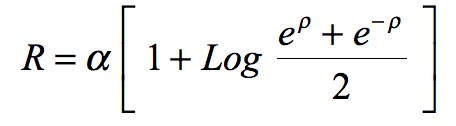
ce qui conduit à une présentation de la solution métrique sous la forme :

Elle est alors régulière quelles que soient les valeurs des variables, sauf le fait que le premier terme s’annule à l’origine. La géométrie associée est alors interprétée en considérant que cette métrique décrit un passage reliant deux espaces-temps de Minkowski avec une symétrie PT, la jonction s’effectuant à travers une sphère de gorge, de périmètre 2πα. Le long de cette sphère, le déterminant est nul, ce qui reflète l’inversion double de l’espace et de la flèche du temps lors du passage à travers cette surface.
En utilisant la métrique sous la forme donnée par Schwarzschild comme solution des équations du champ, exprimée avec les coordonnées (
t
,
r
,
θ
,
φ
), on pourrait à première vue croire que la sphère de gorge se réduit à un seul point, semblable au sommet d’un cône : le point
r = 0. Mais cela reviendrait à attribuer une « valeur dimensionnelle » à cette quantité, qui n’est rien d’autre qu’un « marqueur d’espace ». Un marqueur d’espace en géométrie différentielle est simplement un nombre permettant de localiser certains points. Les seules distances réelles, les longueurs ayant un sens, sont celles calculées à l’aide de la métrique. Ces longueurs, notées par la lettre
s
, sont invariantes quel que soit le système de coordonnées choisi (lorsque vous considérez deux chemins identiques décrits par deux systèmes de coordonnées différents).
La propriété de symétrie sphérique de la solution permet de fixer trois des quatre coordonnées (
t
,
r
,
φ
) et de faire une révolution de 2π selon la coordonnée
θ
. La sphère de gorge dans la représentation de Hilbert correspond à
R = α. Si
t = constant
,
φ = constant
et cette rotation est effectuée selon
θ
, le résultat est 2πα, le périmètre d’un grand cercle sur la sphère de gorge.
Répétons cette opération dans ma propre représentation (
t
,
r
,
θ
,
φ
). La sphère de gorge correspond alors à
ρ = 0. La rotation selon la coordonnée
θ
retourne la valeur 2πα.
Ce qui est plus surprenant, c’est que, en optant pour la représentation de Schwarzschild où la sphère de gorge correspond à la valeur
r = 0, on obtient également cette longueur 2πα ! C’est très troublant, car « tourner autour du point
r = 0 » donne une longueur non nulle ! C’est parce que
r
… n’est pas un point ! C’est un aspect déconcertant de la géométrie différentielle et de la représentation des objets par leur métrique.
Cet exercice de pensée devrait vous faire comprendre que vous ne devez plus considérer
r
comme une « longueur dimensionnelle ». C’est précisément parce que tout le monde imagine
r
comme une « distance radiale » que la confusion surgit.
En réalité, c’est même le mot « dimension » qui crée la confusion. Au lieu de dire « nous allons localiser les points dans cet objet géométrique à l’aide d’un ensemble de dimensions », nous devrions dire :
— Nous allons localiser les points dans cet objet géométrique à l’aide de marqueurs d’espace :
( x 0
,
x 1
,
x 2
,
x 3 )
Mais même la lettre
x
pourrait être trompeuse. Pour éliminer complètement l’idée erronée que
r
serait une variable de distance radiale menant jusqu’à un point central, le marqueur d’espace devrait être défini par une lettre grecque neutre, comme β ou ζ :
(ζ
0
, ζ
1
, ζ
2
, ζ
3 )
Revenons à ce concept général de métrique. En mathématiques, en géométrie, qu’est-ce que c’est ?
La Terre n’est pas plate. Elle est sphérique. C’est un problème pour les cartographes. Si nous regardons les continents sur un globe, tout va bien. Mais comment cartographier un monde courbé sur des feuilles de papier planes, des supports plans, comment procéder ? Plusieurs cartes sont établies et regroupées en un
atlas
. Les cartes voisines peuvent être reliées entre elles en ajustant la correspondance entre leurs méridiens et parallèles.
Plus généralement, il est possible de cartographier toute surface à l’aide de cette technique. Une carrosserie d’automobile, par exemple. Chaque élément plan de cet atlas correspond à une description métrique locale. Les mathématiciens et géomètres ont étendu ce concept en considérant des atlas composés d’éléments non euclidiens. Imaginez un monde où le papier n’existe pas et où les gens utiliseraient des supports en forme de feuilles séchées, découpées comme des portions de sphère pouvant être empilées, formant un étrange atlas courbé. Tout pourrait être cartographié ainsi, étape par étape (y compris un plan !).
Cette technique n’impose aucune contrainte
quant à la topologie de l’objet à cartographier.
Choisir de représenter l’objet décrit par la métrique de Schwarzschild à l’aide de « coordonnées polaires » représente implicitement une hypothèse forte sur sa topologie.
Dans la suite, l’idée est que la solution métrique
contient sa propre topologie
et que nous n’avons pas le choix. Nous abandonnons complètement l’approche classique des cartes constituant un atlas, en imaginant que l’objet est décrit uniquement par sa métrique, exprimée dans un ensemble de coordonnées « adaptées », c’est-à-dire qui sont en accord avec la topologie implicite liée à sa solution métrique. Le fil conducteur étant :
– La longueur unité
s
doit être réelle partout.
– Et sa conséquence : la signature de la métrique est invariante.
À partir de ces commentaires et suggestions, on peut alors remettre en question le modèle classique du trou noir, chargé de ses multiples pathologies. N’est-ce pas une conséquence de la manière dont Hilbert a interprété cette géométrie ? Portant ce chimère qu’est « l’intérieur du trou noir », accessible par « l’extension analytique de Kruskal » dont Maldacena, dans sa conférence, a dit que « elle permet d’étendre la solution à tout l’espace-temps ». Le fait est que les chercheurs sur les trous noirs ont une
a priori
sur la topologie de l’objet qu’ils étudient. Comment cela ?
Topologiquement, considérons une surface 2D. Tracez une courbe fermée, puis essayez de réduire son périmètre à zéro. Il y a deux scénarios :
– Soit ce périmètre peut être réduit jusqu’à zéro.
– Soit une limite minimale est atteinte.
Cela peut être illustré par le dessin suivant :

Si un habitant 2D de cette surface nous demandait :
— Qu’est-ce qu’il y a au centre du cercle ?
Nous ne pourrions répondre qu’à sa question est sans sens, car ces cercles n’ont pas de centre.
Si nous passons à un monde 3D, cette
contractibilité
apparaîtrait comme la possibilité de déformer une sphère en réduisant sa surface jusqu’à zéro :

Si cette opération peut réussir, alors cette sphère a un « dedans » et un « centre ».
Mais un espace 3D n’est pas nécessairement contractible. S’il ne l’est pas, alors dans certaines régions (la surface ayant la topologie d’une 2-sphère) la
feuilletage
de cet espace par des sphères concentriques voisines (comme éplucher une pomme de terre) atteindra une surface minimale. Ensuite, si nous tentons de continuer le feuilletage, la surface repartira à la hausse, car la surface minimale que nous venons de traverser était en réalité une
sphère de gorge.
Il n’est plus possible de dessiner cela en 3D, mais en nous référant à la figure précédente, nous verrons que du côté droit, la valeur minimale est un cercle de gorge (en rouge). Tout cela peut être étendu à une hypersurface 3D et à une hypersurface à un nombre quelconque de dimensions.
En louant Joseph Kruskal « qui nous a permis d’étendre la solution à tout l’espace-temps », Maldacena ne réalise pas (comme des milliers d’autres avant lui) qu’il fait inconsciemment une hypothèse sur la topologie de l’hypersurface 4D dont il parle : l’« espace-temps ».
Pourtant, cette tentative aboutit à une altération de la signature métrique, allant de pair avec la transformation de la longueur unité en une quantité purement imaginaire. Cela exprime simplement la « réponse » fournie par le formalisme :
— Attention ! Vous êtes en dehors de l’hypersurface !
En réalité, il veut explorer
une portion de l’espace-temps qui n’existe même pas
, tout comme un géomètre qui construirait une continuation analytique pour étudier les propriétés du plan tangent à un tore… près de son axe, comme un mécanicien fou dans le monde d’Alice au pays des merveilles, qui s’efforcerait de coller une pièce sur le tube intérieur d’un pneu dans la région située près de l’axe de la roue…

Si j’ai raison, tant de papier, d’encre et de matière grise (y compris la matière grise quantique) consommés pendant des décennies pour décrire un objet qui n’existe pas, et tout ce qu’il implique, comme les propriétés d’une « singularité centrale » ! On peut se demander pourquoi tout cela est apparemment passé complètement inaperçu pendant un siècle entier. Les historiens des sciences pourraient nous fournir la réponse. Disons que, grâce à sa fantaisie d’un temps imaginaire, Hilbert a transmis l’idée d’une signature spatiale (– + + +), ce qui signifie peut-être que personne après lui n’a été préoccupé par le fait que le carré de l’unité de longueur changeait de signe. Mais il est erroné de dire que cela ne concerne que « une convention ».
Cependant, Schwarzschild (et Einstein) ont opté pour une signature temporelle (+ – – –), comme on peut le voir dans le papier de Schwarzschild :

Inversement, en fixant le signe des termes faisant référence aux angles, Hilbert fixe implicitement la signature à (– + + +) :

Les physiciens, étudiants et ingénieurs souhaitant explorer ces questions peuvent télécharger ci-dessous les traductions anglaises des divers articles cités sur cette page, y compris les articles historiques initialement publiés en allemand il y a mille ans. Ils n’ont probablement jamais été lus par nos modernes « hommes des trous noirs », qui semblent avoir perdu contact avec la réalité, construisant une astrophysique sans observation, issue de mathématiques sans rigueur.
• Articles historiques :
Schwarzschild, K. (13 janvier 1916).
« Über das Gravitational eines Massenpunktes nach der Einsteinschen Theorie »
.
Sitzungsber. Preuss. Akad. Wiss. Berlin (Phys.-Math.) 1916
. 189–196
traduit en anglais par :
Antoci, S.; Loinger, A. (12 mai 1999). « On the gravitational field of a mass point according to Einstein's theory ».
arXiv:physics/9905030
Schwarzschild, K. (24 février 1916).
« Über das Gravitationsfeld einer Kugel aus incompressibler Flüssigkeit nach Einsteinsechen Theorie »
.
Sitzungsber. Preuss. Akad. Wiss. Berlin (Phys.-Math.) 1916
. 424–434
traduit en anglais par :
Antoci, S. (12 mai 1999). « On the gravitational field of a sphere of incompressible fluid according to Einstein's theory ».
arXiv:physics/9912033
Frank, Ph. (1916) dans
Jahrbuch über die Fortschritte der Mathematik
.
46
: 1296.
traduit en anglais par :
Antoci, S. (2003). « Appendix A: Frank’s review of Schwarzschild's 'Massenpunkt' paper » dans « David Hilbert and the origin of the Schwarzschild solution ».
Meteorological and Geophysical Fluid Dynamics
. Bremen : Wilfried Schröder, Science Edition.
arXiv:physics/0310104
Droste, J. (1917).
« The field of a single centre in Einstein’s theory of gravitation, and the motion of a particle in that field »
.
Proceedings of the Koninklijke Nederlandse Akademie Van Wetenschappen, Series A
.
19
(I) : 197–215. (Communicated by Prof. H. A. Lorentz at the KNAW meeting, 27 mai 1916).
Réimprimé (2002) dans
General Relativity and Gravitation
.
34
(9) : 1545–1563. doi:10.1023/A:102074732.
Weyl, H. (1917).
« Zur Gravitationstheorie »
.
Annalen der Physik
.
54
(18) : 117–145. doi:10.1002/andp.19173591804.
traduit en anglais par :
Neugebauer, G.; Petroff, D. (mars 2012). « On the theory of gravitation ».
General Relativity and Gravitation
.
44
(3) : 779–810. doi:10.1007/s10714-011-1310-7.
Hilbert, D. (23 décembre 1916).
« Die Grundlagen der Physik (Zweite Mitteilung) »
.
Nachrichten von der Gesellschaft der Wissenschaften zu Göttingen, (Math.-Phys.)
. 53–76.
traduit en anglais par :
Renn, J. (2007). « The Foundations of Physics (Second Communication) ».
The Genesis of General Relativity, Vol.4: Gravitation in the Twilight of Classical Physics: The Promise of Mathematics
. Springer. 1017–1038.
• Pour aller plus loin :
Abrams, L. S. (novembre 1979). « Alternative Space-Time for the Point Mass ».
Physical Review D
.
20
(10) : 2474–2479. doi:10.1103/PhysRevD.20.2474.
- correction :
Abrams, L. S. (avril 1980). « Erratum: Alternative space-time for the point mass ».
Physical Review D
.
21
(8) : 2438. doi:10.1103/PhysRevD.21.2438.
arXiv:gr-qc/0201044
Abrams, L. S. (2001). « Black Holes: The Legacy of Hilbert's Error ».
Canadian Journal of Physics 67
(9) : 919–926. doi:10.1139/p89-158.
arXiv:gr-qc/0102055
Antoci, S.; Liebscher, D.-E. (2001). « Reconsidering Schwarzschild’s original solution ».
Astronomische Nachrichten
.
322
(2) : 137–142.
arXiv:gr-qc/0102084
Antoci, S. (2003). « David Hilbert and the origin of the Schwarzschild solution ».
Meteorological and Geophysical Fluid Dynamics
. Bremen : Wilfried Schröder, Science Edition.
arXiv:physics/0310104
Petit, J.-P. (2017).
Version originale (anglais)
Version originale en Français
Report of the 3rd Karl Schwarzschild Meeting
FIAS, Frankfurt, Germany
24–28 July 2017
August 2, 2017
I've just come back from the 3rd Karl Schwarzschild Meeting on gravitational physics and the gauge/gravity correspondence, held in Frankfurt, Germany, at the prestigious FIAS (Frankfurt Institute for Advanced Studies).
Iwas very hesitant about the content of my poster and finally decided to present my system of two coupled field equations, heart of the Janus Cosmological Model.
A text which did not fit well with the central theme of the symposium, focused on "the physics of black holes". This is a topic Iintended to address later, but a paper Ipublished in 2015 in
Modern Physics Letters A
:
Petit, J.-P.; d'Agostini, G. (21 March 2015).
"Cancellation of the central singularity of the Schwarzschild solution with natural mass inversion process"
.
Modern Physics Letters A
.
30
(9): 1550051. doi:10.1142/S0217732315500510.
was the closest thing Ihad already published though peer review. As there was a blackboard next to my poster, Iwrote the main lines of this paper:

It attracted a lot of attention. Conference delegates took pictures and a crowd formed. A sixty-year-old senior researcher immediately expressed his skepticism about the fact that all singular aspects of the metric solution found by Schwarzschild in 1916 (which supports the theory of the black hole) could be eliminated using a simple change of variable. Since he was not wearing a badge, unlike others, Iconcluded he should be a member of the FIAS, the
Frankfurt Institute for Advanced Science
, hosting this symposium. Here is this change of variable:

Some critic, at last! To make things even clearer Iquickly wrote all the details of the calculation on a sheet of paper that Igave to my expert. He took the paper, walked away a bit, sat down on a chair and buried his nose in the equations for a quarter of an hour.
Everyone waited for his verdict. He finally gave my paper back with a nod of agreement. The greatest perplexity could be read on his face. Ithink he must have said:
"I've never seen this thing anywhere before. Obvioulsy this French guy has made some mistake somewhere that Ihave missed for now. I'll find it later."
Itried to hook him up to this problem, which raises the question of the interpretation of Karl Schwarzschild's 1916 result (the symposium was called the "Karl Schwarzschild Meeting"!). Iasked him if he had read the original paper published in the Proceedings of the Prussian Academy of Sciences, detailing what is now called the "exterior Schwarzschild solution":
Schwarzschild, K. (13 January 1916).
"Über das Gravitational eines Massenpunktes nach der Einsteinschen Theorie"
.
Sitzungsber. Preuss. Akad. Wiss. Berlin (Phys.-Math.) 1916
. 189–196
translated in English as:
Antoci, S.; Loinger, A. (12 May 1999). "On the gravitational field of a mass point according to Einstein's theory".
arXiv:physics/9905030
[physics.hist-ph]
As well as his second paper, published a few weeks later (less than three months before his death), the "interior Schwarzschild solution":
Schwarzschild, K. (24 February 1916).
"Über das Gravitationsfeld einer Kugel aus incompressibler Flüssigkeit nach Einsteinsechen Theorie"
.
Sitzungsber. Preuss. Akad. Wiss. Berlin (Phys.-Math.) 1916
. 424–434
translated in English as:
Antoci, S. (12 May 1999). "On the gravitational field of a sphere of incompressible fluid according to Einstein's theory".
arXiv:physics/9912033
[physics.hist-ph]
He admitted he had never read them (!) adding:
— Do you read German?
— No, but Ihave read English translations, relatively recent admitedly (1999) for century-old papers. Ihave these documents in my laptop. Do you agree we look at them together? There is also a very important text published by David Hilbert in December 1916, taking over Schwarzschild's work after his death.
Hilbert, D. (23 December 1916).
"Die Grundlagen der Physik (Zweite Mitteilung)"
.
Nachrichten von der Gesellschaft der Wissenschaften zu Göttingen, (Math.-Phys.)
. 53–76.
translated in English as:
Renn, J. (2007).
"The Foundations of Physics (Second Communication)"
.
. Springer. 1017–1038.
He eluded, adding that he did not know this other article neither (!)
Actually, what Idiscovered in Frankfurt is that the
black hole men
simply do not know the founding texts from which the works they intend to develop have been conceived. In a masterly lecture in front of all the congressmen,
Juan Maldacena
, a "figure" of modern developments of the black hole theory, began saying (as reproduced in the
symposium brochure
):
Juan Maldacena
— The Schwarzschild solution has confused us for over a hundred years and it has forced us to sharpen our views on space and time. It has lead to a sharper understanding of Einstein's theory. Experimentally, it is explaining several astrophysical observations. Its quantum aspects have been a source of theoretical paradoxes that are forcing us to understand better the relation between spacetime geometry and quantum mechanics.
Concretely, what's the point?
First there was the "discovery" of the "Hawking radiation". In fact, all this is based on the idea of a union between General Relativity and Quantum Mechanics. We know such a marriage has never been consummated (gravitation refuses to be quantified, which would lead to the description of a graviton, a spin-2 particle, still AWOL).
Our modern theorists are convinced such a fantasy
is a true reality
. It is indeed by invoking a quantum phenomenon near the event horizon that Hawking "demonstrated" that the black hole could lose energy, "radiate". This immediately lead to the black hole information paradox. Indeed, in these objects named black holes, any structure is supposed to be crushed. Anything would totally disappear. So black holes would be "machines destroying information". Maldacena then outlined the progress made about "black-hole thermodynamics". In particular, he pointed out that "the entropy of black holes was shown to be proportional to their surface".
In short, in the last few decades all the attention of theorists has focused on how circumventing this information paradox. You've probably heard of a "firewall" and other things like that. In his last work, Maldacena invokes a new "magic word":
entanglement
. A concept derived from quantum mechanics and the famous Einstein-Podolsky-Rosen paradox (EPR paradox) which Idescribed in my video
JANUS 6 (at 14:04)
. In this famous experiment, two emitted photons are "entangled." In short, according to Maldacena, "entanglement" brings all the answers. This, plus a pinch of string theory.
Such a speech is the very best of the theory in 2017.
Participants at the conference obviously referred to the JANUS videos (see
the whole playlist here
). Thanks to Julien Geffray's great work, videos were translated in English with subtitles, six of them being already translated at the opening of the symposium (JANUS 14 to 19). And it is there that we realized that subtitling in good English is something
absolutely indispensable
to be heard outside of France. Ican't provide a translation in bad English: foreign Internet users would zap immediately. Geffray, who has been following my work for 20 years and fully masters the language of Shakespeare, was the only one able to ensure this subtitling work, very delicate, taking 2-3 days of work for each video. This represents 15,000 to 20,000 characters per video, with a text including a lot of specific jargon to translate, the difficulty of visually organizing and calibrating these subtitles to the nearest tenth of a second, as well as the creation of cards pointing to my published papers and science comics.
Seeing the impact on non-francophones, Irealized that Ishould have all the Janus series subtitled in English. We renegotiated the price to expand the translation further, but the budget is still high for 20+ videos.
Internet users answered the call and made donations through
PayPal
. This money allows me to travel abroad and attend international conferences (inscription fee, travel and stay expenses) as well as this video subtitling work. Let me add that Iwill continue to produce these videos at a rate of two per month (yes, there will be also a Janus video about quantum mechanics). It is, in my opinion, well invested money because if the texts on the websites often end up in oblivion, it is not the same for videos, which will continue without limitation of time and which are the modern communication tool par excellence.
Forecast budget until Spring 2018 (subtitling + symposia): 20,000 euros
Making truth emerge, has a price.
If the money sent by Internet users (huge thanks to them!) is enough to ensure my presence in the next few symposia (the Schwarzschild Meeting, Frankfurt; then COSMO-17, Paris…) Iwill need additional help to deal with these subtitling costs and subsequent conferences.
Impact of these videos: reactions of young researchers at the Schwarzschild Meeting. One of them, an Italian, ended up saying to me:
— Isaw your papers about your Janus cosmological model
(he had the expertise to appreciate the content)
. Iam looking at how you are welcomed here. How can you expect these people to do anything but turn their back on you? What you are proposing is to destroy the very basis of their work!
The contact with this young man was established and is maintained. He works in Italy on Modified Newtonian dynamics. It is a first seed planted. If Icontinue to "chat up in international conferences", there will be others in the younger generation and probably not among those who have established their notoriety on the fantastic works Ihave mentioned.
Some of these young people shall eventually say:
"I don't really believe in this MOND theory, what if Itry to see where the ideas from this French physicist are leading me?"
These contacts and exchanges will be facilitated by the fact that these young researchers can see the videos then the papers about the Janus model when they meet me.
In Frankfurt, most of the presentations were centered on "the physics of black holes", about
"what you might observe, if you could observe it…"
Adding this new idea of a "holographic universe" to it (I will have to create a video explaining what a hologram really is). One woman explained that
"we should not be afraid of cosmic strings"
. Another showed how pairs of mini black holes could form during the inflation phase of the cosmic expansion. Let's add stories related to string theory, to "brane collisions". Iwas practically the only one to distinguish myself, proposing works and results… able to be confronted with observations.
If Iwant to wake the cosmological community up, to react, Imust attack their beloved child, the black hole, which Idid not expect to do until much later. But the climate at the Frankfurt meeting led me to correct the situation, so the title of my next video will be:
JANUS 21: The black hole, born of a misinterpretation of the solution found by Karl Schwarzschild in 1916
That will also be my words at the COSMO-17 international conference in Paris. It will not be about proposing an alternative model for the black hole (not yet), but to claim:
— As is, the model of this object called "black hole" is inconsistent, because it does not correspond to the solution found by Karl Schwarzschild in 1916, and Ishow it.
German mathematician Karl Schwarzschild
died in Potsdam on May 11, 1916 at age 43
three months after the publication of his solutions to Einstein's equations
The solution was found in 1916 by Schwarzschild and published as
:
Schwarzschild, K. (13 January 1916).
"Über das Gravitational eines Massenpunktes nach der Einsteinschen Theorie"
.
Sitzungsber. Preuss. Akad. Wiss. Berlin (Phys.-Math.) 1916
. 189–196
translated in English as:
arXiv:physics/9905030
[physics.hist-ph]
In this first paper, Schwarzschild perfectly defines a coordinate
r
as a "polar coordinate":
But he introduces what he calls an auxiliary quantity
R, and it is through it that he expresses his famous "exterior" solution in January 1916:
No need to be a mathematics major to see that, insofar as the variable
r
chosen by Schwarzschild (as he defined above) is strictly positive, the intermediate quantity
Ris not free but has a lower limit α:
Schwarzschild died in Potsdam on May, 11 1916 at age 43, only a few months after this first publication.
Resuming this work in a communication made in December 1916 at the Göttingen Academy of Sciences, great German mathematician
David Hilbert, 54 years old in 1916
considers this method of expressing the solution as being uninteresting, which in this case sends the singularity (in
R
= α) to the origin, in
r
= 0.
Hilbert's communication is dated 23 December 1916 (Schwarzschild passed away in May):
Hilbert, D. (23 December 1916).
"Die Grundlagen der Physik (Zweite Mitteilung)"
.
Nachrichten von der Gesellschaft der Wissenschaften zu Göttingen, (Math.-Phys.)
. 53–76.
translated in English as:
Renn, J. (2007).
"The Foundations of Physics (Second Communication)"
.
. Springer. 1017–1038.
Actually, Hilbert was already working hard on the theory of general relativity, the title of his paper being
"The Foundations of Physics"
. People often tend to think Einstein was the physicist and Hilbert the pure mathematician. Indeed, Hilbert didn't like much the technical aspects of science. On day, he was asked to replace his colleague mathematician Felix Klein, who was ill, to give a lecture in front of student engineers. Hilbert began his talk with a jest:
—
One hears a lot of talk about the hostility between scientists and engineers. Idon't believe in any such thing. In fact Iam quite certain it is untrue. There can't possibly be anything in it because neither side has anything to do with the other.
But not only engineers were hauled over the coals. There is also this famous quote of him:
— Physics is becoming too difficult for the physicists.
Hilbert's work in mathematics is actually considerable. But if you have the curiosity to refer to this historical document, you will discover that he tries to lay the foundations of a highly mathematized physics (a true mathematical physics). In comparizon to his quip at the school of engineering, Hilbert changed his mind a bit, perhaps following his meeting with Einstein, or more generally following exchanges with the great physicists of the time. Of course, when it comes to bringing his own contribution, he thinks big straightaway. This paper lays the basis for a "Lagrangian approach" to
the entire physics
, that is to say, both gravitation and electromagnetism. In this writing it is clear that Hilbert aims to regroup in this approach "all the physics of the time" in what will later be called a "unified field theory", a work Einstein will also attempt in vain to complete for the rest of his life. The project failed, because the two formalisms cannot be included together with only four dimensions. As well explained by Jean-Marie Souriau in 1954,
chapter 7
of his excellent book
"Geometry and Relativity"
(sadly only published in French, but now freely available), electromagnetism can be included in general relativity using five dimensions, adding the "Kaluza 5th dimension".
When Hilbert publishes this 22-page paper, 23 December 1916, it is by no means an improvisation after Schwarzschild's papers, but the second part of a large communication presented in November 2015, previoulsy withdrawn, Hilbert considering it insufficiently constructed. So he gradually added various developments for a year, as well as Schwarzschild's non-linear solution of Einstein's field equations, which had been published in the meanwhile.
Whatever it be, the addition of Schwarzschild's solution is clearly presented by Hilbert as an insignificant point in his own larger work.
Everything lays in the following excerpt:

Hilbert introduces four coordinates
w 1
,
w 2
,
w 3
,
w 4
, immediately stating that the first three (the space coordinates) can be expressed as he does, using
polar coordinates
. To the extent that he thinks about this problem of the gravitational field around a mass point, as falling within a "central symmetry" (
zentrischsymmetrisch
), this seems to go without saying, according to him:

In the last line he even pushes things further, writing that his term
G ( r
) is identified to the square of this "radial distance".
Then everything follows. And generations of scientists will reproduce this approach in hundreds of books. By the way, here is how he handles his time variable
l
:
With Hilbert, time is a pure imaginary quantity!
It is his interpretation of Relativity.

In his equation (45) shown above, he just shows the "bilinear form" but here we discover the historic choice of the spacelike metric signature ( + + + – )

This writing focuses the attention on the tangible,
real
part of space-time:
space
(affected by three
plus
signs).
Whereas
time
is
imaginary
(thus has a
minus
sign when squared). Incidentlaly, the unit length
s
also becomes imaginary, as well as what is called "the proper time". Normal: with Hilbert, anything belonging to time must be
imaginary .
He says he obtains Schwarzschild's result (except for the inversion of signs) which should then be written:

Yet, there is a difference: with Schwarzschild, this is not written with the letter

r
but with the letter
R:
Both have a different meaning. But Hilbert doesn't pay much attention to this detail, because it is ovious to him (and it was true at the time) that in astronomy
r
is always much larger than α (which will later be called the "Schwarzcshild radius").
To make their fundamental difference appear, Let us explain this solution, as Schwarzschild himself might have done if he had lived a little longer. We get:

But he didn't, as the non-explicit form seemed sufficient to him. Remember Schwarzschild's goal in his paper was to explain the precession of the perihelion of Mercury, to find Einstein's prior linearized results, with a non-linear solution to his field equations.
This metric is regular for any value of
r
When
r
= 0 the coefficients of the two first terms also become zero. I'll explain further the interpretation of this point.
Yet Hilbert adds only a short note about this work (as he was aware of Schwarzschild's death, a simple condescendant footnote as a funeral oration seems a bit stingy):

Translation
:
— To transform the locations r = α to the origin, as Schwarzschild does, is not to be recommended in my opinion; Schwarzschild’s transformation is moreover not the simplest that achieves this goal.
The coordinate
r
= α was for Hilbert a "true singularity". However, it was later shown it was a "coordinate singularity" which could be eliminated by a change of variable.
It is known such metric solutions can be expressed in any choice of coordinate system. It is a fundamental property of solutions of the Einstein field equations. The choice of this or that system is the physicist's choice. This involves giving a physical interpretation to these coordinates. But the theoretical results then have to be confronted with observation, i.e. to calculate trajectories of particles along geodesics, orbiting within the gravitational field created by such a "mass point". That's what they did at the time.
Classically, the variable
Ris assimilated to a polar coordinate, which then could be eliminated. It is shown that these geodesic trajectories are inscribed in planes. The solution can then be expressed as a function:

Then comparing the curves obtained with observational data, we conclude:
– These trajectories are "quasi-conical" with a focus in
R
= 0.
– In the usual conditions of planetary astronomy, elliptic trajectories are very close to ellipses, the small difference being what is called the "advance" (or "precession") of the perihelion.
When
R
≪ α the quantities
r
and
Rare practically identical. Schwarzschild makes the point in his paper (more readable in the translated version):

Apart from the choice of different signatures, we can say the solutions of Schwarzschild or Hilbert (as well as the linearized solution proposed by Einstein) are similar: they lead to almost identical results regarding planetary astronomy. Thus, whether opting for Hilbert's radial variable
r
or Schwarzschild's variable
R, the theoretical results are in agreement with "reality".
The Sun radius is 700,000 kilometers. Schwarzschild calculated its length α (i.e. what will be later called "the Schwarzschild radius") which is 3 kilometers, located much inside the star. Assimilating this sphere with a point represents an approximation of only four millionths.
It is also worth noting – but Iwill detail this in a next video – that Schwarzschild not only provided the "exterior" solution but also built the "interior" solution (describing the geometry inside a sphere of constant density) in a second paper, published one month later:
Schwarzschild, K. (24 February 1916).
"Über das Gravitationsfeld einer Kugel aus incompressibler Flüssigkeit nach Einsteinsechen Theorie"
.
Sitzungsber. Preuss. Akad. Wiss. Berlin (Phys.-Math.) 1916
. 424–434
translated in English as:
arXiv:physics/9912033
[physics.hist-ph]
It is only nowadays with objects such as neutron stars that a problem arises, about the geometrical and physical representation of objects where "the distance variable" is no longer negligible at all with respect to the Schwarzschild radius. But then, which variable should be chosen: that of Hilbert or that of Schwarzschild?
Theorists then proposed to give a physical nature to this exterior solution, and said that it describes an object they called "black hole". Geometrically, it is necessary to produce an answer:
– according to Schwarzschild's representation, for what happens where
r = 0
– according to Hilbert's representation, for what happens where
R< α (the "interior" of the black hole)
Iemphasis the second question does not arise in Schwarzschild's representation: you don't have to wonder what happens to mass points falling "beyond" α, since such an "interior"... does not exist.
On the other hand, in Hilbert's representation, if this "interior" really exists, it is very strange: the signature of the metric is altered, which makes our modern theorists say: "inside,
r
becomes time and
t
becomes the radius".
In this peer-reviewed paper:
Petit, J.-P.; d'Agostini, G. (21 March 2015).
.
Modern Physics Letters A
.
30
(9): 1550051. doi:10.1142/S0217732315500510.
Iindicated another choice of coordinates, derived from the Schwarzschild solution through the following change of variable:
which leads to a presentation of the metric solution in the form:
It is then regular, whatever the values of the variables, except for the fact that the first term is zero at the origin. The associated geometry is then interpreted considering such a metric describes a passage connecting two Minkowski spacetimes with PT-symmetry, the junction being performed through a throat sphere, of perimeter 2πα. Along this sphere, the determinant is zero, which reflects the double inversion of space and of the arrow of time, when crossing this surface.
Using the metric in the form given by Schwarzschild as a solution of the field equations, expressed with the coordinates (
t
,
r
,
θ
,
φ
), we could wrongly think at first that the throat sphere is reduced to a single point, similar to the apex of a cone: the point
r
= 0. But it would be attributing a "dimensional" value to this quantity, which is nothing but a "space marker". A space marker in differential geometry is simply a number allowing to locate some points. The only true distances, real lengths having a meaning, are those calculated with the metric. Such lengths, denoted with the letter
s
, are invariant whatever the coordinate system chosen (when you consider two identical paths described by two different coordinate systems).
The spherical symmetry property of the solution makes it possible to consider fixing three of the four coordinates (
t
,
r
,
φ
) and to make a revolution of 2π according to the
θ
coordinate. The throat sphere in Hilbert's representation corresponds to
R
= α. If
t
= constant,
φ
= constant and this turn is performed according to
θ
, the result is 2πα, the perimeter of a great circle on the throat sphere.
Let's repeat this operation in my own representation (
t
,
r
,
θ
,
φ
). The throat sphere then corresponds to
ρ
= 0. The turn along the
θ
coordinate returns the value 2πα.
What is more surprising is that, when opting for Schwarzschild's representation where the throat sphere corresponds to the value
r
= 0 we get this length 2πα too! This is very disturbing, because "turning around the point
r
= 0" gives a non-zero length! This is because
r
… is not a point! It is a disconcerting aspect of differential geometry and the representation of objects by their metric.
This thought experiment should make you understand that you must no longer consider
r
as a "dimensional" length. It is precisely because everyone imagines
r
as a "radial distance" that the confusion arises.
In fact it is even the word "dimension" that brings confusion. Instead of saying "we will locate the points in this geometric object with a set of dimensions" we should say:
— We will locate the points in this geometric object using space markers:
( x 0
,
x 1
,
x 2
,
x 3 )
But even the letter
x
could be misleading. To totally cancel the erroneous idea that
r
would be some variable radial distance down to a central point, the space marker should be defined by a neutral Greek letter, like β or ζ:
(ζ
0
, ζ
1
, ζ
2
, ζ
3 )
Let's go back to this general concept of metric. In mathematics, in geometry, what is it?
The Earth is not flat. It is a sphere. This is a problem for cartographers. If we look at continents on a globe, everything's fine. But how to map a curved world onto flat sheets of paper, planar supports, how to proceed? Several maps are established and gathered as an
atlas
. Neighboring maps can be related to each others by adjusting the correspondence between their meridians and parallels.
More generally, it is possible to map any surface using such a technique. A car body, for example. Each planar element of this atlas corresponds to a local metric description. Mathematicians and geometers have extended this concept considering atlases made of non-Euclidean elements. Imagine a world where paper does not exist and where people would use supports in the form of dried leaves, shaped as portions of a sphere that can be stacked up, forming a strange curved atlas. Anyhing could be mapped like that, step by step (including a plan!).
Such a technique does not entail any constraint
regarding the topology of the object being mapped.
Choosing to shape the object described by the Schwarzschild metric using "polar coordinates" implicitly represents a strong hypothesis on its topology.
In the following, the idea is that the metric solution
contains its own topology
and that we are not free to choose it. We then drop completely the classical approach of maps constituting an atlas, imagining the object is described only by its metric, expressed in a set of coordinates "that goes well" i.e. which is in agreement with the topology implicitly related to its metric solution. The common thread being:
– The unit length
s
must be real everywhere.
– And its corollary: the signature of the metric is invariant.
On the basis of these comments and suggestions, one can then question the classical model of the black hole, burdenned with its multiple pathologies. Is that not a consequence of the way Hilbert interpreted this geometry? Bearing this chimera known as "the interior of the black hole", which is accessed through "Kruskal's analytic continuation" about which Maldacena, in his conference lecture, said that "it allows to extend the solution
to the whole spacetime
". The fact is, black hole men have an
a priori
about the topology of the object they study. How that?
Topologically, let's consider a 2D surface. Draw a closed curve, then try to reduce the perimeter of this curve to zero. There are two scenarii:
– Either this perimeter can be decreased down to zero.
– Or a minimum limit is reached.
This can be illustrated in the following drawing:
If a 2D inhabitant of this surface was asking us:
— What is at the center of the circle?
We could only answer that his question is meaningless, as these circles have no center.
If we switch to a 3D world, such
contractibility
would appear as the possibility of deforming a sphere by decreasing its area down to zero:
If this operation can complete successfully, then this sphere has an "inside" and a "center".
But a 3D space is not necessarily contractible. If it is not, then in some region (the surface having the topology of a 2-sphere) the
foliation
of this space through concentric neighboring spheres (i.e. like peeling an onion) will reach a minimum surface. Then, if we try to continue folliating, the surface will grow again, because the minimum area we've just crossed was actually a
throat sphere
.
It is no longer possible to draw such a thing in 3D, but referring to the previous 2D figure, we shall see that on the right-hand side, the minimum value is a throat circle (in red). All this can be extended to a 3D hypersurface and a hypersurface with any number of dimensions.
Praising Joseph Kruskal "who allowed us to extend the solution to the whole spacetime" Maldacena does not realize (like thousands of others before him) that he unconsciously makes a hypothesis on the topology of the 4D hypersurface he talks about: the "space-time".
Yet this attempt ends in the alteration of the metric signature, going hand in hand with the transformation of the unit length into a pure imaginary quantity. This simply expresses the "answer" provided by the formalism:
— Watch out! You are outside of the hypersurface!
In fact he wants to explore
a portion of spacetime that does not even exist
, much like a geometrician who would construct an analytic continuation to study the properties of the tangent plane to a torus… near its axis, like some Mad Mechanic who, in the world of
Alice in Wonderland
, would endeavor to stick a patch on the inner tube of a tire in the area located near the axis of the wheel…
If I'm right, so much paper, ink and gray matter (including quantum gray matter) consumed for decades to describe an object that does not exist, et tout ce qu'il implique, comme les propriétés d'une "singularité centrale"! One may wonder why all this has apparently gone completely unnoticed for a whole century. May historians of science provide us with the answer. Let's say that with his fantasy of an imaginary time, Hilbert conveyed the idea of a spacelike signature (– + + +) which means that, perhaps, nobody thereafter became concerned that the square of the unit of length changed sign. But it is wrong saying that it is only a question of "convention".
However, Schwarzschild (and Einstein) had opted for a timelike signature (+ – – –) as can be seen from Schwarzchild's paper:
Conversely, by fixing the sign of the terms referring to angles, Hilbert implicitly locks the signature to (– + + +) :
Physicists, students and engineers who wish to explore these issues can download below the English translations of the various articles cited in this page, including the historical papers originally published in German a thousand years ago. They have probably never been read by our modern black hole men, who seem to have lost contact with reality, building an astrophysics without observation, resulting from mathematics without rigor.
• Historical papers:
Schwarzschild, K. (13 January 1916).
"Über das Gravitational eines Massenpunktes nach der Einsteinschen Theorie"
.
Sitzungsber. Preuss. Akad. Wiss. Berlin (Phys.-Math.) 1916
. 189–196
translated in English as:
arXiv:physics/9905030
.
Schwarzschild, K. (24 February 1916).
"Über das Gravitationsfeld einer Kugel aus incompressibler Flüssigkeit nach Einsteinsechen Theorie"
.
Sitzungsber. Preuss. Akad. Wiss. Berlin (Phys.-Math.) 1916
. 424–434
translated in English as:
arXiv:physics/9912033
.
Frank, Ph. (1916) in
Jahrbuch über die Fortschritte der Mathematik
.
46
: 1296.
translated in English as:
Antoci, S. (2003). "Appendix A: Frank’s review of Schwarzschild's 'Massenpunkt' paper" in "David Hilbert and the origin of the Schwarzschild solution".
Meteorological and Geophysical Fluid Dynamics
. Bremen: Wilfried Schröder, Science Edition.
arXiv:physics/0310104
.
Droste, J. (1917).
"The field of a single centre in Einstein’s theory of gravitation, and the motion of a particle in that field"
.
Proceedings of the Koninklijke Nederlandse Akademie Van Wetenschappen, Series A
.
19
(I): 197-215. (Communicated by Prof. H. A. Lorentz at the KNAW meeting, 27 May 1916).
Reprinted (2002) in
General Relativity and Gravitation
.
34
(9): 1545–1563. doi:10.1023/A:102074732.
Weyl, H. (1917).
"Zur Gravitationstheorie"
.
Annalen der Physik
.
54
(18): 117–145. doi:10.1002/andp.19173591804.
translated in English as:
Neugebauer, G.; Petroff, D. (March 2012).
"On the theory of gravitation"
.
General Relativity and Gravitation
.
44
(3): 779–810. doi:10.1007/s10714-011-1310-7.
Hilbert, D. (23 December 1916).
"Die Grundlagen der Physik (Zweite Mitteilung)"
.
Nachrichten von der Gesellschaft der Wissenschaften zu Göttingen, (Math.-Phys.)
. 53–76.
translated in English as:
Renn, J. (2007).
"The Foundations of Physics (Second Communication)"
.
. Springer. 1017–1038.
• To go further:
Abrams, L. S. (November 1979). "Alternative Space-Time for the Point Mass".
Physical Review D
.
20
(10): 2474–2479. doi:10.1103/PhysRevD.20.2474.
- correction:
Abrams, L. S. (April 1980). "Erratum: Alternative space-time for the point mass".
Physical Review D
.
21
(8): 2438. doi:10.1103/PhysRevD.21.2438.
arXiv:gr-qc/0201044
.
Abrams, L. S. (2001). "Black Holes: The Legacy of Hilbert's Error".
Canadian Journal of Physics 67
(9): 919–926. doi:10.1139/p89-158.
arXiv:gr-qc/0102055
.
Antoci, S.; Liebscher, D.-E. (2001). "Reconsidering Schwarzschild’s original solution".
Astronomische Nachrichten
.
322
(2): 137–142.
arXiv:gr-qc/0102084
.
Antoci, S. (2003). "David Hilbert and the origin of the Schwarzschild solution".
Meteorological and Geophysical Fluid Dynamics
. Bremen: Wilfried Schröder, Science Edition.
arXiv:physics/0310104
.
Petit, J.-P.; d'Agostini, G. (21 March 2015).
.
Modern Physics Letters A
.
30
(9): 1550051. doi:10.1142/S0217732315500510.
Petit, J.-P. (2017).
"
The Janus Cosmological Model
"
(Youtube playlist, subtitled in English).
See also this
PDF file listing the video content
.
Back to the top of the page
