двойные миры против темной материи, темной энергии и космологической постоянной
- **Черные дыры не существуют. **
Откуда берется модель черных дыр? Из уравнения поля с нулевым вторым членом. Парадоксально, но такой плотный объект возникает из уравнения, изначально предназначенного для описания пустых областей Вселенной. Тензор Керра не дает намного больше: объект становится просто более сложным. Вращение приводит к явлению азимутального сдвига рамки, что означает, что скорость света различна в зависимости от того, смотрим ли мы вперед или назад относительно вращательного движения. Какой бы техникой мы ни воспользовались, вещи становятся действительно патологическими, когда мы проходим горизонт и попадаем внутрь. В центре находится «сингулярность». Начнем с упражнения. Рассмотрим двумерную метрику (a). Если мы рассматриваем r как радиальное расстояние, а j как полярный угол, мы сталкиваемся с проблемами при r < Rs. Но если мы вводим изменение (b), выражение метрики становится (c). Все патологии исчезают. Кроме того, эту поверхность можно погрузить в R3: уравнение меридиана — (d). См. рисунок 25, где мы представили геодезическую. Это иллюстрирует тот факт, что патология может зависеть от неправильного выбора координат и неправильного выбора топологии.
В примере 3D мы вычислили плоские геодезические (см. рисунок 26), которые проецируются в начальное пространство представления (r, q, j). Мы получаем «сферу горла», соединяющую два евклидовых 3D-пространства. Внутри ничего нет. Пространство для r < Rs не имеет физического смысла. Если бы мы попытались вычислить геодезические в этом месте, мы получили бы мнимое решение.

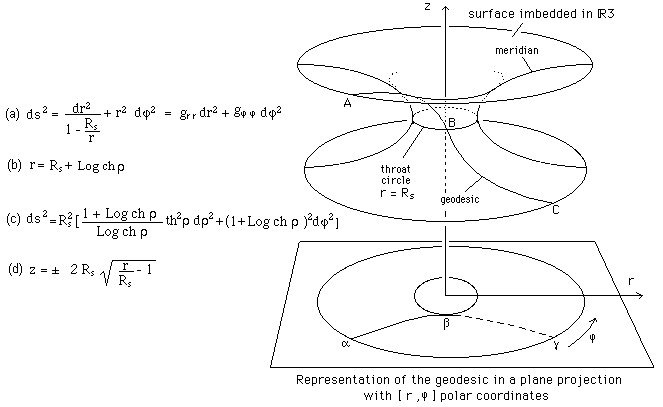
Рис. 25: двумерная метрика поверхности с «мостом», соединяющим два складки.
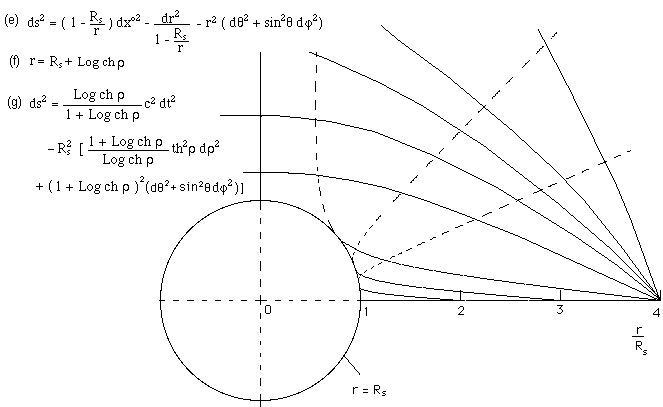
Рис. 26: трехмерная гиперповерхность с «пространственным мостом». Геодезические.

Классически, вводится собственное время s (j) и «координата времени» t (i). Исследование радиальных геодезических дает две дифференциальные уравнения (k) и (l), решения которых соответствуют кривым (m), рис. 6.2, ссылка [52].
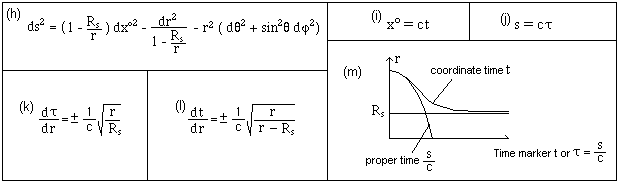
Кривые, показанные на рисунке (m), являются основой модели черных дыр. Координата t идентифицируется со временем собственного наблюдателя «на расстоянии», так что время свободного падения частицы-теста к сфере Шварцшильда становится бесконечным для него. Покажем, что это полностью связано с этим особенным выбором временной координаты. В 1925 году Эддингтон предложил новый маркер времени (p).

Затем исследование соответствующих радиальных геодезических.
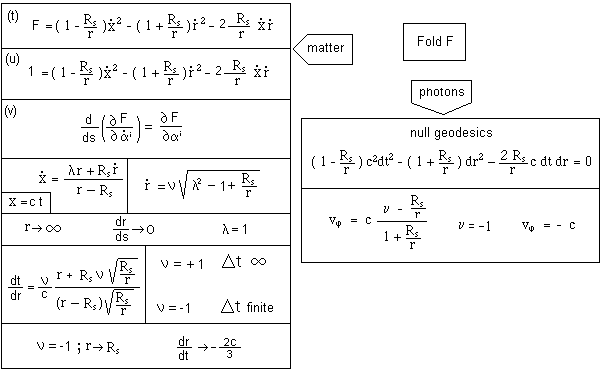
Мы используем уравнения Лагранжа. Справа мы видим, что скорость света, следуя радиальным путям, имеет два значения. (nu = -1) соответствует центростремительным путям: скорость имеет постоянное значение – c. Точно так же (слева), время прохождения от удаленной точки до сферы Шварцшильда зависит от ориентации путей. Центростремительное (nu = -1) время свободного падения достигается за конечный интервал времени Dt. В противоположность этому, путь, направленный от сферы Шварцшильда (nu = +1), дает бесконечный интервал времени, так что сфера Шварцшильда действует как односторонняя мембрана. Это соответствует радиальному эффекту сдвига рамки. Это не причина отвергать эту интерпретацию геометрии Шварцшильда. В действительности мы находим подобное явление в тензоре Керра (азимутальный сдвиг рамки). Затем классическое выражение тензора Керра. Мы видим, что мы получаем два различных значения азимутальной скорости света. В зависимости от того, рассматриваем ли мы свет, следующий за вращением или идущий в обратном направлении.
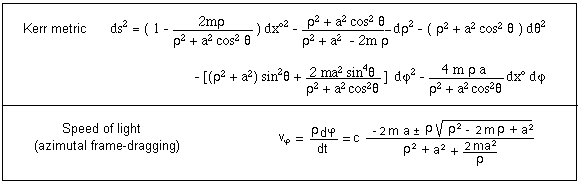
Мы можем дать новую интерпретацию геометрии Шварцшильда, через пространственный мост, соединяющий два складки F и F. Если складка F соответствует складке-близнецу, временная координата t = -t (симметрия T). Согласно разделу 19, мы знаем, что эта симметрия T сопровождается инверсией массы, поэтому, проходя через сферу Шварцшильда, рассматриваемую как поверхность горла, положительная масса становится отрицательной. Сопряженная геометрия, как представлена в разделе 13, соответствует замене Rs на – Rs. Затем мы вводим следующее изменение маркера времени, аналогичное предложению Эддингтона:

При использовании уравнений Лагранжа мы изучаем систему радиальных геодезических и устанавливаем связь между двумя складками.

Но обратные пути требуют бесконечного времени, поэтому это односторонний проход от одного мира к другому. Здесь также мы находим эффект сдвига, но в противоположном направлении.
Во время транзита поток собственного времени остается неизменным: ds > O. Это делает модель черных дыр проблематичной. В действительности, согласно новой интерпретации геометрии Шварцшильда, такой пространственный мост может поглощать огромные количества материи за очень короткое время (» 10-4 с). Для сравнения, анализ, основанный на тензоре Керра, хотя и немного более сложный, дает похожие результаты.
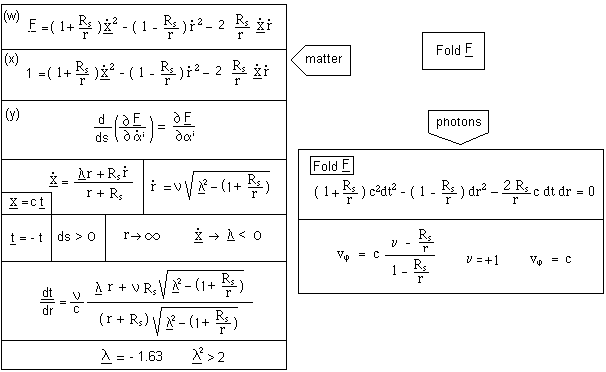
Затем решение систем геодезических.
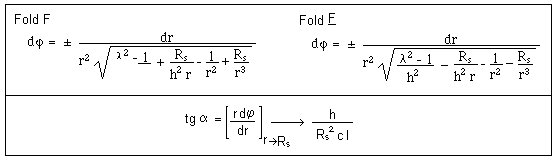
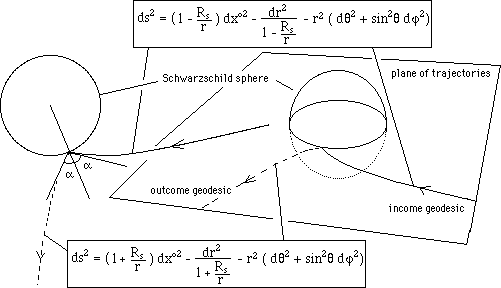
Как представить такие пути? Мы можем использовать начальное пространство представления (r, q, j). Тогда мы получаем систему дифференциальных уравнений выше и схему рисунка 27.
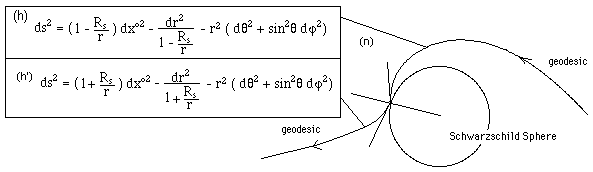
Рис. 27: Геодезические входа и выхода.
Геодезическая кажется «отскакивающей» от сферы Шварцшильда, как показано также на рисунке 28.
**  **
**
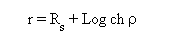
Но все это происходит из-за наивного евклидова представления пути. Используя следующее изменение маркера пространства:
Выражение совместной метрики становится:
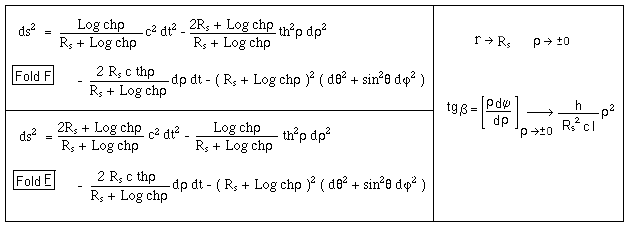
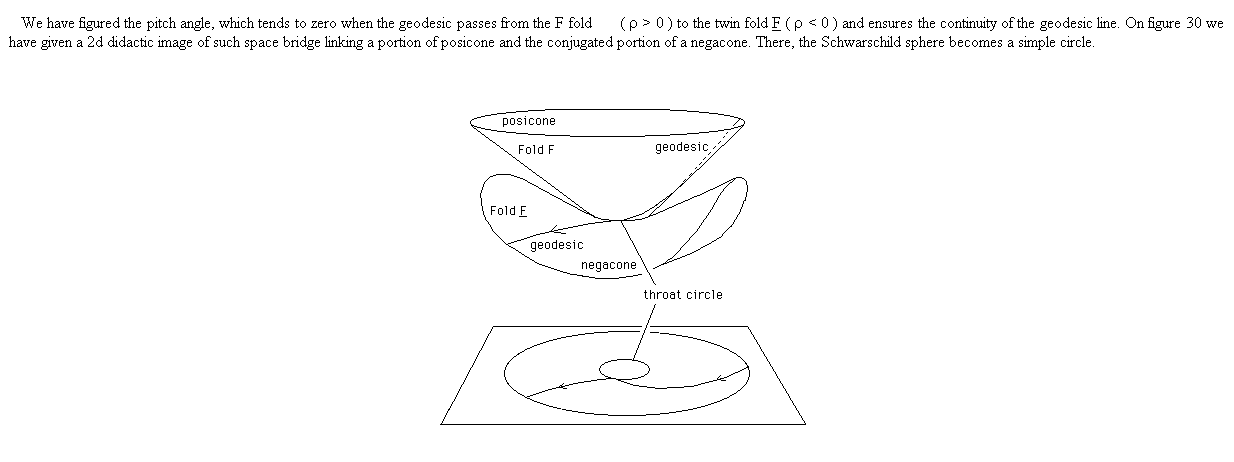
Рис. 29: Образовательное изображение быстрого пространственного моста.
Ссылки.
[1] J.F.Augereau : « Если темная материя отклоняет световые лучи, значит, она существует » (If dark matter bends light rays it shows it does exist). Le Monde, 17 марта 2000 г.
[2] Интервью B.Fort в Ciel et Espace, июнь 2000 г.
[3] J.P.Petit : Эффект недостающей массы. Il Nuovo Cimento, B, том 109, июль 1994 г., стр. 697-710
[4] J.P.Petit, Космология двойных миров. Astrophysics and Space Science. Astr. And Sp. Sc. 226 : 273-307, 1995
[5] Zel'dovich Ya.B., Astrophysica 6. 319 MNRAS 192, 192 (1970)
[6] Doroskhevich A.G. MNRAS 192, 32 (1980)
[7] Klypin A.A & Shandarin S.F. MNRAS 204, 891 (1983)
[8] Centrella J.M. & Mellot A.L. Nature 305, 196 (1983)
[9] Mellot J.M. & Shandarin S.F. Nature 346, 633 (1990)
[10] Shandarin S.F. В Large Structures of the Universe, ред. J.Audouze, M.C. Peleton и A.Szalay, 273. Dordrecht : Kulwer (1988).
[11] Kofman.L.A., Pogosyan D. и Shandarin S. MNRAS 242, 200 (1990)
[12] Peebles P.J.E. Principles of Physical Cosmology, Princeton University Press (1993).
[13] M.Myamoto и R.Nagai Publ. Astrom. Soc. Japan 27, 583, 1975
[14] J.Binney и S.Tremaine, "Galactic Dynamics", Princeton University Press, Princeton, 1987. [16] Bahcall J.N & Soneira R.M. APJ. S** 44** p. 73 1980
[15] Bahcall J.N., Flynn A и Gould A. APJ 389 p.234 1992
[16] B.Lindblad, Handbuch der Physik 53, (1959) 21
[17] C.C. Lin и F.H.Shu : Astrophysics and Gen. Relat. Vol.2 Gordon and Breach Sc. Publ. 1971, p. 235
[18] Toomree A. (1981) The structure and dynamics of normal galaxies. Cambridge University Press, p.111
[19] Toomree A. и Toomree J. (1972) Astrophys. J. 178, 623
[20] A.Toomree, Ann. Rev. Astronom. Astrophys. 15 (1977) 437
[21] E.Athanassoula : Spirales et barres entraînées par des compagnons. International Astronomic Union. Symposium n° 146 (1991)
[22] A.Toomree Astrophys. J. 158 (1969) 89
[23] R.H.Miller и B.F. Smith, Astrophys. J. 277 (1979) 785
[24] F. Hohl, Astrophys. Sp. Sc. 14 (1971) 91
[25] Holmberg E. (1941) Astrophys. J. 94, 385
[26] B. Sundelius и K.J. Donner : Galaxies en interaction, Dynamique des galaxies en disque (1991) Sundelius éd. p. 195
[27] S. Engström : Vitesses caractéristiques dans des simulations numériques. , Dynamique des galaxies en disque (1991) Sundelius éd. p. 332
[28] A.Toomree Ann. Rev. Astron. Astrophys. 15 (1977) 437.
[29] F.Bouchet и L.Hernquist : Simulations cosmologiques utilisant des méthodes théoriques arborescentes. Astr. Jr Suppl. Series 68 , pp. 521, 538, 1988.
[30] F.Bouchet, L.Hernquist и Y.Suto : Application de la méthode d'Ewald aux simulations N-corps cosmologiques. Apj. Suppl. Series 75 , pp. 231-240, 1991
[31] A.Sakharov : "Violation de CP et asymétrie baryonique de l'Univers". ZhETF Pis'ma 5 : 32-35 (1967) : Traduction JETP Lett. 5 : 24-27 (1967)
[32] A.Sakharov : "Un modèle cosmologique à plusieurs feuillets". Préprint Institut de Mathématiques Appliquées, Moscou 1970
[33] A.Sakharov : "Modèle cosmologique de l'Univers avec inversion du vecteur temps". ZhETF 79 : 689-693 (1980) : Traduction en Sov. Phys. JETP 52 : 349-351 (1980)
[34] A.Sakharov : "Structure topologique des particules élémentaires et asymétrie CPT" dans "Problèmes de physique théorique", dédié à la mémoire de I.E.Tamm, Nauka, Moscou 1972 pp. 243-247
[35] Green M.B. & Schwarz J.H. Nucl. Phys. B181 , 502-530 (1981) ; B198 , 225-268 (1982) ; Phys. Lett. B , 444-448 (1982)
[36] Green M.B. Surv. High Energy Phys. 3 , 127 (1982)
[37] Gross D.J. , Harvey J.A. , Martinec E. & Rohm R. , Phys. Rev. Lett. 54, pp 503-505 (1985)
[38] Kolb E.W. , Seckel D , Turner M.S. : Le monde invisible des théories des supercordes, Nature Vol. 314, avril 1984 pp. 415-419
[39] P.C.W.Davies & J.B.Brown : Supercordes, Cambridge University Press 1988
[40] Abdus Salam, Nuovo Cimento 5 , 299 (1957)
[41] Nima-Arkani Ahmed, Savas Dimopoulos и Georgi Dvali : "Les dimensions cachées de l'univers", PLS oct 2000 n° 276 pp. 56-64
[42] J.P.Petit : Une interprétation du modèle cosmologique à vitesse de la lumière variable. Modern Physics Letters A, Vol. 3, n°16, nov 1988, p.1527
[43] ** **J.P.Petit : Modèle cosmologique à vitesse de la lumière variable: l'interprétation des décalages vers le rouge. Modern Physics Letters A, Vol.3 , n° 18, déc. 1988, p.1733
[44] J.P.Petit & Maurice Viton : Modèle cosmologique à vitesse de la lumière variable. Comparaison avec les données observationnelles de QSO. Modern Physics Letters A Vol.4 , n°23 (1989) pp. 2201-2210
[45] P.Midy & J.P.Petit : Cosmologie invariante d'échelle. The international Journal of Modern Physics D, Vol.8 juin 1999 pp.271-280
[46] E.A.Milne : Relativité cinématique Oxford 1948.
[47] J.D.Anderson, P.A.Laing, E.L.Lau, A.S.Liu, M.M. Nieto и S. Turchev : Indication pour les données Pioneer 10/11, Galileo и Ulysse, une accélération anormale, faible, à longue portée. Phys. Rev. Letters : 81 31 août 1998.
[48] G.J.Stephenson Jr. , T.Goldman, Phys. Rep. 205, 211 (1992) ; 216, 343 (1992).
[49] M.N. Nieto и T.Goldman, Phys. Re. 205, 221, 1991; 216, 343.
[50] R.Adler, M.Bazin & M.Schiffer : Introduction à la relativité générale, Mac Graw Hill book, 1975, chapitre 10, section 10.5 : Limite classique des équations gravitationnelles, p. 345.
[51] J.M.Souriau, Structure des Systèmes Dynamiques, Ed. Dunod 1970, France & Structure of Dynamical Systems. Birkhauser Ed. Boston-Zurich 1997.
[51] J.P.Petit : Univers énantiomorphes à flèches du temps opposées (Enantiomorphic universes with opposite time arrows). Comptes rendus de l'Académie des Sciences de Paris, t. pp. 1977
[52] Eddington S.A : : Une comparaison des formules de Withead et d'Einstein. Nature 113 : 192 (1924).
****Резюме статьи
Оригинал (английский)
univers jumeaux contre matiere sombre matiere noire et constante cosmologique
- **Black holes do not exist. **
Where the black hole model does come from ? From the null second member field equation. Paradoxically such very dense object rises from an equation which was initially built to describe empty regions of the Universe. The Kerr metric does not bring so much : the object becomes more complex, thats all. Rotation brings an azimutal frame-dragging phenomenon, which means that the speed of light is different if one looks forward or backward with respect to the spinning movement. Whatever is the technique you choose, the things become frankly pathological when you pass the horizon and get in. At the centre lies the singularity. Let us start with an exercise. Consider the 2d metric (a). If we consider r as a radial distance and j as a polar angle, we get problems for r < Rs. But if we introduce the change (b) the expression of the metric becomes (c). All pathologies disappear. Moreover this surface can be imbedded in R3 : the meridian equation is (d). See figure 25 where we have figured a geodesic. This illustrates the fact that a pathology can depend on a wrong choice of coordinates and on a wrong choice of topology.
In the 3d example we have computed (plane) geodesics ( see figure 26 ) which are projected on the initial (r,q,j) representation space. We get a throat sphere linking two Euclidean 3d spaces. There is nothing inside. Space for r < Rs has no physical meaning. If we would try to compute geodesics in that place, we would find an imaginary solution.
Fig. 25 : 2d metric of a surface with a bridge linking two folds.
Fig. 26 : 3d metric hypersurface with a space bridge. Geodesics.
Classically, one introduce a proper time s (j) and a time-coordinate t (i). Then the study of radial geodesics gives two differential equations (k) and (l), whose solutions correspond to curves (m), fig. 6.2, reference [52].
The curves shown on figure (m) are the basis of the black hole model. One identifies the coordinate t to the proper time of a distant observer so that the free fall time of a test particle, towards the Schwarzshild Sphere become infinite for him. Let us show that this is completely due to this peculiar choice of time coordinate. In [54] 1925 Eddington suggested a new time-marker (p).
Following, the study of corresponding radial geodesics.
We use Lagrange equations. On the right we see that the speed of light, following radial paths has two values. ( nu = - 1 ) corresponds to centripetal paths : the speed has a constant value c. Similarly (left) the transit time from a distant point to the Schwarzschild sphere depends on the orientation of the paths. Centripetal ( nu = - 1 ) free fall time is achieved in finite time interval Dt . Oppositely a centrifugal path ( nu = + 1 ), starting from the Schwarzschild sphere gives an infinite time interval, so that the Schwarzschild sphere works like a one-way membrane. This corresponds to a radial frame-dragging effect. This is not a reason to reject this interpretation of the Schwarzschild geometry. In effect we find a similar phenomenon in the Kerr metric ( azimutal frame-dragging). Next, the classical expression of the Kerr metric. We see that we get two distinct values for azimutal speed of light. Depends if we consider light following the rotation or going backwards.
We can give a new interpretation of the Schwarzschild geometry, through a space-bridge linking two folds F and F. If the fold F corresponds to the twin fold, the time coordinate t = - t ( T-symmetry). From section 19 we know that this T-symmetry goes with a mass-inversion, so that when a positive mass passes through the Schwarzschild sphere, considered as a throat surface, the sign of it becomes negative. The conjugated geometry, as presented in section 13 corresponds to change Rs into Rs. Then we introduce the following Eddington-like time marker change :
Still using Lagranges equation we study the radial geodesics system and build a link between the two folds.
But the inverse paths requires an infinite time, so that it is a one-way passage from a Universe to the other. Here again we find a frame-dragging effect, in the opposite direction.
During the transit the proper time flow is unchanged : ds > O . This makes the black hole model questionable. In effect, according to this new interpretation of the Schwarzschild geometry such space bridge can swallow in a very short time ( » 10-4 sec) unlimited amounts of matter. By the way, an analysis based on the Kerr metric, although a little bit more complicated gives similar results.
Following, the solution of the geodesic systems.
How to figure such paths ? We can use the initial ( r , q , j ) representation space. Then we get the above system of differential equations and the schema of figure 27 .
Fig.27 : Income and outcome geodesics.
The geodesic seems to bounce on the Schwarzschild sphere, as shown of figure 28 too.
** **
But all that comes from such naïve Euclidean representation of the path. Using the following change of space marker :
The expression of joint metrics become :
Fig. 29 : Didactic image of a fast flow space bridge.
References.
[1] J.F.Augereau : « Si la matière sombre dévie les rayons lumineux, cest donc quelle existe (If dark matter bends light rays it shows it does exist). Le Monde, March 17 th 2000.
[2] Interview of B.Fort in Ciel et Espace, june 2000.
[3] J.P.Petit : The missing mass effect. Il Nuovo Cimento, B , vol. 109, july 1994, pp. 697-710
[4] J.P.Petit, Twin Universe Cosmology. Astrophysics and Space Science. Astr. And Sp. Sc. 226 : 273-307, 1995
[5] Zel'dovich Ya.B., Astrophysica 6. 319 MNRAS 192, 192(1970)
[6] Doroskhevich A.G. MNRAS 192, 32 (1980)
[7] Klypin A.A & Shandarin S.F. MNRAS 204, 891 (1983)
[8] Centrella J.M. & Mellot A.L. Nature 305, 196 (1983)
[9] Mellot J.M. & Shandarin S.F. Nature 346 , 633 (1990)
[10] Shandarin S.F. In Large Structures of the Universe, ed. J.Audouze, M.C. Peleton and A.Szalay, 273. Dordrecht : Kulwer (1988).
[11] Kofman.L.A., Pogosyan D. and Shandarin S. MNRAS 242, 200 (1990)
[12] Peebles P.J.E. Principles of Physical Cosmology, Princeton University Press (1993).
[13] M.Myamoto and R.Nagai Publ. Astrom. Soc. Japan 27, 583, 1975
[14] J.Binney and S.Tremaine, "Galactic Dynamics", Princeton University Press, Princeton, 1987. [16] Bahcall J.N & Soneira R.M. APJ. S** 44** p. 73 1980
[17] Bahcall J.N. , Flynn A and Gould A. APJ 389 p.234 1992
[18] B.Lindblad, Handbuch der Physik 53, (1959) 21
[19] C.C. Lin and F.H.Shu : Astrophysics and Gen. Relat. Vol.2 Gordon and Breach Sc. Publ. 1971, p. 235
[20] Toomree A. (1981) The structure and dynamics of normal galaxies. Cambridge University Press, p.111
[21] Toomree A. and Toomree J. (1972) Astrophys. J. 178, 623
[22] A.Toomree, Ann. Rev. Astronom. Astrophys. 15 (1977) 437
[23] E.Athanassoula : Companion driven spirals and bars. International Astronomic Union. Symposium n° 146 (1991)
[24] A.Toomree Astrophys. J. 158 (1969) 89
[25] R.H.Miller and B.F. Smith, Astrophys. J. 277 (1979) 785
[26] F. Hohl, Astrophys. Sp. Sc. 14 (1971) 91
[27] Holmberg E. (1941) Astrophys. J. 94, 385
[28] B. Sundelius and K.J. Donner : Interaction galaxies, Dynamics of Disk Galaxies (1991) Sundelius ed. p. 195
[29] S. Engström : Feature velocitys in numerical simulations. , Dynamics of Disk Galaxies (1991) Sundelius ed.p. 332
[30] A.Toomree Ann. Rev. Astron. Astrophys. 15 (1977) 437.
[31] F.Bouchet and L.Hernquist : Cosmological simulations using theoretical tree methods. Astr. Jr Suppl. Series 68 , pp. 521, 538, 1988.
[32] F.Bouchet, L.Hernquist and Y.Suto : Application of the Ewald method to cosmological N-body simulation. Apj. Suppl. Series 75 , pp. 231-240, 1991
[33] A.Sakharov : "CP violation and baryonic asymmetry of the Universe". ZhETF Pis'ma 5 : 32-35 (1967) : Traduction JETP Lett. 5 : 24-27 (1967)
[34] A.Sakharov : "A multisheet Cosmological Model" Preprint Institute of Applied Mathematics, Moscow 1970
[35] A.Sakharov : "Cosmological Model of the Universe with a time-vector inversion". ZhETF 79 : 689-693 (1980) : Traduction in Sov. Phys. JETP 52 : 349-351 (1980)
[36] A.Sakharov : "Topological structure of elementary particles and CPT asymmetry" in "problems in theoretical physics", dedicated to the memory of I.E.Tamm, Nauka, Moscxow 1972 pp. 243-247
[37] Green M.B. & Schwarz J.H. Nucl. Phys. B181 , 502-530 (1981) ; B198 , 225-268 (1982) ; Phys. Lett. B , 444-448 (1982)
[38] Green M.B. Surv. High Energy Phys. 3 , 127 (1982)
[39] Gross D.J. , Harvey J.A. , Martinec E. & Rohm R. , Phys. Rev. Lett. 54, pp 503-505 (1985)
[40] Kolb E.W. , Seckel D , Turner M.S. : The shadow world of superstring theories, Nature Vol. 314, april 1984 pp. 415-419
[41] P.C.W.Davies & J.B.Brown : Superstrings, Cambridge University Press 1988
[42] Abdus Salam, Nuovo Cimento 5 , 299 (1957)
[43] Nima-Arkani Ahmed, Savas Dimopoulos and Georgi Dvali : "Les dimensions cachées de l'univers", PLS oct 2000 n° 276 pp. 56-64
[44] J.P.Petit : An interpretation of cosmological model with variable light velocity. Modern Physics Letters A, Vol. 3, n°16, nov 1988, p.1527
[45] ** **J.P.Petit : Cosmological model with variable light velocity: the interpretation of red shifts. Modern Physics Letters A, Vol.3 , n° 18, dec. 1988, p.1733
[46] J.P.Petit & Maurice Viton : Gauge cosmological model with variable light velocity. Comparizon with QSO observational data. Modern Physics Letters A Vol.4 , n°23 (1989) pp. 2201-2210
[47] P.Midy & J.P.Petit : Scale Invariant Cosmology. The international Journal of Modern Physics D, Vol.8 June 1999 pp.271-280
[48] E.A.Milne : Kinematic Relativity Oxford 1948.
[49] J.D.Anderson, P.A.Laing, E.L.Lau, A.S.Liu, M.M. Nieto and S. Turchev : Indication for Pioneer 10/11, Galileo and Ulysse Data, an an Apparent Anomalous, Weak, Long-Range Acceleration. Phys. Rev. Letters : 81 31 August 1998.
[50] G.J.Stephenson Jr. , T.Goldman, Phys. Rep. 205, 211 (1992) ; 216, 343 (1992).
[51] M.N. Nieto and T.Goldman, Phys. Re. 205, 221, 1991; 216, 343.
[52] R.Adler, M.Bazin & M.Schiffer : Introduction to general relativity, Mac Graw Hill book, 1975, chapter 10, section 10.5 : Classical limit of gravitational equations, p. 345.
[53] J.M.Souriau, Structure des Systèmes Dynamiques, Ed. Dunod 1970, France & Structure of Dynamical Systems. Birkhauser Ed. Boston-Zurich 1997.
[53] J.P.Petit : Univers énantiomorphes à flèches du temps opposeés (Enantiomorphic universes with opposite time arrows). Comptes rendus de lAcadémie des Sciences de Paris, t. pp. 1977
[54] Eddington S.A : : A comparizon of Witheads and Einsteins formulæ. Nature 113 : 192 (1924).
****Резюме статьи