Le problème de la masse manquante (p3)
4) Solution à symétrie sphérique
… En 1916, Eddington a dérivé une solution stationnaire à symétrie sphérique, combinant les équations de Vlasov et de Poisson. Il a supposé que l’ellipsoïde des vitesses était à symétrie sphérique et orienté vers le centre du système.
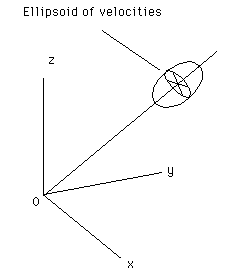
Figure 1 (ga3114) : Ellipsoïde des vitesses correspondant à une solution de type Eddington.
Eddington a dérivé la relation suivante entre la densité de masse et le potentiel gravitationnel :
(20)
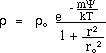
qui représente une distribution stationnaire de matière dans un gaz sans collisions, dans un potentiel gravitationnel Ψ, dans lequel la force gravitationnelle équilibre la force de pression. Considérons la même forme de solution pour la région antipodale :
(21)
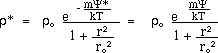
Ainsi, nous devons résoudre l’équation suivante :
(22)

Posons
(23)
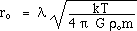
Introduisons les grandeurs adimensionnelles suivantes :
(24)

Nous obtenons
(24 bis)
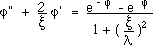
qui peut être résolue par calcul numérique. Nous pouvons prendre les conditions initiales suivantes :
φ'₀ = 0
φ"₀ = 10
λ = 10
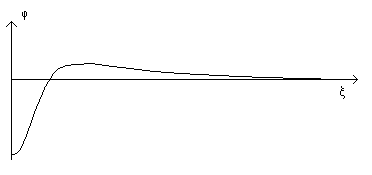
Figure 2 : Solution de type Eddington à symétrie sphérique. Le potentiel gravitationnel
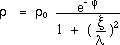
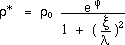
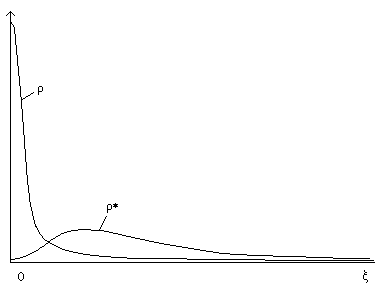
Figure 3 : Solution de type Eddington à symétrie sphérique. Densités de masse. Si un amas existe dans un pli, un halo diffus associé existe dans la région conjuguée du second pli.
Version originale (anglais)
The missing mass problem (p3)
4) Spherically symmetric solution
...In 1916 Eddington derived a spherically symmetric steady-state solution, combining the Vlasov and the Poisson equations. He assumed that the ellipsoid of the velocities was spherically symmetric and pointed towards the center of the system.
Figure 1 (ga3114): Ellipsoid of velocities corresponding to an Eddington-type solution.
Eddington derived the following relation between the mass density and the gravitational potential
(20)
which represents a steady-state distribution of matter in a collision-free gas, in a gravitational potential Ψ, in which the gravitational force balances the pressure force. Let us take the same kind of a solution for the antipodal region
(21)
So that we have to solve the following equation
(22)
Take
(23)
Introduce the following adimensional quantities :
(24)
We get
(24)
which can be solved by numerical computation. We can take the following initial conditions
φ'₀ = 0
φ"₀ = 10
λ = 10
Figure 2 : Spherically symmetric Eddington-type solution. The gravitational potential
Figure 3 : Spherically symmetric Eddington-type solution. Mass densities. If a cluster exists in one fold, an associated diffuse halo exists in the conjugated region of the second fold.