A
cosmological model : The twin bang. (p.2)

VLS : The very large structure
of the universe.
...As
show in our works, the joint evolution of the two universes are not identical.
The ghost universe has higher mass-density r* and
higher temperature T*. We decided to study joint gravitational instabilities
in such mixture, where, we recall :
-
m attracts m ( Newton's law)
-
m* attracts m* (Newton's law)
-
m and m* repel each other (
"anti-Newton's" law ).
A few words about the gravitational
instability (Jeans' instability).
...Take
a single population, a set of masses m . This medium has a mass-density r
. It also owns a (mean) thermal velocity Vth.
...Assume
that somewhere we have a portion of space, whose characteristic span is f
, where
the density is higher. See figure (147).
(147)

...The
thermal velocity tends to dissipate this mass concentration and the corresponding
characteristic dispersion time is :
(148)

...Imagine
now this thermal veolicity is zero. This clump tends to collapse. One can
compute the characteristic collapse time:
(149)

...On
the other hand, any clump tends to attract surrounding matter, and to grow.
This perturbation will grow if the characteristic accretion time ( characteristic
collapse time ) is smaller than the dispersion time. :
(150)

We find a characteristic length
:
(150-a)

called Jeans' length.
...Any
mass-concentration whose span is larger than this characteristic Jeans'length
will grow and form clumps. Smaller will dissipate.
...When
a clump of matter forms, the last is warmed, which raises the internal pressure
force. Finally, internal pressure stops the process.
...One
could think that the gravitational instability, Jeans'instability, forms galaxies,
stars, and so on. But this is not so simple. For example, in the Standard
Model, when t < 500,000 years, the temperature of mixed matter and radiation
is higer that 3000°K. Then matter (75 % hyydrogen, 25 % helium) is fully
ionized.
...Radiation,
electromagnetic waves, cross ionized gases with great difficulty. When an
astronaut is in the re-entry process, his space ship is surrounded by hot,
fully ionized gas for several minutes. Then no radio-communication is possible
for electromagnetic waves cannot cross the shell of ionized gas which surrounds
his ship.
...A
light ray is an electromagnetic wave. It acts on free electrons, not on bounded
electrons. An ionized gas contains much free electrons. A neutral gas, none.
That's why when Universe is warm, ionized, radiation and matter are strongly
coupled.
...In
matter, the absolute temperature Tm is the measure of the thermal velocity
:
(150-b)

where k is the Boltzmann's constant
(k = 1.38 10-23).
When :
-
Matter and radiation are closely
coupled -
Radiation dominates ( Standard
model t < 500,000 years )
then :
(150c)

but :
(150d)

The Jeans' length obeys :
(150-e)

...The
last corresponds to the mass-conservation requirement, during expansion process
R(t). We see that the Jeans' length varies like R(t). So, the younger the
universe, the smaller the size of the clumps which would tend to form.
...When
t < 500,000 years the radiation prevents the clumps forming. But, immediatly
after discoupling, matter clumps can form. Let us compute their mass. It is
:
(150-f)

...i.e
: 100,000 solar masses ( the typical mass of a globular cluster).
...According
to this schema the globular clusters would form first, just after discoupling.
The galaxies, considerered as sets of such clusters, would appear after, and
so on....
...But
all this occurs in a fastly expanding universe. We don't know how to compute
it, to describe the gravitational instability in an expanding universe. Furthermore
; we don't know how to define Newton's law in an expanding universe.
...As
a conclusion we have several schemas for the birth of galaxies. Some believe
that stars form first, then galaxies. Others have the inverse opinion ...
...Following
this general idea of hierarchic structure, people thought that, if galaxies
were organized into clusters of galaxies (Coma, Virgo), at larger size these
clusters should belong to some super-clusters. But the observations (1977)
bought a completely different structure. See figure (151):
(151)
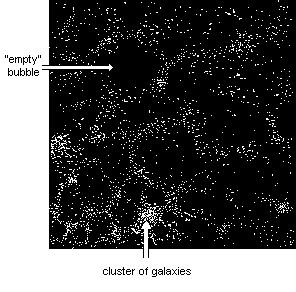
...The
galaxies were arranged around large voids (typically 100 light-years large).
At a very large scale (VLS), the universe looks like joint soap bubbles. The
clusters of galaxies correspond to the intersection point of three "folds".
See figure (152).

...Today,
it is still difficult to explain such structures. Following the initial idea
of the Russian Zel'dovitch, Mellot carried out 3d numerical simulations. But
the obtained cells were not stable in time. They vanish rapidly, except if
one stabilizes the system with ad hoc cold dark matter distribution.
...The
model matter-repulsive ghost matter gives an alternative interpretation of
the phenomenon. See our paper :
J.P.Petit, P.Midy and and F.Landsheat : Matter ghost matter astrophysics.
5 : Results of numerical 2d simulations. VLS. About a possible schema for
galaxies' formation. Geometrical Physics A, 8 , 1998.
