Cinema policy: reality vs fiction
Chronicle of ordinary madness
December 14, 2005
Arnold Schwarzenegger was asked, as Governor of California, to comment on the execution of a long-term prisoner on death row. He remained inflexible. The press showed him seated in his governor's chair, expressionless face. A few days earlier, I had seen this man quite differently. I can't remember who left a DVD at my place with the title "Terminator." It's a work of fiction. Two characters from the future spread through a city in the United States. One is a robot, played by Arnold. He has come to kill a woman who is destined to give birth to a man who will supposedly save the world. The second character is a human being, also from a future that we are shown glimpses of. Things don't seem to be going very well in those future centuries. People are fighting as best they can against machines that have escaped their control. But according to this messenger, this sort of angel entrusted with the Annunciation, if this woman is killed, it would change history, and it could then be truly worse.
Terminator is a "new generation" robot. He has no conscience, yet his skin is made of human skin. As soon as he arrives, he begins killing indiscriminately. How many people die in this film? Fifty? A hundred? Two hundred? More? It's hard to say. It goes so fast. Arnold Schwarzenegger kills faster than his shadow. At one point, he enters a police station with a rifle in each hand. With his impassive blue eyes and his Mussolini-like chin, he shoots left and right, never missing his targets.
The film is nothing but an unbroken succession of ordinary massacres. At every street corner, cars burn. Normal, we're at the cinema. It's "for show." As for "Marie," she tries to escape her fate as best she can. In this variant of the New Testament, it's not the Holy Spirit who impregnates her, but the angel. Original.
Schwarzie, with a closed face, is merciless. In the final scene of the film, the angel, before dying, manages to plunge the killer robot into a torrent of flames. But unexpectedly, the robot rises again and reveals his true face—chromed steel with two red eyes glowing.
After watching this film, I broke the CD-ROM and threw it in the trash, thinking at least someone else wouldn't be able to use it to watch this mediocre, nauseating movie. But now, Terminator has become governor of one of the most powerful states in America. After killing so many people on movie sets, he is suddenly confronted with real life and real death. He admits this decision caused him some moral dilemmas. But that's all.
But anyway, what does it matter to us, who are watching all this through the window of our television? Fiction and reality have long since merged. We know well that politics is cinema. Aren't politicians becoming a kind of remote-controlled robots, or equipped with a bit of artificial intelligence? Paraphrasing Einstein, we could say:
To do politics, a brain is not necessary. A brainstem is more than enough.
The actor Schwarzenegger made a decision. He confirmed the decision to execute a man. According to a journalist, these injections apparently aren't instantaneous. We still have progress to make, or perhaps the dosage wasn't quite right. Anyway, what did people see on their screen? The politician? No. They saw the actor. Madame probably still found him attractive. Images have lasting power. It's no coincidence that political forces place professional actors in key positions of power. When Ronald Reagan was president, American politics resembled a B-series film. Today, politics has become fiction. We are in Matrix. We vaguely sense something is brewing, that a drama is unfolding, but we've lost touch with reality a long time ago.
The second impression I retained from this past week was a report on the missing persons from Mourmelon. A dossier traced the entire story of seven young men who died. For years, just a few hundred meters from the Mourmelon military base, young conscripts disappeared, vanishing shortly after leaving the barracks for leave. The army refuses to open an investigation. On the records, they are listed as "deserters." When families press the Minister of Defense (René Giraud, I believe at the time) with their questions, he responds, "But in France, people disappear every day..." And that's it. But one day, the body of one of these young conscripts is found, already devoured by vermin, abandoned in a forest under a mattress of leaves. Suddenly, the word crime is associated with this series of disappearances. A gendarme in charge of the investigation suggests that if so many young men in peak physical condition could be victims of a murderer, that killer must be at least a skilled athlete. He must be capable of immobilizing and binding a twenty-year-old man without missing his shot. It could be, he says, a man experienced in commando techniques—essentially, a military man. Yet despite this assumption, no investigation focused on the Mourmelon camp, a true sanctuary where only "military justice" can be exercised.
The gendarmeries exchange information notes. It was a gendarme near Paris who was arrested after asking the driver of a Volkswagen van for identification. The man, very calm, produced a military ID card. He probably thought presenting this document would immediately resolve the identity check issue. He was stationed in the Paris region. But on the back were listed his successive assignments. The gendarme read: Mourmelon. He then had the idea to inspect the vehicle, obscured by drawn curtains. He glimpsed the body of a young man, securely tied with straps and chains. The vehicle's owner is Pierre Chanal. He simply said he is homosexual and that this corresponds to "classic little games." That's not the view of the young foreigner tied up, who, as soon as the gendarme freed him, thanked him warmly for saving his life.
Chanal claimed he tried to rape him, committed acts on his genitals, and masturbated in front of him. Having been neutralized and tied up by a real professional, the young man quickly realized his days were in danger. I recall Chanal's expression—nothing special, neither fear nor malice. It wasn't the look of a monster. He was calm. A professional, a cold-blooded man. The justice system then decided to intervene and launched as many investigations as there were murders. But strangely, all these cases of disappearances were assigned to different judges who had no contact with one another. And this is where attention must be paid to the story. One of the judges is tasked with handling the Chanal case. In his car, they found a shovel with soil on it. The soil was collected and placed in a plastic bag for analysis. Since one of the victims was found dead, half-buried in a forest, analyzing this soil could become a key element of the investigation. But the judge... misplaced this sample.
That night, I was too tired to follow this case to the end. It was already late. I'll just tell you one thing. Our heads are full of images. The military protects us. Politicians safeguard our future. Doctors care for our bodies. Scientists scrutinize the universe to uncover its secrets. Journalists inform us. Police officers are courageous and honest. As for judges, they are, as their name suggests, above all suspicion. Perhaps we need this image of society to maintain a minimum of mental balance.
And yet, lately these images are beginning to waver. A few days ago, a reader alerted me to a website where one could watch, live-streaming, a 100-megabyte video lasting one hour. Here is the URL:
http://news.stcom.net/modules.php?name=Downloads&d_op=getit&lid=136
In this video, a young man, Charles, and his sister Diane discuss confessions their father, a judge and president of an appeals court, Pierre Roche, made to them shortly before his death. I believe one must watch this entire document to form one's own opinion. In a few words, early in 2003, a few months before the Allègre scandal broke, Pierre Roche suddenly, one might say, decided to "confess," speaking at length to his two children over three successive interviews. He confessed his fear of being assassinated, and what he told them otherwise was truly hallucinatory. For a long time, he had been part of a secret society composed of important people—judges, politicians, doctors, media figures, financiers. This group operated around a sect-like ideology promoting the absence of limits in any action, which could go as far as murder. Here we find the entire theme of satanic cults, which have existed throughout history. The groups to which Judge Roche claimed to belong would gather to perform rituals combining group sexuality, sadistic acts on victims of various ages—possibly minors, even children—and these sessions could go as far as murder, a fact that was by no means exceptional.
Why would this appeals court judge feel so threatened? Because regarding a minor moral scandal, he had exercised blackmail. As Charles Roche, his son, notes, blackmail can become a double-edged weapon. Pierre Roche had long accumulated compromising files on many people. But it seemed that by making threats, he had gone too far this time and put his life in danger. Charles and Diane say that toward the end, their father seemed to have completely lost his mind and spent an entire night burning documents that might have been his... life insurance. Shortly after revealing these things to his two children, he died under unexplained circumstances. They were only notified after their father's body had been cremated. They discovered with shock that the death certificate gives no details about the circumstances of his death. He died and was cremated twenty-four hours later—nothing more.
The two children, who themselves belong to the judicial institution, attempted to open an investigation but say that for two years, their requests to the Keeper of the Seals, Dominique Perben, have gone unanswered.
When we return to their testimony about what their father revealed, we feel as if we've plunged into a horror film. The central theme of Satanism is indeed a kind of marriage with evil. Followers are approached when the group detects what one might call a predisposition. They are gradually drawn into these practices in such a way that their commitment becomes irreversible. The organizers ensure that participants in these murder rituals are not mere spectators but active agents. This is not simply group sex or even rape, but practices that can go as far as murdering people with no ties—homeless, family-less, and... without papers. The Roche children recall that over ten years, 190 suspicious deaths were counted in Toulouse, many of which were identified as suicides, they say, always by the same experts, they emphasize. These rapes associated with torture sessions would, according to their father, be filmed, and these video documents then sold at high prices to enthusiasts.
These documents have a name in the United States. They are called "snuff-movies." Snuff, in English, means to die (Harrap's). They are films where people are killed slowly. All of this seems dizzying. There is a comic book series, Largo Winch, that touches on this. In the first album, titled Golden Gate, a young prostitute confides in Winch:
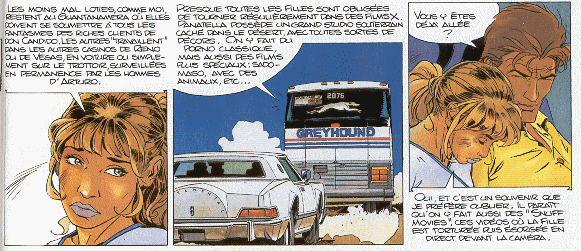
In the next album, titled Shadow, the series' hero, Largo Winch, barely manages to rescue his colleague Sarah Washington just as she is about to play the lead role in one of these abominable productions, filmed in a secret underground studio in Nevada.
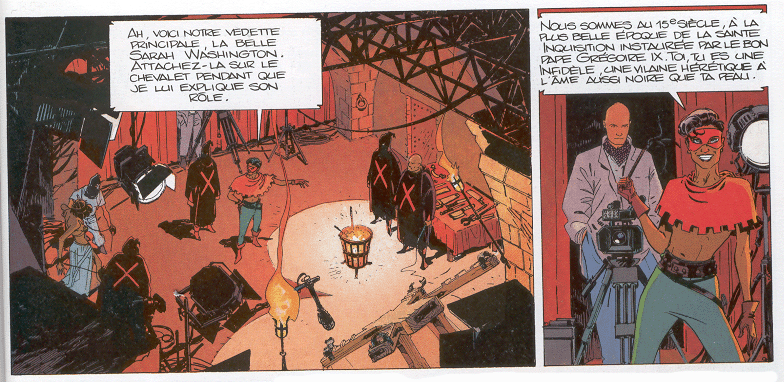
I admit that when I read these albums, I hadn't yet seen the interview with the two Roche children. Suddenly, everything becomes dizzying. Indeed, the scenes Pierre Roche, their father, claims to have experienced are identical in every detail to the image above, on the left. Charles Roche tells us:
- The world we live in is merely a theater of shadows. We are sheep governed by wolves, for whom we are merely livestock and possibly prey they can devour with impunity. The public has no idea what's going on in the highest echelons of power. What our father described was supposed to have taken place in Toulouse. Soon after, the Allègre scandal erupted, where this man was quickly presented as a serial killer, a madman, when he was merely a simple henchman, an instrument, the supplier of fresh flesh for members of this abominable organization. Isolated individuals, homeless people, prostitutes were identified by people like Allègre. But the real actors are people from the highest levels of society, individuals who feel above human laws, above all morality, and guaranteed complete impunity, given the networks they've woven throughout all the highest spheres of society.
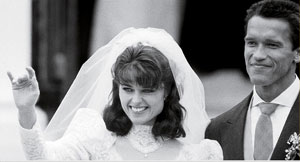
What should we think of all this? I leave it to you to judge. Suddenly, we think of all the rumors surrounding a secret society to which George Bush might have belonged. The "Bohemian Grove" or the "Skulls and Bones" sect, if I recall correctly. Pressed by my readers, I hadn't given any attention to this before. We think of some rather intriguing recognition signs I presented in a previous dossier, in the form of a joke. You'll notice that... Schwarzenegger is among them, alongside his wife, making the same finger gesture.
Here, Bush and his wife. Behind, his father:
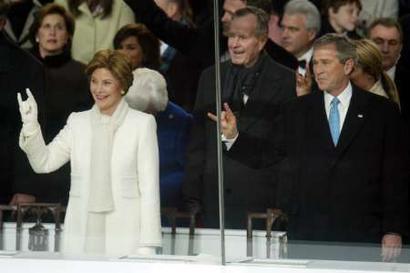
Was this a recognition sign for a Texas football team, as some have claimed? But why does Bush make this sign in this video, taken at the moment of his inauguration as President of the United States? Is it really the right moment to make such an insistent gesture to old football club friends, when you're parading before the entire American nation gathered?
What do we really know about the world we live in? Not much. Sometimes history reveals some of its turpitudes. The hidden side of a black iceberg.
Satanism is still very much alive. Human sacrifices have existed since the dawn of humanity. We think of rituals meant to appease the anger of gods. But as philosopher René Girard explains (see "The Ancient Road of Wicked Men"), human sacrifice serves another purpose. Humans are fully aware that they always have something to reproach themselves for. Sacrifice thus has an expiatory character. By killing another human being, man "loads him with his sins." This is the "scapegoat." The reader might wonder where this expression comes from. It's an ancient Middle Eastern tradition. Each year, each member of the tribe would write their sins on a goat, then release it into the desert "to carry away the sins of the tribe."
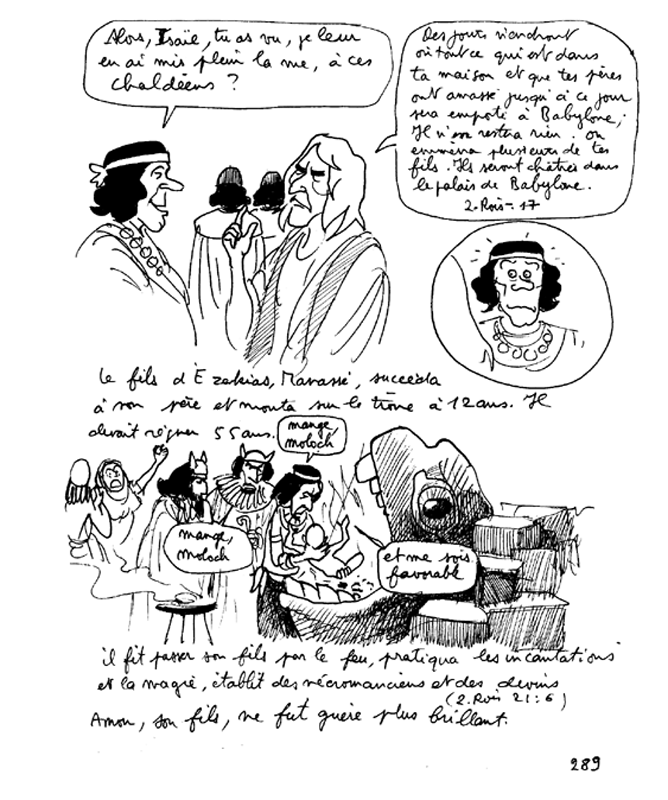
The Carthaginians practiced child sacrifices on a large scale, worshipping their god Moloch. In the city stood a large bronze statue functioning as a chimney, its gaping mouth serving as the top opening. The statue had two articulated limbs resembling arms with two enormous open hands. Everything was operated by chains. Young victims, tied up, were placed in this metal receptacle, their heads covered with a black cloth. Then, by pulling the chains, assistants would swiftly hurl the sacrificial victims into the monster's gaping mouth, which spat flames.
The Canaanites, who inhabited the Promised Land before the arrival of the Jews, sacrificed their firstborn and buried them under the threshold of the door, so their gods would favor them. In the mythological story of Abraham's sacrifice, we see symbolically the transition from human sacrifice to animal sacrifice. Later, they sacrificed the firstborn of every mother in each flock. We no longer kill humans, but the theme of sacrifice, the act of slaughter, persists. In this monotheistic theme, two biblical figures opposed sacrifice in general: Isaiah (759 BCE) and Jesus.
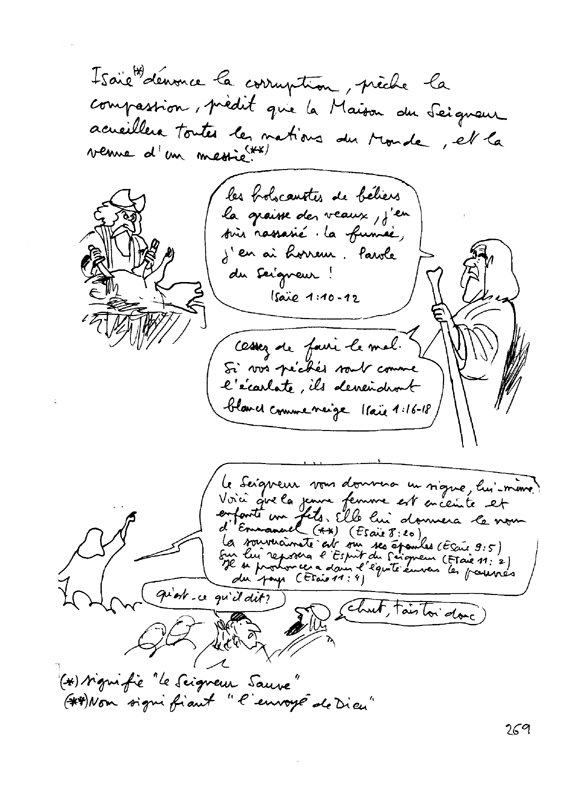
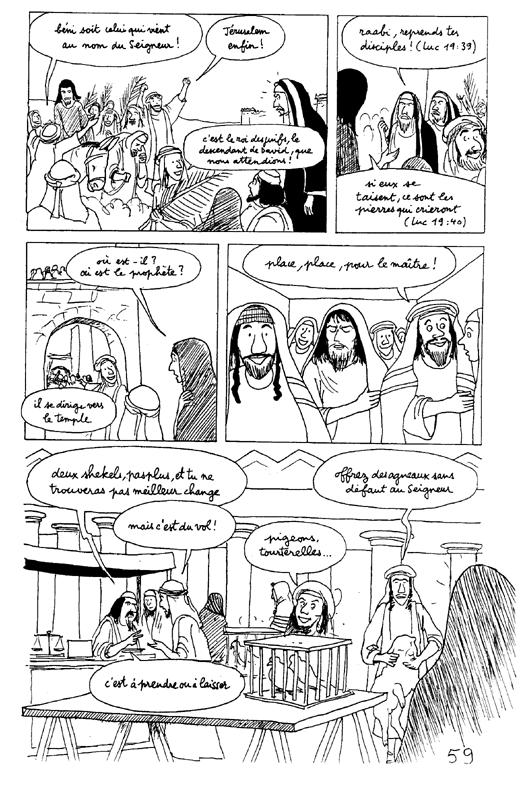
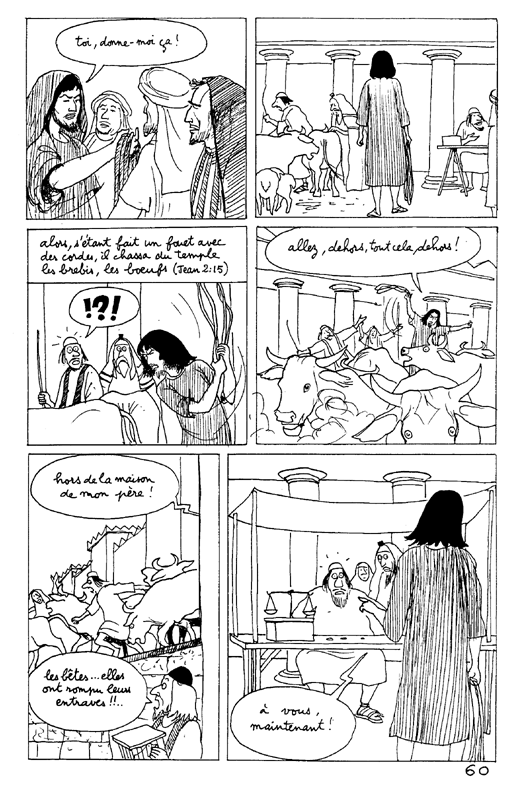
Later, when Jesus entered the precincts of the Jerusalem Temple (whose esplanade, the Mosques of Jerusalem, indicates the location), he discovered shops of money changers, as foreign currency could not be accepted within the temple. This "Court of the Gentiles" was also a vast livestock market destined for sacrifices. Below is Jesus' arrival in Jerusalem.
His anger seized him:
It's also worth recalling that one of the Jewish kings, Manasseh, son of Ezekias, revived the practice of child sacrifice in Israel, long after Solomon's death:
Consider also the massive human sacrifices carried out by the Aztecs. No matter where you look, the theme of human sacrifice seems etched into human history since time immemorial. Why should we be surprised it resurfaces? It's one of the pillars of our collective unconscious, heavily burdened. For a yes or a no, we slaughter each other, we throw ourselves into crematoria, we shoot each other. It's not just about eliminating the enemy. Sacrifice and torture are part of the ostentation of violence, a kind of externalization. When Catherine of Russia seized a rebel who, after conquering Kazan, was preparing to march on Moscow, she pronounced his death sentence. Then her entourage and the people demanded the expiatory punishment "as the custom requires." The man, before being hanged, had to be disemboweled, eviscerated, castrated. But already influenced by the "Enlightenment" message, she decided to be more humane—or less inhumane—by simply having him hanged.
Let's not deceive ourselves. The human unconscious is burdened with all the violence of its past history. What could be more significant than the fact that the actor who was "Conan the Barbarian" has now become the... Governor of California? How can we bear, daily, seeing so many people killed on our television screens? How can we watch (the recent trend) young forensic specialists, freshly graduated and wearing rubber gloves, fiddling with corpses, plunging their fingers into wounds, all while making jokes?
Our societies are sick. All it takes is to look at the images they display before our eyes to realize it.

The mask from the film "Scream" (scream of horror)
This gadget is sold in all children's toy stores. It allows "playing at being scared." In a second version, given the success of this "product," the manufacturer released a variant where the child can, using a bulb, make a red liquid drip down the mask, imitating blood.
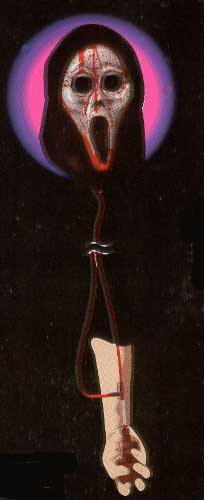
A striking effect.
This is part of the paraphernalia of the holiday that comes to us from across the Atlantic: Halloween. A psychiatrist would tell you there are two ways for a human being to exorcise their impulses. They can express them through simulations, or they can simply... act them out. Is it healthy to celebrate horror, to sell monster masks in toy stores? Does this allow the child to "let off steam"? Or does it instead imprint potentially dangerous images into their unconscious? Remember that there were two murders committed by teenagers who... were wearing the same mask. Murders... ritualistic, materializing rituals learned by watching the same images in films.
Why, finally, does Judge Roche's behavior seem so aberrant to us? Secure in his immunity due to his position, he simply, with his companions, made things concrete. In the minds of these people, ancestral customs, barbaric rituals, and tortures are reactivated. These customs existed everywhere. Buy the comic book series "Les Passagers du Vent" by Bourgeon, and you'll discover African violence, witnessed under the impassive, indifferent gaze of white slave traders. They look down with disdain on these "savages." But later, at sea, they would throw a significant portion of their "cargo"—slaves who died during the crossing—into the ocean, disposing of them with indifference, like rotten fruit (we know that in these slave trades, a large part of this "ebony wood" died during the crossing). If you know the album, recall the captain Boisboeuf's words, dictated to his second after a slave was devoured by a shark while trying to escape at the moment of departure:
- Lost a female in the harbor of Juda.
In one of Bourgeon's albums, an African king discovers that two of his wives have been unfaithful. He has them buried alive, leaving only their heads exposed, coated with palm oil. Then he lets ants devour them before the eyes of a crowd rushing to enjoy the spectacle.
Does all this belong to the past? Not at all. The return to sadistic practices—does it correspond to a pathological deviation? Can we answer yes when our entire society is sick?
I think of Moore's film: Bowling for Columbine, and suddenly I see images taken by a reader during a French military equipment presentation in Lyon in 2005. See a previous dossier.
Note the nail polish worn by the female sergeant
A reader described the scene in this photo as "innocent fun."
All of this is just ordinary madness. Charter flights and immigration have given rise to what we might call "Madness Without Borders." All kinds of violence now find powerful outlets thanks to various drugs from Africa. In terms of pharmacology, compared to African sorcerers, "marabouts," we are complete beginners. Let's remember that 90% of the medicines we consume come from plants? We know about antidepressants. Know that there are natural depressants, very powerful, capable of driving someone to suicide, and that no forensic medicine seeks to identify, simply because they don't even know of their existence. "Perfect crimes"? There are new ones every day. Other drugs can render men impotent, while a vaginal cream can restore their vigor. These practices, common in Africa, are not part of "Western culture," which ignores the existence of such techniques.
I want to say one thing: not only does what you see on your small screen, presented as fiction, correspond to reality, but reality is actually far worse than what you're shown. Where does "evil" come from? I can't tell you. Young would speak of the collective unconscious. Regardless, it's dizzying to see how it coexists with humans, sometimes even within their own families, or even their offspring. There are unsuspected murderers. The son of Judge Roche gives the example of his father, President of an Appeals Court, whom he says he repeatedly witnessed ritual murders (but when questioned about his father's direct involvement in such acts, the two children suddenly seemed embarrassed to answer clearly). *There are murderers and female murderers who will never be charged, because no one would believe for a second what they might