Janus Cosmological Model
December 16, 2014
January 7, 2015
January 10, 2014
February 26, 2015
March 6, 2015
April 24, 2015: Fourth goal scored
I stopped updating my website a year ago, almost to the day. There is a very simple reason. I began a battle to publish scientific work.
For several days now, "new ideas have been making a buzz."
There are essentially two:
- Canadian researchers have just launched a "revolutionary," "mind-blowing" idea that is making waves internationally.
Michel de Pracontal comments on this research in Mediapart, dated December 13, 2014:
Is there a parallel universe where time is reversed and flows from the future back to the past? As strange as it may seem, this hypothesis could explain the direction of the arrow of time, according to British physicist Julian Barbour and his colleagues Tim Koslowski and Flavio Mercati.
The researchers built a model in which the universe, starting from the Big Bang, splits into two branches, each with a time arrow oriented in the opposite direction of the other. In other words, the direction of time, which our intuitive experience shows us flows inevitably from past to future, could reverse.
We learn that at the Big Bang, not one universe but two were created, and in this second universe, time flows backward.
Internet users' messages show that this idea is captivating. Yet it is not new. The first to publish an article on this topic was Andrei Sakharov, in 1967.
A.D. Sakharov, ZhETF Pis’ma 5 : 32 ; JETP Lett. 5 : 24 (1967)
A.D. Sakharov, ZhETF Pis’ma 76 : 1172 (1979); JETP 49 : 594 (1979)
A.D. Sakharov (1980).
Cosmological Model of the Universe with a Time Vector Inversion
ZhETF (Tr. JETP 52, 349-351) (79): 689–693
Personally, I discovered this work, with great surprise, in 1982, in a book entirely in French, published by Éditions Anthropos, titled "A.D. Sakharov, Scientific Works." The publishing house has since disappeared. You might find this book in a library. In fact, this book was a translation of the English edition, published by the Library of Congress:
A.D. Sakharov, Collected Scientific Works, Library of Congress Cataloging in Publication Data, 1982.
The second introduction of such a disconcerting idea corresponds to the two publications below, dated 1977:
J.P. Petit:
"Enantiomorphic Universes with Opposite Proper Times"
CRAS, May 8, 1977, vol. 285, pp. 1217-1221
J.P. Petit:
"Universes Interacting with Their Mirror Image in Time"
CRAS, June 6, 1977, vol. 284, series A, pp. 1413-1416
I had mentioned two ideas. The second refers to the concept of negative mass. Here, this work has just been published, on November 14, 2014, in a highly prestigious journal: Physical Review D. Here is the reference.
Negative mass bubbles in de Sitter space-time
Saoussen Mbarek, M. B. Paranjape.
Journal reference: Phys. Rev. D 90, 101502(R), 2014
Nov. 14
DOI: 10.1103/PhysRevD.90.101502
Report number: UdeM-GPP-TH-14-235
The articles, if you try to download them from the journal's website, are paywalled (about twenty dollars). But there is a preprint online platform, arXiv. If you click on this link, you will immediately have access to the article:
http://arxiv.org/abs/1407.1457
Again, this article is the subject of numerous comments on various blogs around the world. For example:
https://www.sciencenews.org/article/negative-mass-might-not-defy-einstein
Translation: "Negative mass might not defy Einstein's theory"
In September, two articles appeared in two high-level journals, Astrophysics and Space Science and Modern Physics Letters A:
J.P. Petit and G. D’Agostini:
Negative mass hypothesis and the nature of dark energy.
Astrophysics and Space Science (2014) 354: 611-615, September 20, 2014 DOI 10.1007/s10509-014-2106-5
Abstract:
The observed acceleration of the universe raises a puzzling question. What is the nature of a dark energy that would cause this phenomenon? We recall the arguments against the existence of negative matter on General Relativity grounds. These arguments vanish if the universe is considered as a manifold M4 associated with two coupled metrics, solutions of a coupled field equation system. We build a non-steady solution where the positive species accelerates while the negative one decelerates. Thus, dark energy is replaced by (dominant) negative matter action.
J.P. Petit and G. D’Agostini:
Cosmological bimetric model with interacting positive and negative masses and two different speeds of light in agreement with the observed acceleration of the Universe.
Modern Physics Letters A. Modern Physics Letters A Vol. 29, No. 34 (October 24, 2014) 1450182 (15 pages) DOI: 10.1142/S021773231450182X
Abstract:
An extension of a previously published model of a bimetric universe is presented, where the speeds of light associated with positive and negative mass species are different. As presented earlier, the dissymmetry of the model explains the acceleration of the positive species, while the negative one slows down. Dissymmetry affects scale factors linked to lengths, times, and speeds of light, so that if craft’s mass inversion could be achieved, interstellar travel could become non-impossible, at a velocity less than the speed of light corresponding to the negative sector, possibly much higher than the one of the positive sector.
Translation:
First paper: J.P. Petit and Gilles d'Agostini: Bimetric cosmological model with interaction between positive and negative masses, associated with two different speeds of light. Model consistent with the observed cosmic acceleration.
Abstract:
The fact that we have observed a phenomenon of cosmic acceleration remains a puzzling question (this discovery was awarded a Nobel Prize in 2011). What could be the nature of this "dark energy" that is supposed to be the driver of this acceleration? We begin by recalling the arguments, derived from General Relativity, that oppose the existence of negative masses in the universe. These arguments disappear if we consider the universe as a four-dimensional manifold M4 equipped with two metrics, solutions of a system of two coupled field equations. We construct an exact, non-stationary solution of this system, showing that positive-mass species (us) accelerate, while negative-mass species decelerate. Thus, the "dark energy" effect is replaced by the action (dominant) of negative mass.
Second paper: J.P. Petit and Gilles d'Agostini:
The negative mass hypothesis and the nature of dark energy.
Astrophysics and Space Science, September 20, 2014.
Abstract:
This is an extension of the previous article, which referred to a bimetric description of the universe, but where different speeds of light are associated with positive and negative mass species. As presented in the previous article, this model explains the observed acceleration of positive masses. We recover its corollary: negative-mass entities decelerate. This dissymmetry affects not only the limitations to a luminous speed, but also the scale factors (distances) and the flow of time. This suggests a possible technology where interstellar travel could be envisaged by inverting the mass of a vehicle, allowing it to evolve, "under this aspect," at a subluminal speed greater than the speed of light in the negative sector, possibly much higher than that in the positive sector.
It is not possible for me, as was the case with the article published in Physical Review D, to guide the reader toward a file on the arXiv site. Until 2014, I had been able to upload a number of articles: (http://arxiv.org/abs/0712.0067, http://arxiv.org/abs/0801.1477, http://arxiv.org/abs/0803.1362, http://arxiv.org/abs/0805.1423). For a reason I do not understand, I have not been able to submit a single preprint on this site since the beginning of 2014. When I activate my account and download the PDF file, the announcement of online publication appears within hours. Twenty-four hours later, the article does not appear but is put "on hold" (suspended). The stated reason is "that one or more moderators are reviewing the document and will decide later whether to publish it." For information, as of today (December 15, 2014), I have seventeen preprints on hold on arXiv, the first of which was attempted over eight months ago, a delay that seems a bit excessive for a moderator to make a decision. It should be recalled that the arXiv site does not include the scientific expertise of the submitted documents. Over 700,000 documents are currently downloadable on this site. It is a scientific communication tool of which I am thus deprived, for inexplicable reasons. The questions addressed to the "anonymous moderators" remain unanswered. arXiv is, in principle, the structure that allows a researcher to post an article before it is accepted or rejected by a journal, thus "securing priority," while also disclosing the content of their work. With seventeen articles "on hold," I find myself in the opposite position.
I had posted on my website, as soon as the phenomenon became apparent, a request addressed to astrophysicists (and/or cosmologists) and theoretical physicists, asking to be "endorsed" (or "sponsored") on this arXiv site. But this request has remained unanswered. It is still valid and should be directed toward the following two specialties:
- Astro-ph (Astrophysics)
- Gr-Qc (General Relativity)
Retired, I also requested to be "hosted as an unpaid collaborator" by an astrophysics laboratory or observatory. Same failure. It is a disadvantage to approach journals without being able to provide an email address from a laboratory, rather than a personal email address.
Let us set this aside for now. There is another site allowing exchanges between researchers. It is the site:
There, I was able to be sponsored. My articles can thus be accessed by members of the scientific community (and non-members). Here are the relevant links.
But you can also simply download the PDFs of the articles from my own website via the links:
Negative mass hypothesis and the nature of dark energy
Cosmological bimetric model with interacting positive and negative masses and two different speeds of light in agreement with the observed acceleration of the Universe.
These articles represent the first and only coherent modeling of this observed cosmic acceleration, which has been known for ten years and earned the Nobel Prize in 2011 for Saul Perlmutter, Adam Riess, and Brian Schmidt.
http://fr.wikipedia.org/wiki/Accélération_de_l'expansion_de_l'Univers
For beginners, a few explanatory words.
Prior to this major discovery, the cosmological model directly derived from the work of the Russian physicist Friedman, which could perhaps be summarized in a simple differential equation giving the law R(t) for the variation of the "characteristic dimension" of the cosmos as a function of time t, starting from a time t = 0 supposedly referring to an instant called the Big Bang.
R² R" + a² = 0
From this equation, one immediately draws a conclusion:
R" < 0
The second derivative of the function R(t) is fundamentally negative. This cosmos can only decelerate. The three researchers cited based their deductions on a very meticulous study of the expansion velocities of very luminous objects, allowing measurements at very large distances: supernovae. Their conclusion can be summarized in a single inequality:
R" > 0
The cosmos does not slow down; it accelerates! ... which is in complete contradiction with the Friedman model, even enriched with "cold dark matter."
To understand the dynamics of the Friedman models, refer to page 65 of my comic strip "Big Bang."
To explain this cosmic acceleration, other than by manipulating words like "dark energy" or "quintessence," I introduced negative mass into the cosmological model, which implies a complete paradigm shift, rather difficult to grasp, even for scientists.
First, why was it so problematic to imagine that the cosmos could contain particles with negative mass? The question was considered in 1957 by the cosmologist H. Bondi. One must clearly understand this: until the publication of our article in September 2014, the cosmos was represented by a four-dimensional "manifold," equipped with a single metric obeying Einstein's equation:

Before attempting to convey this concept to the reader, let us go directly to Bondi's result. When we "inject" positive masses into Einstein's equation, it produces (in what is called its "Newtonian approximation") a law of interaction. Know this:
Newton's law is contained within Einstein's equation
Bondi then attempts to "inject" both positive and negative masses into Einstein's equation. In his "Newtonian approximation," the equation "responds" by providing the following laws of interaction:
-
Positive-mass particles attract everything, that is, both their counterparts and negative-mass particles.
-
Negative-mass particles repel everything, that is, both their counterparts and positive-mass particles.
Very, very problematic. Indeed, if we bring two particles of opposite masses into proximity, the negative-mass particle will immediately repel the positive-mass particle, which will flee. But since it attracts the negative-mass particle, the latter will immediately chase after it, and the pair becomes entangled in a motion of uniform acceleration. This phenomenon has been called "runaway." Where does the energy associated with this uniform acceleration come from? From nowhere. The kinetic energy 1/2 m V² is conserved, since one of the two masses is... negative.
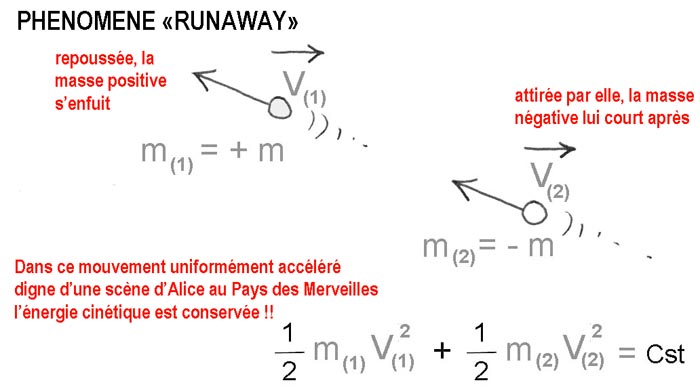
Unbearable...
This analysis by Bondi had the effect of prohibiting the use of negative masses for fifty-seven years. There were indeed my articles from 1994 and 1995 (in Nuevo Cimento and Astrophysics and Space Science), but these passed completely unnoticed, remained without echo, and were not cited by anyone.
Let us set aside any discussion about the priority of such or such ideas (including that of the two sides of a universe with antiparallel time arrows) and, even if we have to reset the clock, let us focus on these September 2014 articles. How can we introduce negative masses into the cosmological model?
With the Einsteinian model, it is simply impossible. In the article published by Physical Review D, the authors... attempt to put two feet in one shoe. Their ambition remains modest and is limited to trying to describe the configuration of the universe in a very primitive stage, such as revealed by the COBE satellite, which reports only fluctuations of one ten-thousandth. Everyone knows the following image, which represents the "cosmic face" in its most primitive stage.
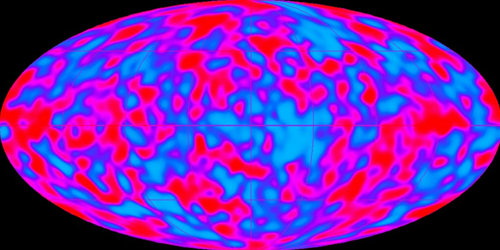
The primitive universe, with contrast accentuated by a factor of ten thousand
This image is misleading and shows many inhomogeneities. In fact, these are obtained, with "false colors," by multiplying the contrast by a factor of ten thousand. In reality, the primitive cosmos is extremely homogeneous, to within one ten-thousandth, and a more realistic portrait would be:
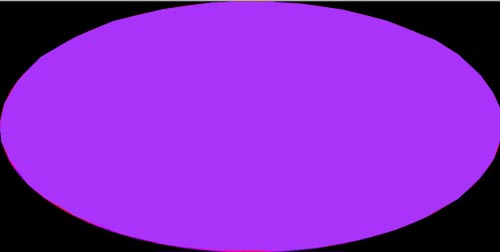
The primitive universe, without this artificial accentuation of density contrast.
This paper, published in November in Physical Review D, attempts to justify these weak inhomogeneities by considering that in this primitive cosmos, positive and negative mass elements could have coexisted, in the form of aggregates, bubbles ("bubbles") of a very modest relative value, since globally, the universe's mass would still remain positive.
Returning to this way of introducing negative-mass particles (and negative energy E = - m c²) into the cosmological model, we must consider that the universe does not obey a single field equation, Einstein's equation, but two coupled equations of the same type:
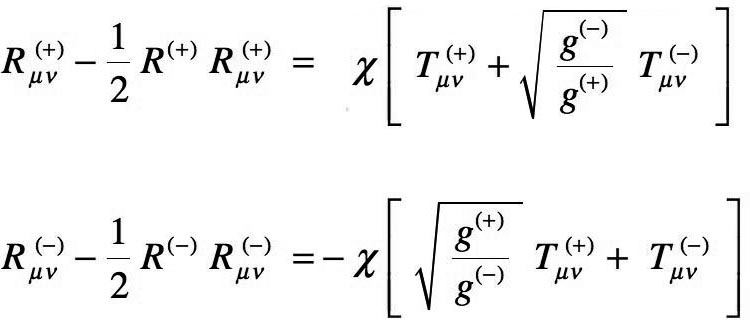
The equations of Petit
If I am right, and I believe I am right, cosmology (and astrophysics) for the "matter-dominated" phase will now have to be based on these two equations, not on Einstein's equation, which is merely an approximate form.
It is this pair of field equations that is presented in the two articles mentioned at the beginning of this page. When we introduce two systems of positive and negative masses into this pair of equations, the Newtonian approximation produces completely different laws of interaction:
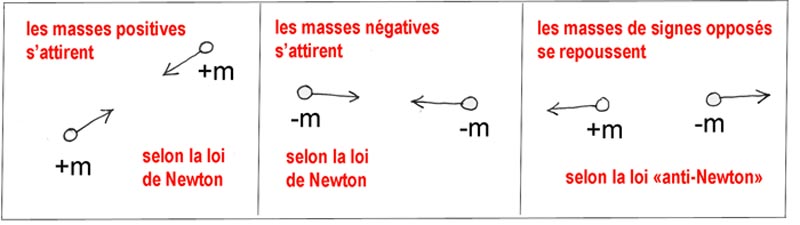
A completely different interaction scheme.
The "runaway" phenomenon is eliminated.
A different Newtonian-type interaction scheme represents a different astrophysics, which I have been developing laboriously for nineteen years. Incidentally, for specialists, this system of field equations derives from a Lagrangian derivation, currently under publication.
Thus, positive and negative masses repel each other. Therefore, where positive mass is dominant, near the solar system, negative mass exists in negligible amounts. The distribution of these two types of matter is governed by these two tensors:
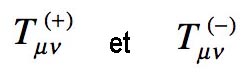
which appear in the right-hand sides of the system of the two equations. Near the solar system, the second tensor is almost zero. The system of Petit's equations reduces to:
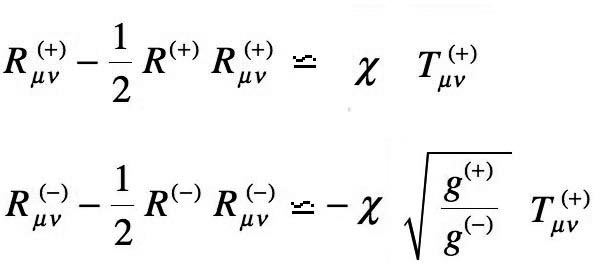
Near the solar system: at the top, the equation becomes Einstein's equation (with a zero cosmological constant)
Thus, the model aligns with all classical verifications of General Relativity.
Why propose a system of two equations replacing Einstein's equation? Because it allows explaining this phenomenon of cosmic acceleration, which Einstein's equation cannot do. And this phenomenon is far from minor. The cosmos is accelerating full throttle. To justify this phenomenon, we are forced to introduce a new component: 70% dark energy. A completely mysterious ingredient.
I remind you, according to the current "standard" view, the assumed composition of the cosmos:
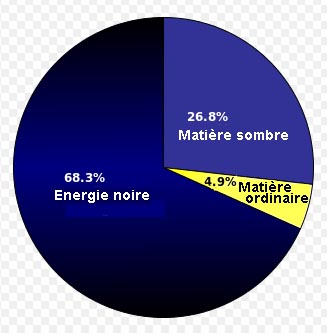
Current estimate of the composition of the "cosmic soup"
What about "dark matter," contributing 26.8%? Its nature remains a mystery. We are in "dark science." Deep in mines, researchers hunt for "astroparticles," supposed components of this dark matter, which we now admit is invisible. Among the most sought-after candidates, the neutralino.
I believe these hypothetical ingredients, dark matter and dark energy, can be effectively replaced by negative mass, which pleasantly fulfills both functions. Not only does it account for cosmic acceleration, but it produces, through the "inverse gravitational lensing effect" (described in my 1995 article in Astrophysics and Space Science), the strong gravitational lensing effects that visible matter cannot explain, whether in galaxies or galaxy clusters.
I believe that astroparticles... do not exist, and that those who hunt them in mines are wasting their time and money, just as those who once struggled to detect "MACHOs" (dark mini-stars) in our galactic neighbor, the Large Magellanic Cloud, did.
Thus, the dynamics of the cosmos are dominated by its content of negative mass. Generating negative pressure, it is what causes the acceleration of our "side of the universe," with positive mass. It is also this geometrically invisible negative matter that is responsible for the large-scale structure of the universe, with its lacunar structure (see my 1995 article). It ensures the confinement of galaxies and galaxy clusters. The "dynamic friction" between galaxies and their negative-mass environment (ex "twin matter") produces stable spiral structures, lasting for dozens of turns.
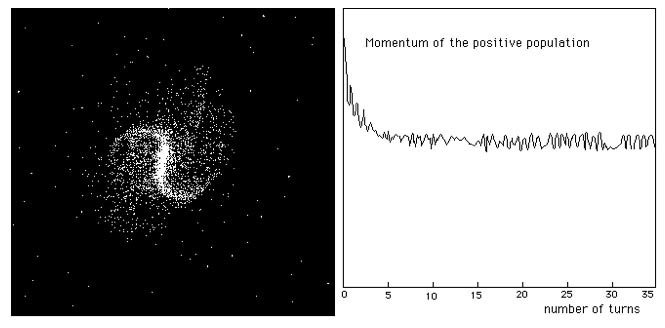
Barred spiral. Simulations from 1992. Work rejected by all journals:
- Sorry, we don't publish speculative works.....
But what is this "negative matter" composed of? The specialist will find the answer to this question, via the theory of Dynamic Groups (thanks to Jean-Marie Souriau), in section VII of the article published in September in Astrophysics and Space Science. In this negative matter, one finds "neg-electrons," "neg-protons," "neg-neutrons," etc., up to "neg-quarks," with negative energy.
The duality "matter-antimatter" also exists in this negative side of the universe. Negative-mass antimatter is the PT-symmetric counterpart of our matter. The antimatter we observe in cosmic rays and produce in our particle accelerators is the C-symmetric counterpart of our matter and possesses an intrinsically positive mass. Experiments designed to "weigh antimatter" are meaningless. Wasting time and money.
These negative masses emit and capture "neg-photons," photons