Report from the international conference COSMO-17
COSMO-17 Conference Report
Paris, France, 28 August – 1 September 2017
2 September 2017
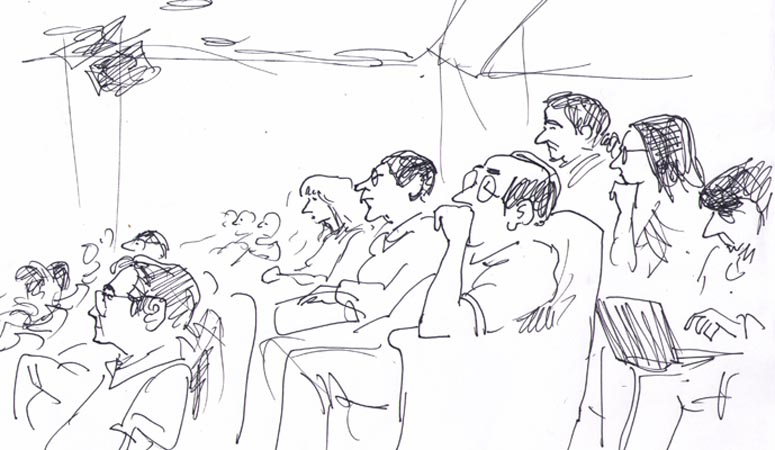
I have just returned from the 21st annual international conference on particle physics and cosmology (COSMO-17), held on the campus of Paris Diderot University in Paris, France, from 28 August to 1 September 2017. The event was organized by the Astroparticles and Cosmology Laboratory (APC). I suppose readers are wondering: “So, how was this conference?”
The reactions were the same as in Frankfurt. I’d even say it was worse.
First of all, internet users should understand what a real participation in an international conference is like when presenting a poster. It’s a reduced presentation. No comparison with oral presentations in a hall, which are the only ones where people can “react,” or simply wish to do so.
There were 193 participants from 24 countries, with a strong presence of Paris-based researchers. One room was completely packed, people were sitting on the steps. I will detail these presentations below. But it’s useful to describe what international symposia have become today, at least in this field. Speakers present their work for 30 to 40 minutes, illustrated by slides projected onto a large screen.
During these presentations, half of the participants—sometimes two out of three—had their laptop on their lap. What are they doing? When you glance at their screens, it has absolutely nothing to do with the presentation they are supposed to be listening to. Since everyone is connected to the internet, you can receive, read, and send emails and text messages during talks. I was sitting next to a young Russian woman working in Bonn, Germany, who spent the entire session staring at a Cyrillic text displayed on a small tablet, paying no attention whatsoever to the presentations. She didn’t hesitate to tell me she was reading… a novel!
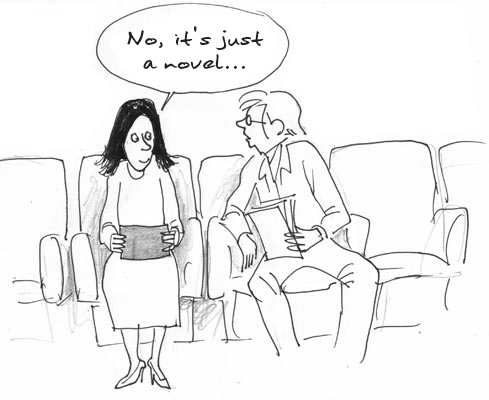
In many sessions, I would say less than half of the participants were listening. This phenomenon was identical. When the presentation ended, the chair warmly thanked the speaker, and the room was then flooded with applause. I saw the same thing in Frankfurt. But back then, during the rare times I attended an international conference, I had never seen this. You can clearly distinguish “normal” applause from what I witnessed. It’s almost a standing ovation. As if the audience wanted to apologize for their lack of attention, or validate the content, usually completely empty, especially when it comes to theoretical talks.
So why do these researchers attend such conferences? For the majority of delegates, it boils down to the opportunity to mention their participation in an international event in an activity report. The research barons can also meet, present the development of their powerful observation instruments, costing tens of millions of dollars. Yes, observation is also very much alive. Technical means allow collecting increasingly precise data and making authentic discoveries, such as the Great Repulsor in January 2017.
This lack of attention during talks may seem shocking. But in the theoretical field concerned, there is no unity. The specialist on the right hand doesn’t understand a thing said by the specialist on the left hand. It’s like an overdose of unilateral speeches.
At this international cosmology conference held in France, I didn’t find a single French specialist: not Thibaud Damour, not Françoise Combes, not Aurélien Barrau, not Alain Riazuelo, nor even Marc Lachièze-Rey, who is a member of the laboratory hosting the symposium, APC (Astroparticles and Cosmology Laboratory).
I counted the participants, in descending order:
Japanese: 32 (…)
Americans: 31
French: 27
British: 27
Koreans: 12
Germans: 10
Dutch: 9
Spanish: 8
Canadians: 8
Swiss: 6
Poles: 5
Chileans: 4
Mexicans: 4
Portuguese: 2
Estonians: 2
Brazilians: 2
Finns: 2
Italians: 2
Iranians: 2
Chinese: 1
Indians: 1
Swedes: 1
Israelis: 1
Emiratis: 1
Total: 192 participants from 24 countries! A major annual international event in cosmology.
By the way: not a single French journalist. If they mention it, it will be through second-hand accounts. I contacted four journalists from the magazine Ciel & Espace; none came.
I presented two posters on the scheduled day (Tuesday, 29 August 2017). But I couldn’t expect any reaction other than curiosity (at best) toward something immense: the idea of replacing Einstein’s equation with two coupled field equations. In the second poster, I presented my alternative to the stellar black hole model: the escaping neutron star, which evacuates excess mass accumulated from the stellar wind of a companion star. I will dedicate an entire video to this topic.
I’ll skip over discussions with young Canadian, Japanese, and other researchers… who showed vague curiosity, but unfortunately nothing more.
MONDAY.
I began attending a talk on dark energy, presented by Italian researcher Filippo Vernizzi from the Institute of Theoretical Physics (IPhT) at CEA-Saclay. You can easily find his professional background on Google Scholar. He embodies the archetype of the contemporary theoretical physicist: scalar fields, quintessence, quantum gravity, etc. In his talk on dark energy, he speaks of “ghosts,” “massive gravity,” “quintessence,” “k-essence,” and “scalar-tensor theory.” I discover the word “Symmetron” (…). He concludes: “Something is missing in our framework.” Certainly…
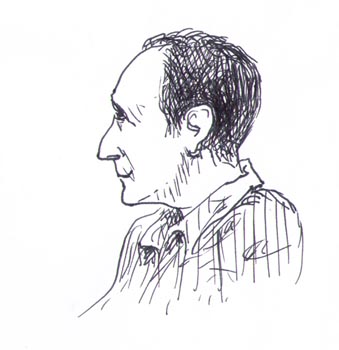
Filippo Vernizzi, dark energy theorist
Department of Astrophysics, CEA-Saclay
I’ll meet him during the coffee break. He faces me with evident displeasure. After briefly outlining my approach (but he’s clearly not listening), I continue by citing something that could impact his field, quantum mechanics:
“Currently, the accelerated expansion of the universe implies, in quantum field theory, states of negative energy. Do you agree? As you stated in your main presentation (before all participants, not in smaller afternoon sessions), this cosmic acceleration implies negative pressure. Therefore, states of negative energy.”
I continue despite his frown:
“A pressure is also energy per unit volume, i.e., an energy density.”
“Impossible!” he protests. “Pressure is force per unit area. It has nothing to do with energy. Even negative pressure implies positive energy.”
“I’m sorry, but that’s a mistake. If you want to approach this pressure issue as force per unit area, let’s go ahead. It’s a subject I master well, since I’ve done a lot of kinetic gas theory. Place a wall in a fluid medium. It experiences collisions with incoming particles. These particles then transfer part of their momentum to the wall, corresponding to the component of their velocity vector V perpendicular to it. Do you agree?”
“Yes…”
“Now, this momentum is mV. So if a fluid in contact with a wall has negative pressure, it doesn’t push the wall—it attracts it. Thus, if we speak of negative pressure, these collisions are due to particles with negative momentum. Since E = mc², the energy of these particles is also negative. Do you agree?”
“Yes, yes—don’t get upset. Okay, this energy is negative, you’re right. I’ll take it into account now.” (…)
“It’s not all. When you talk about instabilities caused by negative energy states, you think of energy emission by positive-energy photons. But particles with negative energy emit negative-energy photons. And this, quantum field theory does not address.”
“Yes… Very well—I’ll take it into account, I promise.”
Annoyed, he immediately turns around and walks away.
He clearly dismissed me, refusing any discussion. I couldn’t get anything more out of him. These people avoid all dialogue.
We return to the hall. Next presentation: Robert Brandenberger, McGill University, Quebec, Canada. Title of his talk: “Update on bouncing and emergent cosmologies.” These are trendy ideas. He presents himself as a “string theorist.” All the keywords are there: the “Big Bounce,” “quantum gravity,” “string gas” (…), “Hagedorn temperature” (beyond which hadrons can no longer exist—estimated at around 1030 K—some even claim this temperature is “unattainable”).
Brandenberger refers to inflation as the only theory capable of solving the horizon paradox. He concludes:
“There is no alternative to the inflation theory.”
At the end of his talk, during the question session, I speak up:
“As an alternative to inflation theory, what do you think of a model with a varying constant, which includes VSL, a variable speed of light, challenging this inflation theory? I published peer-reviewed articles on this topic as early as 1998, and even earlier in 1995, where I propose a joint variation of all physical constants as a gauge process—”
But Brandenberger immediately evades the question, pointing me toward a young Canadian researcher he identifies in the crowd, who has also worked in this direction:
“You’ll be better inspired talking to this researcher than with me.”
End of discussion. In reality, Brandenberger has very rigid ideas. Axions, string gas, quantum gravity… that’s serious. But a variable speed of light? What a crazy idea! Let the madmen argue among themselves.
Later, I exchange with this young Canadian, who is actually a pleasant person, who told me:
“I glanced at your poster and discussed it with colleagues. It seems interesting. But for the variable speed of light model, I haven’t done much, you know. Nothing related to your work in this field.”
Late morning: presentation by Eric Verlinde on “Emergent Gravity.” This is not a review of empirical methods for modifying gravity, as the Israeli Milgrom does with MOND, but a very complex theory that makes gravity an “emergent” property. I quote the key sentence:
“Using entanglement in the subspace of the code (…) we can reproduce the strange behavior of the duality region (…)”
TUESDAY.
I participate after the second presentation of the second day, discussing the various elements of consistency between the current dominant model (ΛCDM model) and observational data such as the CMB. Silvia Galli from the Paris Institute of Astrophysics (IAP) engages in this long investigation.
I raise my hand. I’m given the microphone:
“How do you view the compatibility between the ΛCDM model and the Great Repulsor?”
“… The… What?”
“The Great Repulsor, or Dipole Repulsor, presented in Nature in January 2017 by Hoffman, Courtois, Tully, and Pomarède, where they show a void region 600 light-years across, completely empty, pushing galaxies—including our own at 631 km/s.”
She has no memory of this and remains speechless. Then others in the hall confirm my statements. There’s a moment of great embarrassment when the IAP researcher finally says:
“I’m not aware of it.”
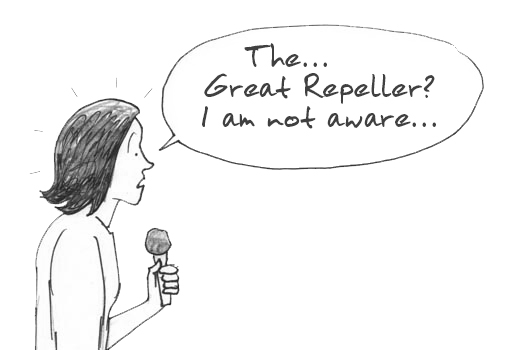
I hadn’t imagined creating such discomfort with this precise question. Let’s move on.
In a later presentation by Daniel Harlow, MIT, on black holes, quantum information, and the “holographic principle,” I try to spark interest in the foundations of the black hole model:
“I would like to emphasize that the black hole theory rests on a 1916 publication by Karl Schwarzschild. But who knows that Schwarzschild, at the beginning of 1916, just before his death in May, published not one, but two articles?”
Confusion in the hall. I continue:
“The content of this second article, translated into English only in 1999, is very important. Who knows that this second article exists?”
Silence… Then I ask:
“So, among the black hole specialists present here, who has read Schwarzschild’s first article, from January 1916?”
Deafening silence.
This confirms what I suspected. No black hole specialist has ever read Schwarzschild’s, Einstein’s, or Hilbert’s original articles. They’ve always worked, since the 1950s, on commentaries after commentaries. I don’t press further.
WEDNESDAY.
Third day. Hendrik Hildebrandt, head of the Emmy Noether research group at the Institute of Astronomy AIfA, University of Bonn, presents techniques of weak lensing, which distort galaxy images. Everything is oriented toward the reliability of conclusions drawn from this analysis, in relation to “bias,” i.e., possible errors due to assumptions made in data processing.
Thus, Hildebrandt’s interest lies in the reliability of these analyses.
I speak up:
“In this type of observational data processing, there is a fundamental assumption: that this effect is due to positive-mass dark matter. A few years ago, a group of Japanese researchers published an article in Physical Review D, referring to the fact that if positive mass generates azimuthal distortion, negative mass would produce radial distortion.”
The document I refer to is:
Izumi, K. et al. (2013). « Gravitational lensing shear by an exotic lens object with negative convergence or negative mass ». Physical Review D. 88 : 024049. doi : 10.1103/PhysRevD.88.024049. arXiv:1305.5037.
I continue:
“Have you considered analyzing your data—concerning a million galaxies—by attributing the distortions not to positive mass, but to negative mass? I think this would require only a small change in your data processing program.”
“We already find radial distortions,” replies Hildebrandt, “when there’s a void in dark matter. Such a void acts as if it had negative mass there.”
“Of course, but here I’m talking about real concentrations of negative mass, similar to those I believe create the Great Repulsor effect.”
Obviously, my remark confuses him. He hasn’t really grasped the extent of my proposal and must be wondering, “Who is this guy? Where does he work? I’ve never seen him, I don’t know him…”
I don’t press further.
It’s very difficult to disturb people like this. After his presentation, Hildebrandt engaged in a long conversation with other colleagues, probably involved in similar studies. Me? I’m… completely exotic in this game. Negative masses? What an idea!
In another presentation by a researcher from the local French laboratory, APC (Astroparticles and Cosmology Laboratory) at Paris Diderot University, Chiara Caprini discusses results from numerical simulations, where “we hope to learn more about dark matter physics.” She adds:
“Regarding galaxies, they remain very mysterious objects.”
At that moment, I think of the work I initiated in 1972 and am currently finalizing on galactic dynamics (yes, I’ve resumed this work 45 years later). A work based on a joint resolution of the Vlasov equation and the Poisson equation.
She gives a fairly exhaustive presentation.
I ask for the microphone again and say:
“Since Monday, people in the hall have understood that I don’t believe in the existence of dark matter in the form of positive-mass particles, which have never been observed—neither in tunnels, mines, aboard the International Space Station, nor at the LHC. Personally, I think these astroparticles will never be detected, because these invisible elements aren’t where you’re looking. I believe that invisible negative mass is located at the center
I will show that it’s exactly the opposite. There has been a misinterpretation of Schwarzschild’s solution by the great mathematician David Hilbert. And everyone followed. The first to notice this was an American, Leonard Abrams, who published an article in the Canadian Journal of Physics:
Abrams, L. S. (1989). "Black Holes: The Legacy of Hilbert's Error". Canadian Journal of Physics 67 (9) : 919–926. doi:10.1139/p89-158. arXiv:gr-qc/0102055.
A work completely ignored (Abrams died in 2001). The Italian physicist Salvatore Antoci picked up this work:
Antoci, S. ; Liebscher, D.-E. (2001). "Reconsidering Schwarzschild’s original solution". Astronomische Nachrichten. 322 (2) : 137–142. arXiv:gr-qc/0102084.
Antoci, S. (2003). "David Hilbert and the origin of the Schwarzschild solution". Meteorological and Geophysical Fluid Dynamics. Bremen: Wilfried Schröder, Science Edition. arXiv:physics/0310104.
I tried to contact him, unfortunately he didn’t reply.
I believe he understood it wasn’t wise to challenge the cult object of current cosmology.
I will show (and you’ll understand my explanations) that the black hole rests on a topological error that has lasted for a century. In Frankfurt, I would have liked to ask all participants if they had read Schwarzschild’s articles, especially Maldacena. I bet I’d have gotten the same negative response as during my oral presentation on Tuesday.
It’s frightening. None of the specialists who make black holes their daily bread have ever read the two foundational articles published in January and February 1916 by Karl Schwarzschild, a century ago. It’s true that his first article (the “external” solution) was only translated into English in 1975. For 59 years, those who don’t read German had to rely on “commentaries after commentaries,” and errors spread, on which practically no one has returned. As for Schwarzschild’s second article (the “internal” solution), published in February 1916, three months before his death, it was only translated by Antoci in… December 1999!
How does the community perceive me?
The first answer is very simple: “It doesn’t perceive me at all.” No one pays attention to someone who gets only a poster presentation, especially one introducing negative mass into cosmology!
As for those who attended my repeated “outbursts” in the amphitheater: what did they think? I suppose they didn’t understand a single word I said. Negative mass between galaxies? Never heard of that…
No one approached to learn more. By questioning the existence of black holes, or even dark matter, and suggesting alternative research paths, I was probably perceived as “a retired researcher, a bit rusty, outside the main currents of current cosmology,” as Alain Riazuelo from the Paris Institute of Astrophysics (IAP), a major designer of black hole CGI, wrote to me.
The general public has a completely false idea of the scientific community. They imagine scientists as attentive scholars open to new ideas, ready for debate. Yet most behave like religious followers. In recent years, new currents have emerged that rest on no observational basis. The most spectacular is “quantum gravity.” You may know that gravity has not yet been quantized. Every attempt to create a graviton hits insurmountable divergence problems. But it gives the impression that, by speaking of “quantum gravity,” by repeating these words like a mantra, the thing will eventually exist.
Just think about how the black hole is announced, how it is literally “sold” to you. For thirty years, you’ve been served the same phrase, endlessly repeated by the media under the influence of this community (they sell what they’re given):
“Although there is no observational confirmation of the existence of black holes, no scientist doubts it today.”
Does such a sentence deserve to be called scientific? Will you continue to swallow this without reacting? While we base everything on a single case—the binary system Cygnus X-1, detected in 1964, where the X-ray-emitting companion is credited with a mass of eight to fifteen solar masses (thus exceeding the critical mass of 2.5 solar masses). For fifty years, for half a century, this has been the only case of a “stellar black hole.” Distance: 6,000 light-years. There is therefore an obvious uncertainty in measuring the distance and in the resulting mass estimate of the two objects orbiting a common center of gravity.
Il y a deux cents milliards d’étoiles dans notre galaxie. La moitié sont des systèmes multiples, généralement binaires. Il y aurait entre dix et cent millions de « trous noirs » dans notre galaxie, des objets évidemment plus proches de nous que Cygnus X-1. Et nous ne les avons pas observés pendant 50 ans, alors que nos moyens d’observation s’améliorent chaque année !
Au centre des galaxies : « trous noirs géants ». Dans le nôtre, un objet dont la masse équivaut à quatre millions de masses solaires. Immédiatement « c’est un trou noir supermassif ». Mais cet objet ne se comporte pas comme un trou noir. Le gaz autour n’émet pas de rayons X. En 1988, le satellite Chandra est mis en orbite, capable de détecter une telle radiation. Il est pointé vers le centre de la Voie lactée : rien.
« C’est un trou noir plein » nous avons même entendu !
En 2011, un flux de gaz interstellaire s’approche. Des simulations sont mises en place pour montrer ce qui va se passer : la masse gazeuse va se déformer et être aspirée.
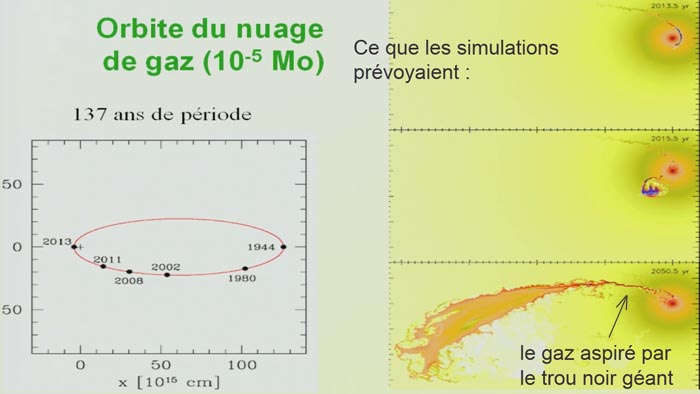
Été 2013 : la matière passe à proximité et… rien. À ce propos, voir la conférence de Françoise Combes sur les trous noirs géants à 12:33 ici (en français).
Serait-ce… un trou noir anorexique ?
Vous avez entendu parler des quasars. Là encore, c’est un trou noir qui… etc. Le modèle ? Dans la même vidéo : quand le trou noir a assez mangé, il « crache »… Le mécanisme de ce hoquet cosmique ? Inconnu, non décrit.
C’est insensé ! C’est l’astrophysique et la cosmologie aujourd’hui. Des mots, de la vantardise, des théories qui ne sont pas. Des arguments d’autorité, des visions mythiques et des images générées par ordinateur. Certains ajoutent même une grande envolée lyrique d’ambition poétique. Confrontation avec l’observation ? Pourquoi, est-ce si important ? Avançons, comme avec cette sottise du multivers !
VENDREDI.
Je me suis assis au premier rang. Cette fois, le président m’avertit du programme serré et qu’il ne permettra pas de longues questions. Un discours dissuasif.
Un Coréen fait une présentation sur les différents candidats à la matière noire. Toute la gamme de la poussière de fée est passée en revue.
À la fin de la présentation, je lève la main. Mais le président, qui est à deux mètres de moi, tourne la tête, feignant de ne pas me voir, et s’enfuit dans le couloir pour chercher d’autres questionneurs dans la salle. Au premier rang, je reste le bras complètement levé.
Une stratégie bien connue. Deux ou trois orateurs sont sélectionnés et reçoivent la parole, après quoi le président revient vers le perturbateur potentiel en disant :
« Je suis désolé, mais nous avons maintenant épuisé le temps. »
Mais il ne trouve qu’une seule personne qui veut parler. Il revient alors vers moi et pour couper court à toute remarque que je pourrais lui faire :
« Je veux poser une question. Une seule. »
Tous les participants ont entendu. Il me donne à contrecœur le micro.
Alors je demande :
« Dans ce contexte du comportement des candidats à la matière noire, comment considérez-vous l’effet du Grand Répulsor ? »
Le Coréen me fixe avec de grands yeux ronds. Il semble abasourdi. En tant qu’Asiatique, il est « en perte de face ». Je persiste :
« Vous savez, le Grand Répulsor, tel qu’il a été montré en janvier dernier par Hoffman, Courtois, Pomarède et Tully. Un vide à 600 millions d’années-lumière, où il n’y a rien, et qui pourtant repousse les galaxies. »
Voilà encore une fois. Le Coréen n’est pas au courant. Je ne persiste pas…
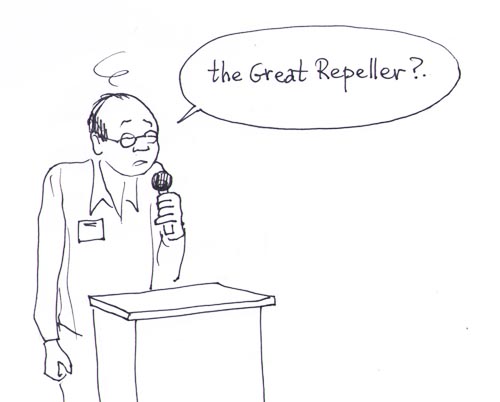
À chaque fois que j’ai parlé, j’ai essayé de garder un ton posé, pour ne pas paraître un fou énergique. Un exercice difficile dans un tel contexte. Je me suis forcé à le faire. J’étais présent à cette conférence grâce à l’aide financière des internautes. Je devais donc montrer jusqu’où les choses étaient allées.
Ma femme m’a dit :
« En créant de telles situations embarrassantes, ce que tu risques, c’est de voir les portes des conférences internationales dans ce domaine se fermer devant toi. »
Très possible. À l’avenir, cela se produira de la même manière, évidemment. Pourtant, je n’ai jamais été agressif, ni insultant. Mais toutes mes interventions ont touché un nerf. Je pense que ce qui était le plus effrayant, c’était le théoricien italien, spécialiste de l’énergie noire, qui m’a dit que la pression négative n’allait pas de pair avec une densité d’énergie négative. Comment pouvait-il dire une telle bêtise ? Là, je me suis fait un ennemi mortel, un de plus.
Heureusement, la suite de la vidéo, sous-titrée en anglais, aura éventuellement un impact international et suscitera l’intérêt de certains scientifiques. Pas nécessairement positif, d’ailleurs. Pensez à cette remarque de ce jeune chercheur italien à Francfort, qui m’a dit :
« J’ai vu vos articles sur votre modèle cosmologique Janus. Je regarde comment vous êtes accueilli ici. Comment pouvez-vous espérer que ces gens fassent autre chose que vous tourner le dos ? Ce que vous proposez, c’est de détruire la base même de leur travail ! »
La première barrière est le scepticisme. Quelques étincelles de curiosité se sont allumées chez les jeunes, mais rien de plus. Pendant le dîner, jeudi soir, quand j’ai essayé de parler à un jeune chercheur américain à ma droite à table, il m’a évidemment considéré comme un fou, même quand j’ai cité mes articles révisés par les pairs de 2014 et 2015. Il était aussi buté que les autres. Qu’est-ce que ces « jeunes chercheurs » cherchent ? Un sujet de thèse passionnant ? Non. Ils cherchent une perspective de poste au sein d’un groupe de chercheurs du même type, où ils pourront facilement co-publier. Ou un contrat bien payé sous la direction d’un patron puissant.
Croire que les jeunes chercheurs s’intéresseront à ces idées nouvelles est une illusion, je pense. Ils ont tout à perdre, comme leurs chefs.
Un lecteur m’a parlé de cette jeune femme de 24 ans, Sabrina Pasterski, présentée comme la future Einstein.
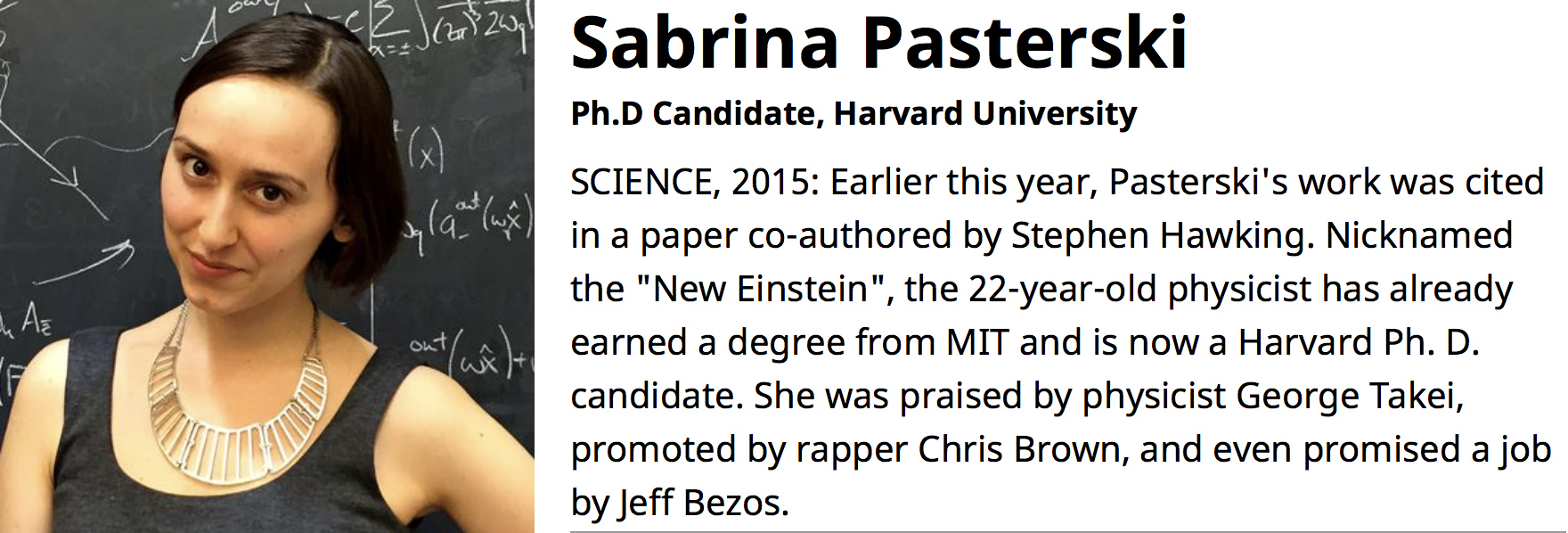
Profil de Sabrina Pasterski sur Forbes
Il est vrai que son parcours est surprenant. Voir la vidéo où elle est montrée construisant un avion léger, âgée de 13-14 ans, qu’elle volera seule à 16 ans. Intégrée au MIT, elle a immédiatement montré de grandes dispositions pour la physique théorique, puis a rejoint l’équipe de recherche d'Andrew Strominger.
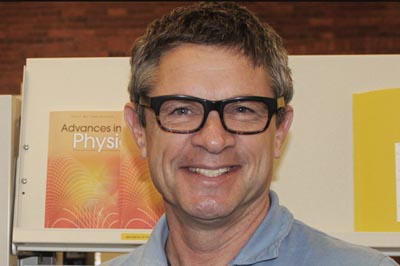
Andrew Strominger
Âgé de 61 ans (et donc relativement jeune), il a reçu de nombreuses récompenses pour ses contributions à la théorie des cordes.
Sa jeune disciple a un site web : physicsgirl.com qui indique qu’elle a déjà été invitée partout, que la presse parle d’elle, partout dans le monde.
On me dit : « Peut-être que cette fille… ? »
J’ai aussi l’adresse e-mail de cette jeune « génie ». Je vais lui écrire aussi.
Je vais écrire à Strominger pour lui demander de venir me rencontrer et présenter mes idées et mes travaux. L’aide financière des internautes me permettrait de mener à bien une telle mission. Mais répondra-t-il ?
En tout cas, aujourd’hui, j’envoie des messages à deux laboratoires, aux responsables des séminaires :
– du laboratoire Astroparticules et Cosmologie (APC) de l’Université Paris Diderot, où sont attachés George Smoot et Marc Lachièze-Rey.
– du Laboratoire d’Astrophysique de l’CEA-Saclay, où travaille le physicien théoricien Filippo Fabrizzi.
en demandant à pouvoir présenter mes travaux là-bas.
Je parie que, encore une fois, personne ne me répondra. Et ensuite, je mentionnerai ces comportements dans les vidéos Janus, qui resteront en ligne sans limite de temps, avec les noms des personnes concernées. Car une telle évitement systématique est anormal.
C’est un signe que cette partie de la science empire de plus en plus.
Compte rendu de la conférence précédente (KSM 2017)Le modèle cosmologique Janus sur YouTube
Version originale (anglais)
Report of the COSMO-17 international conference
Report of the COSMO-17 conference
Paris, France, August 28–September 1, 2017
September 2, 2017

I've just come back from the 21st annual International Conference on Particle Physics and Cosmology (COSMO-17) held at the Paris Diderot University campus in Paris, France, August 28–September 1, 2017. The meeting was hosted by the Astroparticle and Cosmology Laboratory (APC). I imagine readers are asking: "So then, how did it go?"
*Reactions were the same as in Frankfurt. I would even dare to say: it was worse. *
First of all, Internet users need to know what is really a participation to an international conference when presenting a poster. This is a rump presentation. No comparison to oral presentations, in a room, which are the only ones where people can "react", or simply wish to react.
There were 193 attendees from 24 countries, with a lot of Parisian researchers. An auditorium was packed to standing room only, so people sat on the stairs. I will detail these interventions below. But it is worth describing what international symposia became, at least in this specialty today. Speakers present their work, during 30 to 40 minutes, illustrated with slides on a big screen.
In the rooms during these presentations, half of attendees – sometimes two out of three – have their laptop on their lap. What are they doing? When you take a look at their screen, it has nothing to do with the presentation they are supposed to listen to. As everyone is connected to the Internet, one can receive, read and send emails and text messages during the presentations. I was personally seated next to a young Russian woman who works in Bonn, Germany, who spent all these sessions with her eyes on a Cyrillic text displayed on a small tablet, without paying any attention to the talks. She did not hesitate at all to tell me that she was reading… a novel!

In many sessions I would say that less than half of attendees do listen. By the way it was the same . When the presentation ends, the chairman thanks the speaker very much, and the room is then overwhelmed with applause. I witnessed the same phenomenon in Frankfurt. But back in the day, the few times I've been able to attend an international conference, I've never seen this. One can very well distinguish between "normal" applause and what I saw. It is almost a standing ovation. As if the audience wishes to apologize for its lack of attention, or to validate the content, which is usually completely empty, when it comes to theoretical lectures.
So what? Why do these researchers attend such conferences? For the most part of delegates, it can be summed up as the possibility to mention their participation to an international event in an activity report. The barons of research can also meet, present the development of their powerful observational instruments, to the tune of tens millions of dollars. Yes, observation is as fit as a fiddle. Technical means make it possible to collect more and more precise data, to make authentic discoveries, like that of the Great Repeller in January 2017.
This lack of attention, during the presentations, may seem staggering. But in the theoretical field concerned, there is no unity. The specialist of the right hand does not hear anything to what the specialist of the left hand has to say. This is like an overdose of one-way talks.
At this international conference on cosmology held in France, I didn't find any of the French specialists: neither Thibaud Damour, ni Françoise Combes, ni Aurélien Barrau, ni Alain Riazuelo, not even Marc Lachièze-Rey, who is a member of the laboratory hosting the symposium, the APC (Astroparticle and Cosmology Laboratory).
I made the count of participants, in descending order:
Japanese: 32 (…)
American: 31
French: 27
English: 27
Korean: 12
German: 10
Dutch: 9
Spanish: 8
Canadian: 8
Swiss: 6
Polish: 5
Chilean: 4
Mexican: 4
Portugese: 2
Estonian: 2
Brazilian: 2
Finnish: 2
Italian: 2
Iranian: 2
Chinese: 1
Indian: 1
Swedish: 1
Israeli: 1
Emirati: 1
Total: 192 attendees, from 24 countries! A major annual international milestone in cosmology.
By the way: not even one French journalist. If they echo this event, it will be according to second-hand testimonies. I called upon four journalists from the Ciel & Espace magazine; none came.
I presented two posters on the scheduled day (Tuesday, 29 August 2017). But I should not expect any reaction other than curiosity (at best) with respect to something as enormous: to consider replacing Einstein's equation with two coupled field equations. In the second poster, I presented my alternative to the stellar black hole model: the leaking neutron star, which evacuates any mass in excess that would be accreted from the stellar wind of a companion star. I will dedicate an entire video to this subject.
I pass on discussions with young Canadian, Japanese, and other researchers… who showed a vague curiosity, but alas nothing more.
MONDAY.
I started attending a lecture devoted to dark energy, presented by Italian researcher Flippo Vernizzi, from the Theoretical Physics Institute (IPhT) of CEA-Saclay. You can easily find his professional track record on Google Scholar. He is the archetype of today's theoretical physicist: scalar fields, quintessence, quantum gravity, etc. In his presentation on dark energy, he speaks of "ghosts", "massive gravity", "quintessence", "k-essencce", "scalar-tensor theory". I discover the word "Symmetron" (…). He concludes: "Something is missing in our schema". Certainly.....

*Filippo Vernizzi, dark energy theorist
Astrophysics departement at CEA-Saclay *
I go to meet him at the coffee break. He faces me with evident displeasure. After having evoked the main lines of my approach (but he obviously does not listen) I go on to quote what may have an impact on his field, quantum mechanics:
"Currently, the accelerating expansion of the universe implies to assume, in quantum field theory, negative energy states. Do you agree? As you said in your main presentation (in the face of all attendees, not to little groups in smaller rooms during the afternoon), this cosmic acceleration implies a negative pressure. Hence negative energy states."
I continue despite his pout of annoyance:
"A pressure is also an energy per unit volume, i.e. an energy density."
"No way!" He protests. "A pressure is a force per unit area. That has nothing to do with energy. Even a negative pressure implies a positive energy."
"I am sorry but this is a mistake. If you want to address this issue of pressure as a force per unit area, let's go. This is a subject I know very well since I did a lot of kinetic theory of gases. Place a wall in a fluid medium. It undergoes collisions from incident particles. These will then transfer some of their momentum to the wall, corresponding to the component of their velocity vector V perpendicular to it. Do you agree?"
"Yes…"
"Yet this momentum is mV. Therefore if a fluid in contact with a wall has a negative pressure, it does not repel the wall, it attracts it. So if we are talking about a negative pressure, such collisions are due to particles with a negative momentum. Since E = mc² the energy of these particles is also negative. Do you agree?"
"Yes, yes — Don't get upset. OK this energy is negative, you're right. I will now take it into account." (…)
"That is not all. When you talk about instability issues due to negative energy states, you think of an emission of energy using positive energy photons. But negative energy particles emit negative energy photons. And that, the quantum field theory does not handle it."
"Yes… Fine — I will take this into account, I promise."
Annoyed, he immediately turns on his heel and walks straight away.
He obviously played me for a fool, refusing any discussion. I could not get anymore. These people are fleeing from any dialogue.
We return to the auditorium. Next presentation: Robert Brandenberger, McGill University, QC, Canada. Title of his communication: "Update on Bouncing and Emergent Cosmologies". These are the trending ideas. He presents himself as "a string theorist". Every buzzing word happens there: the "Big Bounce", "quantum gravity", the "string gas" (…), the "Hagedorn temperature" (beyond which hadrons can no longer exist – estimated at about 1030 K – one even read that some think such temperature would be "unsurpassable").
Brandenberger refers to inflation as the only theory able to solve the horizon paradox. He concludes:
"There is no alternative to inflation theory."
At the end of his presentation during Q&A, I take the floor:
"As an alternative to inflation theory, what do you think of a variable constant model, which in particular implies VSL, a variable speed of light, which challenges this inflation theory? I published peer-reviewed papers on this subject as from 1998 then 1995, where I propose a joint variation of all physical constants as a gauge process —"
But Brandenberger immediately dodges the issue, redirecting me toward a young Canadian researcher he points to in the crowd, who also would have worked in this direction:
"You'll be better off speaking with this researcher than with me."
End of discussion. Actually Brandenberger has very fixed ideas. Axions, string gas, quantum gravity… that's serious. But a varying speed of light: what an idea! Let the wacky guys discuss among themselves.
I will have an exchange afterward with this young Canadian, who is a kind person by the way, who said to me:
"I had a look at your poster and I talked with colleagues. It seems interesting. But as for that light velocity model, I did not do much, you know. Nothing to do with your work in this area."
Late morning: Eric Verlinde's presentation on "Emergent Gravity". This is not a review of the empirical ways of modifying gravity, as the Israeli Milgrom does with MOND, but of a very complex theory that makes gravitation an "emerging" property. I quote the key phrase:
"By using entanglement in the code subspace (…) we can reproduce the puzzling behavior of the region of duality (…)"
TUESDAY.
I take part after the second presentation of the second day, situating the different elements of concordance between the current dominant model (ΛCDM model) and observational data like the CMB. Silvia Galli, of the Paris Astrophysics Institute (IAP), is engaged in this long survey.
I raise my hand. Someone give me the mic:
"How do you consider the compatibility between the Lambda-CDM model and the Great Repeller?"
"…
Dans une autre présentation d’un chercheur du laboratoire français local, l’APC (Astroparticules et Cosmologie) de l’Université Paris Diderot, Chiara Caprini expose les résultats des simulations numériques à travers lesquelles « nous espérons en apprendre davantage sur la physique de la matière noire ». Elle ajoute :
« Concernant les galaxies, ce sont encore des objets très mystérieux. »
À cet instant, je pense à l’œuvre que j’ai initiée en 1972 et que je suis en train de finaliser actuellement sur la dynamique galactique (oui, j’ai repris ce travail 45 ans plus tard). Un travail fondé sur une résolution conjointe de l’équation de Vlasov et de l’équation de Poisson.
Elle livre une conférence assez exhaustive.
Je redemande le micro et déclare :
« Depuis lundi, les personnes présentes dans l’audience ont compris que je ne crois pas à l’existence de particules de matière noire à masse positive, que personne n’observe, que ce soit dans les tunnels, les mines ou à bord de la Station spatiale internationale ou encore au LHC. Personnellement, je pense que ces astroparticules ne seront jamais détectées, car ces éléments invisibles ne se trouvent pas là où vous les cherchez. Je pense que la masse négative, invisible, se situe au cœur des grands vides cosmiques et entre les galaxies, où elle assure leur confinement et favorise immédiatement leur formation à la fin de l’ère dominée par le rayonnement. C’est également cette masse négative environnante qui produit leur structure en spirale, par friction dynamique. Je pense que si vous introduisez dans vos simulations d’autres données, avec une masse négative de forte densité, auto-attractante gravitationnellement, mais qui interagit avec la masse positive selon une répulsion mutuelle, vous découvrirez de nombreuses choses intéressantes. Par exemple, la structure à grande échelle, telle que décrite par l’Israélien Tsvi Pirán, qui prend la forme de bulles de savon adjacentes. »
Ces phrases provoquent immédiatement une stupéfaction, entraînant un silence général. Ils doivent penser : « Ce type énerve vraiment tout le monde avec ses masses négatives ! » Le présentateur est troublé, ne sait plus à qui s’adresser ni que dire. Je ferais une comparaison avec une intervention lors d’un service religieux. Imaginez-vous, dans un pays occidental, à l’intérieur d’une église, prenant la parole et disant soudain au prêtre et aux fidèles :
« Comment savez-vous que la base de votre croyance est une réalité, que l’histoire dont vous parlez comme de faits s’est effectivement déroulée ? »
La stupéfaction serait comparable. Nous ne sommes plus dans une réunion scientifique où les idées sont débattues, mais, dans le cas des parties purement théoriques, dans une série de services religieux, une mise en scène de croyances dénuées de la moindre base observationnelle.
La jeune femme continue et parle de la façon dont les simulations montrent l’influence des trous noirs supermassifs sur la dynamique galactique.
Je lève de nouveau la main :
« Vous parlez de trous noirs géants. Mais quelles preuves avez-vous qu’ils sont effectivement des trous noirs ? »
« Euh… On s’appuie sur l’augmentation des vitesses des étoiles près du centre galactique. »
« Bien sûr, et leur mouvement implique la présence d’un objet de très grande masse à cet endroit. Mais si vous placez, dans une sphère de rayon égal à celui de l’orbite terrestre, un gaz dont la densité moyenne serait celle de l’eau – ce qui correspond à la densité moyenne à l’intérieur de l’orbite du Soleil – alors vous obtenez vos quatre millions de masses solaires. Quant au trou noir supposé, où est la signature spectrale confirmant sa présence ? Vous savez que, lors du lancement du satellite Chandra il y a 17 ans, nous nous attendions à recevoir un puissant éclair de rayons X. Mais nous n’avons rien obtenu. Vous savez également qu’en 2013, un nuage de gaz interstellaire est passé à proximité et que son comportement n’était en rien celui qu’il aurait dû avoir s’il était passé près d’un trou noir. L’observation contredit complètement les prédictions issues des simulations. »
De tels commentaires devraient déclencher un débat parmi les scientifiques présents sur place. Mais non, rien. On pourrait croire que la Science est morte. Il ne reste qu’un regard brillant dans les yeux de quelques jeunes qui entendent soudain une parole différente. Mais pour la plupart d’entre eux, et pour leurs supérieurs, je ne suis qu’un Charlie qui perturbe le bon déroulement du symposium.
Ainsi, je pense que je dois essayer d’attirer l’attention des « grandes têtes » et, pendant la pause-café, je décide d’aborder George Smoot, qui travaille actuellement au laboratoire Astroparticules et Cosmologie (APC) de l’Université Paris Diderot.
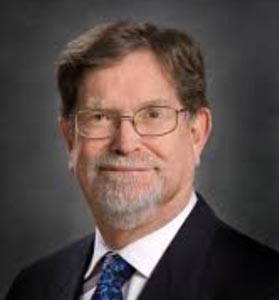
George Smoot, prix Nobel de physique 2006
Celui-ci a reçu le prix Nobel pour avoir démontré que le rayonnement du fond cosmique micro-onde (CMB) correspond à un rayonnement de corps noir. Je me tiens à ses côtés alors qu’il monte les escaliers.
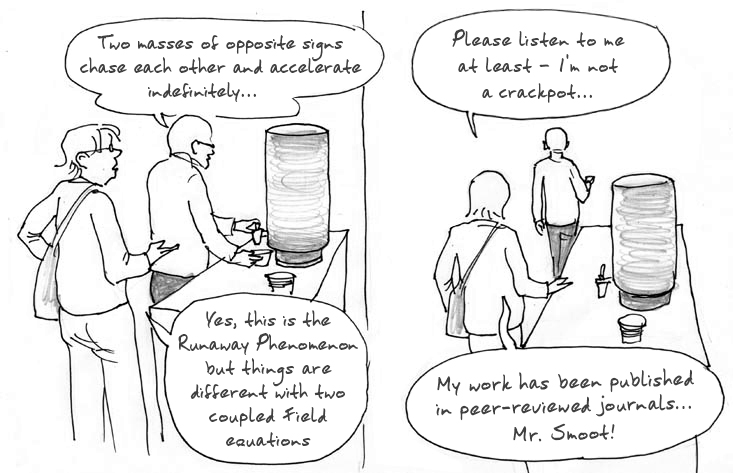
« Monsieur Smoot, je souhaiterais présenter mon travail lors d’un séminaire dans votre laboratoire. »
« Ce sera difficile, car je vais bientôt partir pour Hong Kong. »
« Il n’y a pas d’urgence. Nous pourrions fixer une date. »
Il accélère le pas, agacé.
« Vous avez peut-être aperçu mon affiche. J’ai développé un modèle où l’univers est peuplé de masses positives et de masses négatives. »
« Lorsque de telles masses opposées se rencontrent, elles s’entre-chassent et l’énergie cinétique de la masse positive augmente indéfiniment… »
« Oui, c’est l’effet de course à l’énergie, démontré par Bondi en 1957. Mais justement, dans mon modèle, cet effet disparaît. Les lois d’interaction qui découlent de l’approximation newtonienne à partir de deux équations de champ couplées font que les masses négatives deviennent auto-attractantes et que les masses de signes opposés se repoussent mutuellement selon une loi anti-newtonienne. »
Smoot se sert une tasse de café, manifestement sans accorder la moindre attention à mon propos. Il ne me jette aucun regard, ne tourne même pas la tête vers moi. Je n’ai jamais vu une telle grossièreté de ma vie. Je termine par dire :
« Vous me traitez comme un illuminé. Mais je suis un scientifique sérieux. J’ai publié mon travail dans des revues à comité de lecture — »
Je n’ai pas fini ma phrase que Smoot lui-même s’est déjà tourné le dos et s’éloigne. Complètement sidéré par ce comportement de la part d’un prix Nobel.
Peut-être a-t-il été averti à mon sujet par ses collègues français, qui ne me permettent pas de présenter mon travail dans l’un quelconque de leurs laboratoires et ne répondent même pas à mes courriels.
JEUDI.
Quatrième jour. Je décide de me reposer. Il fait très chaud à Paris. 31 °C (88 °F) en fin de journée, et je peine à dormir. Ces « interventions hostiles » sont très éprouvantes. Quoi qu’il en soit, les présentations de la journée portent sur la détection des ondes gravitationnelles, un sujet que je n’ai pas encore abordé. Je me rends tout de même à l’événement du soir au restaurant Le Train Bleu, près de la gare de Lyon, où a lieu le dîner traditionnel rassemblant tous les participants.
Au passage : un repas de 90 euros absolument scandaleux. Un serveur verse une goutte de vin rouge. Il y en avait si peu qu’on aurait cru qu’il s’agissait d’une dégustation. La planche de fromages : risible, avec des tranches de 2 mm d’épaisseur. Le pain, semi-rassis, visiblement congelé. Les amuse-bouches et les desserts provenant directement d’un supermarché. Il ne reste que la décoration, les peintures du plafond. Le menu de ce restaurant Le Train Bleu, gare de Lyon : on aurait mangé mieux dans un snack !
Je ne retrouve pas les quelques jeunes avec lesquels j’ai discuté les jours précédents, je m’installe donc au hasard à une table. J’essaie d’engager un peu la conversation avec mon voisin de droite, un jeune Américain. Il n’est pas chercheur mais simplement étudiant. Je me retrouve alors confronté à un conservatisme très simpliste, typiquement américain. Ce garçon est déjà bien « formaté », très sûr de lui, totalement hermétique à toute idée qui s’écarte de ce qui lui a été inculqué durant ses études. Notre échange est bref.
Mon voisin de gauche est le directeur d’un laboratoire de haute énergie. J’évoque l’échec de la recherche de superparticules. Mais rien ne fait vaciller sa conviction qu’il faut poursuivre tous les projets en cours : « On finira bien par trouver quelque chose », dit-il. Il en va de même pour le travail de la Italienne Elena Aprile, qui, dans son tunnel sous le mont Gran Sasso, recherche le neutralino dans une tonne de xénon liquide (et ne découvre… rien !).
À un moment, il sort, moqueur :
« Dis donc, si personne n’a prêté attention à votre théorie, c’est peut-être parce qu’elle ne tient pas debout ? »
On peut être certain que celui-ci ne lira jamais mes articles.
À Francfort, j’avais péché par timidité. Il n’est pas aisé de s’exprimer devant deux cents personnes, en défendant des idées diamétralement opposées aux leurs. Des idées qui, pire encore si elles étaient confirmées, feraient effondrer tout leur propre travail.
Francfort est la ville natale de Schwarzschild. La conférence s’appelait la « Karl Schwarzschild Meeting » et les « jeunes espoirs de la cosmologie » se voyaient décerner un « prix Schwarzschild ». Vous avez vu (ici) mon compte rendu de cette conférence, où un chercheur allemand senior m’avait avoué qu’il n’avait jamais lu ces articles fondateurs. Dans sa présentation, Juan Maldacena faisait référence à cette première œuvre, publiée exactement il y a un siècle, comme « quelque chose qui avait créé de la confusion, mais qui par la suite avait été clarifié. »
Je vais montrer que c’est exactement le contraire. Il y a eu une mauvaise interprétation de la solution de Schwarzschild par le grand mathématicien David Hilbert. Et tout le monde l’a suivi. Le premier à avoir remarqué cela fut un Américain, Leonard Abrams, qui publia un article dans le Canadian Journal of Physics :
Abrams, L. S. (1989). « Black Holes: The Legacy of Hilbert's Error ». Canadian Journal of Physics 67 (9) : 919–926. doi:10.1139/p89-158. arXiv:gr-qc/0102055.
Un travail complètement inconnu (Abrams est décédé en 2001). Le physicien italien Salvatore Antoci a repris ce travail :
Antoci, S.; Liebscher, D.-E. (2001). « Reconsidering Schwarzschild’s original solution ». Astronomische Nachrichten. **322 **(2) : 137–142. arXiv:gr-qc/0102084.
Antoci, S. (2003). « David Hilbert and the origin of the Schwarzschild solution ». Meteorological and Geophysical Fluid Dynamics. Bremen : Wilfried Schröder, Science Edition. arXiv:physics/0310104.
J’ai essayé de le contacter, hélas il n’a pas répondu.
Je crois qu’il a compris qu’il n’était pas bon de remettre en question l’objet de culte de la cosmologie actuelle.
Je montrerai (et vous comprendrez mes explications) que le trou noir repose sur une erreur topologique qui dure depuis un siècle. À Francfort, j’aurais aimé demander à tous les participants s’ils avaient lu les articles de Schwarzschild, notamment Maldacena. Je parie que j’aurais reçu la même réponse négative que lors de mon intervention orale mardi.
C’est affligeant. Aucun des spécialistes qui font du trou noir leur pain quotidien n’a jamais lu les deux articles fondateurs, publiés en janvier et février 1916 par Karl Schwarzschild, il y a exactement un siècle. Il est vrai que son premier article (la solution « extérieure ») n’a été traduit en anglais qu’en 1975. Pendant 59 ans, ceux qui ne lisent pas l’allemand se sont contentés de « commentaires sur commentaires », et les erreurs se sont propagées, sur lesquelles pratiquement personne n’est revenu. Quant au second article de Schwarzschild (la solution « intérieure »), publié en février 1916, trois mois avant sa mort, il n’a été traduit par Antoci qu’en… décembre 1999 !
Comment le milieu me perçoit-il ?
La première réponse est très simple : « Il ne me perçoit pas du tout ». On n’accorde pas attention à un type qui n’obtient qu’une présentation sous forme d’affiche, qui en plus introduit la masse négative en cosmologie !
Quant à ceux qui ont assisté à mes « interventions répétées » dans l’amphithéâtre : que pensaient-ils ? Je suppose qu’ils n’ont pas compris un mot de ce que j’ai dit. Masse négative entre les galaxies ? Jamais entendu parler d’une telle chose…
Personne ne vint à moi pour en savoir plus. En contestant l’existence des trous noirs, et même celle de la matière noire, en suggérant d’autres pistes de recherche, j’ai sans doute été perçu comme « un chercheur à la retraite, un peu rouillé, en marge des grandes tendances de la cosmologie actuelle », comme l’a écrit Alain Riazuelo de l’Institut d’astrophysique de Paris (IAP), grand concepteur CGI des trous noirs, dans un courriel à mon intention.
Le grand public se fait une idée complètement fausse de la communauté scientifique. Les gens imaginent des scientifiques comme des savants attentifs aux nouvelles idées, prêts au débat. Or, la plupart d’entre eux se comportent comme des croyants. Ces dernières années, de nouvelles tendances ont émergé, sans aucune base observationnelle. La plus spectaculaire est la « gravité quantique ». Vous savez sans doute que la gravitation n’a pas encore été quantifiée. Toute tentative de créer un graviton bute sur des problèmes de divergences insurmontables. Mais on a l’impression que, en parlant de « gravité quantique », en répétant ces mots comme une incantation, la chose existera tôt ou tard.
Il suffit de penser à la façon dont le trou noir est présenté, à la façon dont il vous est littéralement « vendu ». Depuis trente ans, on vous sert la même phrase, répétée sans cesse par les médias sous la coupe de ce milieu (ils vendent ce qu’on leur donne) :
« Bien qu’il n’y ait aucune confirmation observationnelle de l’existence des trous noirs, aucun scientifique ne doute plus de leur existence. »
Une telle phrase mérite-t-elle d’être qualifiée de scientifique ? Continuerez-vous à l’avaler sans réagir ? Alors que tout repose sur un seul cas, celui du système binaire Cygnus X-1, détecté en 1964, dont l’objet compagnon émettant des rayons X est crédité d’une masse comprise entre huit et quinze masses solaires (donc supérieure à la masse critique de 2,5 masses solaires). Depuis 50 ans, soit un demi-siècle, c’est le seul cas de « trou noir stellaire ». Distance : 6 000 années-lumière. Il y a donc une incertitude évidente sur la mesure de la distance et donc sur l’évaluation qui en est faite de la masse des deux objets en orbite autour d’un centre de gravité commun.
Il y a deux cent milliards d’étoiles dans notre galaxie. La moitié sont des systèmes multiples, généralement binaires. Il devrait y avoir entre dix et cent millions de « trous noirs » dans notre galaxie, objets évidemment plus proches de nous que Cygnus X-1. Et nous ne les avons pas observés pendant 50 ans, alors que nos moyens d’observation s’améliorent d’année en année !
Au centre des galaxies : des « trous noirs géants ». Dans la nôtre, un objet dont la masse équivaut à quatre millions de masses solaires. Immédiatement, « c’est un trou noir supermassif ». Mais cet objet ne se comporte pas comme un trou noir. Le gaz qui l’entoure n’émet pas de rayons X. En 1988, le satellite Chandra est placé en orbite, capable de détecter ce rayonnement. Il est pointé vers le centre de la Voie lactée : rien.
« C’est un trou noir saturé », avons-nous même entendu dire !
Un flux de gaz interstellaire se dirige vers lui en 2011. Des simulations sont mises en place pour montrer ce qui va se passer : la masse gazeuse se déformera et sera aspirée.

Été 2013 : la matière passe à proximité et… rien. À ce sujet, voir la conférence de Françoise Combes sur les trous noirs géants à 12:33 (en français).
Serait-ce… un trou noir anorexique ?
Vous avez entendu parler des quasars. Ici encore, c’est un trou noir qui… etc. Le modèle ? Dans la même vidéo : lorsque le trou noir a assez mangé, il « crache »… Le mécanisme de ce hoquet cosmique ? Inconnu, non décrit.
C’est insensé ! C’est l’astrophysique et la cosmologie d’aujourd’hui. Mots, bluff, théories qui ne sont pas. Arguments d’autorité, visions mythiques et images de synthèse. Certains ajoutent même un grand vol lyrique d’ambition poétique. Confrontation à l’observation ? Pourquoi donc, est-ce si important ? Allons-y, comme avec cette absurdité du multivers !
VENDREDI.
Je m’installe au premier rang. Cette fois, le président me prévient que l’horaire est serré et que les longues questions ne seront pas autorisées. Un discours dissuasif.
Un Coréen fait une présentation sur les différents candidats à la matière noire. Tout l’éventail de la « poussière de fée » est passé en revue.
À la fin de la présentation, je lève la main. Mais le président, qui se trouve à deux mètres de moi, tourne la tête ailleurs, manifestement en m’ignorant, et sort dans le couloir pour chercher d’autres personnes souhaitant poser des questions dans la salle. Au premier rang, je reste le bras complètement levé.
Cette stratégie est bien connue. Deux ou trois intervenants sont sélectionnés et donnés la parole, puis le président se retourne vers le potentiel perturbateur en disant :
« Je suis désolé, mais nous n’avons plus de temps. »
Mais il ne trouve qu’une
Version originale (anglais)
Rapport de la conférence internationale COSMO-17
Rapport de la conférence COSMO-17
Paris, France, 28 août – 1er septembre 2017
2 septembre 2017

Je viens tout juste de revenir de la 21e conférence annuelle internationale sur la physique des particules et la cosmologie (COSMO-17), tenue sur le campus de l'Université Paris Diderot, à Paris, France, du 28 août au 1er septembre 2017. La rencontre était organisée par le Laboratoire Astroparticules et Cosmologie (APC). Je suppose que les lecteurs se demandent : « Alors, comment s’est passée cette conférence ? »
Les réactions ont été les mêmes qu’à Francfort. Je dirais même : c’était pire.
Tout d’abord, les utilisateurs d’Internet doivent savoir ce qu’est réellement une participation à une conférence internationale lorsqu’on présente un poster. Il s’agit d’une présentation réduite. Aucune comparaison avec les exposés oraux, dans une salle, qui sont les seules où les gens peuvent « réagir », ou tout simplement souhaiter le faire.
Il y avait 193 participants venus de 24 pays, avec une forte présence de chercheurs parisiens. Une salle était bondée à saturation, les gens étaient assis sur les marches. Je détaillerai ces interventions ci-dessous. Mais il est utile de décrire ce qu’ont désormais les symposiums internationaux, du moins dans ce domaine aujourd’hui. Les conférenciers présentent leur travail pendant 30 à 40 minutes, illustrés par des diapositives projetées sur un grand écran.
Dans les salles durant ces présentations, la moitié des participants – parfois deux sur trois – ont leur ordinateur portable sur les genoux. Que font-ils ? Quand on jette un œil à leurs écrans, cela n’a strictement rien à voir avec la présentation qu’ils sont censés écouter. Comme tout le monde est connecté à Internet, on peut recevoir, lire et envoyer des courriels et des messages texte pendant les exposés. J’étais assis à côté d’une jeune femme russe travaillant à Bonn, en Allemagne, qui a passé toute la séance les yeux fixés sur un texte cyrillique affiché sur une petite tablette, sans prêter la moindre attention aux exposés. Elle n’a pas hésité à me dire qu’elle lisait… un roman !

Dans de nombreuses sessions, je dirais que moins de la moitié des participants écoutent. Ce phénomène était identique. Quand la présentation se termine, le président remercie chaleureusement le conférencier, et la salle est alors submergée d’applaudissements. J’ai vu le même phénomène à Francfort. Mais à l’époque, les rares fois où j’ai pu assister à une conférence internationale, je n’avais jamais vu cela. On peut très bien distinguer les applaudissements « normaux » de ce que j’ai vu. C’est presque une ovation debout. Comme si le public voulait s’excuser de son manque d’attention, ou valider le contenu, généralement complètement vide, lorsqu’il s’agit de conférences théoriques.
Alors, pourquoi ces chercheurs assistent-ils à de telles conférences ? Pour la majorité des délégués, cela se résume à la possibilité de mentionner leur participation à un événement international dans un rapport d’activité. Les barons de la recherche peuvent aussi se rencontrer, présenter le développement de leurs puissants instruments d’observation, au prix de dizaines de millions de dollars. Oui, l’observation est aussi en pleine forme. Les moyens techniques permettent de collecter des données de plus en plus précises, de faire des découvertes authentiques, comme celle du Grand Répulsor en janvier 2017.
Ce manque d’attention pendant les exposés peut sembler choquant. Mais dans le domaine théorique concerné, il n’y a pas d’unité. Le spécialiste de la main droite n’entend rien à ce que dit le spécialiste de la main gauche. C’est comme une surdose de discours unilatéraux.
À cette conférence internationale de cosmologie tenue en France, je n’ai pas trouvé un seul spécialiste français : ni Thibaud Damour, ni Françoise Combes, ni Aurélien Barrau, ni Alain Riazuelo, ni même Marc Lachièze-Rey, qui est membre du laboratoire qui accueillait le symposium, l’APC (Laboratoire Astroparticules et Cosmologie).
J’ai fait le décompte des participants, par ordre décroissant :
Japonais : 32 (…)
Américains : 31
Français : 27
Anglais : 27
Coréens : 12
Allemands : 10
Néerlandais : 9
Espagnols : 8
Canadiens : 8
Suisses : 6
Polonais : 5
Chiliens : 4
Mexicains : 4
Portugais : 2
Estoniens : 2
Brésiliens : 2
Finlandais : 2
Italiens : 2
Iraniens : 2
Chinois : 1
Indiens : 1
Suédois : 1
Israéliens : 1
Émiratis : 1
Total : 192 participants, venus de 24 pays ! Un événement international majeur annuel en cosmologie.
Au passage : pas un seul journaliste français. S’ils en parlent, ce sera à travers des témoignages de seconde main. J’ai contacté quatre journalistes du magazine Ciel & Espace ; aucun n’est venu.
J’ai présenté deux posters le jour prévu (mardi 29 août 2017). Mais je ne pouvais pas m’attendre à une réaction autre que de la curiosité (au mieux) face à quelque chose d’immense : envisager de remplacer l’équation d’Einstein par deux équations de champ couplées. Dans le second poster, j’ai présenté mon alternative au modèle de trou noir stellaire : l’étoile à neutrons fuyante, qui évacue toute masse excédentaire accumulée à partir du vent stellaire d’une étoile compagne. Je consacrerai une vidéo entière à ce sujet.
Je passe sous silence les discussions avec des jeunes chercheurs canadiens, japonais et autres… qui ont montré une vague curiosité, mais hélas rien de plus.
LUNDI.
J’ai commencé à assister à une conférence sur l’énergie noire, présentée par le chercheur italien Filippo Vernizzi, de l’Institut de physique théorique (IPhT) du CEA-Saclay. Vous pouvez facilement trouver son parcours professionnel sur Google Scholar. Il incarne l’archétype du physicien théoricien d’aujourd’hui : champs scalaires, quintessence, gravité quantique, etc. Dans sa présentation sur l’énergie noire, il parle de « fantômes », de « gravité massive », de « quintessence », de « k-essence », de « théorie scalaire-tenseur ». Je découvre le mot « Symmetron » (…). Il conclut : « Quelque chose manque dans notre schéma ». Certainement…

Filippo Vernizzi, théoricien de l’énergie noire
Département d’astrophysique du CEA-Saclay
Je vais le rencontrer pendant la pause-café. Il me fait face avec une évidence de mécontentement. Après avoir évoqué les grandes lignes de mon approche (mais il écoute manifestement pas) je poursuis en citant ce qui pourrait avoir un impact sur son domaine, la mécanique quantique :
« Actuellement, l’expansion accélérée de l’univers implique de supposer, en théorie quantique des champs, des états d’énergie négative. Êtes-vous d’accord ? Comme vous l’avez dit dans votre exposé principal (devant tous les participants, pas dans de petits groupes en salle plus petite l’après-midi), cette accélération cosmique implique une pression négative. Donc des états d’énergie négative. »
Je continue malgré son froncement de sourcils :
« Une pression est aussi une énergie par unité de volume, c’est-à-dire une densité d’énergie. »
« Impossible ! » proteste-t-il. « Une pression est une force par unité de surface. Cela n’a rien à voir avec l’énergie. Même une pression négative implique une énergie positive. »
« Je suis désolé, mais c’est une erreur. Si vous voulez aborder ce problème de pression comme une force par unité de surface, allons-y. C’est un sujet que je maîtrise bien, puisque j’ai fait beaucoup de théorie cinétique des gaz. Placez un mur dans un milieu fluide. Il subit des collisions avec les particules incidentes. Ces dernières transmettent alors une partie de leur impulsion au mur, correspondant à la composante de leur vecteur vitesse V perpendiculaire à lui. Êtes-vous d’accord ? »
« Oui… »
« Or cette impulsion est mV. Donc si un fluide en contact avec un mur a une pression négative, il n’repousse pas le mur, il l’attire. Ainsi, si nous parlons d’une pression négative, ces collisions sont dues à des particules ayant une impulsion négative. Puisque E = mc², l’énergie de ces particules est aussi négative. Êtes-vous d’accord ? »
« Oui, oui — Ne vous énervez pas. D’accord, cette énergie est négative, vous avez raison. Je vais maintenant la prendre en compte. » (…)
« Ce n’est pas tout. Quand vous parlez de problèmes d’instabilité dus à des états d’énergie négative, vous pensez à une émission d’énergie par des photons à énergie positive. Mais les particules à énergie négative émettent des photons à énergie négative. Et cela, la théorie quantique des champs ne le traite pas. »
« Oui… Très bien — Je vais le prendre en compte, je vous le promets. »
Agacé, il tourne aussitôt les talons et s’éloigne directement.
Il m’a clairement joué, refusant toute discussion. Je n’ai rien pu obtenir de plus. Ces gens fuient tout dialogue.
Nous retournons dans la salle. Prochaine présentation : Robert Brandenberger, Université McGill, Québec, Canada. Titre de sa communication : « Mise à jour sur les cosmologies rebondissantes et émergentes ». Ce sont des idées en vogue. Il se présente comme « théoricien des cordes ». Tous les mots-clés sont là : le « Grand Rebond », la « gravité quantique », le « gaz de cordes » (…), la « température de Hagedorn » (au-delà de laquelle les hadrons ne peuvent plus exister – estimée à environ 1030 K – certains lisent même que cette température serait « infranchissable »).
Brandenberger fait référence à l’inflation comme étant la seule théorie capable de résoudre le paradoxe de l’horizon. Il conclut :
« Il n’existe aucune alternative à la théorie de l’inflation. »
À la fin de sa présentation, lors de la séance de questions, je prends la parole :
« En tant qu’alternative à la théorie de l’inflation, que pensez-vous d’un modèle à constante variable, qui implique notamment VSL, une vitesse de la lumière variable, qui remet en cause cette théorie d’inflation ? J’ai publié des articles révisés par des pairs sur ce sujet dès 1998, puis 1995, où je propose une variation conjointe de toutes les constantes physiques comme un processus de jauge — »
Mais Brandenberger esquive immédiatement la question, me renvoyant vers un jeune chercheur canadien qu’il désigne dans la foule, qui aurait également travaillé dans cette direction :
« Vous serez mieux inspiré en parlant avec ce chercheur qu’avec moi. »
Fin de la discussion. En réalité, Brandenberger a des idées très figées. Les axions, le gaz de cordes, la gravité quantique… c’est sérieux. Mais une vitesse de la lumière variable : quelle idée ! Laissez les dingues discuter entre eux.
Je vais échanger plus tard avec ce jeune Canadien, qui est d’ailleurs une personne sympathique, qui m’a dit :
« J’ai jeté un œil à votre poster et j’en ai parlé à des collègues. Cela semble intéressant. Mais pour ce modèle de vitesse de la lumière, je n’ai pas fait grand-chose, vous savez. Rien à voir avec votre travail dans ce domaine. »
Matinée tardive : présentation d’Eric Verlinde sur la « Gravité émergente ». Ce n’est pas une revue des méthodes empiriques de modification de la gravité, comme le fait l’Israélien Milgrom avec le MOND, mais d’une théorie très complexe qui fait de la gravitation une propriété « émergente ». Je cite la phrase clé :
« En utilisant l’intrication dans le sous-espace du code (…) nous pouvons reproduire le comportement étrange de la région de dualité (…) »
MARDI.
Je participe après la deuxième présentation de la deuxième journée, en situant les différents éléments de concordance entre le modèle dominant actuel (modèle ΛCDM) et les données observationnelles comme le CMB. Silvia Galli, de l’Institut d’Astrophysique de Paris (IAP), s’engage dans cette longue enquête.
Je lève la main. On me donne le micro :
« Comment considérez-vous la compatibilité entre le modèle ΛCDM et le Grand Répulsor ? »
« … Le… Quoi ? »
« Le Grand Répulsor, ou Répulsor du dipôle, présenté dans Nature en janvier 2017 par Hoffman, Courtois, Tully et Pomarède, où ils montrent une région vide à 600 années-lumière, totalement vide, qui repousse les galaxies, y compris la nôtre à 631 km/s. »
Elle n’a aucune mémoire de cela et reste là, bouche bée. Puis d’autres dans la salle confirment mes propos. Il y a un grand moment d’embarras quand la chercheuse de l’IAP dit enfin :
« Je n’en ai pas connaissance. »

Je n’avais pas imaginé créer une telle gêne avec cette question précise. Passons.
Dans une présentation ultérieure de Daniel Harlow, MIT, portant sur les trous noirs, l’information quantique et le « principe holographique », j’essaie de susciter un intérêt pour les fondements du modèle de trou noir :
« Je voudrais souligner que la théorie du trou noir repose sur une publication de Karl Schwarzschild en 1916. Mais qui sait que Schwarzschild, au début de 1916, juste avant sa mort en mai, a publié non pas un, mais deux articles ? »
Incompréhension dans la salle. Je poursuis :
« Le contenu de ce deuxième article, traduit seulement en anglais en 1999, est très important. Qui sait que ce deuxième article existe ? »
Silence… Alors je demande :
« Alors, parmi les spécialistes des trous noirs présents ici, qui a lu le premier article de Schwarzschild, celui de janvier 1916 ? »
Silence assourdissant.
Cela confirme ce que je supposais. Aucun spécialiste des trous noirs n’a lu les articles originaux de Schwarzschild, Einstein, Hilbert. Ils ont toujours travaillé, depuis les années cinquante, sur des commentaires après commentaires. Je n’insiste pas.
MERCREDI.
Troisième jour. Hendrik Hildebrandt, chef du groupe de recherche Emmy Noether à l’Institut d’astronomie AIfA de l’Université de Bonn, présente les techniques de lentille faible, qui déforment les images des galaxies. Tout est orienté vers la fiabilité des conclusions tirées de cette analyse, par rapport au « biais », c’est-à-dire aux erreurs possibles dues à une hypothèse posée pour le traitement des données.
Ainsi, l’intérêt de Hildebrandt porte sur la fiabilité de ces analyses.
Je prends la parole :
« Dans ce type de traitement des données observationnelles, il existe une hypothèse de base, selon laquelle cet effet est dû à une matière noire de masse positive. Il y a quelques années, un groupe de chercheurs japonais a publié un article dans Physical Review D en faisant référence au fait que si une masse positive génère une déformation azimutale, une masse négative produirait une déformation radiale. »
Le document auquel je fais référence est :
Izumi, K. et al. (2013). « Gravitational lensing shear by an exotic lens object with negative convergence or negative mass ». Physical Review D. 88 : 024049. doi : 10.1103/PhysRevD.88.024049. arXiv:1305.5037.
Je poursuis :
« Avez-vous envisagé d’analyser vos données, concernant un million de galaxies, en attribuant les déformations non pas à une masse positive, mais à une masse négative ? Je pense que cela ne nécessiterait qu’un petit changement dans votre programme de traitement. »
« Nous trouvons déjà des déformations radiales », répond Hildebrand, « lorsqu’il y a un vide dans la matière noire. Un tel vide agit comme s’il avait une masse négative là-bas. »
« Bien sûr, mais ici je parle de concentrations réelles de masse négative, semblables à celles qui, je pense, créent l’effet du Grand Répulsor. »
Évidemment, ma remarque le déconcerte. Il n’a pas vraiment compris l’étendue de ma proposition et doit se demander « Qui est ce type ? » Où travaille-t-il ? Je ne l’ai jamais vu, je ne le connais pas… »
Je n’insiste pas.
Il est très difficile d’importuner des gens ainsi. Après sa présentation, Hildebrandt s’est engagé dans une longue conversation avec d’autres collègues, probablement impliqués dans des études similaires. Moi, je suis… totalement exotique dans ce jeu. Des masses négatives ? Quelle idée !
Dans une autre présentation d’un chercheur du laboratoire français local, l’APC (Laboratoire d’Astroparticules et Cosmologie) de l’Université Paris Diderot, Chiara Caprini discute des résultats de simulations numériques par lesquelles « nous espérons en apprendre davantage sur la physique de la matière noire ». Elle ajoute :
« En ce qui concerne les galaxies, ce sont encore des objets très mystérieux. »
À cet instant, je pense au travail que j’ai initié en 1972, et que je suis en train de finaliser actuellement, sur la dynamique galactique (oui, j’ai repris ce travail 45 ans après). Un travail fondé sur une résolution conjointe de l’équation de Vlasov et de l’équation de Poisson.
Elle fait une présentation assez exhaustive.
Je demande à nouveau le micro et dis :
« Depuis lundi, les personnes dans la salle ont compris que je ne crois pas à l’existence d’une matière noire sous forme de particules à masse positive, que personne n’a jamais observée, qu’il s’agisse de tunnels, de mines, à bord de la Station spatiale internationale ou au LHC. Personnellement, je pense que ces astroparticules ne seront jamais détectées, parce que ces éléments invisibles ne sont pas là où vous cherchez. Je crois que la masse négative, invisible, se trouve au centre
Je vais montrer que c’est exactement le contraire. Il y a eu une mauvaise interprétation de la solution de Schwarzschild par le grand mathématicien David Hilbert. Et tout le monde a suivi. Le premier à avoir remarqué cela était un Américain, Leonard Abrams, qui a publié un article dans le Canadian Journal of Physics :
Abrams, L. S. (1989). "Black Holes: The Legacy of Hilbert's Error". Canadian Journal of Physics 67 (9) : 919–926. doi:10.1139/p89-158. arXiv:gr-qc/0102055.
Un travail totalement ignoré (Abrams est décédé en 2001). Le physicien italien Salvatore Antoci a repris ce travail :
Antoci, S. ; Liebscher, D.-E. (2001). "Reconsidering Schwarzschild’s original solution". Astronomische Nachrichten. 322 (2) : 137–142. arXiv:gr-qc/0102084.
Antoci, S. (2003). "David Hilbert and the origin of the Schwarzschild solution". Meteorological and Geophysical Fluid Dynamics. Bremen : Wilfried Schröder, Science Edition. arXiv:physics/0310104.
J’ai essayé de le contacter, hélas il ne m’a pas répondu.
Je crois qu’il a compris qu’il n’était pas bon de remettre en question l’objet de culte de la cosmologie actuelle.
Je vais montrer (et vous comprendrez mes explications) que le trou noir repose sur une erreur topologique qui dure depuis un siècle. À Francfort, j’aurais aimé demander à tous les participants s’ils avaient lu les articles de Schwarzschild, notamment Maldacena. Je parie que j’aurais eu la même réponse négative que lors de mon intervention orale mardi.
C’est effrayant. Aucun des spécialistes qui font du trou noir leur pain quotidien n’a jamais lu les deux articles fondateurs publiés en janvier et février 1916 par Karl Schwarzschild, il y a un siècle. Il est vrai que son premier article (la solution « extérieure ») n’a été traduit en anglais qu’en 1975. Pendant 59 ans, ceux qui ne lisent pas l’allemand se sont contentés de « commentaires après commentaires », et les erreurs se sont répandues, sur lesquelles pratiquement personne n’est revenu. Quant au deuxième article de Schwarzschild (la solution « intérieure »), publié en février 1916, trois mois avant sa mort, il n’a été traduit par Antoci qu’en… décembre 1999 !
Comment le milieu me perçoit-il ?
La première réponse est très simple : « il ne me perçoit pas du tout ». On ne prête pas attention à un type qui n’obtient qu’une présentation affichée, qui plus est introduit une masse négative en cosmologie !
Quant à ceux qui ont assisté à mes « sorties » répétées dans l’amphithéâtre : qu’ont-ils pensé ? Je suppose qu’ils n’ont compris aucune parole de ce que je disais. Une masse négative entre les galaxies ? Jamais entendu parler de ça…
Personne ne s’est approché pour en savoir plus. En remettant en question l’existence des trous noirs, voire celle de la matière noire, en suggérant d’autres voies de recherche, je fus sans doute perçu comme « un chercheur retraité, un peu rouillé, en dehors des grands courants de la cosmologie actuelle », comme Alain Riazuelo de l’Institut d’Astrophysique de Paris (IAP), grand concepteur de CGI de trous noirs, m’a écrit.
Le public général a une idée totalement fausse de la communauté scientifique. On imagine les scientifiques comme des savants attentifs aux nouvelles idées, prêts au débat. Alors que la plupart se comportent comme des religieux. Ces dernières années, de nouveaux courants sont apparus qui ne reposent sur aucune base observationnelle. Le plus spectaculaire est la « gravité quantique ». Vous savez peut-être que la gravitation n’a pas encore été quantifiée. Toute tentative de créer un graviton heurte des problèmes de divergence insurmontables. Mais on a l’impression que, en parlant de « gravité quantique », en répétant ces mots comme un incantation, la chose finira par exister.
Il suffit de penser à la manière dont le trou noir est annoncé, à la manière dont il est littéralement « vendu » à vous. Pendant trente ans, vous avez été servis de la même phrase, répétée à l’infini par les médias sous la botte de ce milieu (ils vendent ce qu’on leur donne) :
« Bien qu’il n’y ait aucune confirmation observationnelle de l’existence des trous noirs, aucun scientifique n’en doute plus aujourd’hui. »
Une telle phrase mérite-t-elle d’être appelée scientifique ? Continuerez-vous à avaler cela sans réagir ? Alors que nous fondons tout sur un seul cas, celui du système binaire Cygnus X-1, détecté en 1964, où la compagne émettrice de rayons X est crédité d’une masse de huit à quinze masses solaires (donc supérieure à la masse critique de 2,5 masses solaires). Pendant 50 ans, pendant une demi-siècle, c’est le seul cas de « trou noir stellaire ». Distance : 6 000 années-lumière. Il y a donc une incertitude évidente sur la mesure de la distance et sur l’évaluation résultante de la masse des deux objets gravitant autour d’un centre de gravité commun.
Il y a deux cents milliards d’étoiles dans notre galaxie. La moitié sont des systèmes multiples, généralement binaires. Il y aurait entre dix et cent millions de « trous noirs » dans notre galaxie, des objets évidemment plus proches de nous que Cygnus X-1. Et nous ne les avons pas observés pendant 50 ans, alors que nos moyens d’observation s’améliorent chaque année !
Au centre des galaxies : « trous noirs géants ». Dans le nôtre, un objet dont la masse équivaut à quatre millions de masses solaires. Immédiatement « c’est un trou noir supermassif ». Mais cet objet ne se comporte pas comme un trou noir. Le gaz autour n’émet pas de rayons X. En 1988, le satellite Chandra est mis en orbite, capable de détecter une telle radiation. Il est pointé vers le centre de la Voie lactée : rien.
« C’est un trou noir plein » nous avons même entendu !
En 2011, un flux de gaz interstellaire s’approche. Des simulations sont mises en place pour montrer ce qui va se passer : la masse gazeuse va se déformer et être aspirée.

Été 2013 : la matière passe à proximité et… rien. À ce propos, voir la conférence de Françoise Combes sur les trous noirs géants à 12:33 ici (en français).
Serait-ce… un trou noir anorexique ?
Vous avez entendu parler des quasars. Là encore, c’est un trou noir qui… etc. Le modèle ? Dans la même vidéo : quand le trou noir a assez mangé, il « crache »… Le mécanisme de ce hoquet cosmique ? Inconnu, non décrit.
C’est insensé ! C’est l’astrophysique et la cosmologie aujourd’hui. Des mots, de la vantardise, des théories qui ne sont pas. Des arguments d’autorité, des visions mythiques et des images générées par ordinateur. Certains ajoutent même une grande envolée lyrique d’ambition poétique. Confrontation avec l’observation ? Pourquoi, est-ce si important ? Avançons, comme avec cette sottise du multivers !
VENDREDI.
Je me suis assis au premier rang. Cette fois, le président m’avertit du programme serré et qu’il ne permettra pas de longues questions. Un discours dissuasif.
Un Coréen fait une présentation sur les différents candidats à la matière noire. Toute la gamme de la poussière de fée est passée en revue.
À la fin de la présentation, je lève la main. Mais le président, qui est à deux mètres de moi, tourne la tête, feignant de ne pas me voir, et s’enfuit dans le couloir pour chercher d’autres questionneurs dans la salle. Au premier rang, je reste le bras complètement levé.
Une stratégie bien connue. Deux ou trois orateurs sont sélectionnés et reçoivent la parole, après quoi le président revient vers le perturbateur potentiel en disant :
« Je suis désolé, mais nous avons maintenant épuisé le temps. »
Mais il ne trouve qu’une seule personne qui veut parler. Il revient alors vers moi et pour couper court à toute remarque que je pourrais lui faire :
« Je veux poser une question. Une seule. »
Tous les participants ont entendu. Il me donne à contrecœur le micro.
Alors je demande :
« Dans ce contexte du comportement des candidats à la matière noire, comment considérez-vous l’effet du Grand Répulsor ? »
Le Coréen me fixe avec de grands yeux ronds. Il semble abasourdi. En tant qu’Asiatique, il est « en perte de face ». Je persiste :
« Vous savez, le Grand Répulsor, tel qu’il a été montré en janvier dernier par Hoffman, Courtois, Pomarède et Tully. Un vide à 600 millions d’années-lumière, où il n’y a rien, et qui pourtant repousse les galaxies. »
Voilà encore une fois. Le Coréen n’est pas au courant. Je ne persiste pas…

À chaque fois que j’ai parlé, j’ai essayé de garder un ton posé, pour ne pas paraître un fou énergique. Un exercice difficile dans un tel contexte. Je me suis forcé à le faire. J’étais présent à cette conférence grâce à l’aide financière des internautes. Je devais donc montrer jusqu’où les choses étaient allées.
Ma femme m’a dit :
« En créant de telles situations embarrassantes, ce que tu risques, c’est de voir les portes des conférences internationales dans ce domaine se fermer devant toi. »
Très possible. À l’avenir, cela se produira de la même manière, évidemment. Pourtant, je n’ai jamais été agressif, ni insultant. Mais toutes mes interventions ont touché un nerf. Je pense que ce qui était le plus effrayant, c’était le théoricien italien, spécialiste de l’énergie noire, qui m’a dit que la pression négative n’allait pas de pair avec une densité d’énergie négative. Comment pouvait-il dire une telle bêtise ? Là, je me suis fait un ennemi mortel, un de plus.
Heureusement, la suite de la vidéo, sous-titrée en anglais, aura éventuellement un impact international et suscitera l’intérêt de certains scientifiques. Pas nécessairement positif, d’ailleurs. Pensez à cette remarque de ce jeune chercheur italien à Francfort, qui m’a dit :
« J’ai vu vos articles sur votre modèle cosmologique Janus. Je regarde comment vous êtes accueilli ici. Comment pouvez-vous espérer que ces gens fassent autre chose que vous tourner le dos ? Ce que vous proposez, c’est de détruire la base même de leur travail ! »
La première barrière est le scepticisme. Quelques étincelles de curiosité se sont allumées chez les jeunes, mais rien de plus. Pendant le dîner, jeudi soir, quand j’ai essayé de parler à un jeune chercheur américain à ma droite à table, il m’a évidemment considéré comme un fou, même quand j’ai cité mes articles révisés par les pairs de 2014 et 2015. Il était aussi buté que les autres. Qu’est-ce que ces « jeunes chercheurs » cherchent ? Un sujet de thèse passionnant ? Non. Ils cherchent une perspective de poste au sein d’un groupe de chercheurs du même type, où ils pourront facilement co-publier. Ou un contrat bien payé sous la direction d’un patron puissant.
Croire que les jeunes chercheurs s’intéresseront à ces idées nouvelles est une illusion, je pense. Ils ont tout à perdre, comme leurs chefs.
Un lecteur m’a parlé de cette jeune femme de 24 ans, Sabrina Pasterski, présentée comme la future Einstein.

Profil de Sabrina Pasterski sur Forbes
Il est vrai que son parcours est surprenant. Voir la vidéo où elle est montrée construisant un avion léger, âgée de 13-14 ans, qu’elle volera seule à 16 ans. Intégrée au MIT, elle a immédiatement montré de grandes dispositions pour la physique théorique, puis a rejoint l’équipe de recherche d'Andrew Strominger.

Andrew Strominger
Âgé de 61 ans (et donc relativement jeune), il a reçu de nombreuses récompenses pour ses contributions à la théorie des cordes.
Sa jeune disciple a un site web : physicsgirl.com qui indique qu’elle a déjà été invitée partout, que la presse parle d’elle, partout dans le monde.
On me dit : « Peut-être que cette fille… ? »
J’ai aussi l’adresse e-mail de cette jeune « génie ». Je vais lui écrire aussi.
Je vais écrire à Strominger pour lui demander de venir me rencontrer et présenter mes idées et mes travaux. L’aide financière des internautes me permettrait de mener à bien une telle mission. Mais répondra-t-il ?
En tout cas, aujourd’hui, j’envoie des messages à deux laboratoires, aux responsables des séminaires :
– du laboratoire Astroparticules et Cosmologie (APC) de l’Université Paris Diderot, où sont attachés George Smoot et Marc Lachièze-Rey.
– du Laboratoire d’Astrophysique de l’CEA-Saclay, où travaille le physicien théoricien Filippo Fabrizzi.
en demandant à pouvoir présenter mes travaux là-bas.
Je parie que, encore une fois, personne ne me répondra. Et ensuite, je mentionnerai ces comportements dans les vidéos Janus, qui resteront en ligne sans limite de temps, avec les noms des personnes concernées. Car une telle évitement systématique est anormal.
C’est un signe que cette partie de la science empire de plus en plus.
Compte rendu de la conférence précédente (KSM 2017)Le modèle cosmologique Janus sur YouTube
Version originale (anglais)
Report of the COSMO-17 international conference
Report of the COSMO-17 conference
Paris, France, August 28–September 1, 2017
September 2, 2017

I've just come back from the 21st annual International Conference on Particle Physics and Cosmology (COSMO-17) held at the Paris Diderot University campus in Paris, France, August 28–September 1, 2017. The meeting was hosted by the Astroparticle and Cosmology Laboratory (APC). I imagine readers are asking: "So then, how did it go?"
*Reactions were the same as in Frankfurt. I would even dare to say: it was worse. *
First of all, Internet users need to know what is really a participation to an international conference when presenting a poster. This is a rump presentation. No comparison to oral presentations, in a room, which are the only ones where people can "react", or simply wish to react.
There were 193 attendees from 24 countries, with a lot of Parisian researchers. An auditorium was packed to standing room only, so people sat on the stairs. I will detail these interventions below. But it is worth describing what international symposia became, at least in this specialty today. Speakers present their work, during 30 to 40 minutes, illustrated with slides on a big screen.
In the rooms during these presentations, half of attendees – sometimes two out of three – have their laptop on their lap. What are they doing? When you take a look at their screen, it has nothing to do with the presentation they are supposed to listen to. As everyone is connected to the Internet, one can receive, read and send emails and text messages during the presentations. I was personally seated next to a young Russian woman who works in Bonn, Germany, who spent all these sessions with her eyes on a Cyrillic text displayed on a small tablet, without paying any attention to the talks. She did not hesitate at all to tell me that she was reading… a novel!

In many sessions I would say that less than half of attendees do listen. By the way it was the same . When the presentation ends, the chairman thanks the speaker very much, and the room is then overwhelmed with applause. I witnessed the same phenomenon in Frankfurt. But back in the day, the few times I've been able to attend an international conference, I've never seen this. One can very well distinguish between "normal" applause and what I saw. It is almost a standing ovation. As if the audience wishes to apologize for its lack of attention, or to validate the content, which is usually completely empty, when it comes to theoretical lectures.
So what? Why do these researchers attend such conferences? For the most part of delegates, it can be summed up as the possibility to mention their participation to an international event in an activity report. The barons of research can also meet, present the development of their powerful observational instruments, to the tune of tens millions of dollars. Yes, observation is as fit as a fiddle. Technical means make it possible to collect more and more precise data, to make authentic discoveries, like that of the Great Repeller in January 2017.
This lack of attention, during the presentations, may seem staggering. But in the theoretical field concerned, there is no unity. The specialist of the right hand does not hear anything to what the specialist of the left hand has to say. This is like an overdose of one-way talks.
At this international conference on cosmology held in France, I didn't find any of the French specialists: neither Thibaud Damour, nor Françoise Combes, nor Aurélien Barrau, nor Alain Riazuelo, not even Marc Lachièze-Rey, who is a member of the laboratory hosting the symposium, the APC (Astroparticle and Cosmology Laboratory).
I made the count of participants, in descending order:
Japanese: 32 (…)
American: 31
French: 27
English: 27
Korean: 12
German: 10
Dutch: 9
Spanish: 8
Canadian: 8
Swiss: 6
Polish: 5
Chilean: 4
Mexican: 4
Portugese: 2
Estonian: 2
Brazilian: 2
Finnish: 2
Italian: 2
Iranian: 2
Chinese: 1
Indian: 1
Swedish: 1
Israeli: 1
Emirati: 1
Total: 192 attendees, from 24 countries! A major annual international milestone in cosmology.
By the way: not even one French journalist. If they echo this event, it will be according to second-hand testimonies. I called upon four journalists from the Ciel & Espace magazine; none came.
I presented two posters on the scheduled day (Tuesday, 29 August 2017). But I should not expect any reaction other than curiosity (at best) with respect to something as enormous: to consider replacing Einstein's equation with two coupled field equations. In the second poster, I presented my alternative to the stellar black hole model: the leaking neutron star, which evacuates any mass in excess that would be accreted from the stellar wind of a companion star. I will dedicate an entire video to this subject.
I pass on discussions with young Canadian, Japanese, and other researchers… who showed a vague curiosity, but alas nothing more.
MONDAY.
I started attending a lecture devoted to dark energy, presented by Italian researcher Flippo Vernizzi, from the Theoretical Physics Institute (IPhT) of CEA-Saclay. You can easily find his professional track record on Google Scholar. He is the archetype of today's theoretical physicist: scalar fields, quintessence, quantum gravity, etc. In his presentation on dark energy, he speaks of "ghosts", "massive gravity", "quintessence", "k-essencce", "scalar-tensor theory". I discover the word "Symmetron" (…). He concludes: "Something is missing in our schema". Certainly.....

*Filippo Vernizzi, dark energy theorist
Astrophysics departement at CEA-Saclay *
I go to meet him at the coffee break. He faces me with evident displeasure. After having evoked the main lines of my approach (but he obviously does not listen) I go on to quote what may have an impact on his field, quantum mechanics:
"Currently, the accelerating expansion of the universe implies to assume, in quantum field theory, negative energy states. Do you agree? As you said in your main presentation (in the face of all attendees, not to little groups in smaller rooms during the afternoon), this cosmic acceleration implies a negative pressure. Hence negative energy states."
I continue despite his pout of annoyance:
"A pressure is also an energy per unit volume, i.e. an energy density."
"No way!" He protests. "A pressure is a force per unit area. That has nothing to do with energy. Even a negative pressure implies a positive energy."
"I am sorry but this is a mistake. If you want to address this issue of pressure as a force per unit area, let's go. This is a subject I know very well since I did a lot of kinetic theory of gases. Place a wall in a fluid medium. It undergoes collisions from incident particles. These will then transfer some of their momentum to the wall, corresponding to the component of their velocity vector V perpendicular to it. Do you agree?"
"Yes…"
"Yet this momentum is mV. Therefore if a fluid in contact with a wall has a negative pressure, it does not repel the wall, it attracts it. So if we are talking about a negative pressure, such collisions are due to particles with a negative momentum. Since E = mc² the energy of these particles is also negative. Do you agree?"
"Yes, yes — Don't get upset. OK this energy is negative, you're right. I will now take it into account." (…)
"That is not all. When you talk about instability issues due to negative energy states, you think of an emission of energy using positive energy photons. But negative energy particles emit negative energy photons. And that, the quantum field theory does not handle it."
"Yes… Fine — I will take this into account, I promise."
Annoyed, he immediately turns on his heel and walks straight away.
He obviously played me for a fool, refusing any discussion. I could not get anymore. These people are fleeing from any dialogue.
We return to the auditorium. Next presentation: Robert Brandenberger, McGill University, QC, Canada. Title of his communication: "Update on Bouncing and Emergent Cosmologies". These are the trending ideas. He presents himself as "a string theorist". Every buzzing word happens there: the "Big Bounce", "quantum gravity", the "string gas" (…), the "Hagedorn temperature" (beyond which hadrons can no longer exist – estimated at about 1030 K – one even read that some think such temperature would be "unsurpassable").
Brandenberger refers to inflation as the only theory able to solve the horizon paradox. He concludes:
"There is no alternative to inflation theory."
At the end of his presentation during Q&A, I take the floor:
"As an alternative to inflation theory, what do you think of a variable constant model, which in particular implies VSL, a variable speed of light, which challenges this inflation theory? I published peer-reviewed papers on this subject as from 1998 then 1995, where I propose a joint variation of all physical constants as a gauge process —"
But Brandenberger immediately dodges the issue, redirecting me toward a young Canadian researcher he points to in the crowd, who also would have worked in this direction:
"You'll be better off speaking with this researcher than with me."
End of discussion. Actually Brandenberger has very fixed ideas. Axions, string gas, quantum gravity… that's serious. But a varying speed of light: what an idea! Let the wacky guys discuss among themselves.
I will have an exchange afterward with this young Canadian, who is a kind person by the way, who said to me:
"I had a look at your poster and I talked with colleagues. It seems interesting. But as for that light velocity model, I did not do much, you know. Nothing to do with your work in this area."
Late morning: Eric Verlinde's presentation on "Emergent Gravity". This is not a review of the empirical ways of modifying gravity, as the Israeli Milgrom does with MOND, but of a very complex theory that makes gravitation an "emerging" property. I quote the key phrase:
"By using entanglement in the code subspace (…) we can reproduce the puzzling behavior of the region of duality (…)"
TUESDAY.
I take part after the second presentation of the second day, situating the different elements of concordance between the current dominant model (ΛCDM model) and observational data like the CMB. Silvia Galli, of the Paris Astrophysics Institute (IAP), is engaged in this long survey.
I raise my hand. Someone give me the mic:
"How do you consider the compatibility between the Lambda-CDM model and the Great Repeller?"
"… The… What?"
"The Great Repeller, or Dipole Repeller, presented in Nature in January 2017 by Hoffman, Courtois, Tully and Pomarède, where they show a void region 600 lightyears away, totally emply, that repels galaxies, including ours at 631 km/s."
She has no recollection of such a thing and stands there goggling. Then others in the room confirm my sayings. There is a big moment of embarrassment when the IAP researcher finally says:
"I am not aware."

I did not think I would have created such awkwardness with this specific question. Let's skip over that.
In a subsequent presentation by Daniel Harlow, MIT, which deals with black holes, quantum information and the "holographic principle," I try to derive interest in the foundations of the black hole model:
"I would like to point out that the black hole theory is based on a publication made by Karl Schwarzschild in 1916. But who knows that Schwarzschild at the beginning of 1916, just before his death in May, published not one paper, but two?"
Incomprehension in the room. I go on:
"The content of this second article, which was only translated in English in 1999, is very important. Who knows that this second paper exists?"
Silence… So I ask:
"Then, among black hole specialists here, who has read Schwarzschild's first paper, that of January 1916?"
Deafening silence.
This confirms what I supposed. None of black hole specialists read the original papers from Schwarzschild, Einstein, Hilbert. They have always worked, since the fifties, based on comments after commentaries. I do not insist.
WEDNESDAY.
The third day, Hendrik Hildebrandt, head of the Emmy Noether research group at the astronomy institute AIfA of the University of Bonn, presents the techniques of weak lensing, which distorts the images of galaxies. Everything is geared towards the reliability of the conclusions drawn from this analysis, with respect to "bias" i.e. possible errors due to a hypothesis posed for data processing.
So Hildebrandt's interest concerns the reliability of these analyzes.
I speak:
"In this type of processing of observational data, there is a basis hypothesis, that this effect is due to dark matter of positive mass. A few years ago, a group of Japanese researchers published a paper in Physical Review D referring to the fact that if a positive mass generates an azimuthal distortion, a negative mass will create a radial distortion."
The document I referred to is:
Izumi, K. et al. (2013). "Gravitational lensing shear by an exotic lens object with negative convergence or negative mass". Physical Review D. 88: 024049. doi:10.1103/PhysRevD.88.024049. arXiv:1305.5037.
I continue:
"Have you thought about trying to analyze your data, about a million galaxies, by imputing the distortions, not to a positive mass, but a negative mass? I think this would require only a small change in your processing program."
"We already find radial distortions," Hildebrand answers, "when there is a gap in dark matter. Such a gap acts like if it was negative mass there."
"Of course, but here I am talking about genuine negative mass concentrations, similar to that which creates, I think, the effect of the Great Repeller."
Obviously, my remark disconcerts him. He did not really understand the scope of my proposal and must ask himself "Who is this guy?" Where does he work? I never saw him before, do not know him…"
I do not insist.
It's very difficult to harass people like that. After his presentation, Hildebrandt entered into great conversation with other colleagues, probably involved in similar studies. I am… completely exotic in this game. Negative masses? What an idea – !
In another presentation by a researcher from the local French lab, the APC (Astroparticles and Cosmology laboratory) of the Paris Diderot University, Chiara Caprini discusses the results of numerical simulations through which "we hope to learn more about the physics of dark matter". She adds:
"About galaxies, they are still very mysterious objects."
At this moment I am thinking about the work I initiated in 1972, and which I am currently finalizing, on galactic dynamics (yes, I have resumed this work 45 years after). A work based on a joint resolution of the Vlasov equation and Poisson's equation.
She delivers a quite exhaustive talk.
I ask again for the microphone and say:
"Since Monday, people in the audience understood that I do not believe in the existence of a dark matter as positive mass particles, that no one observes, whether it is in tunnels, mines, on board of the International Space Station, or in the LHC. I personally think that these astroparticles will never be detected, because these invisible elements are not where you are looking for them. I believe that negative mass, invisible, lies at the center of the great cosmic voids and between galaxies, of which it ensures their confinement and immediately favors their formation at the end of the radiation-dominated era. It is also this surrounding negative mass which produces their spiral structure, by dynamic friction. I think that if you introduce other data into your simulations, with a negative mass of high density, gravitationally self-attractive, but which interacts with positive mass according to mutual repulsion, you will find many interesting things. The large-scale structure, for example, as described by Israeli Tsvi Pirán, taking the shape of adjoining soap bubbles."
Sentences that immediately create a stupor, triggers a general silence. They must think "this guy really pisses everybody off with his negative masses!" The presenter is bothered, no longer knows who to turn to, what to say. I would make a comparison with an intervention in a religious service. Imagine yourself, in an occidental country, inside a church, taking the floor and suddenly saying to the priest and the faithful:
"How do you know that the base of your belief is a reality, that the story you are talking about as facts actually happened?"
Stupefaction would be comparable. We are not anymore in a scientific meeting where ideas are debated but, in the case of purely theoretical parts, in a series of religious services, a display of beliefs free from the slightest observational support.
The young woman continues and talks about how simulations show the influence of supermassive black holes on galactic dynamics.
I raise my hand again:
"You are talking of giant black holes. But what proof do you have they are indeed black holes?"
"Errr — One relies on increasing star velocities near the galactic center."
"Of course, and their motion implies the presence of an object of very large mass there. But if you put, in a sphere having the radius of Earth's orbit, a gas with an average density that would be that of water – which corresponds to the average density inside the Sun – then you find your four million solar masses. As for the supposed black hole, where is the spectral signature that confirms its presence? You know that when the Chandra satellite was launched 17 years ago, we expected to receive a powerful flush of X-rays. But we got nothing. You also know that in 2013, a bunch of interstellar gas passed by and that his behavior was not at all what he should have had if it passed near a black hole. The observation totally contradicted the predictions based on the simulations."
Such comments should trigger a debate among scientists present there. But no, nothing. It is to believe that Science is dead. There is only a sparkling look in the eyes of a few young people who suddenly hear a different speech. But for most of them, and for their bosses, I am only a Charlie who disrupts the smooth running of the symposium.
Thus I think I must try to hook up "big shots" and at the coffee break I decide to approach , who currently works at the Astroparticles and Cosmology Laboratory of the Paris Diderot University.

*George Smoot, Nobel Prize in Physics 2006 *
This one had the Nobel Prize for showing that the CMB radiation corresponds to a black-body radiation. I stand at his side as he goes up the stairs.
"Mister Smoot, I would like to present my work at a seminar in you lab."
"This will be difficult as I am about to leave for Hong Kong soon."
"There is no urgency. We could save the date."
He lengthens his stride, annoyed.
"You may have glimpsed my poster. I developped a model where the universe is populated by positive masses and negative masses."
"When such opposite masses encounter, they chase one after the other and the kinetic energy of the positive mass grows indefinitely…"
"Yes, this is the runaway effect as shown by Bondi in 1957. But precisely, in my model this effect disappears. The interaction laws resulting from the Newtonian approximation with two coupled field equations cause the negative masses to become self-attracting and the masses of opposite signs mutually repel according to anti-Newton."
Smoot poured himself a cup of coffee, ostensibly not paying the least attention to my purpose. He did not give me a look at any time, did not turn his head towards me. I have never seen such rudeness in my whole life. I ended by saying to him:
"You are treating me as if I were a crackpot. But I'm a serious guy. I published my work in peer-reviewed journals —"
I haven't finished my sentence yet Smoot has already turned his back on me and is walking away. Totally shocking from this Nobel Prize.
Maybe he was briefed against me by his French colleagues, who do not allow me to present my work in any of their labs and don't even answer my emails.

THURSDAY.
Fourth day. I decide to rest. Temperature is very hot in Paris. 31 °C (88 °F) at the end of the day, and I have trouble sleeping. These "hostile interventions" are very trying. Whatever, presentations of that day deal with detection of gravitational waves, a subject I have not yet addressed. I still go to the evening event at the restaurant "Le Train Bleu", near Gare de Lyon, where the traditional diner is held, bringing together all the attendees.
By the way: a 90-euro meal absolutely scandalous. A minion pours a finger of red wine. There were so little that one would have thought it was to taste. The cheese plate: laughable with slices 2 mm thick. The bread, semi-stale, visibly frozen. Appetizers and desserts coming directly from a supermarket. It remains the decoration, the paintings on the ceiling. The menu of this restaurant Le Train Bleu, Gare de Lyon: we would have eaten better in a snack!
I do not find the few young people I discussed with the preceding days, so I sit randomly at a table. I try to engage a bit of conversation with my right-hand neighbor, a young American. He is not a researcher but a simple student. I am then confronted with the most simplistic conservatism, typically American. This boy is already well "formatted", very sure of himself, totally impervious to anything that could deviate from what he was inculcated in his studies. Our exchange is short.
My left-hand neighbor is the director of a high-energy lab. I evoke the failure of the quest for superparticles. But nothing shakes his conviction that we must pursue all the projects in progress: "We will eventually find something" he says. The same applies to the work of the Italian Elena Aprile who, in her tunnel underground the Gran Sasso mountain, hunts for the neutralino within a ton of liquid xenon (and discovers… nothing!).
At one moment he is coming out, mockingly:
"Say, if no one has paid attention to your theory, it may be because it does not stand up?"
You can be convinced this one will not read my papers.
At Frankfurt I had sinned by timidity. It is not convenient to speak before two hundred men and women, supporting ideas diametrically opposite to theirs. Ideas which, even worse if they were confirmed, would collapse all their own work.
Frankfurt is Schwarzschild's birthplace. The conference was called the "Karl Schwarzschild Meeting" and "the young hopes of cosmology" were awarded a "Schwarzschild prize". You saw (here, my report of that conference) that a senior German researcher had confessed to me that he had never read these founding papers. In his presentation, Juan Maldacena referred to this first work, which was published exactly a century ago as "something that had created confusion, but afterward these things were cleared up."
I will show that it is exactly the opposite. There was a misinterpretation of the Schwarzschild solution by the great mathematician David Hilbert. And everyone has followed suit. The first one who noticed this was an American, Leonard Abrams, who published an article in the Canadian Journal of Physics:
Abrams, L. S. (1989). "Black Holes: The Legacy of Hilbert's Error". Canadian Journal of Physics 67 (9): 919–926. doi:10.1139/p89-158. arXiv:gr-qc/0102055.
A totally unrecognized work (Abrams died in 2001). Italian physicist Salvatore Antoci took this work over:
Antoci, S.; Liebscher, D.-E. (2001). "Reconsidering Schwarzschild’s original solution". Astronomische Nachrichten. **322 **(2): 137–142. arXiv:gr-qc/0102084.
Antoci, S. (2003). "David Hilbert and the origin of the Schwarzschild solution". Meteorological and Geophysical Fluid Dynamics. Bremen: Wilfried Schröder, Science Edition. arXiv:physics/0310104.
I tried to get in touch with him, alas he did not reply.
I believe he understood that it was not good to question the fetish object of today's cosmology.
I will show (and you will understand my explanations) that the black hole is based on a topological error that has lasted for a century. At Frankfurt, I would have liked to ask all attendees if they had read Schwarzschild's papers, especially Maldacena. I bet I would have received the same negative answer, as I did in my oral intervention on Tuesday.
This is appalling. None of the specialists who make the black hole their daily bread ever read the two founding papers, published in January and February 1916 by Karl Schwarzschild, a century ago. It is true that his first article (the "exterior" solution) was translated in English only in 1975. For 59 years those who do not read German have contented themselves with "comments after comments", and mistakes have spread, on which practically nobody has returned. As for Schwarzschild's second paper (the "interior" solution) published in February 1916, three months before his death, it has been translated by Antoci only in… December 1999!
How does the milieu perceive me?
The first answer is very simple: "it does not perceive me at all". One does not pay attention to a guy who only gets a poster presentation, which in addition introduces negative mass in cosmology!
About those who witnessed my reiterated "outings" in the auditorium: what did they think? I suppose they did not understand a word of what I said. Negative mass between galaxies? Never heard of such a thing…
None came to me to find out more. In contesting the existence of black holes, and even that of dark matter, suggesting other paths of research, I was no doubt perceived as "a retired, rather rusty researcher, outside the great currents of today's cosmology", as Alain Riazuelo of the Paris Astrophysics Institute (IAP), great CGI designer of black holes, wrote me.
The general public has a totally false idea of the scientific community. People imagine scientists as scholars attentive to new ideas, ready to debate. Whereas most of them behave like religious people. In recent years, new currents have emerged which are not based on any observational basis. The most spectacular is "quantum gravity". You may know that gravitation has not yet been quantified. Any attempt to create a graviton runs into problems of insuperable divergence. But one gets the impression that by talking about "quantum gravity", to repeat these words as an incantation, the thing will eventually exist.
You just have to think about how the black hole is advertised, how it is litterally "being sold" to you. For the past thirty years, you have been served the same phrase, repeated endlessly by the media under the heel of this milieu (they sell what they are given):
"Although there is no observational confirmation of the existence of black holes, no scientist any longer doubts their existence."
Does such a phrase deserve to be called scientific? Will you continue to swallow that without reacting? Whereas we base all on a single case, that of the binary system Cygnus X-1, detected in 1964, where the companion that emits X-rays is credited with a mass of eight to fifteen solar masses (thus greater than the critical mass of 2.5 solar masses). For 50 years, half a century, it is the only case of a "stellar black hole". Distance: 6,000 lightyears. So there is obvious uncertainty about the distance measurement and the resulting evaluation of the mass of the two objects gravitating around a common center of gravity.
There are two hundred billion stars in our galaxy. Half are multiple systems, usually binaries. There would be between ten and one hundred million "black holes" in our galaxy, obviously objects that would be closer to us than Cygnus X-1. And we did not observe them for 50 years, while our observation means are refined year after year!
In the center of galaxies: "giant black holes". In ours, an object whose mass is equivalent to four millions solar masses. Immediately "it's a supermassive black hole". But this object does not behave like a black hole. The gas arround does not emit X-rays. In 1988, the Chandra satellite is placed in orbit, able to detect such radiation. It is pointed toward the center of the Milky Way: nothing.
"It is a replete black hole" we have even heard!
A flow of interstellar gas goes towards it in 2011. Simulations are set up to show what will happen: the gaseous mass will deform and be aspirated.

Summer 2013: the stuff goes nearby and… nothing. For that matter, see Françoise Combes' conference on giant black holes at 12:33 (in French).
Would it be… an anorexic black hole?
You heard of quasars. Here again it is a black hole that… etc. The model? In the same video: when the black hole has eaten enough, it "spits"… The mechanism of this cosmic hiccup? Unknown, not described.
This is insane! It is astrophysics and cosmology today. Words, bluff, theories that are not. Arguments of authority, mythical visions and computer-generated imagery. Some even add a great flight of lyricism of poetic ambition. Confrontation with observation? Why, is it so important? Let's go ahead, as with this multiverse twaddle!
FRIDAY.
I sat down in the front row. This time the chairman warns me about the tight schedule and that long questions will not be allowed. A dissuasive speech.
A Korean makes a presentation about the different candidates for dark matter. The whole pixie dust range is reviewed.
At the end of the presentation I raise my hand. But the chairman, who is two meters away from me, turns his head away, ostensibly ignoring me, and runs into the corridor to look for other questioners in the room. In the first row, I remain the arm completely raised.
That kind of strategy is well known. Two or three speakers are selected and are given the floor, after which the chairman turns back to the potential disturber, saying:
"I am sorry, but we have now run out of time."
But he finds only one person who asks to speak. He then returns to me and to cut short any remarks I say to him:
"I want to ask one question. Only one."
All attendees in the room heard. He reluctantly gives the microphone to me.
So I ask:
"In this context of the behavior of dark matter candidates, how do you consider the effect of the Great Repeller?"
The Korean guy stares at me with great big round eyes. He looks shattered. As an Asian he is "loosing face". I insist:
"You know, the Great Repeller, as shown last January by Hoffman, Courtois, Pomarède and Tully. A void 600 million lightyears away, where there is nothing, yet which repels galaxies."
Here we go again. The Korean is not aware. I do not insist ….

Each time I spoke, I tried to keep a posed tone, to avoid appearing as an energetic nutcase. A difficult exercise in such a context. I forced myself to do it. I was present at this conference thanks to the financial help of internet users. So I had to show how far things had gone.
My wife said to me:
"Having created such embarrassing situations, what you risk is to see the doors of international conferences in this specialty closing in front of you."
Highly possible. In future conferences this shall happen the same way, obviously. Yet at no time I was aggressive, or insulting. But all my speeches hit a nerve. I think the most frightening thing was the Italian theoretician, a dark energy specialist, who told me that negative pressure did not go hand in hand with a negative energy density. How could he say such bullshit? There I made myself a mortal enemy, one more.
Hopefully, the continuation of the , subtitled in English, will eventually have an international impact and trigger interest among some scientists. Not necessarily positive, by the way. Think of this remark of this young Italian researcher in Frankfurt, who had said to me:
"I saw your papers about your Janus cosmological model. I am looking at how you are welcomed here. How can you expect these people to do anything but turn their back on you? What you are proposing is to destroy the very basis of their work!"
The first barrier is scepticism. Some glimmers of curiosity were lit up among young people, but nothing more. During the dinner, Thursday evening, when I tried to speak with a young American researcher on my right at the table, he obviously considered me as a wacky man, even when I quoted my 2014 and 2015 peer-reviewed papers. He was as thick as the others. What do these "young researchers" look for? An exciting thesis topic? No. They are searching for a position perspective within a group of researchers of the same kind, where they can easily copublish. Or a well-paid contract under the leadership of a powerful boss.
To believe that young researchers will turn to these novel ideas is an illusion, I think. They have everything to lose, like their bosses.
A reader told me about this 24-year old young woman, Sabrina Pasterski, presented as the future Einstein.

Sabrina Pasterski's profile on Forbes
It is true that her history is surprising. See the video where she is being shown building a light aircraft, aged 13-14, which she will fly alone at 16 years old. Having integrated the MIT, she immediately showed great dispositions for theoretical physics and then joined the research team of Andrew Strominger.

Andrew Strominger
Aged 61 (and therefore relatively young), he has received numerous awards for his contributions to string theory.
His young disciple has a website: physicsgirl.com which reports that she has already been invited everywhere, that the press speaks of her, all over ther world.
I'm told: "Maybe that girl…?"
I also have the email address of this young "genius". I'll write to him as well.
I am going to write to Strominger, to ask him to come to meet him and present my ideas and works. The financial help of Internet users would allow me to carry out such a mission. But will he answer?
Anyway, today I am writing messages to two labs, to the seminar managers:
– of the Astroparticles and Cosmology (APC) laboratory of the Paris Diderot University, where George Smoot and Marc Lachièze-Rey are attached.
– of the Astrophysics Laboratory of CEA-Saclay, where theoretical physicist Filippo Fabrizzi works.
asking to be able to present my works there.
I bet that, again, nobody will answer me. And then I will mention these behaviors in the Janus videos, which will remain in place without any time limit, with the names of those concerned. Because such systematic avoidance is abnormal.
It is a sign that this part of science is getting worse and worse.
Report of the previous conference (KSM 2017)The Janus Cosmological Model on YouTube