双子宇宙对抗暗物质、暗能量和宇宙常数
22)黑洞并不存在。
黑洞模型源自何处?来自零第二项的场方程。令人惊讶的是,这样一个密度极高的物体却源于最初用于描述宇宙中空旷区域的方程。克尔张量并没有带来太多新内容:物体变得更为复杂而已。旋转导致了方位角框架拖拽现象,这意味着光速根据观察方向是向前还是向后而有所不同。无论采用何种技术,一旦越过视界进入内部,事情就会变得非常病态。在中心是“奇点”。我们先做一个练习。考虑二维度规(a)。如果我们把r看作径向距离,j看作极角,那么当r < Rs时会出现问题。但如果我们引入变化(b),度规的表达式就变为(c)。所有病态现象都消失了。此外,这个表面可以嵌入R3中:子午线方程是(d)。见图25,我们描绘了一条测地线。这说明病态可能取决于坐标选择错误和拓扑选择错误。
在三维示例中,我们计算了平面测地线(见图26),它们被投影到初始的(r,q,j)表示空间中。我们得到一个“喉部球体”,连接两个欧几里得三维空间。里面什么也没有。对于r < Rs的空间没有物理意义。如果我们试图在该处计算测地线,我们将得到一个虚数解。

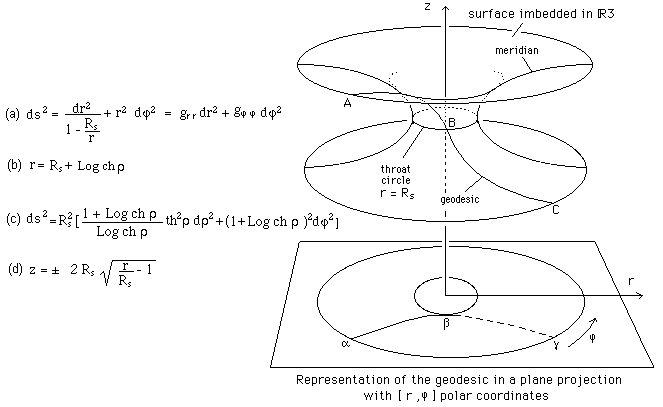
图。25:带有“桥”连接两个褶皱的表面的二维度规。
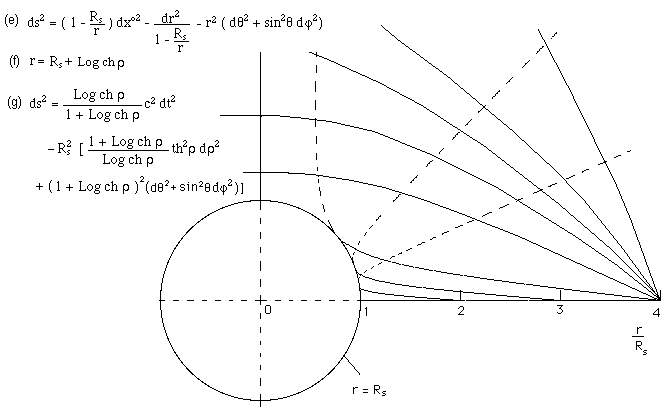
图。26:带有“空间桥”的三维度规超曲面。测地线。

经典上,我们引入固有时s(j)和“时间坐标”t(i)。然后研究径向测地线得到两个微分方程(k)和(l),其解对应于曲线(m),图6.2,参考文献[52]。
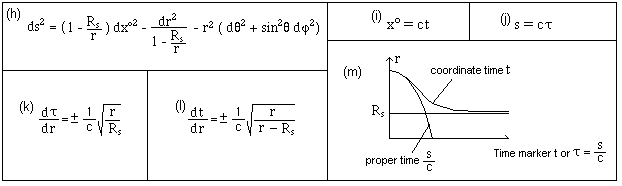
图(m)中显示的曲线是黑洞模型的基础。我们将坐标t与“远处观察者”的固有时联系起来,这样测试粒子向施瓦茨希尔德球体自由下落的时间对他来说是无限的。让我们证明这完全是因为时间坐标的特殊选择。1925年,爱丁顿提出了一个新的时间标记(p)。

随后,研究相应的径向测地线。
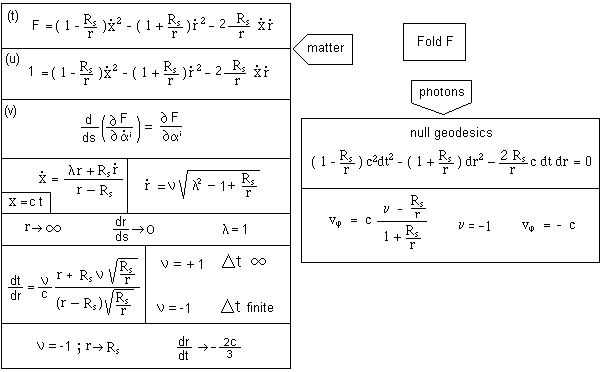
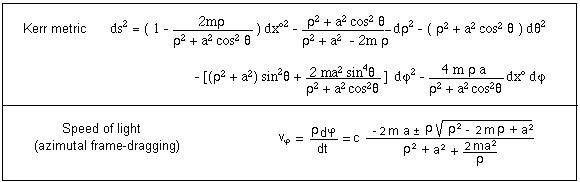
我们使用拉格朗日方程。在右边,我们看到沿径向路径的光速有两个值。(ν = -1)对应于向心路径:速度有一个恒定值 - c。同样(在左边),从远处点到施瓦茨希尔德球体的传输时间取决于路径的方向。向心(ν = -1)自由下落时间在有限时间间隔Dt内完成。相反,离心路径(ν = +1),从施瓦茨希尔德球体出发,给出无限时间间隔,因此施瓦茨希尔德球体像一个单向膜一样起作用。这对应于径向框架拖拽效应。这并不是拒绝施瓦茨希尔德几何解释的理由。事实上,我们在克尔张量中也发现了类似的现象(方位角框架拖拽)。接下来是克尔张量的经典表达式。我们看到,我们得到了光的方位角速度的两个不同值。根据我们考虑光是沿旋转方向还是反方向。
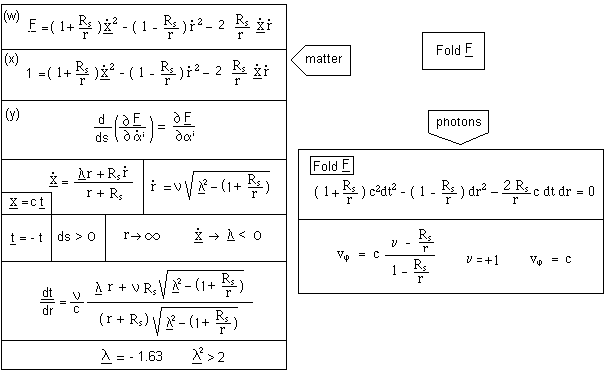
我们可以对施瓦茨希尔德几何给出一个新的解释,通过一个连接两个褶皱F和F的空间桥。如果褶皱F对应于双子褶皱,时间坐标t = -t(T对称性)。根据第19节,我们知道这种T对称性伴随着质量的反转,因此当正质量穿过施瓦茨希尔德球体(视为喉部表面)时,其符号变为负。第13节中呈现的共轭几何对应于将Rs替换为 - Rs。然后我们引入以下类似爱丁顿的时间标记变化:

仍然使用拉格朗日方程,我们研究径向测地线系统,并在两个褶皱之间建立联系。

但反向路径需要无限时间,因此这是从一个宇宙到另一个宇宙的单向通道。在这里,我们再次发现一个框架拖拽效应,但方向相反。
在传输过程中,固有时流保持不变:ds > O。这使黑洞模型变得有问题。事实上,根据施瓦茨希尔德几何的新解释,这样的空间桥可以在很短的时间内(≈10-4秒)吞噬无限量的物质。相比之下,基于克尔张量的分析,虽然稍微复杂一些,但结果相似。
随后,求解测地线系统。
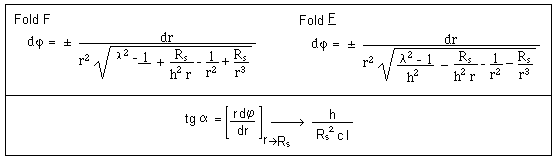
如何表示这样的路径?我们可以使用初始的(r,q,j)表示空间。然后我们得到上面的微分方程组和图27的图示。
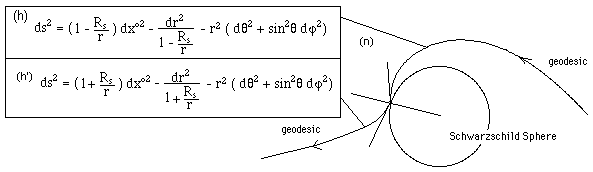
图。27:输入和输出测地线。
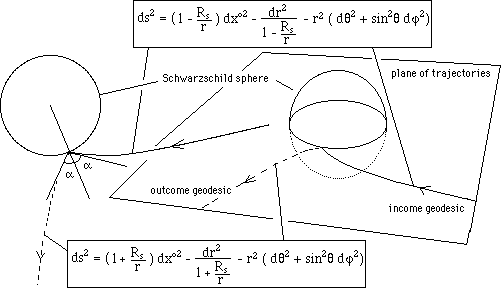
测地线似乎“反弹”在施瓦茨希尔德球体上,如图28所示。
**  **
**
但这一切都源于对路径的天真欧几里得表示。使用以下空间标记的变化:
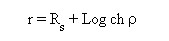
联合度规的表达式变为:
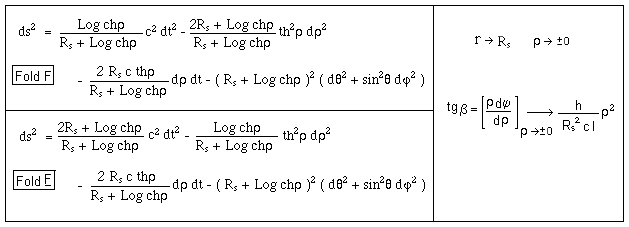
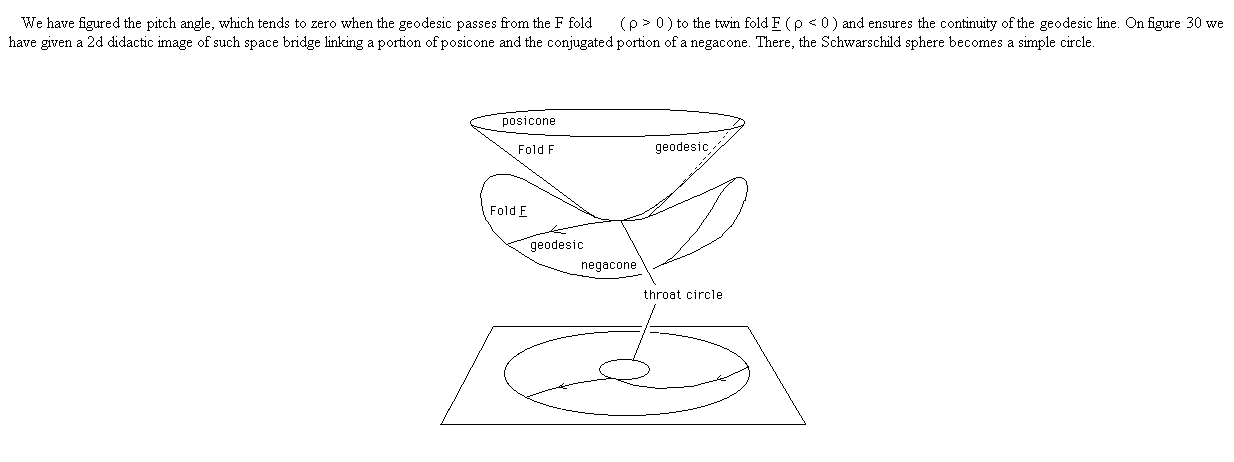
图。29:快速流动空间桥的教学图像。
参考文献。
[1] J.F.Augereau : « Si la matière sombre dévie les rayons lumineux, c'est donc qu'elle existe »(如果暗物质使光线偏转,那它就存在)。Le Monde,2000年3月17日。
[2] B.Fort在Ciel et Espace的采访,2000年6月。
[3] J.P.Petit : 缺失质量效应。Il Nuovo Cimento,B,第109卷,1994年7月,第697-710页
[4] J.P.Petit,双子宇宙宇宙学。天体物理学和空间科学。Astr. And Sp. Sc. 226 : 273-307,1995
[5] Zel'dovich Ya.B.,Astrophysica 6. 319 MNRAS 192,192(1970)
[6] Doroskhevich A.G. MNRAS 192,32(1980)
[7] Klypin A.A & Shandarin S.F. MNRAS 204,891(1983)
[8] Centrella J.M. & Mellot A.L. Nature 305,196(1983)
[9] Mellot J.M. & Shandarin S.F. Nature 346,633(1990)
[10] Shandarin S.F. 在《宇宙的大尺度结构》中,编辑J.Audouze,M.C. Peleton和A.Szalay,273。Dordrecht:Kulwer(1988)。
[11] Kofman.L.A.,Pogosyan D.和Shandarin S. MNRAS 242,200(1990)
[12] Peebles P.J.E. 物理宇宙学原理,普林斯顿大学出版社(1993)。
[13] M.Myamoto和R.Nagai Publ. Astrom. Soc. Japan 27,583,1975
[14] J.Binney和S.Tremaine,《星系动力学》,普林斯顿大学出版社,普林斯顿,1987。[16] Bahcall J.N & Soneira R.M. APJ. S** 44** p. 73 1980
[15] Bahcall J.N.,Flynn A和Gould A. APJ 389 p.234 1992
[16] B.Lindblad,Handbuch der Physik 53,(1959)21
[17] C.C. Lin和F.H.Shu:天体物理学和广义相对论。第2卷,Gordon和Breach Sc. Publ. 1971,第235页
[18] Toomree A.(1981)《正常星系的结构和动力学》。剑桥大学出版社,第111页
[19] Toomree A.和Toomree J.(1972)《天体物理学杂志》178,623
[20] A.Toomree,Ann. Rev. Astronom. Astrophys. 15(1977)437
[21] E.Athanassoula:伴星驱动的螺旋和棒。国际天文学联合会。第146号研讨会(1991)
[22] A.Toomree 天体物理学杂志 158(1969)89
[23] R.H.Miller和B.F. Smith,天体物理学杂志 277(1979)785
[24] F. Hohl,天体物理学和空间科学 14(1971)91
[25] Holmberg E.(1941)天体物理学杂志 94,385
[26] B. Sundelius和K.J. Donner:相互作用星系,盘状星系动力学(1991)Sundelius编辑,第195页
[27] S. Engström:数值模拟中的特征速度。盘状星系动力学(1991)Sundelius编辑,第332页
[28] A.Toomree Ann. Rev. Astron. Astrophys. 15(1977)437。
[29] F.Bouchet和L.Hernquist:使用理论树方法进行宇宙学模拟。Astr. Jr Suppl. Series 68,第521、538页,1988年。
[30] F.Bouchet,L.Hernquist和Y.Suto:将Ewald方法应用于宇宙学N体模拟。Apj. Suppl. Series 75,第231-240页,1991年
[31] A.Sakharov:“CP破坏和宇宙的重子不对称性”。ZhETF Pis'ma 5:32-35(1967):翻译为JETP Lett. 5:24-27(1967)
[32] A.Sakharov:“多层宇宙模型”。莫斯科应用数学研究所预印本,1970年
[33] A.Sakharov:“具有时间向量反转的宇宙模型”。ZhETF 79:689-693(1980):翻译为Sov. Phys. JETP 52:349-351(1980)
[34] A.Sakharov:“基本粒子的拓扑结构和CPT不对称性”在“理论物理问题”中,献给I.E.Tamm的纪念,Nauka,莫斯科1972年,第243-247页
[35] Green M.B. & Schwarz J.H. Nucl. Phys. B181,502-530(1981);B198,225-268(1982);Phys. Lett. B,444-448(1982)
[36] Green M.B. Surv. High Energy Phys. 3,127(1982)
[37] Gross D.J.,Harvey J.A.,Martinec E. & Rohm R.,Phys. Rev. Lett. 54,pp 503-505(1985)
[38] Kolb E.W.,Seckel D,Turner M.S.:超弦理论的不可见世界,Nature Vol. 314,1984年4月,第415-419页
[39] P.C.W.Davies & J.B.Brown:超弦,剑桥大学出版社1988
[40] Abdus Salam,Nuovo Cimento 5,299(1957)
[41] Nima-Arkani Ahmed,Savas Dimopoulos和Georgi Dvali:“宇宙的隐藏维度”,PLS 2000年10月第276期,第56-64页
[42] J.P.Petit:可变光速宇宙模型的解释。现代物理快报A,第3卷,第16期,1988年11月,第1527页
[43] ** **J.P.Petit:可变光速宇宙模型: 红移的解释。现代物理快报A,第3卷,第18期,1988年12月,第1733页
[44] J.P.Petit和Maurice Viton:可变光速宇宙模型。与类星体观测数据的比较。现代物理快报A第4卷,第23期(1989)第2201-2210页
[45] P.Midy和J.P.Petit:尺度不变宇宙学。《现代物理国际期刊D》,第8卷,1999年6月,第271-280页
[46] E.A.Milne:运动相对论,牛津1948。
[47] J.D.Anderson,P.A.Laing,E.L.Lau,A.S.Liu,M.M. Nieto和S. Turchev:先驱者10/11、伽利略和尤利西斯数据的异常弱长程加速度迹象。物理评论快报:81 1998年8月31日。
[48] G.J.Stephenson Jr.,T.Goldman,Phys. Rep. 205,211(1992);216,343(1992)。
[49] M.N. Nieto和T.Goldman,Phys. Re. 205,221,1991;216,343。
[50] R.Adler,M.Bazin & M.Schiffer:广义相对论导论,Mac Graw Hill book,1975,第10章,第10.5节:引力方程的经典极限,第345页。
[51] J.M.Souriau,动力系统结构,Dunod出版社1970年,法国 & 动力系统结构。Birkhauser出版社,波士顿-苏黎世1997年。
[52] J.P.Petit:时间箭头相反的对映宇宙(Enantiomorphic universes with opposite time arrows)。巴黎科学院报告,第pp. 1977
[53] Eddington S.A : : 与怀特海和爱因斯坦公式比较。自然 113 : 192 (1924)。
****论文摘要
原始版本(英文)
univers jumeaux contre matiere sombre matiere noire et constante cosmologique
- **Black holes do not exist. **
Where the black hole model does come from ? From the null second member field equation. Paradoxically such very dense object rises from an equation which was initially built to describe empty regions of the Universe. The Kerr metric does not bring so much : the object becomes more complex, thats all. Rotation brings an azimutal frame-dragging phenomenon, which means that the speed of light is different if one looks forward or backward with respect to the spinning movement. Whatever is the technique you choose, the things become frankly pathological when you pass the horizon and get in. At the centre lies the singularity. Let us start with an exercise. Consider the 2d metric (a). If we consider r as a radial distance and j as a polar angle, we get problems for r < Rs. But if we introduce the change (b) the expression of the metric becomes (c). All pathologies disappear. Moreover this surface can be imbedded in R3 : the meridian equation is (d). See figure 25 where we have figured a geodesic. This illustrates the fact that a pathology can depend on a wrong choice of coordinates and on a wrong choice of topology.
In the 3d example we have computed (plane) geodesics ( see figure 26 ) which are projected on the initial (r,q,j) representation space. We get a throat sphere linking two Euclidean 3d spaces. There is nothing inside. Space for r < Rs has no physical meaning. If we would try to compute geodesics in that place, we would find an imaginary solution.
Fig. 25 : 2d metric of a surface with a bridge linking two folds.
Fig. 26 : 3d metric hypersurface with a space bridge. Geodesics.
Classically, one introduce a proper time s (j) and a time-coordinate t (i). Then the study of radial geodesics gives two differential equations (k) and (l), whose solutions correspond to curves (m), fig. 6.2, reference [52].
The curves shown on figure (m) are the basis of the black hole model. One identifies the coordinate t to the proper time of a distant observer so that the free fall time of a test particle, towards the Schwarzshild Sphere become infinite for him. Let us show that this is completely due to this peculiar choice of time coordinate. In [54] 1925 Eddington suggested a new time-marker (p).
Following, the study of corresponding radial geodesics.
We use Lagrange equations. On the right we see that the speed of light, following radial paths has two values. ( nu = - 1 ) corresponds to centripetal paths : the speed has a constant value c. Similarly (left) the transit time from a distant point to the Schwarzschild sphere depends on the orientation of the paths. Centripetal ( nu = - 1 ) free fall time is achieved in finite time interval Dt . Oppositely a centrifugal path ( nu = + 1 ), starting from the Schwarzschild sphere gives an infinite time interval, so that the Schwarzschild sphere works like a one-way membrane. This corresponds to a radial frame-dragging effect. This is not a reason to reject this interpretation of the Schwarzschild geometry. In effect we find a similar phenomenon in the Kerr metric ( azimutal frame-dragging). Next, the classical expression of the Kerr metric. We see that we get two distinct values for azimutal speed of light. Depends if we consider light following the rotation or going backwards.
We can give a new interpretation of the Schwarzschild geometry, through a space-bridge linking two folds F and F. If the fold F corresponds to the twin fold, the time coordinate t = - t ( T-symmetry). From section 19 we know that this T-symmetry goes with a mass-inversion, so that when a positive mass passes through the Schwarzschild sphere, considered as a throat surface, the sign of it becomes negative. The conjugated geometry, as presented in section 13 corresponds to change Rs into Rs. Then we introduce the following Eddington-like time marker change :
Still using Lagranges equation we study the radial geodesics system and build a link between the two folds.
But the inverse paths requires an infinite time, so that it is a one-way passage from a Universe to the other. Here again we find a frame-dragging effect, in the opposite direction.
During the transit the proper time flow is unchanged : ds > O . This makes the black hole model questionable. In effect, according to this new interpretation of the Schwarzschild geometry such space bridge can swallow in a very short time ( » 10-4 sec) unlimited amounts of matter. By the way, an analysis based on the Kerr metric, although a little bit more complicated gives similar results.
Following, the solution of the geodesic systems.
How to figure such paths ? We can use the initial ( r , q , j ) representation space. Then we get the above system of differential equations and the schema of figure 27 .
Fig.27 : Income and outcome geodesics.
The geodesic seems to bounce on the Schwarzschild sphere, as shown of figure 28 too.
** **
But all that comes from such naïve Euclidean representation of the path. Using the following change of space marker :
The expression of joint metrics become :
Fig. 29 : Didactic image of a fast flow space bridge.
References.
[1] J.F.Augereau : « Si la matière sombre dévie les rayons lumineux, cest donc quelle existe (If dark matter bends light rays it shows it does exist). Le Monde, March 17 th 2000.
[2] Interview of B.Fort in Ciel et Espace, june 2000.
[3] J.P.Petit : The missing mass effect. Il Nuovo Cimento, B , vol. 109, july 1994, pp. 697-710
[4] J.P.Petit, Twin Universe Cosmology. Astrophysics and Space Science. Astr. And Sp. Sc. 226 : 273-307, 1995
[5] Zel'dovich Ya.B., Astrophysica 6. 319 MNRAS 192, 192(1970)
[6] Doroskhevich A.G. MNRAS 192, 32 (1980)
[7] Klypin A.A & Shandarin S.F. MNRAS 204, 891 (1983)
[8] Centrella J.M. & Mellot A.L. Nature 305, 196 (1983)
[9] Mellot J.M. & Shandarin S.F. Nature 346 , 633 (1990)
[10] Shandarin S.F. In Large Structures of the Universe, ed. J.Audouze, M.C. Peleton and A.Szalay, 273. Dordrecht : Kulwer (1988).
[11] Kofman.L.A., Pogosyan D. and Shandarin S. MNRAS 242, 200 (1990)
[12] Peebles P.J.E. Principles of Physical Cosmology, Princeton University Press (1993).
[13] M.Myamoto and R.Nagai Publ. Astrom. Soc. Japan 27, 583, 1975
[14] J.Binney and S.Tremaine, "Galactic Dynamics", Princeton University Press, Princeton, 1987. [16] Bahcall J.N & Soneira R.M. APJ. S** 44** p. 73 1980
[17] Bahcall J.N. , Flynn A and Gould A. APJ 389 p.234 1992
[18] B.Lindblad, Handbuch der Physik 53, (1959) 21
[19] C.C. Lin and F.H.Shu : Astrophysics and Gen. Relat. Vol.2 Gordon and Breach Sc. Publ. 1971, p. 235
[20] Toomree A. (1981) The structure and dynamics of normal galaxies. Cambridge University Press, p.111
[21] Toomree A. and Toomree J. (1972) Astrophys. J. 178, 623
[22] A.Toomree, Ann. Rev. Astronom. Astrophys. 15 (1977) 437
[23] E.Athanassoula : Companion driven spirals and bars. International Astronomic Union. Symposium n° 146 (1991)
[24] A.Toomree Astrophys. J. 158 (1969) 89
[25] R.H.Miller and B.F. Smith, Astrophys. J. 277 (1979) 785
[26] F. Hohl, Astrophys. Sp. Sc. 14 (1971) 91
[27] Holmberg E. (1941) Astrophys. J. 94, 385
[28] B. Sundelius and K.J. Donner : Interaction galaxies, Dynamics of Disk Galaxies (1991) Sundelius ed. p. 195
[29] S. Engström : Feature velocitys in numerical simulations. , Dynamics of Disk Galaxies (1991) Sundelius ed.p. 332
[30] A.Toomree Ann. Rev. Astron. Astrophys. 15 (1977) 437.
[31] F.Bouchet and L.Hernquist : Cosmological simulations using theoretical tree methods. Astr. Jr Suppl. Series 68 , pp. 521, 538, 1988.
[32] F.Bouchet, L.Hernquist and Y.Suto : Application of the Ewald method to cosmological N-body simulation. Apj. Suppl. Series 75 , pp. 231-240, 1991
[33] A.Sakharov : "CP violation and baryonic asymmetry of the Universe". ZhETF Pis'ma 5 : 32-35 (1967) : Traduction JETP Lett. 5 : 24-27 (1967)
[34] A.Sakharov : "A multisheet Cosmological Model" Preprint Institute of Applied Mathematics, Moscow 1970
[35] A.Sakharov : "Cosmological Model of the Universe with a time-vector inversion". ZhETF 79 : 689-693 (1980) : Traduction in Sov. Phys. JETP 52 : 349-351 (1980)
[36] A.Sakharov : "Topological structure of elementary particles and CPT asymmetry" in "problems in theoretical physics", dedicated to the memory of I.E.Tamm, Nauka, Moscxow 1972 pp. 243-247
[37] Green M.B. & Schwarz J.H. Nucl. Phys. B181 , 502-530 (1981) ; B198 , 225-268 (1982) ; Phys. Lett. B , 444-448 (1982)
[38] Green M.B. Surv. High Energy Phys. 3 , 127 (1982)
[39] Gross D.J. , Harvey J.A. , Martinec E. & Rohm R. , Phys. Rev. Lett. 54, pp 503-505 (1985)
[40] Kolb E.W. , Seckel D , Turner M.S. : The shadow world of superstring theories, Nature Vol. 314, april 1984 pp. 415-419
[41] P.C.W.Davies & J.B.Brown : Superstrings, Cambridge University Press 1988
[42] Abdus Salam, Nuovo Cimento 5 , 299 (1957)
[43] Nima-Arkani Ahmed, Savas Dimopoulos and Georgi Dvali : "Les dimensions cachées de l'univers", PLS oct 2000 n° 276 pp. 56-64
[44] J.P.Petit : An interpretation of cosmological model with variable light velocity. Modern Physics Letters A, Vol. 3, n°16, nov 1988, p.1527
[45] ** **J.P.Petit : Cosmological model with variable light velocity: the interpretation of red shifts. Modern Physics Letters A, Vol.3 , n° 18, dec. 1988, p.1733
[46] J.P.Petit & Maurice Viton : Gauge cosmological model with variable light velocity. Comparizon with QSO observational data. Modern Physics Letters A Vol.4 , n°23 (1989) pp. 2201-2210
[47] P.Midy & J.P.Petit : Scale Invariant Cosmology. The international Journal of Modern Physics D, Vol.8 June 1999 pp.271-280
[48] E.A.Milne : Kinematic Relativity Oxford 1948.
[49] J.D.Anderson, P.A.Laing, E.L.Lau, A.S.Liu, M.M. Nieto and S. Turchev : Indication for Pioneer 10/11, Galileo and Ulysse Data, an an Apparent Anomalous, Weak, Long-Range Acceleration. Phys. Rev. Letters : 81 31 August 1998.
[50] G.J.Stephenson Jr. , T.Goldman, Phys. Rep. 205, 211 (1992) ; 216, 343 (1992).
[51] M.N. Nieto and T.Goldman, Phys. Re. 205, 221, 1991; 216, 343.
[52] R.Adler, M.Bazin & M.Schiffer : Introduction to general relativity, Mac Graw Hill book, 1975, chapter 10, section 10.5 : Classical limit of gravitational equations, p. 345.
[53] J.M.Souriau, Structure des Systèmes Dynamiques, Ed. Dunod 1970, France & Structure of Dynamical Systems. Birkhauser Ed. Boston-Zurich 1997.
[53] J.P.Petit : Univers énantiomorphes à flèches du temps opposeés (Enantiomorphic universes with opposite time arrows). Comptes rendus de lAcadémie des Sciences de Paris, t. pp. 1977
[54] Eddington S.A : : A comparizon of Witheads and Einsteins formulæ. Nature 113 : 192 (1924).
****Paper's Summary