双宇宙宇宙学 双宇宙宇宙学(第2页) .
2)大尺度结构和“双宇宙模型”。
...我们在前一篇文章[1]中假设宇宙具有S3 x R1的几何结构。宇宙的任何区域都通过方程(1)与对应的对极区域发生反重力相互作用。存在一种正物质m,填满了S3球体。因此,宇宙的总质量是非零的。在参考文献[1]中,提供了几张2D的示意图(图10、11和12),以解释两个相邻褶皱之间的相互作用机制。
...使用增强的HP工作站和一组2 x 5000个相互作用的点,F. Lansheat确认了Pierre Midy的工作(参考文献[1],图8)。然后他将注意力集中在图3中所指示的一个较小区域,在该区域中,“相邻褶皱”中的物质密度明显高于另一个褶皱。图3:虚线方框:聚焦于非常大尺度结构的一部分,其中第一褶皱(假设是我们的,灰色)中的物质密度被认为低于相邻褶皱(白色)中的物质密度。
正如预期的那样,引力不稳定性仍然发生,并产生新的共轭结构。参见图4和图5。
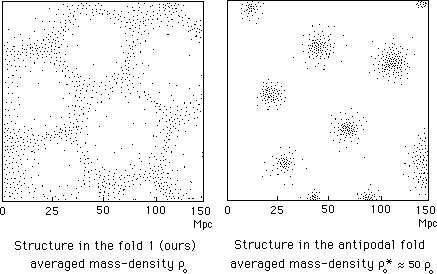
图4:F. Lansheat进行的模拟结果,显示了由于两个相邻褶皱相互作用而产生的宇宙大尺度结构。r*的平均值为r平均值的50倍(左)。左:细胞结构。右:星系团结构。
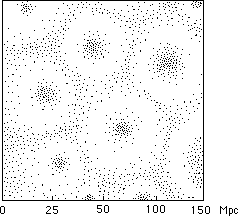
图5:相同情况的叠加
...双宇宙褶皱中的物质形成大的稳定团块,这些团块将我们宇宙褶皱中的物质推开,后者则占据剩余的空间。与“薄饼”模型的数值模拟不同,这种模式明显是非线性的。在形成之后,对应于高密度系统的Jeans时间(2 × 10⁹年),在与宇宙年龄相当的时间内,整体模式没有显著变化,因此该模型可能是一个解释我们宇宙大尺度结构“海绵状”外观的良好候选模型。
3)二维和三维模拟。
...从二维模拟的结果出发,F. Lansheat计算了两点相关性,并将其与从随机点分布(泊松分布)中获得的两点相关性进行了比较。结果如图6所示。曲线的左侧不相关,因为点之间的距离变得与随机分布的平均距离相当。右侧的增加只是由于场的边界(周期性边界条件)造成的伪影。这一结果不能直接与从观测数据推导出的经验定律(斜率-1.8)进行比较,参见Bahcall(1988)[31]、Bahcall和Soneira(1983)[32]、Bahcall和West(1992)[33]、Luo和Schramm(1992)[34]的研究。必须进行三维模拟,并使用更多点。如果可能的话,与观测数据拟合将有助于获得两个宇宙质量密度的比值。
...在该模型中,如何描绘大尺度宇宙结构形成的场景?只要质量和光之间的耦合仍然很强(t < 10⁵年),宇宙保持均匀,所有与引力不稳定性相关的过程(团块、星系、恒星和海绵状结构的形成)都被冻结。当宇宙变得透明时,我们可以假设所有这些过程都发生,并具有其自身的形成和演化特征时间。我们所能说的是,所建议的非常大尺度结构形成于2 × 10⁹年。
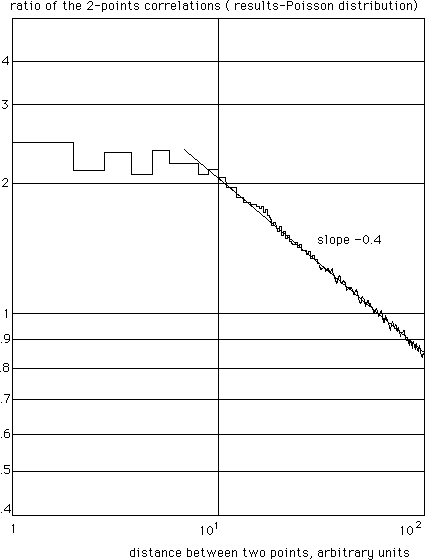
**** 图6:两点相关性曲线的斜率 (数值模拟与泊松随机分布)
** **
原始版本(英文)
twin universe cosmology Twin Universes cosmology (p 2) .
2) Large scale structure and "twin universe model".
...We assumed in the previous paper [1] that the Universe had a S3 x R1 geometry. Any region of the universe interacts antigravitationnaly with its associated antipodal region, through equation (1). There is a single kind of positive matter m, filling the S3 sphere. Then the total mass of the Universe is non-zero. In the reference [1] several didactic 2d images (figures 10, 11 and 12) were given, in order to explain the mechanims of the interaction of the two adjacent folds.
...Using a boosted HP work-station and a set of 2 x 5000 interacting points, F.Lansheat confirmed the work of Pierre Midy (reference [1] , figure 8) . Then he focussed on a smaller region, indicated on the figure 3, in which the density of the matter in the "adjacent fold" was much higher that in the other fold. Fig 3 . Dotted square : focussing on some portion of the very large scale structure in wich the density of matter in the first fold (supposed to be ours, grey color) is supposed to be smaller that the density of matter in the adjacent fold (white color).
As expected the gravitational instability still occurs and provides new conjugated structures. See figure 4 and 5 .
Figure 4 : Results of simulations performed by F.Lansheat, showing the large structure of the Universe, due to the interaction of the two adjacent folds. Mean value of r = 50 times the mean value of r (left). Left : cellular structure. Right : cluster structure.*
Figure 5 : The same, superposed
...The matter of the twin fold forms big stable clumps, which repel the matter of our fold of the universe, this last taking place in the remnant space. By opposition to the pancake model numerical simulations, this pattern is fairly non-linear. After its formation, corresponding to the Jeans time of the high density system (2 109 years) , there is no significant evolution of the general pattern over a time comparable to the age of the Universe so that this model could be a good candidate to explain the observed spongy aspect of our fold of the Universe, at large scale.
3) 2d and 3d simulations.
...From the results of the 2d simulation, F. Lansheat performed a 2 point correlation and compared to the 2d correlation obtained from a grey distribution of points (Poisson distribution). The result is shown on the figure 6. The left hand of the curve is not relevant, for the distance between the points becomes comparable to the mean distance of the random distribution. The growth on the right hand is just an artefact due to the border of the field (periodic boudary). This result cannot be compared directly to the empirical law derived from observational data (slope -1.8), see the surveys of Bahcall (1988) [31], Bahcall and Soneira (1983) [32], Bahcall and West (1992) [33], Luo and Schramm (1992) [34]. Three-dimensional simulations have to be performed, with a larger number of points. If possible, the fitting with the observational data would provide the ratio of the mass densities of the two universes.
...How to outline a scenario for the formation of large-scale cosmological structure in this model ? As long as the coupling between mass and light remains strong (t < 105 years), the Universe remains homogeneous and all the processes linked to the gravitational instability (formation of clumps, galaxies, stars and spongy structure) are frozen. When the Universe becomes transparent we can assume that all these processes occur, with their proper charateristic times of formation and evolution. All that we can say is that the suggested very large structure forms in 2 109 years.
**** Figure 6 :The slope of the curve of the 2-points correlations ratio (numerical simulation versus Poisson random distribution)
** **