20)
孪生物质可能由什么组成。
理论物理自30多年前以来一直处于严重危机之中。多年前曾有许多关于磁单极子的文章发表,但从未被观测到。超对称伙伴的存在尚未被证实。没有人知道“引力子”是什么。当科学家试图探测质子的衰变时,质子并没有配合。几乎所有新望远镜带给我们的仍然是一个完全的谜团。没有人知道类星体(QSO)、伽马暴是什么,以及它们是如何工作的。巨大的黑洞异常安静,等等。超弦理论只不过是另一种新潮流,尽管在这一“新学科”中发表了数千篇文章。超弦世界是一个奇怪的领域,物理似乎绝望地缺席。在下面,我们给出了反物质的第一个几何描述。正如J.M. Souriau常说的那样,群论是我们处理物理现象的基本工具。李群的一个自然作用是其在李代数上的共轭作用,如J.M. Souriau于1970年[53]所引入的。群G的维度是其依赖的参数数量。这也是其动量J的组成部分数量。洛伦兹群L是一个六维群,具有四个连通分支。引入四元素群ω,以矩阵表示(a)。然后我们可以从其中性分支Lₙ通过群的直积(b)构建完整的洛伦兹群L,其中(c)表示矩阵表示。一个新的半直积(d)给出了庞加莱群。
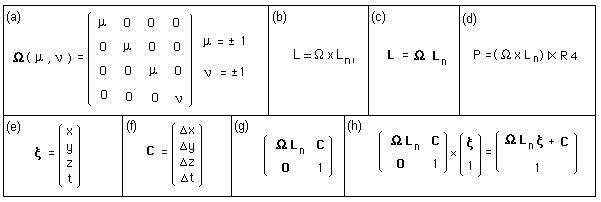
引入四维事件矢量(e)和时空平移矢量C:(f)。我们可以给出庞加莱元素的矩阵表示(g)。在(h)中,其在时空上的作用被定义。但这一作用隐藏了一个更重要的作用:群在其十维动量空间J上的共轭作用(庞加莱群是十维的)。
Souriau将这一动量写成如下形式:
J = {E, p, f, l},
其中E是能量,p是动量,f是“通过”量,l是自旋。按照Souriau的建议,引入一个反对称矩阵M:(a)和四维动量-能量矢量P:(b)。计算群在其李代数上的作用的对偶,得到动量上的作用{(c),(d)}。
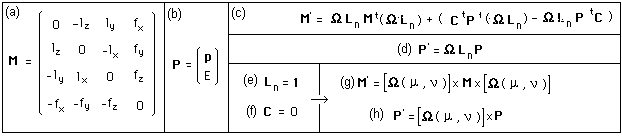
现在,如果我们想要突出I、P、T和PT对称性,我们选择(e)和(f)。共轭作用变为{(g),(h)},这给出:
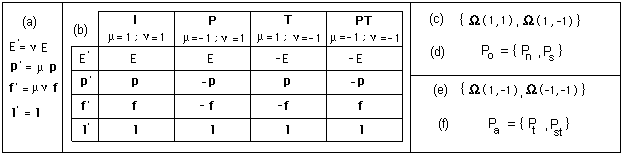
正如J.M. Souriau在1970年所指出的,从矩阵(c)出发,我们构建了正时子群P₀:(d),由两个连通分支组成:中性分支Pₙ和空间反演分支Pₛ。这些两个分支的元素不会改变能量E的符号。相反,矩阵(e)产生反时子集,其元素会改变能量的符号,因此时间反演伴随着能量反演,即质量反演,如果粒子具有质量的话。总之,我们看到负质量和负能量从庞加莱群的动力学描述中浮现出来,这基于相对论性质点的运动。现在,我们将扩展庞加莱群,考虑:

我们引入矩阵(a)和(b)。然后,我们给出群的矩阵表示,作用在(e)上的Z₂ × U(1) × ℝ⁴纤维丛上。在(f)中,我们得到对称性C的几何表达。第五维(c)是紧致的。因此,与(f)选择相对应的群的任何元素都意味着相对于所指示的直线的对称性。
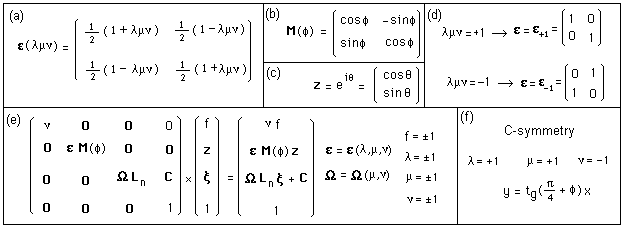
群在其动量上的共轭作用的计算没有特别的困难。正如Souriau在1970年所指出的,添加一个紧致维度q会伴随一个额外的量化标量,即电荷q。对庞加莱群部分动量的作用不变。对电荷的作用给出:

粒子用群的轨道来描述。一些具有正能,一些具有负能。f可以被视为一个折叠指数。
f = +1表示折叠F,
f = –1表示折叠F̅。
我们因此得到一个几何上的孪生结构。作用简单为:
f′ = n f。
这可以总结在图21中:
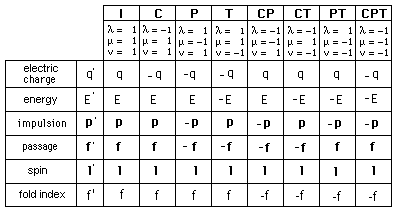
图27:对称性对动量分量的影响。
请注意(ν = –1)表示群的反时项。一个粒子及其运动对应于动量的一个特殊元素。反时项将正时运动转化为反时运动,并反转质量和能量。由于时空由两个分离的折叠F和F̅组成,如果将正能粒子放在一个折叠(例如F)中,而将负能粒子放在其孪生折叠F̅中,就可以避免相反能量粒子的相遇。这种物理描述与群的性质一致。
21)PT对称性和CPT对称性。
正如Souriau在1970年指出的,任何包含T对称性的对称性都会反转能量和质量。如果我们考虑一个正常粒子,其质量为m,电荷为q,其CPT对称体具有负的能量和质量。费曼表明,一个粒子的PT对称体表现得像一个反粒子;然而,根据Souriau的结果,它具有负的质量和能量。根据以上内容,我们构建了宇宙的新描述,即由两个孪生实体组成。第一个是折叠F,假设是我们的,充满了物质和狄拉克反物质,相对于第一个具有C对称性。在第二个折叠F̅中,物质-反物质的对偶性同样适用。它的物质相对于我们具有CPT对称性,而它的反物质对应于费曼的反物质。整体而言,这两个折叠是CPT对称的。这与萨哈罗夫的初始想法一致([33]至[36])。作者关于孪生宇宙学的最初工作于1977年发表。
22)逃逸中子星模型:黑洞模型的替代方案。
经典上,中子星的临界性基于几何临界性。一个密度恒定的球体,被真空包围,可以用两个相关的施瓦茨希尔德度规(内部和外部)来描述。这些表达式在第7节中给出。当中子星的半径趋近于其对应的施瓦茨希尔德半径时,这些度规变得临界。托尔曼、奥本海默和沃尔科夫推导出(见[52],公式14.22)一个著名的“TOV方程”,给出了中子星中压力与径向距离的关系。
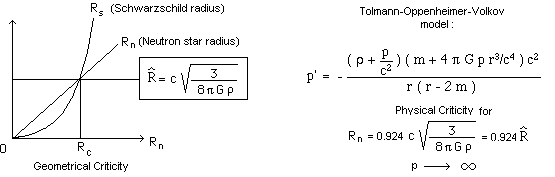
图28:左,几何临界性;右,物理临界性。
计算表明,在达到几何条件之前,就会出现物理临界性:在恒星中心,压力趋于无限(左)。
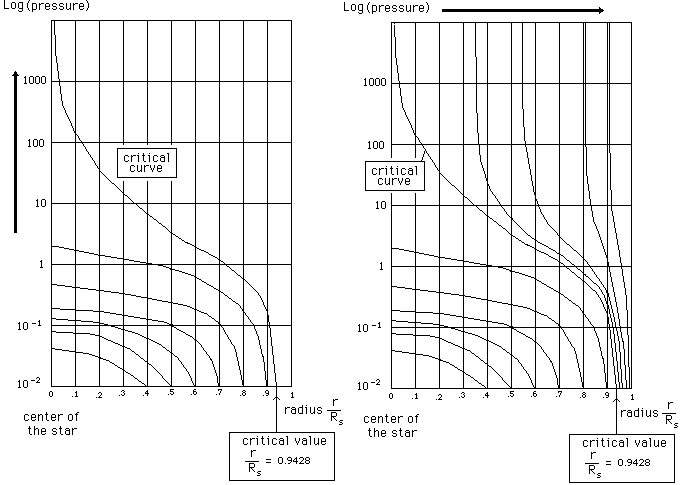
图29:中子星中压力与径向距离的关系。
我们现在将提出一些假设。在第15节中,我们尝试描述宇宙的原始状态,回溯其过去。为了解释其巨大的均匀性,我们引入了辐射时代物理常数的变化。然而,这种探索仍然非常危险。我们只是试图为以下问题提供新的视角:“当我们回望宇宙遥远的过去时,会发生什么?”我认为我们并不拥有所有的钥匙。不过,我将表达一个观点:我认为,当压力达到临界值(待确定)时,我们的宇宙会与它的孪生宇宙相连,正如A. Sakharov所建议的“存在于它的过去”。尽管这仍然模糊,但我承认,这只是一个假设。我认为我们的宇宙与它的过去相互作用,这可能沿着某种时空桥梁延伸。Sakharov认为我们的宇宙和它的孪生宇宙是相连的。我补充说,它们在任何地方、任何时间都相互作用。这就是为什么时间箭头在孪生宇宙中似乎被反转,如第19节所示。这也是为什么孪生原子似乎具有负质量并排斥我们的原子。对我们来说,它们只是在时间上倒流,根据Souriau的研究,它们的表观质量是负的。
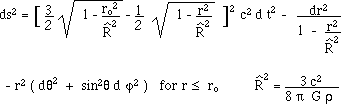
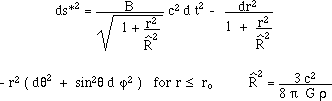
类比地,我认为当中子星中心达到物理临界性时,局部物理常数的值会发生根本性的变化。这种条件将“局部重现”“大爆炸条件”。一个空间桥梁将打开,以相对论速度吸入物质。这种“温和的场景”将在伴星恒星的恒星风导致的物质流达到中子星中心的临界条件时发生。然后,可以使用四个施瓦茨希尔德度规几何地描述一个稳态。对于折叠F:
对于孪生折叠F̅相邻的共轭区域:
可以研究测地线系统,并通过仅以面积为参数的空间桥梁将其连接起来。微小的空间桥梁可以吸收来自伴星恒星恒星风的物质,因为靠近伴星时,密度极大且速度是相对论性的。图24中是该模型的二维教学图像。
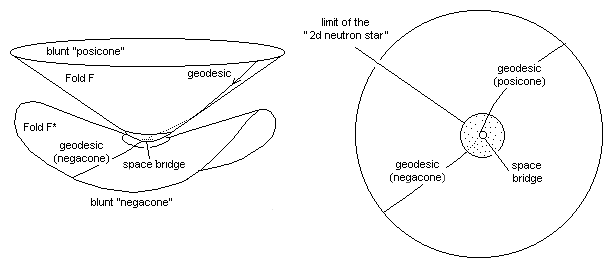
图30:逃逸中子星(SNS)的二维教学图像。
由于伴星更剧烈的爆发现象或两颗中子星融合形成双星系统而引起的物质剧烈流入,可能会迅速打开一个空间桥梁,如图24右侧所示。伽马暴的解释可能就在这里。这个模型挑战了黑洞模型。我们将在后面进一步探讨这个模型为何值得怀疑。这个黑洞模型有问题。候选者太少,而且大家都知道,距离评估的微小误差可能会将这些黑洞候选者变成普通的中子星。没有任何不可反驳的证据证明它们的存在。人们只是习惯性地相信它们。人们总是说:“你还能想象别的什么?”看看文章的开头。我们提到了Fort和Méillier在《世界报》上发表的彩色3D暗物质地图,记者兴奋地标题为[1]:“暗物质确实存在:它偏转光束”。但那些由同一研究者发现的“暗簇”[2]又如何呢?它们“吸引并偏转光束,但似乎排斥普通物质”?如果这些被证实,它们将如Fort所建议的那样,完全由“奇异物质”组成。如果是这样的话,那又是什么物质呢?关于航天器的加速度[49],暗物质分布无法解释。如今,人们需要在星系中心找到巨大的黑洞,以解释这些区域的动力学参数。但这些巨兽似乎非常安静,就像睡美人一样,对吧?有人建议它们可能是“饱食的黑洞”。我们还要尝试多久,通过发明新名称来解决新问题?文章摘要---
原始版本(英文)
20 )
What twin matter could be made of.
Theoretical physics is in a big crisis since mode than 30 years. A lot of papers were published many years ago about magnetic monopole, but no one appeared. The existence of supersymetric partners has not been proved yet. Nobody knows what a graviton could be. When scientists tried to evidence the protons decay, this last did not cooperate. Almost all that new telescopes bring is still e complete mystery. Nobody knows what are QSO, gamma flashes and how it works. Giant black holes are strangely silent, and so on. Superstring is nothing but a new fashion, in spite thousands papers published in this new field. Superstring world is a strange play field in which physics seems desperately absent. In the following we give the first geometrical description of antimatter. As J.M.Souriau
uses to say, group theory is the most basic tool we have to deal with physical phenomena. A natural action of a Lie group is its coadjoint action on its Lie algebra, as introduced by J.M.Souriau in 1970
[
53]. The dimension of a group G
is the number of parameters it depends on. This is also the number of components of its moment
J. The Lorentz group L is a six-dimensional group, which owns four connex components. Introduce the four elements group omega
, in its matrix representation (a). Then we can built the complete Lorentz group
Lfrom its neutral component
L n
, through a direct group product (b), where (c) is the matrix representation. A new semi-direct product
(d) gives the Poincaré group. Introduce the event-quadrivector
(e) and the space-time translation vector
C: (f).
We can give a matrix representation (g) of the Poincaré element. In (h) its action on space-time. But this one hides a more important action : the coadjoint action of the group on its ten components moment space
J(the Poincaré group owns ten dimensions).
Souriau writes this moment
: J = {
E ,
p
,
f
,
l } E
is the energy,
p
the impulsion,
f
the passage an
l
the spin. It is convenient to introduce, following Souriau, an antisymmetric matrix
M: (a) and the quadrivector impulsion-energy
P: (b)
. The calculation of the dual of the action of the group on its Lie algebra gives the action on the momentum { (c) , (d) }.
Now, il we want to evidence symmetries
I , P , T
and
PT
we choose (e) and (f). The the coadjoint action becomes { (g) , (h) } , which gives :
As pointed out in 1970 by J.M.Souriau, with the matrixes (c) we build the orthochron subgroup
P o
: (d), composed by two connex components : the neutral one
P n
and by the space-inversion component
P s .
The
terms of these two components do not inverse the sign of the energy
E. Conversely, the matrixes (e) produce the antichron subset, whose terms inverse the sign of the energy, so that time-inversion goes with energy inversion, i.e. mass-inversion, if the particles own one. As a conclusion we see that negative mass and negative energy arise from the dynamic Poincaré group description, referring to relativistic mass-point movements. Now, we are going to extend the Poincaré group, considering :
We introduce the matrix (a) and (b). Then we give a matrix representation of the group, acting (e)
on a bundle
Z 2 x U
(1)
x R4
. In (f) we get the geometrical expression of the C-symmetry. The fifth dimension (c) is compact. Then any element of the group corresponding to choices (f) implies a
symmetry with respect to the indicated straight line. The calculation of the coadjoint action of the group on its momentum shows no peculiar difficulty. As pointed out by Souriau in 1970 the addition compact dimension
q
goes with a quantified additional scalar, identified to the electric charge q. The action on the part of the moment corresponding to Poincaré does not change. The action on the electric charge gives :
Particles are describes in terms of orbits of the group. Some own a positive energy and others a negative one. f can be considered as a fold index.
f = +1 refers to fold F
f = -1 refers to fold
FWet get a geometrical twin structure. The action is simply :
f =
n f
This can be summarized on figure 21.
Fig.
27 :
Impact of symmetries on the momentum components.
Notice that (
nu = - 1 ) refers to antichron terms of the group. A particle and its movement correspond to a peculiar element of the momentum. Antichron terms transform orthochron movements into antichron ones and reverse mass and energy. As space time is composed by two separate folds F and
F, encounters of opposite energy particles can be avoided if we put positive energy particles in one fold, F for example, and negative energy in its twin fold
F. This physical description is consistent to the group properties.
PT-Symmetry and CPT-symmetry .
As pointed out by Souriau in 1970, all symmetry which includes a T-symmetry reverse the energy and the mass. If we consider a normal particle, with mass m and electric charge q , its CPT-symmetrical owns negative energy and mass. Feynman showed that the PT-symmetrical of a particle behaved as an antiparticle, but, according to Souriaus result, it owns negative mass and energy.. From above, we have built a new description of the Universe as composed by two twin entities. The first is a fold F, supposed to be ours, filled by matter and Dirac-antimatter, C-symmetrical with respect to the first. In the second fold
Fthe matter-antimatter duality holds too. Its matter is CPT-symmetrical with respect to ours, while its antimatter identifies to Feynman one. As a whole, the two folds are CPT symmetrical. This goes with initial Sakharovs ideas ( [33]
to [36]
). The initial work of the author, devoted to twin Universe cosmology, was published in 1977.
Leaking neutron star model : a challenger to black hole model.
Classically the criticity of a neutron star is based on a geometrical criticity. A constant density sphere, surrounded by void can be described by two linked Schwarzschild metric (internal and external). These expressions have been give in section 7. Both become critical when the neutron stars radius tends to its associated Schwarzschild radius. Tolmann, Oppenheimer and Volkov derived ( see
[
52], eq. 14.22 ) a famous TOV equation giving pressure versus radial distance in a neutron star.
Fig.
28 :
Left, geometrical criticity. Right : physical criticity.
The calculation shows that, before the geometrical conditions are reached, a physical criticity occurs : pressure tends to infinite at the centre of the star (left).
Fig
. 29 :
Pressure versus radial distance in a neutron star.
We are going now to make assumptions. In section 15 we tried to describe the primitive stage of the Universe, going backward in its past. In order to explain its great homogeneity we introduced a variation of the constants of physics, during the radiative era. By the way, this exploration is still very hazardous. We only tried to give new insights on the question : what happens when we look at the distant past of the Universe ?. I think we dont own all the keys. I will just expression an opinion. I would think that when the pressure reaches a critical value (to be determined) our Universe becomes linked to its twin which, as A.Sakharov suggested lies in its past. Although it is still confused, I admit, I think that our universe interacts with its past, which would extends over some sort of space-time bridge. Sakharov Thought that our Universe and its twin were linked. I add they would be interacting, everywhere, all the time. Thats for the arrow of time is found to be reversed in the twin, from section 19. Thats for the twins atoms seem to own a negative mass and repel ours. For us, they just live backward in time, thats for, according to Souriaus works, their
apparent mass
is negative. By analogy I would think that when physical criticity is reached at the centre of a neutron star, the local values of the constants of physics change drastically. Such condition would reproduce locally the Big Bang conditions. A spaced bridge would open, sucking matter at relativistic velocity. Such soft scenario would occur when the matters flux due to the solar wind of a companion star achieves critical conditions at the centre of the star. Then a steady state can be geometrically described, using the four Schwarzschild metrics. For fold F :
For the adjacent, conjugated region of the twin fold
F:
One can study the geodesic systems and link them, through a space bridge whose single parameter is its area. Tiny space bridges can absorb the matter corresponding to stellar wind of a companion star, for, close to it, the density is enormous and the velocity relativistic. On figure 24 a 2d didactic image of the model.
Fig.
30 :
2d didactic image of a sleaking neutron star
(SNS).
A violent inflow of matter, due for example to more eruptive phenomena of a companion star or to the fusion of two neutron stars, forming a binary system, could produce fast opening of a space bridge, as suggested on the right of figure 24. The explanation of gamma bursts could lie there. This
model challenges the black hole model. We will see further how this last is questionable. Something goes wrong with this black hole model. There are too few candidates and everybody knows that a slight error about distance evaluation can convert such black holes candidates into simple neutron stars. There is no undeniable proof of their existence. People only
believe
in. They always said : what could you imagine else ?. Look at the beginning of the paper. We evoked the issue of the Journal le Monde in which Fort and Meillier presented a coloured 3d map of dark matter and the journalist, enthusiastic, titled
[ 1 ]
: The dark matter does exist : it bends the light rays. But what about the dark clusters
[ 2 ]
, discovered by the same people, which attract the light rays, bend it, but apparently repel the ordinary matter. If this is confirmed they would be made, as suggested by Fort, exclusively of exotic matter, and if they are, what is that stuff ? What about the acceleration of the space probes [
49], that a dark matter distribution cannot explain ? Today people
need
to find giant black holes at the centre of galaxies, in order to justify the dynamical parameters of such regions. But these giants seem very silent, like sleeping beauty, dont they ? Some suggested they could be satiated black holes. How long time will we try to answer new problem just inventing new
name ?
Paper's Summary ---