Kosmologie der Zwillinguniversen Kosmologie der Zwillinguniversen (S. 2) .
2) Großskalenstruktur und „Zwillinguniversen-Modell“.
...Wir gingen in dem vorherigen Artikel [1] davon aus, dass das Universum eine S3 x R1-Geometrie besaß. Jede Region des Universums interagiert antigravitationell mit ihrer zugehörigen antipodalen Region, über die Gleichung (1). Es gibt eine einzige Form positiver Materie m, die die S3-Kugel füllt. Die Gesamtmasse des Universums ist daher nicht null. In der Referenz [1] wurden mehrere didaktische 2D-Bilder (Abbildungen 10, 11 und 12) bereitgestellt, um die Wechselwirkungsmechanismen der beiden benachbarten Faltungen zu erklären.
...Mit einer verstärkten HP-Arbeitsstation und einem Set aus 2 x 5000 wechselwirkenden Punkten bestätigte F. Lansheat die Ergebnisse von Pierre Midy (Referenz [1], Abbildung 8). Danach konzentrierte er sich auf einen kleineren Bereich, der in Abbildung 3 angegeben ist, in dem die Materiedichte im „benachbarten Faltungsabschnitt“ viel höher war als in dem anderen Faltungsabschnitt. Abbildung 3. Gestricheltes Quadrat: Fokussierung auf einen Teil der sehr großen Struktur, in dem die Materiedichte im ersten Faltungsabschnitt (vermutlich unseres, graue Farbe) geringer ist als die Materiedichte im benachbarten Faltungsabschnitt (weiße Farbe).
Wie erwartet tritt die gravitative Instabilität erneut auf und führt zu neuen konjugierten Strukturen. Siehe Abbildungen 4 und 5.
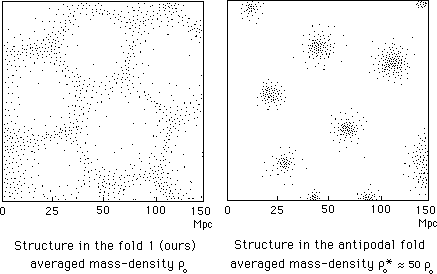
Abbildung 4: Ergebnisse der von F. Lansheat durchgeführten Simulationen, die die große Struktur des Universums zeigen, verursacht durch die Wechselwirkung der beiden benachbarten Faltungen. Mittelwert von r = 50-mal der Mittelwert von r (links). Links: Zellstruktur. Rechts: Haufenstruktur.*
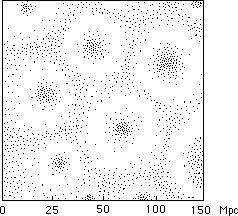
Abbildung 5: Das gleiche, überlagert
...Die Materie des Zwillingfaltungsabschnitts bildet große stabile Haufen, die die Materie unseres Faltungsabschnitts des Universums abstoßen, wodurch diese sich in den verbleibenden Raum verlagert. Im Gegensatz zu den numerischen Simulationen des „Pfannkuchen-Modells“ ist dieses Muster deutlich nicht-linear. Nach seiner Bildung, die dem Jeans-Zeit des hochdichten Systems (2 × 10⁹ Jahre) entspricht, gibt es keine signifikante Entwicklung des allgemeinen Musters über eine Zeitspanne, die dem Alter des Universums entspricht, sodass dieses Modell eine gute Kandidatin sein könnte, um das beobachtete „Schwamm“-Aussehen unseres Faltungsabschnitts des Universums auf großer Skala zu erklären.
3) 2D- und 3D-Simulationen.
...Aus den Ergebnissen der 2D-Simulation berechnete F. Lansheat eine Zweipunktkorrelation und verglich sie mit der Zweipunktkorrelation, die aus einer zufälligen Punkteverteilung (Poisson-Verteilung) gewonnen wurde. Das Ergebnis ist in Abbildung 6 dargestellt. Der linke Teil der Kurve ist nicht relevant, da der Abstand zwischen den Punkten dem mittleren Abstand der zufälligen Verteilung entspricht. Das Wachstum auf der rechten Seite ist einfach ein Artefakt, verursacht durch die Ränder des Feldes (periodische Randbedingungen). Dieses Ergebnis kann nicht direkt mit der empirischen Gesetzmäßigkeit verglichen werden, die aus beobachteten Daten abgeleitet wurde (Steigung -1,8), siehe die Studien von Bahcall (1988) [31], Bahcall und Soneira (1983) [32], Bahcall und West (1992) [33], Luo und Schramm (1992) [34]. 3D-Simulationen müssen durchgeführt werden, mit einer größeren Anzahl von Punkten. Wenn möglich, würde die Anpassung an die beobachteten Daten das Verhältnis der Massendichten der beiden Universen liefern.
...Wie lässt sich ein Szenario für die Bildung der großskaligen kosmologischen Struktur in diesem Modell skizzieren? Solange die Kopplung zwischen Masse und Licht stark bleibt (t < 10⁵ Jahre), bleibt das Universum homogen und alle Prozesse, die mit der gravitativen Instabilität verbunden sind (Bildung von Haufen, Galaxien, Sternen und der Schwammstruktur), sind eingefroren. Wenn das Universum transparent wird, können wir annehmen, dass all diese Prozesse stattfinden, mit ihren eigenen charakteristischen Zeiten der Bildung und Entwicklung. Alles, was wir sagen können, ist, dass die vorgeschlagene sehr große Struktur in 2 × 10⁹ Jahren entsteht.
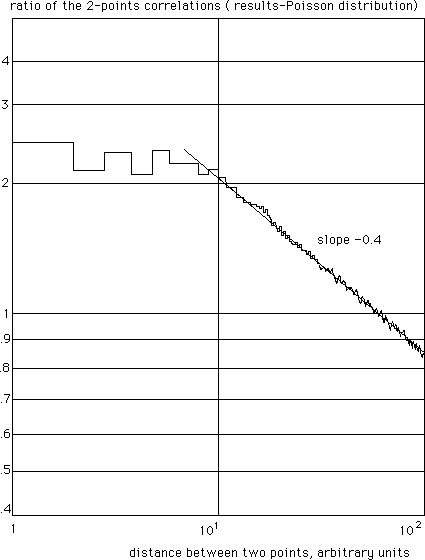
**** Abbildung 6: Die Steigung der Kurve der Zweipunktkorrelation (numerische Simulation versus Poisson-Zufallsverteilung)
** **
Originalversion (Englisch)
twin universe cosmology Twin Universes cosmology (p 2) .
2) Large scale structure and "twin universe model".
...We assumed in the previous paper [1] that the Universe had a S3 x R1 geometry. Any region of the universe interacts antigravitationnaly with its associated antipodal region, through equation (1). There is a single kind of positive matter m, filling the S3 sphere. Then the total mass of the Universe is non-zero. In the reference [1] several didactic 2d images (figures 10, 11 and 12) were given, in order to explain the mechanims of the interaction of the two adjacent folds.
...Using a boosted HP work-station and a set of 2 x 5000 interacting points, F.Lansheat confirmed the work of Pierre Midy (reference [1] , figure 8) . Then he focussed on a smaller region, indicated on the figure 3, in which the density of the matter in the "adjacent fold" was much higher that in the other fold. Fig 3 . Dotted square : focussing on some portion of the very large scale structure in wich the density of matter in the first fold (supposed to be ours, grey color) is supposed to be smaller that the density of matter in the adjacent fold (white color).
As expected the gravitational instability still occurs and provides new conjugated structures. See figure 4 and 5 .
Figure 4 : Results of simulations performed by F.Lansheat, showing the large structure of the Universe, due to the interaction of the two adjacent folds. Mean value of r = 50 times the mean value of r (left). Left : cellular structure. Right : cluster structure.*
Figure 5 : The same, superposed
...The matter of the twin fold forms big stable clumps, which repel the matter of our fold of the universe, this last taking place in the remnant space. By opposition to the pancake model numerical simulations, this pattern is fairly non-linear. After its formation, corresponding to the Jeans time of the high density system (2 109 years) , there is no significant evolution of the general pattern over a time comparable to the age of the Universe so that this model could be a good candidate to explain the observed spongy aspect of our fold of the Universe, at large scale.
3) 2d and 3d simulations.
...From the results of the 2d simulation, F. Lansheat performed a 2 point correlation and compared to the 2d correlation obtained from a grey distribution of points (Poisson distribution). The result is shown on the figure 6. The left hand of the curve is not relevant, for the distance between the points becomes comparable to the mean distance of the random distribution. The growth on the right hand is just an artefact due to the border of the field (periodic boudary). This result cannot be compared directly to the empirical law derived from observational data (slope -1.8), see the surveys of Bahcall (1988) [31], Bahcall and Soneira (1983) [32], Bahcall and West (1992) [33], Luo and Schramm (1992) [34]. Three-dimensional simulations have to be performed, with a larger number of points. If possible, the fitting with the observational data would provide the ratio of the mass densities of the two universes.
...How to outline a scenario for the formation of large-scale cosmological structure in this model ? As long as the coupling between mass and light remains strong (t < 105 years), the Universe remains homogeneous and all the processes linked to the gravitational instability (formation of clumps, galaxies, stars and spongy structure) are frozen. When the Universe becomes transparent we can assume that all these processes occur, with their proper charateristic times of formation and evolution. All that we can say is that the suggested very large structure forms in 2 109 years.
**** Figure 6 :The slope of the curve of the 2-points correlations ratio (numerical simulation versus Poisson random distribution)
** **