Das Problem der fehlenden Masse
(p3)
.
- Sphärisch symmetrische Lösung
Im Jahr 1916 leitete Eddington eine stationäre Lösung mit sphärischer Symmetrie ab, indem er die Vlasov- und Poisson-Gleichungen kombinierte. Er ging davon aus, dass das Geschwindigkeitsellipsoid sphärisch symmetrisch und auf den Mittelpunkt des Systems ausgerichtet war.
Abbildung 1 (ga3114): Geschwindigkeitsellipsoid, das einer Eddington-artigen Lösung entspricht.
Eddington leitete die folgende Beziehung zwischen der Massendichte und dem gravitativen Potential ab
(20)
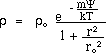
was eine stationäre Verteilung von Materie in einem kollisionsfreien Gas in einem gravitativen Potential
Y
darstellt, in dem die gravitative Kraft durch die Druckkraft ausgeglichen wird. Wir nehmen eine Lösung desselben Typs für das antipodale Gebiet
(21)
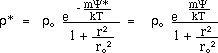
So müssen wir die folgende Gleichung lösen
(22)

Setzen wir
(23)
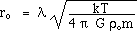
Führen Sie die folgenden dimensionslosen Größen ein:
(24)

Wir erhalten
(24)
die numerisch gelöst werden kann. Wir können folgende Anfangsbedingungen wählen
j
'o = 0
j
"o = 10
l = 10
Abbildung 2: Sphärisch symmetrische Eddington-artige Lösung. Das gravitative Potential
Abbildung 3: Sphärisch symmetrische Eddington-artige Lösung. Massendichten. Wenn ein Haufen in einer Falte existiert, existiert in der konjugierten Region der zweiten Falte ein damit verbundener diffuser Halo.
Originalversion (Englisch)
The missing mass problem
(p3)
.
- Spherically symmetric solution
In 1916 Eddington derived a spherically symmetric steady-state solution, combining the Vlasov and the Poisson equations. He assumed that the ellipsoid of the velocities was spherically symmetric and pointed towards the center of the system.
Figure 1 (ga3114): Ellipsoid of velocities corresponding
to an Eddington-type solution.
Eddington derived the following relation between the mass density and the gravitational potential
(20)
which represents a steady-state distribution of matter in a collision-free gas, in a gravitational potential
Y,
in which the gravitational force balances the pressure force. Let us take the same kind of a solution for the antipodal region
(21)
So that we have to solve the following equation
(22)
Take
(23)
Introduce the following adimensional quantities :
(24)
We get
(24)
which can be solved by numerical computation. We can take the following initial conditions
j
'o = 0
j
"o = 10
l = 10
Figure 2 : Spherically symmetric Eddington-type solution. The gravitational potential
Figure 3 : Spherically symmetric Eddington-type solution. Mass densities. If a cluster exists in one fold, an associated diffuse halo exists in the conjugated region of the second fold.