Document consolidé. 26 pages d'origine ont été réunies ici ; les liens ci-dessous ouvrent chaque section.
Retrouver : Documents scientifiques.
Sommaire
- Introduction.
- Geodesics.
- (positive) Curvature.
- Didactic image of a heavenly body
- Trajectories, paths.
- Negacones.
- Conjugated geometries.
- Coordinate-invariant formalism.
- The singularities' problem.
- A110
- Representative space.
- A112
- Space at microscopic scale.
- A single universe, or two ?
- A115
- About 'negative masses'.
- c (T + + T - )
- The kingdom of research.
- How old is the universe ?
- A120
- A word about parallax method :
- Geometric context.
- Conjugated curvatures.
- Introducing a field equations system.
- Geometries induced by ghost matter.
- Conclusion of this first part devoted to geometry.
Introduction.
Geodesics.
(positive) Curvature.
Didactic image of a heavenly body
Trajectories, paths.
Negacones.
Conjugated geometries.
Coordinate-invariant formalism.
The singularities' problem.
A110
Representative space.
A112
Space at microscopic scale.
Space at microscopic scale.
We ignore the microscopic scale space-time structure. We just assume space time is a continuum . In technical terms, we assume the 4d structure is a manifold, than can be differentiated. We also assume that local topology is hyperspheric. But, when we look closer and closer, we find two characteristic quantities :
The Planck's length : 10-33 cm
The Planck's time : 10-43 second
We cannot cut such intervals. On quantum mechanics grounds it does not make any sens.
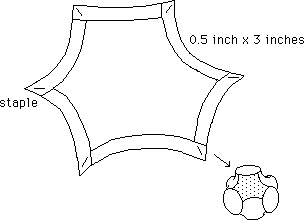
Various other space textures can be imagined. Take for example a 3d space, an euclidean 3d space, like we imagine ours looks like. You can split it into two disjoint sub-spaces. Take cartboard strips, both firm and flexible. Size : half an inch x three inches. You can join such elements with a stapler.
Then you can build a hexagon whose angles are all equal to 90°;. (78)
With such strange "recta-hexagons" you can build the following object (79)
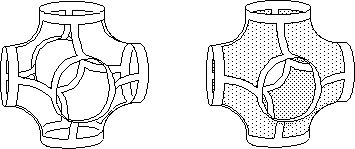
The you connect similar "bottles with six entries" : (80)
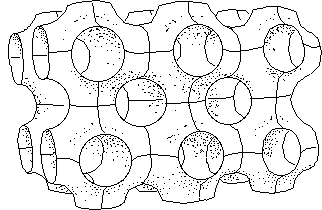
Remark : Your strips form circular geodesics of the surface. This latter is a frontier between two worlds. These two "half 3d universes" are identical. They have the same (infinite) volume. You can transform those by a simple translation. (81)
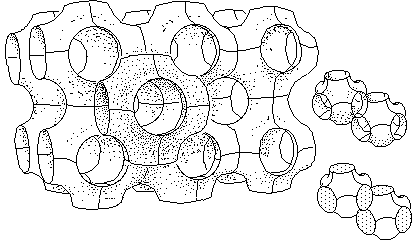
On figure (82) a simpler system to build, using a polyhedric representation. Next, left, one element. Right, two elements connected. (82)
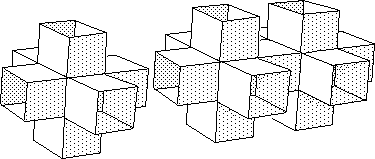
These images show that two universes could be overlapped together.
These two 3d worlds are separate. At my home, we have an aquarium whose single red inhabitant is a fish called by my wife : "Jonas". If I could, I would build a complex aquarium in which two liquid 3d volumes would be separated by the above plexiglass surface. If two fishes would be put, each in one of these "worlds" they could go "almost everywhere" but they could not meet together, for they should be separated by this transparent surface, everywhere they went.
This offers an interesting solution to make buildings in which two populations can live "together", whilst never meeting.
About Jonas, I have a story to tell you. This poor fish was living in the enterprise where my wife Claire works. Deadly boring people, by the way : lawyers.
One day Claire found the poor Jonas alone in a pan. The boss of my wife had decided to clean Jonas'aquarium with bleach !
Thinking Jonas was in danger, due to the behaviour of this woman, Claire put the fish in a bottle and brought it at our flat. Then we bought an aquarium. But I made a mistake : I chose one where one of the walls is a mirror. Then, instead of one red fish, we have two. But Jonas was immediatly conviced that his image in the mirror corresponded to another real red fish. He started to patrol along the mirror-wall, his eyes fixed on his companion, all day long (we supposed he stopped during the night but we cannot be assaured of that). Jonas had no possibility to realize that this fish was his own image. A fish sends sonic waves and records the waves sent by other creatures living in water. The sonic signature of Jonas companion was surely identical to his own one (that's why we think Jonas was patrolling nights too. Exhausting). Jonas could also see, during the day, the "other fish". He was deeply convinced that this image corresponded to some brother or living clone. Immediate terrirorial problem.
We were sad, because Jonas was so busy, watching the "other fish" that he did not pay attention to anything else. Finally, after three monthes we bought another aquarium, without the mirror-wall and Jonas became friendly again. It was cheeper than calling in an analyst specializing in red fishes.
Another remark : can a fish suffer sea-sick ?
What is sea-sick ? It comes from the opposition of two messages coming from two distinct perception systems. We are inside a boat, in your cabin. The walls do not move, but you feel the movement through your internal ear system. Then you get sick.
If you take a fish, swiming in an aquarium, this is a very strange. In effect the walls of the box, even if they are transparent, behave like flat mirrors, with respect to soundwaves. By night, when the lights are switched off, Jonas "see" an infinite number of brothers, due to the multiple reflexions of soundwaves on orthogonal plane walls. In a pond, flat walls do not exist. The nocturnal world of a red fish must be very strange, full of "ghosts".
During the day one could imbed the glass box into another one, composed by five mirrors. If one moves the second box with respect to the transparent one (which gives soundwaves mirror images), the fish will receive two contradictory messages and get sick.
Remember this story. In the future we will widely talk about two interacting universes (not about sea sick). But are there really two ? Could the "second universe" be some sort of image in a "space-time mirror" ?
Remark we use mirrors. We have mirrors in our homes, toilets. They are usefull. Thanks to the bath-room mirror, when I am thinking about some complex mathematical problem I dreamt about that night, I don't put my tooth brush in my nostril.
All mathematicians mainly practice oniric work. Souriau, me , and many others..... Few confess it.
Now, focuss on 2d mixed worlds.
The two-dimensional image of a didactic model where matter and ghost-matter mix is simply checkers. You know that this game is played by moving pieces on the black squares. (83)
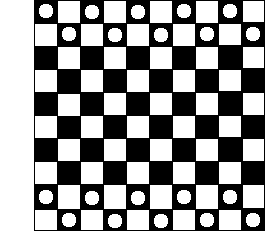
But could'nt we use the unused withe squares to play a second game, independent from the first? Just put a second set of pieces like this. Then this gameboard could be used by two teams of players. (84)
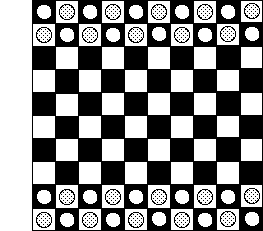
The two games would be in these circumstances totally independent. In the ghost matter model, we suppose that the first elements "communicate" with second exclusively through the intermediary of gravitation. We could simulate this by imagining the game to be played on a "soft gameboard." When a piece is on a square, it would sink into the material and deform the surface. The second game's pieces would thus be "informed of its presence," without being able to interact with it, take it or be taken by it.
The solar neutrino deficit puzzle.
In classical general relativity, one assumes implicitly that there is a single universe. People say :
- Apply Occam's principle : there is no need to change this vision !
In the center of stars, and sun, fusion reactions occur and produce energy, which is carried by :
-
Photons
-
Neutrinos.
Neutrinos very weakly interact with matter. They easily can cross the sun, for example. Then, they leave the central solar boiler in one second. The energy carried by photons takes more time to reach the surface of the star, its chromosphere. Emitted photons are absorbed by atoms, then emitted again, an so on. Moreover, convective phenomena brings energy from the center of the star to the surface, like in boiling watter.
On Earth, we measure photons' and neutrinos' fluxes (since the last few years). This revealed a 50 % neutrino deficit. We must build a convincing explanation, someday. If we cannot do that, a conclusion will assert itself :
We don't understand how a star works...
Solar dynamics : back to the starting box.
Some theoreticians are very disappointed. Some others are very glad and say : .
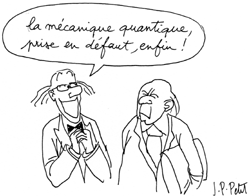
- Hourrah ! Quantum mechanics fails, at least. We will be obliged to create something really new.
A single universe, or two ?
A115
About 'negative masses'.
c (T + + T - )
The kingdom of research.
In Geometrical Physics B the reader will find our personal approach, towards building a group acting on ten-dimensional space, this work being closely related to matter-anti-matter geometry.
Additional dimensions ? Which ones ? What could be their physical meaning ? Could we measure it ?
In his works (Géometrie et Relativité, Hermann-France Ed. 1964, Structure of Dynamical Systems, Birkhauser 1997, and Dunod-France 1973) the french mathematician Jean-Marie Souriau has widely extended physics in a five dimensional context. Then one has the four classical dimensions ( x , y , z , t ) of space-time, plus an extra-dimension z . This last was primarly introduced by the polish Kaluza in the 1920'.
Surperstring approach is an attempt to extend Kaluza trial to six more dimensions. Why 4 + 6 = 10 ? Because group and symmetries constraints.
When a physicist wants to make expriments he asks :
- How much energy do I need ?
Energy is linked to frequency and wavelength, through :

The smaller is the wavelength, the bigger is the energy.
The physicists looked upon these additional dimensions, searching what could be the associated characteristic length, hence the subsequent associated characteristic energy. They found :
The Planck's length : 10-33 cm
Definitively ugly. To give to particles such energies you need an accelerator as big as our galaxy.
-
Normal, says Michio Kaku, in his book "Hyperspace", Oxford University Press, 1994. We deal with future physics. Superstring corresponds to next centuries' science.....
-
Hmmm.....
Strange new discipline. Some years ago I was at Souriau's home. He showed me the proceedings of a meeting devoted to superstrings. On the first page, the chairman had declared :
- Although this new science cannot predict anything nor interpret any observation or experiment, when we consider the increasing number of papers published in the field, it's a symptome that shows its great vitality and dynamism.
Souriau is easily sarcastic, but always with a good sense of humor. About today's theoretical physics, he has his own and short definition :
Mathematics without severity.
Physics without experience
He thinks that since Feynmann's works fifty years of null-physics have past.
(98)
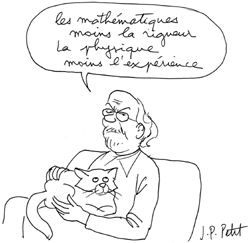
Theoretical physics : "Mathematics without severity. Physics, without experience".
The kingdom of research.
Is it something rotten in the kingdom of research ?
Today, there are more alive scientists than all who worked in the whole history of Science. Which one will write his name in books, in golden letters ?
Between 1895 ( when natural radio-activity was discovered in France by Henri Becquerel ) and 1932 (when the British Chadwick discovered the neutron) it's only been 37 years. During such short time the scientific panorama has been totally changed. Everybody knows that.
I'm writing in 1998. What have we discovered that's so great since 1961, thirty years ago ?
Of course, we have sent people to the Moon, we make micro-computers, cd-roms, we have radio-telephone, we have biologic engineering, and so on.. But they are technologic developments. No really new basic idea. No revolution.
Science seems jailed in a golden paradigm.
After the second world war the system of anonymous referee's system was generalized. The official idea was to protect the independence of the required referee, the expert whose charge was to decide if a paper could be published or not.
Then, when you want to publish something, the rule wants you to submit your paper to some Journal, who calls in an expert. After a month, or two, the answer comes back.
I have published dozens of papers in my life. If the work is conventional, it is relatively easy, but if you frankly go west, search "the physics at the west of the Pecos", if you try to search something really new, you get serious problems.
In fact, you have no problem at all. The answer comes back quickly :
Sorry, we don't publish speculative works.
No expert was chosen. Your paper was not reviewed. Why ?
Because top level journals receive too much papers, daily. Nature receives 100 papers each morning. Physical review, a dozen. How do you think they can manage that ? Next, historical references.:
COSMOGONIA Cosmology, Theoretical Physics. Agora Street. Eube 58340 Macedonia.
Publishing manager : Pr. Aristote.
to :
Mr. Nicolas COPERNIC
Old Mill Street. , 7
2304 Gdansk
Poland.
Eube, 81 bef. JC, oct the 30
Reference : D-5703
Dear Sir;
I have read your paper entitled : "De revolutionibus orbivm coelestivm" with attention and interest. Your model is attractive but unfortunately absurd. As everybody knows, objects can move only if a force acts on them. Furthermore the heavy objects are evidently more sensitive to forces than light ones. Do a simple experiment. Drop a stone and a feather from the second floor of your house. As you will see, the stone gets to the ground faster. Base your physical vision on simple facts.
If the Earth was moving, as you suggest, some force should act on it. As inhabitants of the Earth we should be imbedded in this force field too, and this force should act on us. As we are made of material lighter than the Earth, this last should go away and we should stay in space like idiots.
I am sorry but I must reject your paper.
Pr. Aristote
Publishing Manager

COSMOLOGIA International Journal for Astronomia and Cosmologia. Uraniborg 26120 Danmark
Publishing manager : Pr. Tycho Brahé.
to :
Mr. Nicolas COPERNIC
Old Mill Street, 7
2304 Gdansk
Poland.
Uraniborg, le 6 février 1590
Référence : A-4428
Dear Sir,
I have read your paper entitled : "De revolutionibus orbivm coelestivm" with attention and interest.
This idea of a moving Earth is not new, but it never resisted, when analysed seriously.
If the Earth was moving, as you suggest in your paper, this should cause an apparent displacement of nearby stars, with respect to the background, composed by distant ones.
Stars do not lie at the same distance from us. Like candles, the fainter they are, the farther they are.
If the Earth was moving, the closest stars should get an apparent displacement, due to parallax effect.
What is parallax ? Place your finger in front of your nose and look at it, first with your right eye, then with the left one. Your finger will seem to move, with respect to the background. Your two eyes just figure two distinct positions of the Earth, if moving on a circular orbit, around the sun, as you suggest in your paper. .
Look at the sky. Do you see any stars moving ? The constellation of the Big Bear is the same since thousands of years. I'm sorry, but your model, with its moving Earth, contradicts observations.
The movement of planets, which has been intensively studied during centuries, is now quite well undestood. See : "C.Ptolemy, Almageste, Elements for mathematical composition, Phd thesis (231 after JC), chapter " epicyclic paths of planets", page 77. "
This book, where all these things are clearly explained, is probably in your university's library.
I'm sorry, but your paper cannot be published in our Journal.
Pr. Tycho Brahé
Publishing manager.
How old is the universe ?
A120
A word about parallax method :
Geometric context.
Conjugated curvatures.
Introducing a field equations system.
Geometries induced by ghost matter.
Conclusion of this first part devoted to geometry.

Pages d'origine : a101.htm, a102.htm, a103.htm, a104.htm, a105.htm, a106.htm, a107.htm, a108.htm, a109.htm, a110.htm, a111.htm, a112.htm, a113.htm, a114.htm, a115.htm, a116.htm, a117.htm, a118.htm, a119.htm, a120.htm, a121.htm, a122.htm, a123.htm, a124.htm, a125.htm, a126.htm