ANTIBABEL
Introduction
It is written in the Bible that God, dissatisfied with the arrogance of men who had begun to build a tower so high that it would have allowed them to reach the heavens, decided to create a linguistic panic on a global scale. As work accidents multiplied, the works had to be abandoned.
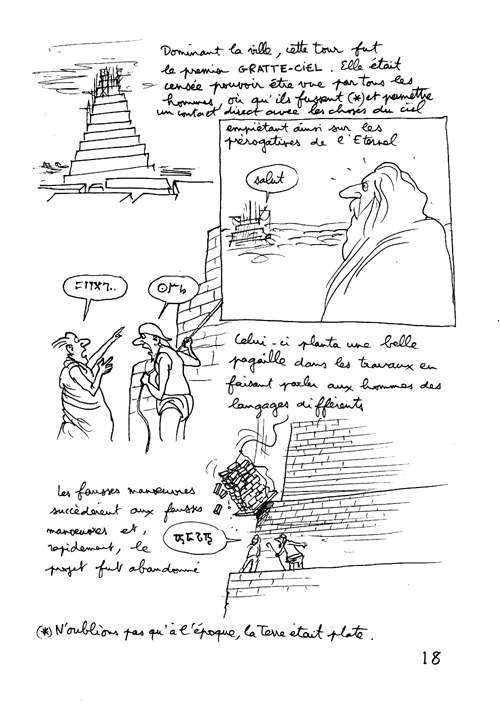
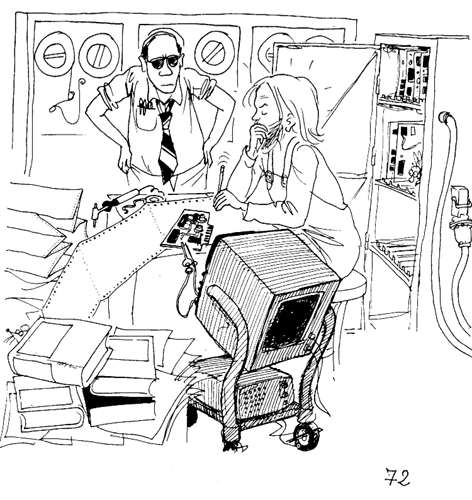
...Today, there are an incredible number of languages and dialects on Earth. Yet we are reaching an interesting time, where people should finally be able to speak to each other, regardless of the distances separating them. For today's youth, who were born with a bottle in one hand and a mobile phone in the other, all of this may seem obvious and natural. But this has only been possible thanks to half a century of technological advancement. However, when it all began, space was not really believed in, or it was imagined that we would build bases on the Moon or on Mars. The main use of space has proven to be communication, with its two inseparable aspects: education and brainwashing. While the International Space Station accumulates delays and budget overruns, and while the Mir station ended its days burning up like a beautiful meteor, the geostationary communication satellites are elbow to elbow. This is one of the peculiarities of computing and its derivatives. The price-to-quality ratio keeps increasing. In any large store, you can find thousands of megahertz and gigabytes for practically nothing. In ten years, where will we be? Will we end up selling super CDs at the entrance of the National Library, where all the documents gathered over the centuries have been compiled? I won't venture to provide an answer. I see us, twenty years ago, in the microcomputer service I had created at the Faculty of Letters in Aix-en-Provence, looking at a two-megabyte hard drive that made as much noise as a sewing machine, and which was equivalent to fifteen floppy disks (five-inch "floppy disks") of the time, using machines running at 2 megahertz, with 48 K central memories, 120 K floppy disks, "high-resolution" screens displaying 130 by 180 pixels, with "screen pages" of 8 K.
Presenting this first hard drive, my friend Iohannès Baggoe, whose portrait is forever immortalized on the last page of informagique, at the time when he still wore suspenders, said solemnly:
*- You can fit the entire Bible inside it. *
.
I won't surprise anyone by saying that we live in an amazing time. The CD, the USB key, the MIT hand-cranked computer, freed from the constraint of having to be near an electricity source, is Gutenberg II.
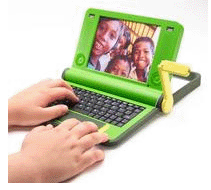
The portable computer developed by MIT
whose battery is recharged using a dynamo operated by the yellow crank
The web was born from the concerns of American military: "how to maintain contact in case of a nuclear conflict?" This kind of outdoor game excluded any centralized communication system. Thus was born the net, a machine full of ganglions, but without a brain. In a way, it's the reverse evolution. It's great, you can chat with anyone, from one end of the planet to the other. When I opened this site seven years ago, the visits started like a trail of powder. We had installed a software indicating the countries to which the people connecting belonged. In barely a year, this number reached a hundred, to the point that, consulting my archives, I said to myself:
*- Hey, it's strange, there are no Eskimos in my list. *
But there was an explanation for this immediate enthusiasm. My site had an "English-speaking" version. This explains that. Conclusion: if you want to enter the great planetary club, you must speak the language of Bill Gates. I don't like that. Language is the first community element of an ethnicity, its cement, its framework. When the language leaves, the ethnicity disperses, it dies. It is the first step of ethnocide, a word invented by the French ethnologist Bernard Jaulin. The death of a people is above all the death of its language.
One could say "it's natural selection. Here in France, no one speaks Gaulish, Vandal or Visigoth anymore. Indeed. This is the theme dear to the Yanks, that of the "melting pot". But after melting everything into everything, does it really give good things? In fact, it doesn't really convince me. After being run through the linguistic rolling mill, peoples lose their identity, their cultural richness.
Well, some might say, there are automatic translation software. But have you ever used one? I gave up on it. What to do with something that translates "il y a belle lurette" as "there is a beautiful candle". Everyone knows the problems of automatic translations. A poor man is not a poor type, etc. In one language, it's this, in another, it's that, and the misunderstanding, or at best the unbearable heaviness, is at the end of the road. The slightest word can adopt five or six completely different meanings depending on the context, or even what might have been said in the previous sentences. We don't realize it, but the slightest biped among us has millions of ready-made sentences in their head. A language is monstrous.
But there are translators. I know, I myself translated a book "The Stars", in the series "Journey Through the Universe", by Time-Life. Looking closely, on the last page, in tiny characters, you will find me. My mother was not English and I don't pretend to be bilingual, far from it. Yet my translation is very acceptable. Two principles:
- Respect the author's thoughts, without deviating from them.
- Make sure no one can guess that this text in French was translated from English.
To do this, you simply need to understand what you read, the meaning of the speech. A good translator never does a word-for-word translation. He manages, in his language, to rephrase the thoughts of the foreign author whose prose he is translating. In contrast, a computer is incapable of understanding "what it reads". As I make my characters say, in "What Robots Dream", one of the 19 science comics I have written, in the series of Anselme Lanturlu's adventures:
In terms of artificial intelligence, we have barely reached the stage of stupidity.
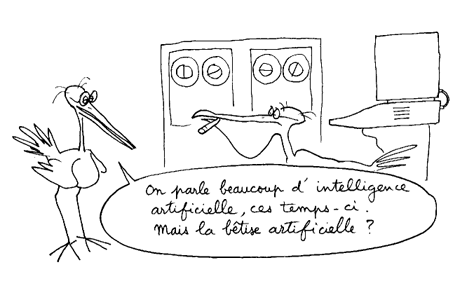
In short, that's it. Corollary: the computer is an inexhaustible generator of all kinds of stupidity. This is why we have given up managing "defense" by computer. Too dangerous.
So, what to do? In my opinion, the solution is right in front of our eyes. If I had time, I would get back into programming, but I have so many things to manage that a choice is imposed. I will give the ideas, in a jumble. There would need to be many people to create the linguistic communication tool "all languages".
What is common to languages? The meaning, what we talk about and which pre-exists with respect to words. We have dictionaries. What do an English-English dictionary and a Russian-Russian dictionary have in common? Answer: the images. I don't know how to say "elephant" in Russian, but if we include a photo of an elephant in a plate, an Englishman and a Russian would recognize it at first glance. An Eskimo would have more difficulty, certainly. It is not obvious that the word "elephant" appears in an Eskimo-Eskimo dictionary. Indeed, there are no elephants near the polar circle, but, apart from in zoos, there are none in Russia, or in Seine-et-Marne.
We therefore have a first base: the image. There is also movement, gesture. The comic strip has its codes. One day I may try to create a comic strip with a pedagogical purpose, without words, just with recognizable objects for many readers, attitudes, gestures. It's amazing what you can explain with a comic strip. Many years ago I was in the Massai country. I love this part of the world where I feel at home and that I have traversed from end to end, when I was driving clients on safari. One day we were invited to dinner by the chief of a village. He was surprised by two things. The first was that I had beaten the men of the area at archery. That a white man could fit arrows into a tree while the Massai shot them aside amazed him. The second thing that surprised the locals was a strange piece of wood that I was carrying with me. It was simply a simple pencil. But the Massai do not sculpt or draw. They make beautiful assemblies with metal wires and colored beads. This goes back to the dawn of time. They decorate themselves with dried mud drawings made with their fingers. But that's as far as it goes. Therefore, the fact that a man could create intelligible things with a piece of wood and a sheet of paper seemed to them to be pure magic. Don't you find that incredible? The Massai have remained relatively isolated for a long time. The facts I am telling you date back to a time when tourism had not yet become popular there, as it is today. There were either very rich people, or sorts of madmen who, after stocking a vehicle with supplies in Nairobi, went anywhere. To tell you the truth, I even improved the ordinary by poaching a bit. Hence this archery skill, of a gastronomic nature.
The Massai are lovely, intelligent and full of humor people. They squinted mischievously when they saw the pencil running on the paper and when, in the end, this set of trajectories began to resemble one of them. The language they speak, "maa", different from Swahili, is inaccessible to the average Westerner. I had therefore found a language through which I could communicate with people who lived on a planet really different from mine. However, by chance of these meetings, we were invited into one of the huts made of interwoven branches and dried cow dung. Only the village's notable people could sit with us around the fire. As the meeting interested many people, "couriers" kept leaving with the drawings I made, which were commented on by firelight, outside. Suddenly the chief made an unequivocal offer: my flat flashlight, in exchange for his bow, his leather quiver and his arrows. I was extremely embarrassed, especially since at least at that time flat batteries did not exist in the country. In the stores, run by the Indians, there were only round batteries. I tried to explain this to the chief. It was long, laborious, but he read my drawings with the greatest attention. Everything went through. The flashlight that weakens, the chief who takes the road to trade a goat for this magical object that allows to make light again. And, finally, the Indian who shows him that the round battery does not fit into the casing. The chief gets angry and goes back on the road, furious at having been tricked by a white man who had not sold him the right magic. ...I will never know exactly what he understood. The important thing is that he realized that this trade would be to his disadvantage. And all this with drawings, without words, without verbs, without grammar. A "meta-language" would say the linguists. The members of the tribe commented on this linguistic event until morning.
A few years ago I returned to Kenya. Even though the country is now crisscrossed by Volkswagen or Toyota vans full of Japanese, don't think that the locals have a clear perception of our world. One night I was around a fire with some Massai, the chief of a neighboring village. The moon was full, magnificent in this clear sky. I had binoculars. I gave them to him. He let out a cry of astonishment when suddenly the lunar body appeared so large. The binoculars allowed him to see the craters, which he had never seen. I didn't understand what he was saying to his neighbors, but the conversation was very animated. Obviously, his friends also wanted to take part in this. Finally, he passed the pair of binoculars to one of them, who started searching for the moon in all directions, pointing the binoculars... in all directions. That's when I realized that these people had no notion of optics or electricity. Did they know where the oil gas that we put in our cars came from? He probably had no idea. For them, we were aliens.
I finally exchanged my pair of binoculars for his acacia staff. He appreciated this symbolic gesture. The staff of the herdsman is a sign of clan membership. We were moved when we parted. He had hung the binoculars around his neck. God knows how many Massai, young or old, have discovered the wonders of the sky thanks to them. I realized that we formed a large family of earthlings, inhabitants of this "wayward planet" as Saint Exupéry called it.
To speak, to understand. But how to cross the language barrier. How many men kill each other on earth simply because they don't speak the same language?
There are my "science comics" that spread like a trail of powder through the "Knowledge Without Borders" operation. But you can imagine that my idea is not to communicate people through comics. I'm thinking of something else, an idea that is close to my heart. For the conversion, the shift of the message towards any language, to be easy and safe, it would be necessary to perform a
semantic input
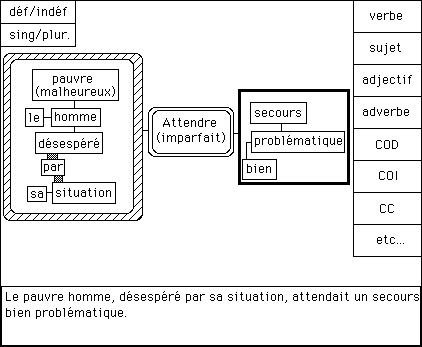
. What is important, is what we want to say, not the language in which this message is expressed. All grammar manuals will tell you that sentences are organized like molecules, around a "verbal core". Subject, complements, assemble around this verb like functional radicals. It is finally misleading to write a sentence in a linear way, from left to right (or from right to left for Arabs, Hebrews or others). The 2D structure of a sentence is comparable to the "developed formula" of a chemical compound which, without this mode of presentation, does not reveal all its richness.
Take the sentence *
The poor man, desperate because of his undesirable situation, was waiting for a problematic help. *
How could we imagine a non-linear writing of this sentence, in "2d"? It is necessary to conceive a coding with a system of input: screen, plus mouse. In this black and white file I have represented boxes with sequences of characters: verb, subject, adjective, adverb, direct object complement, indirect object complement, circumstantial complement, etc...
Other boxes represent the singular and the plural. This notation could easily be made international by using simple colors. Red for the verb, yellow for the subject, blue for the adjective, etc...
The input is done in a given language. The same software could allow this input in a large number of languages. At the center, the verb "wait", in the imperfect. It is a verb apparently not ambiguous, otherwise the program would react immediately, asking for clarifications. You click on the "verbal core" icon and a box appears. In the box you type the verb and you click on the time icon. At this stage the machine does not know who is waiting, nor what, but it knows that the action is in the imperfect. What coding? Colors, patterns, stripes, dots. The graphic palette is rich. The whole thing is to agree on an international standard. Think: for road signs, everyone has agreed that the color red is related to a prohibition or a danger. It would never occur to anyone in a city to put a parking sign of a blue color.
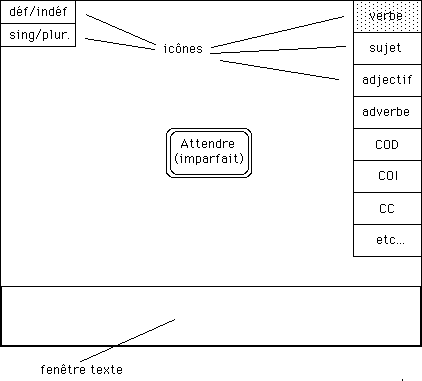
You click on "subject of the verb". A box is positioned, with the link coded. You type "man". Then you click on "singular". Immediately the verb is automatically modified, in its box and "wait" (imperfect) becomes "waited".
You then make a choice, for the subject man between definite or indefinite. If it is indefinite, a man appears.
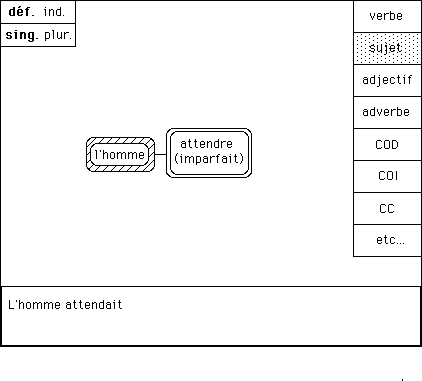
You click on adjective and you introduce "poor". But the adjective "poor" can have different meanings. The computer, which has as much memory as it wants, can memorize these nuances, which the human being cannot do. It would be too heavy. Imagine manipulating verbal objects like poor(1), poor(2), poor(3), poor(4), etc...
We know that the adjective "poor" does not have the same meaning if we talk about a poor man or a poor type. Should we specify the semantics of the adjective by using poor(1) in the first case and poor(2) in the second? No, the usage has introduced a positional overcoding, which is far from the only one. There are sentences where the whole structure contributes to revealing the meaning of one of its elements. But since the computer is not stingy with memory, it can, in its turn, note these semantic variations as they occur. In practice, it is necessary to implement a system for eliminating ambiguities. For this adjective, or any other word: a "dropdown"
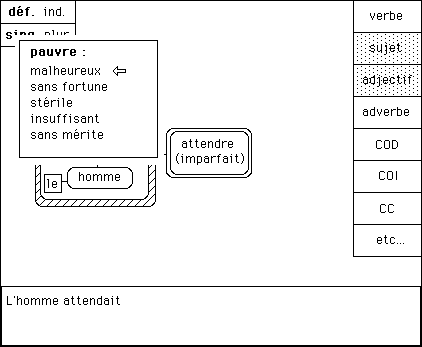
When the choice is made, the text is automatically modified in the lower window. It is synthesized in the language through which the input is performed. But these meanings of the adjective "poor" exist in many languages. The meaning pre-exists with respect to the expression.
On the screen, the "developed formula" changes according to the choices made.
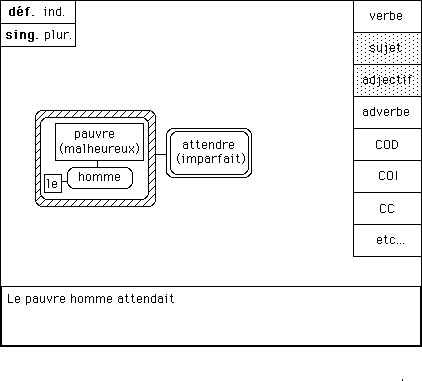
We move to the COD, the direct object complement. The word is "help". We specify "singular". The article appears automatically. At the end of the input, we could have, for example:
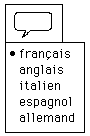
Somewhere, in a "navigation bar", a universal ideogram, meaning "language": the bubble, the phylactery of comic book authors.

When you click on it, the dropdown of languages appears:
where the input language would be indicated. You could change it at will. By clicking
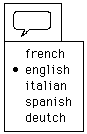
.The text, in the "composed sentence" window, would change. I am convinced that such a program would be feasible. Of course, there would be difficulties to master, but such messages, entered not only in their form, but in their grammatical and semantic structure, would be easy to express without misunderstanding in different languages. Heavy, some would object. But what satisfaction to know that you compose a text that can be immediately understood in 22 languages.
As it is, it's just an idea, a program. It would be impossible for a single man to manage it. It would above all be an immense team effort. It would be necessary to consider a software that is capable of evolving, of enriching itself. A kind of Linux of translation. But, some would say, what is the basis of a language? It is simply the real, the things, the gestures, the attitudes, expressions, true linguistic atoms, logons. In principle, a dictionary should be composed in such a way that the entire set of words can be described using basic words. But we know that it is impossible, because words have multiple meanings. However, illustrated plates, carrying images, can be unambiguous. A handbag is a handbag, in all countries where people use it. Also think that the presentation, the storage of objects, can today be conceived in 3D, in "VRML format" (virtual reality). Multimedia allows to manipulate sounds, movement.
In history, it has happened many times that men met on a beach, who had no common linguistic element. Then, what did they do? They spontaneously returned to the universal language: that of gestures and mimics. I will clarify this another time: I am eager for this file to be online. I will not delay in having it translated into English, so that a larger number of people can be interested, react to the idea. I had started to raise these things five years ago. It led me to contact a French team. But it didn't give much, although they were professional linguists from the CNRS. I think they simply didn't understand the idea, continuing to cling to a linear coding where they simply envisioned adding more signs to the sentences. However, in my opinion, it is essential to break this linear writing, at the level of input (even if, at the stage of verbal synthesis, in a given language, this linearity reappears). To illustrate this, I will provide an example where 2D writing is imposed. It is the ... mathematics.
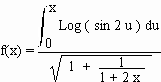
The writing using the fraction is typical of this two-dimensional arrangement. The integral and the radical "operate" on sets of characters, according to a coding that mathematicians have designed to precisely eliminate all ambiguity. At the other end of the chain, the person who manipulates a computer programming language is constrained to a linear writing, which does not make life easier for him (but already the "formal calculators" are trying to get as close as possible to the usual writing).
I composed this formula using a mathematical text processor. Here is what my screen looked like:
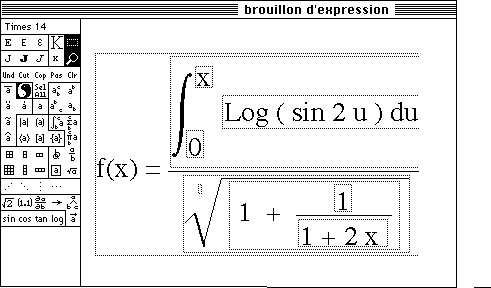
All scientists know how to use these tools skillfully. The habit is acquired very quickly. The linearized expression consists of "saying" this equation verbally, what you would do if you had to transmit it by telephone. It would give:
...*We consider a function f of x which is written in the form of a fraction. The denominator is equal to the root of a sum of two terms, the first being one and the second the fraction one over one plus two x. The numerator is a function defined by an integral where the variable is the upper bound of that integral. This integral is written as the sum from zero to x of the logarithm of the sine of two u, du. *
From this statement, a student is able to reconstruct the formula above. Therefore, this juggling between linear representations and 2d representations already exists in a particular language, mathematics, but how efficient.
*What can be done in mathematics should be extended to all languages. *
By the way, I mention an idea that would make it possible to materialize this project of international semantic expression. There is even money to be made in this matter, and quite a bit.
In an airport you hear, or you see displayed, messages, in limited numbers. They appear on simple video screens or on large screens. Imagine a message like:
*Passengers on Air France flight 745 to Ankara are informed that due to bad weather conditions, this flight is suspended. Passengers are asked to go to gate 5 of terminal C, with their identity documents and their ticket. A stewardess will take them to a bus that will take them to town, to a hotel where they can spend the night and benefit from a free telephone connection to inform their relatives. They will be informed as soon as the improvement of the weather conditions makes the flight possible again, very likely during the day of tomorrow. *
If you think, you see that the entire message can be converted into animated ideograms, displayed on a screen. Nearby, kiosks with liquid crystal or plasma screens, allowing the message to be displayed, without risk of error, without possible misunderstanding, in an unlimited number of languages, possibly in sound form for those who have reading problems, the user only having to type the name of the language on a keyboard or click on the corresponding flag. Why? Because the message, in the computer's memory will be present in its semantic form and can thus be instantly converted into a linguistic message.
It would be very easy to make a demonstration program based on animated gifs, and if programmers want to do it, I will make the gifs in question, that is to say the elements of this graphical language. After that, they could approach large companies to interest them in this project, which is ultra-simple.
Number of visits between September 27, 2004 and January 24, 2006: 34,000 (without much echo)
**Number of visits since January 24, 2006 ** :
Return to News ...... Return to Guide......
