Warning: Beware of the dangers of apnea!
home_fr.htm ../../apnee.htm apnee.htm
Translated by Benjamin ROTTIER
Apnea diving is an ancient practice. In sunken galleons containing amphorae of wine or olive oil, discovered off the southern coast of France where the sea is 25 meters deep, large stones were found that couldn’t possibly have rolled down from any cliffs. Each stone weighed between 11 and 22 pounds and resembled a large pebble. For a long time, these stones puzzled archaeologists, until they realized that when placed in rope baskets made of plant fibers, they served as weights for divers attempting to retrieve objects from sunken ships.
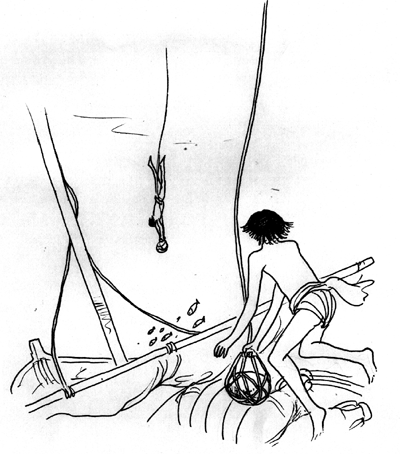
Back then, shipowners, whenever possible, tried to salvage their valuable cargo when the water wasn’t too deep. Back then, human lives weren’t valued very highly.
In dictionaries, apnea is defined as a voluntary cessation of breathing. But what happens when you hold your breath? Within just a few dozen seconds, you’ll feel a painful sensation of suffocation that quickly becomes unbearable, forcing you to breathe again. This sensation arises from an increase in carbon dioxide levels in the blood (or, more precisely, in the partial pressure of carbon dioxide; the distinction will be explained later).
How can you prolong the duration of apnea? There are three methods: – The first involves controlling that suffocating sensation. Some divers achieve this through techniques similar to yoga (which also helps control pain). – The second method involves filling the lungs with as much air as possible before holding one’s breath, for instance prior to diving. – The third method involves hyperventilation before diving.
For prolonging apnea duration, the third method is by far the most effective—but also the riskiest. Let’s examine why! To hyperventilate, a diver breathes rapidly for a certain period. This doesn’t necessarily mean taking a massive inhalation; rather, it ensures efficient ventilation of the lungs: residual air is expelled and replaced with fresh air. It’s well known that under normal breathing conditions, not all air in the lungs gets replaced with each inhalation-exhalation cycle. This process is regulated by muscles: primarily the diaphragm, and to a lesser extent the muscles controlling rib movement. Yet this technique has its limits: it cannot completely empty the lungs. When hyperventilating, nearly all air is replaced. Consequently, the lungs contain air identical to the surrounding water, rather than a mixture of inhaled air and residual carbon dioxide from previous breaths.
Put simply: hyperventilation lowers the amount of CO2 in pulmonary air. Hemoglobin is a blood molecule capable of binding both oxygen (oxyhemoglobin) and carbon dioxide. Hyperventilation thus reduces not only CO2 levels in the lungs but also in the bloodstream.
You can’t alter the proportion of oxygen in atmospheric air (20%, the remainder being nitrogen), but you can increase its concentration in the blood. If you continue hyperventilating for several dozen seconds, you’ll feel dizzy; this symptom reflects the blood’s heightened oxygen content. If you hold your breath at the surface or one meter underwater in a swimming pool, remaining completely motionless, you’ll be amazed at how long you can remain submerged. Apnea durations exceeding one minute can thus be achieved quite easily. With sufficient training, many individuals can reach one minute without any difficulty whatsoever. The absolute human limit is roughly four minutes, attained only by elite ‘record-holders’.
Why can you endure such prolonged apnea? It’s not so much due to oxygen enrichment of the blood, but rather to CO2 depletion prior to apnea onset. Yet CO2 acts as a crucial danger signal. The real risk lies in fainting when blood oxygen levels drop below a critical threshold. This is extremely perilous, as there’s no preliminary warning such as discomfort; unconsciousness ensues instantly, without any possibility of restarting breathing. A person who drowns this way retains dry lungs. This is how apnea functions following hyperventilation. A diver employing this technique achieves superior results, yet simultaneously disables his natural warning mechanism (the suffocation sensation caused by rising CO2 levels). He may faint without experiencing any sense of suffocation at all.
Apnea is primarily practiced in free-diving. Under such conditions, a diver must ask himself: ‘Given my goal depth, should I swim vigorously to reach it as swiftly as possible within the apnea window, or conversely minimize exertion throughout descent, at depth, and ascent?’
The latter approach is correct. An apneist must swim, dive, and glide while conserving energy: abrupt movements and intense muscular effort must be avoided (they increase oxygen consumption). Carefully weighted, the diver ascends and descends slowly, without haste. Wearing a wetsuit is essential unless diving in very warm waters; combating cold dramatically raises oxygen consumption.
Any unnecessary exertion must be avoided, as it leads to excessive oxygen usage. Even mental activity, basic brain functioning, consumes vast amounts of oxygen—this effect shouldn’t be underestimated. If you experiment with apnea while performing complex calculations, you’ll notice a considerable drop in endurance. Consciously or subconsciously, apneists thus learn to ‘stop thinking’ while diving. If they succeed in clearing their minds, their performance improves. In doing so, they unwittingly employ rudimentary meditation techniques (Buddhist, Hinduist, yogic).
Mentors encouraging disciples to meditate instruct them: ‘Suppress the flow of thoughts.’ What then occurs? I cannot explain it fully. Either meditation connects humans to transcendent mental realms, altering consciousness, or the brain redirects oxygen toward regions normally receiving less (conscious thought centers, when active, absorb oxygen first). The outcome is a sense of euphoria, familiar to all apnea divers. Effective apnea equates to bliss; otherwise it fails, simply because it demands a non-thinking state.
Prior to attaining spiritual enlightenment or nirvana via non-thinking, apneists relish instinctively adopting this mindset, which proves beneficial amid stress or obsession. Naturally, apnea diving also allows appreciation of underwater beauty. Yet its mystical significance for many divers stems from objective reality, though few recognize it.
Physically speaking, divers can reach 30 meters depth while maintaining apnea for one and a half to two minutes. Some ‘exceptionally gifted’ individuals surpass this. This activity resembles Russian roulette: these ‘supermen’ merely shrink the margin separating them from fatal unconsciousness.
So, what’s advisable? Declare apnea diving an inherently hazardous pursuit, or seek compromise?
Before venturing into specifics, awareness is vital. Fatigue drastically heightens risk; likewise overexertion, sleep deprivation, or any factor inducing exhaustion.
Around age twenty, I frequently practiced apnea diving during vacations. In winter, I occasionally dove in a 50-meter-long swimming pool (Paris’s Tourelles Pool). Fit and strong, I managed to swim across it at one-meter depth wearing fins (equivalent to diving 20 meters and returning). Apnea at such shallow depths appears harmless—a grave misconception! At that time, I was preparing intensively for university entrance exams; I slept minimally and studied relentlessly. I believed swimming would invigorate me. Unattended, I began diving. I’d done so countless times, but only when physically fit; that day, I felt somewhat weary. By chance, I swam toward the shallow end. I never reached it. At approximately 40 meters, I fainted instantaneously, without any warning. I retain no recollection of the incident. Presumably someone found me motionless in the water and summoned help; I regained consciousness at poolside, resuscitated by lifeguards.
Imagine if I’d swum oppositeward. The Tourelles Pool features a ten-meter-high diving board overlooking the deep end, which reaches five meters depth. Had I descended there, momentum might have propelled me deeper still, causing immediate unconsciousness. Human buoyancy fluctuates with depth; even fully inflated lungs succumb to pressure, reducing buoyancy proportionally.
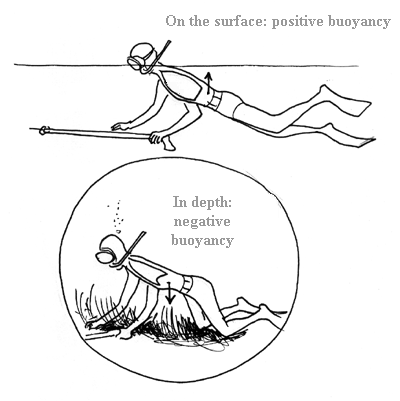
Since I fainted at one-meter depth, I naturally surfaced, retaining some air in my lungs despite gradual loss. Under several meters depth, I’d have sunk inexorably; detection would have proved difficult, and rescue impossible. Upon regaining consciousness, I realized how perilously close I’d skirted disaster.
Upon apnea onset, brain cells cease receiving oxygen. Their resilience is limited; thus, though some drowning victims survive lengthy submersion in frigid waters, this remains exceedingly rare. One can safely assume that total oxygen deprivation lasting five to ten minutes results in irreversible death.
Observe that emergency responders performing mouth-to-mouth resuscitation on drowning victims don’t use ambient air but their own exhaled breath; this supposedly hastens restoration of breathing reflexes governed by CO2 levels.
Why do we instinctively breathe? Simple: blood CO2 concentration rises over time; once surpassing a threshold, the medulla oblongata triggers inhalation. Otherwise, humans would need conscious command to breathe—or else faint.
Fatigue, as noted, heightens apnea risks, especially in cold water. Heart rate and cellular metabolism accelerate, demanding greater oxygen consumption. Even with a wetsuit, performance diminishes markedly. The fundamental issue: no one can predict exactly when unconsciousness strikes under given conditions. The query ‘How long can I hold my breath today, given my fitness level and water temperature?’ defies answer except through personal experimentation. It’s probable countless individuals have teetered on the brink of death unnoticed.
Every abrupt exertion during diving escalates oxygen depletion, potentially dropping levels beneath critical thresholds. This exact scenario claimed my friend Josso’s life forty years ago in Corsica. We’d attended aeronautics college together in Paris circa 1960. Josso regularly dove alongside the Roubaix family; Madame de Roubaix was a champion harpooner. Passionate about spearfishing, they frequented Corsican waters teeming with marine life. Josso dived sensibly—so he believed. One day, at twelve meters depth, he speared a grouper ensconced in a crevice. Struggling to extract it, his oxygen consumption skyrocketed, culminating in fatal unconsciousness.
Well-trained divers can reach fifteen to twenty meters provided a vigilant companion monitors them (preventing dual fatalities). Competitive harpooning demands greater depths; participants typically dive in pairs, each watching the other. Solo deep apnea, however, constitutes pure Russian roulette.
Recall earlier discussion regarding partial pressure of oxygen. Oxygen transfer efficiency hinges on proximity between blood cells and oxygen molecules; higher density equals faster transfer. Hence, professional divers descending beyond 100 meters utilize mixtures containing far less oxygen than ambient levels; otherwise toxicity ensues. Early oxygen-only scuba pioneers suffered convulsions. Excessive oxygen acts as poison.
At twenty meters depth, pressure triples atmospheric levels; though lungs contain less oxygen, pressure triples oxygen density, stabilizing uptake. Conversely, ascending reduces pressure; human physiology reacts to diminished oxygen influx and pressure alike. Hence most fatal unconsciousness incidents occur during ascent. Experts refer to this as the ‘9-meter fainting threshold’.
Deep underwater, even if oxygen reserves suffice to return to surface, a diver feels euphoric. Believing himself superhuman, he neglects prudent ascent timing—and pays with his life.
From mere a few meters depth, air compression within lungs/wetsuit induces negative buoyancy; a rising diver thus sinks rather than surfaces. To clarify: Apnea isn’t sportive; it’s profoundly reckless. Human physiology hasn’t evolved; rather than maintaining safe distances from unconsciousness, ‘champions’ recklessly flirt with death.
With proper conditioning, gradual progression, and adequate gear (especially thermal protection), thirty-second apnea dives at ten meters depth while paired with a vigilant partner prove reasonable. Allow five minutes recovery before subsequent dives; limit overall frequency, as apnea exhausts significantly. Even fit individuals may suffer exhaustion-induced incapacity.
Crucially, media ignore this issue entirely, particularly pre-summer when warnings are imperative. Equally troubling: enthusiasts like Mayol and filmmakers like Besson actively promote reckless behavior. Expecting films like The Big Blue to include cautionary messages is futile; fatalities rarely attract coverage. Consequently, many drownings occur unnoticed. Tragically, many succumb to ‘extreme sport’ delusions.
Approximately fifteen years ago, free deep diving surged in popularity, spearheaded by Jacques Mayol and filmmaker Luc Besson. Post-WWII, divers sought maximal depths; pioneers like Enzo Majorca competed fiercely. Undeniably, apnea exerts allure; yet those assuming ‘apnea has improved greatly’ ignore inherent perils. Federations recommend paired diving, though rescue capability remains uncertain. Mayol pioneered novel techniques: weighted sleds and helium balloons facilitated unprecedented depths. His feats necessitated secret acclimatization: altitude training at Lake Titicaca induced hemoglobin-rich blood, artificially enhancing endurance. East German athletes similarly employed hypoxic chambers to dominate sports arenas. Mayol’s rituals included Zen meditation; post-dive euphoria manifested as primal screams.
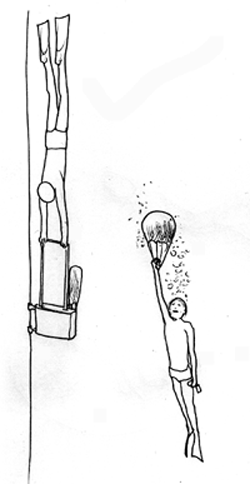
Such spectacle attracted global attention; The Big Blue became iconic. Regrettably, it inspired countless youth to emulate these exploits. My son Jean-Christophe, twenty-three at his demise in 1990, drowned near Marseille. Despite my warnings, he pursued extreme apnea, heedless of risks. His death illustrates how delusional fascination with depth can prove lethal.
From a few meters depth, compression renders divers negatively buoyant; unconscious ascension spells inevitable sinking. To reiterate: Deep apnea isn’t sportive; it’s suicidal folly. Human physiology remains unchanged; ‘champions’ merely gamble with death.
Thirty seconds at ten meters with a partner suffices; no need for superhuman prowess. Exercise restraint: five-minute recovery intervals, limited frequency, and avoidance of exhaustion are mandatory. True mastery demands non-thinking serenity; anything else is hubris.
Undeniably, apnea possesses magnetism; yet practitioners ignoring risks face dire consequences. Historical precedents abound: 1950s wrestling icons halting aircraft via rope tension; cycling speed records achieved via vehicle-mounted wind tunnels. No ethical justification exists for endangering lives through such reckless stunts.
May 18, 2000
Mr. Duhamel from Saint Maur wrote: ‘Like you, I survived apnea incidents. At Saint-Ouen Pool, I remained motionless underwater unaware; rescued only after exhaustion compelled surface ascent. I count myself fortunate.’
November 2000
A French Spearfishing Federation representative shared insightful advice: Hyperventilation effectively clears CO2-laden air; subsequent ‘long inhalations’ mimic this effect. He proposed innovative rescue mechanisms: CO2-powered lifejackets activated upon unconsciousness; ultrasonic signals aiding remote monitoring. Twenty years prior, I developed similar technology, but industry ignored it. Today, dive computers proliferate; perhaps such innovation can flourish.
Julie Gautier from La Réunion recounted her uncle’s demise: ‘At thirty meters, he fainted mid-ascent; my father rescued him, yet trauma resulted. I seek protective systems to spare others such anguish.’
Since September 15, 2001, visitor statistics: