French Apnea
20 July 2006:
One thing I had not thought about, which was communicated to us by a reader who had taken his brother to a doctor after he had fainted in the pool following a prolonged apnea. Yet it is entirely logical. Our body is not designed for extreme apnea.
Even if an apneist manages without problems after apneas of 3, 4 minutes or more, this exercise destroys neurons in his brain and especially cells in his heart muscle each time. Much later, he will pay the price by becoming much more susceptible to heart attacks.
I didn't know that. It is also not taught by the French Apnea Federation and its "licensed instructors."
20 July 2006:
One thing I had not thought about, which was communicated to us by a reader who had taken his brother to a doctor after he had fainted in the pool following a prolonged apnea. Yet it is entirely logical. Our body is not designed for extreme apnea.
Even if an apneist manages without problems after apneas of 3, 4 minutes or more, this exercise destroys neurons in his brain and especially cells in his heart muscle each time. Much later, he will pay the price by becoming much more susceptible to heart attacks.
I didn't know that. It is also not taught by the French Apnea Federation and its "licensed instructors."
A murderous journalism
The article that follows is taken from the newspaper Le Monde dated July 21, 2003. Its reference:
http://www.lemonde.fr/web/article/0,1-0@2-3230,36-373040,0.html
Three years later, the same newspaper repeats its mistake. Go to the end of this long html page
It's the height of summer. There are topics that seem to be in season. A journalist, Charlie Buffet, thought it appropriate to publish this article in a widely read and especially brutal newspaper, Le Monde (July 19, 2004). He titled his article "At the Limits of the Body." I don't think a right of reply is possible, where I would be allowed to expose the dangers of extreme apnea, a real Russian roulette. The text published in Le Monde is in blue. You will read it. Then, I hope you will take note of the file I have put on my website, which apparently has already saved several lives. But it's not "sellable." What is sellable is to publish such stupid texts, to give voice to approaches that are anything but sporting or even scientific.
LE MONDE, 19.07.04
• UPDATED ON 19.07.04
16h25
AT THE LIMITS OF THE BODY
A fish named Mayol
The sailor immortalized in "The Big Blue" explored the mysterious sensations of deep diving.
Gheorgios Haggi Statti would probably never have been photographed in his life if an Italian battleship, the Regina-Margherita, had not come to break his anchor in front of the island of Karpathos on a day in 1913. The accident had caused three deaths, the anchor was resting at 80 meters under the sea, and an officer photographed this 35-year-old sponge diver, with a narrow face and a thick mustache, his body floating in his cotton clothes, who offered to recover the anchor and its chain, attracted by the promise of a reward.
The pretentious man was first dismissed: he was unable to hold his breath for more than forty-five seconds. And the examination that the ship's doctors performed on him was disastrous. Haggi Statti had a rather average chest, emphysema, and poor hearing: one eardrum was perforated, the other non-existent! But the man, who claimed he could dive to 100 meters, managed to do a demonstration underwater and, without any preparation, stayed there for more than six minutes!
In the following days, the doctors saw him dive about fifty times to depths of 60 to 84 meters, in a swimsuit and weighted with a large stone. He climbed up the rope with his arms, after apneas of more than three minutes, neither out of breath nor tired. Finally, after four days, the anchor was found and brought on board. To the astonished doctors who asked him about his sensations at the bottom, he answered: "I feel the whole weight of the sea there, under my shoulders... I have a tight throat, I feel oppressed, but I no longer think about breathing." Words of an alien that would take sixty years to understand. But beware: in the story of Haggi Statti, every word counts, every detail is true.
This incomprehensible story for his contemporaries had fallen into oblivion. In the 1970s, a man found the doctors' reports in the Italian navy archives and told the story in a book, Homo Delphinus. His name was Jacques Mayol. The romanticized Mayol of The Big Blue? Neither quite the same nor quite another...
Jacques Mayol, born on April 1st in Shanghai, has a wandering soul. A cosmopolitan Frenchman, he attended high school in Marseille, traveled (and had two children) in Scandinavia, ended up in Canada as a logger, sailor, and then journalist. A seducer and elusive, even for his closest ones, he loves without counting: languages, beautiful women, the unexpected. In 1957, by the chance of a reportage, his life, as they say in fairy tales, turned upside down. Plouf! He was 30, she was named Clown, the prima donna of the Miami Aquarium. The female dolphin, "at first, had only flirted a little with me." But for the man, it was "a lightning strike," "an illumination that lasted the time of a glance." In Homo Delphinus, Jacques Mayol describes this relationship as a love passion. He let his hair grow so that Clown could pull it, and when the beautiful one did: "A kiss from the most beautiful girl in the world would not have made me happier." It's not (just) playboy humor. As the book's title indicates, surpassing the boundary between man and animal would be the great affair of Jacques Mayol's life.
He would still be a lobster fisherman in the Caribbean, a film student in Hollywood, and an apprentice yogi in Japan. But by diving every day with Clown in the Miami pool, Jacques Mayol became what he is: an apneist. He dived longer and deeper, entered the record race in 1966, launching a decade of legendary competition with the Italian Enzo Maiorca. Mayol, who would become, on November 23, 1976, off the island of Elba, the first man to reach 100 meters in apnea, does not shy away from the pleasure of records.
LE MONDE, 19.07.04
• UPDATED ON 19.07.04
16h25
AT THE LIMITS OF THE BODY
A fish named Mayol
The sailor immortalized in "The Big Blue" explored the mysterious sensations of deep diving.
Gheorgios Haggi Statti would probably never have been photographed in his life if an Italian battleship, the Regina-Margherita, had not come to break his anchor in front of the island of Karpathos on a day in 1913. The accident had caused three deaths, the anchor was resting at 80 meters under the sea, and an officer photographed this 35-year-old sponge diver, with a narrow face and a thick mustache, his body floating in his cotton clothes, who offered to recover the anchor and its chain, attracted by the promise of a reward.
The pretentious man was first dismissed: he was unable to hold his breath for more than forty-five seconds. And the examination that the ship's doctors performed on him was disastrous. Haggi Statti had a rather average chest, emphysema, and poor hearing: one eardrum was perforated, the other non-existent! But the man, who claimed he could dive to 100 meters, managed to do a demonstration underwater and, without any preparation, stayed there for more than six minutes!
In the following days, the doctors saw him dive about fifty times to depths of 60 to 84 meters, in a swimsuit and weighted with a large stone. He climbed up the rope with his arms, after apneas of more than three minutes, neither out of breath nor tired. Finally, after four days, the anchor was found and brought on board. To the astonished doctors who asked him about his sensations at the bottom, he answered: "I feel the whole weight of the sea there, under my shoulders... I have a tight throat, I feel oppressed, but I no longer think about breathing." Words of an alien that would take sixty years to understand. But beware: in the story of Haggi Statti, every word counts, every detail is true.
This incomprehensible story for his contemporaries had fallen into oblivion. In the 1970s, a man found the doctors' reports in the Italian navy archives and told the story in a book, Homo Delphinus. His name was Jacques Mayol. The romanticized Mayol of The Big Blue? Neither quite the same nor quite another...
Jacques Mayol, born on April 1st in Shanghai, has a wandering soul. A cosmopolitan Frenchman, he attended high school in Marseille, traveled (and had two children) in Scandinavia, ended up in Canada as a logger, sailor, and then journalist. A seducer and elusive, even for his closest ones, he loves without counting: languages, beautiful women, the unexpected. In 1957, by the chance of a reportage, his life, as they say in fairy tales, turned upside down. Plouf! He was 30, she was named Clown, the prima donna of the Miami Aquarium. The female dolphin, "at first, had only flirted a little with me." But for the man, it was "a lightning strike," "an illumination that lasted the time of a glance." In Homo Delphinus, Jacques Mayol describes this relationship as a love passion. He let his hair grow so that Clown could pull it, and when the beautiful one did: "A kiss from the most beautiful girl in the world would not have made me happier." It's not (just) playboy humor. As the book's title indicates, surpassing the boundary between man and animal would be the great affair of Jacques Mayol's life.
He would still be a lobster fisherman in the Caribbean, a film student in Hollywood, and an apprentice yogi in Japan. But by diving every day with Clown in the Miami pool, Jacques Mayol became what he is: an apneist. He dived longer and deeper, entered the record race in 1966, launching a decade of legendary competition with the Italian Enzo Maiorca. Mayol, who would become, on November 23, 1976, off the island of Elba, the first man to reach 100 meters in apnea, does not shy away from the pleasure of records.
I had the chance to know Jacques Mayol well. I even dived in the Caribbean with him, during an expedition around the Cay Sal Bank reefs, off the coast of Cuba, in the 1980s. Jacques was a dreamer. He wasn't a man of money, otherwise he would have become rich. He mainly enriched others. For The Big Blue, he signed a contract allowing the use of his name, based on a flat fee and not a percentage, ridiculously low in view of what the film brought in. But he lived like a butterfly, dazzled by the lights of the spotlight, the fame, those that give "the feeling of existing" and for which some are ready to do anything, to put their lives and even others' lives in danger.
He had especially a trick that it is now appropriate to reveal and that explains his famous records. He once confided in me when the time of his records was already just a memory. You know that the body quickly adapts to altitude. Those who have done high mountain climbing know that before a race above 3000 meters, it is good to spend a stay at altitude, in a refuge. I did that, like all other mountaineers, when I was twenty. A few days are enough for the blood to change significantly, to be enriched in red blood cells when staying in a rarefied air, at altitude. Mayol knew that. The top athletes of East Germany also had built, in the greatest secrecy, a complete stadium in a decompression chamber, where top competitors lived, trained, and slept in the days before the events where their astonishing performances would amaze the world, without detectable drugs, without anything. A subterranean stadium, built inside a giant steel chamber where athletes could practice all sorts of disciplines in a reduced pressure air, more rarefied, therefore poorer in oxygen, and whose existence was only discovered after the fall of the Berlin Wall.
Before his records, Mayol therefore discreetly disappeared to dive, do apnea at more than three thousand meters, in Lake Titicaca. The rest, yoga, meditation, and everything else, was nonsense. It was to explain his superhuman abilities, as a man-dolphin, whose blood was simply richer in red blood cells than normal for a few days, the time to "break a new wall." Sorry to tarnish the image of the idol...
He likes to be the first to "break the walls" of 70 or 90 meters. But this yoga enthusiast wants to explore the extraordinary sensations that the descent into the depths provides. To push back the limits of what man is capable of, he puts himself at the service of research on the physiology of apnea. Never has a test subject been so active. In 1973, he enthusiastically joined a five-year physiological research program with the Italian university of Chieti. Each of his dives would be an opportunity for tests. Psychotechnical exercises, lung X-rays in a Peruvian Andes lake, and even blood sampling with a catheter at 50 meters!
Physiology. That's what interested Mayol in the feat of the Greek sponge diver. It was a forgotten record, but above all the first testimony on the greatest mystery of apnea: the existence of an "immersion reflex" in humans, "this reflex that we have had since the beginning and that it is possible to bring back from our genetic memory."
More than sixty years later, he is finally able to explain the story of Haggi Statti. First the ears. Important, the perforated eardrums: they prevented the Greek diver from having to compensate, to send air into the inner ear to balance the external pressure. Then these strange words: "the weight of the sea under the shoulders." During the descent, the pressure increases by 1 bar every 10 meters. At 80 meters, it is therefore about 9 bars, 9 kg per square centimeter. The "weight of the sea" compresses the diaphragm and crushes the lungs under the shoulders, "at their upper tip," explains Mayol.
Pressure is the key point: the diver must accept it without fighting it, relaxed. At the beginning of the immersion, the lungs are fully inflated: up to 8 liters of air for a good apneist, 10 in exceptional cases. In the first meters of the descent, where the pressure increases the most, this balloon decreases by half. After 10 to 12 meters, the "cork stopper" effect that keeps you at the surface disappears, and the descent accelerates.
In the early 1960s, a French physiologist, Dr. Cabarrou, predicted the existence of an insurmountable wall at 50 meters: the rib cage, he said, would not withstand the pressure and would collapse like the air boxes of an equivalent volume that he had submerged during his experiments. What Dr. Cabarrou had fortunately forgotten is that the human body is flexible, and the more relaxed and relaxed it is, the more flexible it is. The lungs of Umberto Pelizzari, when he was the first to reach 150 meters, were no bigger than an apple. Pelizzari dives with his eyes closed, to look inside himself. "Flexible, relaxed, unstrained."
Mayol continues his decryption: "I feel oppressed, but I no longer think about breathing." The key, he explains, is the blood shift. This peripheral vasoconstriction, sometimes called "pulmonary erection," causes blood to flow from the extremities to the lungs, heart, and brain, to irrigate and protect them against external pressure. The phenomenon was known in marine mammals. In 1967, a team of American doctors observed it for the first time in humans. The test subjects were Robert Croft and Jacques Mayol. For the latter, it's a matter of pleasure: "It's a wonderful feeling when, at 60 meters, you feel two giant hands embracing you, but without hurting you, gently, and making blood flow to the lungs to go even deeper."
"The strong emotion, indescribable, invades the whole body," completes Umberto Pelizzari in L'Homme et la mer (Arthaud, 2004). "It starts from the feet and gradually rises. Where it passes, it makes all physical sensations disappear."
There is much simpler. In apnea, the biggest consumer of oxygen is the brain. Instinctively, the apneist reduces it by putting himself in a state of "non-thought." The practice of apnea is therefore very close to meditative activity, with all the well-being that can be derived from it. When you are troubled by problems, putting yourself in a state of non-thought helps a lot. This is the reason for this "metaphysical" enthusiasm for apnea.
In search of the immersion reflex, Mayol also focuses on bradycardia, the slowing of the heart rate, observed by the physiologist Paul Bert on a duck. It occurs a few seconds after the immersion of the face. Mayol, once again, was a pioneer in the research. A few seconds before immersion, his heart rate was 90. After 8 seconds, it was only 50, and it continued to decrease with depth. In 1976, he had his pulse taken for fifteen seconds at 80 meters: 28 beats per minute!
A pioneer of modern apnea, Jacques Mayol became a living myth in the 1980s, with the phenomenal success of The Big Blue, by Luc Besson, which had associated him with the script and filming.
But not with the profits....
But this charismatic extrovert, although a bit erratic, could not recognize himself in the "Jacques" timid and angelic of the film - even less than an Enzo Maiorca caricatured as an Italian, who had the film banned in Italy.
Maiorca tried, in vain, to profit from the exploitation of his character in the film.
A generation, however, benefited from it.
How many deaths, victims of the "Big Blue effect"? Did this idiot of a journalist count them? Hundreds. My son Jean-Christophe, 23 years old, was among them.
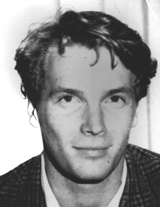
In search of the children of The Big Blue, we board a yellow Zodiac in Nice, heading to the middle of the bay of Villefranche. This is the flagship of the Aida, the International Association for the Development of Apnea.
How is it possible that the Ministry of Youth and Sports and especially the media do not denounce this activity which is not sporting and is nothing more than a dangerous flirt with death.
On board, Cédric Palerme, a strong Neptune, watches over half a dozen amateurs and François Gautier, the young president of the association, prepares a dive to 95 meters in "no limits" - a descent along a cable, pulled by a 30 kg weight, and a return pulled by an air balloon. The atmosphere is relaxed. We help each other, exchange advice, the address of a carbon monofin manufacturer or the price of a nice silver suit.
Diving equipment sellers are the sponsors of such events. Now that the fish has disappeared from our coasts, something must be sold, even if these merchants become sellers of death.
No religious silence, no ostentatious concentration. "Here, we don't do yoga and we don't like dolphins," jokes Cédric Palerme. Worse, they are beginning to welcome young people who have never seen The Big Blue!
The "cloclos of the bay," as they called themselves when they were all unemployed, have become the heart of apnea in France, thanks notably to Loïc Leferme, world record holder with a dive to 162 meters. What animates them is a maniacal search for safety. On board, Cédric Palerme presents an ingenious counterweight system that allows a diver who has fainted (the number one risk) to be raised without the help of divers with tanks. It is an important step for the preparation of future records of Loïc Leferme, who will attempt to dive to 172 meters in September and does not hide that the 200-meter wall makes him dream. Before his dives, to relax, Loïc Leferme plays the harmonica.
What an unimaginable nonsense! Before becoming a superman, sponsored by diving equipment houses, Leferme was unemployed. Before becoming "The Big Blue," Mayol was... nothing. And there is no one who can make another sound, in these contemptible media where they encourage our children to play Russian roulette! That's nothing else. Read my technical file.
From his many trips to the East, Jacques Mayol had brought back a great fascination for the performances of the yogis. In Homo Delphinus, he cites the case of yogis who can hold their breath for more than twenty minutes. Before each dive, Mayol asked for silence and began his breathing and concentration exercises on his yellow and black mat. He loved the science of breath (pranayama) and the idea, central in Indian philosophy, that the same breath animates both physiological and psychic life. Jean-Marc Barr, who portrayed him in The Big Blue, described him as a Peter Pan. In 1983, at 56 years old, Jacques Mayol beat his last record by diving to 105 meters.
Martin Eden, by Jack London, was his favorite book throughout his life. On the night of December 22 to 23, 2001, he hanged himself in his house on the island of Elba. He was 74 years old. It was a premeditated act, announced. He had not hidden his depression from his close ones.
On September 12, 1998, Umberto Pelizzari went to the waters off Karpathos, at the site of the feat of Georghios Haggi Statti. Wearing only a swimsuit, without fins, weighted with an 8 kg stone, he dived to 100 meters and climbed back up the rope, with his arms. Jacques Mayol had initiated him into yoga and considered him his heir. It is he who, at the time of his death, best summarizes what he leaves: "The pleasure of diving from which everything else derives, elegance, symbiosis with the sea, the awareness of being underwater, being a man, but without feeling the need to breathe."
Charlie Buffet
Bibliography:
Jacques Mayol, Homo Delphinus (Glénat, 1987).
Pierre Mayol and Patrick Mouton, Jacques Mayol, l'homme dauphin (Arthaud, 2003).
• ARTICLE PUBLISHED IN THE EDITION OF 20.07.04
Hello
I just read/learned about your website. My name is Artur Barrio... the person you call "Barrillo, the Brazilian diver" in "the dangers of apnea."
If you want to ask me questions...
Sincerely,
Artur Barrio
I imagine he had things that weighed on him. He may have found it convenient to pour them on me, 22 years later, by putting me in the position of an information seeker. I couldn't help but respond. You will find all these details further on. I suppose he would have liked to hear from me something like "Of course, I understand what your reaction was. And perhaps, in your place, I would have acted the same way. But all that is past..."
Two months have passed. I think I will still tell this. This and other things, even more terrible.
Artur Barrio is a Portuguese man living in Rio de Janeiro. He was born in 1945 and was 45 years old at the time of the events. He is now 68 years old.

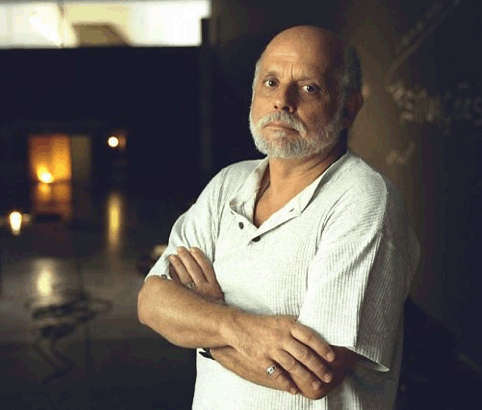
Artur Barrio, "a historical figure of contemporary art"
http://www.evene.fr/culture/agenda/artur-barrio-7164.php
**Here is one of the emails he sent. **
• Wed, Dec 12, 2012 at 5:38 PM Dec 12, 2012 Starred Mail From Jean-Pierre Petit To 1 recipient Re: 1990 ... about ...
Hide details From • Jean-Pierre Petit To • Artur Barrio ... I saw your son Jean Christophe at the Vieux Plongeur store located on Cours Lieutaud/Marseille and that day Pierre Vogel told me that we would dive with a German [Professor Ebersold and his son] a young genius [Jean-Christophe Petit] who worked at Mares and had created and developed a weight for apnea.
Dr. Saint-Jean arrived a bit later. As I didn't have a car, Pierre told me that there was no more space in his mini 4x4, so I had to take a taxi to the Old Port at that moment, Jean Christophe kindly offered to accompany me in his car to the embarkation point.
During the trip, I tried to have a conversation with your son but in vain, he was too focused on himself and in addition, I thought that my French, my articulation, wasn't very understandable, so we arrived where the boat of Pierre was, and I noted that Jean-Christophe was sweating a lot, maybe because of the heat.
We left and there I thought, where is Jean-Christophe's diving equipment, because apart from his bag and the weight that was wrapped, nothing else (!!!???!!!) I was worried, in addition, because apart from the training of Jacques Mayol for the -75 meters (failed) in Cassis for Canal + I had never dived with an apneist at that time, Pierre told me that your son was used to depths but we were on the wreck of the St. Dominique located at - 30m ...
I was very worried, on the contrary, of my companions, Jean-Christophe was very sure of himself and always. in silence.
Well, we start to gear up and there Jean Christophe unpacked the weight, a very nice ergonomic design, small, all black, ...
After that, he put a depth gauge on his wrist and that's all (!) ... no suit, no fins, he jumped into the water completely naked and started doing small apneas at that moment, again, I asked Pierre if it was normal? Yes, it is normal, he is a great apneist.
We get into the water and immediately we are on the stern of the wreck where we see Jean-Christophe calmly looking at his depth gauge, looking around and slowly rising.
When I realized I was alone, everyone had left, so I swam towards the stern of the ship [I don't like the St. Dominique] and then alone towards the hold where to my surprise I got caught by a large fishing net from behind in the plumbing and part of my tank, no diver to help me, nothing, I became a bit out of breath but gradually, by unfastening the tank with the help of the knife and always stabilized in the water, I managed to free myself.
Immediately, I started slowly towards the surface for the scheduled decompression stops (no computer)... I came out a bit far from the boat.
And there the anxiety began of not having seen Jean-Christophe in the water or on the boat. I asked the son of Professor Ebersold where the apneist was, but he understood that the German, but by gestures, he said he was diving, that's what I understood, ... again I became very worried, what to do? Wait? But wait for what? How long?
After 7', I understood. So to dive again but with what? No emergency tank on the boat!
And I had in mine 30 Bar so I had to wait !!!!!.
..
After that you know what happened ... the body of Jean Christophe was recovered due to the twin tanks of the other divers. Upon arriving at the Old Port, we were awaited by the SAMU, the Marine Firefighters and the Police. I went with a policeman to the car to get the papers of Jean-Christopher. A few days later I was called to the Police Station near the Old Port where I declared what you read in this email.
Artur Barrio .
I recall what I knew about the events. In July 1990, Artur Barrio joined other divers. The project was to dive on the wreck of a ship, the Saint Dominique, which lies at thirty meters depth, not far from Marseille.
The four divers were:
-
Pierre Vogel, owner of the well-known store "le Vieux Plongeur" in Marseille. Great experience in diving. It is he who owns the boat that will take the group to the wreck.
-
Ebersoldt, German. Also great experience. He has written books on diving. He is accompanied by his young son and brings with him a submarine camera with which he will take a photo of my son, lying dead, on the deck of the Saint Dominique. The photo he will send to Pierre Vogel, who in turn will kindly forward it to me.
-
Dr. Saint Jean, an ENT doctor. Also possessing great experience in diving with tanks.
-
Artur Barrio, who was 45 years old at the time of the events, and is not at all a novice in diving with tanks.
-
Finally, my son Jean-Christophe, 23 years old. A good experience in apnea. I had taken him to Cuba and the Red Sea, to hunt. But, from the start, having miraculously escaped a syncope in the pool of the Tourelles, in Paris when I was 20 (due to fatigue. Between the written and oral exams of the Grandes Ecoles), I had warned him from the start: "Avoid apnea when tired, after a bad night. No more than a dozen meters, with a maximum of half a minute. No effort at depth. Be careful of the cold. Don't dive alone."
Jean-Christophe, victim at 23 of "the Big Blue effect"
But in the meantime, the "cult film" of Besson and Mayol, "The Blue", has caused its damage. I don't know how many people this film has killed. I had written to Besson after my son's death, suggesting he put a warning at the beginning of his film. But, knowing the man, whose low human value is well known, despite his immense talent, he did nothing. You will find below an analysis, found on the net, which quite well condemns this stupidity, this film, a real praise of suicide:
http://vallaurien.nuage-ocre.net/sem1_grandbleu.html
For some time now, my son has been engaging in this "extreme apnea." His mother knows, but I don't. Too bad. If I had known, knowing better than anyone the inherent danger of this underwater Russian roulette game, I would have reacted immediately. But instead of informing the father, she took our son, in the days before, to a diving doctor, to have him lectured.
Everyone gets on the boat and goes to the diving site. The son of Ebersold remains on the boat. Vogel, Ebersoldt, Saint Jean and "the Brazilian" descend, with their tanks, to the stern of the wreck. Next to them, Jean-Christophe plays the diver. Without a suit to protect him from the cold, at this depth, he multiplies the risks of fainting. Any conscientious diver would think about it. But didn't Vogel say to Barrio "that Jean-Christophe was a great apneist"? Ebersoldt takes some photos. Then they move along the wreck, calmly.
Personally, I would never have let an apneist play around descending thirty meters alone. If he didn't want to stop his exercises, I would have stayed with him, nearby. Possibly in a playful way, I would have given him air through my regulator, waiting to talk to him after the dive. But in no way would I have left him alone, as the other four did.
I remember once, while climbing (I was leading), we were overtaken by a young prodigy who was climbing, on a "variant" near our route, "bare-handed," "free," alone, without rope, without safety. Another stupidity. You have to have a hold that gives way under your fingers, or a rusted piton that breaks suddenly to know that without safety, you are then doomed. A "sport" about which Catherine Destivelle said, "that to climb bare-handed you need to be very in your body and very in your head." I would say it's rather the opposite.
When we crossed this kid, I managed to convince him to join us, climbing in front, but roped.
Returning to this dive, the four men calmly let my son engage in these exercises alone. A few days after his death, when I met Pierre Vogel in his shop, he summarized his philosophy in a sentence:
*- Customers, we watch them like milk on the fire, but friends, they do as they want. *
If they eventually kill themselves, it's their problem...
He even said that day, among other nonsense, "that my son had the death he would have wished for."
Vogel died a few years later, during a dive at moderate depth. According to Barrio (email), he had done a dive to 77 meters the day before (although he was already quite old).
The four divers, equipped with tanks, set off. Very quickly, Vogel, Ebersold and Saint Jean lose sight of Barrio. He ventures alone into the hold of the wreck, but doesn't notice a piece of net there. He gets entangled. To free himself, he discards his tank and uses his knife (I note that divers today often neglect, even in diving schools, to carry this accessory, which is attached to the ankle, and can prove lifesaving in many situations. I remember one, where a hook from an abandoned line had stuck in my heel).
Then, having freed himself, Barrio ascends and makes a stop, near Vogel's boat, at three meters.
Excerpt from one of Barrio's emails:
When I realized I was alone, everyone had left, so I swam toward the stern of the ship [I don't like the St. Dominic] and then still alone toward the hold where to my surprise I got caught by a large fishing net from behind in the plumbing and part of my diving tank.
To help me, nothing, I became a bit out of breath but slowly, by peeling the tank with the help of the knife and always stabilized in the water, I managed to free myself, immediately going slowly up to the surface for the scheduled decompression stops (no computer)... I came out a bit far from the boat.
And there, the anxiety begins of not having seen Jean-Christophe either in the water or on the boat. I asked the son of Professor Ebersold where the apneist was, but he understood that the German, but by gestures, said he was diving, that's what I understood... again I became very worried, what to do?
Wait? But wait for what? How long? After 7 minutes, I understood. Then to dive again, but with what? No emergency tank on the boat! And I had only 30 Bar in mine, so I had to wait !!!!!
...
After that, you know what happened... the body of Jean Christophe was recovered by the other divers' twin tanks. When we arrived at the Old Port, we were met by the SAMU, the Marine Firefighters and the Police. I went with a policeman to the car to get Jean-Christopher's papers. A few days later I was called to the Police Station near the Old Port where I declared what you read in this email.
When he surfaced, the son of Ebersold, who doesn't speak French or Portuguese, made a gesture to him that the apneist, my son, had not returned.
After Barrio's emails, I tried to find out more about the circumstances of my son's death, which have always seemed obscure to me. After the tragedy, I tried to find out. I first went to Vogel, who told me, and repeated insistently (I even recorded it):
*- We were three, Ebersold, Saint Jean and me. *
When I called Ebersold in Germany, he "immediately told me that my questioning was inappropriate," hung up on me.
It was finally by calling Saint Jean that I learned about the existence of a fourth diver, "the Brazilian."
The accounts of Vogel and Saint Jean, except for Vogel's concealment, coincide. According to their testimonies, after the dive, Vogel, Ebersold and he made a stop. To prevent the grapple from getting stuck in the wreck, Vogel attached it to a balloon. Filling it with a little air, with his regulator, he sent it to the surface. When they returned to the boat, Barrio told them that my son had not reappeared. But since the boat was no longer anchored to the wreck, it had drifted, and they had to locate it again, re-anchor it, re-equip, and descend again. Ebersoldt, however, didn't forget his camera and photographed my son, unconscious, lying on the deck of the wreck, a photo he would transmit to Vogel, who would kindly send it to me. Then they lifted my son and put his body in the cabin. I rely here on Barrio's account, who told me:
Excerpt from one of his emails:
All three were whispering to each other, while I, naively, was trying to perform resuscitation on Jean-Christopher through conventional means but without oxygen or mask or other more effective equipment on the boat.
I come to the recent testimony of Barrio. As I ask him, by email, to give me the most accurate chronology of the events, he prefers to tell me by phone. I give him my number, and he calls me from Rio de Janeiro and repeats what he wrote in his emails:
- I came up, and I realized that your son had not come up. But I couldn't dive again. I only had 30 bars left on my tank. I could only wait for the others!!! .....
- What equipment did you have?
*- A Scubapro set. *
*- With 30 bars, you could have dived again. You would have had a minimum of 10 minutes of autonomy. More, if you had conserved your breath. And at such a depth, a short dive would not have loaded you with nitrogen in a dangerous way. *
- But, I was out of breath....
*- No, you wrote that you had just done a stop of several minutes, at 3 meters, while ascending. You knew that the minutes passing were taking your son irrevocably toward death. I would have dived immediately. But I am Jean-Pierre Petit, I am not Artur Barrio. *
Was Artur Barrio burdened by this memory, and did he want to get rid of it, twenty-two years later, by giving it back to me, like a poisoned burden? What did he hope for? That, not knowing anything about diving, I would approve of his actions? No luck. I did my first dives with a tank in 1958.
End of the phone conversation. There was not much more to add, except that everything that followed would never be clarified. Vogel also died while diving. Ebersold, from the start, did not want to be questioned. And besides, it would not bring anything more. Simply that "great professionals of diving" can accumulate stupidity. In the end, "it's each for himself." But what about nets on a wreck? How can one think, even if not so old, to play with one's life by diving to 77 meters depth?
- Friends, they do as they want....
The stars of apnea are dying one after another. Loïc Leferme, who, shortly before his death, was selling his media image to promote treatments for people suffering from pulmonary insufficiency, died as well. Others will follow, since the Ministry of Youth and Sports did not consider it worthwhile to denounce the existence of a French Apnea Federation. The icing on the cake is Mayol, with whom I had dived in the Caribbean and who, abandoned by everyone (especially Besson), chose to hang himself on his suspension, alone in his house on the island of Elba.
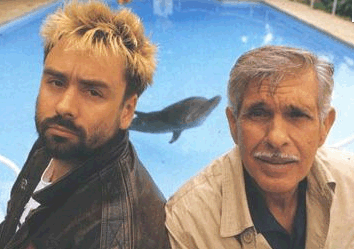
The talented filmmaker Luc Besson who bought from Jacques Mayol, at a low price, the right to bring his life story to the screen, with his "cult film" The Blue
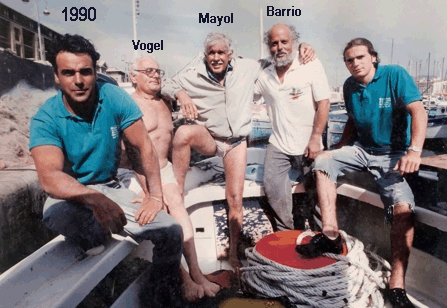
http://www.arturbarrio.blogspot.com (his diving photos )
A this time he filmed his intrusion inside the wreck of Chaouen
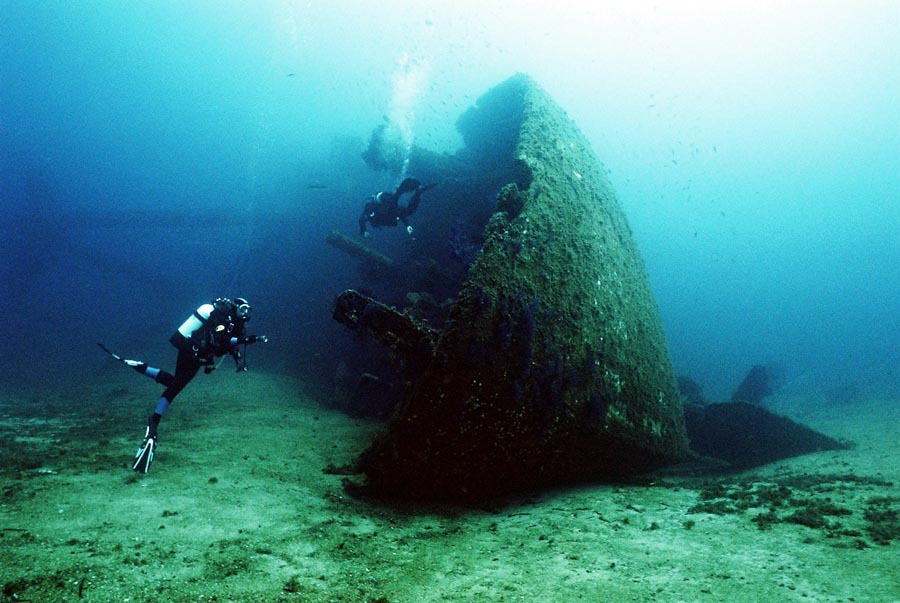
Far from being a beginner diver: Barrio, around the wreck of Chaouen, at 33 meters depth
Artur Barrio is perceived as one of the major figures of contemporary art
http://www.arturbarrio-registros.blogspot.fr/ (his artistic activity)
http://www.youtube.com/watch?v=2Z-raiALfBc (he uses degradable materials)
http://www.youtube.com/watch?v=-AJTc-QZ32I (meat and pearls)
In passing, Barrio had followed Mayol's tests, near Cassis, related to a sequence that was to be filmed by television in the following days, where he was already old (...) to descend to 75 meters on a weighted cart, in a seated position, on a bicycle seat. Things did not go as planned. Suffering from a little ear inflammation, Mayol had to leave his seat and quickly ascend to the surface, to the dismay of the filming team, who told him "Jacques, you can always hope that we will come back to film you."
This was visible on screen, and Barrio confirmed it to me:
*Mayol then started to cry. *
Back to this period of Christmas 2012. These were not to be the only confidences I would receive that month. E.H. is a specialist in late confidences. As if, with time, she wanted to get rid of a past that weighed on her, passing it on to me from time to time. She was the friend of a woman who was to play a certain role in the tragic fate of my son. One day, she showed E.H. some letters:
*- Look, the relationship between the father and the son was not good. Jean-Christophe sent him letters of appeal for help, and he didn't even answer. *
I replied immediately:
- But, E., these letters, about which you speak to me, I never received them....
- What surprised me was that some of these letters, written in blue ink, were not copies. So, these letters meant that she had intercepted them....
I immediately asked E. to testify in writing about all this. I was next to her. I could put a paper and a pen under her nose, and dictate this testimony. She complied. But I think that I had only let a few days pass, she would have changed her mind "not wanting to have trouble." Many others acted this way at the time, men and women. As for E., a witness for more than ten years of phone calls, embezzlement, and displays of greed, she had remained silent. Probably "not wanting to have trouble."
Her testimony about these letter thefts is in documents handed over to the justice, and have passed between the hands of judges. I can therefore mention it.
But, in this month of December, E. felt the need to let out another memory, dating back 22 years. I asked her to testify in writing. After hesitating, and saying on the phone that she would write to me, she fell silent. I think she will never do it. To a mutual friend, Yves, she said "I don't understand why Jean-Pierre is stirring up these old stories from the past."
The memory in question is summarized in a sentence from E.:
*- The day after your son's death, I heard her say "I bet it will be an excuse for him to mess up his vacation." *
If I were to mention a name, without having the written testimony of E., this person could sue me for defamation. So, as it is, this sentence, slightly modified, was therefore spoken ... by an anonymous person. If asked, I think E. would probably deny it, always "not wanting to have trouble."
There are things that weigh on the heart like anvils, without time limit. There is also this feeling of impunity, for certain beings whose Machiavellianism and absence of moral sense, of simple humanity, defy imagination. Add: the simple cowardice of E; who is not even capable of going all the way with her testimony, given orally 22 years later. Spread on the net, citing the author of this sentence, it would enlighten more than one, and especially more than one woman.
What does she fear? Good question. | Excerpt from one of his emails: | All three were whispering to each other while I, naively, was trying to perform resuscitation on Jean-Christopher through conventional means but without oxygen or mask or other more effective equipment on the boat. |
|---|---|
Was Mayol depressed? He committed suicide because he was alone like a rat and all the media had abandoned him. You can't be a record holder over sixty years old.
After the tragic death of my son, who, unknown to me, was doing thirty-meter apneas following (we found a number on the boat) the advice of a newly created magazine, Apnéa, I called Mayol.
*- Jacques, could you use your media contacts? We need to stop this massacre. The film "The Blue" has already caused more than five hundred deaths. You know that without a large team around, ready to intervene, these feats are equivalent to suicides. You, people would listen to you. *
Mayol, always listening to media sirens, turned a deaf ear.
In his last performance, he had managed a final feat in front of the cameras. A more moderate depth, 75 meters, where he had to descend seated, in a standing position, on a bicycle seat, at ... over sixty years old. A ... variation, in a way. A television channel had agreed to film him. I don't remember which one. But it didn't go well. In the days before, Mayol had caught a cold and his Eustachian tubes had become inflamed. In this case, decompression becoming impossible, it was useless to attempt the feat. All divers know this. But the appointment had been made with these damned media.
*- So, are you going, yes or no? *
Mayol suddenly cut the mooring and plunged, but, seized by pain, he had to quickly leave his device and swim to the surface. In doing so, he knew he was "finished" for the media. The TV team was already packing up their equipment and, in Jacques's eyes, I saw some tears. This reminded me of the death of Jacques Delacourt, in the mid-seventies, when the "deltaplane" was starting. I knew the murderous childhood of this sport and, perhaps because of my experiences as a pilot and parachutist, I was lucky to have survived. My first flight was in 1974. The television, interested in this new sport, had agreed to come. But, on the day, there was a tailwind. Delacourt hesitated.
*- So, are you going, yes or no? *
He thought that by rushing he would manage to take off and he died in front of the cameras. Everything was filmed and aired on the eight o'clock news. I wasn't present at the accident, I specify.
*- Nice images, the director must have said. *
There it is, our modern world. And the journalist Charlie Buffet is part of it.
*- Go ahead, kill yourself, dive to the limits of your fragile life, flirt with "the limits of your body," climb without rope, bare-handed, jump from cliffs without a safety parachute, practice "extreme," we will film you, we will talk about you, we will take you out of your anonymity. *
One day I participated in an episode hosted by Jacques Martin. It was just a gag: I knew how to flip a coin with my toes and we filmed the scene. The host had taken over an American show "Incredible but True" showing feats, often harmful to their heroes. After the show, we discussed, him and me, over a coffee.
*- I'm going to stop. The show is doing well. But what disgusts me is the curiosity, the sick voyeurism of people. Recently, one of my assistants received a call. They offered him a scene. It was about filming someone who would rush on a bicycle towards a cliff, attached to an elastic. They called back a bit later and they got the mother who said "François? I'll tell him about your call. He's not back from school yet."
Frédéric Deroche, July 28, 2004 :
With a friend, when we were 17, we practiced apnea in the pool. Not because we were influenced by The Blue, or maybe a little,... but because after 25 meters we felt a kind of well-being once out of the water.
So we tried 50 meters, without fins, at 2 meters depth. Personally I did it 3 times, and my intuition always told me to do it under supervision. So with my friend we watched each other. Unconscious, clearly and clearly in agreement with you...
The third and last time I did it, I covered the distance slowly, to consume little oxygen. I had to take two good minutes to cover the length. At the exact moment I wanted to lift my head out of the water I lost consciousness. My friend told me "that my eyes had turned, they were rolled back." I don't remember. If my friend hadn't been there, I would have sunk. It was a lesson for me and I never did this kind of exercise again.
I'm not a fan of extreme sports... I don't like it... but apnea just gave me the feeling of being well... the fatal trap...
It's pure madness... clearly and clearly...
Your article will be useful to many... today, recklessness is gaining ground on consciousness... this is cultivated by TV-conditioning... where you have to make a big impression.
Frédéric Deroche
Last update (end of the file) on October 13, 2002

... Apnea is an ancient activity. In wrecks of galleys, which contained amphorae for wine or olive oil, discovered near the coasts of the south of France, on depths of twenty to twenty-five meters, they found large stones that could not have rolled from a cliff. They weighed from five to ten kilograms and resembled large pebbles. For a long time, the presence of these stones remained a puzzle for archaeologists, until they realized that enclosed in baskets made of vegetable fiber, they served as weights, allowing divers to descend into the holds of sunken ships to attempt salvage operations.
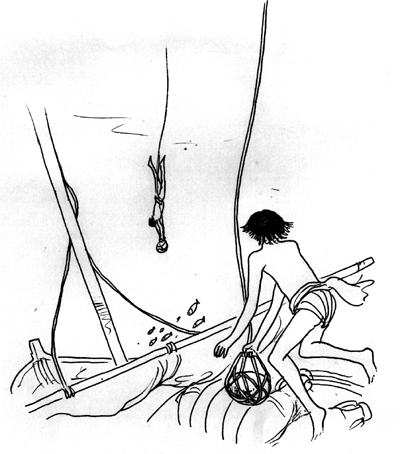
... From this time, the shipowner, when possible, tried to salvage his precious cargo, when the depth was not excessively deep. It is true that at that time, human life was not worth much.
Apnea, Larousse dictionary: voluntary cessation of breathing. But what happens when you block your breathing like that? Very quickly, in a few tens of seconds, you feel a painful sensation of suffocation, which quickly becomes unbearable and forces you to take a breath. The cause of this sensation is the increase in the level of carbon dioxide in your blood (or, more precisely, the partial pressure of carbon dioxide, a distinction that will be clarified later).
What to do to increase the apnea time?
There are three methods.
-
The first consists of mastering this sensation of suffocation. This is what some divers do, with techniques similar to yoga (the same ones that could allow, for example, to master pain).
-
The second consists of trying to store as much air as possible before holding your breath, for example to dive underwater.
-
The third consists of practicing hyperventilation before the dive.
...To increase your apnea time, the third method is by far the most effective, but also the most dangerous. Let's see why. To hyperventilate, the diver breathes for a longer or shorter time. In doing so, he does not necessarily take powerful inhalations, but effectively ventilates his lungs. Thus, he expels the residual air, replacing it with fresh air. It is known that during normal breathing, not all the air in the lungs is renewed at each exhalation-inhalation. This exhalation-inhalation mechanism is controlled by a muscle: the diaphragm, and to a lesser extent by the muscles that lower and raise the ribs. But the process has its limits. In this way, you cannot empty your lungs of all the air they contain. By ventilating the pulmonary volume by breathing, you practically completely renew this air. The lungs then contain a fluid that is identical to the ambient air and not a mixture of inhaled air and residual air, charged with carbon dioxide, this charge coming from previous breaths.
...In short: hyperventilation reduces the amount of CO2 in the pulmonary air. Hemoglobin in the blood is a molecule capable of absorbing and transporting both oxygen (oxy-hemoglobin) and carbon dioxide (carbohemoglobin). Hyperventilation thus reduces not only the amount of CO2 in the lungs but also that in the blood.
...You cannot increase the percentage of oxygen in the atmospheric air (twenty percent, the rest being nitrogen). But you can increase the amount of oxygen in the blood. If you continue this hyperventilation activity, after a few tens of seconds, you feel a sensation of dizziness, a phenomenon that indicates the enrichment of the blood in oxygen. If you then hold your breath, at the surface or under a meter of water, in a pool, remaining perfectly still, you will be surprised by the increase in apnea performance. Times of apnea of one minute can thus be achieved quite quickly. With some training. Many subjects can reach one minute (always in the least physical activity), the maximum human (for the "record holders of the specialty") being around three to four minutes.
Why can you hold your breath for so long?
...It's not so much because you have managed to load the blood with oxygen, but because you have, before the apnea, impoverished it in carbon dioxide. However, this latter plays the role of a danger warning. What is this danger? It is syncope, which manifests when the oxygen level in the blood falls below a certain threshold. This is extremely dangerous because there is no warning sign, such as a feeling of discomfort. It is instant and is manifested by a loss of consciousness of the subject, without resumption of breathing. The one who drowns this way will keep his lungs dry. You can thus see how apnea works after hyperventilation. A diver who uses this technique significantly increases his performance but in doing so disconnects his alarm system (the sensation of suffocation related to the rise of CO2 in his blood). He can thus fall into syncope without having felt the slightest discomfort, the slightest sensation of suffocation.
...This is the first point. Apnea is mainly used for free diving. In these conditions, the diver will ask himself:
- In the measure that I want to reach a certain depth, am I interested in paddling strongly, to reach this depth of evolution as quickly as possible, in this apnea time that is given, or on the contrary should I minimize my physical efforts, both during the descent, the stay at the bottom and the ascent?
...The second answer is the correct one. The apneist swims, dives, and moves economically. No sudden movements, no intense muscular efforts, which correlate with an increase in oxygen consumption. Carefully weighted, the diver will descend slowly and ascend the same (i.e., without rushing). The diving suit, the suit protecting from the cold, is indispensable, except in very warm waters. The fight against the cold is indeed accompanied by a strong increase in oxygen consumption.
...Any unnecessary effort will be avoided, any unnecessary consumption will be avoided, and in this context is the intense oxygen consumption that is simply the intellectual activity, the thought, the simple "functioning of the brain." This is far from negligible. If a subject did apnea experiments in the open air, he would be surprised to notice that his performance would drop significantly if, while holding his breath, he engaged in, for example, complex calculations. Thus, consciously or unconsciously, the apneist, in diving, gets used to practicing "non-thinking." If he "clears his mind," his performance will only be better. In doing so, he practices, without knowing it, the basics of meditation techniques (Buddhist, Hindu or Yoga).
...The "masters" who encourage their students to "meditate" start by telling them "repress, stop the flow of your thoughts." What happens then? I don't have the competence to say. Either the meditative activity, even for a short duration, puts the human being in contact with some mental activity that could be called transcendental, changes his "state of consciousness," or the brain sends the oxygen to centers usually less supplied (the centers of conscious thought having, in a normal state of consciousness, a tendency to capture it first). The result is a feeling of well-being, which all apneists feel. The effective apnea is synonymous with well-being, otherwise it is not effective, simply because it can only be practiced in a state of non-thinking.
...Even before reaching enlightenment, the Nirvana, through non-thinking, the apneist appreciates having to spontaneously acquire this attitude, which can only be beneficial when one is stressed, or plagued by obsessive thoughts. Free diving also allows, obviously, to appreciate the beauty of some underwater landscape. But the mystical dimension it acquires for many divers is based on an objective reality, which few are aware of.
...On the simple level of the physical machine's capabilities, divers can reach depths of thirty meters, in free diving, by performing apneas of one and a half to two minutes. Some "particularly gifted" subjects can even do more. This activity is similar to Russian roulette. These "supermen" only dangerously reduce the distance separating them from a fatal syncope.
...So, what to do? Declare once and for all that apnea is a hyper-dangerous sport or try to find a middle ground, a compromise?
...Before risking numbers, you need to be informed. Fatigue, for example, greatly increases the danger. This can be overwork, lack of sleep, any cause of fatigue.
...When I was in my early twenties, I practiced free diving during my holidays. In winter, I used to swim in a fifty-meter-long pool (the Tourelles pool in Paris). In good physical condition, I could thus cover the entire length of the pool (which would have been equivalent to a round trip at a depth of about twenty meters) under one meter of water with fins. Free diving at shallow depths can thus seem harmless. Big mistake. At that time, I was preparing for entrance exams to the Grandes Ecoles. I slept little, badly, and worked a lot. So I thought that doing some free diving in the pool would do me good. On the spot, without feeling any significant physical exhaustion, I did one length of the pool, in a pool that was almost empty that day, as I had done many times before, but in good physical condition. It so happened that I swam across the pool in the direction of the deep end, shallow end. I never reached the edge of the pool, after this fifty-meter underwater swim. At around forty meters, I fainted, instantly, without any warning signs, without any memory. I suppose a swimmer found my lifeless body floating between two waters, and raised the alarm. I regained consciousness at the edge of the pool, resuscitated by the lifeguard.
...Imagine what would have happened if I had swum in the opposite direction. The Tourelles pool in Paris has a ten-meter diving board, overlooking a deep end where the depth is five meters. By swimming toward the deep end, I could have gained depth at the end of my swim and fainted at that moment. The buoyancy of a human body depends on the depth of immersion, even with fully inflated lungs, the pressure compresses what is inside the thoracic cavity, reducing the Archimedes' buoyancy.
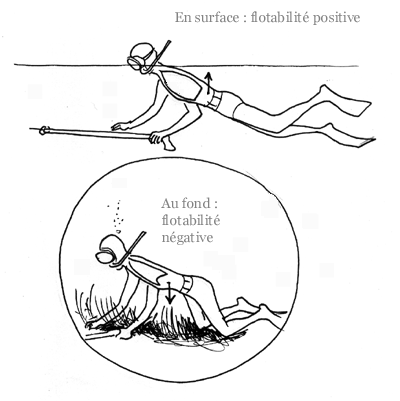
...By fainting under one meter of water, I naturally floated back to the surface, keeping the air in my lungs, even if I lost some along the way. Under a few meters of water, I would have sunk, I would have been less easily detectable, and when they realized that an unconscious body was at the bottom of this deep end, it would have been too late.
...As soon as the fainting occurs, the brain cells stop receiving oxygen. Their autonomy is limited. Although sometimes drowned people have been recovered after relatively long immersion times, sometimes in icy water, this remains quite exceptional. One can consider that an individual who has been completely deprived of oxygen for a period of five to ten minutes is simply dead, irrecoverable.
...You will note that when lifeguards perform mouth-to-mouth resuscitation on a drowning victim, they ventilate the lungs, not with atmospheric air, but with the air the victim exhales, which is richer in carbon dioxide, hoping to quickly trigger the respiration reflex, which is "controlled" by the CO2 level.
...Why do people have a "tendency to breathe"? Simply because over time the CO2 level in the blood rises, and once a certain threshold is passed, the brainstem, which receives the information, immediately triggers the inhalation action. Otherwise, individuals would have to consciously decide to breathe, or they would faint.
...Fatigue increases, as we have seen, the dangers related to apnea, which are always present. The same goes for cold. In colder water, the heart rate increases, as does the cellular metabolism. For the heart to function as a pump, it also consumes the precious oxygen. In colder water, even with a protective suit, the free diver's performance must be reduced. The serious problem with apnea is that no one can know, at any given moment, and in specific conditions, where the limit is. One cannot answer the question "today, in this physical condition, and in this water, how long could I possibly hold my breath before fainting?" unless... you do the experience. It is more than likely that many people have come very close to death without even realizing it.
...During diving, any sudden effort is accompanied by an increased oxygen consumption, which can bring the level above the fatal threshold. This is how my friend Josso died in Corsica, forty years ago. We had been students together at the National School of Aeronautics in Paris, in 1960. Josso was diving with the Roubaix family. Madame de Roubaix had been a female underwater hunting champion. Her son, François, later became a famous musician (music for the film The Adventurers, with Delon and Ventura, or Scoumoune, with Belmondo, for example). All these people were "passionate about underwater hunting," and the marine depths of Corsica were still very rich at that time. Josso practiced apnea without excess. At least, that's what he thought. But one day, at a depth of a dozen meters, he shot a grouper, which got stuck on a rock. Josso slipped into this crevice and made efforts to pull the animal from its refuge, which, due to the oxygen consumption, caused him to faint fatally.
...A well-trained diver can descend to fifteen to twenty meters, if someone nearby is watching him and is capable of providing immediate assistance (and not becoming a second candidate for drowning). Underwater hunting championships are not held in ten meters of water. The really fish-rich depths, especially in our regions, correspond to greater depths. These championships are conducted in pairs. Each team member takes turns diving, each one watching out for the other's safety. But deep underwater hunting alone is nothing more than Russian roulette.
...We have mentioned above "the partial pressure of oxygen." Indeed, the rate of oxygen transfer into the blood depends on the density of the molecules near the blood cells. The higher this density, the more intense the transfer. This is quite logical. Thus, when professional divers make deep dives (beyond one hundred meters), they use mixtures where the oxygen percentage is lowered well below the twenty percent of standard conditions, otherwise this oxygen would become "too oxidizing." From the beginning of dives with equipment, people who wanted to dive using pure oxygen had convulsions. At too high a concentration, oxygen behaves like a toxin.
...When a diver descends to twenty meters on apnea, he is under a pressure equal to three times the atmospheric pressure. Thus, the blood can continue to be supplied with oxygen, even though the oxygen has already become rarer in the air in his lungs. The rate of oxygen flow is maintained, with a poorer air, because the pressure is three times higher and thus the density of oxygen molecules near the blood cells is also three times higher.
...The situation reverses on the ascent. The human body reacts not only to the decrease in the oxygen level in the blood, but also to the decrease in the rate of this oxygen flow. When the diver ascends, he moves from a medium with a pressure equal to three or four times the atmospheric pressure to a pressure close to one atmosphere, just below the surface. The rate of blood flow then collapses. Thus, many fatal faintings occur on ascent. Specialists even speak of the "syncopal meeting at nine meters."
...Thus, when he is at the bottom, while the oxygen in his lungs will not allow him to return alive to the surface, the diver feels very well. If he considers himself a superman, he will not decide to come up in time and will pay for his fatal mistake at the surface.
...From a few meters of depth, the compression of the air (the air in the diver's lungs and the air in the alveoli of his diving suit) gives him negative buoyancy. Someone who faints while ascending will not reach the surface, but will sink to the bottom.
...Let's be clear. If you remember only one thing from this article: deep apnea is not a sport, it's an indefensible nonsense. Apnea has not progressed at all. The human machine has remained the same. Instead of keeping a respectful distance from the catastrophe, for example, at least one minute, people approach it unconsciously and morbidly. The followers of long-duration apnea, of solo deep apnea, are simply people flirting with death, resurfacing a few seconds before a fatal fainting, knowing or not knowing.
...At best, you will receive a "free warning." At worst, it will be irreversible.
......A decade or two years ago, there was a surge in interest in deep free diving. Two people are directly responsible for this phenomenon. The first is the diver Jacques Mayol.
......As soon as diving developed, in the immediate post-war period, people wanted to know "how far one could go." "Supermen" then launched into the race for performance, including this natural force, the Italian Enzo Majorca. It is a fact that people are differently equipped to practice apnea. The limits of one will not automatically be those of another. But in any case, these limits exist, and more than one champion lost his life reaching his. In the field of risky sports, and apnea is one, obviously, nothing is more dangerous than believing oneself superior to the rest of the human race. This applies to many activities, such as rock climbing without ropes, etc.
...Mayol oriented himself towards a quite different type of performance. Instead of descending to increasing depths by his own means, he did so with a heavy weight, attached to a mobile rig running along a cable.
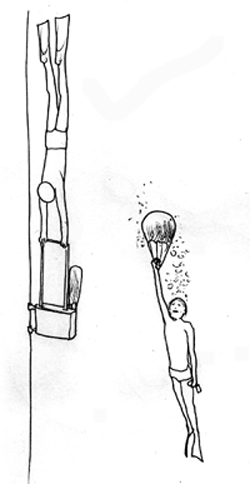
...The ascent was done using a balloon, always in the aim of minimizing physical effort, leading to oxygen consumption. Thanks to this technique, Mayol was the first to exceed "one hundred meters of depth" in "free diving." Let's say right away that these feats were relayed by a series of divers equipped with tanks, spaced along the descent. Thus, the risks taken by Mayol were non-existent. In case of fainting or discomfort, one of those who never left him alone would have immediately brought him back to the surface. He probably died in his bed.
...Interest in this type of activity: quite low. It is known that the air in the lungs is compressed when the diver descends. At ten meters depth, his thoracic volume is halved (Mariotte's law: the pressure is doubled, ten meters of water equals one atmosphere). At one hundred meters depth, the air in the lungs is reduced by a factor of ten. It was feared that this compression would cause the ribs to break, but that did not happen. It was simply the diaphragm that rose into the thoracic cavity. It was also known that the breathing rate decreased during the dive. A check on Mayol showed that this reduction was both noticeable and very rapid, as if the human body adapted to these new conditions.
...But the interest was mainly media-related. These feats were more spectacular than anything else. Today, no one is interested in these records anymore, and no one knows the name of the record holder of the specialty, which is more of a circus than a sporting activity. Mayol, in fact, used, without anyone's knowledge and for many years, a trick to achieve his feats, which required long apneas of about 3 to 4 minutes. Before each new "feat," he would go to the Andes, to Lake Titicaca, where he would dive at altitude. Given the relative lack of oxygen in the air at 3000 meters, his blood quickly changed, enriching in hemoglobin, as happens when people stay in high mountains (the composition of the blood changes in a few days). If he attempted his feat in the days following his return, his apnea abilities were thus artificially increased, compared to people who did not know this "trick." It is known that the East Germans won many sports competitions by taking their champions to a fully enclosed stadium, maintained in a depression. To ensure these performances, the athletes' blood would enrich. In the open air, they could then collect many medals thanks to this "natural doping."
...Mayol's performances involved a whole demonstration of meditation before the apnea. He claimed to have been initiated by a Zen monk. After leaving the water, our "diving monk" would let out a "primitive cry," etc., all for the great joy of the cameramen present.
...The filmmaker Luc Besson one day decided to bring the life of Jacques Mayol to the screen. He himself was a diver and had known "the man-dolphin" for a long time. The result was a "cult film": The Big Blue, which enjoyed worldwide success.
...Undeniably, Besson is a very good filmmaker, who knows how to choose his shots, lighting, and actors. The film tells the story of a man (Mayol agreed that the character in the story, obviously fictional, would bear his own name) who is truly fascinated by apnea. The film is punctuated with competitions, records. A woman tries in vain to divert the "hero" from this race towards the abyss, which seems absurd to her. In the last scene of the film, this woman tells "Jacques Mayol" that she is pregnant with him, which does not divert him, on the contrary, from his obsession. He is seen one last time diving into waters where, at such a depth, darkness reigns. Dolphins then come to meet him and "the man-dolphin" dives into the darkness, far from the light created by the spotlights, following them.
...Homo Delphinus was also the title of a book published a few years earlier by Jacques Mayol. He was convinced that man had not come from a walking prehominid, but from a "swimming monkey," an idea he never missed an opportunity to promote. The fascination from this film and these absurd ideas caused five hundred deaths around the world, especially among the young. A magazine was published in France: Apnea, where the basics of "extreme diving" were explained. Among the victims of this disaster: my son Jean-Christophe, who drowned off the coast of Marseille during the summer of 1990. He was twenty-three years old.
| .... | I had taught him to dive since his adolescence and he had, with me, practiced underwater hunting, therefore apnea, in different seas of the world, especially in the Caribbean and the Red Sea. But, with my own experience, which I described above, I had warned him from the start of the strict limits of this activity. Despite a good predisposition, we had always limited our apneas to no more than a dozen meters and thirty seconds, which placed us very far below our real possibilities, I knew. Unbeknownst to me, the film The Big Blue, which I later found out he had seen five times, was to exert its deadly attraction on my son. Following the "technical advice" of this magazine Apnea, which was found on the boat that took him to the wreck of Saint Dominique, located thirty meters deep, he quickly increased the depth and duration of his apneas, without me being informed of this deviation. The conditions of his death reveal the impact of these absurd ideas in the world of diving. |
|---|---|
......My son met a merchant, Pierre Vogel, who owned the shop "Le Vieux Plongeur," in Marseille. Vogel, who is now deceased, had been one of the pioneers of diving in this region. One day in July 1990, he took my son on his boat, the goal being to dive on a wreck thirty meters long, that of the schooner Saint Dominique, located not far from Marseille. At the age of about sixty, Vogel continued diving with tanks. On his boat that day, in addition to my son, there were four other people: Dr. Saint Jean, a doctor very familiar with the problems related to underwater diving, Professor Ebersoldt, a sort of "German Cousteau," author of books on the subject, and Barrillo, a Brazilian, all of them experienced divers. Ebersoldt was also accompanied by his son, a teenager, who did not dive that day. The four divers, equipped with suits and tanks, dove toward the deck of the Saint Dominique, after their boat had dropped the anchor. While they were visiting the wreck, my son began to play the diver, descending to thirty meters on apnea, and joining them. Ebersoldt took a first photo of him at that moment, at the level of the stern of the wreck. None of the three were worried about my son's behavior. After the accident, Pierre Vogel told me these words (I had asked him for permission to record it):
- Apnea has made great progress (...). It's no longer anything like what you experienced. Divers who hunt or dive to these depths have now become numerous.... the customers, we watch them like milk on the fire, but the friends, they do what they want (...)
...The fact of seeing a young person performing apneas at thirty meters nearby did not worry these three men, aged fifty to sixty, who went on to continue their dive further without worrying about him anymore. At the end of the dive, they ascended, making their stop. It was only after they had removed their equipment that Vogel, the first, asked the son of Ebersoldt about "the diver."
- No, I haven't seen him for a long time, answered the teenager (the boat was several kilometers from the shore).
...In complete panic, the three men re-equipped themselves, while trying to position the boat vertically above the wreck, using landmarks (references taken from the coast). Meanwhile, they had raised the anchor and the ship had drifted. When they recovered my son's body, it was too late, despite the efforts of Dr. Saint-Jean.
...Although I had been in contact with the four divers, I never got a coherent account of this accident. Vogel, who initially seemed confident, first hid the presence of the fourth diver, the Brazilian ("We were three, Dr. Saint Jean, Ebersoldt, and me..."). The German, contacted by phone, evaded when I asked him under what conditions he had taken a photo of my son, who was dead, lying on the deck of the wreck, a photo that Vogel had sent me by post. Through Dr. Saint Jean, I learned of the existence of this fourth diver. During a new contact, Vogel became flustered ("Ah yes, I remember, we were four..."). Of course, my son was not a victim of criminal intentions, but it seemed clear to me that these four were not proud of what had happened that day.
...You can't change the past, you can't bring people back to life. But at that time, four experienced divers, who were not novices in diving, and one of whom was a doctor, had reached the point of considering deep apnea diving alone as a normal, routine event, requiring no reaction from them.
...This accident was followed by many others, around the world. Mayol continued his campaign in favor of apnea diving. No journalist showed interest in the issue. On the contrary, TV segments showed, while Nicolas Hulot was flying in a hang glider without a helmet, various apnea feats. I remember a man who showed how he could stay underwater for four minutes in a pool. What a source of vocation...
...It's time to conclude. Is apnea dangerous? Should it be banned?
.Nous avons vu que le danger était toujours présent, celui d'une syncope se manifestant sans le moindre signe avertisseur.
...Danger which is multiplied if the subject is tired, if the water is cold. Apnea as a "extreme sport" is a complete absurdity, akin to Russian roulette. The human machine has made no progress. Instead of practicing this activity at a respectful distance from this dangerous syncope, limiting dive times drastically to about thirty seconds, even for the most "gifted" and well-trained divers, the "champions" only flirt with death, at least ten seconds, at least....
...In good condition, after a progressive training, with good equipment, especially a diving suit, protecting from the cold: thirty seconds, ten meters, diving with a partner and never losing sight of each other, this is reasonable, with at least five minutes of recovery between dives, and limiting the duration of this activity. Because apnea is tiring. If the individual is in good condition, intensive apnea can alone put his life in danger by causing fatigue.
...What is serious is that the media show no interest in this subject, especially before the summer season, when it would be appropriate to warn divers. It is also serious that magazines and men (Mayol), filmmakers (Besson) contribute to encouraging young people to play dangerously with their lives. It would be pointless to hope that a "cult film" like The Big Blue would be preceded by a brief warning on screen. But death is not media-friendly, heroic. People prefer to talk about "extreme sport." No one shows the bloated bodies of the drowned, the disfigured bodies of those who climb without ropes. When a well-known person dies in this kind of activity, people rush to say "he found the death he would have wished for" and to throw sawdust on the blood that stains the track after the trapeze artist, blinded by the spotlights, crashes to the ground. Strange way to make people dream.
...A few months after my son's death, I met a young baker in the south who practiced deep underwater hunting. He regularly dived to thirty meters and participated in competitions, training regularly with his partner. A short time after our meeting, his partner rescued him just in time, unconscious, on a thirty-meter bottom. He took it to heart.
...He was lucky.
...After my son's death, I tried to invent a system that divers could be equipped with, limiting their apnea dive time. To know this device, click here.
**
February 6, 2003**.
A certain Sébastien Cazin had an amazingly simple and original idea. A little over a decade ago, when the first ultralights appeared, they were simply motorized delta wings. The pilot was in a prone position and held the control bar with both hands. The engine was behind, with a propeller. It was feared at the time that in case of a crash with the engine running, the entire unit, suspended under the aircraft, would fall on the pilot, who could be injured by the propeller. The manufacturer therefore put in place a very simple system (which, I believe, was also used in the first motorized paragliders) where the pilot simply held a circuit breaker in his mouth. If he opened his mouth, a spring would open the clamp, the contact would be cut, and the engine would stop immediately. One can therefore imagine a similar system, integrated with the diver's mouthpiece. As long as he holds it between his teeth, with a slight pressure, it prevents a CO2 cartridge triggering system from activating. But in case of fainting, the muscles relax, the mouthpiece is released, and the safety system is automatically activated.
To avoid any accidental activation, the diver can manually arm his safety system when he considers he is making "high-risk dives," that is, when he ventures beyond ten or fifteen meters depth, not when he is hunting on the surface or near the surface. He must be able to arm and disarm his system with one hand to keep both hands free afterwards. A simple gesture of arming would consist of simply allowing a spring to extend. In the locked position, the diver would have a "normal mouthpiece" between his teeth.
But, in the long term, the solution will simply be an integrated depth meter-trigger system. There are already "diving computers" coupled with a depth meter used by those who practice diving with tanks. All of this is already reliable and perfected. It will be sufficient that one day a manufacturer finally decides to produce a harness coupled with this device programmed to inflate automatically when the immersion time exceeds a given, programmable time. For example, two minutes. The device will automatically reset itself on the surface, out of water, to account for barometric variations. There is an international market for apnea safety. Given that the development of reliable pressure sensors is already a solved problem, companies that produce "computers" for divers could easily release this product. One day, it will happen. The safety of people diving with tanks has made great progress. Practically all of them dive with life jackets that are an integral part of their equipment. They can access the pressure of their tanks through a gauge. They have a backup mouthpiece. But in the field of apnea, nothing has been done, and this sport remains in the "extreme sports" category, a high-risk activity, which is complete nonsense. With the system above, there would simply be no more deaths from apnea in the world.
I did skydiving again, two years ago. Parachutes are now equipped with an altimeter that automatically opens the parachute, in case the skydiver has a fainting spell or simply tries to be an idiot by attempting a "low opening." Problem solved. This does not prevent people from having fun skydiving or diving with tanks. Why should the risk of apnea persist, which could be eliminated? It is not clear. The problem is technically solved. What is needed is a will behind it, someone who pulls the right strings, simply advocating a cause, since at the limit, such a system is not even patentable.
These deaths that make money.
...When my son died, practicing apnea at thirty meters depth, they found in the boat he was on a copy of the magazine "APNEA" which contained an article on deep apnea. When you see the risks you run to practice such an activity, you are right to wonder what incites young people to take up this sport. There was, of course, the formidable impact of the "cult film" The Big Blue, whose release was accompanied by a spectacular increase in the number of apnea diving accidents in all countries. In one of its recent issues, the magazine Apnea even titled "The Big Blue, ten years later."
...We have seen, apnea has something fascinating, that is undeniable. The only problem is that those who think, as Pierre Vogel (deceased) said ten years ago, that "apnea has made great progress" generally ignore the risks they are taking. The federations recommend, of course, to practice this sport in pairs, a partner being always able to rescue a diver who has fainted. But it is still necessary that this is feasible. I read, still in Apnea, that some hunters now operate at 38 meters depth, practicing "lurking," that is, ambush fishing. Who would then be able to rescue a diver who fainted at such a depth? Let's recall, fainting is instantaneous, without any warning signs. The one who is a victim has no means to activate any rescue device.
...Let's analyze a bit the problem of rescuing divers who have fainted at great depth. At thirty meters depth, the human body and the diving suit are subjected to a pressure of four atmospheres. The neoprene suit contains air. All those who have dived must remember their surprise at seeing a five or six millimeter thick suit reduced, at 60 meters, under the effect of pressure, to the thickness of a piece of cardboard.
...At thirty meters depth, all the gases "carried by the diver" have their volume reduced by a factor of four, whether it's the air in his lungs or that in his diving suit. Even if the diver or the free diver adopts a weight system that gives him, at the surface, a certain positive buoyancy, he will be negatively buoyant at depth, and will have to exert some effort to pull himself off the bottom. This negative buoyancy represents several kilograms. ...If now a rescuer attempts to bring up his unconscious teammate from a thirty-meter depth, he will be at the limit of his own performance, and will have to carry double weight on the way up. The rescuer can of course release both his own lead belt and that of his companion. But in such a dramatic situation, does one keep one's head? Have tandem divers considered this aspect? How many have made the effort to check if, in case of an emergency, the rescue of the unconscious diver could be ensured?
...After putting this file online about free diving, a journalist from the magazine Octopus contacted me. One of his best friends practiced this type of deep-sea hunting in tandem. He suddenly fainted, but his companion proved unable to bring him back to the surface and chose to alert a nearby boat for help, but it arrived too late. Let us recall that neurons cannot survive more than ten minutes of anoxia. Now, ten minutes is very short.
...Given the risk involved, why, once again, this race for performance? If you read a magazine like Apnea, you learn that the absolute "static apnea" record now exceeds ... seven minutes! By the way, what does a "static apnea" competition look like?
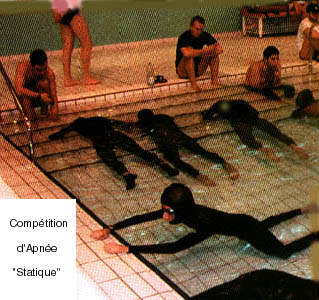
...Here. You can see the competitors lying face down in the small pool of a swimming pool, or more precisely in its shallow end, in thirty centimeters of water. During the operation, their backs are above water. The maximum performance during the meeting mentioned above was six minutes and twenty-two seconds. When you see such a photo, you wonder why a swimming pool is used. Would a simple locker room not do?
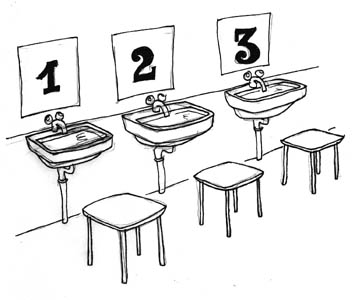
**Above, an Olympic installation where competitors would only have to plunge their face into a sink. **
...In truth, the diving business has to keep going. However, things have changed a lot in recent decades. Recently, I was diving, far out at sea, in reputed depths (the islands off Marseille, specifically the Emaillades reef), where once there were beautiful sponges, sea roses (retepora cellulosa), abalones and all sorts of wonders found in the marine depths. I no longer found anything but desolate seabeds, raked by generations of student divers, each eager to bring back something from their walk. Let's not even mention the fauna, which no longer resembles what could be found in the 1950s, or even the 1960s. One can wonder if such seabeds will ever regain their former richness. ...To avoid returning empty-handed, the underwater hunter was the first to venture into increasingly deeper waters. In the past, free diving took the diver to worlds full of fantastic flora and fauna. At ten to fifteen meters, it was the jungle, the possibility of meeting a large resident. Today, the giant sponges, a specialty of the Mediterranean seabeds, the "nacres" which some reached a meter in length, have completely disappeared. The typical inhabitant of the seabed is... the sea urchin. Therefore, a new sport had to be promoted: free diving, considered as an activity in itself. Without the powerful sponsorship of brands (waterproof watches, underwater equipment), these spectacular feats would not have gained such attention. Above, we mentioned the pioneer of this "discipline": the Marseille native Jacques Mayol. Attached to his gueuse, he reached one hundred meters. But we are no longer there. These records, according to the text of the April 2000 issue of Apnea, had started to progress slowly. After the hundred-meter wall, spectacular, timid progress was recorded: 102 meters, then 104, etc...
...The public and the media quickly tired of such small jumps. As it is written in this issue of Apnea, page 66, "two meters no longer make the cut". Now, media means... advertising. Sponsors demanded more spectacular progress. The leader in this matter is a man named Francisco Ferreiras, nicknamed "Pipin". Diving with a gueuse. Ascending attached to a balloon.
...Simple remark: this is equivalent to compressing a person under seventeen atmospheres in one and a half minutes, then decompressing him in the same time. But the image of a human being sinking into the abyss, attached to his weight, is more fascinating and, let's say, more morbid. Note the presence of the camera, attached to the device. The public likes circus acts. ...On January 15, 2000, Pipin made a first attempt, aiming for 162 meters. He had developed a technique consisting of "washing out his sinuses". But the weather was poor. A little current forced him to swim back to his starting point. The support divers were already in place, and those could not stay long at such depths, due to the decompression stops, which the free diver-kamikaze does not need: his stay in the abyss is too brief for his blood to have time to become charged with nitrogen. "Pipin only has one minute to ventilate" (to block the warning system related to the rise in CO2 levels in the blood, see above). He plunges and will go into syncope four meters from the surface ("this was due to the effort he had to make before his attempt"). . ...Never mind. The medical team considers that he will be able to try again the next day. And the next day, it's the feat. In fact, according to Pipin's own words, "it's an open door to two hundred meters," thanks to this "sinus washing" technique, which Pipin promises to reveal the secret of and which allows "compensating" much more quickly. In these conditions, with a streamlined weighted chamber, why not, one day, consider 300 meters, or even more?
...The future is assured. The media will follow, the sponsors too. Everyone will want to buy the pair of fins or the suit with which Pipin set his record.
..."Static apnea" is developing. There are now no more cities where individuals of both sexes, grouped in clubs, swim, nose down, in the shallow ends of municipal swimming pools. Federation, certification, competitions, media coverage. Any ordinary person can dream of becoming, one day, a record holder, of knowing the spotlight. No need to have muscles, a quick reflex, "everything is in the head".
...Let's be clear: these feats offer no interest, neither "static apnea" nor this mad race to the abyss, driven by a gueuse and rising with a balloon. It reminds one of the time in the 1950s when a famous wrestler prevented an airplane from taking off by holding a rope between his teeth, or the bicycle speed records (one hundred kilometers per hour, or more, "sucked" by a windbreak attached to a vehicle). But don't look for it: this race to a fatal accident, this incitement to catastrophe, who is driving it? The public, relayed by the media and by the business sense of equipment manufacturers, one of whom, very well known, today the main sponsor of activities related to free diving, had told me when I demonstrated the rescue device on this site:
- Safety is not a profitable niche.
Reactions.
...A few days after posting this text on my website, I received reactions, all positive. The first ones came from young people who wrote me, "Sir, my friends and I practiced deep free diving. We didn't know all this and we realize that we may have come very close to death without being aware of it." ...A diving school announced that it had decided to put a link from its website to mine, for the education of its members, while noting that clubs had greatly benefited from the impact of the film The Big Blue, recording record numbers of members with the release of the film. ...Certainly, but one can also estimate that more than five hundred fatal accidents related to free diving occurred in the year following the film's release, with nearly fifty in France alone.
May 18, 2000
A letter from M. Duhamel, Saint Maur
Sir,
*....I was surprised to realize that I had the same experience as you when I was in engineering school. I used to swim 50 meters underwater, in a pool. One beautiful summer day, at the Saint-Ouen pool, I stayed at the bottom (like you, on the least deep side), without realizing anything. I remember having to force myself a bit to reach the end of the pool, and then I woke up lying on the edge of the pool. In the meantime, a schoolmate who had followed my demonstration was surprised to see me stay at the bottom while I had reached the end. He first thought I still had some air left and then, not seeing me move, he alerted the lifeguard who pulled me to the surface. Like you, I am therefore a survivor of free diving. *
Granted by the intervention of a reader, Laurent Latxague, this article could be reproduced in the August 2000 issue of the magazine OCTOPUS. It is true, as already mentioned above, that one of the journalists from the magazine had just lost his best friend in a free diving accident. He was hunting in deep water, monitored by a companion. But when, after a too long dive, he fainted on the way up, and fell back on the bottom, his companion was unable to bring him up. He then went to look for help, in vain. Let's hope that the dissemination of this text will have saved lives this summer. Let's also hope that a diver manufacturer will take interest in the project of a rescue system for free divers who have fainted. Nowadays, all divers have bottle fixation systems with Mae West incorporated. In the past, this was a cumbersome and expensive luxury. Now it's discreet, rational. Why shouldn't free divers also have the right to safety?
...End of August, Thierry Beccaro, host of the program "C'est l'été", on FR3, received the representative of the AIDA association, the International Association for the Development of Free Diving, who came to announce a very close international free diving competition, in the south, under the auspices of this association, no doubt sponsored by underwater equipment brands; linked to this "new sport, in full development". A diver, next to, was demonstrating by performing an apnea of more than four minutes. The activity was trivialized, presented as something as calm as tennis. Not a word about the dangers involved. Did Beccaro realize the risk he was taking with his (young) television viewers? Probably not.
November 2000
...I received a letter from a member of the French underwater hunting federation. I would like him to remind me of his name so that I can cite him in these columns. He first reminded me of something very important. In the past, free divers practiced "hyperventilation", that is, they panted according to a period of one to two seconds, for one to two minutes. This is very effective for completely renewing the air in the lungs, which initially has a higher level of carbon dioxide than ambient air. When one practices such hyperventilation, its effectiveness reveals itself as a kind of intoxication that affects the practitioner. Thus, the blood is in contact with this air less rich in CO2 and thus becomes poorer in carbo-oxyhemoglobin, which we know is the one that causes the feeling of suffocation, of "lack of air". Considering that the free diver who acted in this way was only "disabling his safety system", relying only on his own assessment of the time elapsed to decide when to end his dive, it was recommended to divers to prohibit this forced ventilation activity "by replacing it with a series of long inhalations". However, this is strictly the same, if one chains a series of long inhalations and forced exhalations, the result being the replacement of the pulmonary air with fresh air.
...This man then added a suggestion to his letter, which I found extremely interesting. It is known that underwater hunters are supposed to hunt in pairs (but we have seen, according to the testimony of a journalist from the magazine Octopus, that a companion could be unable to help his partner). My correspondent therefore suggested equipping both partners with a life jacket, inflatable with a small CO2 cartridge, but since fainting during free diving presents no warning signs, it is the partner, noticing that his companion is lying, unconscious, who could remotely trigger the rescue device "by radio". The disadvantage is that radio waves propagate very poorly underwater. On the other hand, this is not the case for ultrasound, which is very easy to produce. Such a system could be worn on the wrist. Going further, parents or friends who want to monitor the activity of a free diver could watch his movements from the corner of their eye, being able to bring him back to the surface manually at the slightest alert.
...In the dossier we presented, we had opted for a device where all electrical power was excluded. But the control of free diving and the triggering by an electrical device may be the simplest solution, after all, the essential thing being that an effective device is developed, regardless of its operating principle. It is known that the vast majority of divers today are equipped with "diving computers", which they wear on their wrist and have a liquid crystal display. I myself had invented such a device more than twenty years ago, which I had presented, in vain, to French industrialists, not as a simple project, but as a prototype. This system is not very complicated. It consists of a battery, a liquid crystal display, and a microprocessor, properly programmed. Twenty years ago, the state of saturation of the human body was calculated using "four guiding tissues" (today, a larger number is used). Indeed, the tissues are not charged with nitrogen in the same way, nor at the same rate, during the dive. All do not have the same rate of degassing and tolerance to this degassing. What is a decompression accident? Take a bottle of champagne. If you pop the cork suddenly, bubbles appear. If, on the other hand, you hold the cork while letting the gas escape gradually, the bubbles do not appear. The mastery of decompression consists of ensuring that no bubbles appear in any tissue. These bubbles are particularly harmful in nerve tissues and in the joints of the limbs, which are supplied by capillaries. The appearance of bubbles then blocks the blood flow, causing irreversible necrosis of the nerves supplied by these vessels. The accident is signaled by pain, sharp or diffuse. The remedy consists of recompressing the subject to make the bubbles disappear, and allow blood circulation to resume, hoping that the damage has not been too significant (hence the need to put the injured person in a chamber as quickly as possible). ...It does not seem to me, at first glance, impossible to conceive an "angel guardian" operating on electricity. The bathymeter-microprocessor coupling is already in place (since "diving computers" exist). A microprocessor has a clock, with which it calculates the dive time. It remains to couple this system with a pyrotechnic triggering device. The people most capable of developing such a device would be those who produce the "diving computers".
...An interesting variation would be a simple modification of the diving computer, where it would suffice to adapt a plug, to transform it into a safety device for free divers.
...There are no lack of technical solutions, it is the will to realize these products. It is surprising to see, for example, that the company Beuchat is not interested, while it sponsors teams of competitive free divers.
Tuesday, November 14, 2000
...I reproduce this testimony from Julie, a "free diver from Réunion". Without comments.
----- Original Message ----- From: Julie To: J.P.PETIT: Sent: Sunday, November 12, 2000 20:16 Subject: a free diver from Réunion
...Dear Mr. Petit,
...I am not a big industrialist looking for a profitable project, but I have still allowed myself the right to send you these few words. I am 20 years old and my name is Julie Gautier, I practice free diving at a high level, I participated in the last world cup which took place in Nice in October last year. I have been practicing underwater hunting for 10 years with my father who taught me everything. I have made a lot of progress in hunting since I started free diving. My 38-year-old uncle was very proud and impressed by my performances. For some time already he has been following me and my father on our expeditions. This Sunday, October 29, 2000, my father and he went out alone. On 30-meter depths, they were diving to wait for the tuna. On his way up, my uncle stopped between two waters to shoot. My father then descended to help him, took the rifle and followed him with his eyes. Everything was fine. When he reached the surface, my father did not see my uncle, so he looked down and saw him sinking to the bottom. He had fainted behind him. Immediately, he dived towards him to try to catch up with my uncle, who weighed at least 80 kg and was above. He was on his back and was sinking to the bottom, looking at my father in the eyes. He had grabbed the lifeline that was still there. But powerless against destiny, which asked him to choose between his life and their death, he went back to the surface. His eardrum was perforated, he had to release his belt. The body of my uncle was found the next day by divers. I know that you understand my sorrow. I wanted to share it with you because, like you, I thought that it was necessary to invent a system to avoid these numerous accidents. I found in you the answer to my fears for the future. I hope that your project will succeed to prevent others from experiencing the pain that is eating us. In all simplicity and sincerity
Julie julie.c.gautier@voila.fr
June 2001.
...Here comes the season of all dangers again. I couldn't ... do anything. However, several points emerge. Some readers wrote to me saying, "the fact of basing everything on an electrical system does not really pose a problem now. We willingly entrust our beauty to a diving computer that works with batteries. The rescue system for divers could be based on electrical equipment."
They are perfectly right. Everything is based on the fact that we currently have very reliable pressure sensors, which are the input of these decompression calculators. Nothing would prevent the release of a version where this sensor would allow the memorization of the surface pressure, then the dive time, under pressure relative to that. The premature triggering would be canceled by preventing the device from triggering for too slow pressure variations (barometric). Beyond a certain depth, which could even be entered into the machine as data, an electrical signal would trigger the pyrotechnic opening of a tank, or simply, that gas would correspond to the product of a simple chemical reaction, which would be even simpler.
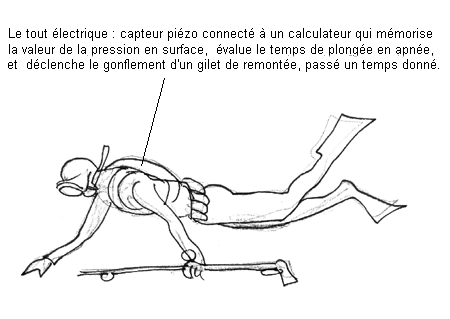
Second idea, launched by another reader: the system where you dive in pairs and the partner visually monitors the safety of his companion. He then has a remote trigger, sending a coded signal, by ultrasound. Each vest has its own. It is obviously necessary to entrust the partner with the trigger that goes with his vest, and vice versa. Beyond that, parents or friends, or a person monitoring from the surface, could manually trigger the forced ascent of the unconscious diver. It will be necessary for the manufacturers of underwater equipment to take this issue into account. But there is a market and the matter is relatively simple.
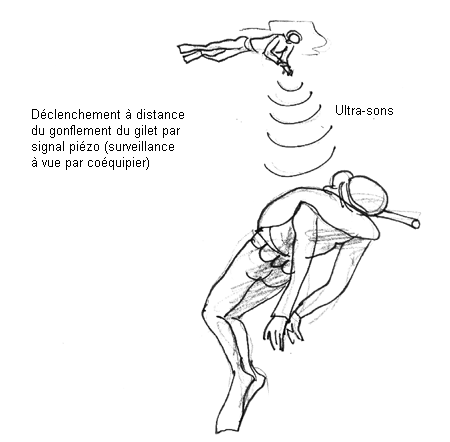
Third idea, which can be implemented as it is. We have seen, with the testimony of this unfortunate young girl, who saw her uncle die before her eyes, that diving in pairs does not automatically solve the problems. If you have an unconscious partner lying on a thirty-meter seabed, what to do? You have to reach him quickly. You have only a few minutes to intervene. At depth, the compression of the suit and the body gases gives an apparent weight gain. You have to grab the unconscious diver, release his belt, then your own, and finally try to bring them up, no matter what, while wrestling with the two apparent weights. One single attempt. If it fails, the diver will be unable to recover quickly enough to make another attempt, which will result in the death of his partner. A variation would consist of being equipped with a kind of Mae West. The rescuer diver then attaches himself to his companion, possibly with a carabiner, and triggers the Mae West, which brings up both. Unfortunately, existing Mae Wests are cumbersome, hinder movement. It is hard to see a free diver using them. Moreover, they are only useful for saving the other. We know that syncope is instantaneous, it does not warn at all. So, on an individual level, it is of no use.
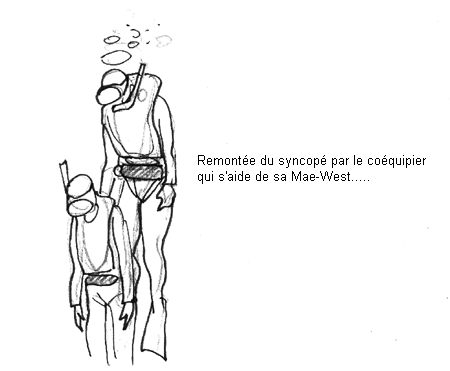
Fourth idea: that each partner carries with him a small polystyrene buoy, on which thirty or forty meters of fishing nylon line of good diameter are wound. At the end, a small carabiner. To be used in a rescue maneuver, in two steps.
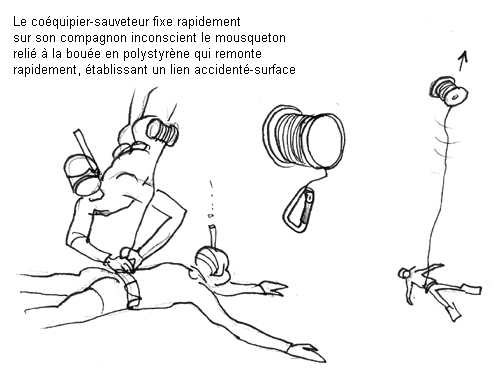
1 - You probe towards the unconscious diver, you quickly attach the carabiner and release the buoy, which rises by unwinding the line.
2 - You are then able to bring up the unconscious diver by pulling on the line from the surface.
Cheap, not cumbersome. It can save lives.
September 3, 2002
I believe there have been fifteen deaths this summer, in accidents related to free diving. Thank you, Jacques Mayol, pioneer of this new "discipline", this new "extreme sport". The media briefly reported these accidents during a news broadcast. There was a short report. What did the journalists go to film? An image of a man training to descend attached to a gueuse in the purest "Big Blue" style. Who did they interview? A champion of the specialty, who is in charge of "a free diving training" and insists on the fact that one must teach practitioners to "manage themselves". All of this is absurd. Remember the anecdote I mentioned at the beginning of the file and which refers to my own experience. At the age of twenty, I went to do "a length of 50 meters in the pool of the Tourelles in Paris". Normally this kind of performance was well below what I could do at the time. And it was my awareness of syncope, instantaneous, without any warning signs. I was rescued by bathers. Fortunately, at that time the pool was not empty. I would have enjoyed playing this game at lunchtime, I would not be here to talk about it.
Television will never invite someone who holds a "safety" discourse, who warns of the dangers inherent in this activity. It is not "media-friendly".
Jacques Mayol, whom I knew well (I dived with him in the Bahamas in the 1980s) committed suicide on December 24, 2001. He knew my son well. When my son died following his foolish example in July 1990, I called Jacques and said to him:
- *This activity is deadly. You know well that man "does not descend from a swimming monkey" as you suggested in your book "homo delphinus". Let's save these kids, let there be no more tragedies of this kind in the future. Help me warn people. Your media image would make you heard. * **
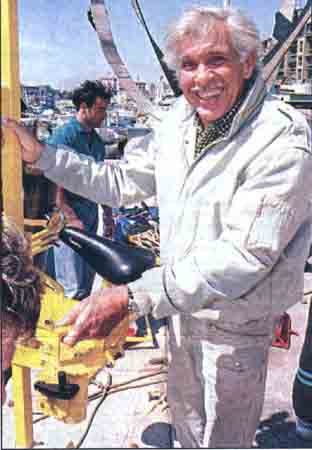
**Jacques Mayol filmed in Cassis in front of a system with which he tried without success, to descend to 75 meters, over 60 years old, in front of these damned television cameras. **
But Mayol did not budge. Without the media, he was nothing. He lived only through this image of the "Big Blue" that he had largely contributed to create, identifying completely with the hero of the film, who in fact bears his name. He preferred to remain silent, thinking that if he joined the "safety" people, the television would stop being interested in him. On December 24, 2001, completely alone in his villa, abandoned by all those who had adored him, by these television stations that had grown tired of filming him, he hanged himself. But if he had chosen to invest in saving lives, he would have found a reason to live.
Free diving consists of holding one's breath within the limits of the moment. Fatigue restricts this range, as the above anecdote shows. There could certainly be a lot of unrecorded parameters that have the same effects, such as certain medications. How to know one's limits at any time? The best is to always stay well below them. Any ordinary person, training, can hold their breath for more than two minutes. Without training, the same person can easily remain breathless for a minute. One can say that it is really necessary to be in poor condition to have a syncope after 20, 30 or 40 seconds of free diving, provided of course that no effort is made. My friend Josso, a student like me at Supaéro, drowned in Corsica in 1960 in ten meters of water while pulling furiously on a grouper, stuck in a hole.
As I said, an individual in good shape, who limits himself to dives at 15 meters and apneas of 45 seconds, in good shape and diving with a suit, in welcoming water, takes a minimal risk, which becomes even smaller if he has the good idea of diving with a companion who can go and find him at the bottom, and even smaller if he is equipped with the gadget described above. Conversely, see the dramatic examples cited, one can lose someone "diving in pairs on a 30-meter seabed" simply because one is not able to bring up an unconscious diver from such a depth. This can be the case for less important depths, around only 10 to 15 meters, if the partner panics, gets out of breath. At depth, death will seize the unconscious diver in less than five minutes and it passes quickly.
It is absurd and irresponsible to see that this "sport" is developing in France, where a "free diving instructor" has been created. It's madness. One might hope to "supervise" people who want to engage in this kind of activity. But the mere fact of recognizing it as a sport is an absurdity in itself. But, in this cursed country, who thinks? The politicians? The journalists?
**In fact, behind it is THE GOD MONEY, and free diving sells masks, fins and snorkels, now that all the fish have been killed. ** ---
**October 13, 2002: **
Die, we take care of the rest
French free diver Audrey Mestre dies while attempting to break the world record for "no limits" [10/13/2002 05:44]
The show must go on**...**
SAINT DOMINGUE, Dominican Republic (AP) -- French free diver Audrey Mestre, who was seventeen when the movie "The Big Blue" was released, died on Saturday while attempting to break the world record for no-limits free diving in the warm and calm waters of the Dominican Republic.
Tied to a line coming from a pulley and pulled down by a 90-kilogram weight, called "the gueuse," the young woman, 28 years old, dived underwater without oxygen at 2:30 p.m. local time (6:30 p.m. GMT). Nine minutes and 44 seconds later, divers brought her lifeless body from the water. A pink foam was coming out of her nose and mouth. The dive was supposed to last about three minutes.
Doctors tried to resuscitate her and took her by motorboat to a hotel on the beach, four kilometers away, where her death was confirmed.
"An accident occurred below," said Carlos Serra, president of the International Freediving Federation, based in Miami (Brilliant deduction). "We think something hit the diver. When she came out of the water, foam was coming out of her mouth and she was bleeding" (Nothing hit the diver. Audrey Mestre was using the technique initiated by her husband "Pipin" consisting of drowning her sinuses. A dive of 160 meters or more, attached to a line, followed by a rapid ascent is simply an absurd risk that a human being imposes on himself, his body being absolutely not made for this. Everything starts from the delirious theories expressed by Jacques Mayol in his book "Homo Delphinus," popularized by filmmaker Besson. Apnea is not a discipline, it's an absurdity, like climbing without a rope or skydiving from a cliff. But it's spectacular. The main responsible for this death are the media and the sponsors, the societies that finance such feats).
Audrey Mestre had reached the depth she had set, 171 meters, near the beach of La Romana, about 130 kilometers east of Santo Domingo, said Mr. Serra. But for this descent to be recognized, the young woman would have had to return safely to the surface (Fantastic remark! A record where the winner dies during the feat cannot therefore be recognized...).
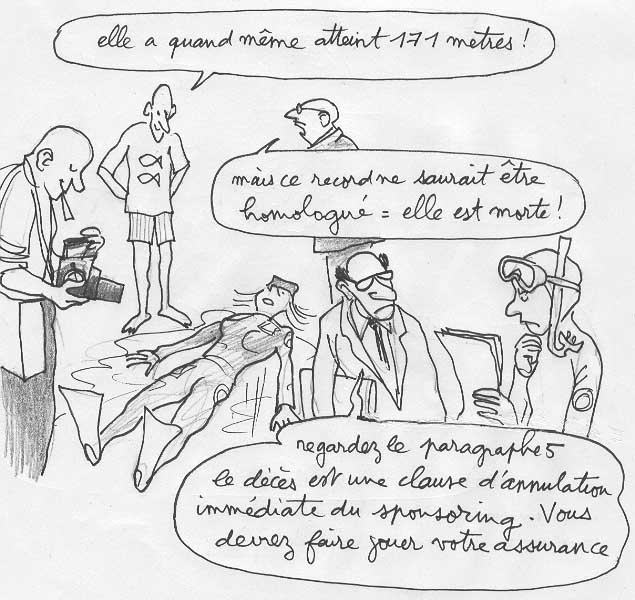
She had already reached this depth during trial sessions on Wednesday.
"Something went terribly wrong," said Jeff Blumenfeld, from the Italian diving company Mares, which sponsored the young Frenchwoman. (My son worked, before he died, for the Italian company Marès. The French company Beuchat also sponsors these "exploits in all kinds of ways," if I'm not mistaken. It sells fins, wetsuits, masks, and magazines like "Apnea." Will the management of the Marès company decide to withdraw from operations evoking Roman circuses and gladiator sacrifices? I would like to know. It's a pity the victim wasn't the director's own son of the Marès company. Maybe it would be necessary to go that far?).
"We still don't know what happened." He added that 13 divers were supervising the descent and that one of them provided her with oxygen during her ascent.
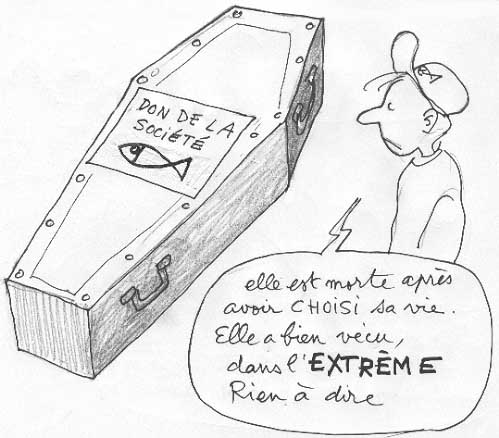
" No limits" is the diving discipline where the records are the deepest but it is also considered the most dangerous (But it's not a "discipline". It's simply a spectacular madness, organized by irresponsible people). This is the one shown by Luc Besson in his film "The Big Blue." After reaching their goal, "no limits" divers return directly to the surface. A decompression phase is not necessary since the diver has inhaled no air underwater.
But on Saturday, things did not go as planned, since she had to be given oxygen and the time she spent underwater was thus tripled. According to Mr. Blumenfeld, she may have lost consciousness (Oh really?). Her body was taken to Santo Domingo for an autopsy.
Audrey Mestre was trying to break the world record of 162 meters recorded by her husband, the legendary Cuban apneist Francisco "Pipin" Ferreras, recognized off Cozumel, Mexico, in January 2000. He was present at the accident (Question: will he continue to play the hero after such a tragedy? It's not impossible. The thirst for publicity, the need to be media-recognized can completely devour an individual to the point of making him lose all humanity).
"She was a pioneer, as much as the first man on the Moon or the first to reach the summit of Mount Everest," said Mr. Blumenfeld (this sentence is scandalously irresponsible). The French champion was supposed to dive early Saturday morning but the weather prevented it. This graduate in marine biology had set the world record for "no limits" women by diving to a depth of 130 meters off Fort Lauderdale (Florida), on May 19, 2001. This dive earned her fifth place in the world champions' ranking of the discipline.
On October 4th, she reached 163.36 meters without taking a breath. In April, she dived tandem with her husband to 103 meters.
Associated Press
Readers may have seen it: France is the first country to have created a "national freediving monitor." As long as we're doing it, why not also create a "national free climbing monitor" or a "national cliff jumping monitor," or even a "national Russian roulette monitor"?
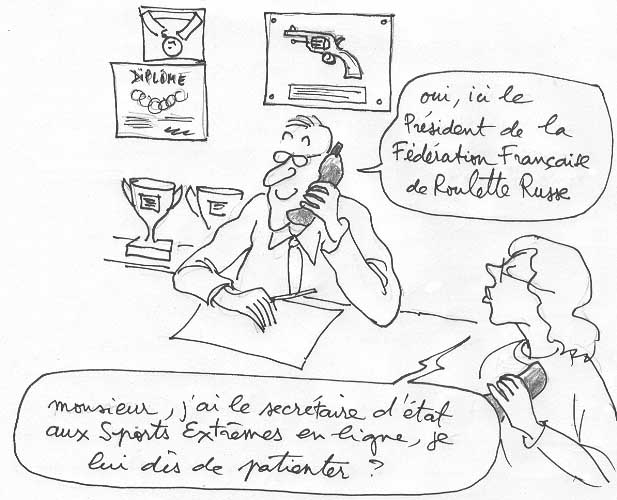
We have in France a minister of youth and sports. Apparently, this one completely doesn't care if people die in a "discipline" closer to Russian roulette than to a real sport. Like this same minister, for 25 years, has completely ignored that ultralights continue to be designed, manufactured, and marketed in France *without a certificate of airworthiness *(which would be the responsibility of the DGAC, the General Directorate of Civil Aviation) and used without mandatory periodic inspections. I saw images yesterday of a new discipline that is causing a lot of damage: "paragliding acrobatics." These images were taken during the last competition in Saint Hilaire du Touvet. While this machine remains problematic in itself, will a "national paragliding acrobatics monitor" be created?
*We live in the idiotic cult of the extreme, a symptom of a more than worrying cultural evolution. *
Behind all this there is a fantastic responsibility of the media. I don't know if people realize how much our media are shaping our lives and what is going on in the heads of our children. This news about Audrey Mestre's death will fall on the teletext of press agencies, in the newsrooms of television channels. Maybe they will talk about it? But how? They will simply announce the news, showing "the recent images of the diver during the trials." Maybe they will question the French champion of the "discipline," or even the "President of the French Apnea Federation"? An idiot journalist may ask seriously, "In your opinion, could it be a decompression accident?" and the "responsible" will answer: "No, the time spent at depth is too short for it to be that. We are currently conducting an investigation to determine the exact causes of the accident." And people will nod gravely, the journalist concluding "investigation ongoing." But no one will think of inviting someone like me on a show to denounce this dramatic lie. In three sentences and two drawings, I could quickly set the clock straight.
Nothing in the head, nothing in the heart, nothing in the balls. Among the people who govern us, among the people in the media who significantly influence our lives and the mentality of our children, there are irresponsible and complete incompetents. I remember a director of civil aviation (a polytechnician I had known for a long time), to whom I had vainly approached for months in 1989, following the death of my best friend, Michel Ktazman, related to a defect in an ultra-light aircraft. I told him:
- How many young people will have to die before you intervene?
He never intervened.
October 15, 2002: The Frenchwoman Audrey Mestre died while trying to break the world record for a descent with a line, returning attached to a balloon, at 170 meters. File. The federation decided to validate this record posthumously.
October 20, 2002: The Frenchman Loïc Leferme becomes record holder and dedicates his record to Audrey Mestre. Article published about him by Luc le Vaillant in Libération of October 18, 2002.
**September 9, 2003: Another disaster. No comments: **
Dear Mr. Petit,
I just discovered your file on the dangers of apnea and it really struck me! Indeed, on August 19th, my son Harold was going to do an apnea in our pool. At 8:15 pm, my husband wanted to tell him something. Harold was preparing his apnea and said, "Shut up, I'm concentrating." These were his last words because my husband found him 15 minutes later lying at the bottom of the pool, his mask full of water! He had just turned 18... The resuscitation unit could do nothing. We are a family of divers, and although we knew the dangers of apnea, we underestimated them in the pool! Harold was doing apneas of 3 minutes 30 and was also fascinated by this film "The Big Blue" that he had just watched twice in a row a few days earlier! He said he felt so good during apnea... My husband feels guilty for having left him alone at that moment! You can understand why your file touches me so much, I live the same story as you and how many others will live it? I would like to do something to prevent this, but I don't know what! Your file is already read by all the members of the diving club. It's a pity I only read it after the accident! I would like to contact a television station to do a program on this subject. Maybe we will meet one day, it would make me happy. Thanks to you, I have better understood the circumstances of my son's death, and I am sure now that he didn't realize anything! Thank you for your attention
Isabelle Eggermont
Journalists won't move. A kid drowning in a pool, "it's not sellable." However, they will make reports on the absurd records of the "extreme apneists," creating vocations that can end just as brutally... in a simple pool.
After my son's death, I contacted Jacques Mayol with whom I had dived in the Caribbean. I told him:
- Help me. Use your media image to stop this massacre. We can save lives.
But he backed out. The media were his only reason for living. Bad calculation. He hanged himself a year ago, alone like a rat in his house on the island of Elba, abandoned by everyone. On that day, Besson wasn't there to film him.
October 10. Message from a reader:
- Imagine that I almost died doing an apnea too. More than 10 years ago after watching the big blue (classic scenario), after some training I could hold 3 minutes 30 (outside of water). I tried it in the pool and after 2 minutes => syncope. If I hadn't had a friend who saw me and pulled me up immediately, I would have had it. * * This "big blue" is a real pain, with its nihilistic utopia that makes apnea a way to escape from real life problems and retreat into a soft virtual paradise. It has almost the characteristics of a religion. The problem is that there are naive teenagers who fall for it and really believe in it. It's almost an incitement to suicide. * * It's an incitement to suicide......
Mayol's message was delirious: "Man was originally a swimming monkey." He saw the world like circus games. One day, Jacques Martin, who at one point had sequences that Americans love, showing stunts that eventually ended tragically, had said to me (after I had appeared on his show for an exploit much less dangerous: I knew how to flip a coin with my toes):
- I'm stopping. All this makes me sick, even if it gives a strong audience. Fifteen days ago, one of my assistants said to me, "we have a guy who proposes an exploit: jumping from a cliff with a bike, attached to an elastic." I called the number indicated and asked for the guy. A woman's voice answered, "he's not back from school yet..."
But for a Jacques Martin who refuses easy audience, how many who wallow in "images that can shock." What's amazing is this theater of shadows that is television. On one hand, we feed people with circus games every day, and on the other, there is this immense cowardice, this journalistic cowardice that makes these people *not have the courage to address the real problems. *I remember the response of one of the most important French companies manufacturing diving equipment, which sponsors apnea competitions, 10 years ago, and to whom I proposed a safety vest for apneists, with automatic activation, which I had invented and developed:
- *Safety is not a profitable niche. *
For the media, it's the same. It's more profitable to give audience to this fabulous nonsense that is "the French Apnea Federation" than to explain to people exactly what's going on. Read the message of this woman who lost her little Harold in ... the family pool. These people *didn't know. *It's staggering;
I think back to a memory from more than twenty years ago. The ultralight was starting. The "French Ultralight Federation" organized the first competition, in Millau. Since the machines were very different, we didn't know very well how to make them compete. There was a circuit, a navigation where pilots were asked to take photos. Then an idiot had the idea of adding a "landing precision" competition, with machines without high-lift flaps. This led pilots to approach at reduced speed, just above the stall. First problem: a guy stalled on the approach, crashed and broke his spine. The TV filmed. They took him, panting, like in Roman circuses. No one said "stop this nonsense!"
Suddenly, another guy came, stalled quite high and ... went into a spin. Shocked (I've flown a lot, of all kinds) I saw that the tail remained fixed. The guy went into a spin and didn't know that when this happens, you have to push the stick and give full power, imperatively. If he had known, he would have escaped. While I was yelling in front of my TV, watching the live sequence "push, damn it! Push!" the guy did three spins and died. The TV filmed. I called, I asked to comment on these images, which would be shown the next day. Useless. "The event has passed." The TV "did its job." "Now, sir, the filming team is on another subject." However, what I can tell you is that we went to interview the "responsible of the Ultralight Federation."
My God, memories come up like mud. Delacourt was, like us, a pioneer of the paraglider. At the time, these machines were "Mantas." I had one too, but already a pilot I was wary of these somewhat unknown machines. We didn't know yet that these machines were prone to "stall," that they could "go into a spin," until we found a solution to this problem. If these machines accidentally went into "negative incidence," the sail would invert, in front. They would then enter an uncatchable dive. The solution existed. It was found, at the cost of some lives. At the time, readers may remember, I immediately sounded the alarm in an article published in Science et Vie. See my dossier on the ultralight.
Before this, the television offered Delacourt to film him. They set a meeting. But the wind was in the wrong direction. Hours passed. The director got impatient:
- So, are you going or not?
Delacourt ran as fast as he could, but lost control of his wing and died, in front of the cameras, these damn cameras that didn't film Mayol's death hanging from his chandelier.
**Etienne Collomb, August 2004 **
Thank you very much for your article on apnea. Wanting to get into it, I came across your article about its dangers, which had the effect of a cold shower like I rarely felt. Not only am I no longer considering trying deep apnea, but your article allowed me to set draconian limits on my future underwater explorations with a mask and snorkel. I get chills thinking about the idea that your article may have saved my life.
Etienne
September 2004 :
Hello,
I am truly "calmed" by your dossier on apnea. Human beings are such that people often tend to deny the obvious until the reality encompasses them entirely...
I was convinced I was a serious diver.... reading your article I remembered all the apneas of this summer: and there, hello the slap!!
Yes, you can say that, on all the dives I have made, few are those where I would have been saved in case of syncope... I'm not proud of it
I hope that your proposals for safety systems will soon be an obvious thing. Know that I am grateful to you, and that what you do will save lives.
Thank you
Serge Yvenou
A murderous and irresponsible journalism
April 2006: The newspaper Le Monde Recidives ****
This discipline popularized by "The Big Blue" allows one to be free of stress by learning to breathe and hold one's breath
Breathe... calmly... slowly... deeply... "Philippe Claudel, the instructor, repeats these instructions softly to the trainees, standing at the edge of the pools. This is how the first session of an introductory program to apnea begins at the UCPA-Aqua 92 center in Villeneuve-la-Garenne (Hauts-de-Seine), ten minutes from Paris.
With their arms along their body, the trainees of all ages, in swimsuits, have their eyes closed. Before getting into the water, they will spend an hour relaxing. The ceremony will be repeated at the beginning of each of the five or six sessions of the course that will make them apneists. "These exercises will teach you to reconnect with your body, to forget the outside world, the noise, the transportation, the work, the family..." explains the instructor. This is how you will be able to master your breath. "
Deep inspiration through the nose, stomach inflated, sensation of the lungs filling, then exhalation through the mouth, twice as slow, with the stomach, this time, hollowing out: the exercise is repeated five to ten times to find the right rhythm, which will be maintained throughout the session. Then a full-body workout. The neck is loosened, the head is tilted in all directions. The pelvis and shoulders rotate like with a hula-hoop. The legs are stretched by bringing the heel against the buttocks. "You start to feel certain of your muscles," comments the instructor, asking to also move the ankles and wrists. The apneists then have to balance on one leg, always with their eyes closed.
" These exercises aim to eliminate internal tensions, both muscular and nervous as well as mental, " explains Philippe Claudel. " These are the ones that consume energy and therefore oxygen useful for staying apneic. "
A dozen minutes of swimming allow them to get in contact with water at 30 ºC. Then, hands on the edge of the pool, after emptying their lungs, the trainees keep their head underwater. Very quickly, personal records are broken. " One minute! " exclaims a fifty-year-old with white hair. I had never managed to hold more than 15 seconds before. " Already, the heart beats slower.
" RETURN TO THE ESSENTIAL "
It's time to put on the fins for a length at the bottom of the pool, this time with full lungs. Arms stretched in front of them, the body undulates gently from shoulders to feet. The swimming is hydrodynamic, therefore economical in physical expenditure. It will also allow, later in natural environments, to move among the fish without scaring them.
The first dives in the large pool are a bit worrying. Not everyone knows how to compensate for the discomfort of the pressure on the eardrums: it doubles below 10 meters and triples below 30 meters. However, once all stress is released, the dives are repeated, getting deeper and deeper, along the "lifeline," a rope to which one can hold to descend more calmly. Some manage to reach the bottom: it only takes 30 seconds to descend and come back up without rushing. " It's just a question of confidence," say those who come up to the surface with a big smile after regaining their breath.
At the end of the course, the best will remain more than two minutes without breathing. Of course, still far from the mythical performances of the apnea champions. The Belgian Patrick Musimu went down to 209 meters in the summer of 2005. The best can hold up to 8 minutes and cover 200 meters underwater.
Since the success of the film "The Big Blue," by Luc Besson, in 1988, apnea has gained many followers. Many for the sporting aspect of this discipline, but also for the well-being it brings. " It's a good way to return to the essentials," says the Frenchman Loïc Leferme, holder of the world record for deep diving ("no limits") reaching 171 meters. Apnea allows one to feel one's body well, but also to engage in a real introspection. When you are face to face with yourself, with your own limits, you can't cheat. "
For him, " staying underwater without breathing is more like meditation than a physical exercise. You quickly learn to master your feelings and then your body to consume less and less oxygen. It's this that gives a feeling of well-being. " All the trainees agree, by the way: they sleep much better after their apnea sessions.
Christophe de Chenay
This discipline popularized by "The Big Blue" allows one to be free of stress by learning to breathe and hold one's breath
Breathe... calmly... slowly... deeply... "Philippe Claudel, the instructor, repeats these instructions softly to the trainees, standing at the edge of the pools. This is how the first session of an introductory program to apnea begins at the UCPA-Aqua 92 center in Villeneuve-la-Garenne (Hauts-de-Seine), ten minutes from Paris.
With their arms along their body, the trainees of all ages, in swimsuits, have their eyes closed. Before getting into the water, they will spend an hour relaxing. The ceremony will be repeated at the beginning of each of the five or six sessions of the course that will make them apneists. "These exercises will teach you to reconnect with your body, to forget the outside world, the noise, the transportation, the work, the family..." explains the instructor. This is how you will be able to master your breath. "
Deep inspiration through the nose, stomach inflated, sensation of the lungs filling, then exhalation through the mouth, twice as slow, with the stomach, this time, hollowing out: the exercise is repeated five to ten times to find the right rhythm, which will be maintained throughout the session. Then a full-body workout. The neck is loosened, the head is tilted in all directions. The pelvis and shoulders rotate like with a hula-hoop. The legs are stretched by bringing the heel against the buttocks. "You start to feel certain of your muscles," comments the instructor, asking to also move the ankles and wrists. The apneists then have to balance on one leg, always with their eyes closed.
" These exercises aim to eliminate internal tensions, both muscular and nervous as well as mental, " explains Philippe Claudel. " These are the ones that consume energy and therefore oxygen useful for staying apneic. "
This discipline popularized by "The Big Blue" allows one to be free of stress by learning to breathe and hold one's breath
Breathe... calmly... slowly... deeply... "Philippe Claudel, the instructor, repeats these instructions softly to the trainees, standing at the edge of the pools. This is how the first session of an introductory program to apnea begins at the UCPA-Aqua 92 center in Villeneuve-la-Garenne (Hauts-de-Seine), ten minutes from Paris.
With their arms along their body, the trainees of all ages, in swimsuits, have their eyes closed. Before getting into the water, they will spend an hour relaxing. The ceremony will be repeated at the beginning of each of the five or six sessions of the course that will make them apneists. "These exercises will teach you to reconnect with your body, to forget the outside world, the noise, the transportation, the work, the family..." explains the instructor. This is how you will be able to master your breath. "
Deep inspiration through the nose, stomach inflated, sensation of the lungs filling, then exhalation through the mouth, twice as slow, with the stomach, this time, hollowing out: the exercise is repeated five to ten times to find the right rhythm, which will be maintained throughout the session. Then a full-body workout. The neck is loosened, the head is tilted in all directions. The pelvis and shoulders rotate like with a hula-hoop. The legs are stretched by bringing the heel against the buttocks. "You start to feel certain of your muscles," comments the instructor, asking to also move the ankles and wrists. The apneists then have to balance on one leg, always with their eyes closed.
" These exercises aim to eliminate internal tensions, both muscular and nervous as well as mental, " explains Philippe Claudel. " These are the ones that consume energy and therefore oxygen useful for staying apneic. "
**The same day (April 14, 2006) I received the following testimony: ** ** **** ****
I am a doctor
I read with interest your article on the dangers of apnea.
Here is my personal testimony. My brother went on summer vacation to Greece a few years ago with 3 friends. They are young people, snowboard enthusiasts. They visited the Cyclades, including the island of Amorgos.
One of the tourist attractions on this island is a cargo shipwreck, beached near the shore. This ship was used as a set in one of the "mythical" scenes of The Big Blue where Enzo Maiorca, alias Jean Reno, saves a diver trapped in the wreck. Other scenes of the film were shot on Amorgos. In fact, tourist guides extensively mention the filming of The Big Blue on the island. The trendy restaurant at the port is called "Le Grand Bleu."
I am part of the "Grand Blue generation." For us Jacques Mayol is (was) a living legend (Thank you Besson). The three friends decided to stay on Amorgos for a few days, practicing swimming, cliff diving, and some free diving in open water. Eventually, they went to Santorini, in a hotel with a large outdoor pool. There, my brother and his friends decided to have an apnea competition in the pool "like in The Big Blue." The competition went well. While one of his friends went to get drinks, my brother wanted to set a record for lengths in apnea in the pool.
He did as he had seen in the movie and started hyperventilating in a yoga position at the edge of the water. Then he took a final breath and dived. The friend of my brother who had stayed at the edge of the pool didn't realize anything. It was only after the return of the other friend several minutes later that they saw an unconscious body between two waters. My brother was pulled out of the water and a hotel employee performed first aid.
My brother, who had a sudden syncope due to hyperventilation, was hospitalized for a week in Santorin, treated with antibiotics for the beginning of a pneumonia due to aspiration. The initial syncope of a few minutes paradoxically saved his life by preventing him from "drowning." The inhalation of liquid occurred at the time of the rescue.
I am a medical assistant (equivalent of a hospital intern, in France) in a internal medicine department in Switzerland, near Gruyères.
We see every day in our work the consequences of extreme sports, which are highly media-covered and completely stupid. Deep apnea is one of them.
My brother almost died and your son died.
During our studies, we are explained in physiology classes the dangers of hyperventilation which cuts the CO2 signal and causes a sudden hypoxic syncope. Young apnea enthusiasts should be better informed of the dangers of this sport.
I hope that our testimonies can help others.
Grégoire Gendre, medical assistant
1782 Belfaux, Switzerland
P.S. You can cite my name if you find this testimony interesting to publish online. If you want, I have other testimonies regarding extreme sports, seen in the context of my work. My brother also almost died while surfing waves in Indonesia. But that's another story...
I am a doctor
I read with interest your article on the dangers of apnea.
Here is my personal testimony. My brother went on summer vacation to Greece a few years ago with 3 friends. They are young people, snowboard enthusiasts. They visited the Cyclades, including the island of Amorgos.
One of the tourist attractions on this island is a cargo shipwreck, beached near the shore. This ship was used as a set in one of the "mythical" scenes of The Big Blue where Enzo Maiorca, alias Jean Reno, saves a diver trapped in the wreck. Other scenes of the film were shot on Amorgos. In fact, tourist guides extensively mention the filming of The Big Blue on the island. The trendy restaurant at the port is called "Le Grand Bleu."
I am part of the "Grand Bleu" generation, along with my brother and his friends. For us, Jacques Mayol was (was...) a living legend (Thank you Besson). The three of them decided to stay in Amorgos for a few days, swimming, cliff diving, and doing some free diving. Eventually, they went to Santorini, to a hotel with a large outdoor pool. There, my brother and his friends decided to hold a pool free diving competition "like in Grand Bleu". The competition went well. While one of his friends went to get drinks, my brother wanted to set a record for pool lengths in breath-hold. He did as he had seen in the movie and started hyperventilating in a yoga position at the edge of the water. Then he took a final breath and dived. My brother's friend who had stayed by the pool didn't notice anything. It was only after the other friend returned several minutes later that they saw an unconscious body between two waters. My brother was pulled out of the water and a hotel employee performed first aid. My brother, who had suffered a sudden syncope due to hyperventilation, was hospitalized for a week in Santorin, treated with antibiotics for the beginning of a pneumonia due to bronchoaspiration. The initial syncope of a few minutes paradoxically saved his life by preventing him from "drowning". The inhalation of liquid occurred at the time of the rescue. I am a medical assistant (equivalent of a hospital intern in France) in an internal medicine department in Switzerland, near Gruyères. We see every day the consequences of extreme sports, which are highly publicized and completely stupid. Deep free diving is one of them. My brother almost died and your son died. During our studies, we are taught in physiology classes the dangers of hyperventilation, which cuts the CO2 signal and causes a sudden hypoxic syncope. Young free divers should be better informed of the dangers of this sport. I hope our testimonies can help others. Grégoire Gendre, medical assistant 1782 Belfaux, Switzerland P.S. You can quote my name if you find this testimony interesting to publish online. If you want, I have other testimonies regarding extreme sports, seen in the context of my work. My brother also almost died while surfing waves in Indonesia. But that's another story... Would this second text need a comment? For fifteen years I have been waiting for a newspaper, written or spoken, to open up about the dangers of free diving, in vain. Extreme sports are "sellable", safety is not. If television gives in to this irresponsible journalistic trend, you now know that your esteemed newspaper Le Monde, with its reputation, is not exempt from this rule of money above all. It doesn't matter the deaths, the suffering that will mark this path. What matters is to fill up readers, at any cost. --- July 5, 2006 How many deaths will there be this summer, encouraged by the "French Free Diving Federation"? Reaction to your dossier on the dangers of free diving: http://www.jp-petit.com/dangers/apnee.htm Hello, Thank you for your well-documented article, which reassured me about the free diving accident my younger brother (24 years old) suffered this weekend. For years, we had the (stupid) habit of practicing static and dynamic free diving in a private pool, inspired by Luc Besson's film. We did it without informing ourselves and for some moments of "well-being" or even to unconsciously relive the gentle sensations we all experienced in our mother's womb. Moreover, we always practiced free diving after hyperventilation followed by a minute of very slow breathing, which allowed us to hold up to 4 minutes in static free diving and swim up to 75 meters in dynamic free diving without fins (done in a public pool without receiving a single warning from the lifeguards). We had no knowledge of the risks, and this activity seemed little dangerous to everyone. In short, my brother went for a dynamic free dive, and after 1 minute and 45 seconds of back and forth in the pool, I saw him calmly exhale his air while coming to the surface, but then he slowly sank to the bottom of the pool right under my feet. I thought he didn't have enough oxygen to continue in dynamic free diving but enough to finish with a little static. After 10 seconds, I still pulled him up because I thought we couldn't hold on any longer once all his air was expelled. He was stiff, had half-open and rolled eyes, a mouth grimace. I immediately put him on the edge of the pool in PLS with the help of friends who were there. He then took 20 seconds to react to our stimulations and woke up suddenly, as if nothing had happened, wondering what he was doing at the edge of the pool. What relief for all of us and what luck for him that he didn't do the same alone... Not knowing about this syncope phenomenon, we thought it was something more serious, so we researched on the internet and found you on Google with the keywords "danger apnea" where you appear as the first result. If we had known the risks of free diving (through TV media, for example), we would have immediately stopped this dangerous activity. Because, after a consultation with a cardiologist, it should be specified in your article that every free dive longer than 1 minute harms the heart and many active cells that compose it are permanently lost, making it more prone to a heart attack. Sincerely, You can quote me: Olivier Grauer, Web designer in Auxerre Reaction to your dossier on the dangers of free diving: http://www.jp-petit.com/dangers/apnee.htm Hello, Thank you for your well-documented article, which reassured me about the free diving accident my younger brother (24 years old) suffered this weekend. For years, we had the (stupid) habit of practicing static and dynamic free diving in a private pool, inspired by Luc Besson's film. We did it without informing ourselves and for some moments of "well-being" or even to unconsciously relive the gentle sensations we all experienced in our mother's womb. Moreover, we always practiced free diving after hyperventilation followed by a minute of very slow breathing, which allowed us to hold up to 4 minutes in static free diving and swim up to 75 meters in dynamic free diving without fins (done in a public pool without receiving a single warning from the lifeguards). We had no knowledge of the risks, and this activity seemed little dangerous to everyone. In short, my brother went for a dynamic free dive, and after 1 minute and 45 seconds of back and forth in the pool, I saw him calmly exhale his air while coming to the surface, but then he slowly sank to the bottom of the pool right under my feet. I thought he didn't have enough oxygen to continue in dynamic free diving but enough to finish with a little static. After 10 seconds, I still pulled him up because I thought we couldn't hold on any longer once all his air was expelled. He was stiff, had half-open and rolled eyes, a mouth grimace. I immediately put him on the edge of the pool in PLS with the help of friends who were there. He then took 20 seconds to react to our stimulations and woke up suddenly, as if nothing had happened, wondering what he was doing at the edge of the pool. What relief for all of us and what luck for him that he didn't do the same alone... Not knowing about this syncope phenomenon, we thought it was something more serious, so we researched on the internet and found you on Google with the keywords "danger apnea" where you appear as the first result. If we had known the risks of free diving (through TV media, for example), we would have immediately stopped this dangerous activity. Because, after a consultation with a cardiologist, it should be specified in your article that every free dive longer than 1 minute harms the heart and many active cells that compose it are permanently lost, making it more prone to a heart attack. Sincerely, You can quote me: Olivier Grauer, Web designer in Auxerre April 2007: death of French champion Loïc Leferme: Below is an advertisement published in Télérama  Dossier How many men and women will have to die senselessly before finally saying stop to this "new discipline", which is absurd? This young man leaves a woman and two children. In the press, it says "a rope may have gotten stuck". An hypothesis to escape from the other hypothesis: the fainting, in the practice of what is anything but a sport. But to admit it would lead those "who exist only through free diving" to question themselves, risking a
  Loïc Leferme Return to the beginning of the page to read, or reread this dossier on the dangers of free diving --- July 9, 2007: I have been completely discouraged for a long time and have abandoned all hope of seeing a debate on free diving as a "competitive sport". I still attach the letter sent by a reader to the ARTE channel, following the broadcast of a report tracing a kind of saga of free diving. ** **** ****
To the attention of Mr. Nassivera, head of the reportage department at ARTE:
Juan-Les-Pins, 09/07/07 Mr., Although I have long been convinced of the quality of your reports, some of them sometimes make me react strongly. Especially when they neglect the lives of young people.
The one this morning about free diving ("the great duels of sport") deserves your careful attention. We emotionally see Loïc Leferme, this young and talented French champion, who died accidentally in Nice during a free diving training session in April. It seems he was a victim of a mechanical incident, or more likely of the merciless syncope of free diving, which strikes without warning, randomly, anyone, anytime, champion or not.
Free diving is just a game with death. That's what excites the crowd, makes them happy, and creates viewership.
Jean-Pierre Petit has been insulted many times for saying this. Again, the facts prove him right. But it's even uncertain whether Loïc Leferme's death will stop this absurd race. Already, this "stupid accident" is limited to "a rope that got stuck". Read the article again. His friend Pierre Frolla is stunned. He doesn't understand.
- Loïc was not a free diver who wanted to do things at all costs. He never took any risks. He would never have gone beyond his limits. He was the one capable of going to 200 meters. And above all, he was surrounded by the best team possible," said the Monégasque to Reuters. This accident, Pierre Frolla sees it "as a stupid day, just a coincidence of circumstances" and adds, "It's too unfair."
Well, of course. Admitting that this "discipline" is just a huge nonsense would mean questioning everything, sending the hero candidates back to the grayness of anonymity.
After the 200-meter wall, what will it be? The 300-meter wall?
These feats are absurd. They have absolutely nothing to do with sport. A man descends quickly, attached to a line, then ascends, pulled by a balloon. If we wanted to create "better safety", the simplest would be to tie the man to a simple rope, itself attached to a line. We could descend him quickly to the bottom, then bring him back up. At least we would be sure to retrieve him. Even in case of syncope, we could take care of him on the surface. But then the feat would present less risk. However, between that and the descent, holding a line and ascending attached to a balloon, where is the difference?
The "great progress" has been to drown one's sinuses. Looking closely, one could also put a man in a chamber, compress him under twenty bars, then release the pressure. Apart from the spectacular aspect, it's the same thing. The only attraction of this activity is the media impact, the morbid fascination.
There will be other deaths, be assured.
Do you believe a media would organize a televised debate on this subject? No, it wouldn't be "sellable". Now there is a young woman with two young children. What a tragedy.
Alain LE COCQ-STEPANOVA, electronics engineer
To the attention of Mr. Nassivera, head of the reportage department at ARTE:
Juan-Les-Pins, 09/07/07 Mr., Although I have long been convinced of the quality of your reports, some of them sometimes make me react strongly. Especially when they neglect the lives of young people.
The one this morning about free diving ("the great duels of sport") deserves your careful attention. We emotionally see Loïc Leferme, this young and talented French champion, who died accidentally in Nice during a free diving training session in April. It seems he was a victim of a mechanical incident, or more likely of the merciless syncope of free diving, which strikes without warning, randomly, anyone, anytime, champion or not.
Free diving is just a game with death. That's what excites the crowd, makes them happy, and creates viewership.
Jean-Pierre Petit has been insulted many times for saying this. Again, the facts prove him right. But it's even uncertain whether Loïc Leferme's death will stop this absurd race. Already, this "stupid accident" is limited to "a rope that got stuck". Read the article again. His friend Pierre Frolla is stunned. He doesn't understand.
- Loïc was not a free diver who wanted to do things at all costs. He never took any risks. He would never have gone beyond his limits. He was the one capable of going to 200 meters. And above all, he was surrounded by the best team possible," said the Monégasque to Reuters. This accident, Pierre Frolla sees it "as a stupid day, just a coincidence of circumstances" and adds, "It's too unfair."
Well, of course. Admitting that this "discipline" is just a huge nonsense would mean questioning everything, sending the hero candidates back to the grayness of anonymity.
After the 200-meter wall, what will it be? The 300-meter wall?
These feats are absurd. They have absolutely nothing to do with sport. A man descends quickly, attached to a line, then ascends, pulled by a balloon. If we wanted to create "better safety", the simplest would be to tie the man to a simple rope, itself attached to a line. We could descend him quickly to the bottom, then bring him back up. At least we would be sure to retrieve him. Even in case of syncope, we could take care of him on the surface. But then the feat would present less risk. However, between that and the descent, holding a line and ascending attached to a balloon, where is the difference?
The "great progress" has been to drown one's sinuses. Looking closely, one could also put a man in a chamber, compress him under twenty bars, then release the pressure. Apart from the spectacular aspect, it's the same thing. The only attraction of this activity is the media impact, the morbid fascination.
There will be other deaths, be assured.
Do you believe a media would organize a televised debate on this subject? No, it wouldn't be "sellable". Now there is a young woman with two young children. What a tragedy.
Alain LE COCQ-STEPANOVA, electronics engineer
Continuation of this free diving dossier Return to Dangers Return to Home Page Return to News
33,820 consultations since the creation of the dossier, October 13, 2002. No journalist has come forward.