Antimatter Storage in Crystals
Storing antimatter in crystals
September 18, 2007
This is an idea that is not new. I believe the first person to propose it, more than ten years ago, was the physicist Gospner.
Let's suppose we have antimatter atoms, in this case light atoms: anti-hydrogen. We know how to synthesize these atoms. We also know how to store them in magnetic bottles. We know how to direct these atoms toward a target with very high precision, on the order of an angstrom, and this has been possible since the mid-1970s. Suppose we have a metallic crystalline structure. The atoms will be arranged in a very strict, very precise order. We can then "shoot" this antimatter atom toward a structure shaped like a cage, so that the atom enters this cage along with its companion electron.
In a metal, there are many free electrons. This is what gives these materials their electrical and thermal conductivity. If an antiproton-positron pair enters this cage, the positron will annihilate with an electron. This annihilation will break the electrical neutrality of the medium. The "response" of the metallic crystal will be to trap the antiproton in a cage where it will be held "with an iron grip." The annihilation of the positron will release energy. However, this energy is two thousand times less than the equivalent energy of the antiproton. Thus, atom by atom, we can "dope" this crystal by inserting a significant amount of antimatter, electrostatically confined. Below is a scientific result published in the magazine Science et Vie.
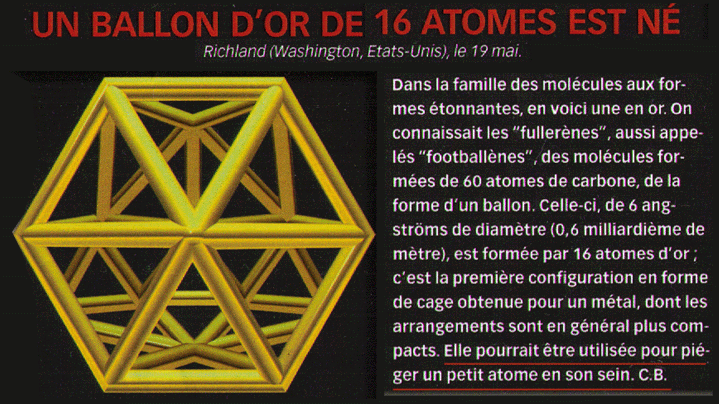
The only thing that can free these antiprotons is the dislocation of the crystalline structure of this metal, here: gold. You could throw this crystal against a wall, and it would not release the antiprotons from their cages. However, it would be sufficient to cause the melting of a tiny element, via the Joule effect, to unleash the release of energy.
Do you remember that movie where James Bond faces a killer who only uses gold bullets?