Bacteriological weapons developed by General Hishi and tested in Manchuria
IS THERE A FLOOR TO INHUMANITY?
August 3, 2002
Updated on April 30, 2010. Eight years already
Recently, I watched an episode on Arte in the series "Scientists in War" and I saw things I would not have believed possible. It was so shocking that I took notes.
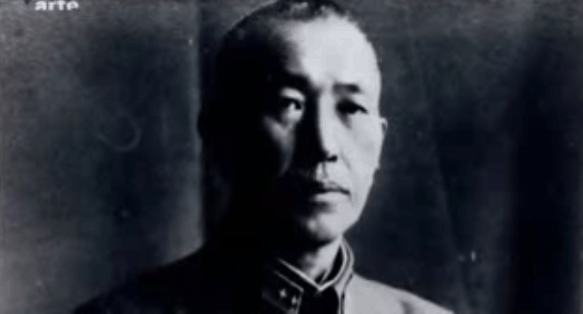
In 1930, the Japanese set up in China a "research center" called "Unit 731", under the command of General Doctor SHIRO HISHI. The ruins of this center still exist, quite impressive. Arte showed images of it (the installation was destroyed by the Japanese themselves when they left the site). From that time, the Japanese began to develop bacteriological weapons. In fact, contrary to what the report said, they would not have been the first to use them. I believe, unless I am mistaken, there was a precedent when the British conquered New Zealand. At that time, smallpox vaccination was known. I believe I know that the British expeditionary force effectively eliminated the natives by distributing infected blankets in the villages while the soldiers, vaccinated, were protected. According to the story, this genocide was very effective, with a substantial saving of bullets and human lives. Another reader recalls that the use of bacteriological weapons dates back to the dawn of time. Indeed, for example, during the Middle Ages, they threw carcasses, dead animal bodies, inside fortified enclosures. A device as powerful as a trebuchet (although extremely simple) could send a cow's corpse hundreds of meters.
One of my readers, Alex Bérubé, Canada, informs me that the British also used this technique against the Huron. See this link.
But let's return to Japan. These methods of exterminating populations were not developed at the end of the war during the Kamikaze attacks in a sort of final surge, in a desperate defensive outburst, but rather were developed as early as 1930, very calmly, very methodically. Japan felt cramped on its island, where it did not have energy and mining resources. It had expansionist ambitions. Japanese strategists knew that numerous peoples could rise against them, including the giant American. Japanese leaders developed what was later called "the poor man's atomic bomb" and, if they had been able to, they would have coldly massacred tens of millions or billions of human beings by unleashing the deadliest epidemics on their land. If these people had been able to develop fission and fusion bombs, they would have done so, not to "defend" themselves but to exterminate the inhabitants of lands they would have immediately perceived as a new living space, a "lebensraum" to conquer. When one sees the images shown by the ARTE channel, one really has the impression that from the early 1930s, for Japanese leaders, anyone who was "non-Japanese" had only two possible outcomes: to become slaves or to disappear. But in any case, the Nazis rode the same theories, particularly regarding the Slavs. We have extremely clear texts on this point.
If I understood correctly (if I make a mistake, my readers will correct me), Emperor Hiro-Hito himself was perfectly aware, having studied biology. In this research center, all sorts of strains were therefore studied, such as cholera and dysentery. The first incubators tested, how primitive they were, shown in images, were initially filled with rotten meat and their operating time was a few days. In this broadcast, many witnesses appeared on air, Japanese who had participated in this enterprise. "Each bacterium had a precise smell," said one of them.
Right away, the Japanese began to conduct tests on the Chinese population. The first tests were carried out by infecting village wells with dysentery germs. This action was obviously carried out secretly, and a disinformation campaign was simultaneously launched. By warning the surrounding populations that an outbreak of dysentery had occurred, they would have been far from thinking that the Japanese could have themselves caused it. When something is too huge, people remain skeptical. Examples abound in this sense, everywhere, in all fields. Japanese doctors could thus easily declare quarantines, isolate the affected villages and pretend to treat the inhabitants with placebos. Thanks to this stratagem, they were able to closely follow the effects of their own actions. They dissected Chinese peasants who were still alive after being anesthetized. They thus obtained many anatomical parts. Then the bodies were sewn back up and thrown into the wells. When everything was over, the Japanese burned the villages that had been "treated". A person named Kakamura testifies to his participation in such operations which targeted small settlements, usually resulting in the death of about thirty people.
Unit 731 was located in a town called Pin Fang. Having learned that her husband had been arrested to be taken to the "Pin Fang prison", a Chinese woman made the journey to try to deliver supplies to her husband. It was upon arriving on site that the local people made it clear to her that Pin Fang was not a prison, but a place it would be better to flee immediately, which she did, terrified. In the Arte film, she testifies. As for her husband, he found the most horrible death there.
The Japanese wanted to test the effectiveness of dropping bacterial strains from airplanes. To do this, they used batches of 200 prisoners used as human guinea pigs. As one of the Japanese who participated in this kind of operation said: "we took Chinese prisoners in batches of two hundred. When we were done with these two hundred, we took others." They were tied every five meters to stakes, in the countryside. They carried out various dispersals on them. The soldiers, equipped with gas masks, forced the victims to hold their heads up and breathe in the spores of anthrax and bubonic plague. The results proved "satisfactory".
By 1942, the British became interested in bacteriological weapons by conducting tests on the island of Gruinard, off the west coast of Scotland. These researches were only revealed in 1997. Until that date, the British files were under the seal of secrecy and kept from the public. The idea was to create "anthrax bombs" (anthrax is synonymous with a deadly lung disease). The British biologists therefore brought sheep to the island and placed them facing the wind, their heads directed toward an "anthrax bomb". The question was whether the spores could survive being dispersed by an explosive. The results were positive. The British burned the bodies of the sheep, but the island could never be completely decontaminated, apparently, at least in part because earthworms and burrowing insects carried the spores deep underground, which had not been foreseen (...).
The Japanese continued their research and assembled 4000 anthrax (UJI) bombs. In 1940, they decided to try to cause the plague in the civilian population of a Chinese town. In the broadcast, a single Chinese survivor testifies. He saw the plane and the cloud of "dust" that it dropped at low altitude, which settled on the nearby houses. Immediately after, the plague broke out. The Japanese had noticed that the plague bacilli, outside of a "vector", proved relatively fragile and vulnerable, therefore problematic to use. The classic vector is the rat, as is well known. They had the idea of using the rat fleas, also infected. In October-November 1940, an airplane dropped several kilograms of plague-infected fleas over a small Chinese town. The disease broke out immediately and there were 500 deaths. Again, the Japanese presented themselves as if they had been concerned about combating an emerging epidemic and the inhabitants never imagined for a moment that they themselves had caused these cases of plague. There were also organ extractions from human beings still alive, previously anesthetized, then killed with a lethal injection.
But the most unimaginable approach was to use Chinese civilians as "living incubators" to produce different bacteria. Indeed, the Japanese doctors said, if we recover the strains that killed men, they will be essentially the most virulent since they have survived the human immune system's counterattack. A Japanese who participated in these actions explains in the film that people were first infected by injection. When it was estimated that their death was near, they were completely anesthetized, then their blood was drained. For this, the soldier who had brought the anesthetized prisoner jumped on his chest with both feet, breaking even the ribs of the ribcage, to better cause the expulsion of blood through a severed vein. Unless I am mistaken, these activities of Unit 731 caused 3,000 deaths.
The Americans discovered the virtues of bacteriological weapons during the collapse of Japan. I remember in passing that the Japanese had released many balloons, which crossed the Pacific, and were set to descend when they reached the reliefs, for example in California. We do not know how many balloons were released. Some of them did reach the American coast, but the local authorities established a total blackout on these successes. Not having information in return, the Japanese did not intensify these actions. It is now beyond doubt that these actions aimed at bacteriological warfare because the explosive charges that balloons could carry across the Pacific would have caused insignificant damage. On the other hand, balloons carrying plague-infected fleas falling in American cities or dispersing anthrax spores could have caused the death of many people. From the start, the Japanese demonstrated that war, for them, had to be waged with the total disregard for human life. When the Americans were preparing the bombs that were to be dropped on Hiroshima and Nagasaki, they probably did not know what the Japanese would have been capable of doing to the civilian populations of the USA. As Arte's commentary says, "with their atomic bombs, the Americans beat the Japanese to the post".
When these latter discovered, after the collapse of Japan, the level of development of Japanese bacteriological weapons, "they feared that such knowledge would be acquired by the ... Soviets", or more simply that these "precious research results" would be lost. They therefore promised total immunity to those who, having participated in the project, would hand over documents. This was done. During the equivalent of the "Nuremberg trial" held in Japan and where the "Japanese war criminals" were judged, the officers responsible for the project and the 731 center, such as General HI SHI, did not appear on the defendant's bench and the term bacteriological warfare was not even mentioned. These responsible people ended their careers quietly and died of old age. The documentary shows that there is even a "memorial erected in memory of the Japanese soldiers who worked in Unit 731", a simple stone slab. In the event that the existence of such a unit could one day be revealed, the disinformation technique consisted of ensuring that "its victims and its heroes" would not disappear from the memory of the Japanese population.
The American Bill Patrick became the head of the development of bacteriological weapons in the United States. Interviewed during the Arte broadcast, he states "that the Japanese work was not so interesting because it was carried out without much method". Bill Patrick cites the birth of a new discipline systematically developed in the USA: "aerobiology", that is, the art and manner of spreading bacteria by airplane, making the best use of meteorological conditions. A large diameter spherical chamber was built to serve as a simulator, which was shown on screen. Tests were carried out on different animal species, including 2000 monkeys. Anthrax quickly emerged as the best pathogenic agent. The Americans' idea was, in case of a nuclear war, to complete the destruction caused by nuclear weapons by infecting the areas surrounding the targets that civilian populations, in panic, would be forced to cross.
Bill Patrick specifies "that tests were carried out in the Pacific but as they are still covered by defense secrecy, he cannot speak about them". One can think of "aerobiology" studies on a larger scale, on how spores could be dispersed across the Pacific. But we also know, the Arte documentary shows, that the Americans did not know the lethal dose of anthrax for humans. Tested on animals, the bacteria gave very varied results. If a dozen spores were sufficient to kill a mouse, five hundred were needed to send a hamster to the grave. Rats, on the other hand, seemed completely indifferent to its pathogenic action. I am absolutely convinced that the Americans carried out discreet tests on populations of Pacific islands. How could people who, with the written consent of Oppenheimer himself, studied the carcinogenic effects of plutonium injections on their own recruits, have been deprived of such interesting results. The Russians, on their side, followed the same approach, did the same tests and it is also beyond doubt that they experimented on human material since, like the Americans, they subjected their own troops to the effects of radiation emitted by atomic bombs.
**the goddess of the Sun Amaterasu
 ****
****
 ****
****
 ****
****
**
 **
**
the Nanking Massacre**
****http://fr.wikipedia.org/wiki/Expansionnisme_du_Japon_Showa
 ** **
** **
 ****
****
 ****
****
 ****
****
 ** **
** **
**Louis Emile Bertin
**
 ****
****
 ****
****
 ****
****
 ** **
** **
 **** ****
 ****
****
 ****
****
 ******** **
 ****
****
Excerpts from the Wikipedia note:
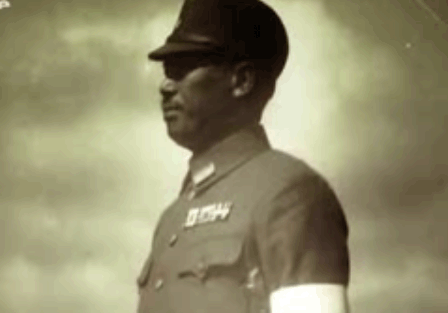
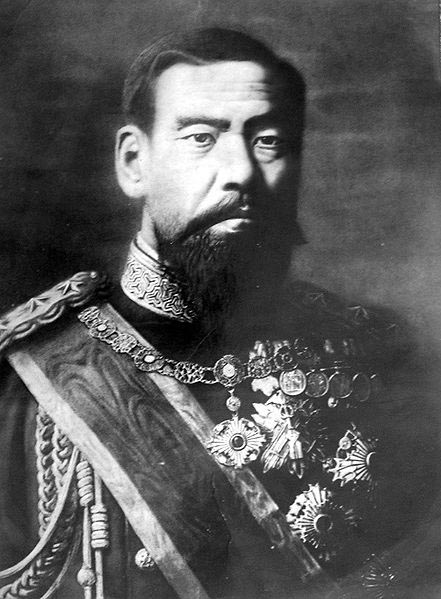
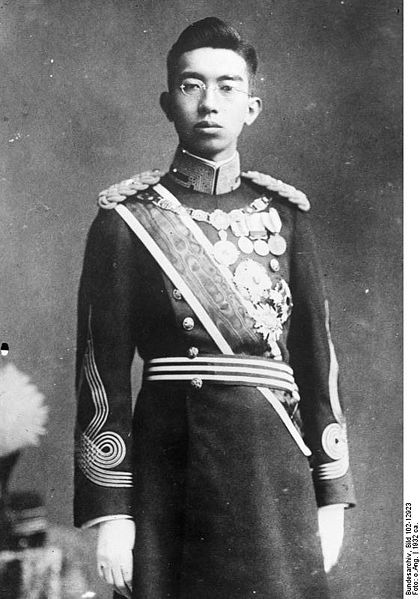
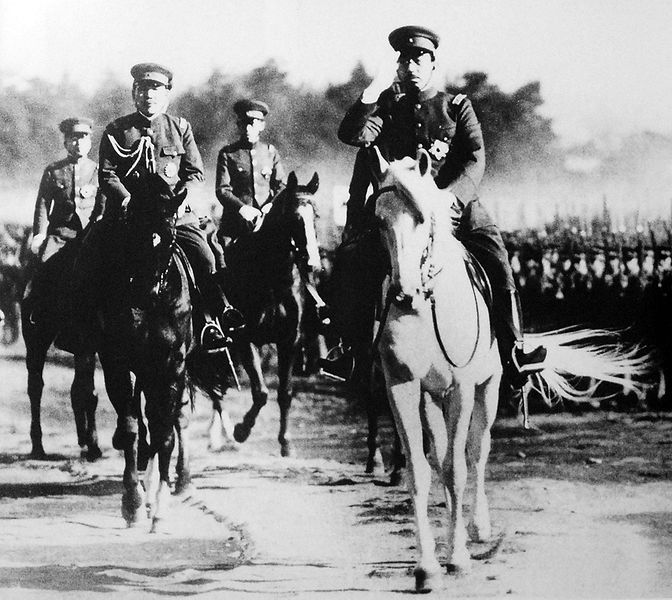
In 1936, the Emperor authorized by imperial decree the expansion of the bacteriological research unit of Shiro Ishii and its incorporation into the Kwantung Army. This "Unit 731" carried out experiments and dissections on several thousand Chinese, Korean, and Russian prisoners, including men, women, and children.
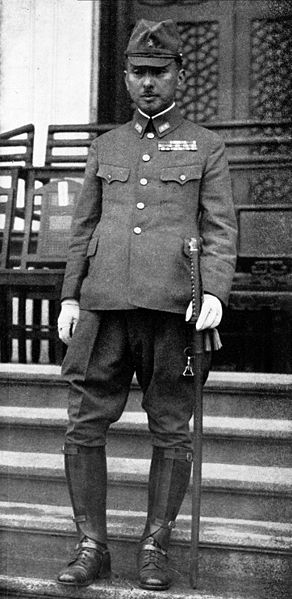
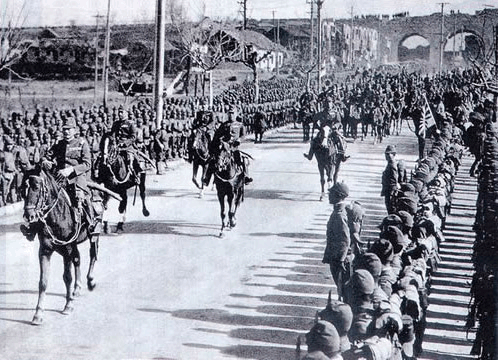
The invasion of the rest of China from 1937 led to countless atrocities against the civilian population.
These atrocities were made possible by the decision made by the Emperor in August 1937 to approve a directive proposing the suspension of the application of international conventions on the rights of prisoners of war.
Among these atrocities, the most well-known are the Nanking Massacre and the "Three Alls Policy" (Sanko Sakusen), "kill all, burn all, loot all," a scorched earth strategy that resulted, from May 1942, in the death of 2.7 million Chinese from the Hebei and Shandong regions.
Military archives and the journal of General Sugiyama, commented on by several Japanese historians such as Yoshiaki Yoshimi and Seiya Matsuno, as well as Herbert Bix, indicate that Showa (the Emperor) reserved control of chemical weapons and authorized their use repeatedly against civilians, particularly in China.
These authorizations were made through specific imperial directives (rinsanmei) transmitted to the generals through the Chief of Staff of the Army, Prince Kotohito Kan'in, then General Hajime Sugiyama (from 1940).
From September to October 1938, the Emperor authorized the use of toxic gas 375 times during the Wuhan battle. In March 1939, General Yasuji Okamura was authorized to use 15,000 cans of toxic gas in Shandong.
After the war, according to John Dower, "the campaign to absolve the Emperor of his responsibility for the war knew no limits. Hirohito was not only presented as innocent of any formal action that could have made him liable for war crimes. He was transformed into a holy icon, bearing no moral responsibility for the war." From 1954, successive Japanese governments supported the dissemination of an official image of an isolated emperor, opposing without success the military clique.
Hiro Hito should have been tried as a war criminal and perpetrator of crimes against humanity. It did not happen!
You can find, on the Wikipedia page, hallucinating passages. Japan, the chosen people, center of the world :
The fundamental principles of this doctrine support that Japan is the center of the world and ruled by a divine being and that the Japanese people, protected by the kami, are superior to others
. The divine mission of Japan is therefore to unite the eight corners of the world under one roof . Politicians such as Prime Minister Fumimaro Konoe ordered the distribution, notably in schools, of pamphlets such as the Kokutai no hongi (the foundations of national policy) repeating these principles. This concept of Japanese superiority had deep repercussions during the war. Thus, orders from the imperial headquarters frequently used the term kichibu (cattle) to describe the Allies, a contempt that, according to some authors, favored violence against prisoners, leading up to the practice of cannibalism.
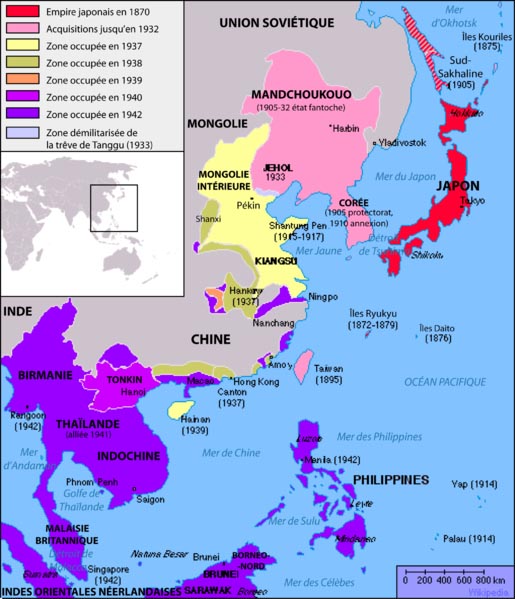
After the invasion of Manchuria in 1931, Japan entered China in 1937. The goal was to seize the entire country, drastically reduce its population, and treat the surviving Chinese as slaves, as the Nazis had planned to do with the Russians. In such a perspective, the possession of bacteriological weapons preceded mass exterminations.
Could there be similar plans today? Why would we have changed, when genocidal behavior seems ready to resurface at any moment? A look at history shows that such large-scale plans, carefully thought out, built, and free of any improvisation, did indeed exist.
In the document "The Heirs of Dr. Mengele", broadcast by Arte, in connection, a Japanese doctor testifies.
- We were made to participate in exercises. For example, one of our superiors shot two bullets into the stomachs of two prisoners, who had their eyes bandaged and their hands tied behind their back, then told us: here, now extract the bullets and manage to keep these men alive until the bullets are extracted. We did it because we were told that these men were political prisoners, and it didn't matter how they died. Others practiced amputations on prisoners who were then killed.
We know that the Japanese simulated anthrax (or anthrax bacillus) attacks, which proved to be one of the best pathogenic agents, by dispersing the spores by airplane, on Chinese prisoners who were spread out on an experimental site, tied to stakes.
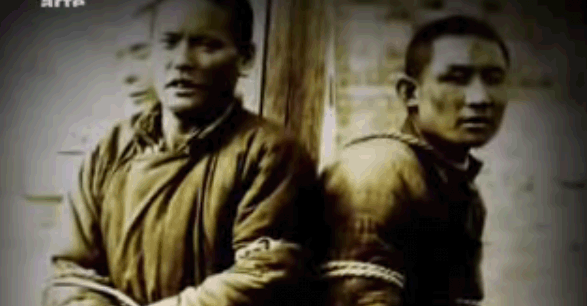
Chinese human guinea pigs, for anthrax attack simulation experiments
We know that it was the Japanese who discovered the existence of jet streams, allowing them to send balloons all the way to the west coast of the United States. In principle, the USA operated a tight blackout regarding these operations. Right away, I had, in 2002, made the link with the use of bacteriological weapons. But this balloon attack, in the dark, was only small beer compared to what the Japanese had prepared for years, in the greatest secrecy, and which was not improvised in the last years of the conflict.
The Americans captured in the middle of the Pacific, submarines specially designed to carry each three airplanes, catapulted from the deck of the submarine. We have photos of these units:
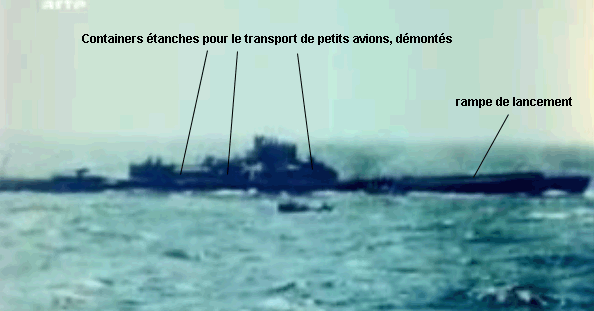
Japanese submarine I400 carrying small airplanes for a bacteriological attack on the United States
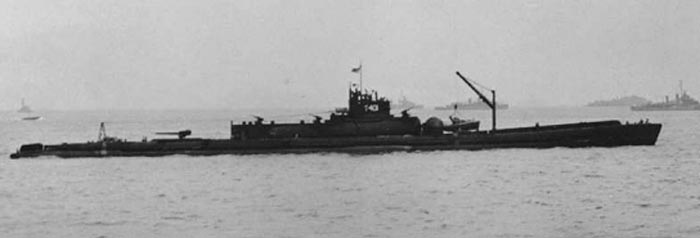
A clearer photo. One of the onboard aircraft is in the process of being assembled
Until the launch of the American submarine Lafayette, it was the largest submarine in the world (122 meters, 144 crew members. It displaced 6500 tons when submerged.
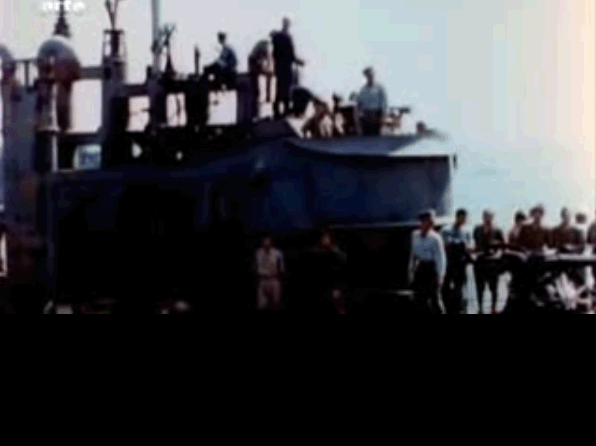
One of these "I-400" units, at the time of its surrender to the Americans, in the middle of the Pacific, on August 29, 1945
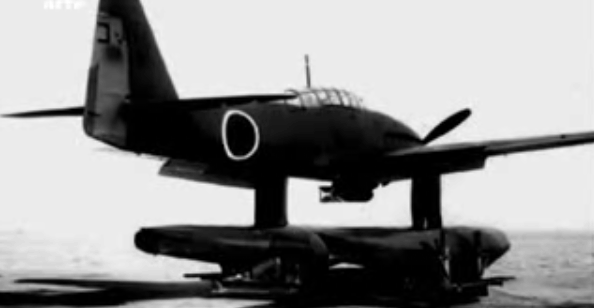
Japanese seaplane, twin-float, exiting its container, being assembled and ready to be catapulted from the submarine
The model enthusiast can find models of these giant Japanese submarines I-400, to build on e-bay. During the war, 5 units were under construction, but two could go to sea. The first operational I-400 was sunk by the Americans, after an aerial attack, followed by a surface attack by a destroyer. The captain of the second submarine, having learned of Japan's surrender, surrendered to the Americans on August 29, 1945, after having thrown overboard its three seaplanes aboard, Ainchi M6A1 Serain ("Clear Weather Storm"). The Japanese submarine was scuttled off Hawaii.
A Japanese model company, the brand Tamiya, distributes models of this twin-float seaplane Aichi Seiran:
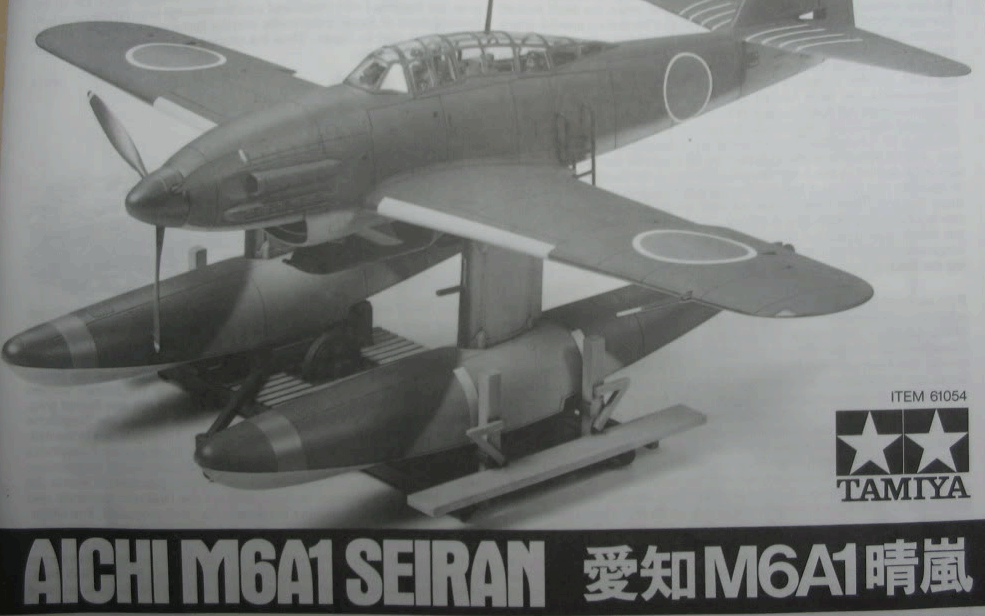
The embarked seaplane Aichi Seiran, on its catapulting trolley
The Wikipedia page indicates that the aircraft could reach 475 km/h, and 560, ... floaters released (...). The aircraft could carry a bomb or torpedo of 800 kilograms. A lighter bomb increased its range, up to 2000 km.
You can find on the site:
http://www.2iemeguerre.com/navires/i400.htm
photos of a model of the giant Japanese submarine, made by Jean-Pierre Chaput:
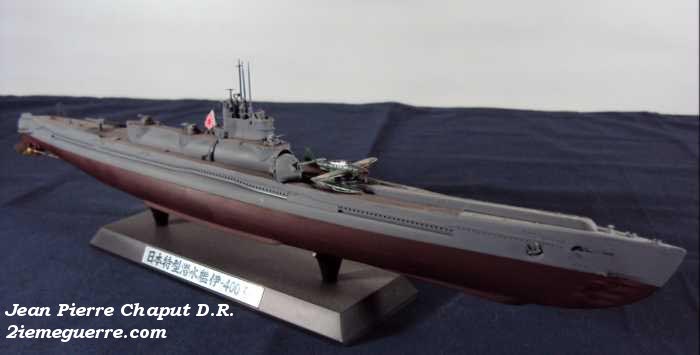
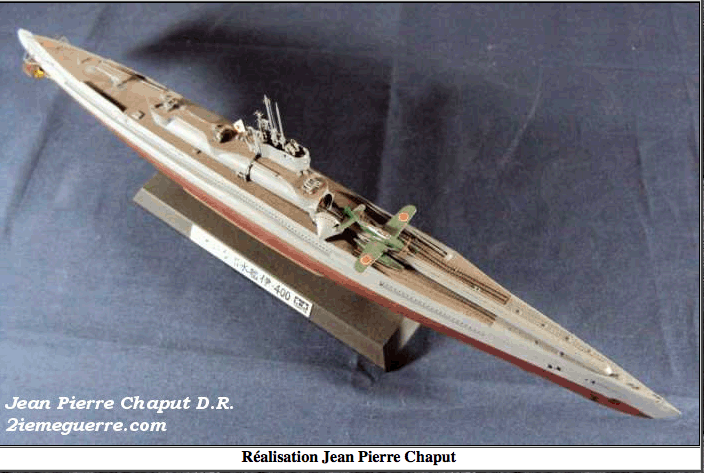
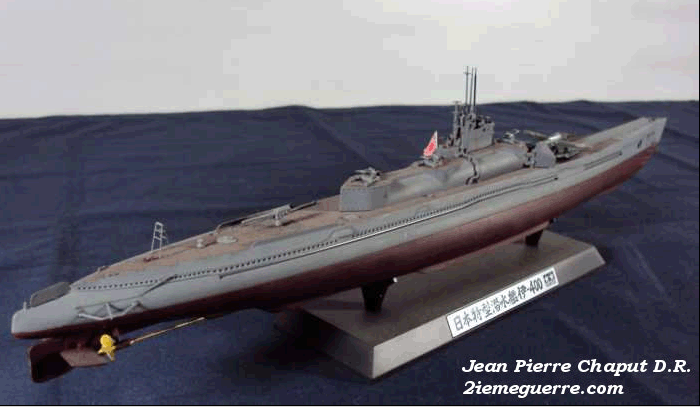
**
June 24, 2010
: Reported by a reader
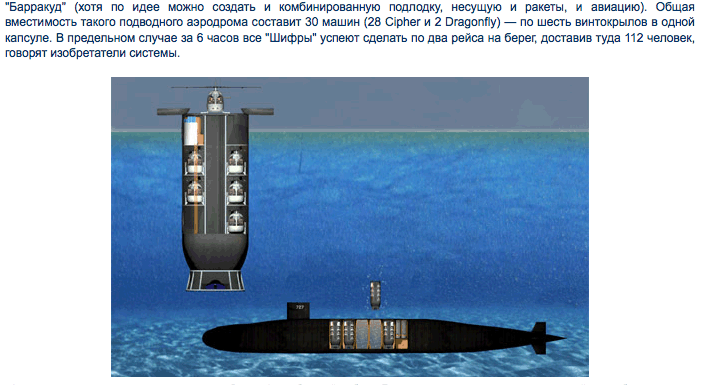
: another type of weapon, studied by the Russians: submarines carrying helicopter drones, released in large numbers from the bottom, in containers. Smarter than cruise missiles. Less fast, but quieter. Suitable for attacks on coastal targets. Carrying ... what?
O
ne can hardly see how these helicopters could be recovered by the submarine after their mission. They would have to rely on their floating platform, descend to take their place using an elevator. Then this platform would have to submerge, dock with the submarine, and take its place again. All of this does not hold up. One can only see a version "drones for low-range attack: coastal attack." A helicopter cannot carry heavy conventional loads, like bombs. Then ... nuclear charges? Unless it is a revival of the old Japanese idea: carrying bacteriological charges.
S
e remember that after the fall of the Berlin Wall and the severe limitations imposed on its thermonuclear arsenal, the former Soviet Union developed bacteriological deterrent weapons at a high pace.
So much human imagination devoted to things like this ...
The idea of attaching a seaplane to a submarine, this time as a reconnaissance aircraft, was already popular in the early 1930s. The most impressive corresponding unit is the French submarine the Surcouf, named after the famous British ship hunter.
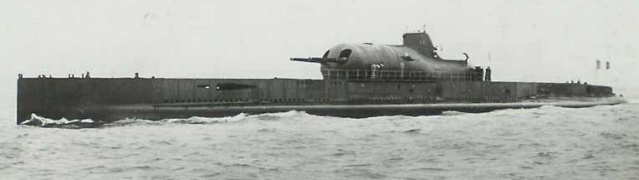
The Surcouf, "submarine cruiser", armed with two 203 mm cannons.
At the time the largest submarine in the world: 111 meters, 126 crew members The embarked aircraft is housed in a container located at the back of the cockpit
A formidable weapon. The Surcouf carried, disassembled without a container of 2 meters in diameter and 7 meters long, a small reconnaissance seaplane Marcel Besson 411, "Petrel". The Parisian reader can find a cutaway model of the submarine at the Marine Museum in Trocadéro.
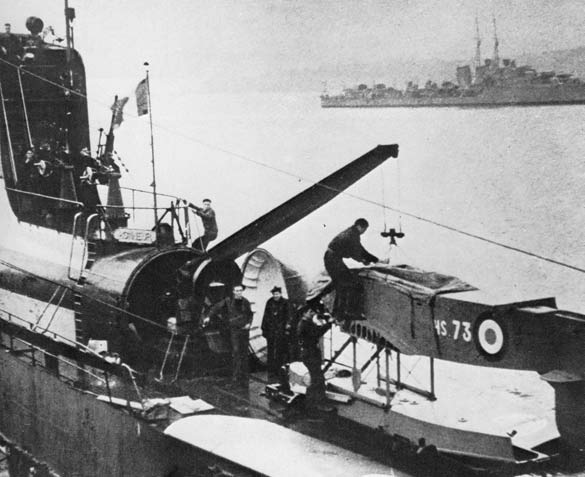
Loading of the Marcel Besson 411 two-seater, entirely constructed in wood
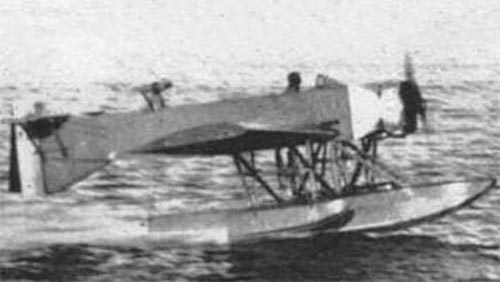
**The Marcel Besson 411 taking off, with a single pilot on board. At the back, an electrical generator. **
The aircraft, light, flying at 180 km/h, and able to climb to 5000 meters had a range of 400 kilometers. Its mission was to spot potential targets of Surcouf, while remaining little vulnerable to the anti-aircraft fire from the ship's batteries. Carrying 126 men aboard, and also armed with 22 torpedoes, Surcouf's armament consisted of two 203 mm cannons, capable of firing 600 shells, with a range of 27 km (20 km) exceeding the terrestrial horizon. By adjusting its fire according to the indications provided by the seaplane, Surcouf, very low on the water, hidden by the curvature of the earth, could engage a surface ship without that ship being able to determine from where the attacks came. The submarine was lost, either due to a collision with a surface ship, or because it might have been mistaken for a Japanese ship by an American bomber.
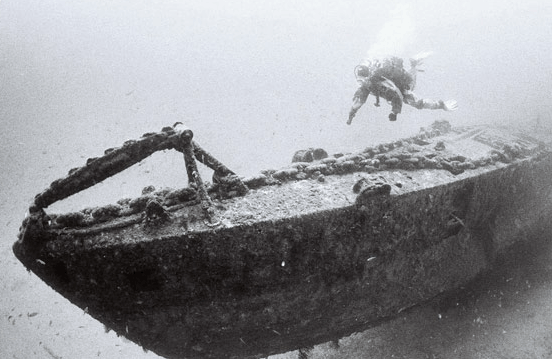
The wreck of Surcouf
When I was in my twenties, at the end of the 1950s, I was one of the pioneers of civilian underwater diving. At that time, I used to make dives "in the blue", right in the middle of the bay of Saint Tropez, on depths of 40-45 meters. The feeling was interesting, because at thirty meters depth, you couldn't see the surface or the bottom. One day, by chance, I came across a French submarine, simply lying on the sand. It was meal time and the crew had decided to have a snack at the bottom, quietly. I could hear the generator running, as well as the voices of the men. I approached the cockpit. I removed my single tank from Spirotechnique and, using it as a hammer, I sent the following signal:
tac tac-tac-tac tac tac-tac
Immediate silence on board.
It was an old unit, maybe 70 meters long (like the American Pompeneruma, anchored and visitable in the bay of San Francisco). After sending this signal, I cautiously moved away from the submarine, to avoid being sucked in by its propeller. I remember that two thick cables connected the rear diving bars to the hull, to prevent them from getting caught in anti-submarine nets.
Indeed, the captain started the engine and the submarine disappeared from my eyes. There may be among my readers a witness of this scene, who could find the trace of this event in the logbook: a noisy encounter with an Unidentified Flying Object.
But let's go back to the Japanese embarked submarines. The fact that these units carry several aircraft on board excludes the idea that they could be reconnaissance devices. Moreover, the smallness of the single bomb carried leaves doubt as to whether it could correspond to a conventional weapon.
The Arte document states that the American secret services, towards the end of the war, would have been aware of such projects. At that time, the USA were finalizing the realization of the two first atomic bombs, with uranium 235 (Hiroshima) and plutonium 239 (Nagasaki). These two cities had been spared from conventional bombings, to better assess the effects resulting from a nuclear attack.
Historical facts are gradually emerging. We are told that the Americans would have then sent the following message:
*- If Japan uses weapons of mass destruction against our troops, we will destroy the Imperial Palace and the Japanese General Staff, which are within our reach, and we will reduce them to ashes. *
When were these Japanese submarines captured by the Americans? Was it the result of a breakdown at sea, a fuel shortage? Even if the captain could have gotten rid of the load carried by his planes, the smallness of the bombs, the number of aircraft on board (three) could only lead the Americans to the hypothesis of a biological warfare attack.
The two available atomic bombs were launched. The Americans did not have a third device in reserve, but the bluff worked, that is to say the threat of razing all Japan. With hindsight, one can wonder what would have happened if the United States had not had these weapons of mass destruction to dissuade the Japanese from attacking with biological weapons. If that had been the case, the three planes carried by the Japanese submarines, flying at night, like Kamikazes and dispersing their load over large cities, could have created millions of civilian victims. No one can say how the war would have evolved then. Despite their immense strategic superiority, the Americans would have been forced to recall many units (submarine hunters, aircraft carriers) to try to thwart these deadly attacks.
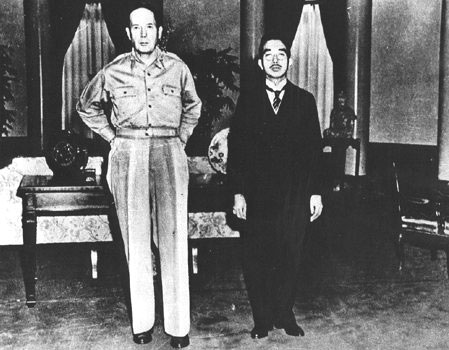
When Japan surrendered, General Hishi immediately contacted Mac Arthur, head of the Pacific armies, and offered to hand over the results of ten years of research conducted at Unit 731, in exchange for immunity. This agreement was concluded.
It is known that Mac Arthur was relieved of his duties for having demanded the use of nuclear weapons against China, during the Korean War (1952). The Arte document mentions that biological weapons tests were carried out, targeting China. American pilots, captured, confessed to these facts, then retracted their statements when they were released, claiming they had made false confessions under duress.
What can be retained from this account?
That the plan to develop a weapon of mass destruction, targeting civilian populations, was launched in Japan as early as 1931.
Is it possible to devastate a country the size of a continent, to bring it to its knees, without risking a backlash from the weapon used? The answer is:
With antimatter weapons.
Either they already exist, or they will certainly exist one day. Nuclear weapons are complicated to use. As they are, they require a fission device, whose minimal TNT equivalent is currently 300 tons. The critical mass is reduced by improving the compression of a hollow sphere of plutonium, using explosives. But the state of the art imposes this limit. The release of a power equivalent to 300 tons of TNT causes the transport of debris into the upper atmosphere, then dispersed by the winds.
Moreover, multi-warhead systems require very precise guidance during re-entry. All the warheads must be fired within a thousandth of a second. Otherwise, the first one that explodes ... destroys the others.
This problem would not exist with weapons where antimatter is stored in a crystalline network, with antiprotons taking the place of electrons (Gospner method). If a continuous flow of antimatter, in the form of anti-hydrogen nuclei, can be obtained, they can be guided towards a crystal with nanometric precision. The anti-electron annihilates one of its electrons, and the negatively charged antiproton ensures the neutrality of the medium. It is then so firmly imprisoned in this crystal that it can be manipulated without risk. The energy released by the electron-anti-electron annihilation represents that the one thousand eight hundred and fiftieth of the energy stored in the crystal.
It is then not necessary to consider a sophisticated detonator, nor to worry about the synchronization of the firing. Devices the size of a golf ball ("bucky balls") would have a unit power of 40 tons of TNT. Already more reasonable. If they are dispersed in number, the first one that explodes causes the others to explode, like in chemical explosive bombs.
The miniaturization of thermonuclear devices is currently the obsession of the Great Powers, like the USA and Russia. It is made possible by the technique of pure fusion, by MHD compression, made feasible since the breakthrough of 2005 (Article by Malcolm Haines). But don't count on the French press to mention this issue. First, they don't want to address a matter related to national defense, even though the French are very behind in this field, whose technology is considered potentially proliferating. The other reason is that journalists don't understand anything about it.
These days, we talk about austerity. I have a suggestion on this subject: stop a project that went from 4.6 billion euros to fifteen, without any guarantee of success.
ITER It must be understood
June 24, 2010
: Reported by a reader
: another type of weapon, studied by the Russians: submarines carrying drone helicopters, released in large numbers from the bottom, in containers. Smarter than cruise missiles. Less fast, but quieter. Suitable for attacks on coastal targets. Carrying ... what?
It is hard to see how these helicopters could be recovered by the submarine after their mission. They would have to rely on their floating platform, descend to take their place using an elevator. Then this platform would have to submerge, dock with the submarine, and take its place again. All of this doesn't hold up. One can only see a "drones for attack within a limited range: coastal attack". A helicopter can't carry heavy conventional loads, like bombs. Then ... nuclear charges? Unless it's a revival of the old Japanese idea: carrying biological charges.
Remember that after the fall of the Berlin Wall and the severe limitations imposed on its thermonuclear arsenal, the former Soviet Union developed biological deterrent weapons at a high rate.
So much human imagination devoted to things like this ...
**Continuation of the page created in 2002: **
Have we, the French, been spared by this mental disease? It would be naive to believe so. Twelve years ago I had an excellent oncologist friend, Dr. Spitalier, who has since died. In the Ummite texts I found original ideas regarding the remote treatment of certain diseases. It was said, for example, that disinfection maneuvers could have been carried out in Albacete on infected humans by subjecting them to pulsed ultrasonics, which would allow, at least on the surface or near the surface, to burst the virus shells. The idea was not at all foolish. All pathogens have their weaknesses. Viruses are fragile and are destroyed beyond a certain temperature. This is why we have fevers. Other agents are killed by the oxygen in the air, like AIDS, pasteurellosis (cat scratch disease). I owe it only to this last technique that I was not amputated of my index finger, where these bacteria, resistant to the action of antibiotics, had lodged themselves after a deep bite that had introduced them into a tendon sheath. If the infection had followed this canal, I would have had to be amputated of a finger, or even of the entire hand, within a few days. Dr. Vilain (now deceased), founder of SOS-mains at the Boucicault hospital, saved my finger by completely opening it and allowing the oxygen in the air to do its work.
Ondulatory phenomena are extremely interesting from the point of view of therapeutic use. Indeed, the combination of two frequencies can give surprising results: a "carrier" frequency and a "modulation" frequency.
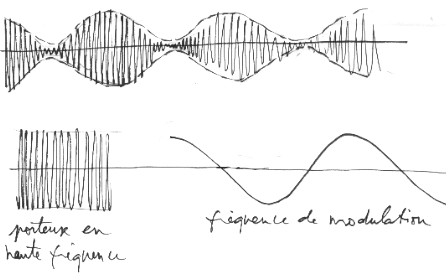
All "materials" are more or less transparent for given frequencies, including living tissues. This is valid for ultrasound as well as for electromagnetic waves. All tissues, everything that inhabits a living being has its own "bandwidth". Between a frequency N1 and a frequency N2, these tissues absorb no radiation. However, any tissue, any cell or structure or biomolecule has a resonance frequency Nr for which the absorption is maximum. Everyone knows the phenomenon of resonance. When you attack a material by hitting it exactly on this value, the energy is amplified, accumulated. It's like how a troop marching in step on a suspended bridge can cause it to break. This was the basis of Ummite biotechnology. The virus shells had a resonance frequency that they knew precisely. By sending pulsed ultrasound beams modulated at this resonance frequency to injected subjects, they could perform remote specific destructions of deadly viruses that had infected the inhabitants of the Spanish town of Albacete (see "the case of the severed hand").
Today, any biology laboratory could carry out this type of research, for example on infected plants. However, in the world of research and medicine, "waves" still have a certain air of charlatanry. It was therefore difficult to sensitize such environments to this kind of approach. A Swede, as Spitalier showed me by giving me a brochure, had indeed tried to attack tumor cells using a simple high-frequency source. The idea was very crude. Cancerous cells are more vascularized than others. Being richer in water, they are presumably more sensitive to electromagnetic waves. The idea of the Swede was to place subjects with numerous metastases in what was nothing more than large microwave ovens. One could thus raise their temperature to more than forty, forty-one, and, if my memory serves me right, locally, forty-two degrees. The cancerous cells, more sensitive to this heating, would die first. Trials were carried out on subjects already condemned by medicine. One obtained, if not remissions, at least spectacular destructions of certain metastases. But the systematic use of such a technique remained extremely dangerous, the boundary between healing and cooking being narrow.
Through Spitalier, twenty years ago, I therefore proposed to oncologists, extremely wary and reluctant, to try experiments with pulsed high-frequency (HF) microwaves. It was already known at the time (even Science et Vie had mentioned it!) that DNA was extremely sensitive to this kind of agent. Indeed, when people began to study the action of microwaves on living organisms, one expected the tissues richest in water to be the most responsive. Indeed, the water molecule, due to its asymmetry, its intrinsic polarization, which makes it a tiny dipole
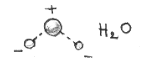
is supposed to react to an alternating electric field, which then tends to rotate it, thus transmitting energy. Even today, this technique called "radar" is used to heat joints from the inside by transmitting this electromagnetic energy to the fluids contained in their joint capsules. Tissues rich in water also have their own bandwidth and resonance frequency. They become "transparent", or almost, when the frequency of the wave becomes high enough. However, if we treat this frequency as that of a "carrier" and modulate it at a low frequency, we obtain results as surprising as unexpected. Ultra-long molecules, like DNA, then behave like antennas, proving sensitive to very low modulation frequencies. It was discovered that DNA solicited by HF in a few gigahertz (carrier frequency), modulated in ... a few hertz (modulation frequency) could prove 400 times more absorbent than water itself. It became possible to solicit these long molecules in a highly selective way with low energy, without creating any heating or secondary damage in the tissues by thermal effect. With Spitalier, we had thought about the DNA of cancer cells, imagining that one could destroy these molecules within living beings. At that time, the AIDS epidemic was already starting. In this specific case, the technique could prove very fruitful, since the virus, hidden in T4 lymphocytes, was presumably protected from biochemical attacks. It seemed to me that one could detect a "weakness point" in the AIDS RNA and attack it through a carrier that would have easily passed through the cytoplasms of the T4.
I take this opportunity to explain to the reader how T4 cells eliminate unwanted cells in the human body. These cells are equipped to recognize an extraordinary number of "cellular signatures". It is thought that this recognition is carried out by the mere contact of molecular subunits. If such a cell is identified as unwanted, the T4 attaches itself to it and destroys it. How? And this is where the imagination of the world of life becomes extraordinary. It is known that living beings are sensitive to incessant mutations. As a result, we are less sensitive to antibiotics than our parents were. If T4 cells were to eliminate infectious cells by biochemical attack, natural selection would give rise to new strains that became insensitive to these cell poisons. Then these "killer lymphocytes" use a mechanical method. Molecules of "perforin" are used. These are introduced through the cell membrane and assembled to form a kind of rivet. The cell then empties through this opening (in fact, these openings, as the electron microscope showed more than twenty years ago, the T4 kills cells with several "stabs", absolutely unmatchable).
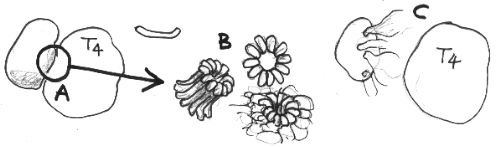
**How T4 cells kill unwanted cells. **
*In A, the lymphocyte adheres to the cell to be eliminated. In B, the characteristic shape of the perforin molecule and the way the T4 arranges these molecules in the cytoplasm, to create a "rivet". In C, the T4 detaches and the cell empties through these different openings. *
To reach viruses entrenched inside lymphocytes, one could then subject the subjects to electromagnetic waves at very low energy, with which their entire body would be "transparent". By modulating these waves according to a very precisely adapted low frequency, one could for example break the RNA of these retroviruses of AIDS or disable them, making them unable to replicate.
The chemical path was preferred, with some success, one must admit, both for AIDS (tritherapy) and for cancer (chemotherapy). In fact, both approaches could have been pursued without problems, the "pulsed microwave" approach not being particularly costly at first. But one must remember that pharmaceutical laboratories seek to treat people, making profits from it, not to cure them. Healthy people bring no profit. Moreover, by making them dependent on a drug, covered by patents, one can fill one's pockets. If diseases could be treated with a simple machine, where would we go?
There is a "apprentice sorcerer" aspect in these pulsed microwave actions on living organisms. Indeed, if this agent can destroy infectious cells, it can also cause mutations. This is one of the multiple ways in which we "tinker" today with viral and bacterial strains "by chance". One must not fool oneself. As Jacques Testard remarked in his book "Des hommes probables", our knowledge in genetics is illusory. We are like people who have laboriously identified the words of a dictionary but, ignorant of grammar and syntax, pretend to have understood the language of life. Biology is made of sentences, not of isolated words. We know the principle "two negatives are equivalent to an affirmation". We find the same phenomenon, sometimes, in genetics. Thus, if the gene that causes glaucoma (blindness) is present once in the DNA of a child, that child will contract this terrible condition. However, if this sequence is present twice, it will not be the case! Ununderstandable. All this shows that the "words of a sentence" interact with each other, that genetic sequences cannot be considered as elementary orders, easily segmented. We touch here the potential danger of genetic manipulations, in the aim of making a certain plant insensitive to this or that. It is possible that this has side effects that become totally uncontrollable one day.
Click here to refer to the information provided by
Jean Christophe Rabouin dated August 6, 2002
Another digression: in the journal La Provence of July 19, 2002, the journalist Amélie Amilhau testifies about the totally incomprehensible behavior of bees from neighboring hives, which suddenly rushed to attack horses grazing peacefully in a neighboring field. These bees, according to Jean Cartoux, an apiarist and former mayor of Sault, are Buckfast and are known to be the most peaceful. They are not "killer bees" like those imported from America. Gentle and docile, they only sting if they are attacked in a characteristic way. After the attack, these bees could be approached without protection. Never seen in the history of beekeeping. Yet three horses died, victims of hundreds of stings. What is the cause of this sudden aggression? No one knows. It could just as well be a reaction of the bees to a disinfectant used for the horses (in which case the experiment should demonstrate it). But one cannot exclude that one day, by performing a "completely ordinary" genetic manipulation on a plant, one might not trigger a cascade of serious and uncontrollable behavioral changes. If there is one trait of scientists, it is being able to venture into virgin territories and perform manipulations they do not master the ins and outs of.
During a phone call between "an Ummite" and Rafael Farriols, about fifteen years ago, the unidentified interlocutor described AIDS as the result of a genetic manipulation that escaped its authors. Starting point: the wish of Nixon, during the Indochina war, to see people develop "a weapon that kills only the yellow people", a "ethnic weapon", in a way, that spares the boys on the battlefield. This type of research, like many others, was part of the framework of a "Jason commission", which had been created. Within the framework of the work of this commission, scientists were asked to use their creativity to produce new techniques to bring the enemy to its knees. A famous Nobel Prize in Physics, Gell-Mann, inventor of quarks, was part of it. It was he who proposed the very interesting idea that an injured person, and especially an invalid, weakened the enemy more than a dead one. According to his recommendations, they then developed grenades emitting not metal fragments, detectable by radio, but pieces of plastic material, which were no longer detectable. Thus, the Vietnam was populated with many invalids. The Jason commission therefore studied retroviruses tinkered with by pulsed microwaves. Tests were carried out in a vast African territory lent by the Zairian government. There, in a reserve, they studied the spread of retroviruses on "green monkeys", grivets. It turned out that one of them accidentally, by mutation, gave the famous AIDS retrovirus. The beginning of the epidemic, said the telephone interlocutor, occurred when a caretaker was simply bitten and the animal escaped.
When such horrible things happen, there is always a risk that they will one day be known (as is currently the case for these Japanese researches on biological weapons). A good solution is to "encapsulate" the information in a fiction. One could believe that this fiction would have the effect of drawing people's attention to the problem. However, paradoxically, the opposite happens. The USA thus produced a film by director Laurence Dworet titled "Outbreak" with Dustin Hoffman. It was there that the public discovered the existence of the Atlanta center, dedicated to high-risk strains (the so-called "fourth-class laboratory"). The film illustrates a phrase by Nobel Prize winner Joshua Lederberg:
*- Viruses constitute the greatest threat that could oppose man's supremacy on this planet. *
In the film, the team of "Dr. Dustin Hoffman" goes to Africa to witness the devastating effects of a viral attack, like the Ebola virus (causing a terrible hemorrhagic fever). In the sequel of the film, it will be discovered that the infection vector is a monkey. In Africa, the Americans intervene by dropping on the infected area a bomb that looks like a large container dropped from an airplane and suspended on a parachute. The pilots of the bomber have the code name "sand merchant". It is understood that it is actually a tactical nuclear bomb. Following the course of this disaster film, a monkey reaches the United States and infects the inhabitants of a small town. A sanitary cordon is then established around it and the soldiers are ordered to shoot anyone trying to escape. The remedy, the vaccine, is miraculously found very shortly before the "final solution" is implemented, that is to say the dropping of a bomb "sterilizing the infected area".
We will never know how this AIDS virus was born, which has already killed a hallucinating number of people and will kill more. But if it turns out, the small team that created this miracle is still alive, like these Japanese researchers who ended their lives peacefully as retired people. Unless these researchers were eliminated to prevent it from being known. Anything is possible.
Regarding pulsed microwaves and their mutagenic effect, let's mention an information that has been circulating on the net for some time. I don't know if it is founded, but it is at least plausible. As plausible as it is frightening. Our grandparents did not have satellites at their disposal. They communicated with very distant regions using submarine cables. Before that, radio operators could communicate, essentially at night, using short waves. They used the property of these waves to reflect on the layers of the upper atmosphere, ionized by the sun's bombardment. According to the documents presented on the web, the Americans have been conducting ionization tests of the upper atmosphere for decades, using an entire network of antennas located in a remote area of Alaska, grouped on large areas. It was demonstrated that it was possible to create an ionized layer, acting as a mirror, at altitudes between 60 and 70 km. These ionized layers can then be used as mirrors to reflect beams of electromagnetic waves emitted from the ground, sending them back to regions located at considerable distances. Waves of various frequencies, possibly modulated, pulsed. One then comes to a whole range of new weapons: biological, teratogenic, capable of remotely annihilating the communication system of the enemy, causing various behaviors in humans, and ... remotely modifying the climate. All of this is far from absurd. It all depends on the powers involved. Today, using nuclear explosives (during secret underground nuclear explosions), one can develop "electromagnetic shots" involving powers of the order of terawatts (a million million watts). And these "stealth" explosions, undetectable by seismographs, how are they negotiated? Simple: at the deepest level of coal mines, for example (it is an excellent absorber) or by surrounding the chambers containing the bombs with a network of tunnels, transforming the surrounding terrain into a cheese, a sponge (the crushing of the cavities, absorbing the energy, attenuates the signal).
The Americans would have first used this type of incapacitating weapon during the Gulf War, against the Iraqis. Well, why not? The effects can be extremely varied. The biological effects of pulsed microwaves are no longer to be demonstrated. They can stimulate endocrine glands, triggering the most varied behaviors. The EMP (electromagnetic pulse) weapon can fry all the electrical circuits of the enemy, fry all their computers. Conversely, an ionized layer can protect communications on which this kind of "space umbrella" has been deployed. It can prevent rockets from taking off, disrupt their trajectories, send planes crashing, fry warheads from a distance. One can also, as suggested above, cause mutations within human populations, in an undetectable way. A question in passing: would the strandings of cetaceans on the coasts be due, as alleged, to the infection of their echolocation and orientation system or to the disturbance of this system by the effect of an electromagnetic wave beam? Have these strandings always occurred where they correspond to a relatively recent phenomenon (post-war). Question posed to the readers.
See the Commentary by Yann Langeard dated August 6, 2002.
See Comment by André Dufour dated August 12, 2002
Finally, this concept of an electromagnetic weapon gives substance to the once very confusing concept of a "climate weapon". It is known that the climate is subject to the "butterfly effect". It is not about bringing the considerable energies represented by natural catastrophes such as hurricanes, but rather about triggering and skillfully controlling them, by marking their path by acting on the upper atmospheric layers. How can one prove that a country totally devastated by a "natural catastrophe" could have been artificially caused? Unfortunately, we must face the fact: everything that man could undertake to destroy, he has implemented. The asphyxiating gases of the First World War caused many victims, but their use remained problematic and, above all, these actions were signed. If the Japanese had been able to implement biological weapons on a large scale and for example succeeded in killing a huge number of people in China, would they have suspected that this was due to "human hands" if they had not had proof? I do not know the current state of development of these microwave weapons, but I am deeply convinced, as they are logical, that they are being studied intensively and could one day cause damage comparable to that of nuclear weapons.
Let us trace back through these various digressions. I had begun to talk to you about the start of research on biological weapons in a laboratory, Unit 731, established in China as early as the 1930s by the Japanese invader. The Arte documentary showed how the Americans, in exchange for their impunity, were able to get hold of the results of these interesting researches, to develop them further for their own account (these researches were supposed to have been suspended in 1970, as underground nuclear tests were suspended at the end of the 1980s, perhaps). The documentary mentioned what we already knew, the intense effort made by the Soviets in this matter (it is unknown whether it is or is not still ongoing). It is also mentioned that 20 anthrax bombs were seized by the Americans in Iraq, by expert Bill Patrick, after the "Desert Storm" operation. I told you then that France was not spotless either. As a preamble, I had mentioned a project that I tried, without success, to push in the early 1980s, regarding possible treatments by low-frequency pulsed ultrasound or microwaves. One day, an excellent friend, aware of my efforts, said to me:
- There is a place where you could certainly find money and means to undertake such research, it's the army. There is a group that is trying to promote cancer-causing weapons and in that group ... is very active.
Under the dots is a polytechnician I have too often crossed paths with. A man devoid of the smallest trace of moral conscience, as is often the case with his colleagues, military engineers. I remember a sentence of his, at the time when I still frequented him:
- Neither you nor I will ever see "the sun"...
There are coded languages. In the world of science, the Army is "the devil". Hence the title of my 1995 book, published by Albin Michel, "Children of the Devil", evoking the close and irreversible link that was woven during the 1939-45 war between the army and cutting-edge science, on which the entire press maintained an unbroken blackout. "The Sun" is the highest level of political power, the dream of this polytechnician. For some men, the dream is to be able to meet the highest figure of the State, the "Sun King", whose most evident representation for many years was Mitterrand. One can imagine this polytechnician one day saying to his wife:
- You know, yesterday I had breakfast with who you know... - Oh really! ... - Yes...
I kept for a long time a brochure published by the French military research, whose title was "Evocation of Cancers". Yes, know that all this exists and that there is no limit to human stupidity and irresponsibility and that scientists can be bought with a handful of bills, a little incense and some promises. In the fall or by the end of the year, my next book "UFOs, the veil is torn" will be released. You will see what the Americans have been able to extract from the "precious information extracted from the UFO file". I will show you very concrete, tangible things. I met American researchers during the winter of 2000-2001 who were at the heart of these projects of hypervelocity MHD torpedoes, stealth planes or hypersonic bombers. To take up the sentence that Enrico Fermi let out about the A-bomb:
- It's really good research!...
When I took the train that brought me back home, I suddenly felt ashamed to be part of the community of scientists.