Untitled Document
Electric Plane
August 6, 2009
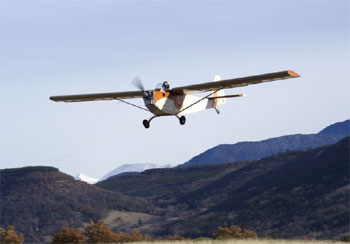
The years we are living today mark the advent of the electric plane, just like the electric car. Take a look at the pros and cons of the electric car:
A short parenthesis on the electric bike, with some data:
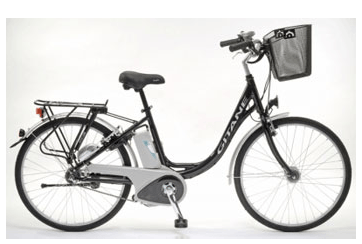
Battery: Panasonic Lithium-Ion Capacity: 8 Ah 26v Range: 50 to 70 km; 3 levels of assistance Charging time: 3 hours Motor: in the crankset, 180w Frame: city aluminum; One size 45 cm Fork: steel Saddle: Kinetic Wheels: 26'' aluminum Brakes: V-brake front and rear Gears: Nexus 3 with automatic shifting Tires: 26 x 1.75 Dimensions: 175 x 65 cm Weight: 22 kg
In China, one of the two battery elements of the bike is removable. The user is therefore used to taking it out of its housing when returning from work, and charging it at home. Same at his workplace. This removable character of the battery increases the vehicle's range (which is anyway according to the models between 50 and 70 kilometers). When considering the ideal electric vehicle, different problems arise. It would be good if the vehicle was two-seater, and could be used for shopping. What is forgotten compared to small cars like the Smart is that the electric vehicle is completely non-polluting and can therefore enter shopping malls, take underground corridors, go... anywhere. One could even consider integrating the system into intercity transport.
This would not pose any problem in equipping it with two different propulsion modes, a thermal engine propulsion system as a backup. Here is what I personally would recommend, inspired by Chinese motorized tricycles, narrow-gauge:
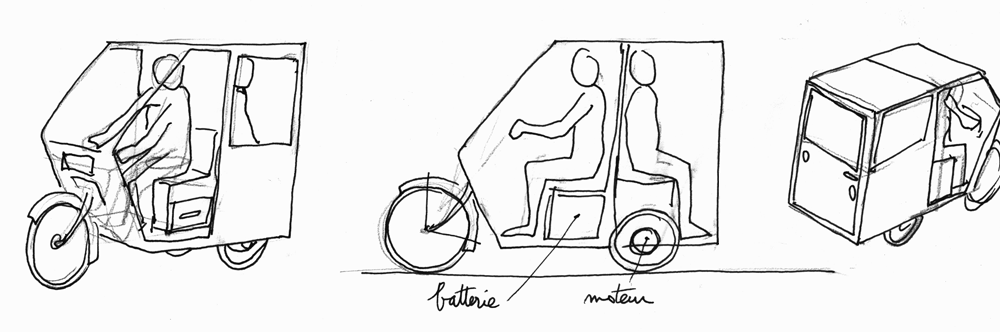

The two-seater electric tricycle
This two-seater tricycle (inspired by its Chinese version) is narrow and not very bulky. The body (in China made of light alloy and plexiglass) is partially removable. The battery is larger for a simple electric bicycle, but it has a removable element, which the user can carry anywhere to charge it. One can plan for outlets on poles or in parking lots.
Battery: Panasonic Lithium-Ion Capacity: 8 Ah 26v Range: 50 to 70 km; 3 levels of assistance Charging time: 3 hours Motor: in the crankset, 180w Frame: city aluminum; One size 45 cm Fork: steel Saddle: Kinetic Wheels: 26'' aluminum Brakes: V-brake front and rear Gears: Nexus 3 with automatic shifting Tires: 26 x 1.75 Dimensions: 175 x 65 cm Weight: 22 kg
In terms of electric energy storage, considerable progress has been made in recent decades, to the point that today all domestic electric drills operate on rechargeable batteries, which would have been unthinkable a few decades ago. The Chinese are far from being at the back of the pack in this area.
Solar sensors have seen their efficiency increase, exceeding 20%
In the field of these " ultra-ultra-light " the name of MacCready comes to everyone's lips immediately.
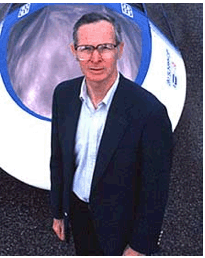
Paul MacCready
One immediately wonders what strange vehicle is behind him. It is simply the electric car with which he won the 1987 Australian solar car race, with a day's advantage over the next competitor (...)
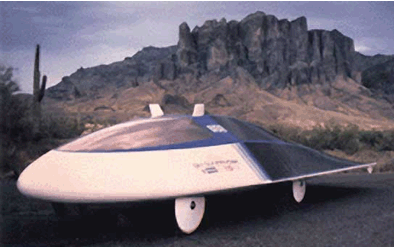
The solar car of Paul MacCready, 1987, during the Australian race
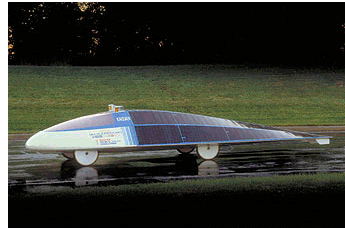
More streamlined, you can't get. Crossing Australia; 3500 km with peaks at 113 km/h
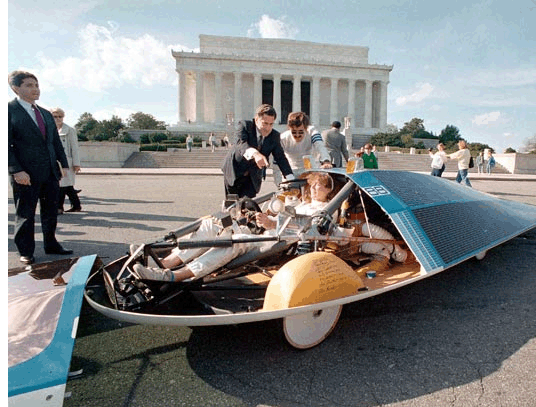
Front cover removed
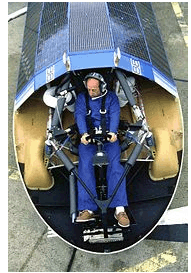
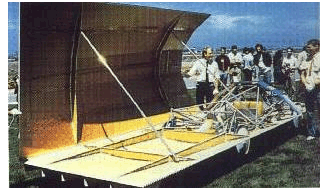
Pilot position and rear cover
As can be seen, the rear upper part was entirely made of joint solar cells. The vehicle rests on a flat panel, with stiffeners. The shape of the vehicle gave it lift, reducing the load on the landing gear.
Born in 1925. First solo flight at sixteen. 1941: US champion in gliding, at 23 years old. Wins the World Gliding Championship in France.
Next, he designed the first flying machine that sustains itself through the muscular energy deployed by its pilot, the Gossamer Condor.
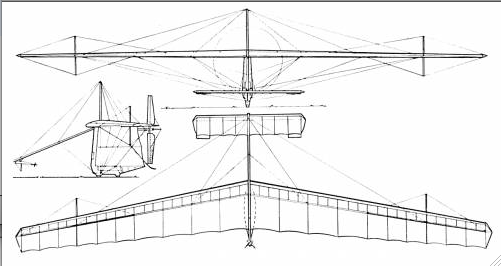
Three-view plan of the Gossamer Condor
MacCready chose the canard configuration, to have a lifting stabilizer. Indeed, the lift of a wing is " paid " at the price of a pitching moment. See my comic book " If We Could Fly ", downloadable for free on the site http://www.savoir-sans-frontieres.com, as well as 350 others, in 33 languages.
An enterprise dating from 3 years, which no media has ever mentioned
To save weight, MacCready chose the wing bracing on the forward keel, which lightens the longeron, which no longer has to withstand only the bending effort.
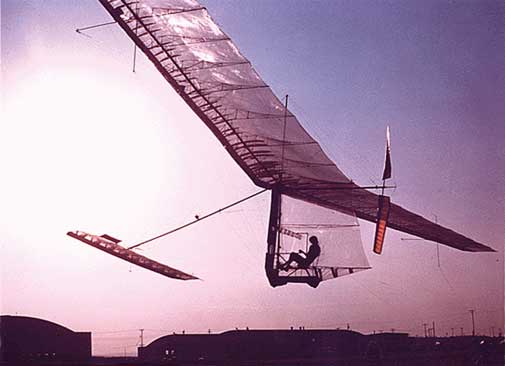
The Glossamer Condor: first human flight
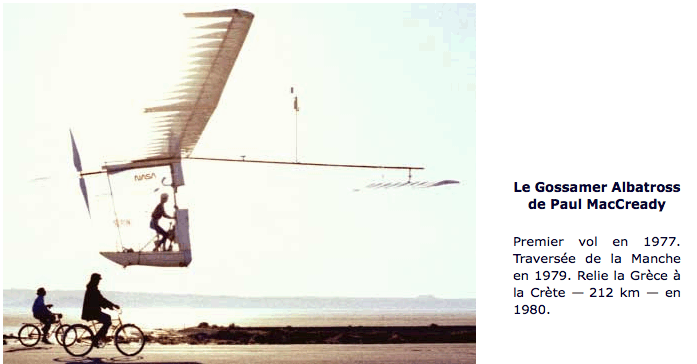
As fast as a bicycle.....
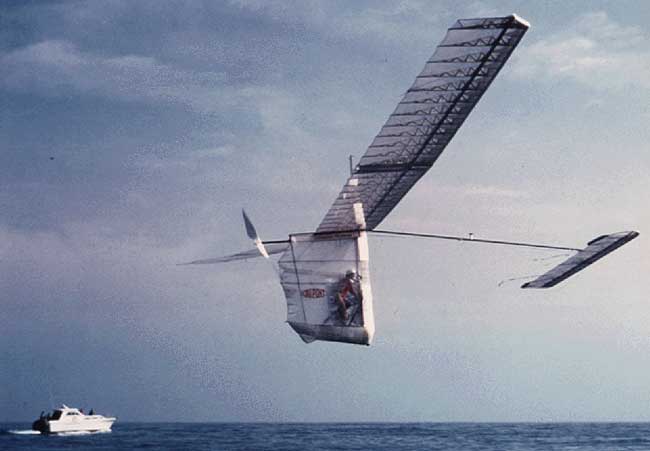
The Glossamer Albatros crossing the English Channel
All these flights are performed " on the ground effect ". The cyclist piloted using a handlebar, which first gave him a support, then adjusted the lift of the front stabilizer and finally made a slight turn by tilting this stabilizer. The wing inclination was ensured by the induced roll. There were no ailerons. But the machine was not designed to perform high banked turns.
Videos of the feats of Paul MacCready's machines
Next, the first flight with solar propulsion, performed by Marc Ready's son, 13 years old, 40 kg, aboard the Gossamer Penguin, equipped with 3900 cadmium-nickel solar cells, developing 500 watts. The aircraft's empty weight: 34 kg. A catapult allowed the device to leave the ground.
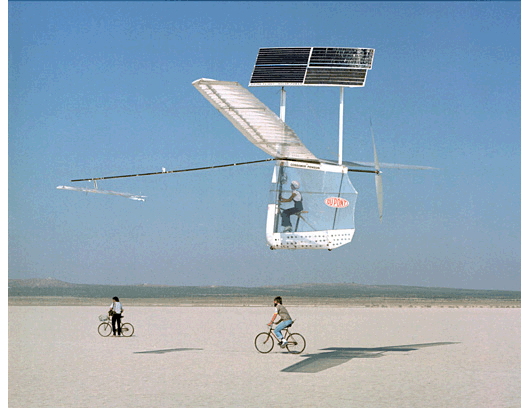
The first flight with solar propulsion, 1974. Still bikes and ground effect
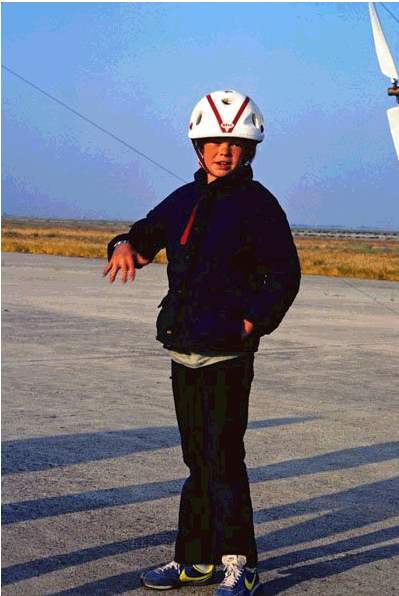
The first human to fly using solar energy: Marc Ready's son, 13 years old
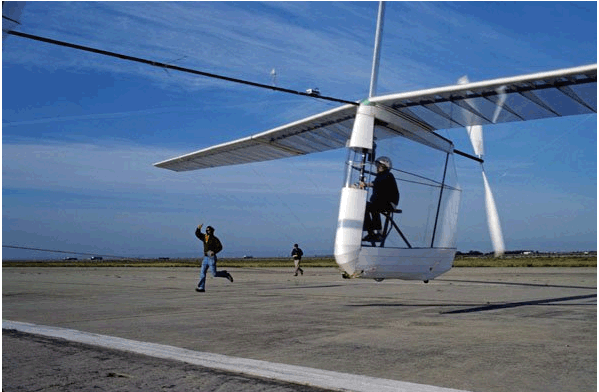
Marshall, 13 years old, at takeoff
But NASA takes over and allows MacCready to fly the Solar Challenger in 1981. Power: 2.5 kW
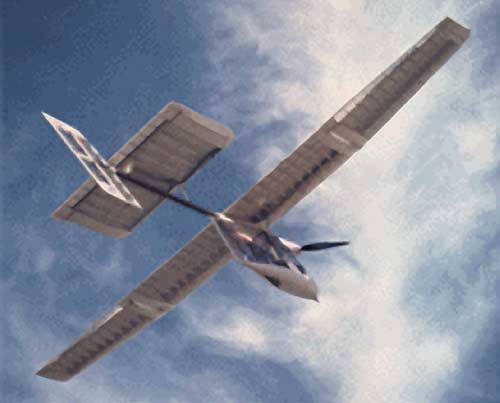
The Solar Challenger of Paul MacCready
There, things change completely. A more robust silhouette, designed to withstand the assault of turbulence.
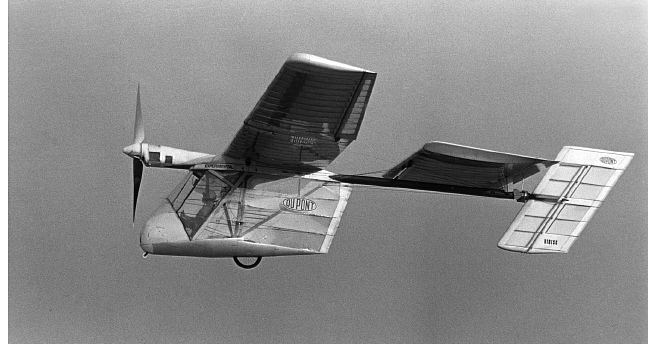
**Profile view. Note that it has ailerons. **
The aircraft's tail is equipped with a lifting profile, to balance the pitching moment of the wing. The upper part is completely flat and carries a large number of solar panels.
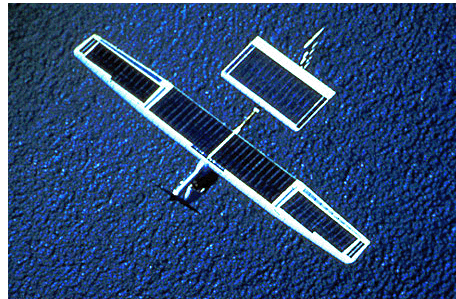
Solar Challenger, from above
It is the fixed part that carries the panels. The mobile part appears as a white strip, and is devoid of them. Flying between France and England, over a distance of 300 km, this aircraft stayed in the air for 5 hours and 23 minutes in July 1981. Three times heavier than the Gossamer Penguin (without the pilot), equipped with 16,000 solar cells, powering two electric motors arranged in tandem, each developing three horsepower, with samarium-cobalt permanent magnets. The aircraft benefits from all the progress made in terms of new materials with a strong strength-to-weight ratio and is equipped with a variable pitch propeller.
*The qualitative leap is considerable. *
Assuming the high-tech materials to be used, one can see that long-duration, long-distance solar flight becomes completely feasible, with a machine whose lines remain quite close to a conventional airplane, for example in terms of aspect ratio. But this is not what interests MacCready then. He is thinking of an unmanned aircraft, a " UAV " (Unmanned aerial vehicle), capable of reaching high altitudes during the day: 30 kilometers, descending somewhat during gliding at night, or returning part of the electric energy collected, stored in batteries, which would allow it to remain in the air indefinitely. .
He then turns towards the " tailless " with a high aspect ratio, where gusts are absorbed by the flexibility of the longeron, allowing a large dihedral. The stability of the aircraft is entrusted to an on-board computer which, acting on a set of flaps arranged along the entire trailing edge of the wing, of considerable aspect ratio, is responsible for controlling the effects of aeroelasticity.
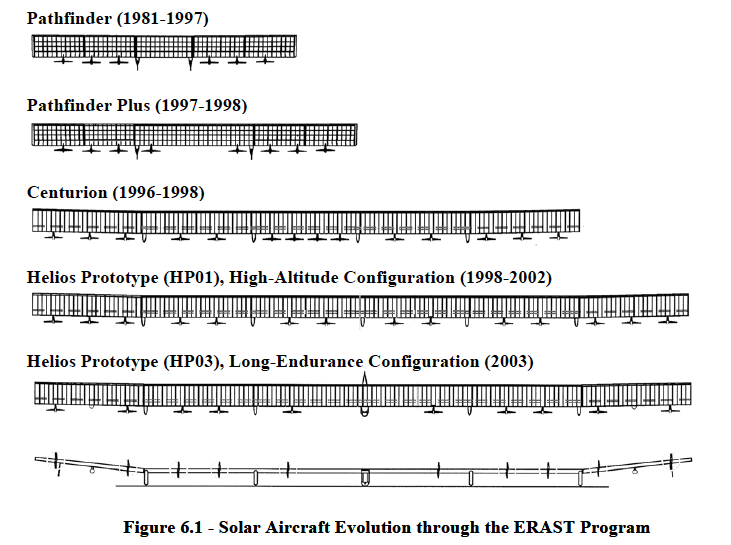
****The entire project (pdf in English)
The altitude of 30 km (100,000 feet) was indeed achieved. The efficiency of the solar sensors exceeds 20%. The aircraft can take off on its own. Different formulas have been successively implemented, from " all solar " to mixed systems where the aircraft carries energy in batteries or generates its electric energy using hydrogen fuel cells.
In the mid-1990s, NASA undertook the ERAST (Environmental Research Aircraft and Sensor Technology) program from its Dryden test center [http://fr/article/u-de-facehttp_-indexhtml]. The studies and research were conducted by the company Aero Vironment, founded by MacCready.
The first aircraft was the Pathfinder. 30 meters wingspan, six motors. After flying on battery it then evolved using solar sensors. It reached 17,000 meters altitude in 1995, then 23,000 meters in 1997.
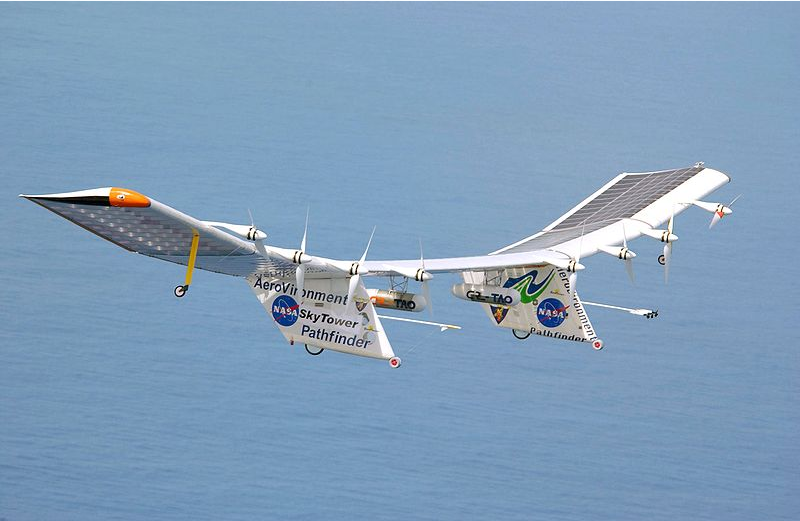
The Pathfinder: 30 meters wingspan, eight motors
An wing generates lift only at the price of a pitching moment, which must be balanced. The profile of the wings of this type of machine is evolving. The central part of the wing is the most " lifting " and has a positive camber. The wingtips have an autostable profile, in S, clearly visible on this photo. These wing elements therefore create less lift. This is the solution implemented by MacCready to arrive at this " tailless " formula, on a simple flying wing, of great aspect ratio. Much has been counted, perhaps too much, on flight control by computer.
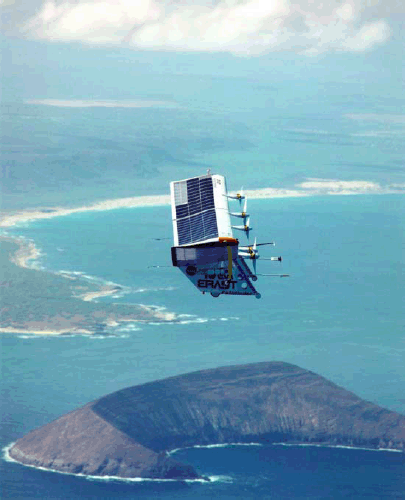
A profile view of the Pathfinder showing its dihedral
NASA then moved to the prototype Centurion (1996-1998), equipped with fourteen motors, a wingspan of seventy meters, designed to reach an altitude of 100,000 feet (thirty kilometers).
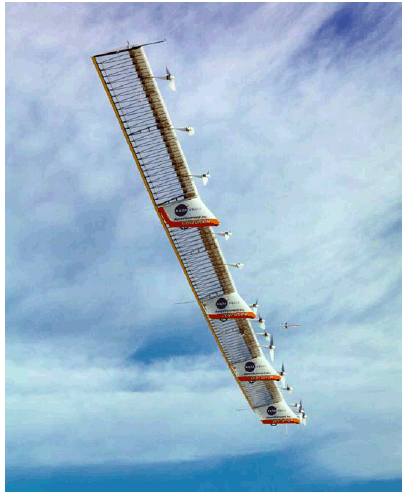
**The Centurion (1996 - 1998 -). Seventy meters wingspan, fourteen electric motors. **
The photo is taken from below. On the rear part of the profile, one can clearly see, in transparency, the thin ribs. This suggests that it is a qualification test of the wing, an evaluation of flight qualities, in the absence of expensive solar sensors. The upper and lower surfaces are covered only by a thin mylar film, as in the previous aircraft created by MacCready.
What else can be seen?
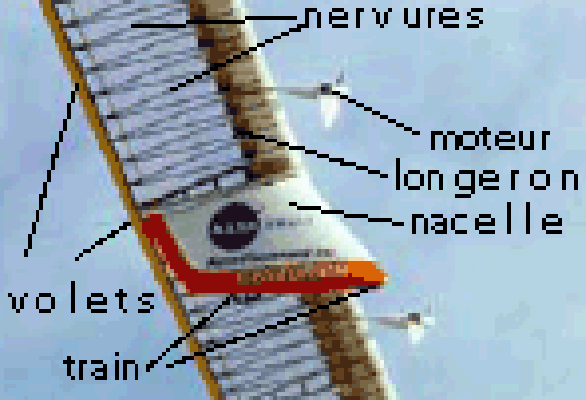
One can see the fourteen electric motors, in action, with their two-blade propellers of two meters in diameter, presumably driven by batteries, intended for relatively short flights. Each motor develops 1.5 kW. The front quarter of the wing is opaque. There must be the main element of the structure, the longeron. Ahead of this longeron, the extension of the ribs, completed by a light leading edge, in expanded polystyrene (styrofoam covered with mylar), as in the previous aircraft.
As will be seen later, the Centurion aircraft, equipped with solar sensors, and still with its 14 motors, was converted, by adding an additional central element, into the Helios HP01 machine, equipped with solar sensors, maximally lightened (1160 kg, wing loading 5 kg per square meter), configured to see if very high altitudes could be reached through solar-powered propulsion. Successful test (30 kilometers altitude).
As will be seen later, the HP03 version was destroyed during its second flight, and we will see how. The magnification of the debris, floating on the surface, allows us to glimpse the longeron, apparently cylindrical and ribbed. It seems that MacCready concentrated all the mechanical resistance of his machine in this longeron, the rest being just an exterior. When one looks at this wing, with an incredible wingspan (aspect ratio: 30), devoid of any bracing, one can wonder how it can negotiate the phenomenon of aeroelasticity. The phenomenon is relatively easy to understand. At the slightest gust, the tip of a wing can be caught. The local incidence becomes higher. The portion of the wing lifts, flexes. Then the mechanical, elastic reaction of the structure tends to bring it back to its initial position. As a result, the machine starts to " flap its wings " and this moment can be amplified until rupture.
Many aircraft manufacturers have experienced this type of trouble, on all kinds of machines. At the beginning of aviation, the solution was to use bracing, generating drag. It was only by improving the mechanical qualities of the internal structure that airplanes could be rid of this real spiderweb of cables. In NASA's machines: no bracing. One could wonder whether the longeron alone can counteract all the efforts related to this " flutter " of the wing. It seems difficult.
There is another way to deal with the phenomenon: make the wing " active ", " intelligent ". In a graph reproduced below, one can see that the machine records its " pitch rate " (its rate of change of incidence) in degrees per second, indicating that it is an essential data for flight control. The wing is full of (at the level of the cylindrical longeron) sensors detecting angular acceleration, in torsion. All this is transmitted to a computer that anticipates and immediately activates a whole series of 72 flaps that line the entire trailing edge (unit length: one meter). These do not only ensure the roll control of the machine, they counteract any tendency to flutter, to this dangerous flapping of the wings. In English, flutter means flapping (of a bird's wing).
The turning of the aircraft is ensured by a differential power regulation to the motors (in flight: 1.5 kW per motor). Therefore, there is no need for a vertical stabilizer. The roll is automatically due to the " induced roll " (the outer portion of the wing during the turn goes slower). The speed of the machine is 38 feet per second, or 45 km/h.
American aviation faced this problem decades ago, when it wanted to put into service its largest military carrier (I think it was the Lookeed Galaxy). Although calculated with the maximum care, the aircraft proved sensitive to an aeroelastic phenomenon, took off in " flapping wings ". The movement was not significant: less than a meter at the tip. But these alternating flexions were detrimental, causing a drastic reduction in the life of the wing, due to material fatigue.
There were two solutions:
- Redesign the wing from scratch (too expensive)
- Equip it with flaps countering this flutter phenomenon
The second solution was adopted. From that day on, the Americans had a good experience of active control of the wing geometry, using flaps, controlled by a set of " accelerometers plus computer ". It will be evident for the reader that such control cannot be ensured manually. Very sensitive accelerometers detect the slightest local change in incidence (or flexion) and immediately counteract this movement by activating the flaps, a behavior that no human being could achieve as quickly. Without a powerful on-board computer, the Helios (ex-Centurion) machine could simply not fly.
This aspect significantly limits the intervention capability of the " pilot " of such a machine, who can only control " if everything is going well ". One should not imagine him holding the controls continuously. All this works ... if everything has been planned by calculation, and properly programmed. However, in the destruction of Helios HP03, we will see that the development of another form of instability, in pitch, although anticipated, was underestimated in terms of its effects and the speed of its development, which the onboard system proved unable to counter in time. If the computer could give adequate orders to counter the start of the instability; in the first instance, the second " jolt " caused the device to " leave its flight domain ", extremely quickly. But there I am anticipating.
Back to the cylindrical structure of the longeron. It is subjected to two types of efforts:
- Bending
- Torsion
In the flutter, aeroelasticity phenomenon, the longeron is subjected to efforts in all directions. The local change in incidence, in a gust, causes a bending effort, in the " up-down " direction. But the local change in drag also generates " front-back " efforts. The cylindrical shape then seems to be the best to withstand bending efforts in all directions.
But the aerodynamicist also knows that the change in lift causes a change in the pitching moment (see my comic book The Aspirisouffle). This local change in the moment will induce dangerous torsion efforts, all the more damaging since the longeron is extremely long. It seems to me that the photo where we see this longeron exposed shows circular ribs, intended to prevent the propagation of a buckling phenomenon along this cylindrical longeron. Of course, adding that if the computer is not there to react instantly to any torsion movement of the wing, the longeron's rupture is guaranteed.
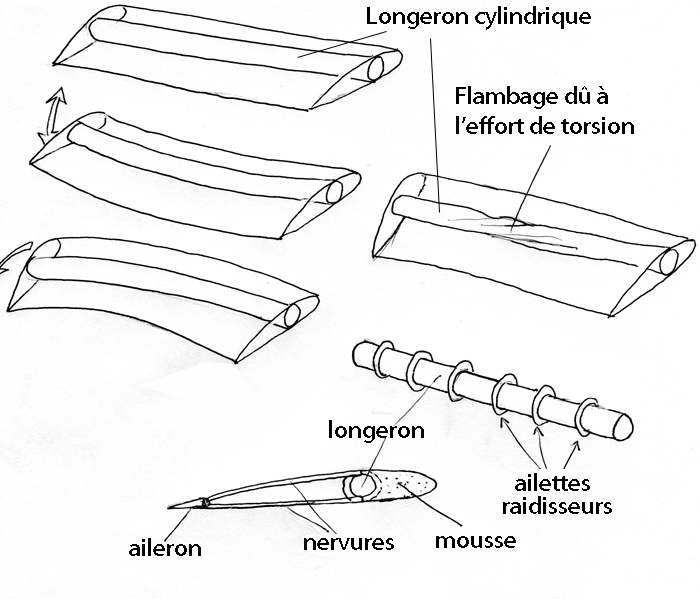
Longeron
In my opinion, only a complete active control of the machine allows it to fly, and even to face relatively significant turbulence and shear, which occur ... at all altitudes. In the lower layers, up to say 5000 meters, then possibly at high altitudes, unpredictably, even in these large corridors formed by the jet streams. In the following photo, we see that Helios takes off in weather conditions that are far from being completely calm. At the time of the Helios HP03 crash, see another photo further on, we can even see the formation of a cumulonimbus, in the distance. We are also in June, not in the middle of winter and the flight is taking place in the northern hemisphere. If the tests had been conducted in the middle of winter, in a calmer air mass, they might not have ended so abruptly and so quickly (on the second flight).
But NASA does not aim simply for an altitude record, achieved with the Helios HP01, but the development of a all-weather machine, capable of providing service at any time of the year, at all latitudes, at stratospheric altitudes (between 15 and 30 km), aiming for non-stop flights.
The Centurion prototype is then modified by adding a central element, which increases its wingspan to 82 meters, still with fourteen motors. It then becomes the Helios HPO1 machine intended to verify the possibility of performing high-altitude flights.
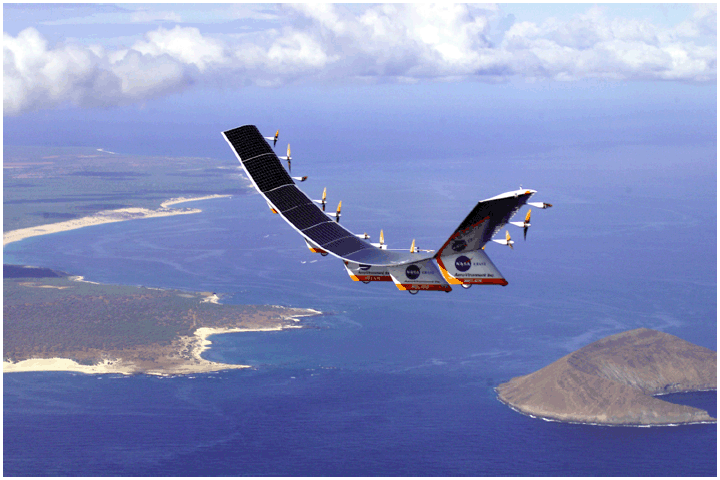
Helios, 14 motors, configured for altitude records (maximally lightened)
With 62,000 solar sensors, on August 13, 2001, Hélios climbed to 97,000 feet (30 kilometers altitude). This is the absolute altitude record for an airplane with wings. Previously, higher altitudes had been achieved by jet-powered (turbojets or rocket engines, like the X-15) during ballistic flights, without the wings participating in the lift, in this phase of the mission.
At this altitude, the atmospheric pressure does not exceed a few millibars. There are then two ways to ensure sustained flight:
*- Either the Helios formula, with a low speed, with a very low wing loading (per square meter of wing area) : 5 kg per square meter during Helios' high-altitude flights. Wingspan 82 meters. Wing chord: 8 feet (2.64 meters). Aspect ratio: 82/2.64 = 31 (....). Wing area 216 square meters. Maximum thickness 28 cm. Leading edge in expanded polystyrene (styrofoam covered with a thin plastic film). Weight of Helios: 1,160 kg, machine maximally lightened (weight increased to 2,320 kg for the Helios HP03, due to the carriage of a fuel cell motorization system weighing more than a ton). Nominal speed 38 feet / second, or 12 m/s or 45 km/h
*- Or have a high wing loading, but evolve in hypersonic (Aurora) *
In 2003, NASA then planned to aim for long-duration flights (one to two weeks) by maintaining flight at night using hydrogen fuel cells, at an altitude of 50,000 feet (16,000 meters), developing 18 kilowatts. The configuration of Helios is then modified. It goes to ten motors. The fuel cell is placed in the central nacelle, while additional tanks are placed at the wingtips (7 kg each).
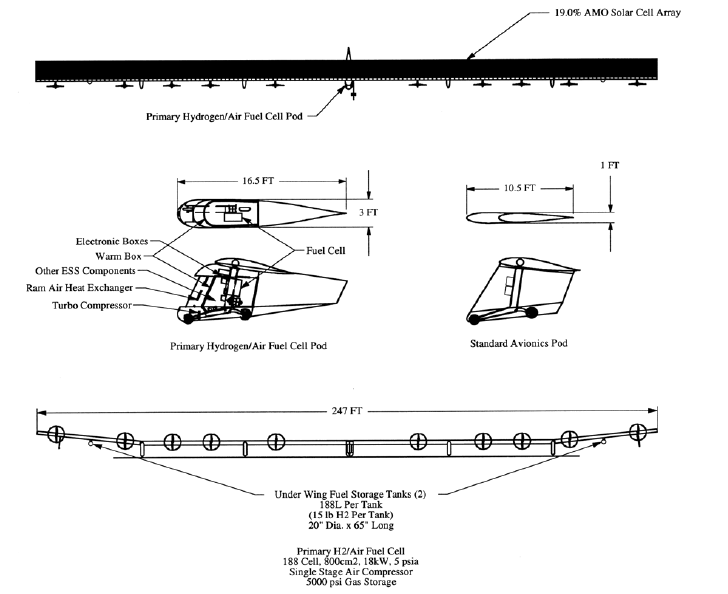
Helios configured for long-duration flights. The arrows point to the wingtip tanks
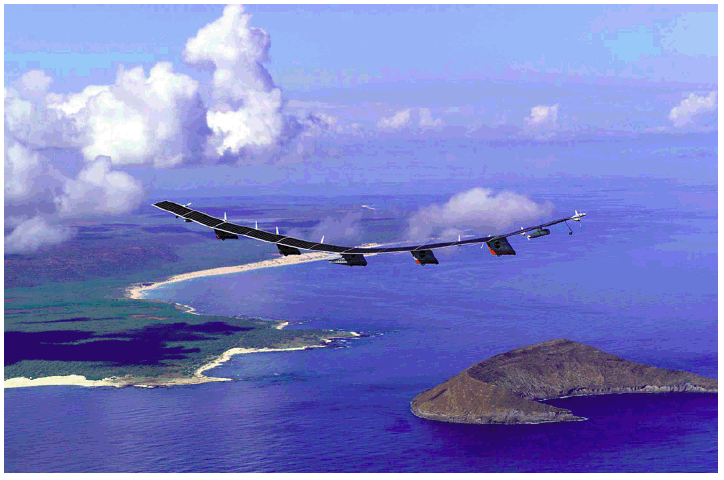
**Helios HP03 in flight. Note the wingtip tanks. **
When the aircraft is photographed from the side, its dihedral seems impressive. But on the photo above (where it is photographed in a 3/4 rear view), or below (where it is almost face-on), one can see that this dihedral is " very reasonable ".
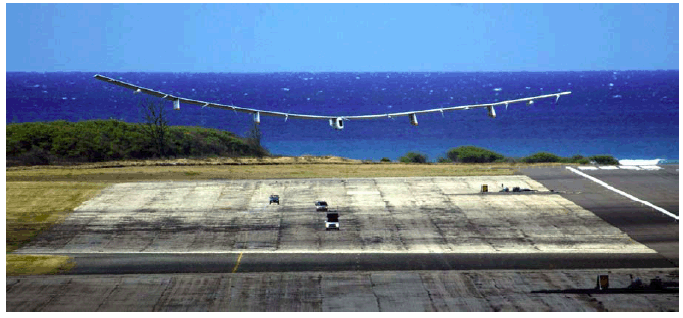
Landing with a crosswind
One might think that this aspect ratio of 31 constitutes an absolute limit. Yes and no. Helios is too light in construction to withstand atmospheric disturbances by its own rigidity. Therefore, its wing has been made " intelligent ", by equipping it with 72 computer-controlled flaps. But with a higher wing loading, one discovers the German two-seater ETA (phonetic translation of the Greek letter eta) whose aspect ratio reaches ... 51!
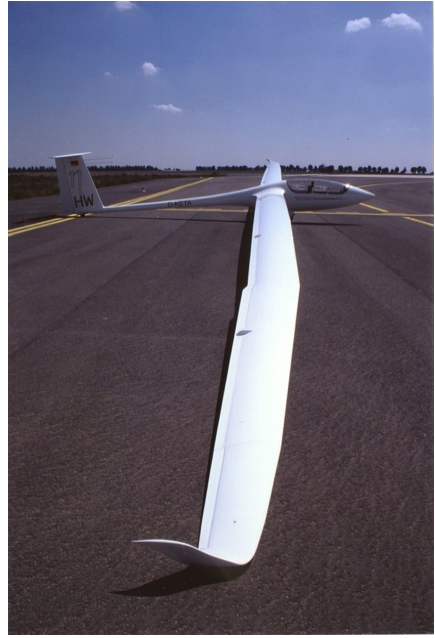
The motor glider ETA from the side
The glide ratio increases with the aspect ratio. Further on, one will discover the Stemme with a glide ratio exceeding 50. The ETA's reaches 72. That is to say, losing 1000 meters of altitude, it can cross in one wing ... 72 kilometers!
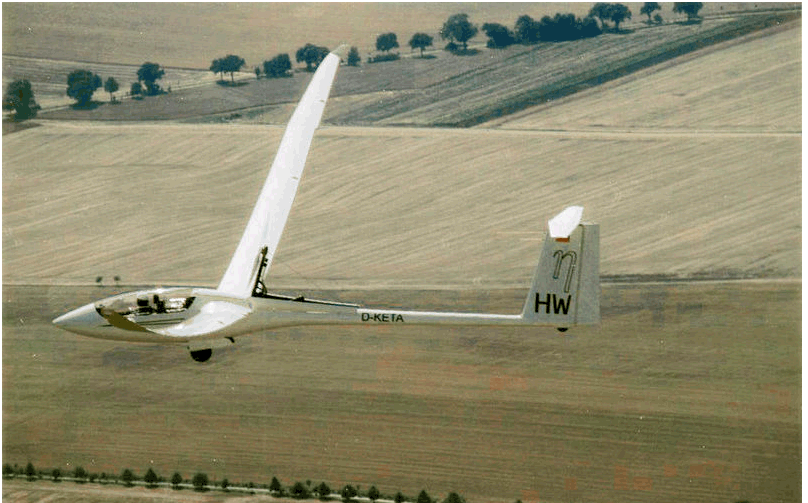
The motor glider ETA with the engine extended (A Solo 2625 of 64 horsepower)
The wingspan reaches thirty meters. The full load mass is 950 kg. Maximum speed 270 km/h. First flights in 2008. Three ETA have been built. One was lost during testing, in a turn. The two pilots were able to use their parachutes.
October 2, 2010: There are no more French gliders
. Most of the gliders flying in our centers are made in Germany. Motor gliders are developing rapidly, for two reasons. They allow those who own them to do without the services of a tug plane. This motorized engine (a minute of setup) allows climb rates of up to 2.5 meters per second. When the engine has returned to its housing, its presence brings no additional drag.
M
But such a climb rate would not allow a pilot in trouble to get out of a strong downdraft, such as those encountered sometimes in mountain flights and which frequently exceed 5 meters per second.
C
These engines provide pilots with an additional safety, comfort of flight, allowing them to avoid excessive risks, to move away from a " local terrain ". Indeed, when the aero-logy collapses, when the cumulus disappear, one can always turn on the engine and return, avoiding " the cow ", sometimes impossible in the mountains.
Less sporty but also less dangerous.
Helios will make two flights before being destroyed in flight. The first, on June 7, 2003 and the second on June 25. Here is Helios HP03 in ascent, on the day of the crash:
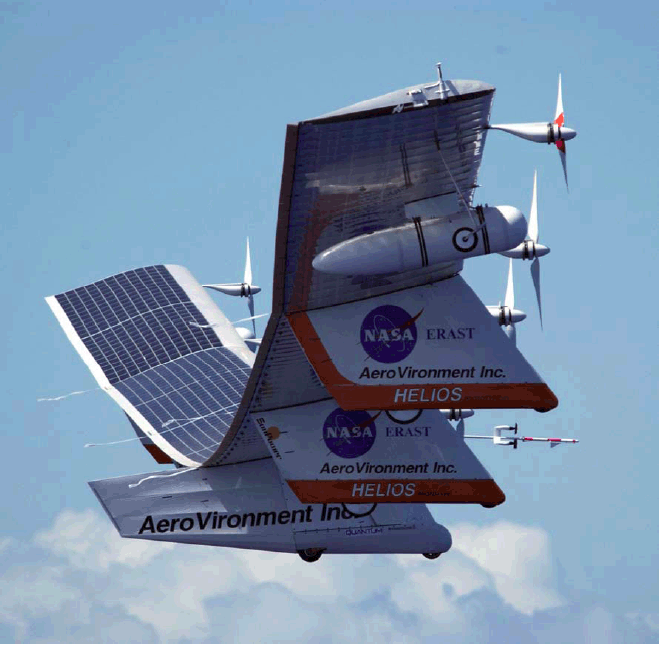
Helios in ascent, during its second and last flight, photographed from a escort helicopter
The climb rate is 0.5 m /s
If one refers to the pdf describing the project, one sees that the technology of non-stop flight was based on a very simple principle: during the day, water electrolysis, carried on board, and stored in the form of oxygen and hydrogen (compressed). Then at night, the gases from the electrolysis are sent into a fuel cell, the water produced being stored again. In this idea, the problematic element is the compressor.
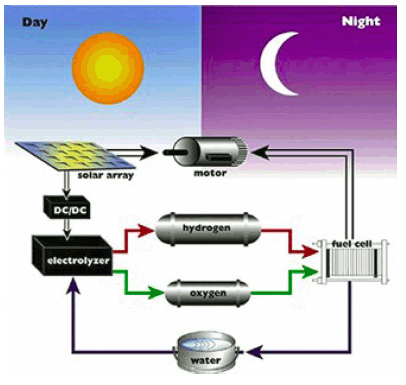
The theoretical diagram of Helios' operation
More simple, you can't get
It is known that the aircraft was destroyed in flight. One might expect this to be due to excessive bending stresses, endured by the wing during the crossing of turbulence and shear. But when one examines the accident report, one sees that the cause is quite different. Indeed, when approaching these turbulence, the wing acquires an impressive dihedral:
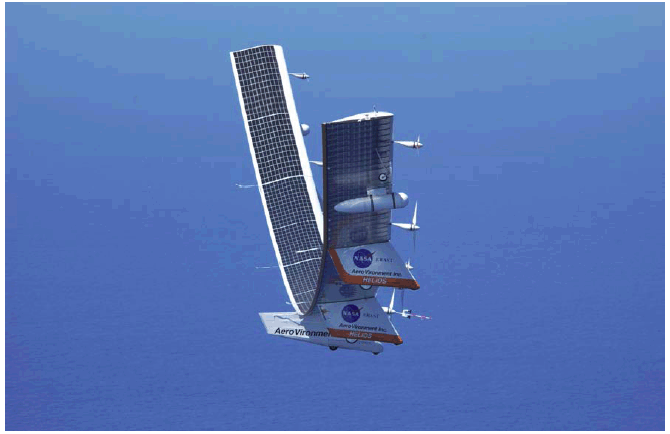
Helios, increased dihedral in a turbulent area, begins its instability movement in pitch
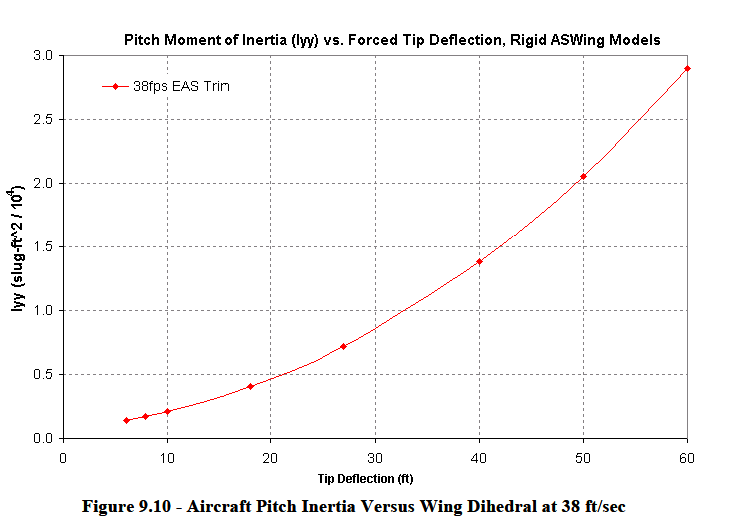
What will lead to the destruction of the machine is not the breakage of its longeron, but its engagement in an uncontrollable pitch movement. The aircraft is subject to the aeroelasticity phenomenon. When the dihedral becomes high, the fact of having placed the tanks at the wingtips increases the moment of inertia of the machine in pitch. The nominal flight speed is 38 feet/second, about 45 km/h. The speed of a " delta wing ". The aircraft is not designed for higher speeds. Its pitch oscillation will bring it to peaks exceeding 70 km/h, according to the flight recorder. These speeds induce a suction effect on the leading edge elements, in expanded polystyrene, glued, which immediately detach. The same happened to the entire wing covering, including solar panels.
On the other hand, the longeron, it holds up. The wing was not broken by turbulence, by air mass shear, but was simply stripped by the overspeed resulting from its pitch instability.
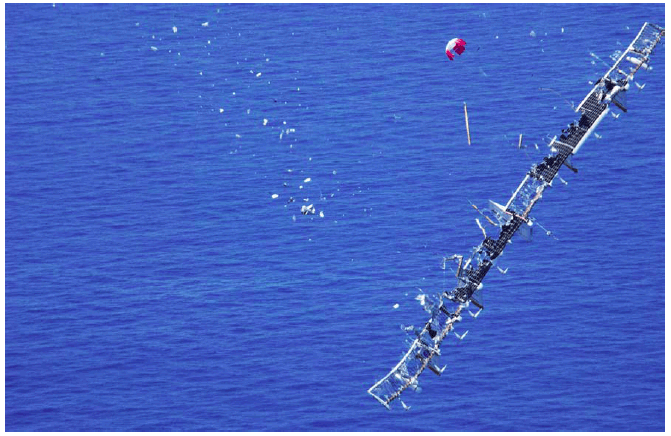
Helios, a short time before the machine is destroyed in the sea
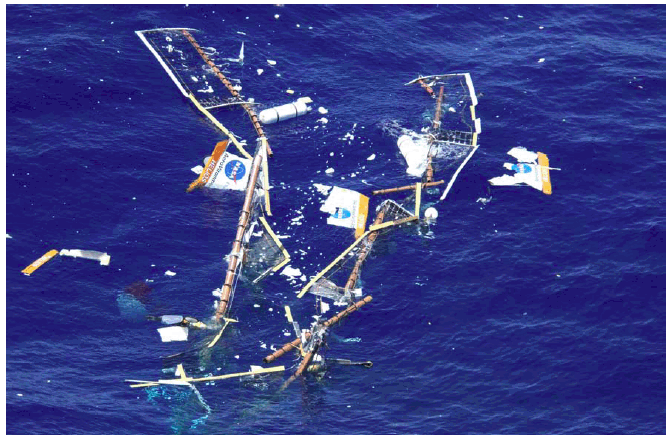
The drifting debris
The Helios accident report is quite confusing. Personally, I think adding a tail that is light enough not to increase the pitching moment of inertia, but with a large enough surface to create "damping" against this instability, would have been a solution worth at least considering. It is true that the name of MacCready does not appear in this report. Below is the increase in the pitching moment of inertia of the machine as a function of dihedral.
Above, the reading of the crash. In the middle of the graph, a first increase in dihedral, which the computer manages. Then, ten minutes later (total flight time: thirty minutes), a new appearance of instability. The dihedral exceeds 30 feet (ten meters). The machine "starts flapping its wings" (aeroelastic instability). Rapid pitching oscillations (bottom curve) then an increase in speed beyond 60 feet per second.
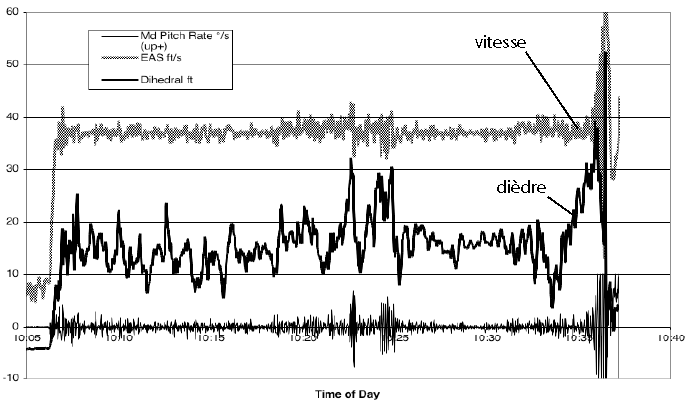
At this point, the aerodynamic forces on the leading edges cause them to detach, same with the wing covering, and in a few seconds, only ... the wing spar remains. The report states "that the computer calculations had not predicted that the instability would develop so quickly and violently."
In conclusion: the risks involved in operating this type of machine are not only limited to the risk of wing spar failure due to gusts. Aeroelastic instability can play an equally catastrophic role.
Leaving the field of solar airplanes, we can now approach that of electric airplanes, which fly using energy stored in batteries. This is a market in full expansion. And on this point, some key points seem to have been marked. We will mention, as a memory, the first flight of a French monoplane in December 2007:

World First in France: The Flight of an Electric Plane
on December 23, 2007
****Association for the Promotion of Electric Aircraft
This is a world first, the APAME, has achieved the first flight of the ELECTRA F-WMDJ airplane, equipped with a 25 hp electric motor and Lithium-Polymer batteries.
This first flight took place on December 23rd last year from the airfield of Aspres sur Buëch in the Hautes-Alpes. The electric airplane flew for 48 minutes, covering 50 km in a closed circuit.
This exceptional experience in the recreational aviation sector offers an unprecedented alternative to current internal combustion engines for aircraft requiring a power of 15 to 50 hp.
Characteristics of the aircraft:
Single seat Wingspan: 9 m Length: 7 m Empty weight without batteries: 134 kg Maximum takeoff weight: 265 kg Cruising speed: 90 km/h Gliding ratio: 13 Wooden and canvas construction Characteristics of the electric propulsion unit:
Industrial "brush" DC motor of 18 kW (25 hp) Power electronics specifically developed for this use Lithium-Polymer batteries (total weight: 47 kg) Ground adjustable ARPLAST propeller adapted to this propulsion system Instrument panel, power control, engine mount, engine flange, etc., specifically developed and manufactured for this aircraft About APAME: A recent association founded in 2007 under the presidency of Anne LAVRAND, APAME aims to promote the design, construction and use of electric aircraft. It had an ambitious project to develop a small electric airplane. In August, APAME had already made a "silent flight" of a ULM ( ).
Contact APAME Phone: 04 92 57 99 40 Fax: 04 92 57 99 41 Website:
This is a world first, the APAME, has achieved the first flight of the ELECTRA F-WMDJ airplane, equipped with a 25 hp electric motor and Lithium-Polymer batteries.
This first flight took place on December 23rd last year from the airfield of Aspres sur Buëch in the Hautes-Alpes. The electric airplane flew for 48 minutes, covering 50 km in a closed circuit.
This exceptional experience in the recreational aviation sector offers an unprecedented alternative to current internal combustion engines for aircraft requiring a power of 15 to 50 hp.
Characteristics of the aircraft:
Single seat Wingspan: 9 m Length: 7 m Empty weight without batteries: 134 kg Maximum takeoff weight: 265 kg Cruising speed: 90 km/h Gliding ratio: 13 Wooden and canvas construction Characteristics of the electric propulsion unit:
Industrial "brush" DC motor of 18 kW (25 hp) Power electronics specifically developed for this use Lithium-Polymer batteries (total weight: 47 kg) Ground adjustable ARPLAST propeller adapted to this propulsion system Instrument panel, power control, engine mount, engine flange, etc., specifically developed and manufactured for this aircraft About APAME: A recent association founded in 2007 under the presidency of Anne LAVRAND, APAME aims to promote the design, construction and use of electric aircraft. It had an ambitious project to develop a small electric airplane. In August, APAME had already made a "silent flight" of a ULM ( ).
Contact APAME Phone: 04 92 57 99 40 Fax: 04 92 57 99 41 Website:
Single seat, 25 horsepower, 48 minutes and 50 km in a closed circuit at 90 km/h ---
The first all-electric commercial tourist airplane is.....anglo-chinese
http://www.avem.fr/actualite-le-premier-avion-electrique-commercialise-en-2010-874.html
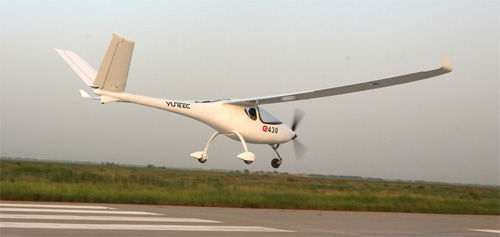
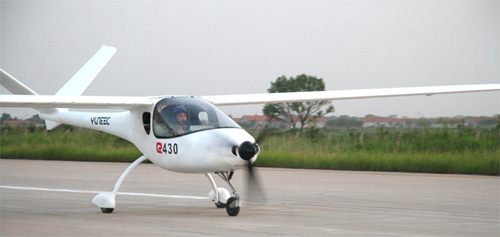
**The Yuneec E 430 is a tandem two-seater, with very studied aerodynamics. **
The wing has a high aspect ratio, synonymous with reduced drag.
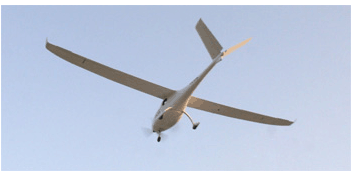
A high aspect ratio (more than winglets) but compatible with easy placement in a hangar
What is interesting is the flight duration performance, for two, with a maximum speed of 90 km/h:
Two hours
Estimated price: 65,000 euros, which is not excessive for a two-seater tourist plane. It is manufactured in China, but cannot be commercialized there. Indeed, the Chinese sky is not open to tourist aviation.
Here we are well within the range of use of a small tourist airplane, suitable for training and local flights. Its lines and the high aspect ratio of the aircraft, unlike the powered Cri Cri, give the aircraft more the appearance of a motor glider (low power motor, or a three-blade propeller in a flag-like position). It obviously takes off on its own.
Evaluation made by Jean-Luc Soullier
: "We are in the 450 kg maximum weight class (international ULM class for two-seaters). Approximately 120 kg of machine, 150 kg of passengers, 180 kg of batteries, likely lithium-polymer, with a carrying capacity of 0.2 kWh per kg. 18 kW of average power is sufficient to fly this kind of motor glider. Hence 2 hours of autonomy.
I think there is a future in the field of electric motor gliders, possibly with the addition of energy via solar sensors. In terms of propulsion, one thinks of the Rolls of motor gliders, a German machine, the Stemme S10, where the propeller can be completely retracted into a nose cover, and deployed by the effect of centrifugal force.
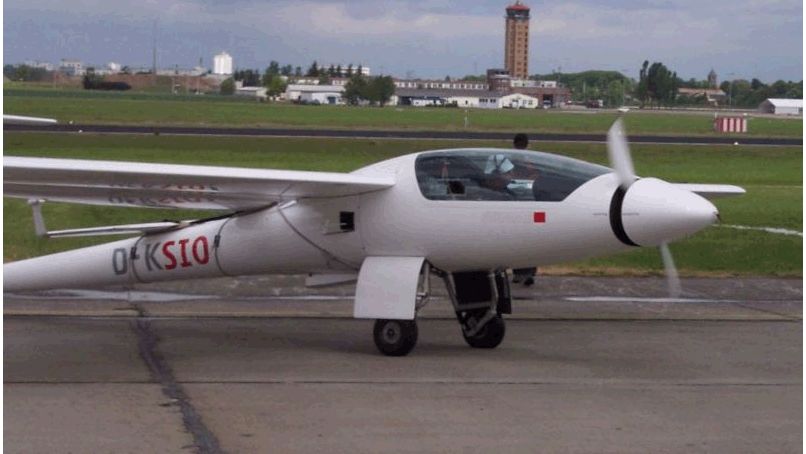
**The Stemme S10, the best motor glider in the world. Two-seater, retractable propeller. The 85 kW (thermal) engine is under the wing. The air intake is visible, open. Electrically retractable landing gear. Maximum speed 270 km/h, aspect ratio: 30. Wingspan: ... 23 meters! Demountable and transportable on a trailer. Gliding ratio higher than ... fifty. **
With a full tank, the distance that can be covered exceeds ... a thousand kilometers. But the cargo in the mini cabin remains ... symbolic (toothbrush and pajamas for two). Here is a video showing
According to my friend Jacques, who owns one (I have also flown on this machine, based in Vinon), the idea of a retractable propeller, excellent glider performance, electric propulsion, plus solar sensors would constitute an interesting formula. Like the ETA, the Stemme can take off on its own (but it needs a good length runway!). Its climb rate remains low. This allows the user to be free from the need to use a tug plane.
My friend Jacques Legalland, a purist of gliding, only uses his engine to take off. But in the air, descending areas can be encountered, and I remember that after a loop above the Verdon gorges, we had to give a boost of the engine to get back to the field with a good safety margin.
The advantage of the Stemme over all other motor gliders, whose propeller, retracted in gliding, is mounted on a pylon, in its dorsal housing and is raised (see the photo of the ETA under engine, above), is that if the engine is slow to restart, the propeller, which in the case of the Stemme only deploys by centrifugal force, immediately retracts into its housing, waiting for a new start. In the meantime, the aircraft maintains its performance in gliding and descent rate (vertical speed). But as soon as a motor glider with a pylon-mounted propeller extends its propeller, it must start quickly, otherwise this assembly, generating a strong drag, degrades its performance, and the "cure" worsens the "condition".
In fact, according to those who use them, rare are the cases where a motor glider pilot can get out of a very bad situation by restarting the engine, if caught by a strong descent in the mountains. The climb rate (2.5 m/s is too low).
The challenge: crossing the Atlantic with an electric airplane: David against Goliath
Among electric airplanes, no one ignores the highly publicized and strongly sponsored project of Bertrand Piccard, under the name of Solar Impulse. Doing a search, I came across a video that presents two very different projects: that of Piccard and that of a certain Jean-Luc Soullier who, in contrast, is neither sponsored nor publicized. I suggest my readers to start by watching this short report made at a fair, where one of Soullier's achievements, the Cri Cri powered by two electric motors, and the model of the Solar Impulse team of Piccard were presented.
Report by euronews on solar aviation at the Research and Innovation Fair
Let's start with Piccard's project. As everyone knows, it has a huge budget, 65 full-time employees for years, strong sponsorship, and a significant media campaign. This seems to be the image of the initial, more ambitious project, evoking a round-the-world flight without stops, with an aircraft that was obviously two-seater.
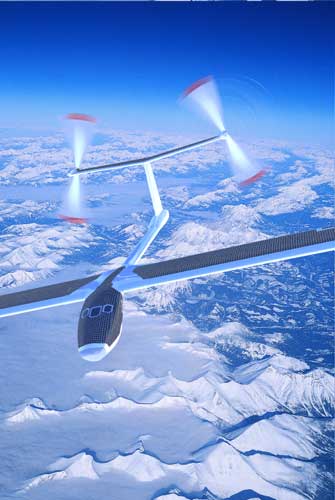
Bertrand Piccard's initial project, two-seater, abandoned
The American company leading to machines like Helios was mentioned above. Common denominator: slow speed, therefore long flight duration (infinite for the successors of Helios, designed as observation platforms in pilot, evolving well above the altitudes corresponding to commercial air routes, which allows them, in principle, to be free from the meteorological disturbances in the lower layers).
Speed of Helios: 45 km/h. At the equator, the Earth's circumference: 40,000 km. So an order of magnitude of 1000 hours to make a round-the-world at this latitude: more than a month. Less, at a higher latitude.
Speed of Piccard's machines: 70 km/h. At an average latitude, a round-the-world without stops represents three weeks. It is therefore necessary to consider that two men can live for this entire time in a cabin that should be heated and pressurized. As it was feasible in the capsule carried by a balloon, which combined the use of helium and a balloon-like operation, using propane bottles, such a formula would be much too heavy for a solar airplane.
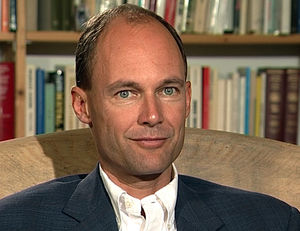
Bertrand Piccard, psychiatrist and aeronaut
(Pioneer of "delta wings", European aerobatic champion)
A look at the (remarkable) achievement accomplished by the team Bertrand Piccard - Brian Jones, completing a round-the-world flight in a balloon (40,000 kilometers covered in 17 days).
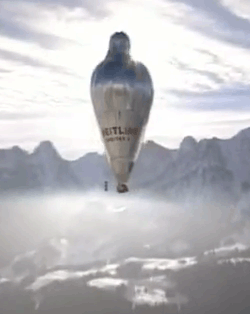
The Breitling Orbiter III. 18,000 cubic meters of helium
It is an achievement, as well as the first ascent of Everest, but it will not lead to the implementation of a regular balloon service for travelers. The piloting of a balloon is done by seeking favorable air currents, regarding their direction and intensity. One could say that the real pilot of the Breitling Orbiter III remained ... on the ground. It was the meteorological service coordinator. The exploitation of jet streams allowed the balloon to reach speeds of up to 250 km/h in "ground speed."
The aerostructural is always very complex, made of layers where the wind direction changes. I remember a hot air balloon flight where, by adjusting the altitude, we could alternate a morning wind, slightly ascending, linked to the heating of a hillside exposed to the sun, directed roughly to the north, with a high altitude wind blowing to the southwest. By exploiting these two air currents and alternating altitudes, it was possible to approach a comfortable area.
Remember that this helium balloon - hot air balloon combination is 55 meters high, and weighs 8 tonnes at takeoff. It carries a living module for two men, powered by solar rechargeable batteries. The sponsor is the watchmaker Breitling, which dedicates three million euros to this project. For them, this will result in a fantastic advertising campaign.
Repeating a "solar" round-the-world posed weight calculation problems that were impossible to solve. Piccard therefore turned to a more modest project: keeping an airplane in the air that uses only solar energy, for a day and a night, which implies storing part of the energy collected during the day in batteries to ensure flight at night. This has already been accomplished in 2005 with an unmanned aircraft, five meters in wingspan, designed by
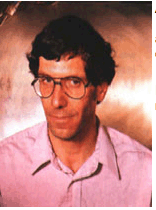
**Alan Cocconi ( AC Propulsion ) **
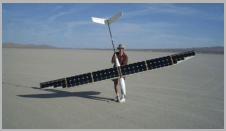
In 2005 Alan Cocconi succeeded in flying this 5-meter model for 48 hours non-stop with daytime battery recharging to ensure night flight
Previously, Alan Cocconi focused on an electric car speed record of less than 1000 kilograms
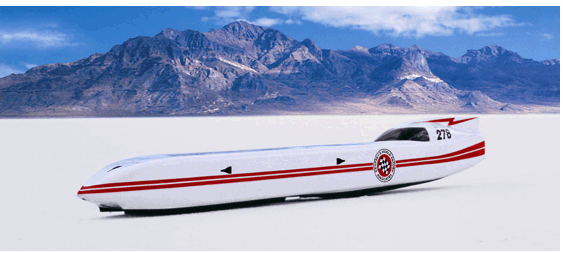
**Alan Cocconi's "White Lightning". 400 km/h in 1997. **
Side note: the hundred kilometers per hour mark (which was at the time the absolute speed achieved by man) was crossed in 1899 by an electric car, the "Jamais Contente". So a gain of a factor of four in speed in a century.
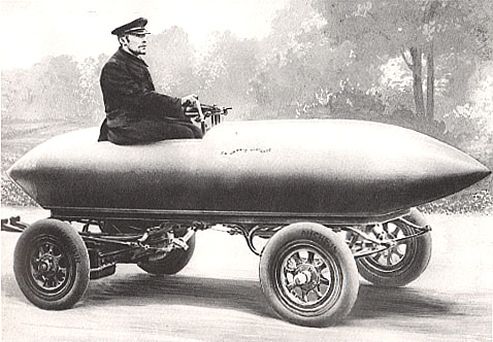
The Jamais Contente, by Belgian Camille Jenatzy, 105 km/h in 1899, one ton, 68 hp
Jenatzy, and others, were fighting on the market of "electric cabs", which were quickly put out of business with the advent of the internal combustion engine.
Back to Piccard's project. He and his large team are turning towards a four-engine single-seat, unpressurized cabin, intended for an altitude not exceeding 8500 meters. The wing's resistance to flutter is not ensured by controlled piloting with 72 flaps, commanded by computer, as in Helios (aspect ratio 32). Here, the aspect ratio is more modest, comparable to that of gliders 5 20 and more. A thick wing (which imposes the thickness of the wing) ensures rigidity.
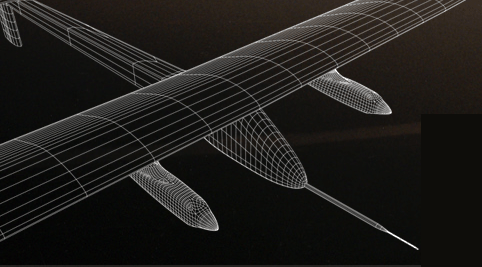
Single-seat version of the Piccard project
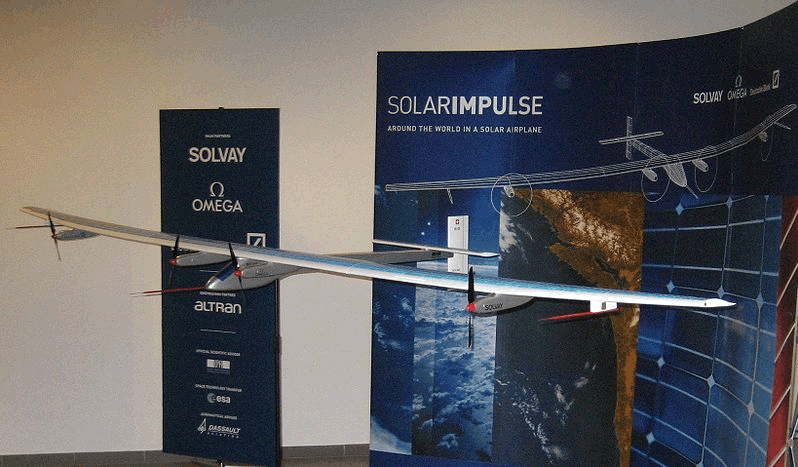
Except for the fantastic media hype, linked to the large communication budget, this flight is nothing particularly extraordinary. The breakthrough in solar flight had already been achieved in 1981 by Paul MacCready, with his Solar Challenger developing 2.5 kW, or a little more than 3 horsepower (one horsepower is 736 watts), capable of staying in the air for 5 hours and covering hundreds of kilometers. The Anglo-Chinese aircraft presented above is its continuation.
Paul MacCready's Solar Challenger
Profile view
**Solar Challenger, from above, during its crossing of the English Channel. **
The feat aimed by Piccard, beyond Solar Impulse, is a three-day and three-night flight, at 70 km/h, still single-seat, with a pressurized cabin, representing 5000 kilometers, allowing a transoceanic flight. Beyond that, Piccard's team will consider a round-the-world flight, with many stops, considering that it is difficult to ask a human being to control such a machine for more than 72 consecutive hours: pilot change at each stop.
Jean-Luc Soullier had joined the race, with a project "Spark", a Cri-Cri powered by him as a test bench.
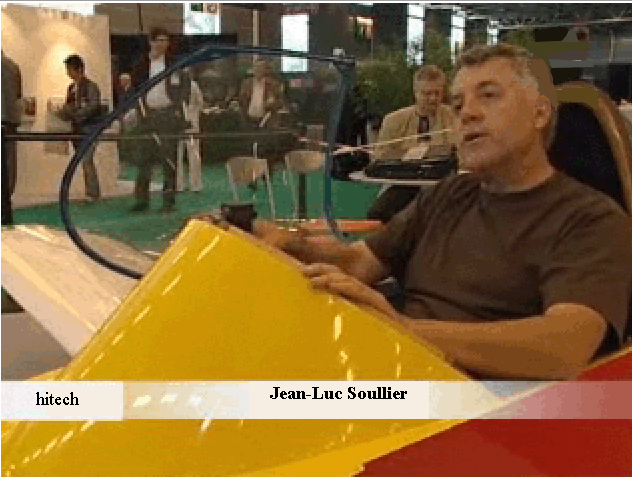
Jean-Luc Soullier, 58 years old, seated at the controls of the Cri Cri MC15E, with electric motors
The man is modest, one could say unassuming. He drives an old car, avoids the spotlight. I could not get a decent photo from him and had to go back to this one, enlarging and retouching it from the video presented above.
No sponsors. He financed everything with his own money, to the tune of 200,000 euros, by spending year after year his savings as a commercial airline pilot. His first work consisted, with the help of his designer, in transforming the famous and tiny Cri-Cri created in 1973 by Michel Colomban, by equipping it with electric motors.
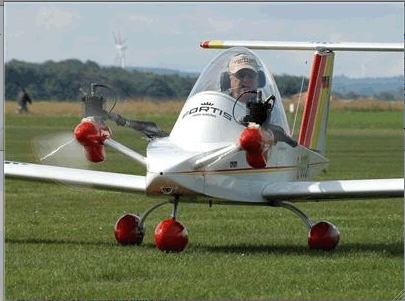
The classic Cri Cri, equipped with two 15-horsepower motors (22 kilowatts)
Hundreds of units in service around the world
In flighthttp://video.google.fr/videosearch?q=Cri+Cri&oe=utf-8&rls=org.mozilla:fr:official&client=firefox-a&um=1&ie=UTF-8&ei=Bjx4StnMCc-i_QaWqKmKBg&sa=X&oi=video_result_group&ct=title&resnum=8#
Five meters wingspan. Flight speed 220 km/h. Weighs empty (70 kg): lighter than its useful load, its pilot. Colomban created this unique machine, capable of aerobatics ( + 4.5 g, - 2.5 g ). He himself tested the wing spar for fatigue by subjecting it to 100 million alternating flexions by using an eccentric operated by a drill.
Here is the aircraft modified by Soullier, equipped with two 15 kW electric motors.
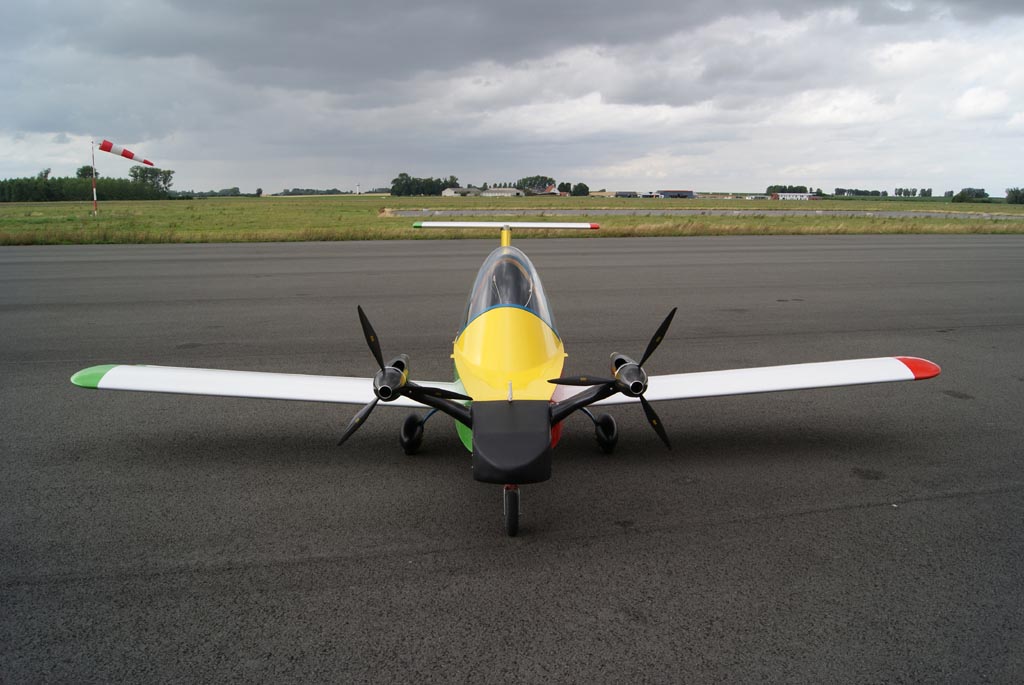
The electric Cri Cri, equipped with two electric motors. The front part has been modified to house batteries.
Autonomy: 45 minutes, with 45 kg of lithium-polymer batteries
There are different types of lithium batteries. In lithium-polymer batteries, the electrolyte is contained in a gel. Those available and equipped on the electric Cri Cri have a limited carrying capacity, 0.2 kWh per kg of weight.
http://fr.wikipedia.org/wiki/Accumulateur_lithium
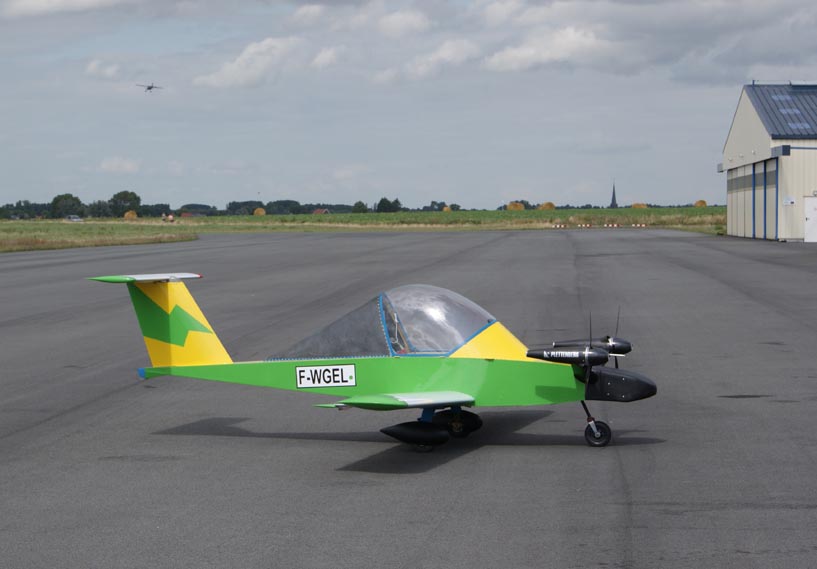
Each motor is powered by its own battery pack, to increase safety. Electric propulsion eliminates the parasitic trails from the exhaust silencer, spark plug wires, cylinders, resulting in a drag reduction estimated at 45%. If the two motors can develop 30 kW, the "iron sparrow" can fly with 10 kW, resulting in a total autonomy of 45 minutes, taking into account a 15-minute reserve during landing procedures. Tests are ongoing.
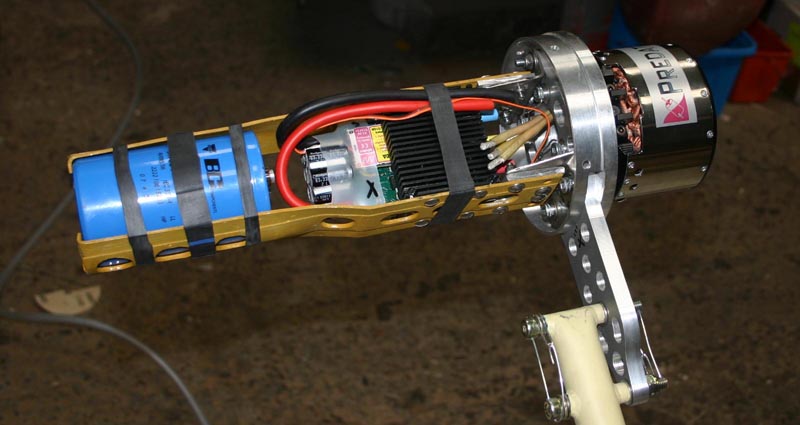
**One of the two electric motors of the Cri Cri, without its cover. **
On the right, the motor itself. On the left, a capacitor. In the center, the system that converts the direct current delivered by the batteries into "alternating current", three-phase (in fact in the form of pulses).
First flight of the electric Cri-Cri
Jean-Luc Soullier at the controls:
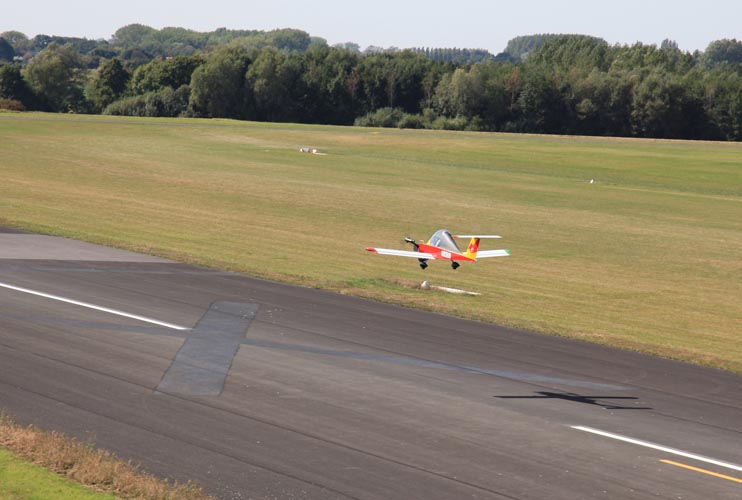
First takeoff, on September 8, 2009, Jean-Luc Soullier at the controls
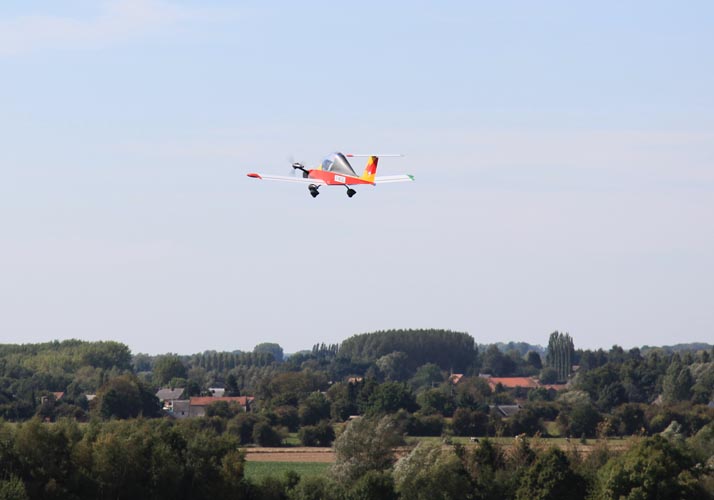
These wonderful mad flyers, in their strange machines
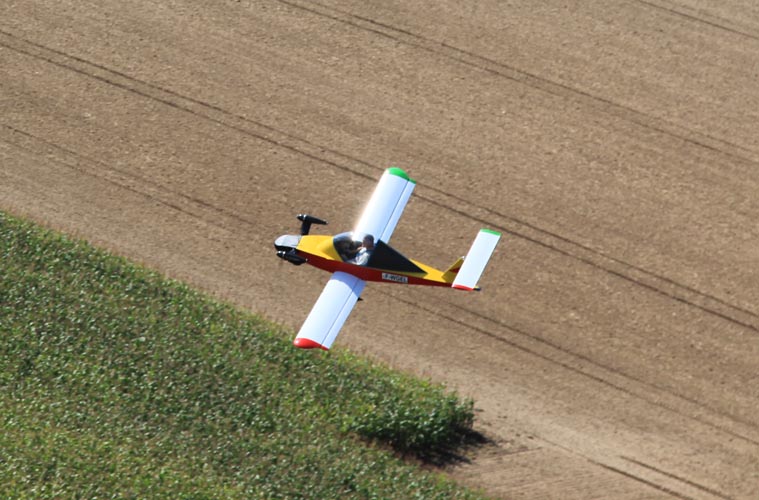
In flight, photographed by Philippe Leynaud, from the helicopter piloted by Daniel Michaud ---
October 2, 2010: Update
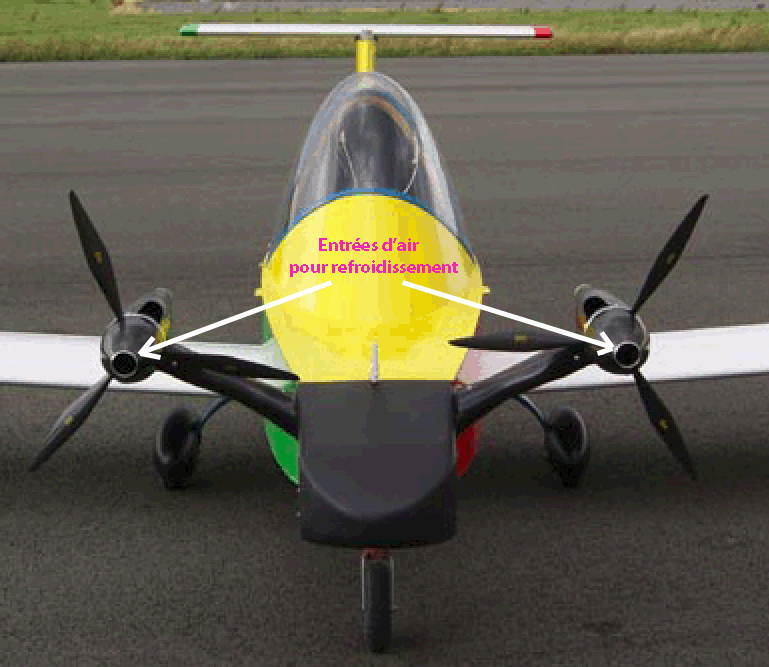
On the photos presented above, one can discern a design flaw, which led Soullier to abandon this formula (see below). The electric propulsion system needs to be strongly cooled. However, in this Cri-Cri formula, the cooling is ensured by two air intakes located on the two propeller cowls, at the front. It only works when the aircraft is moving* and prohibits any fixed point, which is essential for testing the propulsion system before takeoff. *
The Cri Cri dates from the early 1970s. Since then, considerable progress has been made in the field of materials, resulting in improved aerodynamic performance and reduced weight. Carbon fiber has replaced the classic light alloy everywhere. An aircraft that illustrates these advances is, for example, the Quickie.
In 1977 Tom Jewett, Gene Sheehan and the famous Burt Rutan created the Quickie, a single-seat, 5-meter wingspan, 200 km/h, 45 kg per square meter of wing loading. 200 kg of total weight with load. Distance that can be covered at 175 km/h: 950 km. Built in 3000 copies.
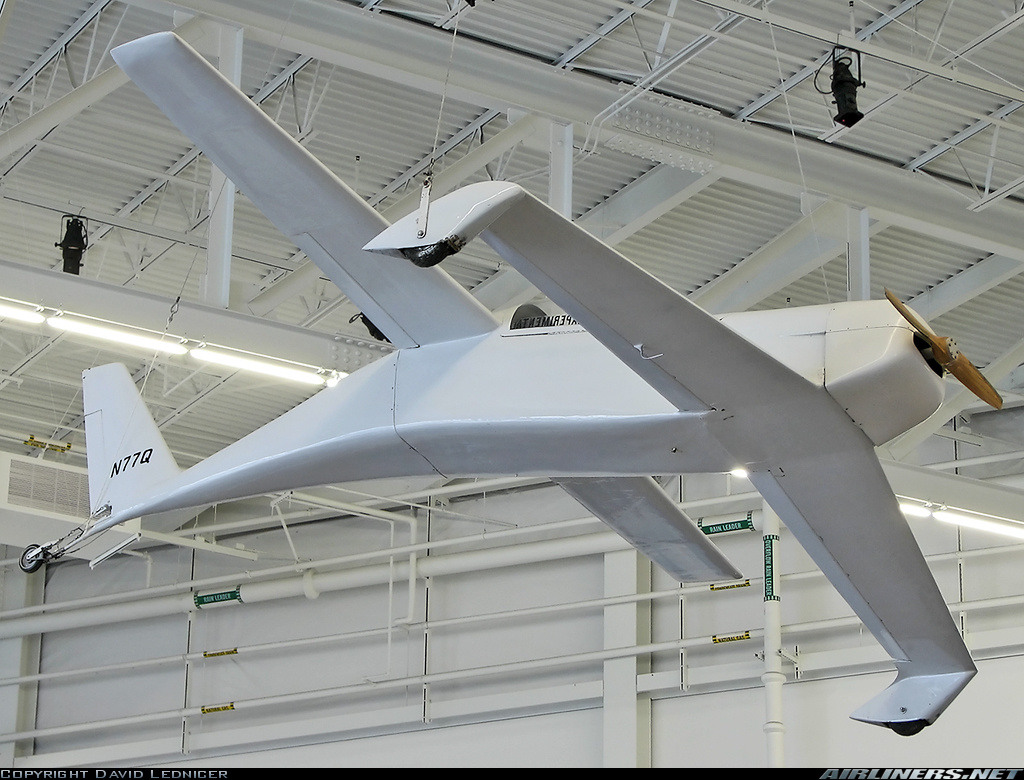
**The Quickie **
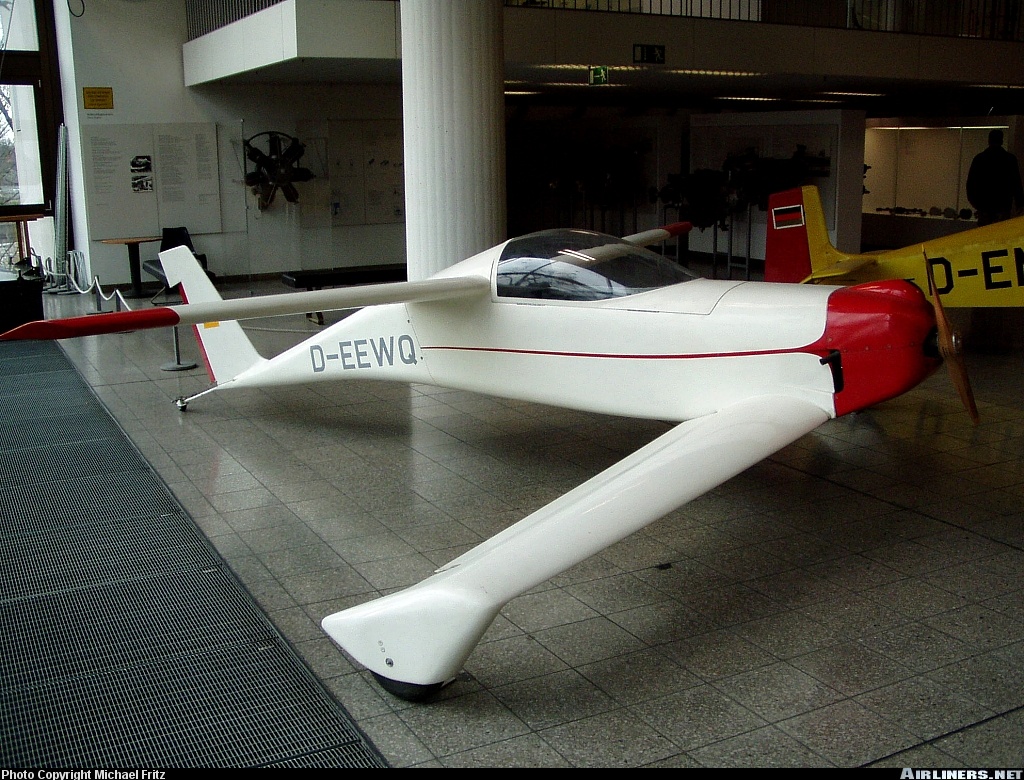
The landing gear, non-retractable, allows minimal drag (no legs of the landing gear) **Maximum ground effect at landing. **
In fact, there are many small single-seat aircraft, using advanced technologies and offering notable performance.
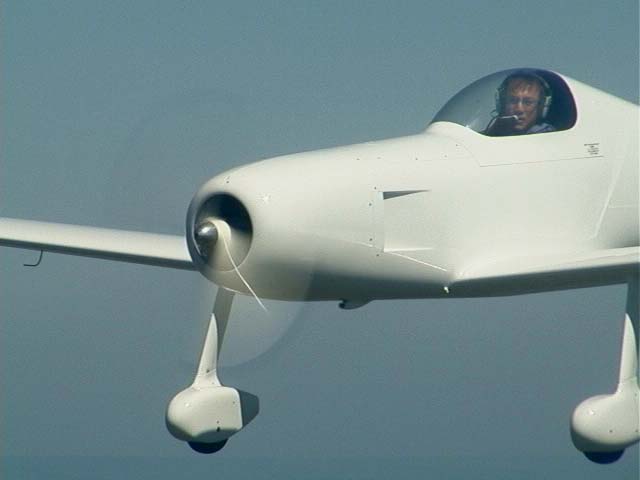
The Arnold AR5, 340 km/h with only 65 horsepower
A French aircraft, also "all carbon", the LH10, a tandem two-seater with a four-blade propeller and a 100-horsepower piston engine, Rotax, air-cooled, has recently been presented. Only the front landing gear is retractable.
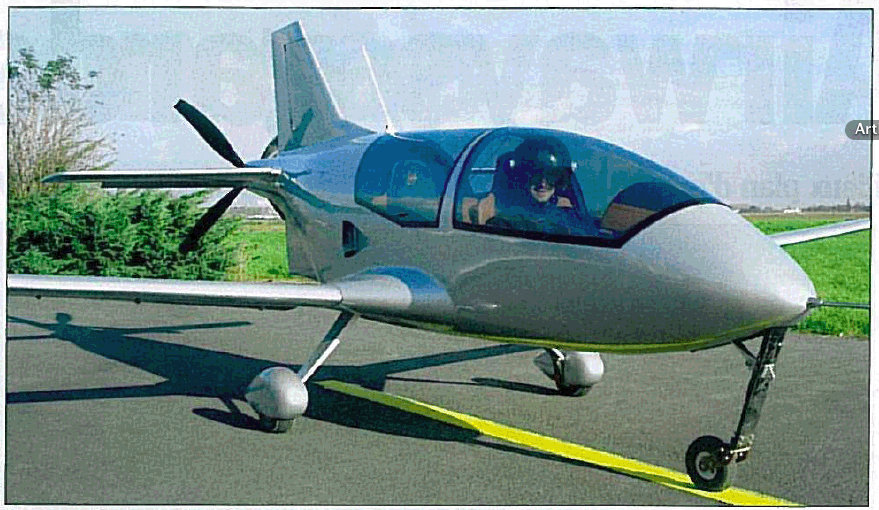
The LH - 10 of LH Aviation. A kit plane at 100,000 euros
Range: 1480 km. Speed: 340 km/h. Only the front landing gear is retractable. ---
The Sunbird project (the sunbird)
It is a ... imaginary project, inspired by the 5-meter wingspan aircraft implemented by Alan Cocconi, which proved capable of flying 48 hours in 2005, flying at night with the energy stored during the day.
By doubling its wingspan and bringing it to 8-10 meters, one could design a similar aircraft, capable of circumnavigating the Earth and even ... flying indefinitely. But instead of being covered with brand logos, flying with dollars, euros, Swiss francs, it would simply be international, funded by anonymous people, and carrying the hopes of Earthlings regarding the use of solar energy. This project would be very affordable. Personally, I had thought of it more than ten years ago. The aircraft could be followed, guided and supported by all the countries it passes through, sending images of the ground, with a small adjustable camera. During its low altitude passes, it could be detected using radar (by placing a radar transponder on board in the form of three orthogonal metal planes), illuminated and filmed. The same applies during the day, during its climbing phases, or at night, when it descends. Commercial airplanes could cross it and passengers could see this Sunbird.
The one most likely to successfully carry out such a project is Alan Cocconi himself, due to his experience. Perhaps he has already thought about it? ---
To conclude this overview, let's mention an extraordinary machine, operating entirely on solar energy, using the most advanced nanotechnology techniques, converting carbon dioxide into free oxygen and carbon, without any pollution, with interesting results on the soil fixation, the synthesis of biodegradable construction materials, climate regulation, nutrition, health, and biodiversity maintenance. Exploiting the extreme possibilities offered by nanotechnology, this machine is also ... self-replicating:
Return to the top of this page, an important article on the electric airplane in general ---
October 2, 2010: Update
The electric airplane represents for Jean-Luc Soullier the realization of a dream that has lasted twenty years. He is far from being an amateur in aviation. A professional pilot, he has flown on all imaginable machines. He has been an instructor, and is currently a pilot on a medium-range B757 for freight transport. He also has considerable experience as a helicopter pilot, seaplane pilot, glacier pilot, and has accumulated 14,000 hours of flight. For decades, he has worked on the recovery and restoration, for museums or clubs, or private individuals, of a variety of flying machines, ranging from antiques elevated to the rank of national heritage, to supersonic Mig 21s recovered from the Czech aviation.
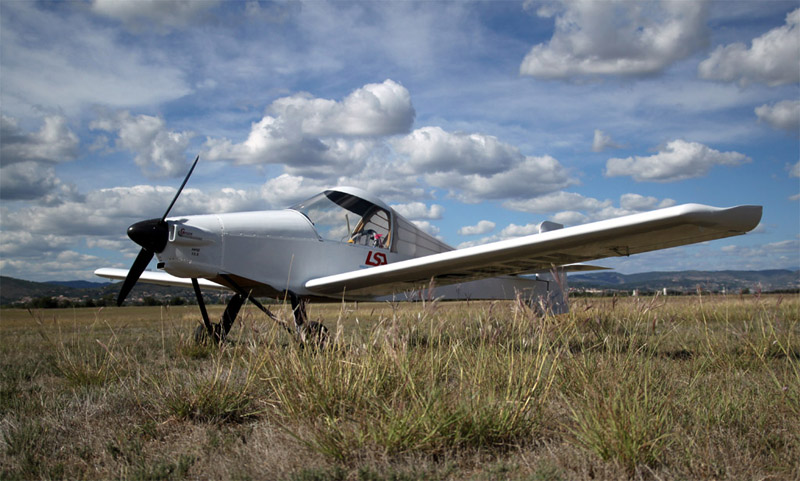
Stubborn as thirty-six mules, not discouraged by the overheating problems encountered with his first propulsion, he now moves to a single-engine.
No, that's not it. I'm mistaken about the image ...
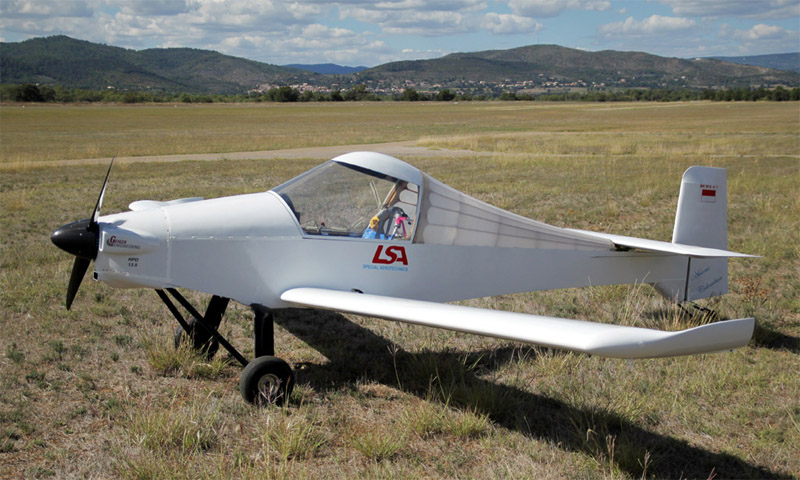
The new baby. You can see the cooling vents on either side of the propeller cowl. Photographed in Vinon
The plane was designed by Michel Colombani, built (fuselage part) by Jacques Labrousse. Engine adaptation by Lean-Luc Soullier
The plane weighs 200 kg max MTOW (maximum takeoff weight)
It is currently the most efficient electrically powered manned aircraft . First postal link project between Monaco and Nice (therefore international )
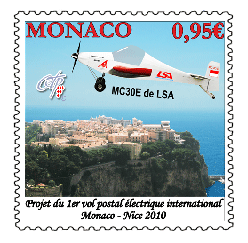
The stamp that was issued for this aero philatelic operation
Waiting for many competitions in 2011, first flight in Vinon, with one hour of flight:
**First takeoff in Vinon, after a good static display. **
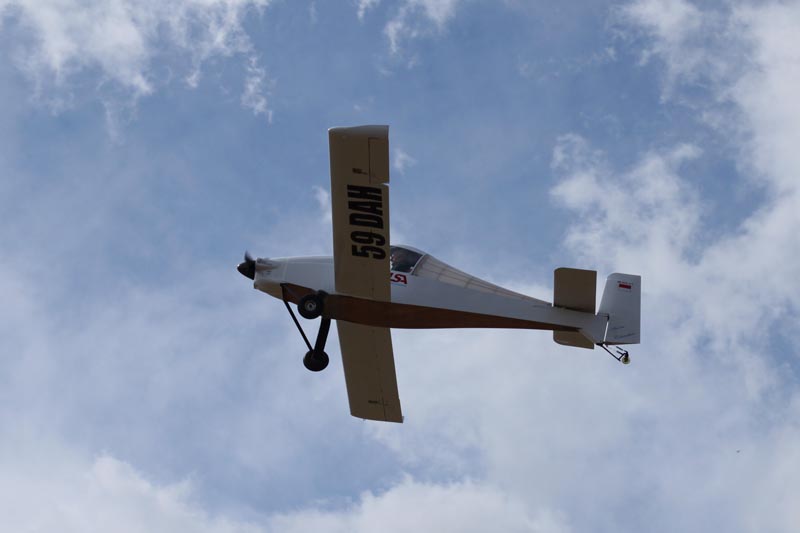
These wonderful crazy fliers, in their strange machines....
To be followed ---