Biography of Jean-Pierre Petit, a scientist
J-P. Petit: Biography
Photo 2004 at the Trevi Fountain in Rome, after giving a lecture on the sphere inversion at the mathematics department of the university
Photo 2005. In flight over Lake Annecy
I don't like biographies where people show the face they had x years ago. The Bogdanoffs make me sad, whom I have known for 25 years. I saw them up close on a TV set two years ago. They have dyed hair, blue contact lenses. If they lose their hair (if it hasn't already happened) tomorrow, it will be a wig. How long can this last? I know them well, for a long time. They are full of debts. Their theses: ten years of all-nighters, working without being paid, without a scholarship, nothing. Of course, they make a lot of nonsense, on all levels. I am well placed to know. They still have in the southwest a castle- a money pit which they could have sold fifteen years ago and at least start over, clear their debts. But their pride opposed it. Living tragically outside of reality, they will die poor, sick, with a smile. All this saddens me, especially since they ruined the only solution that would have permanently pulled them out of the mess: a series of comics with them as characters. The idea came from them and it would have brought us money. But working with "the Bogda" is an impossible thing. I finally gave up three years ago.
I see bloggers, cautiously covered by their pseudonyms and scientists struggling against them, like this little dog Woit ("Not even false", at Dunod) who carefully settles their account in his book. A man without scope who, like many others, like Michael Greene, is for a time brought under the spotlight. Or like Reeves who, surprised, sees himself aging and, after paid lectures, asks for money to be interviewed. In the kingdom of the blind, the one-eyed are kings.
After this parenthesis, here is the face I had in October 2008. The glasses are seen hanging, and the cane is out of frame:
JPP, October 2008
A video of a lecture given in January 2002 by the author at the Science Frontiers festival in Cavaillon, which revolves around the American hypersonic aircraft Aurora and the mysteries of the B2. To access this video, click on:
http://www.01pixel.com:8080/ramgen/petit_sf2003.rm
Interviews of the author, on radio (Marc Ménant's show on Europe 1):
- 1st part: http://ufoweb.free.fr/JPP_1.rm - 2nd part: http://ufoweb.free.fr/JPP_2.rm - 3rd part: http://ufoweb.free.fr/JPP_3.rm - 4th part: http://ufoweb.free.fr/JPP_4.rm
A detail often ignored by Jews themselves, regarding the special status of the members of the tribe of Levi: they accepted to kill three thousand of their brothers, obeying Moses' orders, following the sacrilege of the worship of a zoomorphic idol. After the conquest of the Promised Land, the land of Canaan and the physical elimination of the natives, my Canaanites, the country was divided into eleven territories. Only the tribe of Levi was not assigned any, being entirely devoted to the worship of Yaweh.
End of this biblical parenthesis. At the beginning of the Second World War, in a France occupied by the Nazis, it is not good to bear such a name. If you doubt it, go take a look at this.
More aware than many other French Jews or, Maranes, "Christians bearing Jewish names"; the family of Jean-Pierre Petit decides to falsify his civil status, and for more caution leaves the capital for the seaside resort of La Baule where the young J.P.Petit will spend the whole war, alone with his mother in a family vacation home, in a situation of extreme poverty, but safe from raids like the Vel d'Hiv, which will later be committed by the Vichy French police. To better keep the secret, the family decides to leave him ignorant of his surname. This situation will continue after the war, when he becomes a high school student. The father, mentally ill, is interned just before the war in a psychiatric hospital where he will die.
As a teenager, the young Petit discovers his true identity during a census. Alone among the members of his class to be "omitted," and on the advice of one of his teachers he goes to his birth town hall, Choisy le Roi, near Paris. There, the municipal employee finds no trace of a Jean-Pierre Petit, born on April 5, 1937. His mother then reveals his true identity to him.
Curious, he sets out to discover a paternal family that has completely abandoned him since birth and until his adolescence. This meeting with a paternal family, some of whom are large landowners who are more than well-off, others are ... bigoted Catholics, proves disappointing. In France, the use of this new surname, which does not in any way relate to the rich Jewish culture, is experienced by the teenager as a new handicap, added to the absence of a father and the family's poverty. His stepfather (his mother remarries) offers him his name: de Maison-Celles. A plebeian at heart, Petit finds it hard to bear a name with a particle and, going to the state council, says to the employee who receives him:
- I ask to be called Dupont, or Durand....
The employee laughs and answers him:
*- Listen, you have carried your mother's name until now. We will simply regularize this. *
A year later, the birth certificate of Jean-Pierre Petit will now bear the mention:
Born on April 5, 1937, of Bernard Lévy and Andrée Christine Petit, authorized to bear the name Petit
After this interlude intended to provide clear and precise information in response to certain malicious insinuations of November 2005, let's resume the story.
...Emerging from an old trunk, this photo of a math class at the Lycée Condorcet in Paris. Some names I remember. Boudaille entered Supaéro like me. A great fan of railways, he drove trains with one of his uncles and used to say, "At school, there aren't many people who know as much about locomotives as I do."
At the time when Petit, a teenager, discovered scuba diving in Marseille, he often arrived at the school with his fingers pricked by sea urchin spines, after diving the previous weekend with his friend Roger Poulain, on the wreck of the Drôme, at 60 meters depth, off Marseille, to collect lobsters. The photo below was taken in the late 1950s, in the small port of the Croisettes, near the Goudes, at the extreme east of Marseille. Petit is on the right. With the white "bob", his friend Poudevigne. Summer, and generally as often as possible, Petit leads an adventurous life. At that time, divers and petty criminals with striped shirts, white hats and black ties crossed paths in these remote places, still very little frequented, sites of all kinds of traffic.
...What the uninitiated don't know is that the shallow waters off Marseille, towards the islands, like the majestic Riou, become populated with sharks when the mistral, blowing for more than five days straight, has pushed all the warm water out to sea. Then the cold water from the deeper areas takes its place, bringing with it its entire ecosystem. Then these waters warm up quickly, and, disturbed by this temperature rise, the inhabitants of these benthic waters return to their natural habitat, heading out to sea. Unplanned encounters remain rare, because when the mistral has blown for so many days, the waters are icy, discouraging swimmers, but not professionals, who sometimes have trouble with large animals. In these 1950s, Roger Poulain, "Tarzan" for the Marseillais, had a fin bitten off at 50 meters depth, near the islet of Planier. The shark seized Roger and shook him, to better cut the five centimeters thick rubber of this Cressi fin. The cut is as clean as a razor blade, just above the toes. Philosophical, Poulain comments, upon returning to land:
- Well, he wanted to eat my foot and he only got a piece of chewing-gum....
...Petit captured several sharks during those years, including two strange and rather rare ones, two "fox sharks," very recognizable in the illustrated pages of dictionaries: their caudal fin is as long as their body. These sharks attacked fish caught in nets and, having swallowed their prey, couldn't get out of the net itself. Petit dove and put a noose around the tails of the two animals (the largest was three meters long). The lifting of the animals seemed not to pose a problem, provided one stays at a sufficient distance from the jaws. The teeth of the fox sharks are comparable to those of their Red Sea counterparts, which Petit will meet years later. But with this animal, the danger is the tail, an immense 1.5 meter long blade, comparable to a flat ruler on which a piece of sandpaper has been glued and folded. This whips the air and opens the leg of the fisherman. Stitches.
...Thus, in this corner of the world at the gates of Marseille, whose city dwellers are unaware of its existence (at that time Croisette had neither water nor electricity), fishermen and divers help each other. Thanks to the latter, the former save their precious nets, when for example they get caught in a wreck. In return, the fishermen inform the divers of the depths where, by setting their nets, they have brought up some fragments of amphorae.
...The shark in the attached photo, 4.2 meters long, has another story. The reel that was used to catch it is partially visible on the photo, on the left, behind the old woman climbing the path. It's a ... boat winch. That day, the fishermen reported a new lost one, drifting in the channel, between the Croisette port and the island of Maïre. Petit and his gang collect all the ropes that are lying around, join them to the cable and winch, then cautiously approach the monster, which is barely an arm's length from the entrance of the port, from the back, and quickly put a noose around its tail.
**
After pulling the animal onto the beach, where it struggles, Petit and his team examine it. No, it wasn't a "tiger shark," as initially announced by an overly emotional fisherman, but a simple whale shark, a pilgrim. On the photo above, you can see its huge gills, which make up three-quarters of its head, carrying filter combs. In the region, at that time when the waters were less polluted, divers would cross in the open sea specimens exceeding seven meters in length. As Roger said:
- These creatures aren't dangerous, but they can give you a tail slap, which can ruin you....
Here are two drawings, made in 1960 by the author. The first shows the Croisettes cove, seen from the land. In the distance, the island of Riou. On the highest of its teeth, an shelter had been arranged in antiquity, where wood was burned, brought by slaves, and which served as a lighthouse for the city of Phocaea. A little closer, the island of Maïre. The Croisettes port is separated from it by a channel thirty meters wide. Beyond the island of Maïre, not visible on this drawing, the place where the Liban sank in 1907 (see further on). In the foreground of the drawing, an old man carrying a bucket: the only permanent inhabitant of the port, who saved many lives by helping the shipwrecked. When the city of Marseille asked him what he wished in return for this gesture, he asked that a dock be built, visible at the back and to the left. The "beast" of Roger Poulain, moored. On the right, a cross erected in memory of the tragedy, which claimed two hundred dead.
...To make the second drawing, the author had to cross the channel, his sketchbook between his teeth.
The same character is found, with his bucket. Next to him, the winch that was used to catch the shark. On the pier, Roger's bottles. The places have changed a bit today and this drawing is the only testimony of their state, in the 1960s. At that time there was neither water nor electricity. The pole visible dates from the time when the Germans had installed a battery on the southern slope of the island of Maïre. The man in the hat, washing the dishes at the end of the dock, and the one sunbathing were my diving companions. On the beach, you can see our inflatable boat and our 7.5 HP engine, equipment with which we went to recover the rudder of "the Drôme," which lies in the bay of Marseille, a few miles away, in the open sea, at 52 meters depth.
In the photo below, Roger Poulain, prince of the falls, marquis of the Farillons, reconverted into a learned diving instructor, giving his instructions on board his "pointu" (ten or fifteen years after the shark story).
Looking closely, you can distinguish "Centre de plongée des Amis de Îles". It was... a long time ago. Three hundred meters out to sea, the wreck of the Liban, a Corsican courier that had sunk there, at 37 meters depth, after colliding with "L'Insulaire," in 1907.
Below, the sinking of the Liban, excerpt from the magazine "L'Illustration"
1907: The Liban sinks bow-first a few tens of meters from the island of Maïre, near the Marseille coast
It has changed quite a bit. Its plates have slightly collapsed. Forty-five years ago, one could still enter its holds, one could look through its portholes, at least those that Roger and his gang had not taken.
At the time of the shark, in 1958, Petit worked as a cabin boy on a beautiful old wooden yacht, the "Milos". Captain: Louis de Fouquières. Class, kindness, generosity and humor.
http://www.lesportesdescalanques.fr/page5a.php#requin
July 5, 2007
I received a friendly message from the webmaster of the site "Aux portes des Calanques". Click on this link:
You will hear especially the cries of the "gabians". This is how they call the gulls in the region.
July 5, 2007
I received a friendly message from the webmaster of the site "Aux portes des Calanques". Click on this link:
You will hear especially the cries of the "gabians". This is how they call the gulls in the region.
When I was at Supaéro, we worked in "binômes", in pairs. We did these three years together, Jean-Pierre Frouard, from Barbezieux (on the left), called "the bearded one" and me. He died of cancer in 1987. Michel Serfati, also a student of our class, had a friend who took photos for magazines. The magazine Constellation, for which he worked, had bought an article on the looting of Etruscan tombs and Italy. But they wanted to sell the photos a bit too expensive for their taste. So we took this photo in the catacombs of Paris, which we knew like the back of our hand. The tools and the lamp are authentic. But the head of the statue and the Tanagra figurine are in plaster. The pottery in the background are borrowed props from a theater.
Sometimes I
An summer, Petit arrives on the island of Riou, off Marseille, using a tiny inflatable boat, with his damned companion Jean-Claude Mitteau, accomplice of all his adventures. They have their equipment on board. The goal of this expedition is to try to locate a wreck of amphorae, which they have approximate coordinates. But the island is no longer deserted. The couple Lecomte, Jean and Lulu, are camping there. They make the introductions. Jean is a climber and then takes the two divers, forty years old together, to do "the tours of Riou", a splendid climb on a cliff overlooking the sea, on the open sea side. They have no shoes but enough horn on their feet to do without them. It will be the beginning of a friendship that has lasted for half a century, which will take them to the cliffs of the Belgian Ardennes, then to the Chamonix massif.
Top: Jean Lecomte, on the Chaleux crag, in the Belgian Ardennes. Second Jean-Pierre Petit, twenty years old
- In Paris, Petit and his friends climb monuments at night. In winter, the spire of Notre Dame (which, by the way, entirely made by Violet-Leduc, is made of wood) replaces the needles of Chamonix. Below, Notre Dame by the south route.
Notre Dame de Paris, south route. Drawing by Jean-Pierre Petit
It would be unreasonable to attack this route without equipment, rope, carabiners. The first length does not pose any difficulty. Jean-Louis Philoche claims that the overhang that gives access to the roof is in five sup. But, considering current standards, it may be a bit overpriced. The spire is made of wood. When doing a B reversal in the spire's castle, be careful of the wires that operate the bell. Not dangerous, but if you get caught in them, hello to the noise. I did the last length, along the spire, on the south face. The gargoyles are made of wood. When arriving at the spire, in C, I was surprised to discover that on the north side there were ladder rungs. At the top, we hung a woman's undergarment, the largest size we found. Then we called the local police station in the early morning, asking if it was normal that the archbishop's maid was drying her clothes up there.
With Jean-Claude and Philoche, many climbs over the years, on various constructions. One summer: on the bell tower of the church of Saint Tropez, recently renovated by the priest, who had entirely replastered a masterpiece of the 17th century, sculpted by the sea wind, into a "newly renovated" building. The height of refinement, he had installed spotlights illuminating the bell tower in green. The group climbed up the bell tower by climbing the lightning rod cable. Then they painted on the bell tower:
**
The bell tower with chlorophyll, soon the host in the big Marnier**
The act of impiety caused the village to erupt and we had to run away quickly. The gendarmes of Saint Tropez would quickly repaint the inscription, which would slowly reappear over the years. Some readers must remember having seen it.
...Medicine tries J.P.Petit but his lack of memory of data blocks this path. He writes well, but his spelling is catastrophic, having as much trouble with the agreement of participles as with the atomic masses of chemical elements. ...He ends up in higher mathematics, in "maths sup", in a "preparatory class" at the Lycée Condorcet. In chemistry, students have mnemonic means to integrate the elements of the Mendeleev table. For example, the classic sentence:
Napoléon Mangeait Allègrement Six Poulets Sans Claquer.
Na: sodium Mg: magnesium Al: aluminum Si: silicon P: phosphorus S: sulfur Cl: chlorine
Petit completes with his own. For example:
The Foetus, Complètement Nivelé in the Cuisses of Zoé, se GarGarisait, Assez Sérieusement emBourbé in the Krème.
Fe: iron Co: cobalt Ni: nickel Cu: copper Z(n): zinc Ga: gallium G(e): germanium As: arsenic Br: bromine Kr: krypton.
...For three years, he struggles like a madman, is last at the first math exam, because those bore him. However, he excels in descriptive geometry, where he is able to draw the intersection of two surfaces, immediately after the teacher has finished formulating the problem statement. His "3D" vision, linked to his drawing skills, is exceptional, while at that time these drawing exams were the nightmare of students in preparatory classes.
...Moreover, he is too scattered, interested in too many things, externally at the Lycée. His distraction is already legendary. One day, the alarm clock rings, at 7 o'clock. Quickly, he prepares his things, jumps into the metro from the Pereire square, goes to his school on the Rue du Havre. It is empty. I am early, he says. And he starts, on a blackboard, to review some exercise. At eight o'clock, the school is still empty. Petit is puzzled and the concierge, worried, arrives. In fact, it is not eight o'clock, but twenty o'clock. He has made a mistake of twelve hours and went to the school at the time when people come back from work. He has no choice but to go back the other way.
He enters Supaéro last.
...At that time, entering a Grand Ecole is the sign of an explosive decompression, for students. The years of maths sup and maths spé, with their ink-stained lab coats, their sad "thurnes", fly apart.
...Petit skims over the subjects of the program for three years, but deepens those that interest him, including fluid mechanics. He acquires knowledge in this field that go well beyond those of the program, by frequenting the library. With schoolmates, he directs "the high commission for pranks and tricks", which will leave the school traumatized for many years.
...At the time Supaéro occupies three floors in a large concrete building. Petit notices that the second and third floors are identical. Only the signs above the doors differ. At the windows, in the corridors, frosted glass up to half height, are there to encourage students to focus on their studies. It is enough to change the plastic letters that are stuck in the slots of a velvety brown board on these signs, to change the appearance of the second floor into that of the third floor, and vice versa.
...At night, he and his classmates tinker with the student elevator and the professor elevator. When you press the button for the second, you arrive at the third, and vice versa. ...The next day, the teaching staff and the secretariat are in shock, especially since some, using their keys, have managed to enter the rooms. It is the invisible camera, twenty years earlier. Some are so disturbed that they refuse the explanations of the inspection officer:
- It's the students who have swapped the second and third floors.....
and go home. ...Petit and his gang buy a trout, which they place, at night, in the famous red poison pool of the École Normale Supérieure de Paris, the "Ernests". The trout devours it. They then write to Normale Sup:
*- Thank you for taking our trout in boarding, but we would like to get it back. *
But the normaliens eat the trout and buy red fish. ...At Supéro, Petit, whose attention had always been stimulated outside of his program subjects, discovers that there is another activity, much more exciting than study: research. Thanks to the support of his technology teacher, who has models made in his workshops, he sets up a fluid mechanics laboratory in the basement, discovers the inversion of the ground effect (later renamed and patented by the company Bertin under the name "Fix-Tromp"). 'rriv is
July 5, 2007
I received a friendly message from the webmaster of the site "Aux portes des Calanques". Click on this link:
You will hear especially the cries of the "gabians". This is how they call the gulls in the region.
| (See on this subject his comic strip
| "Si on Volait?"). He meets the Romanian Coanda, inventor of a jet airplane presented at the salon of ... 1909, below: |
|---|
The Coanda airplane, equipped with a jet engine, at the Paris Aviation Salon, in 1910
Supported, from the start, by solid theoretical knowledge, he calculates and experiments with the first supersonic disk nozzle.
He studies the paradoxical aspects of thin hypersonic air jets ejected under high pressure, tangentially to a smooth wall like a mirror, through slots of a few tenths of a millimeter in thickness.
His professors do not encourage him. They are annoyed because they do not know how to interpret his experimental results. The fluid mechanics professor is amazed when Petit, with a mercury manometer, shows him that he actually creates, in his seven-centimeter diameter disk nozzle, which emits only a quiet hiss, a circular, stationary shock wave, of a few tenths of a millimeter in height.
Using hydraulic analogy, which is taught at school by Professor Malavard, he explains that it is the same as in a sink.
**
He is called by the director, the meticulous General de Valroger, who tells him:
- You are not here to do research. If you insist, you will neglect the other subjects of the program and we will be forced to make you repeat the year.
Meanwhile, below, another photo from the time, quite amusing, witness to an eclecticism in activities:
The school ends. Petit ignores the circuits that will later lead him to research. Too absorbed by his ideas, he does not know what a publication is, nor what the writing of a doctoral thesis consists of. The concept of thesis direction is obviously foreign to him.
He manages to get an invitation to spend a year at the James Forrestal Center in Princeton, directed at that time by Professor Bogdanoff (nothing to do with the two twins of the same name). The trip there is made on the old English steamship Mauretania, older than the Titanic (one of the actors mentions this steamer in one of the first lines of the film).
More about this cruise on the Mauretania
The Mauretania, from the British Cunard Line, measuring nearly three hundred meters long, was launched in 1907. Sistership of the Lusitania, which was sunk by a German submarine during the 1914-18 war, which led to the entry of the Americans into the conflict. First ship equipped with steam turbines, and reaching 51 km/h, it thus won the "Blue Ribbon", which it kept until 1929.
When Petit arrives at the laboratory, everyone has gone to lunch. Deliberately ignoring the "restricted area, authorized persons only" signs, Petit explores the halls, one after the other.
At that time, this Princeton laboratory was trying to solve the mystery of flying saucers, the Americans still considering them to be secret Soviet devices. A machine nine meters in diameter was therefore built, driven by a central "turbopropeller". This was used to compress air under two atmospheres, which was then directed towards an annular skirt and ejected through a circular slot:
The Americans hoped to thus suck in the air that was on top of the device and create a depression, thus ensuring its lift and propulsion.
Petit inspects the machine from all sides, gets inside. Then, Bogdanoff having returned from his lunch, he explains to him that it cannot work and what will happen when it is tested, that the air cushion on which it will operate will be terribly unstable.
Bogdanoff chokes. These are researches conducted under contract with the Air Force, ultra-secret. Petit laughs, but is immediately asked to pack his bags. One does not joke with defense confidentiality. He ends up in a soup in the streets of New York, where he earns his living and his return ticket by selling his drawings to passersby. Return, always by boat, on the "Liberty", which is making its last voyage, having been bought by the Japanese, who want to make it a floating hotel. In 1961, charters had not yet been invented.
The powerful ship heads towards Le Havre, in a storm, in November. The wind is three-quarters astern. At the moment when Petit takes the fresh air on the stern deck, the boat resonates with the swell, whose crest-to-crest distance is slightly greater than its own. The roll increases rapidly and reaches, according to the recorder, thirty-eight degrees. At forty-five, the boat would capsize. The captain prefers to head back to.. Newfoundland, facing the swell, waiting for the storm to calm down.
The incident caused two deaths: a passenger broke her skull falling from her bunk onto her sink and a steward, who did not have the presence of mind to drop the tray he was carrying, smashed his head at the end of a corridor, a victim of his professional conscience.
Petit cancels his reprieve and performs his military service as a second lieutenant (at that time, Supaéro students benefited from military training during their school years). He is presumably destined to be a fighter pilot, in Algeria, on a monoplane T6. But, discovering through the testimonies of former students the horror of this war, he abandons the chase for the transmissions and the code.
Assigned to Fribourg, in Germany, upon his arrival, he requests the colonel commanding the air base.
-
My colonel, I am assigned to the coding of documents. But I have just learned that the captain commanding the military flying section (stationed on the base) has just been transferred. Now, I come from the École Supérieure de l'Aéronautique and I have my glider licenses.
-
Humm, replies the colonel, a glider enthusiast, if I understand correctly, I have the choice between acquiring a good director of our military glider center or an excremental code officer.
He chose the first solution.
His misadventure at Princeton diverted Petit for a few years from research. Freed from his military duties, he then divided his time between scuba diving, lithography, mountain climbing, blacksmithing, and delayed-opening parachute jumping.
But the fashion for engraving and lithography had passed. Petit then went down to the south, which he had grown fond of, and was hired at a rocket test center (the "Société d'Etude de la Propulsion par Réaction", then SEPR, later becoming the SEP).
The photo below has a story. The rockets are tested on thrust stands. The one that Petit rides is of moderate size. You can see that it is placed on a heavy cart, which in turn rests on rails, not visible. In the far background, the rocket pushes against a dynamometer. During the few tens of seconds of the firing, the device is observed through a periscope from an underground bunker located a few tens of meters away. Petit was in charge of testing this type of solid propellant engine. As sometimes the powder block cracks and the resulting ignition increases the combustion pressure, a "chapel" was placed at the front of the cylindrical casing of the propellant. It is not visible in this photo. Let's say it is a device consisting of a diaphragm of a certain cross-section, located in the axis of the device, and which is supposed to pop when the pressure becomes too high.
During the test, the block indeed cracks. The pressure immediately rises and the diaphragm releases. This gas leak is supposed to lower the pressure to the point of extinguishing the propellant. This was what the calculations carried out by the designers of the rocket that Petit was in charge of testing indicated. However, not only does the propellant not extinguish, but the jet of gas escaping from the "chapel" after the diaphragm is ejected, proves to provide a counter-thrust greater than that of the rocket itself, whose divergent is visible in the foreground.
The rocket, mounted on wheels, then leaves its test stand and crosses the entire research center, spewing two jets of high-temperature gas, several tens of meters long, one through the normal nozzle and the other through ... the front. Fixing his eye to the periscope's eyepiece, Petit sees this strange vehicle pass, which will end its course a few hundred meters away, after having vaporized the fence of the enclosure.
If you look at this photograph carefully, you will distinguish two strong clamps equipped with thick screws, which, gripping the axles of the rear wheels, firmly press them against the support rail. A device to prevent this "rocket-walker" phenomenon.
But Petit soon gets bored in this test center. When, after a few months, his direction plans to assign him to the development of the MSBS, the nuclear missile intended to be fired from submarines, he resigns to join the CNRS, in a fluid mechanics laboratory in Marseille.
Research in MHD (magnetohydrodynamics) was then in full swing in the world. See the MHD section of the site, which is already integrated or in the process of being written.
These generators, which later became the pivot of the "Star Wars" war, on the Russian side and later the American side, offer phenomenal power-to-volume ratios. An MHD nozzle as big as a can of beer can develop several megawatts. See the operating principle and details in the section of the site dedicated to this subject.
Industry is interested in efficiency: theoretically up to 60%, compared to 40% for conventional thermal power plants. However, the operation involves passing strong electric currents through gases, which are initially poor conductors of electricity. The machine built in Marseille does produce two megawatts, but only for a ten-thousandth of a second. Fortunately, because the gas jet passing through the nozzle, heated and expelled by an explosive, is at ten thousand degrees. Nevertheless, the experiment, imagined by a Swiss resident in the USA, Bert Zauderer, is clever. Everything is so brief that nothing has time to heat up. The electrodes are made of red copper and the nozzle is made of plexiglass.
If we except the American lab and the one in Marseille, in other centers where the experiments are less fleeting, the researchers drown in technological problems. Their electrodes are made of zirconium oxides and the walls of the nozzles are lined with expensive and sophisticated refractory materials.
Technically, an MHD generator intended for industry is supposed to function properly only when its gas is at the temperature of a tungsten filament: 2500°C.
The researchers then think about operating their gas with "two temperatures instead of one". This is what happens in a simple neon tube. The neon itself remains at a relatively low temperature, so that you can touch the glass with your hand. However, the "free electron gas" is at several thousand degrees.
Many teams then throw themselves into this adventure. In France, the CEA builds the expensive Typhée generator, at a cost of billions, in a lab as big as a hangar. Conversely, the Marseille generator fits in a corridor.
But very quickly, things go wrong everywhere. A young Soviet, Vélikhov, who will become vice-president of the Academy of Sciences and right-hand man of Gorbachev, predicts the ultra-fast birth of an instability, of a turbulence of the electron gas, which will bear his name.
The concept is sophisticated. People do not understand the phenomenon well, especially the CEA engineers. This one, which develops in a millionth of a second, and does not allow time to produce a watt, has the effect of transforming the ionized gas passing through the generator into a kind of mille-feuille, with alternating layers rich and poor in free electrons. The efficiency collapses. Everywhere, there is consternation.
The CEA then turns to the "simulator" of the small Marseille lab and grants a small contract. The director jumps on it, but before Petit arrives, not only does no one have the slightest idea of what to do, but none of the researchers understand what this mysterious "Vélikhov instability" is.
Petit dives into calculations. Within a few months he assimilates the knowledge of the time, designs an experiment, which works on the first try. Until now, the gas jet had to be at ten thousand degrees. This gas temperature was lowered to six thousand, then to four thousand degrees, in a morning. But the temperature of the electron gas is maintained.
Petit has found a "trick" to bypass the Vélikhov instability, to get ahead of it, an idea that will not be rediscovered by a Japanese person for fifteen years. See the details in the section of the site devoted to MHD.
His colleagues, Bernard Fontaine and Georges Inglesakis, are skeptical. During the first experiment, they set the recorders to capture dozens of amperes, but the oscilloscope spots go wild. At the time when digital data recording on computers did not exist, they photographed the oscilloscope screens with polaroid cameras. All the recorders had to be enclosed in Faraday cages, and the laboratory looked like a chicken coop.
Four people participated in the adventure. The fourth person is a young student, Jean-Paul Caressa. But this one, who had just been integrated into the team, was content to participate in the operations as a simple spectator.
Petit insists. They reduce the sensitivity and record eight thousand amperes.
-
It's not possible, Inglesakis exclaims in disbelief, at such a temperature this gas mixture is as conductive as cardboard!
-
We will add two percent of carbon dioxide, which will cool the electron gas, bring its temperature to a value close to that of the gas, says Petit, and there will be nothing. It will be a clear proof that we are indeed in "bi-temperature".
-
How do you know that?
-
I calculated it...
Caressa didn't understand much, but he had a lot of fun. By the end of the day, everything was "in the box". But in the months that followed, the atmosphere in the laboratory deteriorated rapidly. The dreams of an industrial application of the process (which is actually impossible, but only Petit knows), unleashed passions and ambitions. Valensi, now deceased, then director of the laboratory, decided to take over the operations from Petit and entrust the management of this research contract to the obedient Bernard Fontaine. Unfortunately, this one, during a wrong maneuver, accidentally destroyed a key element of the complex machine imagined by Petit.
Petit decides to stay at the CNRS, but to abandon experimental research, thus leaving this Marseille fluid mechanics laboratory. He invests more and more in pure theory, learns the kinetic theory of gases, astrophysics, and finally settles at the Marseille Observatory in 1974. He works there for a while with his director, Guy Monnet, who later went on to direct the Lyon Observatory.
The great beneficiary of his departure is his student, Jean-Paul Caressa, who finds there the material to write a doctoral thesis, which will earn him the Worthington Prize, marking the start of a quiet but successful career in the CNRS administration (until recent years he was the director of the CNRS regional office for the entire PACA region).
Between 1975 and 1987 is a phase of Petit's professional life, which he considers sufficiently described in the books he has published, and which ends with him discovering that the state interest also exists in science. At the end of the 1980s, he raises his thumbs and requalifies in theoretical cosmology, and in the mid-1990s in mathematics.
In 1965 he published, in the journal Spirou, The Voyage of Maxiflon and the Secret of Maelstrom, two comics, intended to round out his months. In 1979 he published the first three books of the series of Anselme Lanturlu Adventures, published by Belin.
In these 1970s years is another "Comic Strip" episode, but this time in the newspaper L'Express, where Petit will publish four double pages (the gain of the operation will allow him to buy his first new car: a beautiful green 2C). Below, one of the episodes featuring the mathematician André Lichnérowicz, who publishes Petit's work at the Paris Academy of Sciences and ... Pierre Messmer, former minister of the army, apparently prime minister at the time.

The comic is signed "Mylos", a pseudonym of Petit at the time (which was also the name of the yacht of his friend Louis de Fouquières, father-in-law of Jean-Jacques Servan-Schreiber, founder of the newspaper, alias ("JJSS").
The story is accompanied by a rather tasty anecdote. It was at the request of the latter that Petit had composed these panels. At the time, Messmer was giving a speech at the Assembly, in a night session. At one point the politician had a lull, didn't know where he was. An awkward silence settled and Servan-Schreiber, then a deputy, said:
- It is compact ......
Laughter in the chamber, many people having devoured these pages devoted to the former minister of war in the previous days.
At the time when he was writing his doctoral thesis, Petit began to look for some additional income. The comic, which he had never practiced, seemed to be in his line. He joined a half-dozen Spirou albums, analyzed how they were constructed, then wrote a comic strip, which was published (under the pseudonym of Lartie Shaw) in this journal in 1965, in half-page, unfortunately, which would prevent any conversion into an album. For more than thirty years, he had not been able to find a complete copy of this work, lost for a long time during multiple moves. An announcement, placed on the site in July 2001, provoked the reaction of a Canadian fan, who owns a bound copy of the album "The Voyage of Maxiflon" and offers it to him. Here is a page:
An album that, once scanned, will join the comics available in the CD he distributes.
Among the episodes of Petit's life, here is one, singular. In 1979 colleagues sent him a candidacy file for a ... cosmonaut position at his home in Aix. It was the quest launched by the Cnes, which would end with the recruitment of two candidates, military: Jean-Loup Chrétien, who will fly on Mir, and his replacement Patrick Baudry, who will fly on the American shuttle. No one really expects the choice that the authorities will make, but Petit follows through, for the principle. This act of application will earn him the following message:
. ..
Following this message, he is encouraged to take a "personal navigator" visit with the first accredited doctor. Petit complies and goes to the practitioner. Dialogue:
-
So, you intend to fly on what? An airplane?
-
No.
-
A glider?
-
Hmm. Do you do parachute jumping?
-
No.
-
A hot air balloon? A balloon? A gyrocopter?
Surprised, the doctor:
- Listen, sir. I've exhausted the list of all flying machines I know. You made an appointment for a "PN" visit. What exactly do you intend to fly on?
. ..
Petit hands him the fax he received from Toulouse and the doctor responds, moved:
- Oh... you're my first ...
This photo must date from this time:
1975
Victim
of a work accident in 1976, he will direct from 77 to 83 the microcomputer center he created at the Faculty of Letters in Aix in Provence. He will create, in the process, the first CAD program running on a micro: Pangraphe.
Below, an animation made with this software, representing the central model of the cube inversion
In twenty years, Petit publishes thirty books, some of which have been translated into seven languages (in 2011: 34 languages, thanks to the association he creates later:
But, in France, his position as a ring-walker causes some difficulties. His research on twin universes worries, because, in the end, they could make interstellar travel possible. As for those carried out on disc-shaped aircraft capable of maneuvering in dense air at supersonic speed (B.Lebrun's thesis in 87), don't even mention it.
In the Méridional, 1991, after the release of the book on Ummo
I had my bow (42 pounds) stolen years ago, in my car
I'm looking for a similar one. Modern compound bows are too ugly
In 98 he realizes that his astrophysics and theoretical cosmology research, based on group theory, have become too sophisticated to be understood by those who are supposed to be the specialists of these disciplines. Conversely, he gains increasing success among mathematicians and geometers.
In 96 the Belin editions sold 250 copies for each title of his "Anselme Lanturlu Adventures" collection. 140 in 97. Moreover, the publishing house, which increases prices as sales decrease, refused four albums: Le Logotron, Joyeuse Apocalypse, Opération Hermès and the Chronologicon. Petit, who holds the rights to the digital edition of his works (cd), decides to produce his albums himself.
The press ignores his books, in general. "We have lost half the Universe", a popular presentation of his cosmology and astrophysics work, will sell five thousand copies, thanks to a fan readership, despite a near total press silence, except for a sharp critique, published in Pour la Science in its July 98 issue, under the pen of a simple technician, at the instigation of Hervé This, editor-in-chief. Petit requests a right of reply, to denounce the incompetence of the critic, in vain.
He had, in 1977, caught the train of microcomputing. In June 98 he opens his website and collects 30,000 visits in two years, from 86 countries.
In 99 he decides to get back into delayed-opening parachute jumping, after thirty-eight years of interruption. It's good, they say, for unclogging arteries. The return poses some problems. Petit no longer recognizes anything.
- They put the belly in the back.....
The opening handle has also changed place (for a long time). Instead of being on the left chest, it is on the right hip. The club members are quite worried. Petit's distraction is legendary (except, in fact, when he is occupied with something that really interests him). After performing the required number of jumps in "automatic" mode, he makes his first jump in "commanded" mode.
Some years earlier:
You will find in the following site a partial biographical evocation, not written by the author, but containing quite a few things, unfortunately perfectly authentic.
http://www.rr0.org/PetitJeanPierre.html
With Daniel Michau, in Belgium
.....................................................
Courage, let's flee!
**When you start, **
**you immediately have against you **
Those who do the same thing
Those who do the opposite
those who do nothing
Egypt, May 2006. Dashour: the rhomboidal pyramid
At that time, I was an Egyptologist. Let's say I had found some things, related to the construction of the Great Pyramids. It has been lingering on my site, as well as other pages, on the ships of the Old Kingdom. I removed everything because as soon as I can, I will make a book or books out of it. As long as I'm doing it....
I worked on these questions for a year or two, part-time. It was quite interesting. I even integrated a piece of basalt found near the pyramid of Queen Khent Kawoues, at Giza, to make a machine that would pull blocks of forty tons on stone ramps.
Some had thought they saw in this object a sort of pseudo-pulley. I saw a piece intended to be embedded in a wooden frame, to allow the work, in wear, of three ropes, bearing on grooves carved in the basalt. The conical base was then part of the wood, while the hole ensured its anchoring.
They even reconstructed at the Palais de la Découverte, during an exhibition devoted to the pyramids, a reduced model of this device, which was displayed, and allowed ten-year-old children to lift a block of 250 kilograms on an inclined plane.
Machine ensuring the ramp mounting of 60-ton blocks
The animation ( 110 megabytes ! )/VIDEOS/montage_pyramides_JP_PETIT.mov
I gave a lecture there, in 2007, I think. At one point, a certified Egyptologist, a certain Adam, said to me "you have used a modern application of the lever."
There, I was stunned. Adam must think that the nutcracker was invented in the eighteenth century, or something like that.
Months before, I had failed in trying to publish my theory at the BIFAO, the Bulletin of the French Institute of Oriental Archaeology, where all French Egyptologists publish. I didn't even get a response. After my lecture at the Palais, I gave up Egyptology.
In fact, I have given up a lot of things in my life, and I realize with hindsight that I was right. I often think of Jacques Benveniste. We were very close for many years.
Excerpt from this page dedicated to Jacques
I knew everything that followed his first experiments on high dilutions. Before, Jacques was very well regarded, very connected in many circles. Working at the INSERM 200 in Clamart (the INSERM is the medicine branch of the CNRS), he was on a first-name basis with Lazare, the general director of the INSERM, whom he considered a friend (but who later relegated him to Algeco barracks in the courtyard of his former lab). Having discovered some sort of nonsense in biology, immunology, the "PAF", I believe, it was even said that he was Nobel-worthy.
Then there was this violent conflict with the journal Nature, then edited by a certain Maddox. Jacques was subjected to a descent by an American team, accompanied by the illusion specialist Randi. The cabal against him grew. Many called him a fraud, a forger. A journalist invented the expression "memory of water", which spread around the world.
Jacques stood his ground, like a fighter. I attended face-to-face meetings where he defeated his adversaries with brilliance.
I heard phrases that surprised me, like that of a CNRS chemist:
*- I don't know why water is liquid at normal temperature, and it doesn't prevent me from sleeping. *
Unfortunately, the experiments were capricious. Now they speak of "nanostructures" organizing water in the liquid state. So there would not be "water", but "waters". I also remember that this alleged memory, linked to the presence of an effector, eliminated by an incalculable number of dilutions, disappeared when this same water was heated to 70°.
And here we are, a year ago, I illustrate the book of my friend Christophe Tardy, an Arts et Métiers engineer, battling with hydrocarbon consumption reduction systems by adding water.
../nouv_f/hypnow/bouquin.htm
The book of Christophe Tardy by David Dieule
Very quickly, ten years ago, I thought that this reduction in consumption and pollution could be due to the electrocatalytic action of water molecules, electrified by friction, during their passage between two concentric cylindrical walls, when it is in the form of fog, emerging from the "bulleur".
In the manuscript of his book, Christophe mentioned a moment of despair when, having sold identical kits to two customers, who adapted them on the same tractor, one wrote to him "I bless you. From the first tests I made thirty percent savings", and the other "you're just a fraud, refund me!"
I said to myself: between these two experiments, what is the difference?
The water used.
And Christophe confirmed: when you heat the water above 70°, no fuel savings, nothing works.
I nagged him for two years to set up a simple experiment. Using the tap water from his lab and a generator, he had so much fuel savings with his bulleur system. It was simple to do a control experiment by taking the same device, the same generator, the same fuel and the same water. But in this second test, the water would be heated using a resistor until boiling, that is, above 70°.
Unfortunately, he never found the time to do this experiment, which remains pending.
Today the Nobel Prize winner Montagnier elevates Benveniste to the pinnacle, says he is convinced that the name of the latter will be inscribed in the history of science. Things are starting to move. But as I read one day in a book that evoked the sad fate of innovators:
*- Finally, the last ally arrives, who supports the innovator, like winter in the Russian countryside: death, which allows him to win, posthumously, the laurels of fame. *
Yes, a dead person doesn't ask for anything. In fact, what we don't know is the fate of known scientists. One can name hundreds. The thing is so common that very few inventors benefit from their inventions during their lifetime. Let's mention some of the most well-known, who had these tragic fates. Philippe-Ignace ****Semmelweis (1818-1865) who, in Budapest, discovered, without being able to identify the mechanism (bacterial infection), the benefits of prophylaxis. ****
Semmelweis ( 1818-1865)
After suffering so many setbacks and injustice, his mind broke.
Jacques Boucher de Perthes (1788-1868), following many predecessors (J.F.Esper, 1774, John Frere, 1799, Ami Boue,1823, Crachay, same year, Breuner, Tournal, de Christi, 1823, Schemerling, 1829, Joly, Mac Enery, 1832) fought twenty years to make accepted the idea that prehistoric men could have existed, men who would have lived, in the biological strata where their bones or tools were found, at antidiluvian times. ****
Jacques Boucher de Perthes (1788-1868)
Many of these men left no trace. Many died in poverty, or committed suicide. ****Frédéric Sauvage (1786-1857), inventor of ... the propeller, exhausted himself, ruined. Having thoroughly demonstrated the effectiveness of his invention, he received the following opinion from the Maritime Authorities
*- The large-scale application of the propeller system cannot be adopted; experiments carried out in the United States have demonstrated the impotence of such a system on a large scale. *
Sauvage, insulted, imprisoned for debts, exhausted himself for ten years in the face of the indifference of the public, the government and the official scientists. Later, his invention, which fell into the public domain, was taken up by the English.
**Alphonse Beau de Rochas (1815-1893) **
invents, in vain, the principle of the four-stroke engine. Dies in poverty, completely forgotten.
Ludwig Botzmann ( 1844-1906)
finally commits suicide, facing his inability to promote his ideas. On his tomb is engraved the formula giving *entropy. *
Etc.
My friend Benveniste died on an operating table, his heart in pieces. Will they ever engrave on his tomb:
*Here lies Jacques Benveniste, the man who first had the intuition that proteins communicated using electromagnetic waves, using the envelope of the surrounding water molecules as antennas, transmitters and receivers, and as a source of energy, the ambient electromagnetic energy. He laid the foundations of what would later develop, which he called digital biology. *
How many times had I told him:
- Jacques, give up, you'll lose your life!
I am alive, because I spent my whole career abandoning. If I were to write my memoirs, I would title it
How to succeed in failing
Readers praise my stubbornness. What a mistake! I spent my time turning back, after a last stand.
In 1965 I returned to the Institute of Fluid Mechanics in Marseille. Two years later, having understood the principles of bitemperature plasmas, I succeeded in operating the first MHD generator out of equilibrium (gas temperature: 4000°, electron temperature: 10,000°). Everything was done in a morning. To my skeptical colleagues, researchers, I said:
*- You will see. We will add 2% of carbon dioxide to the mixture. The electrons, by rotating and vibrating these molecules, will lose their energy, and the power produced will fall to zero. *
And that's what happened. Immediately the director of this institute, may God have his soul, undertook to appropriate this discovery. The battle lasted years. The stakes (not only scientific, but financial) were considerable. MHD generators for electricity have efficiency rates that can reach 60%. If we can lower the gas temperature to 1500°, the process becomes industrial.
If, as the Spartans say....
But my calculations show that with this method, it will be impossible. I see myself in front of this ten-meter-long machine, this "electricity cannon," saying "if you stay in this house, you will go mad."
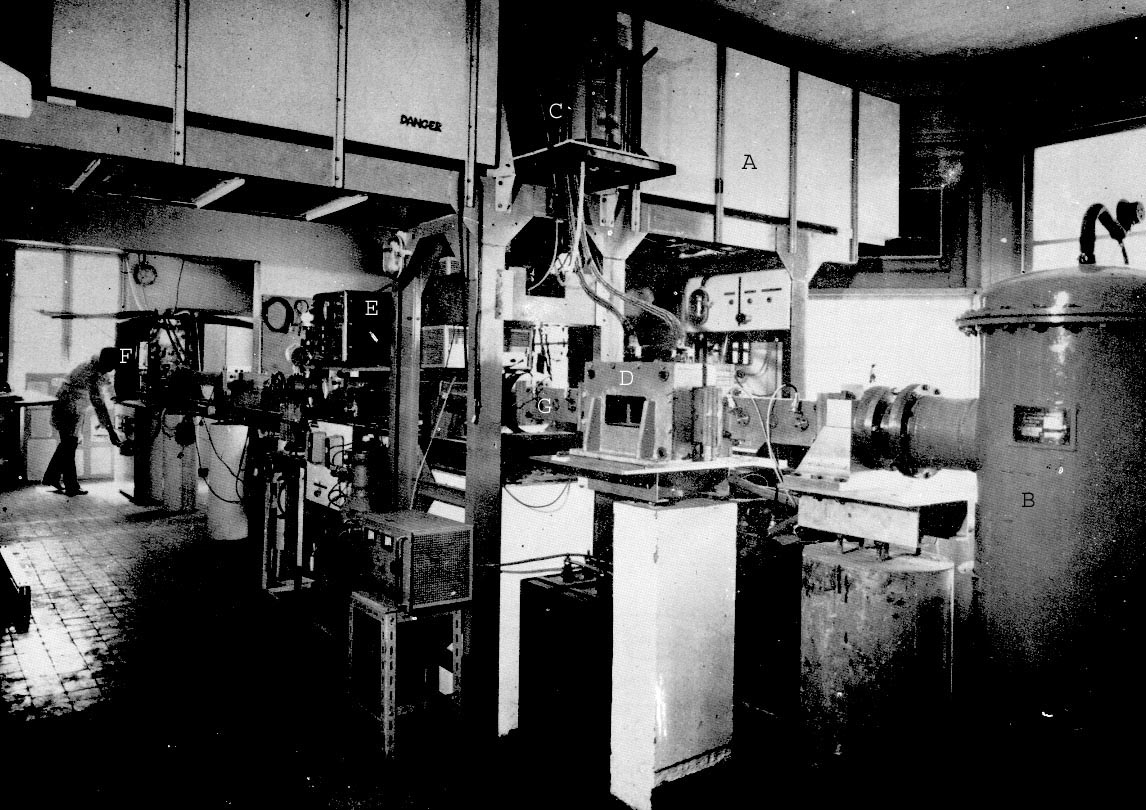
So I abandon my invention to the greed around me, which throws itself on it, not knowing that this pipe is pierced. Meanwhile (a short year) I decide to become a pure theorist and start devouring mathematics by the bucketful, day after day. Looking at the heavy device that came out of my hands, I say:
- If you want to leave here, you will never be able to carry it under your arm. The only way to conquer your freedom is to become a theorist
And yet I have little taste for mathematics, which will surprise many. I understand slowly, laboriously. Christophe Tardy is like me, who invented, surrounding us, the expression, entirely appropriate to my case:
Turbolimace
But to get out of there, like the Count of Monte Cristo digging through the wall of his prison at the Château d'If, I would have learned Chinese. For months, my colleagues see me lining up on a blackboard hieroglyphs, which are completely incomprehensible to them.
This period of my life reminds me of a story. It is a child who charms his audience by playing the violin beautifully. The public rushes to his dressing room, finds him in tears. One of the spectators says:
*- Madam, what sensitivity in your son. See these tears, after his wonderful concert! *
*- No, it's not at all that: he hates music. *
The book I am tackling is called "the mathematical theory of non-uniform gases", by Chapman and Cowling. Very quickly, I discover the method that will make me the pioneer of the theory of bitemperature plasmas (which does not appear in my biography, in Wikipedia).
The board of salvation, excerpts
It's time. Discovering that he had thrown himself onto a rotten board, my tyrannical director ordered me to take over the experiments again. I refused. The tension was phenomenal. He obtained from the general direction of the CNRS a threat of exclusion if I did not justify my activities. He brought out the knout. I can summarize the outcome through a dialogue between his secretary and me:
- Mr. Petit, our director, you're going to kill him!
- Why?
- Well, this morning, he had on the phone Mrs. Plin, the director of personnel at the CNRS, who confirmed that she had indeed sent you the warning letter requested.
- I know. I received it and I replied by sending back the manuscript of my State Doctoral thesis.
- Mr. Valensi didn't know you were doing this thesis, and ... in such a short time.
- I had little choice.
- He argued that it could only consist of uninteresting calculations. But she told him that you had attached a laudatory letter from a mathematician, an academician, Professor Lichnérowicz. But how did you meet this gentleman?
- At a café terrace, in Aix.
- A happy meeting.
- The hand of Providence, madam.
Abandoning the production of electricity using explosives, I ended up in another laboratory, where I was not much better off. The fury of my ex-director pursued me there, especially since this affair had ruined any hope for him of entering the Paris Academy of Sciences, after the report that Lichnérowicz had made on him.
One can consider me as a clay pot that has broken several iron pots
At the CNRS, the confirmation of employment as a researcher lasted five years. One entered as an "attaché de recherche". After that, either one became a "chargé de recherche", or it was the door. The deadline arrived for me. I had submitted the works that formed the basis of my thesis to the Journal of Mechanics, edited then by Paul Germain, who would later become secretary of the Academy of Sciences.
The last year arrived, where I had a chance to be appointed as a researcher. It was the worst possible situation. Cabannes, an academician, chosen by Germain as the reviewer for my article, considered a specialist in kinetic theory of gases, gave his verdict:
- This work shows a deep ignorance of the kinetic theory of gases
Suddenly, the door of my office opened. A group of Russians entered, accompanied by an interpreter who had the build of a coast guard captain.
- Mr. Petit?
- Yes
- I present to you Professor Luikov from Minsk. Professor Vélikhov (who would later become vice-president of the USSR Academy of Sciences) spoke about you. What are you working on right now?
I explained my work. The woman translated like a machine gun. At the end:
- Professor Luikov congratulates you. He says that thanks to this biparametric method you invented, you have solved a mathematical problem on which he and his team had been stuck for many years. He asks where this work is published.
- Uh... I hadn't thought about it yet...
- We would be very honored to publish it in the Soviet Union.
- Well, why not...
Sold, packed, weighed, the 12-page article was published three months later, then translated into English (from Russian) by an American journal that published it as well.
The session of the commission, to which I belonged, the last chance, arrived. The union representative opened his eyes wide when I gave him the two reprints and smiled.
- A nice double. I think we're going to have fun.
On the day, Germain, a good friend of Valensi, opened my file with emphasis.
*- Now, we will come to the case of a researcher that many of you know too well. It's Jean-Pierre Petit. I will read the opinion of the expert who examined the work that forms the basis of his thesis (he sighed, looked up to the sky). He basically says that it reveals a deep ignorance of the field. *
The rope tightened. The guillotine blade rose. The attendees were called to vote by pressing a button, the electric version of the ancient arena's police verso. But the union representative distributed my reprints on the fly. Upon discovering them, Germain changed color, then regained composure.
- Ah, here's a new element!
I barely passed as a researcher, feeling the wind of the bullet.
The next day, Génoche, the director of the laboratory where I had landed, greeted me with the most hypocritical smile imaginable (he had not lifted a finger to help me, not even Raymond Brun, who was supposed to be my research director, although he had not understood much of my writings, and only assimilated them much later, to his advantage).
- So, I heard the big news! Let's celebrate it.
- No, we won't celebrate at all. I would like you to sign this paper.
Génoche (who, at the time I write these lines, like Valensi, has joined the ranks of his ancestors) scans these lines:
- What does this mean? I am required to give my authorization for your transfer to the Marseille Observatory. But what are you going to do there?
- Astrophysics.
- Ah... new information!
- I've already started, for a year. I have published several notes in the Comptes Rendus of the Paris Academy of Sciences (thanks to Lichnérowicz).
- But... how?
- It's very simple. I transformed electrons into stars. I took the Boltzmann equation and removed its second term. It became the Vlasov equation, which I coupled with the Poisson equation. Then I built an elliptic solution.
- An elliptic solution?
- Chandrasekhar had already done similar things. I used dyadics.
- Dyadics! ?
- They are neither aquatic insects nor forest deities, but second-order tensors that compact calculations remarkably. This had impressed Lichnérowicz a lot. But, if you want to sign, here...
Ten minutes later, before throwing my few books into a cardboard box, I had left the place.
A year earlier I had abandoned the kinetic theory of plasmas to move to galactic dynamics, "the theory of self-gravitating stellar systems". In fact, having decided to leave this lab, which was no better than the previous one, I had said to myself, "instead of looking for what interests me, let's find a quiet place."
The Marseille Observatory, at the time, was like a retirement home. I had won the favor of Guy Monnet, its director, by using a trick, which I can now reveal.
Polytechnician, astronomer, observer, he had found it pleasant to be initiated into this elegant calculation technique. Thanks to it, I had rediscovered first the Jeans equation, describing gravitational instability, then the Friedman equation, Newtonian cosmology, discovered in 1934 by Milne and Mac Crea. The remaining task was to put this universe into rotation.
Monnet and I had agreed to undertake this continuation of my work the following week. But obviously, on the way from Marseille to Aix, in my 2 CV, I had done all these calculations in my head.
It reminds me of a scene from the film with Paul Newman and Robert Redford "Butch Cassidy and the Kid". At one point, two outlaws try to get hired as money couriers. Their potential employer wants to test their shooting skills and points to a stone on the path, about ten meters away. He hands the revolver to the one who is supposed to be the more skilled of the two, played by Robert Redford.
He misses the stone. The matter seems settled. But the shooter asks to try again, and this time hits the target. He explains:
- I'm more precise like that, when I draw.
I calculate better in my head. My math professors used to pull their hair out.
- Listen, Petit. I look at your calculation on the board. You made an error here, then recovered two lines later. There again... Instead of wearing out my nerves, why don't you just give us the result? And what are you hiding behind your back?
- Nothing...
- Yes, when you do numerical calculations, you always have your left hand behind.
- It's... for the carry...
Regarding Monnet, I was embarrassed. During our next session, he started by saying:
- Well, we'll see if we can build the same solution, but this time introducing a rotation.
I felt like passing a board to a student. It was laborious. When he approached the solution, my face was adorned with a wide smile. When he moved away, I frowned. Finally, in the late afternoon, he emerged from the whiteboard room, delighted:
- We found it!
All of this was recorded in a new note in the Comptes Rendus of the Academy, presented by Lichnérowiz.
This led us in 1972 to the presentation of a work at a theoretical astrophysics colloquium in Bures sur Yvette, at the Institute of Advanced Studies, dedicated to galaxy dynamics. It was a bloodbath, by the gods!
I presented a work on galactic dynamics, co-authored by Monnet. In the front row, an American, Professor King:
- This work presented by this Frenchman is attractive. Unfortunately, it contradicts Eddington's theorem.
The room froze. One could have heard a fly flying. King turned to me, smiling, convinced he had defeated me. And I replied:
- If you apply it correctly, it won't happen to you.
Demonstration. King went into the ropes (another one...)
Regarding another passage of this paper (which I still have in my attic), the leading figure of the specialty at the time, Professor Lynden-Bell:
- This work is necessarily false. It leads to a result that no one has ever found. This fortunate result can only be due to an error.
- Listen. When you make such statements, you can't do it for free. We are on Tuesday. Here are the details of our calculations. Examine them. If you find an error, I will give you 50 dollars. Otherwise, you owe me the money.
The room screamed.
- Lynden-Bell, accept this bet! Lynden-Bell, accept this bet!
The other grabbed the sheets and disappeared, angry. He would not reappear until Friday afternoon, at the end of the colloquium. The crowd rushed to him.
- So, Lynden, did you find an error?
- No, but there must be one!
But he forgot to give me the 50 dollars of the bet.
Thirty-five years like that, non-stop.
Later, I abandoned galactic dynamics. Too many blockages. My articles were praised by referees with letters of insults. This made Monnet smile, who said:
- Petit doesn't need to present himself to these people. He just needs to send them four equations, and they immediately lose their minds!
He had nicknamed me "the neutrino," because I could pass through the lab without managing to interact with anyone.
All my publications, based on original approaches, have always been exhausting battles, which I have always won. Except once.
I gave up computing after being the doctor Knock of the faculty of letters, then the deputy director of the Aix-Marseille computing center, thanks to the help of Robert Romanetti, my friendly director (who, depending on the Marseille science faculty, the two universities being twin), with whom we did some great climbs in the calanques. At that time I designed the first computer-aided design software running on a microcomputer. The story started with a bet made with an insect specialist, during a drinking evening. I said I was capable of building a software showing what a fly sees, that is, both in front and behind its head, simultaneously. You know the fish-eye lenses, where the lateral vision horizon is inscribed on a circle, centered on "the axis point of vision." The fly's eye lens adds another concentric circle, the image of the "occipital point." See the book Pangraphe.
I even appeared on television, at TF1, for another reason, showing an animation running on an Apple IIe (48K, 2 megahertz clock): a village view, with hidden parts removed. The specialists wondered how on earth I could calculate so fast. In fact, the images were "pre-calculated" and stored on these 5-inch floppy disks (128 K). The screen pages were 8 K. An "extension memory card," recently released by Apple, allowed to store 32 images and a paddle (the mouse had not yet been invented) allowed to chain these images on the screen, at a rate of ten per second. There remains from all this the book "Pangraphe," published by PSI. Seven thousand copies at the time (end of the 1970s). A book that many French developers of more elaborate CAD systems later used.
Unknowingly, I had anticipated the CD-ROM. But a bit too early, as usual.
This period followed shortly after my 1976 work accident (the 250 kg electromagnet that fell on me at the Marseille Observatory, where we had installed, in a basement, "the laboratory where the future already belongs to the past," to quote the Muppet Show's expression). In a few years, I computerized the whole faculty, invented a relief vision system called the stéréocyclette (a motor, mounted on the operator's headset, switched two images on an Apple II screen using a peek or poke instruction (I don't remember which). Everything was synchronized by rotating caches, alternately masking one eye or the other. This had made one of my collaborators at the time say:
- Indeed, you see in relief with your device. But with the noise, there's a risk of going deaf...
If I had stayed there, I would have created a robotics lab (the comic strip What Do Robots Dream Of dates from this time).
But building in a faculty of letters is like plowing in a field of stones. One day a psychologist, Gérard Amy, bearded, joined me in the cafeteria and said:
- I just came from the University Council meeting. I strongly defended you: I was the only one to abstain.
My coffee came back up my nose. I choked. I ran to my office and wrote a resignation letter that I threw into the president's office mailbox before fleeing.
"Courage, let's run away!"
Once again, not the last...
I did some time in mathematics (the sphere eversion, Pour la Science, January 1979), but again I disturbed, as usual. A model of the Boy surface remained for twenty-five years in the room pi of the Palais de la Découverte.
After that, I had a relapse of a few years in MHD, and ... what else? Oh yes, Egyptology, a simple "touch and go" of eighteen months.
And all of this has made me still alive.
Benveniste, on the other hand, was killed on the spot.
In research, salvation is often in flight ---
When I think back to my first flights in a Piper Cub, at Guyancourt, I had the impression of having done certain things through an open window, and I wondered if I wasn't getting my feet tangled in my memories. On these old models, equipped with a flat four engine, without radio, and where you started the propellers by hand, solo flights were done in the back. This Piper was an observation plane. This photo shows that I hadn't imagined it. Same locking system as on the 2 CV:
Flying with the window open, like in the 2 CV ---
November 2011: I found in Paris, in a restaurant, Jean-Pierre Dorlhac, from my Supaéro class of 1961.
Jean-Pierre Dorlhac, in 1961
He had organized a dinner for "the 50th anniversary of the class." There were already 17 who had passed away, my dear!
I didn't want to come to this dinner, fifty years later. I had, in truth, a bit of fear of possible reactions from former classmates. I remembered having located, in my region, Jean Conche, who had made a career as a test pilot, ending up in Istres. I had thought, "a guy who has made such a career must have kept a certain openness of mind."
Jean Conche, in 1961
I was wrong. When I found the phone number of this guy, I had a cold shower conversation:
Him: There's one thing I've always admired about you, it was the way you could make fun of people in your books.
Me: But ... Jean ... I don't make fun of people, as you think. We should meet, talk about it...
Him: Hmmm.... No need. I have my own idea about it.
It hurt me, because I had given a lot of myself in my scientific career, and paid dearly for my honesty. But it was useless to insist. This being said, I didn't want to risk such a disappointment at this dinner.
I met Dorlhac face to face, in a restaurant. Obviously, in 50 years, we change a bit. But him, in his head, no. I learned at this occasion that it was him who, at Guyancourt, had left the tail of a Piper Cub on the runway, during a too steep landing.
On this old photo we find a certain Durand (who, I think, came to my conference at the Palais de la Découverte, on the construction of the pyramids).
Durand, in 1961
His name evokes a memorable memory. When we were at Supaéro, we learned to fly these beautiful Piper Cubs. One day our instructor, a white Russian named Kupkas, colorful, decided to let me go. At that time, it had nothing to do with today. The planes didn't have radios. A student let go was really left to himself (see Dorlhac's landing). Moreover, we were let go after 5 to 7 hours of flight.
Kupkas got out of the plane, and I went to make my first solo landing. It went well. In the Piper, at landing, you can't see much in front once the plane is pitched up. The recommendation was to observe the grass blades on the runway. If you could distinguish them clearly, that meant ... you were near the ground. When you pulled back on the stick, the Piper landed like a horse whose reins are pulled and which raises its head.
I did the circuit, takeoffs, landings. At one moment, as I was about to take off again, Kupkas approached, told me to idle, and said:
- I'm going to let Durand go, on another plane. Stay at a distance, okay!
- Understood.
I took off again and continued my maneuvers, making sure that Durand's small yellow Piper stayed far away from me. Suddenly I lost sight of him. And all of a sudden I saw him coming straight at me. I thought "he's gone crazy!". I pushed full throttle and there followed minutes of dogfight that I will never forget in my life. Imagine a beginner, on his first solo flight, caught in a turning fight. Impossible to get rid of him. I finally decided to land. My pursuer didn't let me go and landed next to me. I cut the throttle, drenched in sweat. Then emerged from the plane ... Kupkas, who shouted, waving his arms above his head:
- What's going on? When I approached to see how you were flying, you ran away!
- Sorry, I thought it was Durand....
- Ah ... then... that's not bad...
Another person was supposed to join us, Dorlhac and me, in this restaurant. It's this tall figure we see behind me: Nicolas Gorodiche.
**Nicolas Gorodiche, in 1961
**In front, the red face of the adjutant Béjot
But he didn't come, finding some excuse. I think ... he has become serious, by now. At the time of the photo, we weren't much. It's little to say.
February 4, 2015: Wow, I'll be 78 in two months. How time flies. I said goodbye to the glider. I don't have a place at Vinon, the largest gliding center in Europe, where there are:
- Young hopes - Old sticks - The rich ones, who have their own machine (often Germans and Russians, and many former airline pilots).
Some guys said "we rent a two-seater, two of us". The result: two flights a year (...).
There are still opportunities, here and there. My friend Alain was selling his twin-engined Fouga Magister, based in Avignon:
-
Jean-Pierre, do you want to fly my Fouga, I'm going to sell it. Let's have one last flight?
-
Hey, wait, I'm coming running!
The thing you don't say twice.
It's very easy to fly. For loops you need to pull 4 g, otherwise the thing loses speed and comes down on the tail, which is to be avoided. What's nice are the rolls. You pitch the plane a bit, and hop, full left stick. When you pass on your back you need to push a bit. It goes like in a dream.
.
I took a photo with my phone.
Devil: the climb, I no longer have the physique. The dive: the bottom is ruined. And in the clubs the atmosphere is unbearable. It lacks sharks, giant rays, epic breath. Of course, cosmology, it's starting to be fun. At the moment I write these lines, we are at the fourth publication in top-level journals and we have one behind. It's work but, while we are in the dark age, where dark science dominates, we are revolutionizing the view of the universe. See this paper published in September in Astrophysics and Space Science and this other one in October in Modern Physics Letters A.
For current nonsense, see the Science et Avenir of February 2015. Françoise Combes, academician, "nearly a thousand scientific publications", opts for four successive laws for gravity. You will read that Françoise Combes came late to astronomy and astrophysics. So to reach this number, assuming a 30-year career, it requires a publication every ... ten days. The research professionals will appreciate.
Back to this extension of the MOND (Modified Newton Dynamics), recommended by our academician, now professor at the Collège de France (where Veneziano knits super socks with his superstrings). For the solar system, the beast law in 1/r 2. At the scale of the galaxy, a first corrective term. As it doesn't work at the scale of galaxy clusters, another corrective term. Finally, when you launch the ball at the cosmological scale, a fourth law, ad hoc, this time repulsive, to account for the acceleration. The egg of Columbus. Don't forget to sprinkle with a bit of cold dark matter. The interview of Madame Combes repeats her phrase:
- Let's dare to modify Newton's law.
It reminds of Ptolemy's epicycles. It should be known that Newton's law directly derives from Einstein's equation, and that if you fiddle with it, it means you turn your back on General Relativity. It's Dark Science. This said, it will give results, like the epicycles. I prefer the whole geometric, our Janus universe model.
A third of my Supaéro classmates already eat dandelion roots. It seems that at 78 years old I have reached the life expectancy of men. Women, it's more. Hence the fact that some men change sex, maybe.
So I play extra time. This said, in this world that is completely disintegrating, I needed a project that moves. I thought of a machine to travel in time. Five thousand years back. I would need a guy who has a naval architecture software to transform a smooth hull into a hull with live bilges, where you can develop the facets and create a file that I can print on an architectural plan printer. More convenient to cut the plywood sheets and build a seven-meter demonstrator in my garden. Yes, I was a sailor, in one of my many lives.
This is the general appearance:
The same, viewed from below:
A friend scanned a laser model. I therefore have a "3D pdf", but I'm not sure it works on the Internet. Let's try:
****To download the 3D pdf file
Here are the successive sections and the desired diagram for the bilges:
The bow and stern need to be sharpened.
The next set of frames:
To download the shape file in DXF format:
I claim that the light, elegant, seafaring ships of the Ancient Egyptian Empire crossed the Atlantic at high speed, could sail against the wind and match our modern sailboats. To prove it, you have to do it (as Thor Heyerdahl did with his Kon Tiki, which he crossed the Pacific with.
The tricks used by the Ancient Egyptians are simply brilliant, and I mean it. There is a film where an American archaeologist tries to reconstruct the ship of Queen Hatshepsut... designed by archaeologists and built by boat builders.
It reminds me of what was said in Djibouti, where they still built boutres at the time I went to cruise the Seven Brothers Islands with my son, flirt with giant manta rays, catch sharks and be towed by sea turtles, used as natural underwater scooters:
- If it sinks, it's a wreck. If it floats, it's a boutre. .
If the seven-meter demonstrator works, and I think it won't disappoint my expectations, since it works super on the model, I will look for a sponsor or sponsors to build a twelve-meter one, old-fashioned, with sewn hull, and cross the Atlantic.
You can't change.
Today is August 5, 2018. Three years have passed. I am 81 years old. The body still functions reasonably, except for a 50% blocked aorta, which made me give up skiing in winter.
I have just published a fifth and sixth article, in high-level journals, on my Janus model.
/legacy/papers/cosmo/ 2014_AstroPhysSpaceSci.pdf
/legacy/papers/cosmo/ 2014_AstroPhysSpaceSci2.pdf
/legacy/papers/cosmo/ 2014_ModPhysLettA.pdf
****/legacy/papers/cosmo/ 2014_AstroPhysSpaceSci2.pdf
/legacy/papers/cosmo/ 2018-AstroPhysSpaceSci.pdf
/legacy/papers/cosmo/ 2018-Progress-in-Physics.pdf
More will follow. If you look at these works, you see that my Janus model fits with 13 observational confirmations. I think therefore that I am right. Otherwise, current cosmology, and astrophysics, will have to be based, not on Einstein's equation, but on the system of the two coupled JPP equations.
But my ankles don't swell. Because without the pipes kindly provided by "people from elsewhere," since 1975 (...) I would never have done such a job. Guys who, despite their height of one meter twenty, obviously know much more than us. Instead of seeing myself as "the Einstein of the third millennium," I see myself more like a hamster, piloted by these guys. You can doubt all that. But, still, an 81-year-old former engineer, who is aligning papers with things that match observations, makes you think, right? Some will say "Petit is too modest. He wants us to believe that these ideas come from extraterrestrials ...". Well, my second book will be published at the end of 2018, where I will reveal a bit of all this. It is published by Tredaniel and the title "Cosmic Contacts". .
It's precisely for this reason that the people of this specialty are braced against the doors of seminars. They say: "It's interesting, what he does. But he won't be able to avoid talking about his space friends."
In any case, I see one thing. My Janus videos, where what deals with "my" model starts at: https://www.youtube.com/watch?v=kYIurRmmnsU&feature=youtu.be have mainly touched "math sup levels". The specialists (Thibaud Damour, Jean-Pierre Luminet, Alain Riazuelo, Roland Lehoucq, Aurélien Barrault, Françoise Combes etc ... etc ... ) courageously remain silent. I don't think those people will move. However, the pdfs that accompany my videos have touched many people. I will create the JANUS 25 video, which has been awaited for months.
It does not give a very bright image of the scientific community, including internationally. When I send papers to journals, it starts with a rejection of submission to a referee, accompanied by some arbitrary cut-and-paste. But indeed, upon reflection, we can understand them: a French researcher, 81 years old, retired, completely unknown in the field, who keeps sending papers one after another, as if saying "stop everything, the new Einstein is me," there is one chance in a thousand it's not a fraud. I can't really tell them "me, it's different. Aliens give me tips! ".
I will continue regardless. Regarding the media, it's not very bright. Watch this interview on the Thinkerview channel: https://www.youtube.com/watch?v=VanOVShKsCM&feature=youtu.be&t=176. For a person whom Etienne Klein says "I have a terrible character," I think I have still managed to stay calm in front of someone who only wanted to destabilize me. There are nicer things: https://www.nurea.tv/video/armes-secretes-russes-et-mhd-avec-jean-pierre-petit/
Fortunately, I practice an activity that allows me to clear my head of all these things. I first found a small glider club near my home, where we fly all year round. I do tandem flights with my friend Pascal, in the mountains. On this page you will find how to download the IGC file of one of our recent flights, then how to display it with Google Earth. It's ... amazing. And a big thank you to Pascal for such gifts (I am the pilot in these images).
My last flight in the mountains (June 2018). Pascal lets me fly the whole time
Images: soaringlab software (free)
I think that at 81 years old, I have a great luck to be able to experience things like this. I have to leave you now, I need to create JANUS 25
TO BE CONTINUED
../bons_commande/bon_global.htm return to home page