Untitled Document
A very well-crafted hoax
June 17, 2010
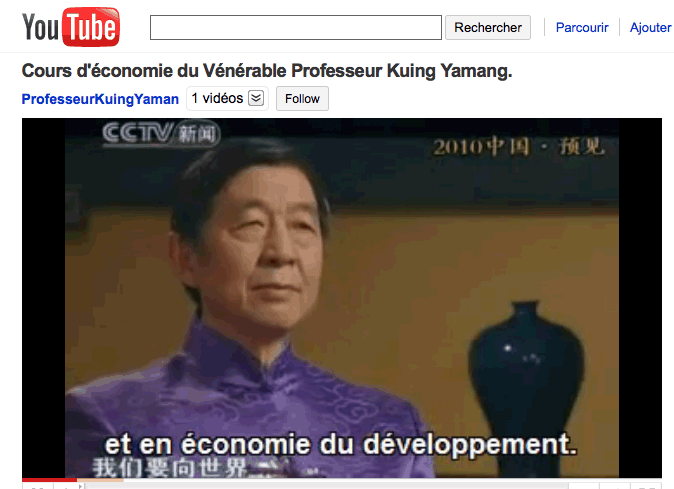
http://www.youtube.com/watch?v=DMKb9A6Kouk
I'm speaking up because this hoax continues spreading. It's very well done, in fact. Many people have fallen for it. Not me: my wife is Chinese. In reality, these two men are discussing different topics, including the exposition in Nanjing. The hoax is skillfully constructed, exploiting every expression of this so-called "Chinese economist," who is actually talking about matters entirely unrelated to the subtitles.
What's interesting is that the hoaxer wanted to convey a certain message: the French are portrayed as interested only in football and leisure. They're just lazy people who don't understand that first and foremost, one must work. They borrow more than they earn, and are given too much credit. French civil servants, in particular, have excessive social benefits that they cling to. The worst part is that the French state is bleeding to death by supporting those who create wealth.
What response can one make to such a speech?
There are sentences that are perfectly accurate—even though the interviewed person never actually said them. For example, we're made to believe he says:
- While their standard of living declines, ours rises.
- In one or two generations, we will catch up with Europeans, and even surpass them. They will become "our poor," and we'll send them bags of rice.
Between emerging nations like China and India, and Western countries, a kind of communicating vessels phenomenon is taking place—especially regarding China, which isn't hindered by religious or cultural burdens like India is. Offshoring is happening everywhere and accelerating. China has become "the workshop of the world."
Six or seven years ago, I knew a businessman who manufactured all kinds of display stands. His company had been doing reasonably well until one day I met him and he told me:
- I must ensure my company's proper functioning and health, anticipate future developments. I just returned from Czechoslovakia. Our display stands will now be made there.
Today, if a company wants to create and manufacture something, its leaders wouldn't even consider doing it in France—they'd choose an Eastern European country, India, or China.
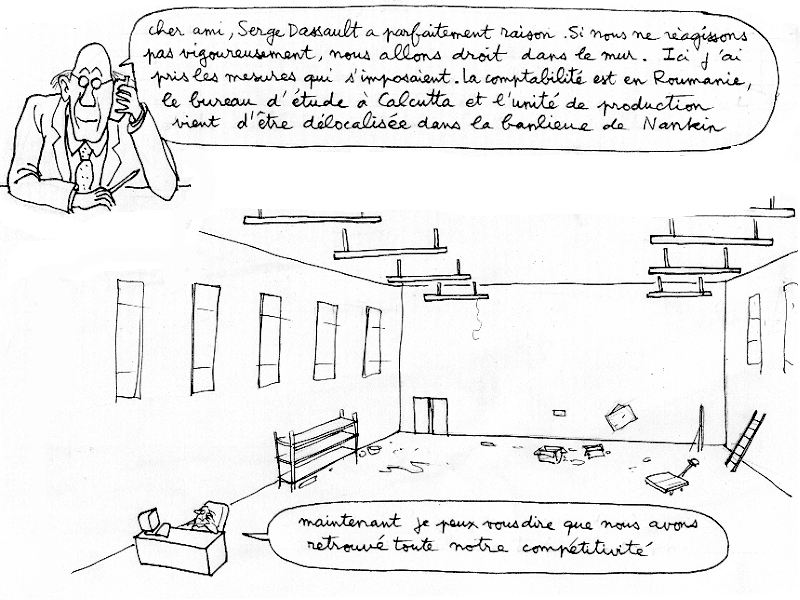
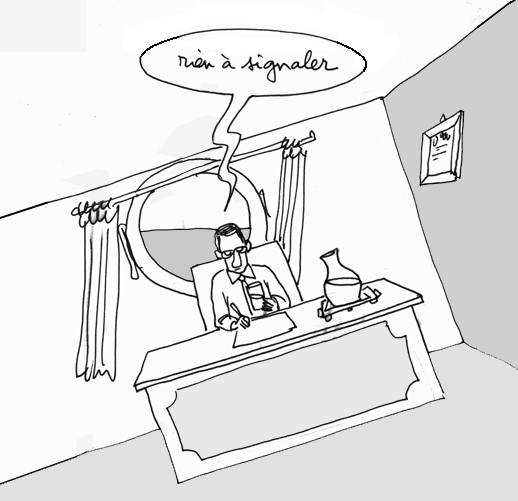
A humorous cartoon from 2005
Sometimes in France, you encounter a company that has existed for generations, employing skilled workers. I hear about "a company that actually produces something," with machines, workers, technicians—only to see it suddenly taken over, its management handed to a dynamic new CEO who is more "modern." He immediately sets out to "cut fat," negotiating early retirements for experienced, competent workers in their 50s and 60s. He reduces labor costs by hiring young, cheap workers lacking experience. The result can be catastrophic, so much so that even the most patriotic customers may grow tired of the idea that "making things in France" is simply too problematic...
The communicating vessels phenomenon continues.
The rise of Chinese industrial and commercial assertiveness can be credited to Deng Xiaoping, who died at 92.
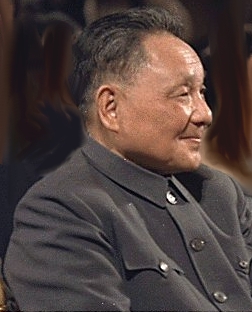
Deng Xiaoping in 1962
It doesn't matter if the cat is black or white. If it catches mice, it's a good cat. (Deng Xiaoping, 1962)
There's a common thread among all our politicians, whether on the right or "left"...
...they rarely, if ever, talk about how China is currently influencing global geopolitics—something this hoax attempts to caricature. This influence is very real. Just look at the exponential growth of products labeled "Made in China" everywhere.
Mao Zedong was a literary man by training and had no understanding of technical matters.
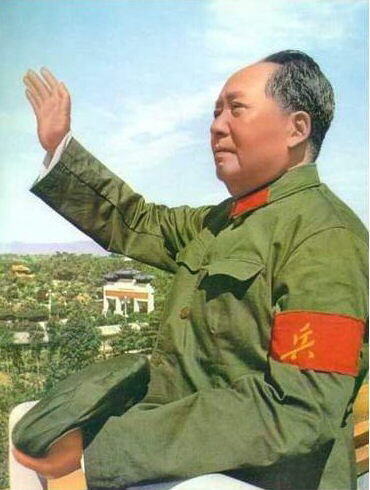
Mao (in Chinese, pronounced "Mô")
He is responsible for fantastic disasters, such as the idea of developing steel production in rural areas. Mao continued a movement initiated at the beginning of the century to pull China out of its backwardness. He intensified measures already begun by his predecessors, such as banning foot-binding, which in China symbolized not only a long-standing sexual fantasy but also the subjugation of Chinese women.
But I won't dwell further on this period of history.
There has been a "clash of cultures," though we should be cautious about the term's implications. Perhaps we can speak instead of a "clash of lifestyles at a given time." I'm currently preparing a dossier on Japan's history, which, under the "Meiji era," transitioned from medieval times to the modern world within just a few decades (19th century). The Japanese did even better, and I'll tell you all about it. Under the impetus of their Emperor—essentially an Asian Peter the Great—and a group one might call a "military-industrial complex" (similar to the Japanese lobby that helped Hitler rise), they rapidly adopted all the mechanisms of Western modernity across every domain. They created a modern army, police force, administration, education and health services, factories, arsenals, etc.
In doing so, they chose modernity outright, making a fantastic leap from junks to heavily armed battleships, which crushed China's weak navy and, in 1905, the fleet of... the Russian Empire, astonishing everyone.
I'll tell this story in detail—it's fascinating. The creator of Japan's war navy was a Frenchman, a Polytechnicien who, during just four years in the country, equipped it with an ultra-modern naval fighting machine. Visionary, he immediately understood that a war navy must be:
- All-metal
- Heavily armored
- Composed of large units
- Equipped with cannons whose caliber exceeds that of land-based artillery, capable of long-range fire (Yamato's cannons had a 460 mm caliber—never matched worldwide).
- Fast, very fast.
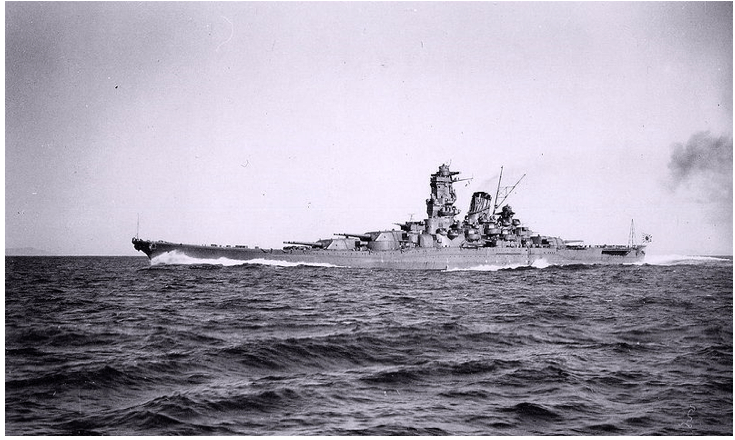
The largest cruiser in the world, the Yamato, launched in 1941, 245 meters at the waterline, crew of 2,450 men
Designed by a Frenchman, this fleet could match the most modern navies in the world and, in any case, easily crush both Chinese and Russian fleets.
I mention these aspects to suggest how rapidly Japan, under the leadership of a visionary oligarchy, transitioned from medieval backwardness to the most astonishing modernity.
This required extraordinary adaptability, made possible in 19th-century Japan due to a high literacy rate. The consequences of this "Japanese leap forward" were brutal and expansionist.
In 1972, Deng Xiaoping realized that for China to progress in every way—economically, industrially, strategically, scientifically—the country could no longer remain isolated, clinging to the ineffective Marxist ideas of Mao, the Great Helmsman.
Like Japan, China is relatively poor in natural resources, especially energy. Its development and dominance across vast Asia required modern weapons. China's goal is not to invade neighboring countries—except perhaps Tibet. But on this point, relations between these two regions represent a long history, which many people ignore, preferring to focus solely on the destruction of monasteries and the harsh suppression of the monastic caste.
China has a score to settle with the Western world. These people haven't forgotten the Two Opium Wars. Readers surely picture Chinese people utterly incapacitated, lying on mats in opium dens.
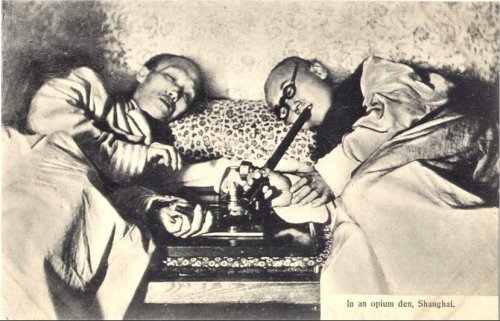
Opium den in Shanghai
What they may not realize is that this opium, manufactured in India for the British, was introduced into China by the British themselves. The Qing Dynasty sought to resist this destructive product's infiltration. The West (first Britain, later joined by France, Russia, and the United States) responded militarily, forcing China to accept this highly profitable import.
Geopolitics is not a game—it's a battlefield, a site of constant competition. If Japan in the 19th century chose to enter technological modernity, it was to avoid what the West was already imposing throughout the East (the French in Vietnam, Europeans in China during the Opium Wars, and Russian ambitions toward the Pacific, etc.). The Japanese said to themselves:
- If we remain stuck in our Middle Ages—with feudal provinces managed by local lords, defended by over a million samurai forming private armies—we will be crushed by the West and become, like Vietnam, a colony divided among various powers. We must therefore quickly acquire modern weapons and equipment. It's a matter of national survival.
Meanwhile, Korea had no political leadership, China was wracked by embryonic revolutionary convulsions, led by an empress from another age, living in the Forbidden City surrounded by eunuchs.
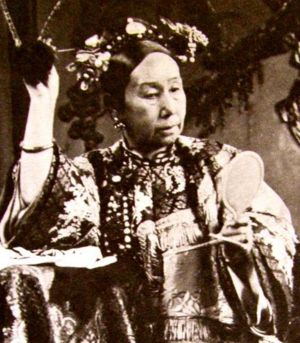
China: Empress Cixi in 1902, looking at herself in a mirror
Mao's mindset remained frozen in the years 1917 and beyond—the era of collective farms, collectivized agriculture, and five-year plans. Deng Xiaoping, however, conceived an entirely new model of development, unprecedented in history. He decided to keep the political apparatus—party rule and the power of the People's Army—while hosting within this "communist" China economic units and production structures modeled on Western systems, applying what could be called controlled liberalism. Hence his famous phrase summarizing everything:
It doesn't matter if the cat is black or white. If it catches mice, it's a good cat.
Translated, this becomes:
It doesn't matter what political-economic system governs the country, as long as it allows us to develop.
China has had millennia of corruption, still present today. Poor peasants converge toward urban centers and industrial megacities to provide China's workforce: labor at extremely low wages. One might say "fed and housed," but one could also add "receiving medical care provided by the company." These masses of workers are exploited, yet the level of exploitation doesn't descend to the inhumane degradation seen in Europe at the beginning of the 20th century—unsanitary living conditions, child labor in mines, etc. But for these people, having a roof over their heads and food in their bellies is already miraculous.
That said, if you took a European worker and "transformed" him into a Chinese proletarian, would he accept living in dormitories, eating in canteens, walking just a few meters to his production unit wearing a uniform?
This applies to the "lower tier" of Chinese society, which numerically constitutes a significant portion of the population. It works because the regime has allowed an oligarchy to emerge, one that loudly fills its pockets. Among the richest are coal mine owners and operators. China has "de-nationalized" and privatized its production system. Before Deng, mines were state-owned. Now, almost everything (except for weapons manufacturing) has been privatized. When it comes to high output, nothing works better than a good capitalist system with low wages, no social benefits, no pensions, etc. Chinese mines are gulags. Working conditions are known to be the harshest in the world. The focus is on production, not safety.
Every year, accidents occur in Chinese mines. Yet every year, when Western car manufacturers unveil their new models, there's always one hyper-luxurious, hyper-expensive car immediately purchased—regardless of price—by a coal mine owner.
Capitalists around the world are free of moral qualms. Chinese capitalists are too—but they love flaunting their wealth.
The regime tolerates this structure while maintaining iron control over everything. It says:
- Get rich, but don't dare confuse that wealth with the beginning of political power.
In the West, politicians are puppets in the hands of financial powers. In China, political power remains firmly in the party's hands. Its police and army exist to enforce iron control over anything that moves or "goes in the wrong direction."
Anything that threatens this forward march is inopportune. For example, the Tiananmen protests. We now know Deng himself ordered immediate, brutal repression. In China, bayonets replace water cannons and rubber bullets. A May 1968 in China? Sorry, we don't have time for such trivialities. Disperse. Move along—nothing to see.
Some saw the Tiananmen deaths as a ferocious, cruel act. Satellite photos showing bodies were doctored. This doesn't mean there were no victims, but paradoxically, many of the dead were people who became targets of Chinese soldiers as they rushed toward the square at full speed. Orders had been given: clear the square of demonstrators. Residents, stay home and close your shutters. The order was directed at those whose windows faced the main avenue leading to the square. Soldiers arrived and fired into every open window! Then the square was cleared with little difficulty. The number of deaths is simply on a scale appropriate to the country. In France, a badly handled demonstration results in a few dozen deaths. In China, expect one or two orders of magnitude more.
But the message was clear:
- The country is moving forward. The general standard of living will rise. The machine will run, in its own way, whether you like it or not. We want a powerful China on the international stage, in every domain. If you're students, study hard to secure a good place in society and contribute to national development. But if you dream of becoming political leaders in the style of the French students of May 1968—playing the Cohn Bendit or Sauvageot roles—forget it. You'd be inopportune.
China is an immense army on the move, a colony of ants, a marabunta. It is silently conquering "the world" (the word "market shares" has now replaced "territory"). Germans once imagined themselves as representatives of a superior race, entitled to their "living space"—vast territories where indigenous populations, considered subhumans, were to be decimated and eliminated coldly. Following Operation Barbarossa, the Germans didn't just kill millions of Jews; they were responsible for the deaths of 20 million Russians.
What is often forgotten is that Japan's expansionist war in Asia caused the deaths of thirty million people across all nations. In Nanjing, the Japanese killed 300,000 people, including 200,000 civilians—men, women, and children—in just six weeks.
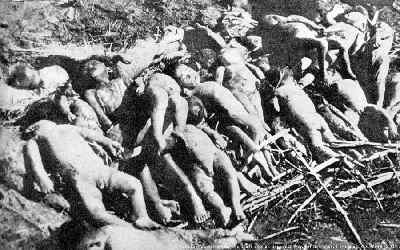
Chinese children massacred by the Japanese in Nanjing
Germany and Japan had to kill indigenous populations to occupy vast territories because one cannot invade a continent with a population of only 60 to 70 million.
Does this mean that someday hordes of Chinese will flood the world, like in a Jean Yanne film, and that the Champs-Élysées in Paris will be filled with Chinese people wearing Mao jackets and caps, displaying red stars?
No. One day there will simply be... many Chinese tourists, dressed Western-style, visiting us like we visit an African reserve, out of curiosity. Like we traverse countries "economically conquered." With Deng, China began its conquest of the world—but not on geographical terrain. The targets, the "mice" that this great yellow cat aims to catch, are markets.
China is changing. But how profound is this change?
First, it's important to understand there are two Chinas: "the upper China" and "the lower China." The echoes of prosperity reach only faintly into the countryside. The manna comes only from children who have gone to work "in the city" or in industrial collectives. There's an abyssal gap between the fortunes of China's new rich and the meager incomes of peasants. These peasants live like deep-sea creatures that can't graze on vegetation, which doesn't exist beyond 100 meters depth due to lack of light. A vast biomass of creatures, whose importance we're only beginning to grasp, feeds on scraps falling from the surface.
China is emerging from decades of Maoism, which left deep scars—eradicating religious beliefs, for example. The demand for "unisex attire," imposed by Mao, and the one-child policy have had lasting effects on Chinese sexuality. While little father Mao wasn't shy about bedding women, sex, romance, eroticism, and coquetry were considered signs of bourgeois decadence.
The Cultural Revolution also destroyed much, promoting contempt for the past as an attachment to bourgeois values. There remain millennial family mechanisms: a certain submission of offspring to parents, even into late adulthood. Sexually and maritally, today's China resembles 19th-century France.
For example: a friend of my wife, 40 years old, living in Beijing, divorced and moved back in with her parents with her eight-year-old child. One night she went out and returned at midnight. At the doorstep, her mother waited and said:
- You're home at this hour!
Chinese parents consider themselves at home when they arrive at their children's homes. When one of their children moves abroad and marries a foreigner, the parents can show up unannounced and stay for months—until, exasperated, the couple finally kicks them out.
This expectation is experienced as a return to a parental behavior typical of... a "king child." And a king child implies rejection of family values. The only pressure comes from future social success—hence intense academic pressure, just like in Japan.
In this context, China's new society is evolving. Toward what? We don't know. Where the video is truthful is when we hear:
- China is rising, the West is on a downward slope.
The reasons given—such as "the laziness of the French who don't want to work"—are simplistic descriptions. Let's reverse the perspective. In China, national-scale "machines" are being set in motion, paralleling Japan in the 19th century. When Japan built one of the world's most modern navies, it also trained a generation of high-level Japanese naval engineers. The same happened in aeronautics, etc. What's astonishing is the speed of this training and the ability to assimilate science and technology.
I tried to see if scientific comics might interest Chinese people. The answer came quickly: Chinese parents would never encourage their children—whether young or students—to read books promoting what could be seen as reflection on science. Children and students are fed endless exercise books. Chinese schools and universities are beehives, factories producing diplomas—not leisure clubs.
The Chinese are formidable traders. When a company decides to do business with China, it's wise to have deep knowledge of customs, systems, laws, and language.
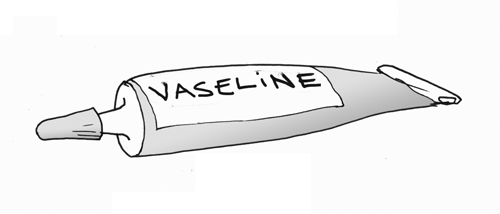
Export product
China doesn't aim to be merely "the workshop of the world." Don't confuse India and China with Maghreb countries like Morocco, Algeria, Tunisia, or Egypt. China has changed. If you go to Beijing, you'll see a few old bicycles from Mao's era, rusted and preserved as antiques. But what you'll see first are powerful cars. Their number has grown so much that the Beijing municipal government issued a decree allowing private vehicles to drive only one day per two—odd or even numbers.
Due to its massive financial surpluses, China can equip itself in every field with the latest technology. It's rapidly training a vast army of engineers and technicians across all disciplines. In the "design, research, development" sector, it aims to compete with the best and even become the leader—just as the Japanese did in the 19th century.
It takes a rare stupidity, like that of Cohn Bendit, to say:
- We'll sell them Airbus planes...
A Chinese engineer hearing this would double over laughing. For two reasons. First, among the Airbus planes sold to China by France, one is missing from all flight plans—it has... vanished. In fact, it was dismantled down to the last bolt for examination. It's just good business (economic warfare).
Copied? No. Those who think the Chinese main idea is to copy Western products are as naive as those in the postwar era who dismissed "those Japanese watches as mere junk"—only to see their two-wheeled "Motobécane" bikes disappear before the performance of Japanese motorcycles, or their old transistors rendered obsolete by Japanese electronics.
The Chinese ant colony organizes itself on scales unimaginable to any Westerner. Companies build structures (one should rather compare them to beehives) where, on successive floors, you find, like honeycombs: training floors, fundamental research, applied research, development, and commercialization—production management.
China has a millennia-old tradition of excellence. Throughout history, people from humble backgrounds could rise to high office by acquiring knowledge and skills, even becoming advisors to the Emperor. In the West, descendants of wealthy families or representatives of the X or ENA—far from being the most intelligent in society—still run the country. One might even say that in our country, administrative or political success is often hindered by competence.
At a time when our youth are demoralized, Chinese youth are driven by hope of success, raising their standard of living and social status. Every young person believes they can seize an opportunity in this all-out assault. In China, spectacular successes transform young people from modest backgrounds into billionaires in remarkably short time—something that doesn't exist in France.
Deng Xiaoping defined this orientation toward excellence and emphasized the vital importance of this strategy. During the Russian Revolution, a miner named Stakhanov became famous for extracting record amounts of coal alone—allegedly "for the benefit of the Bolshevik revolution." Hence the term "Stakhanovite."
China is filled with intellectual, scientific, technical, and commercial Stakhanovites—especially powerful because the rewards don't come in the form of a "Hero of the People's Republic" medal or a photo at a factory or university entrance. Social success that doesn't exclude bribery is tolerated—as long as the cat catches the mouse.
Deng Xiaoping is the Machiavelli of economics and commerce, of "markets."
The Chinese have surpassed the French in Africa, taking charge of many projects. "ChinAfrica" is replacing "Françafrique" (which is also "France-for-Francs"). Instead of systematically exploiting local labor—often unskilled, difficult or impossible to train, often dilettantish and unreliable—they bring their own workers and technicians, who don't mind hard work and adapt well to the climate. Simply because what they earn there, far from home, will be a good savings upon return. In exchange for building durable infrastructure, Chinese companies obtain mining concessions and access to energy sources desperately needed by China. These deals are quickly sealed because the Chinese understand African negotiation dynamics perfectly—their own brand of corruption being "Made in China." They also avoid interfering in the politics of the host country. They export no ideology, carry no messages, promote no political system, bring no missionaries. Pragmatic above all, they work, sign agreements, and that's it.
This liberal policy doesn't forget China's ambition to grow militarily. Achievements here are also at the cutting edge of technology. China's rapid entry into the nuclear club and space colonization is proof. They've demonstrated effective anti-satellite weapons. The first American rockets had ranges of three to five thousand kilometers—sufficient from NATO bases encircling the entire USSR to reach any strategic Russian target. The Russians developed rockets with an immediate range of 8,000 kilometers (the famous Semorka designed by engineer Korolev), which incidentally allowed them to be the first to reach circumterrestrial space. But one must also note that from Russia, reaching American targets required such ranges.
Chinese rockets have a range of 12,000 kilometers. Allegedly for... going to the Moon.
Who would believe that lie?
The Chinese are naturally discreet.
I have nothing to say, nothing to propose. I'm surprised our politicians—on the right or "left"—remain so silent, just like our economists and journalists, about this "workshop of the world" that has formed and may one day become a "Middle Kingdom"—but an economic, strategic, financial one. You know the famous phrase, repeated by Perrefitte:
The day China awakens, the Earth will tremble.
China is awakening—or rather, reawakening, for it has a millennia-long rich scientific and technical past, and it's doing so rapidly, just as Japan did, which lacked such a tradition. By "scientific activity," we mean primarily that directed toward technological applications (there are still no Chinese Nobel laureates).
In the West, we debate endlessly, speculate, procrastinate, indulge in flashy displays, try to vaccinate to allow pharmaceutical industries to profit, stagnate, confuse economics with finance. We never stop dismantling the education-research system through reforms designed by incompetents, draining salaries and SMEs.
In passing, I would have liked to include active links to interesting videos. Our Visionary President, author of the famous phrase "I'm going to clean up the suburbs with a Karsher," has created a situation of decay and lawlessness, which was evident in the testimonies of French police officers from 2010, presented in this Arte video—which is unfortunately no longer available. It's a shame. This is a document that every French citizen should be able to consult:
http://videos.arte.tv/fr/videos/flics_le_grand_malaise-3247444.html
You know the proverb:
- He who sows the wind reaps the storm
Exactly what is currently happening, under the guidance of a former interior minister who believes that to properly manage the police, they must generate daily fines equal to the cost they impose on the state. Police officers are therefore "expected above all to produce numbers," which, in the eyes of their superiors, is infinitely more important than chasing criminals or conducting prevention.
Sarkozy is orchestrating the mess, and before being just a small, insecure, ambitious man with a sharp wit, he is above all an idiot. But, to make matters worse, the others are hardly better. If the French replace Sarkozy with Strauss-Kahn, or Ségolène Royal, or by... (the list is long), it will simply be replacing a lame horse with a one-eyed one.
It's particularly regrettable that another video, also broadcast by Arte, about the German police, is no longer available either:
http://videos.arte.tv/fr/videos/allemagne_au_bonheur_des_flics-3253538.html