Untitled Document
Chronicle from February 26, 2010 to .......
We need to turn a new page. I'd like to repost here the confession of John Perkins, probably the most important video I've seen in years.
http://www.dailymotion.com/video/xa636d_john-perkins-confessions-dun-corrup_news
http://www.dailymotion.com/video/xa636d_john-perkins-confessions-dun-corrup_news
If you've already seen it, skip ahead. S
What's new under the sun? ---
Why would someone want to become a representative of the people?
Here are two documents explaining why people fight so hard to become "representatives." We'll start with a PowerPoint referencing a law quietly passed in February 2010, which only Le Canard Enchaîné and &&& reported on. It concerns the extension of unemployment benefits for deputies who are not re-elected.
5,177 euros per month for six years
At a time when you're being told to tighten your belt, you realize this discourse isn't meant for all citizens.
The second document is a video about the golden retirements of our politicians. Indeed, these pensions are cumulative. Hold on. While French citizens are learning they'll all have to contribute for 40 years, we discover the extent of these "special retirement regimes"...
The golden retirements of our politicians
Even more astonishing: a 9,000 euro monthly pension at age 50 for European Union civil servants!
Rich or poor, does it matter as long as we have money?
At the European Parliament, British politician Nigel Farage denounces the excesses of the Lisbon Treaty
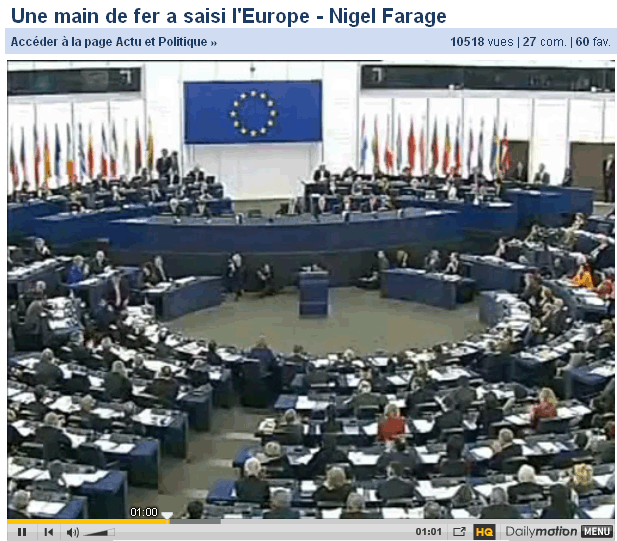
The European Parliament
On February 9, 2010, Nigel Farage, president of the EFD group, denounced the totalitarian drifts of the Lisbon Treaty during a session at the European Parliament.
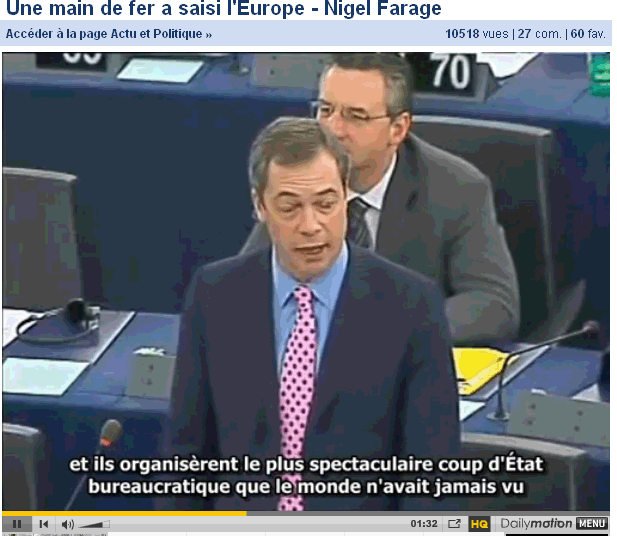 http://www.dailymotion.com/video/xc67d9_une-main-de-fer-a-saisi-l-europe-ni_news
British politician Nigel Farage, president of the EFD group
Europe of Freedom and Democracy
http://www.dailymotion.com/video/xc67d9_une-main-de-fer-a-saisi-l-europe-ni_news
Some applaud, others smile. ---
This reaction isn't unlike the powerful lines Audiard wrote for Gabin in the film "The President." If you haven't seen this video yet, take a look. It was prophetic.
Gabin's tirade in the film "The President" against the Europe of banks
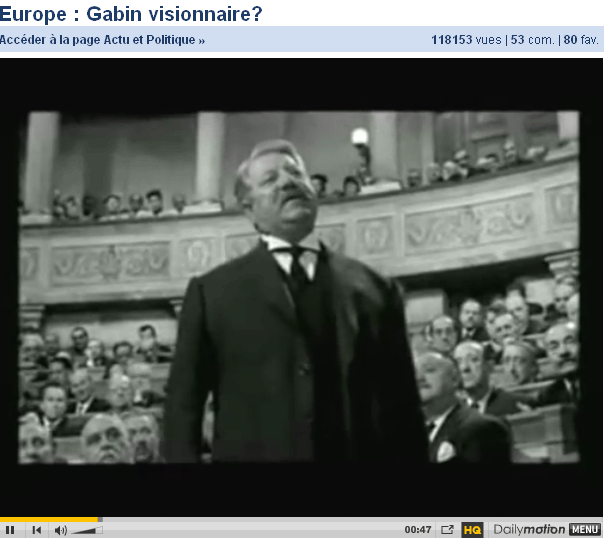 http://www.dailymotion.com/video/x970st_europe-gabin-visionnairey_news
Gabin's tirade against the Europe of banks in the film "The President," text by Audiard
http://www.dailymotion.com/video/x970st_europe-gabin-visionnairey_news
French military involvement in the massacre of Tutsis in Rwanda
Here is a text sent by one of my readers, Luc Pilonnel:
http://www.dailymotion.com/video/xc67d9_une-main-de-fer-a-saisi-l-europe-ni_news
http://online.wsj.com/article/SB10001424052748704240004575085214201591380.html****
Below you will find a translation of an article from the Wall Street Journal.
Three things stand out particularly.
-
The extensive, year-long investigation conducted independently and at personal expense by Serge Farnel. Serge provides a decisive factual contribution to understanding the Rwandan genocide. Knowing Rwanda well and having personally witnessed crimes committed by the French army on the ground, I know that throughout his investigation, Serge was isolated, under immense pressure, and his safety was threatened by the extraordinary gravity of the revelations he was preparing about French involvement in the Rwandan Tutsi genocide. He had to display exceptional inner strength, dedication, and empathy toward survivors. Without this, the survivors would not have testified as they did. A special prize combining human rights, investigative journalism, historical expertise, and personal courage should be created to honor Serge. Thank you, Serge, for this remarkable contribution.
-
Regarding the revelations brought by Serge. He provides proof that as early as May 13, 1994—six weeks before the start of Operation Turquoise—French soldiers directly intervened in the massacre of Tutsis, especially on the Bisesero hills, where French military actions were decisive in the killing of 40,000 people. He adds a crucial dimension to understanding the genocide by showing that the hundreds of thousands of genocidaires were actually just auxiliaries acting under French command.
-
Serge’s investigation shows that by mid-May at the latest, the genocide was nearly over and could only continue and end in late July due to direct French military involvement. Without this involvement, it is likely that the Rwandan Patriotic Army (the armed wing of the FPR) would have ended it much earlier—perhaps even in May. (Recall that the capital Kigali fell on July 4.)
Best regards,
Luc Pilonnel
The Rwandan Genocide: The Story That Was Never Told by Anne Jolis © Wall Street Journal and © Metula News Agency for the French version, Friday, February 26, 2010 Translated from English by Llewellyn Brown. Ms. Anne Jolis is a writer at the Wall Street Journal Europe.
"I’ll tell you how I saw it," says Fidèle Smugomwa, former leader of the extremist Hutu militia during the Rwandan genocide, in an interview with documentary filmmaker Serge Farnel. "The French soldiers had taken positions on a hill and were shooting at the Tutsis... We [the Hutu militiamen. Ndlr. Ména] wore a distinguishing mark so the French wouldn’t shoot us—we had hidden ourselves under tree leaves."
One by one, the former genocidaires filmed by Serge Farnel recount the same story: on May 13, 1994, small groups of white men, whom they described as "French soldiers," dressed in camouflage and transported in jeeps or trucks, gathered on the heights in the western Rwandan hinterland. They fired shots into the Bisesero hills to flush out Tutsis.
Then they directly targeted men, women, and children fleeing. When the gunfire stopped, the Hutu killers moved in. Armed with machetes, spears, spiked clubs, and their own rifles, they finished off the wounded. About twenty survivors told me the same version of events.
That day and the next, 40,000 Tutsis were massacred. In total, around 800,000 people—Tutsis and Hutus opposed to the genocide—were brutally killed that spring of 1994.
- Few events in modern history have left deeper scars on Western consciences than the Rwandan genocide.
Samantha Power, advisor to President Obama and Pulitzer Prize winner in 2003 for her book "A Problem from Hell: America and the Age of Genocide," paints a bleak portrait of how the Clinton administration avoided and remained passive during the genocide.
Later, President Clinton, during a visit to Kigali, the capital, apologized on behalf of the United States and the "international community."
In France, however, the official narrative of the genocide presents a more favorable image of France’s role. The Foreign Ministry website notes: "In the 1990s, France contributed to international efforts to contain tensions in Rwanda... France was the first country to denounce the genocide and launched a humanitarian mission." This mission, named Operation Turquoise, began in June 1994, ostensibly to create humanitarian safe zones.
At this point in our analysis, a brief historical overview is necessary. Although Rwanda was a Belgian colony before independence in 1962, France long considered it part of Françafrique—the group of Francophone African countries where France continues to exert a paternalistic influence, often opportunistic, sometimes positive.
In Rwanda, this influence took the form of a close relationship with the dictatorship of Juvénal Habyarimana, who promoted Hutu supremacy. During the Rwandan civil war in the early 1990s, French troops came to Habyarimana’s aid in his war against the forces of the Rwandan Patriotic Front (FPR)—a Tutsi-majority, also Anglophone group—coming from Uganda under the command of Paul Kagamé, now President of Rwanda.
Today, absurd as it may seem, the government of President François Mitterrand at the time feared that an FPR victory would mean not only the loss of a trusted ally, but also the loss of Rwanda to the "Anglophone world."
The event that ultimately triggered the genocide occurred on April 6, 1994, when an airplane carrying Habyarimana was shot down. The identity of the perpetrators remains one of the unsolved mysteries of modern history.
A prominent French magistrate is convinced the assassination was orchestrated by the FPR, and he has issued numerous arrest warrants targeting close associates of Mr. Kagamé. In the past, the French have also insisted that what happened in Rwanda was a "double genocide," arguing that Tutsis were as much aggressors as victims in the early and peak stages of the Rwandan tragedy.
However, this version of events also has its detractors. Mr. Kagamé categorically denies any involvement in Habyarimana’s death, which occurred just as the president was about to sign a peace agreement with the FPR.
For a long time, the Rwandan government claimed that France played an active role in supporting Rwandan extremists during the genocide, citing numerous well-known genocidaires who openly and peacefully lived in France for years.
In 1998, French journalist Patrick de Saint-Exupéry, who visited French soldiers during Operation Turquoise, wrote a series of articles in Le Figaro describing how the "humanitarian zones" served primarily to protect Hutu killers as they fled from advancing FPR forces.
These articles provoked outrage in the National Assembly, leading to the creation of a parliamentary inquiry committee, which ultimately concluded that France bore no particular responsibility for the genocide and, at worst, had been an innocent victim of misunderstanding.
It was at this moment that Serge Farnel entered the scene—a 44-year-old Parisian of imposing stature, trained in aeronautical engineering. Mr. Farnel’s curiosity about the genocide was sparked years ago when he heard comparisons between France’s actions in Rwanda and the behavior of the Vichy regime during World War II.
During a trip to Rwanda last April, he met a Tutsi survivor who testified that French soldiers were indeed present in May 1994, when, supposedly, there were none. At first, Farnel assumed the trauma-stricken man’s memory was playing tricks on him, but he persisted with his version of the story. Farnel then began interviewing other witnesses, filming their accounts.
The result is 100 hours of film, primarily consisting of interviews with individuals and groups—both victims and perpetrators of the massacre—along with meticulous reenactments of the massacre scenes.
It’s difficult to overstate the rigor with which Mr. Farnel conducted the interviews: on film, those being interviewed sometimes grow impatient when he calls them back to ask further questions—as if they were witnesses on the stand—jumping on the slightest inconsistency in their testimony.
Not all survivors of the May 1994 massacres claim to remember French soldiers at Bisesero, but many do, and their accounts are consistent. After viewing these filmed testimonies, I decided to join Mr. Farnel in Rwanda, on the ground of his investigation, to personally verify these stories.
Rwandans are waiting to testify about events in 1994: "The whites were posted on the heights, and they first drove us out of our hiding places with gunfire... They stopped when the Interahamwe [Hutu militia] arrived, then resumed when we resisted," says Sylvestre Niyakayiro, a 22-year-old Tutsi at the time, who remembers being chased from hill to hill during the three attacks that day, led by whites.
Mr. Farnel repeatedly asks whether Mr. Niyakayiro isn’t confusing dates, whether the whites he remembers from mid-May weren’t actually French soldiers who arrived at the end of June for Operation Turquoise, when another assault was launched against the few remaining Tutsis in the Bisesero area.
"The 13th and 14th of May were unforgettable," replies Mr. Niyakayiro.
But who exactly were these "whites"—assuming they were indeed present? "Your information isn’t credible because it’s not based on any historical reality," wrote General Jean-Claude Lafourcade, who commanded Operation Turquoise and now leads an association of soldiers who served in Rwanda, in response to my questions, adding, "It seems you’re being manipulated."
Like the Élysée, the association claims, "There were no French soldiers in Rwanda in May 1994." The François Mitterrand Institute, directed by Hubert Védrine, close advisor to the former president, refused to comment on this article.
Paul Barril is a Frenchman who was in Rwanda at the time. He is certainly one of the most prominent former members of the GIGN, an elite intervention unit. Mr. Barril was an advisor to Habyarimana at the time of the president’s death. According to his memoirs, published in 1996 in "Secret Wars at the Élysée," where he notes, "Following the attack, a cycle of massacres began that led to the establishment of Paul Kagamé’s pro-American Tutsi dictatorship. Over a million people died in Rwanda. What does it matter?"
My attempts to contact Mr. Barril by phone and email for this article were unsuccessful. "He doesn’t want to be found," his publisher told me.
A detailed account of Mr. Barril’s activities appears in "No One Must Survive: The Genocide in Rwanda" by renowned expert Alison Des Forges, an American who died in a plane crash last year.
Des Forges writes that Mr. Barril was hired by the Rwandan Ministry of Defense to train up to 120 men in shooting and infiltration tactics for an elite unit, intended to launch attacks behind FPR lines. The operation was code-named "Operation Insecticide," meant to exterminate the inyenzi, the "cockroaches." When questioned about this training program during an interview with a Human Rights Watch researcher, Mr. Barril denied all knowledge and abruptly ended the conversation. The Rwandans Mr. Farnel and I met insisted that French troops were involved in the mid-May massacres. "I know they were French troops because I had been with them in Mutara in 1991," says Semi Bazimaziki, a corporal in the Rwandan army during the genocide. "I knew their methods well." Another former genocidaire, Jean Ngarambe, says he was rejected as a guide for the whites visiting because "I didn’t speak French." In his place, they took another man who spoke French.
An incident described both by perpetrators and victims is particularly compelling. Some of the former genocidaires recall that on May 12, the day before the massacres began, they were summoned to a village.
They say a local Hutu official, Charles Sikubwabo, currently a fugitive sought by the International Criminal Tribunal for Rwanda, introduced "French soldiers" who had come to reinforce them.
Mr. Sikubwabo ordered the assembled Rwandan killers to follow a certain route without attacking or approaching Tutsis along the way. They ended up several kilometers away, at a place called Mumubuga, where they found over 50 Tutsis. Surrounded by white men, Mr. Sikubwabo told the Tutsis not to fear, that the whites were there to help them, and that they should return to the hills to await aid.
"We knew it was a trick against the Tutsis," says Raphaël Mageza, Mr. Sikubwabo’s brother-in-law. The whites were decoys, meant to gather information about where Tutsis were hiding. Gudelieve Mukangamije, one of Mr. Mageza’s potential victims, agrees: "They [the whites] didn’t give us tarpaulins [as promised]. They killed us. And they handed us over to the Interahamwe."
- Yesterday, Nicolas Sarkozy became the first French president to set foot in Rwanda in a quarter of a century. "What happened here obliges the international community, including France, to reflect on the mistakes that prevented it from preventing and stopping this terrible crime," he said. Mr. Sarkozy had previously suggested a committee of historians should investigate what happened during the genocide. According to the French Foreign Minister Bernard Kouchner, the president "does not oppose France examining its own history." If so, the best way to begin would be for France and its historians to examine the extraordinary testimonies collected in Mr. Farnel’s intense documentary. They have a moral and historical duty to consider the consequences of the evidence presented by Farnel. As Mr. Farnel says: "No country can escape its history."
The Rwandan Genocide: The Story That Was Never Told by Anne Jolis © Wall Street Journal and © Metula News Agency for the French version, Friday, February 26, 2010 Translated from English by Llewellyn Brown Ms. Anne Jolis is an editor at Wall Street Journal Europe.
"I’m telling you exactly as I saw it," says Fidèle Smugomwa, former leader of the extremist Hutu militia during the Rwandan genocide, in an interview with documentary filmmaker Serge Farnel. "The French soldiers had taken position on a hill and were shooting at the Tutsis... We [Hutu militiamen. N.d.L.R. Ména] wore a distinguishing mark so the French wouldn’t shoot us—we had hidden ourselves under tree leaves."
One by one, the former genocidaires filmed by Serge Farnel recount the same story: that on May 13, 1994, small teams of white men, whom they describe as "French soldiers," dressed in camouflage and transported in jeeps or trucks, gathered on the heights in western Rwanda’s interior. They fired shots into the Bisesero hills to flush out Tutsis.
Then they directly targeted the men, women, and children fleeing. When the gunfire stopped, the Hutu killers moved in on the hills. Armed with machetes, spears, spiked clubs, and their own rifles, they finished off the wounded. About twenty survivors told me the same version of events.
That day and the next, 40,000 Tutsis were massacred. In total, approximately 800,000 people—Tutsis and Hutu opponents of the genocide—died brutally that spring of 1994.
- Few events in modern history have left deeper scars on Western consciousness than the Rwandan genocide.
Samantha Power, advisor to President Obama, winner of the 2003 Pulitzer Prize for her book A Problem from Hell: America and the Age of Genocide, paints a dark portrait of how the Clinton administration evaded and remained passive during the genocide.
Later, President Clinton, during a visit to Kigali, the capital, apologized on behalf of the United States and the "international community."
In France, however, the official narrative of the genocide presents a more favorable image of France’s role. The website of the Ministry of Foreign Affairs notes: "In the 1990s, France actively participated in international efforts to contain tensions in Rwanda... France was the first country to denounce the genocide and launched a humanitarian mission." This mission, named Operation Turquoise, began in June 1994 and was ostensibly intended to create humanitarian safe zones.
At this point in our analysis, a bit of history is necessary. Although Rwanda was a Belgian colony before gaining independence in 1962, the French long considered it part of Françafrique: the network of Francophone African countries where France continues to exert a paternalistic influence, often opportunistic, sometimes positive.
In Rwanda, this influence took the form of a close relationship with the dictatorship of Juvénal Habyarimana, who promoted Hutu supremacy. During the Rwandan civil war in the early 1990s, French troops came to Habyarimana’s aid in his war against the forces of the Rwandan Patriotic Front (FPR)—a Tutsi-majority, also Anglophone, force originating from Uganda under the command of Paul Kagame, now President of Rwanda.
Today, however absurd it may seem, the government of President François Mitterrand at the time feared that an FPR victory would not only mean losing a trusted ally, but also losing Rwanda to the "Anglophone world."
The event that ultimately triggered the genocide occurred on April 6, 1994, when Habyarimana’s plane was shot down. The identity of the perpetrators remains one of the unsolved mysteries of modern history.
A prominent French magistrate is convinced that the assassination was orchestrated by the FPR, and has issued numerous arrest warrants targeting close associates of Mr. Kagame. In the past, the French have also insisted that what happened in Rwanda was a "double genocide," arguing that the Tutsis were as much aggressors as victims in the early stages and climax of the Rwandan tragedy.
However, this version of events also has its detractors. Mr. Kagame categorically denies any involvement in Habyarimana’s death, who was on the verge of signing a peace agreement with the FPR at the time of his assassination.
For years, the Rwandan government claimed that France played an active role in supporting Rwandan extremists during the genocide, citing numerous well-known genocidaires who openly and peacefully lived in France for years.
In 1998, French journalist Patrick de Saint-Exupéry, who had visited French soldiers during Operation Turquoise, wrote a series of articles in Le Figaro describing how the "humanitarian zones" were primarily used to protect Hutu killers as they fled from advancing FPR forces.
These articles provoked outrage in the National Assembly, leading to the creation of an investigative commission, which ultimately concluded that France bore no particular responsibility for the genocide and, at worst, had been an innocent victim of misunderstandings.
It was at this moment that Serge Farnel entered the scene—a 44-year-old Parisian with a large frame, trained in aeronautical engineering. Mr. Farnel’s curiosity about the genocide was sparked years ago when he heard comparisons between France’s actions in Rwanda and the behavior of the Vichy regime during World War II.
During a trip to Rwanda last April, he met a Tutsi survivor who testified that French soldiers were indeed present in May 1994, when they were supposedly absent. At first, Farnel assumed the trauma-stricken man’s memory was playing tricks on him, but he maintained his version of the story. Farnel then began interviewing other witnesses, filming their accounts.
The result is 100 hours of film, consisting mainly of interviews with individuals and groups—both victims and perpetrators of the massacre—along with meticulous reenactments of the massacre scenes.
It is difficult to overstate the rigor with which Mr. Farnel conducted the interviews: on film, those being interviewed sometimes grow impatient when he calls them back to ask further questions—as if they were witnesses summoned to the stand—jumping on any inconsistency in their testimony.
Not all survivors of the May 1994 massacres claim to remember the presence of French soldiers in Bisesero, but many do, and their accounts are consistent. After viewing these filmed testimonies, I decided to join Mr. Farnel in Rwanda, on the ground of his investigation, to personally verify these stories.
Rwandans await their turn to testify about events in 1994. "The whites were stationed on the heights, and they first drove us out of our hiding places with gunfire... They stopped when the Interahamwe [Hutu militia] arrived, then resumed when we resisted," says Sylvestre Niyakayiro, a 22-year-old Tutsi at the time, who remembers being chased from hill to hill during the three attacks that day, directed by whites.
Mr. Farnel repeatedly asks whether Mr. Niyakayiro might be confusing dates, whether the whites he remembers from mid-May were not actually French soldiers who arrived at the end of June for Operation Turquoise, when another assault was launched against the few remaining Tutsis around Bisesero.
"The 13th and 14th of May were unforgettable," replies Mr. Niyakayiro.
But who exactly were these "whites"—assuming they were truly present? "Your information is not credible, as it is not based on any historical reality," wrote General Jean-Claude Lafourcade, who commanded Operation Turquoise and now leads an association of soldiers who served in Rwanda, in an email response to my questions, adding, "It seems you are being manipulated."
Like the Élysée, the association claims, "There were no French soldiers in Rwanda in May 1994." The François Mitterrand Institute, headed by Hubert Védrine, a close advisor to the former president, refused to comment on this article.
Paul Barril is a Frenchman who was in Rwanda at the time. He is certainly one of the most prominent former members of the GIGN, an elite intervention unit. Mr. Barril was an advisor to Habyarimana at the time of the President’s death. According to his memoirs, published in 1996, in Secrets of the Élysée: "Following the attack, a cycle of massacres began that led to the establishment of the pro-American Tutsi dictatorship of Paul Kagame. Over a million people died in Rwanda. What does it matter?"
My attempts to contact Mr. Barril by phone and email for this article were unsuccessful. "He doesn’t want to be found," his publisher told me.
A detailed account of Mr. Barril’s activities appears in Aucun témoin ne doit survivre: le génocide au Rwanda [No One Must Survive: The Genocide in Rwanda], written by renowned expert Alison Des Forges, an American who died in an airplane accident last year.
Des Forges writes that Mr. Barril was hired by the Rwandan Ministry of Defense to train up to 120 men in shooting and infiltration tactics for an elite unit intended to launch attacks behind FPR lines. The operation was code-named "Operation Insecticide," designed to exterminate the inyenzi, the "cockroaches." When questioned about this training program during an interview with a researcher from Human Rights Watch, [Mr.] Barril denied all knowledge and abruptly ended the conversation.
The Rwandans that Mr. Farnel and I met insisted that French troops were involved in the mid-May massacres. "I know they were French troops because I had served with them in Mutara in 1991," says Semi Bazimaziki, a corporal in the Rwandan army during the genocide. "I knew their methods well." Another former genocidaire, Jean Ngarambe, recounts that he was rejected as a guide for visiting whites because "I didn’t speak French." In his place, they took another man who did speak French.
One incident described by both perpetrators and victims is particularly compelling. Some of the former genocidaires recall that on May 12, the day before the massacre began, they were summoned to a village.
They say a local Hutu official, Charles Sikubwabo, now a fugitive sought by the International Criminal Tribunal for Rwanda, introduced "French soldiers" who had come to provide reinforcements.
Mr. Sikubwabo ordered the assembled Rwandan killers to follow a certain route without attacking or approaching any Tutsis along the way. They ended up several kilometers away, at a place called Mumubuga, where they found over 50 Tutsis. Surrounded by white men, Mr. Sikubwabo told the Tutsis not to fear, that the whites were there to help them, and that they should return to the hills to await assistance.
"We knew it was a trick against the Tutsis," says Raphaël Mageza, Mr. Sikubwabo’s brother-in-law. The whites served as decoys to gather information about where the Tutsis were hiding. Gudelieve Mukangamije, one of Mr. Mageza’s potential victims, agrees: "They [the whites] didn’t give us tarpaulins [as promised]. They killed us. And they handed us over to the Interahamwe."
- Yesterday, Nicolas Sarkozy became the first French president to set foot in Rwanda in a quarter of a century. "What happened here obliges the international community, including France, to reflect on the errors that prevented it from preventing and stopping this terrible crime," he said. Mr. Sarkozy had previously suggested a committee of historians investigate what happened during the genocide. The French Foreign Ministry, under Minister Bernard Kouchner, adds that "the president does not oppose France examining its own history." If so, the best way to begin would be for France and its historians to examine the extraordinary testimonies gathered in Mr. Farnel’s intense documentary. They have a moral and historical duty to consider the consequences of the evidence presented by Farnel. As Mr. Farnel says: "No country can escape its history."
I made this page quickly because readers asked me to relay information. I’ve just finished coloring a new comic book:
Cover for the thousand copies distributed (to school libraries, public libraries)
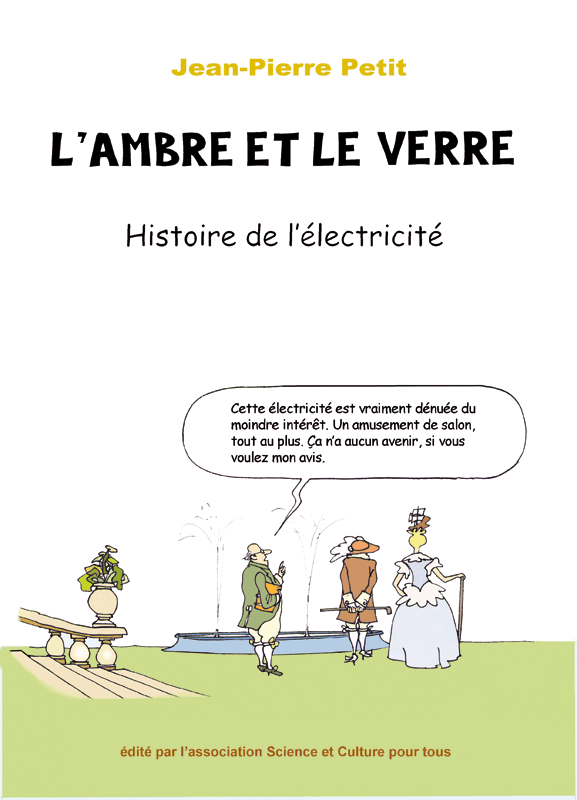
Cover for the thousand copies sold in support of the association Science et Culture pour tous
Nothing prevents you from reserving your copy by sending a check for 8.5 euros (9.5 euros for foreigners)
addressed to J.P. Petit, BP 55, 84122 Pertuis, but made out to Science et Culture pour tous (not Savoir sans Frontières)
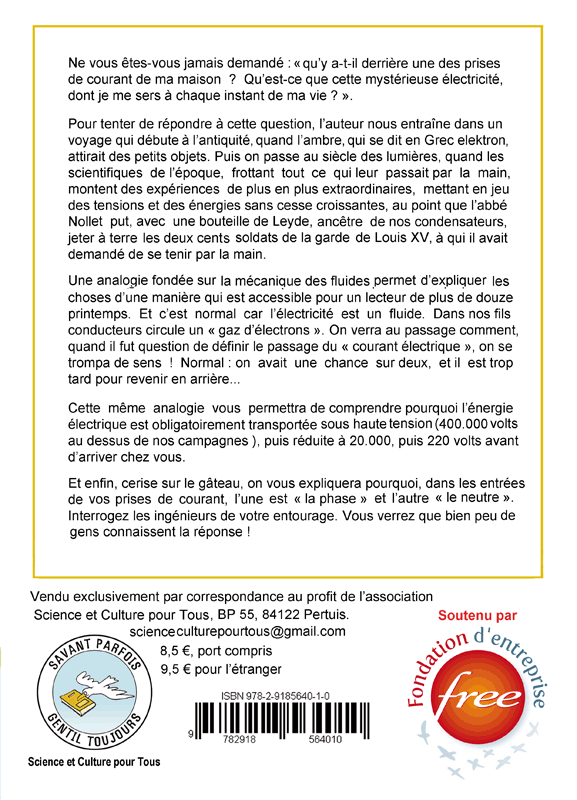
Fourth cover, common to both editions. The ISBN will be added today, and printing will begin.
A 64-page album. I think I haven’t lost my touch. As I’ve already said, a thousand copies, under a sponsorship agreement with the Free Foundation (the hosting provider), will be sent free of charge to school libraries and municipal libraries that request them. Paradoxically, despite the announcement on France Inter, we’re having a hard time gathering email addresses for these organizations to send them a mailing. It must be said that such a proposal is not common.
I’ve compiled a PDF file containing sample pages from this album.
This sponsored album will definitely be printed within the next two months. Half will be distributed, and the other half sold in support of a "sister" association to Savoir sans Frontières (which I wish to keep free of any sales activity), the association Science et Culture pour tous.
Following this, I’ve begun another album titled "Fishbird." If my readers had the good idea to buy printed copies, it would motivate me to create more such works, especially since these new books will be in color. Since I can’t risk ending up with large quantities of unsold books, I’m considering a subscription-based publishing model. I would need two hundred firm orders to cover printing costs for each book. I plan to offer these albums at around 8.5 euros each, including postage (for France). For international orders, it would be 11.5 euros, also including postage. I would need 200 checks of this amount, representing 200 firm orders. I will collect these checks until the number is reached, then launch the printing. Here is a page from the album, not yet colored:
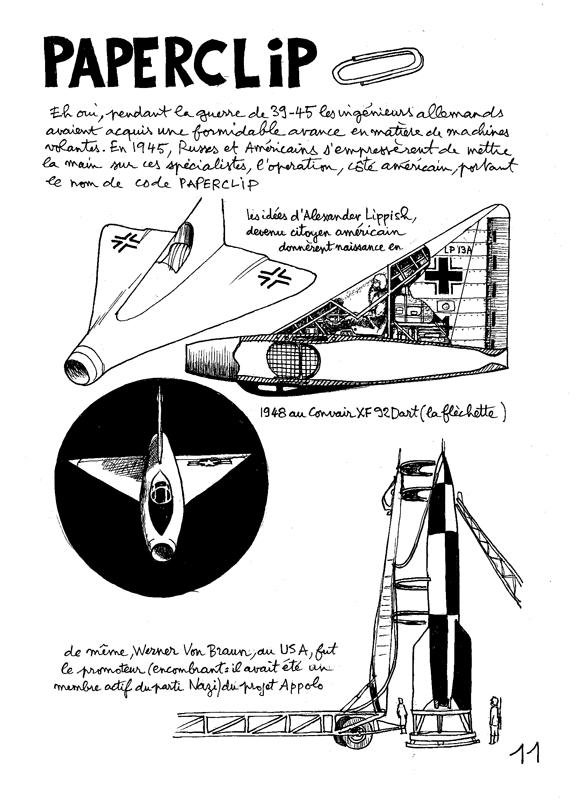
[And here are the first pages of Fishbird, currently in black and white](/legacy/find/hep-th/1/au_+Steer_D/0/1/0/all/0/illustrations/The Fishbird.pdf).
If you’re interested in this new Fishbird album, please send me a check for 8.5 euros if you reside in France, or 10.5 euros if you’re abroad. Make the check payable to Jean-Pierre Petit and send it to:
J.P. PETIT BP 55, 84122 Pertuis
along with your address for sending the book. I will only cash these checks if I receive enough to launch printing. Well, if it works, you’ll have reactivated the machine that produces these scientific comics. Lanturlu, Sophie, and I would be delighted.
This summer, when I fly to Vinon, I’ll resume with my friend Charpentier the comic album project on weather that we started two years ago.
Otherwise, once the studio is finally cleared (the closet is OK, finally), I’ll move forward with my project to build a mini-studio for producing free videos. Equipment: several camcorders, HF microphones, a retroprojector. This decision follows what I mentioned in a previous page. From the Bogdanoff brothers, I’ve received confirmation that I’m banned from the media, except for rare exceptions, like that brief interview on the show La Tête au Carré on France Inter a few weeks ago. No one can recall ever having seen one of my articles in magazines like Science et Vie, Pour la Science, La Recherche, etc., for over twenty years, nor have my books—whatever they are—ever been mentioned in those same publications. Aside from the broadcast on Direct8, which had no follow-up, all my television appearances have always been in shows of indescribable mediocrity. I remember a woman I met in a store who said to me:
“We saw you on TV, my husband and I, and we feel sorry for you…”
In the end, there’s no point continuing this way. The best course is to create our own media. That’s already what a website represents. The next step is video. "Télé-Pertuis" sounds good. But I doubt the municipality would appreciate what I’d say about ITER, our neighbor. We’ll have to find something else.
.