One last thing before hitting the road – created on June 12, 2005; updated on March 17, 2007 (bottom of page)
Before getting into the topic of drunk driving, a memory from my past comes to mind. I was a student at Supaéro. This must have been in 1959 or 1960. Back then, the school was still located in Paris, on Boulevard Victor. It admitted two types of students: the first were civilian engineering students; the second were graduates from Polytechnique who enrolled at Supaéro “as an applied sciences school.” After two years of study they became “military air engineers.” One of them was named Gildas Rouvillois. He owned a Renault Dauphine and a nice pipe covered with seal skin—that was quite fashionable back then. One day we got invited to a chalet for some skiing. Duvillois was supposed to drive us both there.
Before being assigned to Supaéro, he’d wanted to become a fighter pilot and had spent time at the Meknès base in Morocco. There he flew subsonic single-engine Dassault “Ouragan” jets, ancestors of the Mirage III, which were used as training aircraft.
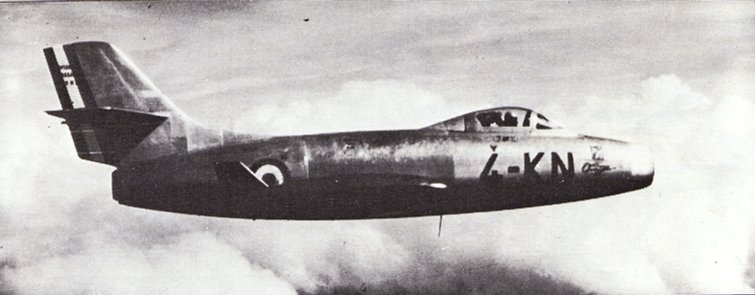
The Dassault “Ouragan” aircraft
Pilots were trained in shooting by diving toward towed targets and firing using their “movie cameras.” But Rouvillois—who later became a general engineer at the DGA, the French defense procurement agency—had his own unique method for executing his firing runs. He’d dive toward the target and jerk the control stick and rudder at the very last moment to avoid a collision.
After a few months, his instructors gently explained to him that he’d stand a much better chance of living longer by working in an office. He was sent back to France and joined the corps of military air engineers.
He himself told me this story. Frustrated at no longer being able to fly jets, he bought a Renault Dauphine—obviously far less powerful and lacking wings.
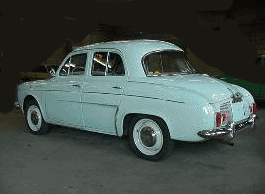
The Renault Dauphine
Rouvillois didn’t drink, but behind the wheel he hadn’t lost his reflexes as a would-be fighter pilot. So, when overtaking another car, he’d floor the accelerator (back then, the Dauphine, notoriously unstable because its engine was mounted at the rear, could reach a top speed of 120 km/h). Just as he was about to catch up to the “target vehicle,” he’d make two sharp turns of the steering wheel to complete the overtake.
We never made it past Meulun.
When Rouvillois finally caught up to his final “target,” they were going downhill. It was a small black truck traveling at moderate speed, staying well to the right. The first turn of the wheel put the Dauphine on two wheels on the right side. Immediately afterward, he turned the wheel the other way, putting it on two wheels on the left. The third turn sent it rolling over repeatedly onto the left side of the road. The truck driver, unaware of anything, kept driving innocently along. How could he have imagined that he’d been mistaken for a towed target by a former fighter pilot who still fancied himself at the controls of a jet?
Seat belts didn’t exist back then. Crossing a small embankment flung us out of our seats. I distinctly remember floating inside the front part of the car and watching it spin around. I also saw Duvillois exit the car through a door that had popped open upon impact, then perform a soaring flight for dozens of meters (perhaps perfectly normal for a pilot, after all).
What struck me most was the silence that followed. The car lay on its side. I managed to get out through the door. Rouvillois had landed in a tree, miraculously unharmed. He slid down like a ripe fruit. I wore a white shirt and noticed it was stained red with blood. I figured I might have lost an ear or some other body part. While climbing out of the wreckage I did a quick check: my nose was still there, my ears too. My hands were intact. But where did all that blood come from? Did I have a hole in my skull?
One of my ears had been torn off.
Rouvillois regained consciousness. He mumbled:
- In the front trunk... my jacket with my wallet, my... papers.....
Some people, after a severe crash, first try to recover their identity.
I’d walked about ten meters away from the car, whose wheels were still spinning. But instead of heading toward it, something stopped me. It was fortunate I did so. The fuel tank, holding forty liters, caught fire. It happened exactly as in those Belmondo movies: the car was instantly engulfed in a bright yellow ball of flame. Within seconds all five tires burst. I retreated more than a hundred meters away to avoid being burned by the intense heat radiating from the blaze.
While the gasoline finished burning, I tried to flag down a car on the busy country road we’d just left via aerial means. But motorists, spotting the flaming vehicle and me waving with my blood-stained shirt, sped up and swerved to avoid me, continuing on their way.
I counted seventy such cars.
I finally managed to stop the seventy-first by standing right in the middle of the road, arms outstretched. He managed to avoid me, but figuring I might have noted his license plate, he pulled over a few dozen meters ahead. I ran to catch up before he could flee, opened his door. He asked:
- Do you need help?
I commended him on his excellent powers of observation. He drove us to Meulun Hospital. Rouvillois, clearly shaken by his tree landing, kept repeating:
- I must have a ruptured spleen. Some people have accidents. You think they’re fine, but actually their spleen bursts and they die suddenly...
We were admitted to the emergency ward. The Polytechnique graduate’s spleen had withstood the shock. The blood on my shirt came from my right ear, which was barely hanging on by a strip of flesh. The intern offered to remove it, but I protested:
- Try to sew it back on. If it doesn’t hold, there’ll still be time to cut off that earlobe.
Experience proved me right; everything healed fairly quickly. On the bus back to Paris, Rouvillois asked me:
- Which French cars are stable?
As is well known, the Dauphine wasn’t exactly a stability marvel. But judging by how he drove, I believe he could have made a tank do somersaults.
The next day I returned to the accident site, again by bus. I’ll never forget what I found there. Everything had been vaporized, turned into the finest ash, within which lay clumps of glass marking what remained of the windshield and side windows melted by the heat. Not a scrap of fabric, leather or plastic remained—nothing. No object could be identified. Continuing to sift through the ash, which had had all night to cool, I found ski boot eyelets, a belt buckle and another smaller lump of glass, probably what was left of Rouvillois’ camera.
- Good heavens, I thought, if you’d stayed trapped in that car, all we’d have found of you would be your belt buckle and dental fillings.
And that was absolutely true. From this mishap I developed profound respect for automobiles. I’ve always driven while imagining what might happen if, suddenly, an oil slick appeared at a bend in the road. As for priorities, I’ve always believed it’s better to give the other driver the benefit of the doubt—because “dying in one’s right” ultimately brings little consolation. I didn’t walk away from this episode fearing cars or driving; I simply retained the memory of what occurred one fine day on the Paris-Meulun route. I could have died. But that’s a lesser evil. Few people escape accidents altogether. The worst ones are those that could have been easily avoided if just one driver had stayed reasonably sober before taking the wheel. At the Marseille Observatory there’s a colleague whose son was killed by a man with X grams of alcohol in his blood. Sadly, this is all too common.
You can’t joke about alcohol when driving. It slows reaction times, weakens judgment, distorts perception of distance and speed—especially when attempting to overtake. When you feel uneasy behind the wheel, it’s better to pull over, lie down in the back seat and patiently wait until the effects of alcohol dissipate—for your sake and for others’. Often, when a driver drinks, it’s everyone else who pays the price.
All this leads to paraplegics, cripples and fuels the wheelchair industry. The images you’re about to see are hard to bear. If you tend to drink before driving, force yourself to look at them. If you have a child who does the same, show him these photos. They demonstrate just how far things can go.
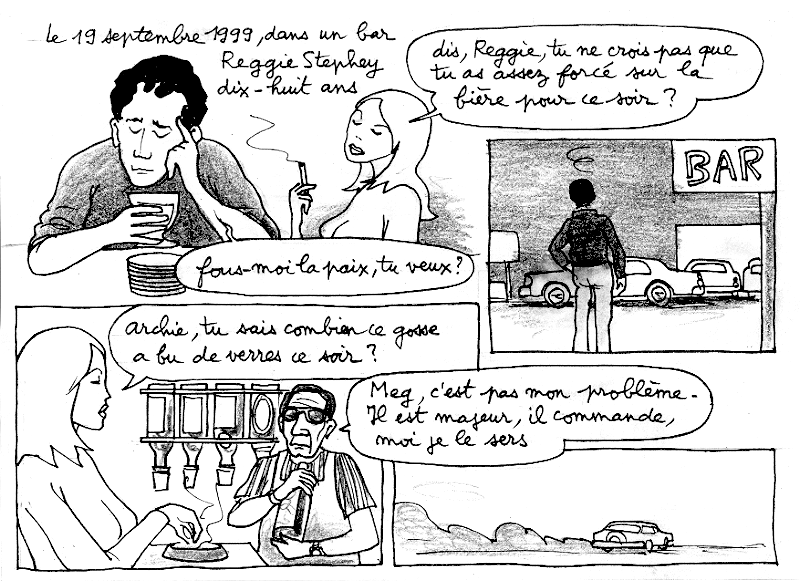
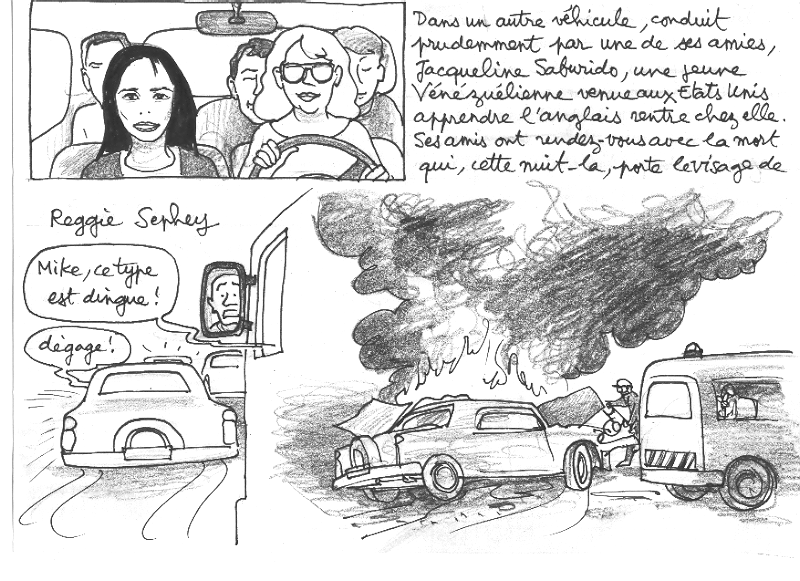
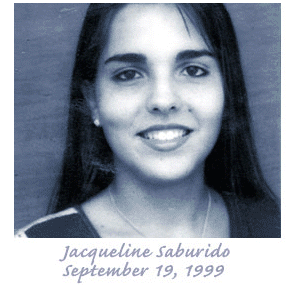
Three of the passengers in the car where the young Venezuelan girl rode were killed instantly. She herself remained trapped in the burning vehicle. Here’s a photo of her before the accident—right side, with her father:
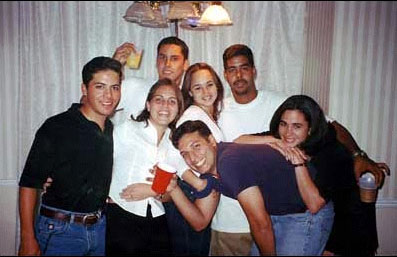
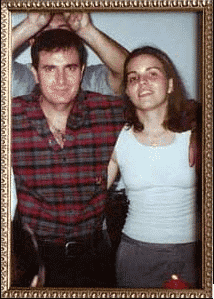
And after the accident:
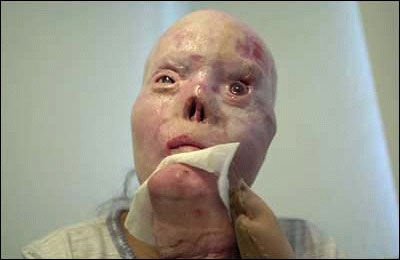
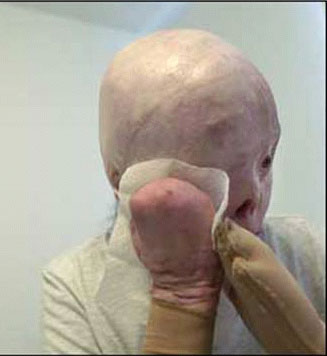
When firefighters finally freed her, she was 60% burned and required forty operations. Her fingers had also suffered deep burns, necessitating almost total amputation of her phalanges.
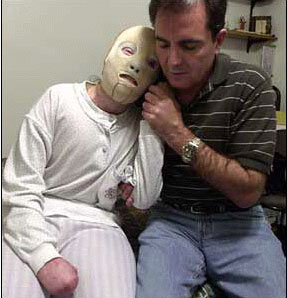
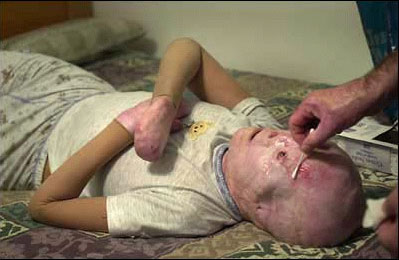
This is what remains today of lovely Jacqueline Saburido. To the right, the driver, Reggie Stephey, who took to the road after drinking too much beer; sentenced to seven years in prison for manslaughter. Behind him, the bars of his cell.
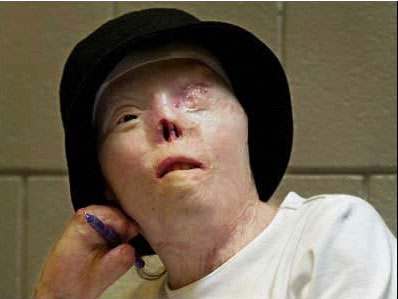
June 23, 2005: Just a passing thought.
In such a tragic tale there are two culprits:
- The young man who drove after drinking
- The person who served him all those beers, assuming this young customer drank them at the same establishment.
Of course, once the “sole guilty party” is apprehended, he’s the one who ends up serving seven years in prison. Imagine that every customer served alcohol has the right to receive a receipt detailing the drinks consumed, their quantity, date and time served, automatically calculating the total alcohol content. In case of an accident, if the customer proves liable and presents this receipt, the proprietor could be held responsible (with aggravated liability if the customer is a minor).
This system is “heavy-handed,” but the consequences of accidents are even heavier. The USA once tried Prohibition; it failed. Here, it’s about automatically managing (modern cash registers are computers too) the amounts of alcohol sold and consumed. A proprietor might be motivated to refuse a customer extra drinks, knowing he could share responsibility should that driver cause an accident due to drunkenness.
If a customer drives after drinking, he knows that detecting alcohol in his blood immediately puts him in a legally vulnerable position, making him an obvious culprit. By demanding a receipt, he realizes he makes the establishment equally responsible for any accident, should the amount consumed render him a public hazard on the road.
This amounts to holding liquor sellers accountable. Given what we know and see regarding drunken driving, such strict measures seem reasonable.
The media never show images like these. It’s a car crash. But consider that daily planes drop napalm bombs which, even if they don’t kill, leave victims in similar condition. Think that while people like Bush, Dick Cheney, Condoleezza Rice, Donald Rumsfeld and many others get fabulously rich without a shred of guilt, every day young American soldiers perish in Iraq and ten times as many return home crippled, disabled, burned, blind. Multiply that number tenfold to gauge the suffering endured by the Iraqi population, all for a war that was nothing but an operation aimed at controlling Middle Eastern oil resources before Western reserves dried up.
I wonder if you’ve seen the film “The Nerve of the War,” an extraordinary documentary on how America’s military-industrial lobby dictates U.S. policy. Two pilots are interviewed—the very men who, at night, dropped four “laser-guided” bombs from their F-117A stealth fighters, supposedly targeting one of Saddam Hussein’s residences, thus kicking off the operation against “the nation possessing weapons of mass destruction.” We hear the younger pilot say:
- There’s something exhilarating about knowing you’re dropping bombs that will mark the start of a war meant to liberate an entire people.
But there were “collateral damages.” Some bombs missed their targets and struck a nearby residential district. In fact, 40% of the bombs dropped on Iraq—which, according to Donald Rumsfeld, “boast unimaginable precision”—regularly miss their targets. Today Iraq’s per capita income is back to what it was in 1940.
We must keep in mind what lies behind these bland press releases. Forty years ago we had the same during the Algerian War.
- An encounter occurred between rebels and law enforcement resulting in numerous deaths.....
History doesn’t repeat itself; it stutters.
March 17, 2007: Sent in by a reader.
Every year, there are still 5,000 deaths on French roads.
You may find the images in this document horrid and unbearable. In reality, they’re terribly commonplace. This is what can remain of your son or client—a young person to whom you served one drink too many. And even this one died instantly, without suffering. Think of “those who survive.”
Drunk driving is a scourge. Why isn’t there a warning message on every bottle of alcohol or beer, just like on cigarette packs? Remember the slogan:
One drink is fine. Three drinks: watch out for the damage