Paragliding: the dangers of the "kite" effect
January 8, 2008
Paragliding is a wing, which only keeps its shape at the mercy of aerodynamic forces. In August 2007 the young son of a reader of my site was killed on his fourth flight. His instructor was having him do "pitch tests" and he ended up in his sail "and was killed after a 500-meter fall.
The first question I asked the mother was "what time was it when the accident happened?". Answer: 12:30 p.m. and it was in the middle of August.
I think that making beginners fly in full sun in the middle of the day presents significant risks, unless the sky was overcast to the point of eliminating all lift. But that was not the case: look at the photos taken during young Ludwig's last takeoff:
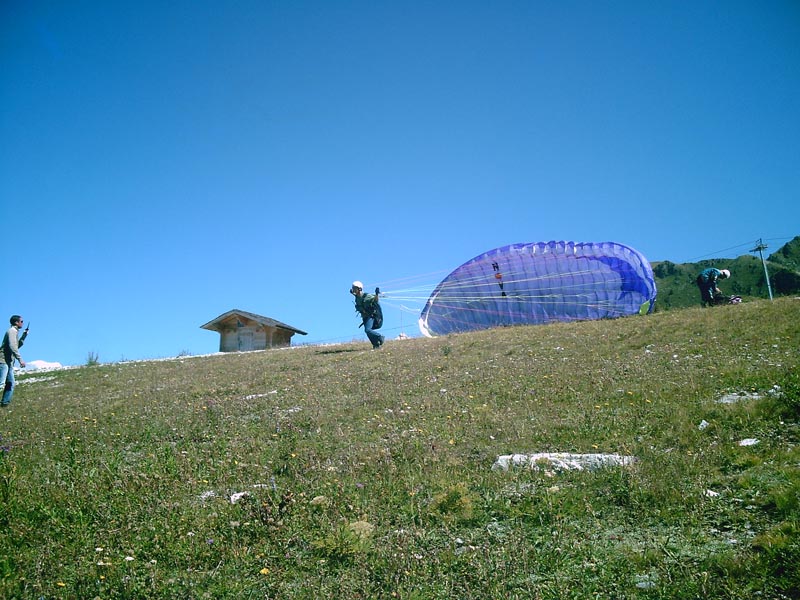
Ludwig's last takeoff
Further on I explain how it happens that any wing, at a very high angle of attack, undergoes an aerodynamic force which, instead of being directed toward the rear of the profile, constituting its "normal aerodynamic drag," is, under these particular conditions, directed .... forward!
It is thanks to this that the paraglider pilot can bring his wing above him, before immediately starting the run that will ensure his takeoff. In the photo above, the pilot has just torn his wing from the ground by pulling on his lines. The airflow then strikes the profile at an angle (relative to the profile) close to 90°. And what will this wing do? It will quickly rise and place itself just above the pilot, precisely because the aerodynamic force pulls it forward (from its profile). Then, having reached directly above the pilot, this movement stops. It stabilizes above him instead of continuing its tipping movement. Quite simply because the profile of this wing is this time attacked at a lower angle and the aerodynamic force has changed direction. It stops pulling this profile forward.
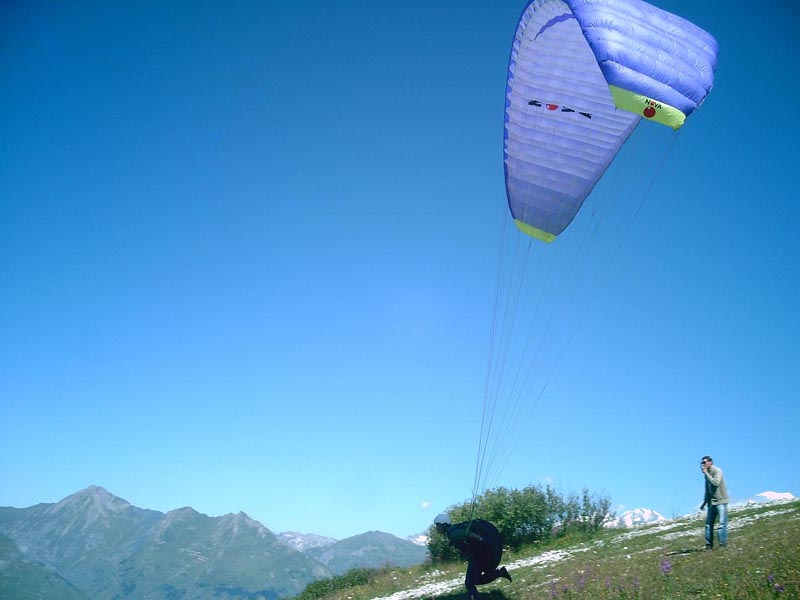
Here the sail quickly came to place itself above the pilot. The latter then begins his run, down the slope, facing the wind, which will bring him to takeoff.
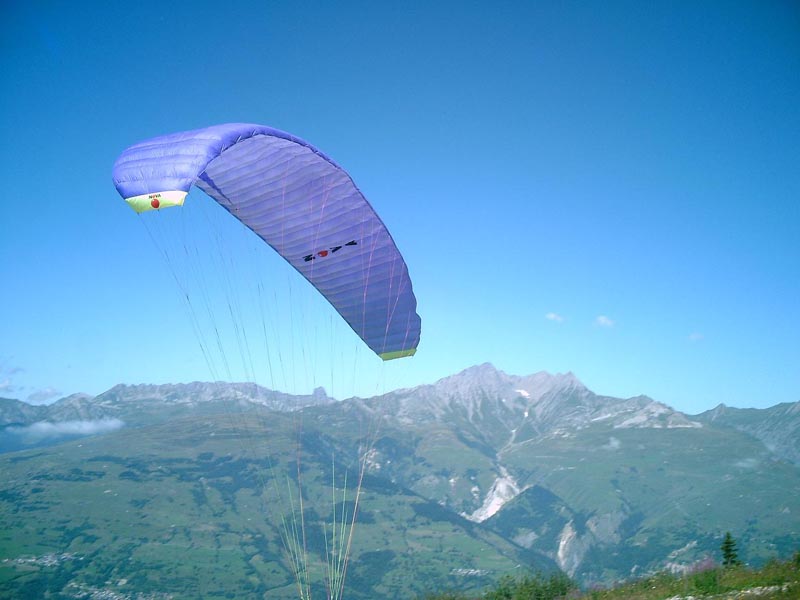
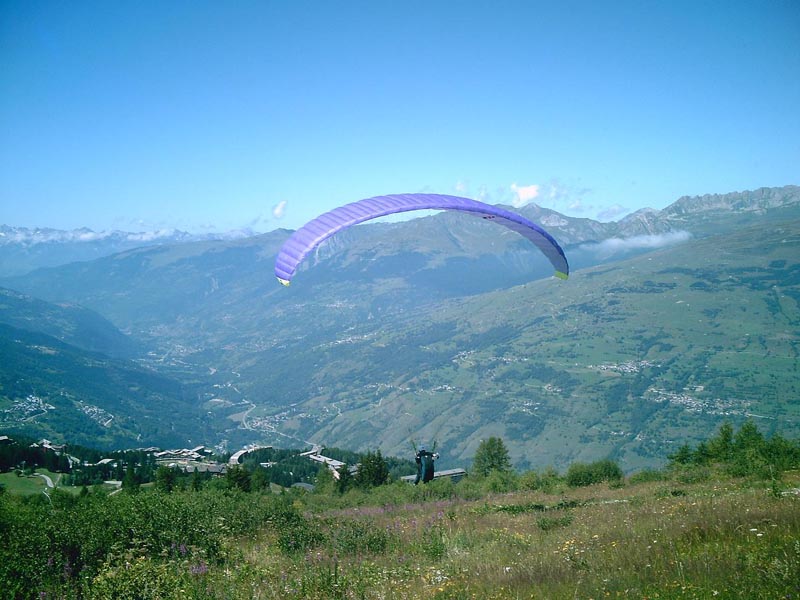
The uninitiated would tend to say to themselves: the weather is superb, it's so calm. On the ground, yes. But the glider pilot knows that as soon as one moves away from the terrain everything changes. At 12:30 p.m. the sun heats the valley. The hot air rises in bursts, called "thermals" which are absolutely not felt on the ground. It is by exploiting these thermals that the experienced pilot will be able to climb and cover distance. The instructor who wrote to me knows this perfectly well.
There are, admittedly, temperature inversion configurations where the valley floor recovers in the morning cold air descending from the mountain peaks, which accumulates at the bottom of the valley and leads to a more stable configuration. That will need to be verified. This is what is called a temperature inversion. But meteorology brings complex, local phenomena into play.
*The only conditions where one can be totally sure that the beginner will not find himself confronted with a thermal burst is a flight early in the morning, when the sun is not yet active. *
I have flown many times in these beautiful blue skies. With a hang glider, these thermals are not to be feared. One feels them as the occupant of a sailboat feels gusts. The rises of hot air do not occur homogeneously. In this mass of air beneath your eyes there are shears, unpredictable, invisible, where the vertical speeds of the air masses are different. Given the time, the clear state of the sky, the season, the sunshine* it is impossible for it to be otherwise.* In a hang glider this lifts one of the wings by a meter as it passes. Precisely, when one grazes a column of hot air, it is on the side of the wing that lifts that it is located and it is in that direction that one must turn to "hook" it. But for a paraglider it is a whole other story. Such a disturbance can fold a wing, quite simply. I have seen with my own eyes, in the Southern Alps in summer, in the middle of the day, a paraglider fold up like a vulgar handkerchief in a blue-sky storm, far from any terrain. The pilot was flying in a straight line, without making the slightest maneuver. He got away with a 50-meter tumble before his wing unfolded again. A violent thermal can cause a stall. If a beginner were confronted with such a situation he could moreover chain mistimed maneuvers.
A beginner on his fourth flight *must *not be confronted with this type of problem. He must fly in air free of lift and turbulence. So early in the morning.
More than thirty years ago my friend Michel Katzman, who was killed in 1989 following the in-flight failure of an undersized "patte à trous," an object of ... 20 grams, had organized the first hang-gliding course in the Queyras, precisely at the Col Agniel. I must have an old photo lying around that I will find again. We had Mantas, real flat irons, descending in horizontal flight at 2.5 m/s. One evening we were facing the valley. The air was fantastically calm. It must have been 5 or 6 p.m. A friend and I said to each other:
*- We're going to have a hell of a flight. It's going to be tremendous, calm and all. *
I have never been so shaken in my life.
We were unaware of the phenomenon of restitution. We were flying fairly close to the ground, over a forest if I remember correctly. The scenery, I don't remember very well, but the jolts, I haven't forgotten. Good grief, I couldn't wait for that flight to end. During the day the sun heats the ground, differently depending on its nature. Above warm places updrafts occur. But when the sunshine stops, the ground cools, at different rates always depending on its nature, its vegetation, it then releases the heat it has received. A typical example is the restitution above a lake, like that of Annecy (the photo in my biography refers to a two-seater flight made above this lake). During the day the sun heats the stony slopes. The hot air rises along the slopes that lead to the Forclaz pass, where a take-off has now been set up with beams and planks, which looks like a diving board. At the end of the day these slopes stop "giving". As the lake water releases the accumulated heat one can then venture far from the banks above the lake in a rising mass of air. But restitution is not always as peaceful, although that is often the case. This to say that one should not trust aerological appearances.
Here is the bulletin sent by the national meteorology service that corresponds to the moment of the accident:

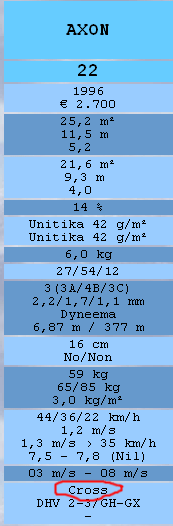
The wing used by this beginner pilot (4th flight) was a NOVA AXON 22. I see that it is given as a cross-country wing. Was it a wing that could be entrusted to a beginner? For such a wing, what is the pilot weight range? I asked my readers who quickly answered. Here are its characteristics:
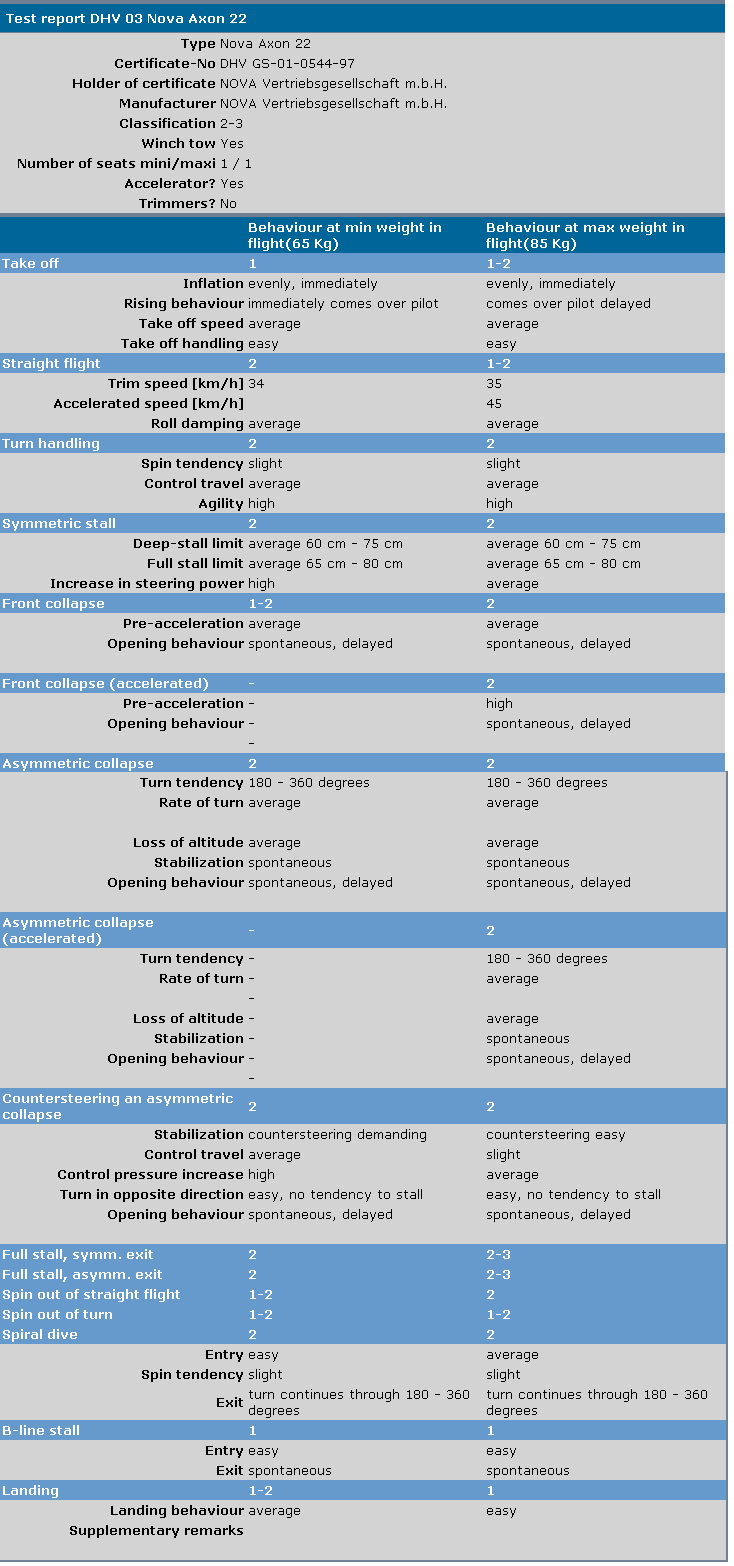
Here are the test results for this wing ( source http://www.para2000.org/wings/nova/axon-22-tests.html (archive of 21/06/2010) )
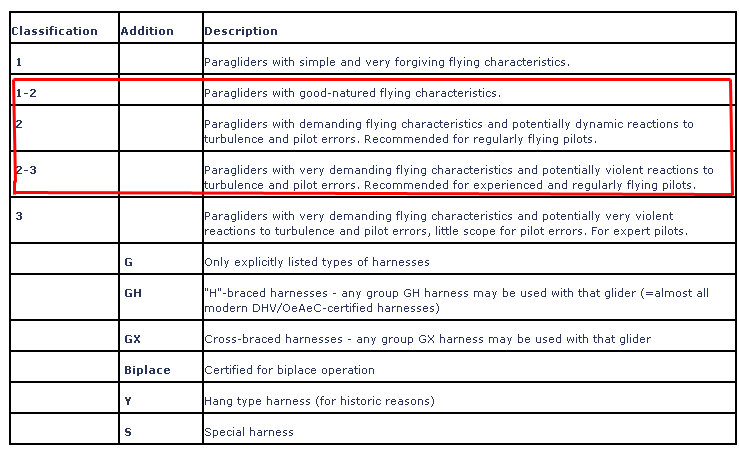
A reader, Luc Ferry, pointed us to this site: http://www.dhv.de/typo/DHV_OeAeC_classifica.831.0.html (archive of 21/09/2011)
Which specifies what these classifications 1 - 2 - 3 mean

Here is what we find:
The most important thing in this report is this:
- Classification 2-3
If we refer to the meaning of the classifications on the site of the DHV organization (which issues the certifications for free-flight craft) here is what that means:
- " Paragliders with very demanding flying characteristics and potentially violent reactions to turbulence and pilot errors. Recommended for experienced and regularly flying pilots ."*
*" Paragliders very demanding in terms of piloting abilities, with regard to potentially violent reactions and piloting errors. Recommended for experienced pilots, flying regularly. *
According to this, it is therefore clearly not a craft for beginners.
11 January 2008: Message from Guillaume Doisy
Hello,
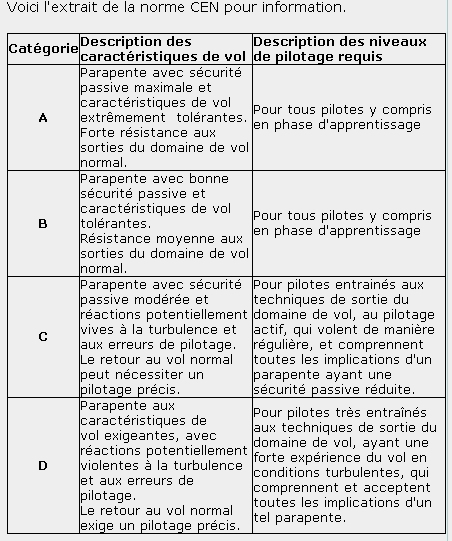
If the wing involved in the incident is indeed a DHV 2-3, then it had no business being in the hands of a beginner. The DHV certification system is a different system than the CEN, but a DHV 2-3 wing corresponds to a CEN C or even CEN D wing.
A beginner must learn to fly on a DHV 1 wing (or CEN A).
Information obtained (from the boy's mother) the wing in question, which is under seal (so its traceability will be fully established) would no longer be manufactured since 1996. It would be more than ten years old. Paragliders are less subject than hang gliders to the phenomenon of fatigue. But over time the flexible wings of ultralights deform. This reduces their performance. A somewhat deformed hang glider wing, insofar as the type suits a beginner, is not a priori dangerous. Provided it does not tear in flight, as happened at Laragne, at the Otto Lilienthal school, with a Cosmos ultralight. The pilot and his passenger were killed and the reserve parachute, not maintained, did not work. But the "Air Gendarmes", before I took this investigation back from scratch, had been content to take photos of the bodies. The Civil Aviation delegate, summoned to the scene, and as incompetent as the gendarmes in the field, was in a hurry to conclude "accident, undetermined cause". I still remember the daughter of this woman, wandering in the center while we were trying to reach the father and the grandparents. In this case the cause was the fact of flying on an out-of-date machine, whose fabric I was able to tear ... by hand.
Let's return to this NOVA AXON 22 canopy affair. It has been established that it was not suitable for a beginner. The fact that it is more than ten years old makes it dangerous in any case. The flight qualities of paragliders change a great deal because of the deformations linked to ageing. But schools buy second-hand wings back from pilots and toss them out as "school wings". In this specific case the main responsibility lies with the school, more than with the instructor. All this will be clarified and will constitute an element of the case in court. The family declares itself ready to do everything to establish the truth. We will help them. Regarding legal action, currently under way, the defence will be able to object that there are no precise guidelines concerning introduction to this sport. We will check this, and it is likely. A friend told me that there was no specific paragliding federation, but that this sport was managed jointly by the hang-gliding and skydiving federations (...). If people have information to communicate, let them not hesitate.
11 January 2008 . Message from Mathieu Daly, trainee paragliding instructor in the Pyrenees
Reproduced with his permission:
Hello Mr PETIT,
I take the liberty of sending you this letter in response to your article on the stall in paragliding.
Generally speaking, you are right: the strong pitch-down (diving movement) of the paraglider on recovery comes from aerodynamics (centre of lift at the leading edge during over-incidences). This characteristic is moreover very useful during the inflation phase since the wing "wants" to rise as soon as the leading edge is shaped in a relative wind.
I was somewhat in the dark before your sybilline description of the accident.... But the information you have just delivered about the equipment astounds me! No, a cross-type canopy (DHV 2-3: which corresponds roughly to a certification in France in the Performance/Competition category) should not find itself above a beginner pilot! Never! Nor a canopy more than 10 years old!
According to the table you present, the PTV (total flying weight (aircraft mass + pilot)) of this wing is 65 to 85 kg. The wing weighs 6 kg, the harness and the rest of the equipment around 10 kg (roughly!), the acceptable pilot mass (clothed) is therefore 50 to 70 kg.
We do not know the aerological conditions of the day, I will not comment on that subject.
Nevertheless, a thought comes irresistibly to my mind: in a consumer act, who is the more responsible? the buyer or the seller?
Let me explain: a paragliding teaching structure that uses equipment 10 years old and completely unsuitable can only survive by slashing course prices ... thus attracting a clientele whose main selection criterion is indeed price!
Is it reasonable to skimp on safety for a few euros? No! If all the clients of paragliding schools reasoned this way, the "black sheep" of this little world would have stopped doing harm long ago.
On the other hand, in our consumerist and de-responsibilising society, the public reasons more and more in terms of obligation of result: I pay therefore I want to fly, without worrying unduly about my safety since I have paid (the instructor will know what to do ...)! In that case the least one can do is to turn rather to a structure approved by the FFVL (admittedly more expensive but bound by a federal charter that defines the equipment and its framework of use).
But the reality is quite simple: the instructor is not at the student's side to act or react in his place: the student IS INDEED the commander on board and it is his actions (directed from the ground by radio) that will bring him (safely or not) back to the ground. This is in any case true in the great majority of paragliding teaching structures. It nevertheless seems that many schools are moving towards a different training, focused on discovering flight in tandem, which could avoid this kind of drama. But let us not dream: this type of course is necessarily more expensive than a conventional course ....
There, I hope this letter has not been too long or tedious to read!
Cordially
Mathieu DALY
A second investigation of the same kind is under way, concerning a microlight accident on a Cosmos trike in May 2008 in which a young girl died, during a first flight. If parents or relatives of the victims of microlight accidents come forward, their file can be examined.
The problem is that the relatives of the victims, when confronted with the drama, are not in a state to react at the time, so crushed are they by grief. I experienced this when my son died. It was only afterwards, by conducting a very painful investigation, that I was able to establish that the witnesses had lied (if only about their number) to cover up a behaviour of failure to assist a person in mortal danger.
In ultralight accidents, the findings are made by gendarmes,* totally incompetent*. They tell any old nonsense to the relatives and families who in any case know nothing about these sports and are not in a position to ask the right questions.. As for the evidence, it quickly ceases to be accessible, disappears purely and simply. Beyond that there is what the father of a victim called *omertà, *the law of silence. The bizness must not be broken. Practitioners who are unharmed are also afraid that their favourite sport will be "put under surveillance", and wish to continue to enjoy their splendid freedom, which sometimes hides risks of which they are not even aware, of which they are not even conscious. Some parents are tempted to withdraw into themselves, telling themselves "that won't bring him (or her) back to life". In the current approach we are thinking of future fatal accidents, or ones leaving victims permanently disabled, due to incompetence and irresponsibility.
In the case of this fatal accident, the instructor, in an email she sent me, tries to shift all the responsibility onto the victim. She protests indignantly against what she considers to be unfounded insinuations. Yet what happens when you look into the wing used, the references having been supplied by the young man's mother? You find fairly quickly that it was not a model for beginners.
Send any message to:

For information, the federation has established a classification of the different types of paragliders. Aeroplanes and gliders are machines offering active safety, in the sense that, at a sufficient altitude, they return of their own accord to normal flight conditions, with the controls neutral. This is the sine qua non condition of their approval. You will note the expression "exits from the normal flight envelope", which would need to be clarified. It is a property of paragliders to be sensitive to aerological conditions or to piloting errors, during which the wing deforms and the pilot must act to give it a normal attitude again. This kind of problem does not exist in hang gliders, where the sail is fixed on an assembly of tubes.
This exit "outside the flight envelope" is linked to the way the paraglider has evolved over time. Parachute canopies (those used for free fall) have fairly low aspect ratios, which means that it is extremely rare for turbulence to be able to render them inoperative and, for example, make one of the suspension lines pass over the canopy, which would require action by the pilot for everything to return to normal (in fact, if that were the case, the manoeuvre would be problematic and the parachutist would prefer to release that canopy and switch to his reserve canopy). I do not even know whether that has ever happened, due to turbulence, after opening.
The performance of a wing, whatever it may be, being directly linked to aspect ratio (albatrosses fly better than pigeons), the performance of paragliders has therefore been increased, at the same time increasing their vulnerability to turbulence. Machines have thus been obtained that are liable "to collapse in flight" (except if they are used in hyper-calm weather, but then updrafts are absent). When this happens, the return to a normal configuration takes place with a loss of altitude, of the order of 50 metres. I know experienced pilots who have been seriously injured because of canopy collapses close to the ground (both legs broken or fractured pelvis). Turbulence occurs at any altitude. A little further on you have the account of Mr Alain G, who had his shoulder dislocated following an asymmetric stall, during the landing phase, due to a gust of wind.
Unless flying in air free of turbulence (and therefore of updrafts), the paraglider therefore presents an inevitable intrinsic danger. Personally I preferred to stay in the field of free flight where this risk is considerably reduced. You can be shaken about, you can risk a dynamic stall if you have negotiated an approach too slowly. But a hang glider does not collapse in flight. That being said, the paraglider has the enormous advantage of being foldable into a bag, and therefore easily transportable. It can be stored in a bedroom, a cupboard. A practitioner can, after having gone tens of kilometres away from his vehicle during a cross-country flight, come back hitchhiking, take a bus, the train, anything. Free flight requires a whole system of retrieval at the end of a "cross" and of transport in general. This is the reason why free flight or hang gliding is almost on the way to disappearing today, in favour of paragliding.
No paraglider practitioner will be able to tell you that this risk of collapsing in flight does not exist, in air populated with updrafts, and therefore turbulent. All practitioners have experienced this kind of event and in fact consider it "normal". And if you add: "what happens if that occurs near the ground?" the answer will be:
- Yes, that's the risk of this sport ....
I have experience as a hang glider pilot, since 1974, and as a parachutist (200 jumps), first in "hemispherical" canopies then using ram-air parachutes, the forerunners of paragliders. .When I moved from hemispherical canopies to ram-air parachutes I was surprised by their behaviour on stall. I will detail that further on.
The hemispherical parachute of course disappeared long ago. By essence it was a system that descended practically vertically. The structure could be deformed by pulling on the suspension lines. There were four of them. By pulling on the two front ones you could move forward slightly. On the two rear ones you moved back, etc....
A very primitive mode of control, linked "to a finesse very much lower than unity". Just enough to avoid an obstacle or try to counter a slight ground wind, nothing more. On the other hand I remember perfectly the rate of descent: 6 m/s.
Ram-air canopies brought real progress compared with these antiques, modulo a greater complexity of packing. In commanded opening, the ram-air canopy requires a well-stabilized position. Thus the beginner is asked to wait 10 seconds before opening, against only three for the hemispherical one. But I will not dwell further on the history of the parachute. Be that as it may, ram-air canopies have a non-negligible finesse and a lower rate of descent than that of their ancestors.
The ram-air canopy subsequently gave birth to paragliding, which is also a ram-air structure, with a higher finesse and a lower rate of descent. But to improve these performances it was necessary to increase the aspect ratio, with the drawbacks that immediately resulted: a greater instability of the canopies, devoid of any rigid structure, in turbulence.
I would like to raise here the question of the stall of this type of canopy. There is no flight without a stall since finalizing a landing consists precisely in provoking the stall very close to the ground. Let us take a ram-air canopy or a paraglider. The pilot negotiates his approach. Near the ground he lowers the rear part of his canopy, which plays the role of a brake. He increases the drag, slows down somewhat then "pulls all the way" when he estimates he can make a ground contact.
It is quite different when the stall is performed outside the landing procedure. A small aside to mention the stall in a "delta" wing. This machine has the same behavior as the airplane, if this stall is provoked gently. The speed decreases. The nose of the craft drops, the machine "bows". In airplane piloting one would say that the instruction is then, for the pilot "to give back the hand", to push on the stick to put the craft into a slight dive. As soon as the speed recovery is sufficient and the angle of attack of the airflow has returned to a normal value, this airflow reattaches to the profile. The lift is restored. In a flying wing, "giving back the hand" is on the contrary pulling the control bar toward oneself (to bring one's weight forward), but the pattern is the same: after a rapid speed recovery, return to normal flight conditions.
All this if the stall is well symmetrical. What happens in the event of an asymmetrical stall?
The flying wing has no "flaps". If the pilot triggers his stall in stabilized horizontal flight, the stall will be symmetrical. On the other hand in an airplane, and in a glider, the pilot can, at the moment of the stall, give a flick of the stick to the side. Let us imagine that he puts the stick to the left. This will accentuate the camber of the right wing profile and reduce that of the left wing. As a result the stall will be accentuated on the most cambered part of the profile. The right wing will sink. At the same time this accentuation of the stall brings about an increase in drag. This is the start of a "triggered spin", the key to "triggered aerobatics".
The first time I deliberately triggered a stall at altitude with a ram-air canopy I was surprised by the sharpness of the reaction, although I had approached the maneuver gently. All those who have had this experience know the reaction of the canopy:
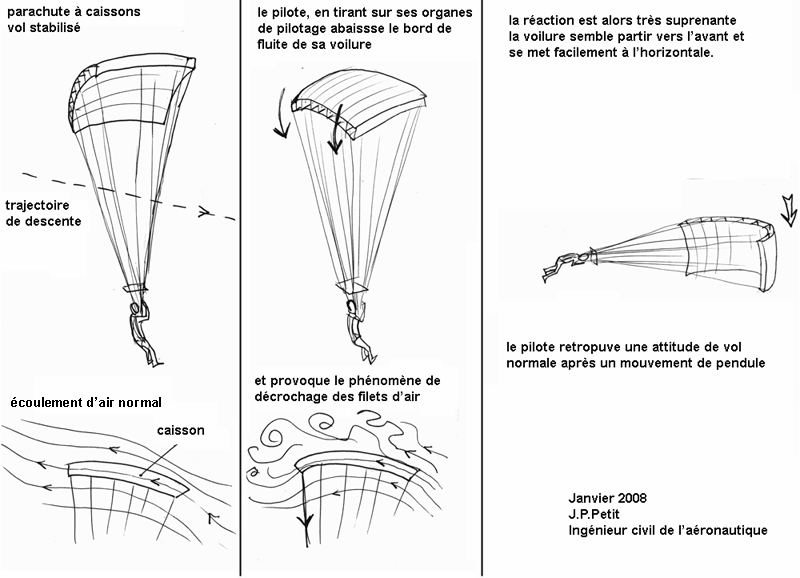
Stall of the canopy of a ram-air parachute.
(Schematic: the air, entering at the front through openings, serves to inflate the canopy and in fact only escapes partially thanks to the porosity of the fabric).
This maneuver is strongly inadvisable near the ground. Indeed the pendulum motion means that the pilot, coming back into contact with the ground in this way, risks breaking his legs. About ten years ago I saw a beginner make a presentation while being "too long". By pulling straight he was simply going to land in bushes, in scrubland and risked damaging his canopy. To land shorter he decided, inappropriately, to pull prematurely. Hence a stall at about ten meters high, a pendulum motion and ... two broken ankles.
In this article, where I incidentally seek the opinion of theoreticians and practitioners of paragliding, I would like to question this behavior, fairly specific to ram-air canopies. I would first like to recall a fact that will serve as support for my argument. The aerodynamics of parachutes is not something as simple as it might appear. Let us take the case of hemispherical parachutes. These are domes pierced at their top part with a hole called a chimney. This is indispensable for stabilizing the canopy. Without this air leak at its upper part, the latter would oscillate endlessly.
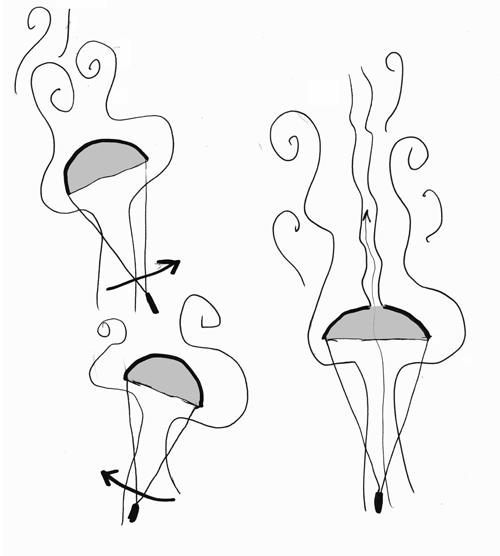
On the left the dome is unstable, oscillates. On the right the flow is stabilized by the chimney
In free fall, body flat on the air, a man's descent speed is 50 m/s. When hemispherical canopies were used, the canopies were extracted from a back pack by an extractor, a sort of "mini-parachute" about forty centimetres in diameter. The drag of this extractor was sufficient to pull the parachute out of a "sleeve" (having exactly the shape of a sock). The air then penetrated through the lower part and "inflated the parachute". But the latter then opened in... overspeed, at a speed close to 50 m/s, eight times its nominal descent speed: 6 m/s. A large mass of air was then driven downwards (induced velocity effect). At the same time, in these parachutes of yesteryear, part of the opening energy had to be absorbed by the elasticity of the suspension lines and canopies. A double effect belonging to aeroelasticity then occurred. The parachutist, stopped in his fall, bounced upwards, while the mass of air accelerated by his canopy caught up with it and partially closed it again. In fact the lower part of the parachute then took the shape of a chimney 50 - 80 cm in diameter, wide enough to allow air to penetrate and reinflate the canopy immediately. All those who have jumped a hemispherical remember this strange impression. When handling the extraction handle, the reflex was to look upwards to see whether the opening was taking place correctly. Let us say that between the moment the handle was pulled and the moment a stabilised descent speed of 6 metres per second was reached, something like two seconds, two and a half seconds must have elapsed. During that lapse of time, if one watched the whole opening sequence, one could see the canopy deploy, then close again, only to reopen again (with a very audible snap at ground level).
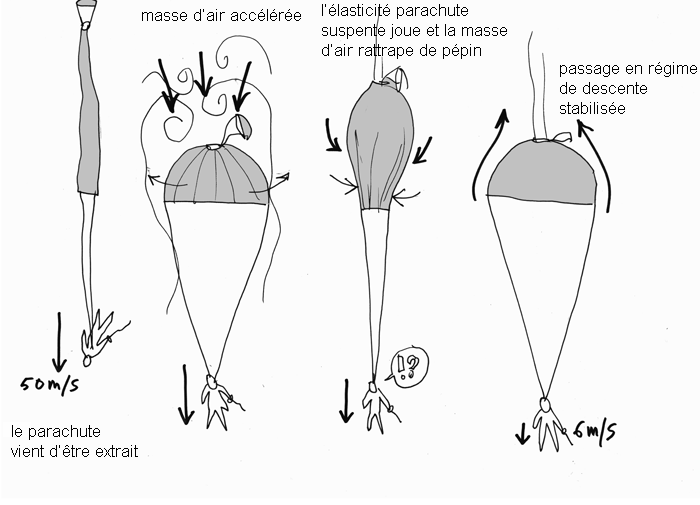
Opening of a hemispherical parachute
You no longer hear, today, that sharp snap of parachute opening. The ram-air parachutes used today are equipped with a very well designed opening retarder. You see it just above the parachutist:
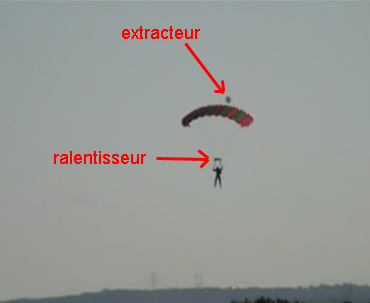
Ram-air parachute, open, showing the extractor above and the opening retarder below
It is a rectangle of nylon fitted with four large eyelets. Through each eyelet runs a bundle of suspension lines. At the time of packing it is placed in the upper position. After extraction of the canopy it slides downwards, until it takes the position seen in the photo.
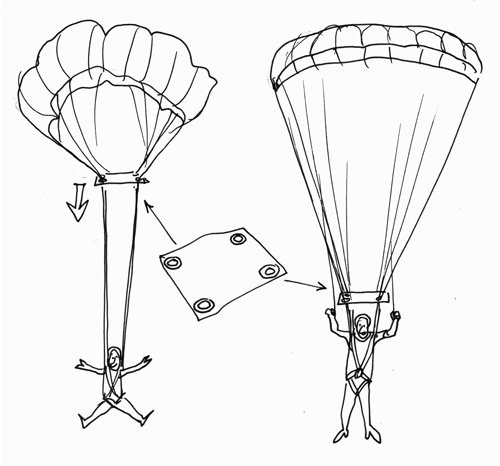
During the opening the retarder descends
I do not know whether the aerodynamics, the flight mechanics of the paraglider is perfectly understood (which would have implied wind tunnel tests that are very convenient to carry out, in unsteady situations).
How does one pilot a ram-air parachute or paraglider canopy? By lowering the trailing edge by pulling on cords attached to that part of the canopy. The pilot therefore has two controls. They cannot be described as aileron controls. These elements play the role of brakes. When one lowers the trailing edge of the right part of the wing, one initiates a right turn. Thus the turn is initiated by an increase in drag on one part of the canopy. In this rotational movement, the part of the wing outside the turn goes faster. A phenomenon of induced roll occurs, well known to glider pilots, which sustains the turning movement. Ram-air parachutes enter turns very easily and the practitioners of these wings, whether parachutes or paragliders, can quickly chain turns by banking steeply. (entering a turn on a hang glider is completely different in nature and the response is also slower). .
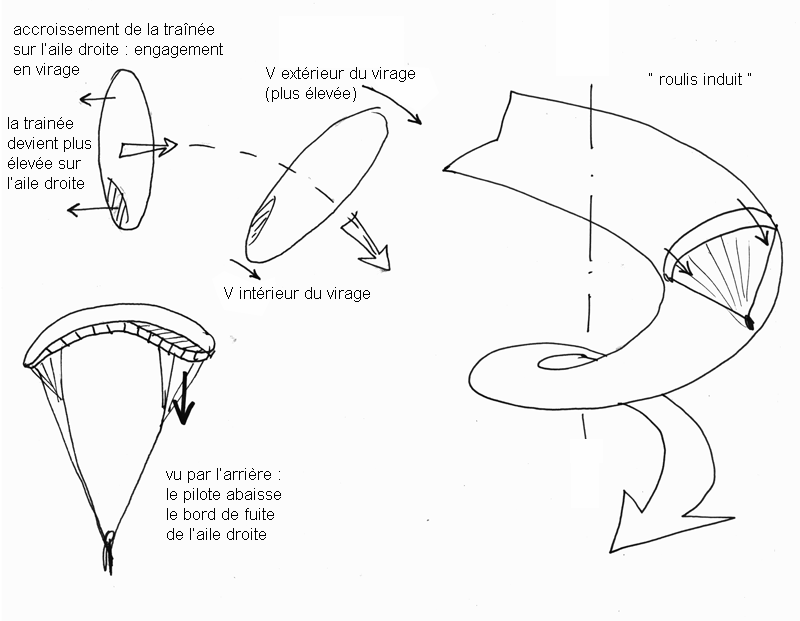
Entering a turn on a paraglider or a ram-air parachute canopy
At altitude the pilot can pull on both controls, right and left, and cause an oscillating movement, typical of the paraglider and the ram-air parachute. By lowering the trailing edges on both sides he increases drag and (tell me if I am wrong) moves slightly forward. If he releases he can thus oscillate on his canopy, forwards and backwards. If he pulls more sharply he can go as far as stall. I do not think I am talking nonsense in saying that the phenomenon should tend to become more pronounced.
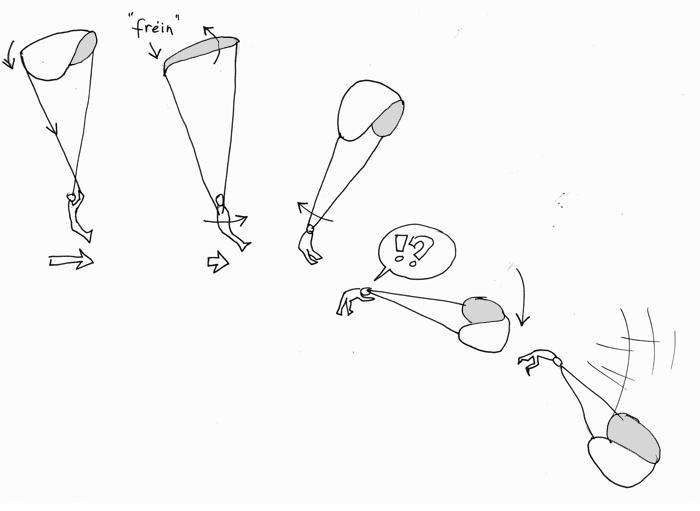
Stall on a paraglider, triggered by the pilot
By pulling on his controls, the pilot brakes his canopy. He moves forward and this pendulum movement increases his wing's incidence, its angle of attack relative to the airflow, so the stall phenomenon is accentuated. Of course the pilot swings back, by pendulum effect, but experience shows that an unexpected configuration appears. I have experienced it myself with a simple ram-air canopy. By triggering a stall gently, the canopy's response is surprising, inexplicable. One easily ends up with the suspension lines horizontal. Why such a reaction?
There are even quite a few paraglider pilots who have told me: "one day I found myself with the canopy right below me, without understanding why, and I was scared stiff!" An experience they did not judge to be among the most pleasant. See the explanation further on, confirmed by the specialists.
The reader will be able to download from my site http://www.savoir-sans-frontieres.com my comic strip " La Passion Verticale " whose pdfs are hosted until July 2008 on the site of the company Eurocopter. On page 6 I illustrated a phenomenon discovered at the beginning of the century which is not the inversion of the drag of a wing, *but the inversion of its projection onto the plane of the wing. *
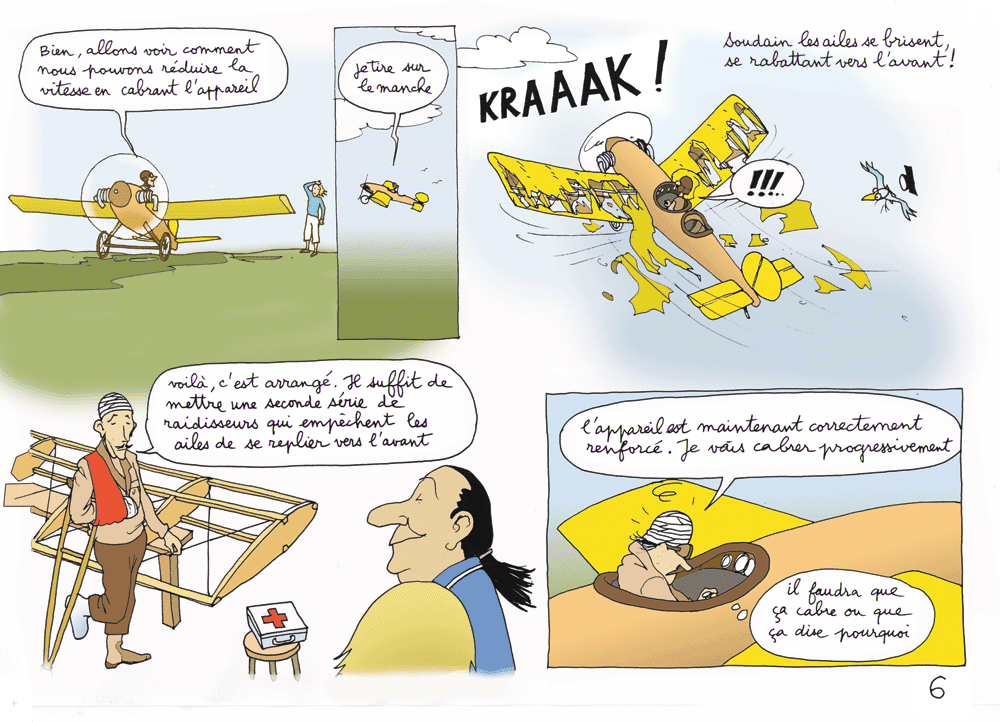
Excerpt from " La Passion Verticale " on the flight mechanics of the helicopter
The explanation is provided two pages further on.
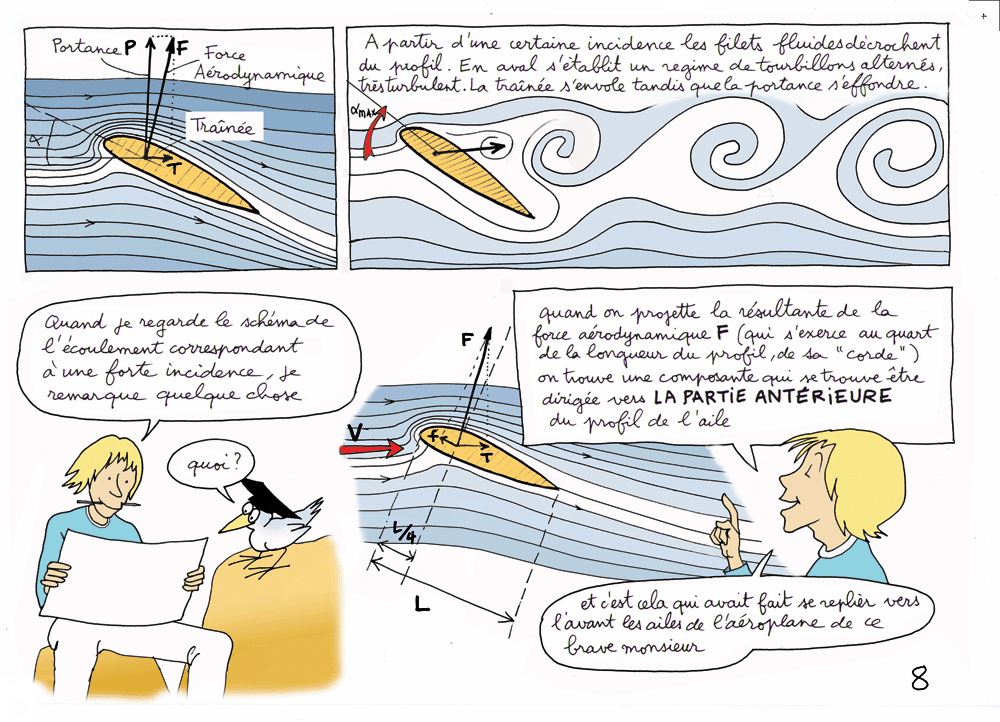
At the top and on the left, under high incidenceFis the aerodynamic force andPthe lift, projection of this force onto the vertical.Tis the drag, projection onto the direction of the speed. At the bottom and on the right the same force F is projected onto the plane of the wing ( componentf). One sees that under this high incidence this force is directed toward the leading edge of the wing and therefore tends to make the wings fold forward.
After the stall configuration the canopy of the paraglider returns to a normal flight incidence ( if the pilot does not fall into it ). It is the transient regime that would need to be perfectly elucidated. It is difficult to study in a wind tunnel. It would perhaps be necessary to equip test canopies with smoke emitters to better understand what happens. One interpretation could be that on leaving the " stalled " configuration the wing profile could pass to a " high angle " configuration where the aerodynamic force would propel the canopy forward, which would explain the configurations so singular sometimes observed.
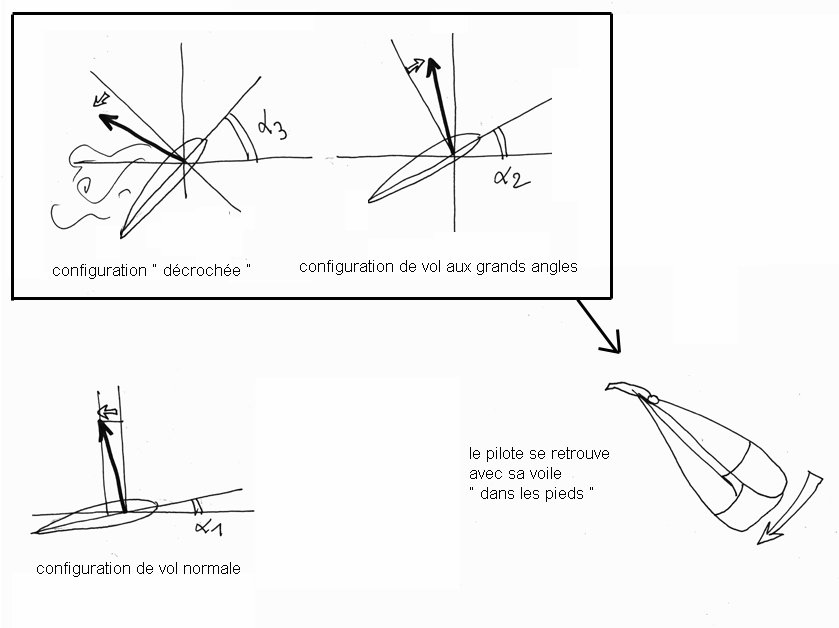
It is the explanation of the brutal departure of the canopy forward, which is thus " self-propelled " by the aerodynamic force that it generates. Go back to the beginning of the page and look at the take-off photos. This direction of the resultant of the aerodynamic force toward the front is immediately obvious: otherwise the paraglider pilot could not make his wing rise above him at take-off. Before taking off he lays his canopy flat, the upper surface being in contact with the ground. Then by pulling on the lines the pilot puts his wing in a position that makes it roughly perpendicular to the ground.
First stage of take-off. The canopy is perpendicular to the ground ( and to the wind ) more or less
The air intakes of the cells, clearly visible, allow the canopy to inflate, to take its shape. One sees the gloved hands of the pilot holding the paraglider lines in the high position. The air streams begin to follow the anterior part of the profile and, correlatively, the resultant of the aerodynamic forces is directed toward the front of the profile, it will pull the wing upward, exactly like a kite. Following image
The canopy continues its ascent to arrive above the pilot. The aerodynamic flow now envelops the whole profile. If the wind is nil it is necessary, for the pilot to leave the ground, that the slope of the terrain exceed the natural descent slope of the machine. &&&
But it happens that the canopy passes under the fellow and that he falls into it:
| In paragliding. Mexico: death live. The guy falls back into his canopy. 700 meters of fall. Video |
|---|
| In paragliding. Mexico: death live. The guy falls back into his canopy. 700 meters of fall. Video |
The " high-angle flight " of the Kite
Who has not handled a kite? These are machines " that fly systematically at high angles ". There is no better illustration of the phenomenon of orientation of the projection of the aerodynamic force onto the plane of the wing, toward the leading edge of the profile: *it is it that makes ... the kite rise. *As long as the kite is attacked at high angles, it rises.
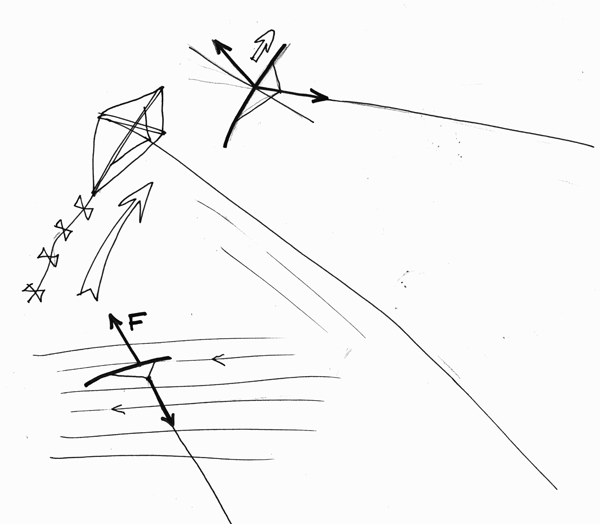
As long as the kite is " at high angles " it rises
When it reaches a maximum altitude, the aerodynamic force tips toward the rear. The kite stabilizes when this force is equal and opposite to the tension exerted by the string that holds it. It has surely already happened to you to pull a kite, at high angles, then, having given it a certain momentum, to see it overtake you and go crash to the ground, nose to the ground.
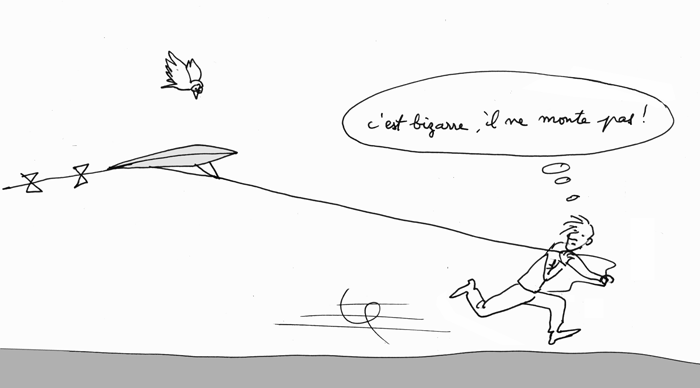
Give it a try. If you build a kite that is not designed for high-angle attack it will not rise.
Wind tunnel tests on paraglider. The dangers of humidity: http://www.shv-fsvl.ch/f/glider/archiv_sicherheit/sicher_0302.htm (archive of 09/04/2008)
In an airplane, a glider, a hang glider, " one becomes one with one's machine ". Whether one likes it or not the paraglider unfortunately has a certain kinship with the kite and one must draw the consequences.
By way of conclusion I will say, returning to the fatal accident to which I refer, that it is a matter of grave incompetence and irresponsibility to make a beginner fly (who was killed on the fourth flight) in very turbulent air (month of August, 12:30!) and moreover to make him "pendulum" with the risk of amplification of these movements (by acting at the wrong moment through inexperience), of stalling with the catastrophic scenario illustrated above (the boy fell 500 metres to his death by "falling into his canopy"). The paragliding school where this accident occurred. All the specialists with whom I spoke about this story were all of the same opinion: a school that allows such errors should be closed. A young man who is killed is no small matter. I hope that the parents of this young man will file a complaint against the instructor and against the school. But they must have been told "that everything had happened normally" and "that they didn't know what could have happened". Unless someone from the school dared to invoke a piloting error.
- He must have panicked.....
No, making beginners fly a paraglider in the month of August at 12:30 is a serious fault.
Before a properly informed judge the case is not defensible.
It is manslaughter through negligence and nothing else.
*As long as these serious failings are not sanctioned, fatal accidents will continue to occur *
| The immediate reaction of a reader, Mr. Albert . G. Hello, Regarding the stall in paragliding you have forgotten a capital element in the attempt to describe the aerological phenomena that occur on the wing, it is the piloting, that is to say the pilot's actions on the sail either at the moment when the wing is going to stall (it "warns" by a very clear slowing down and by a firmness in the controls that becomes dissuasive from going further), or after the effective stall of the wing. If the experienced pilot wants to perform a sustained stall (to "unwedge" a piece of the wing caught in the lines for example) he keeps the controls pushed in after the sail has stalled with a high vertical fall speed, then little by little he "rebuilds" the wing by raising his hands slightly and gradually and thus allows the cells to gradually fill with air and the wing to fly normally again. But at the end of this maneuver, the wing will make a large surge (wing far in front of the pilot) that will have to be controlled. If on the contrary the pilot is surprised by the stall of the wing after having slowed it down too much, he has the reflex to raise his hands brutally, the sail resuming speed too brutally will "shoot" forward until diving far below the pilot. Extremely dangerous phase where the pilot can fall back into his wing as was the case of the young man mentioned in your article on the site. It is a piloting or overpiloting error that I experienced without wanting to and that taught me this. But I confirm this rather frightening sensation of being pulled forward by the wing which sets off at an incredible speed to dive far in front of the pilot. I was just lucky not to fall back into the wing, I fell back between the lines with my helmet torn off by the passage of my head between the lines. Probably this is due to this component f that you describe and which finds itself brutally increased when at the same time the lift and the aerodynamic force collapse at the moment of the stall and which is the only active one in the phase of the wing resuming speed in case the pilot "raises" his hands brutally. Yours. Albert G. PS: this subject interests me extremely for having involuntarily stalled my paraglider with the consequences described above and also because I dislocated my shoulder last summer on an asymmetric stall one meter from the ground in a gust of wind. Paragliding, a sport without problems? Come on .... |
|---|
| The immediate reaction of a reader, Mr. Albert . G. Hello, Regarding the stall in paragliding you have forgotten a capital element in the attempt to describe the aerological phenomena that occur on the wing, it is the piloting, that is to say the pilot's actions on the sail either at the moment when the wing is going to stall (it "warns" by a very clear slowing down and by a firmness in the controls that becomes dissuasive from going further), or after the effective stall of the wing. If the experienced pilot wants to perform a sustained stall (to "unwedge" a piece of the wing caught in the lines for example) he keeps the controls pushed in after the sail has stalled with a high vertical fall speed, then little by little he "rebuilds" the wing by raising his hands slightly and gradually and thus allows the cells to gradually fill with air and the wing to fly normally again. But at the end of this maneuver, the wing will make a large surge (wing far in front of the pilot) that will have to be controlled. If on the contrary the pilot is surprised by the stall of the wing after having slowed it down too much, he has the reflex to raise his hands brutally, the sail resuming speed too brutally will "shoot" forward until diving far below the pilot. Extremely dangerous phase where the pilot can fall back into his wing as was the case of the young man mentioned in your article on the site. It is a piloting or overpiloting error that I experienced without wanting to and that taught me this. But I confirm this rather frightening sensation of being pulled forward by the wing which sets off at an incredible speed to dive far in front of the pilot. I was just lucky not to fall back into the wing, I fell back between the lines with my helmet torn off by the passage of my head between the lines. Probably this is due to this component f that you describe and which finds itself brutally increased when at the same time the lift and the aerodynamic force collapse at the moment of the stall and which is the only active one in the phase of the wing resuming speed in case the pilot "raises" his hands brutally. Yours. Albert G. PS: this subject interests me extremely for having involuntarily stalled my paraglider with the consequences described above and also because I dislocated my shoulder last summer on an asymmetric stall one meter from the ground in a gust of wind. Paragliding, a sport without problems? Come on .... |
The numerous messages that I receive show me that there is a real problem. The explanation of the forward departure of the sail, more violent in the case of paragliding than in the case of the ram-air parachutes of people practicing free fall is confirmed. One reads that when the paraglider stalls the sail becomes totally inoperative, " like a rag ". Its drag becoming significant it sends its pilot forward, by simple inertia. On the return of this pendulum movement the wing loses incidence and will then find " its aerodynamic efficiency " again. But what happens then corresponds to the transient phenomenon of a stall exit. Although the ram-air wing cannot be directly compared to a fixed-geometry wing, the diagrams below enlighten the reader on the phenomenon.
A model maker could demonstrate this kind of behavior with a non-deformable wing, for example in polystyrene, and a radio-controlled model. This phenomenon would then be very clearly highlighted.
I make a parenthesis concerning the beginnings of the delta wing. The Manta (the only wing on the market at the time) killed quite a few people. Then, the same thing with the Exo-7, of grim memory. The cause of the accidents was "the pitch-up". When people started killing themselves I went to see Danis, who was marketing the Manta. His answer, for all the fatal accidents:
- Pilot error!
I did my investigation, with the help of models that I dropped in a dive from the top of a ladder, and understood that when a wing of this kind entered a dive, the pitching moment could quickly exceed the pitch-up moment that the pilot could apply by throwing all his weight backward. Then he was done for. I reported on it in an article that had a certain echo in the milieu. I believe I was the first to say "that it was not only pilot errors but that the machines had a defect that made them dangerous". Manufacturers then invented the "floatings", simple rods of light alloy that keep the rear part of the sail raised, on the wingtips, and bring about the automatic righting of the wing. This system, which immediately demonstrated its effectiveness, solved the problem. But at that time wing manufacturers continued to leave in circulation wings devoid of floatings, which still killed pilots. All that so as not to... lose money. Indeed, if this manufacturer had said "your wing, as it stands, is dangerous. Bring it to me, I will modify it", the customer would have immediately answered "refund me!".
The history of the ultralight was written with blood and unnecessary tears and a lot of incompetence. The record of irresponsibility is inscribed in the history of the ULM where there is a persistence in ignoring the phenomenon, crucial in aeronautics, of material fatigue (which killed my best friend, Michel Katzman, in 1990). One day, at the end of a discussion with the president of the federation of the time, the latter declared to me:
- You know, bad manufacturers eliminate themselves (a form of aeronautical Darwinism)
To which I answered:
*- The people belonging to the group that you form design the machines, manufacture them, sell them. You manage the schools. You benefit from a derogation dating from the seventies which means that these flying machines are exempt from any certificate of airworthiness, which buyers and enthusiasts are most often unaware of. It is the federation that insures the pilots. Buy yourself an undertaker's company, that way you'll win on all counts! *
In those nineties, after the death of my friend Katzman, following the failure in flight of a 20-gram part, an undersized "hole lug", I tried to arrange this situation. My friend Laroze, with whom I had done Supaéro (who limped because of a paragliding accident) was director of the structures department of the école supérieure de l'aéronautique, Toulouse. I arranged a meeting with the technical manager of the free-flight federation, Laroze and me, at the school. The project: to put a young Supaéro graduate on this miserable question of the ultralight. To quickly solve all the problems of strength of materials, fatigue resistance, flight mechanics. The school offered the free use of the Katia simulation software, and its workshops. The doctoral student had imperatively to practice the sports in question, to be a man of the field. That was findable. Engineer-doctor thesis over two years. Laroze and I would have been the thesis directors. Available, free of charge, the school's wind tunnels, the workshops, the technical services. The tests on the structures would simply have been done by the students, as practical work. These sophisticated studies, including the fatigue tests, would not have cost the manufacturers a penny. The federation and the manufacturers declared themselves in agreement to provide the wings and to finance 50% of the cost of the engineer-doctor thesis, spread over two years. It was not a question of killing this sport but of helping the designers and manufacturers not to do just anything and to get out of the "trial-and-error" system, costly in human lives. This thesis would have produced calculation programs, free, running on simple PCs, standards of use (with periodic technical inspections), criteria for retirement. Afterwards one could have hoped that, for example, the ministry of youth and sports would create a "mister ultralight" post for this doctoral student who could have continued his mission by going to the manufacturers, following the evolution, stopping the nonsense in time.
At that time I was in contact with the director of the DGAC, the Direction de l'Aviation Civile, the polytechnician Daniel Tennenbaum, former Ingénieur général de l'armement (therefore a military engineer). When all this progressed, I told him:
*- Everything seems to be going very well. If the DGAC gives us the complement, we can launch this business immediately. *
For the DGAC the financing of half of an engineer-doctor thesis was a derisory sum. Tennenbaum... played dead, refusing to answer my phone calls. Likewise Frantzen, another polytechnician responsible for light aviation at the DGAC, also a former military engineer. In a final letter I wrote to Tennenbaum, with whom I had done Supaéro (he, after the X, as an "application school"):
*- How many young people will have to kill themselves before you react? *
But Tennenbaum had already essentially become a "politician" in the world of aeronautics, and this business of a few deaths in ultralights was the least of his worries. You now know the main person responsible for the series of deaths in ULM and ultralights: the DGAC. I remember the last phone retort from a member of that house:
*- You know, when these people get tired of killing themselves, they'll stop! *
Yeah, right.
But let's get back to the problems of paragliding. When a wing has suffered a stall there are two possible outcomes. One is resolutely non-classical and corresponds to machines that have today totally disappeared, but with which I have flown. One is a glider called the C 25 S, fabric-covered, which can be seen in the final scenes of la Grande Vadrouille, with de Funès. This glider had the capacity to ... parachute. That is to say that one could continue to manage, more or less happily, a stalled situation (which did not mean that it could land like that. But it did not do a nose-dive). Needless to say, this kind of machine has totally disappeared. The second flying machine was the "hang glider" Manta, which could also "parachute". It was linked to its strong sweep (90°). In the seventies I made a few "emergency" landings in "parachute mode". One pushed on the control bar. . The wing totally lost its speed and descended wobbling, like a parachute. One made contact with the ground at a speed comparable to that of the hemispherical canopies: around 6 m/s (which corresponds to the speed one acquires by jumping from a height of one meter eighty. With good ankles one came out unharmed.
V (meters per second) = square root of two "g" x altitude in meters
Take V = 6 m/s, g = 9.81 m/s2, that gives you an "altitude" of one meter eighty. One survives very well a jump from a height of one meter eighty, with a well-negotiated roll, legs together. That was roughly the speed of contact with the ground during a parachutal descent in a Manta. It was not a maneuver one sought, but these wings flew like irons (sink rate in horizontal flight: 2.5 m/s, in a turn one reached 3.5 m/s. The "floating crossbar" had not yet been invented). I landed a few rare times this way because the hazards of my flight and of the aerology had taken me above a wood or houses! Those were the very beginnings of this sport, in 1974.
This is a simple aside. Ram-air canopies "do not parachute". Nor do the wings of gliders or airplanes. If the pilot holds the stick back, on an airplane or a glider, the craft will lose speed, then sink. In the angle of attack of the wing profile, it is the anterior part, close to the leading edge, that will generate a residual aerodynamic force other than a strong turbulent drag. There will be a "Venturi effect" and this will translate into a suction of the profile, toward the front. This suction, which induces a slight acceleration, the airplane or glider pilot does not feel it.
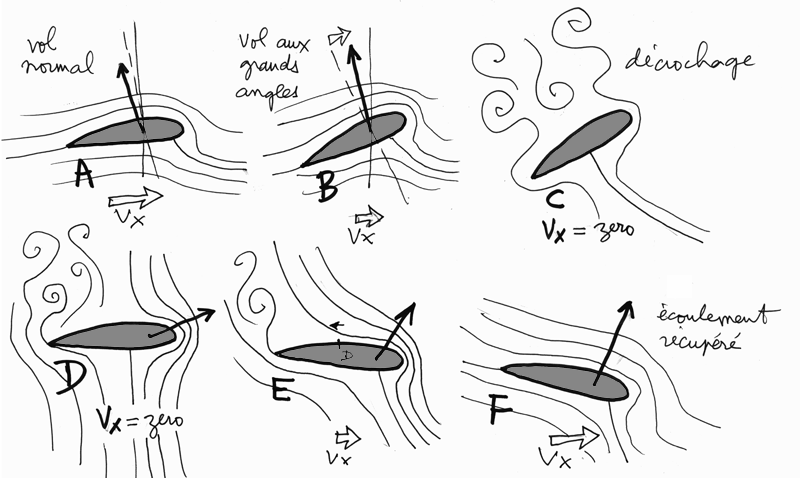
The stall of an airplane or glider wing. Vx represents the horizontal component of the speed. In A, normal flight configuration. In B, flight at high angles, the resulting vector of the aerodynamic forces tips forward and goes beyond the perpendicular to the plane of the profile, although the wing still "drags". In C: the moment of the stall. The stagnation point of the streamlines slides backward. The horizontal speed drops to zero. Lift collapses. Above the profile: a mass of turbulent air. In D, in a momentary, transient "parachutal" descent, the streamlines reattach on the front, which creates an aerodynamic force directed toward the front of the profile. In E, the phenomenon continues during the "nose-dive". The separation point moves back toward the downstream of the profile. In F the flow has reattached over the whole profile.
But in the case of the paraglider, or of the parachute wing where the load-bearing structure (the canopy) and the mass (the pilot) are not closely linked, the stall sends the wing forward, with a violence that surprises. This is specific to the paraglider and this is what makes it dangerous, besides the poor hold of its canopy with respect to turbulence (canopy collapses with a drop of at least 50 meters)
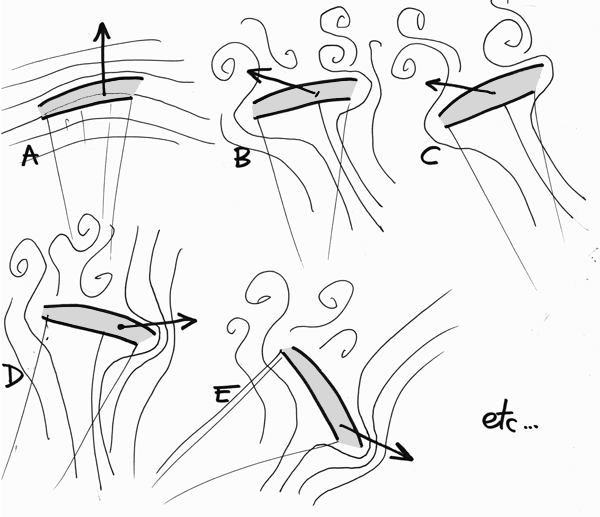
We have here the explanation of the behavior of a paraglider canopy during a stall on a gust. In A, normal flight configuration. In B an updraft gust causes the streamlines to stall. Lift collapses, drag increases. By inertia the pilot goes forward. In C this movement increases the angle of attack and worsens the situation (reaction specific to the paraglider). In D the pilot's pendulum movement back has reduced the angle of attack. The streamlines reattach near the front of the profile. The aerodynamic force then pulls the canopy forward very violently, to the point that it can pass right under the pilot's feet (see the video that follows).
*Once again, this representation of the wing profile is only schematic. The air does indeed enter through vast openings, at the front, which serves to inflate the profile, but the air is closed and if any air escapes, it is only due to the porosity of the canopy fabric. *
Here we have shown a stall due to an updraft of air. If the stall were caused by the pilot pulling on the "brakes" the diagram would be identical. But as Mr. Alain G. noted, the pilot's reflex is then to let everything go, canceling what seems to him to have been the cause of this difficulty. In doing so he only makes things worse. In a paraglider, lowering the rear part acts as a brake. If this excessive braking (in flight in calm air) caused this stall, then releasing these brakes will only allow the wing to perform the maximum pitch-forward. Alain G. testifies that he "went into the lines," quite happy to have come out of it alive. The stall is therefore a fundamentally dangerous maneuver in paragliding, more so than in any flying machine, because to the reaction of the wing must be added the worsening of the phenomenon because the pilot pendulums, modifying, without being able to do anything about it, the angle of attack of his canopy.
Beyond that lies the question of how wings react to these updrafts. There are three possible types of reaction. The healthiest is the one where the wing reduces its angle of attack by itself. The worst is the one where the wing rears up, increasing the angle of attack and the risk of stalls. Between the two, "neutral" wings, which stay flat on the air. The rearing wing must be watched very closely and its movements must trigger immediate control inputs.
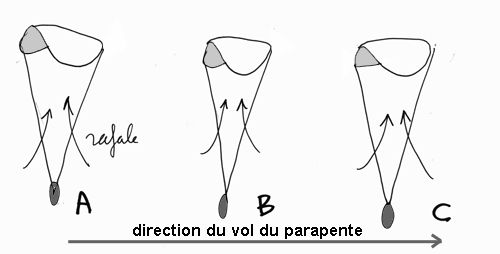
Behavior of the different types of paragliders when they are subjected to an updraft gust. In A the trailing edge lifts. Self-stability, minimal risk. In B the wing stays flat. In C the front of the wing lifts, which increases the angle of attack relative to the air mass and the risk of dynamic stall
For a long time I had been receiving testimonials from paraglider pilots, including pilots with experience of many flights, who told me:
- Suddenly the wing went in front of me and I saw it settle almost under my feet. I didn't understand anything about what happened. I was flying along quietly and it was extremely brutal. I was happy to get out of it cheaply.
Diagnosis: effect of a particularly violent dynamic stall, in turbulent atmosphere
I received from the instructor involved in the fatal accident mentioned at the beginning of the article a long email that takes the form of an aerology lesson for beginners, very condescending. But she remained prudently silent about the radio dialogue she had with the young man who was killed. All of that will be clarified. As for the aerology, that is already done, whereas she writes that it is not the cause. If her responsibility (and beyond that that of the school) can be established, we will see to it that justice is done by providing the courts with all the necessary elements of assessment.
That being said, the general opinion is that fluid mechanics and the flight mechanics of the paraglider remain poorly understood. That is what I have always thought
In the following video you will see that pilots have imagined using this way the wing has of going forward to do ... loopings! In English "tumbling." They can even chain them ("infinite tumbling"). You will see that they practice this kind of eccentricity near the ground. You can imagine the example these images represent for young people seeking thrills.
http://www.youtube.com/watch?v=H8R-zCdDFeg
The game consists of recovering as close to the ground as possible, to demonstrate to what extent one is a "hotshot." You will note that this brilliant demonstration, which will certainly create emulators, (perhaps it gave birth to a new "discipline": acrobatic paragliding flight?) is part of the "Coupe Icare," an event sponsored by the officials, the "those in charge."
I can tell you one thing. If the organizers of this event were really responsible people they would have immediately put a stop to these idiotic exhibitions and would have published a firm warning in the specialized magazines. I suppose these shots must have been taken at Saint Hilaire du Touvet, near Grenoble. These same officials, and the municipality, should have banned these idiots from this site for a year. But on the contrary I imagine that all these people must have thought "that it would promote the paragliding activity, and the site." For information, the ultralight officials are very often equipment distributors, as are the people who own the magazines.
Memories, each more dramatic than the last, come back to me, like another investigation into a fatal accident on an English Striker machine, following an in-flight break-up (instructor plus student killed). A very well-known French importer, owner of a magazine, had bought at a low price these machines, banned from flying across the Channel, where they had killed several people.
At that time the Internet did not exist, but today things may change
These are real crimes, covered by impunity. The parents of the deceased instructor, at the time, knew nothing about this activity. If they had been warned, they would have known that they had to turn against this importer and not against the head of the center, who took good care, omertà oblige, to warn them. Their complaint was dismissed, the courts having been unable to establish any fault.....
Unless I am mistaken, the bloody silt lying at the bottom of the nameless quagmire of ultralight flying may perhaps rise to the surface.
Nowadays there is a trend in "risky sports". There used to be skydiving. We know that all parachutes are equipped with a reserve parachute. In current equipment, when the main canopy has opened badly, for example when it is held back by a line that has passed over the parachutist, he pulls on "his reserve"; he begins by releasing the main canopy and this maneuver immediately triggers the opening of his reserve parachute. This is preferable to the old "belly" formula where the reserve parachute had to be thrown by hand far from the main parachute ("streaming") or else the second would get caught in the first. By releasing the badly opened parachute one increases one's chances of the reserve parachute opening.
But base jump was invented: jumping from cliffs where it is then out of the question to be able to use a reserve parachute. You will find a page devoted to this "new sport", which already has its instructors, its introductory courses, in Wikipedia, where it is specified "that it is not more dangerous than high mountains". The risk is the following. With a ram-air canopy, it starts moving forward as soon as it opens. If in this cliff jump the parachutist has not kept his feet rigorously toward the wall, if he has turned around and opens facing it, he does not have time to turn and crashes into the cliff. But these flight incidents have killed only 113 people, specifies the Wikipedia page. It is therefore ... reasonable.
There was climbing. So free solo climbing was invented and that idiot Isabelle Patissier, a pioneer in the field, even said that "to practice this sport you have to be well in your body and well in your head". Climbing, I have done a lot of it, in all conditions. I was even an assistant instructor, in a Belgian university structure. There are rock flakes that stay in your hands, you don't know why, or pitons whose state of oxidation was not apparent and which also stay in your hand. I have known and I see that in these situations I simply said to myself "old man, if there weren't the rope, you would be a dead man". Claude Barbier, a Belgian climber, a pioneer in this field of solo climbing in the sixties, ended up dying in the Dolomites, in Italy.
There was high mountain. I have also done it. Good heavens, it was already dangerous enough in itself because of the whims of the weather (read "to my mountains" by Walter Bonatti and the dramatic account of the attack of the Red Pillars of the fog, at Mont Blanc, by four super competent and trained mountaineers: two dead). But Solo High Mountain was invented, immediately mediatized and sponsored. Another form of Russian roulette. A star of this kind of sport disappeared recently in the Himalayas. Disappeared body and goods. But Paris-Match chartered a helicopter to take his widow "to pay him a last tribute".
There was diving. So extreme freediving was invented, which killed my son Jean-Christopohe, and many others. The brilliant inventor of this "discipline", "The Big Blue", Jacques Mayol, perished in freediving, but in a different way: he hanged himself. Loïc Leferme, a star for a time (who did advertising in the medical sector for "respiratory insufficients") also ended up staying there. But of course "all this is not linked to this new extreme sport, does not call into question the existence of this discipline". We don't know why Leferme died. "A rope must have gotten stuck". And we will continue....
*The responsibility? The media, quicker to show the stupidities than to point out the dangers, and the federations. *
I had started free fall at the end of the fifties. At that time a few parachutists wanted to launch the fashion of low openings. At the time the opening altitude was 600 meters (that is to say 12 seconds of free fall). Some pulled at 50 meters above ground. The reaction was not long in coming. The responsible federation pronounced six-month jump bans, which immediately calmed these excitable people. It must be said that it is difficult to practice skydiving without a plane having a side door that lends itself to an easy exit. Being banned from jumping at the time meant the impossibility of continuing to jump. But today there remains base jump ....
I have a site that is fairly widely read (3000 readers per day). It worries some people, I know. But without this site, what media gave an echo to these discreet dramas, to this distress of the families, faced with what the father of a young girl who died in May 2007 during a baptismal flight given in a microlight calls omertà, the "law of silence"?
http://parapente.ffvl.fr/ffvl_cts/document/257
Section: fatal accidents in 2003
Throughout the year 2003, we noted that the experience/non-experience criterion was not very discriminating for accidents. This seems to be confirmed for the most serious of them, the deaths.
http://parapente.ffvl.fr/ffvl_cts/document/370
Accident data 2004.
Thursday, 31 March, 2005 - 23:00 by Webmaster CITS
FREE FLIGHT ANALYSIS Tandem accidents There is a 20% increase in the number of tandem accidents on an 8% decrease in participants. Overall the accidents occurred on take-off and landing. It seems that tandem flying takes place in conditions that are often at the limits with equipment whose behaviour increasingly resembles that of performance paragliders (asymmetric collapses, frontal collapses, stalls, etc.). Passengers pay a heavy price (lower limbs mainly) for take-offs at too low a speed, landings in turbulent conditions, as well as poor receptions following frequent poor flares. Are the passenger briefings sufficient? (Do not sit down before being in flight, ensure a real take-off run, landing run, etc. …) Is the weather taken sufficiently into account? (stalls and hard landings due to the gradient). Accidents with possible equipment problems A few years ago we noted a decrease in in-flight accidents. It is in the upsurge of asymmetric collapses, frontal collapses and the increase in stalls that we must question the level of the equipment, or the insufficient training of the pilots having access to this equipment. Under the pretext of a supposedly higher level of passive safety
The main causes of the accidentology
Overall analysis in paragliding
|
|
source : http://parapente.ffvl.fr/ffvl_cts/document/533
Section : Fatal accidents 2005 :
2005 Report There were 8 fatal accidents (7 paragliding/1 hang gliding, a Luxembourg airline pilot, FFVL member), all in solo flight, among FFVL members, for 360 accidents in total with 18 hang gliders involved (5%), the rest (95%) being paragliding. These fatal accidents, obviously intolerable like all accidents, represent a rate of 0.26 per thousand or 0.026% since the FFVL counted 30291 members in 2005. The distribution over the year of the fatal accidents (March (2), May, June, August (2), September, October) once again shows the famous "peaks" of spring (the resumption) and summer (heavy activity, holidays) The average age slightly above 45, i.e. also slightly above the federal average, average weight 69 and average height 1.76. But for this kind of calculation on a very small number, the unfortunate death of a young girl of 20 skews the figures, which are usually in the French average. None of the 8 victims, 7 men, one woman, used or was able to use their reserve parachute and 4 of the 8 were carrying one, i.e. 50%. (for the others it is Not referenced, NR) 4 had a Mousse bag and this type of device is not referenced for the others. 4 fatal accidents occurred in flight and/or just after take-off (closure, impact) 4 accidents are due to an asymmetric closure. 1 to a stall The other causes are not detailed Two deaths took place in competition, which is statistically enormous and contradicts certain claims that competition is no more risky than the rest of the practice. One might perhaps think that the level of the competitors protects them from minor accidents but exposes them to more serious accidents? One death in a school, 2 on group outings, 3 in individual practice When indicated, 4 normal wind conditions (<15 km/h) and two strong, from 16 to 30 km/h, are found. The others NR 7 of the 8 deceased had a flying licence and a very large experience, > 5 years of practice. The 8th is not referenced on this item. 5 of the 8 had a regular daily or weekend practice and the others a more occasional, seasonal practice. Conclusion of caution: It must therefore be remembered that fatal accidents in free flight are mostly the consequence of an in-flight closure of the paraglider, near the ground or with late reopening, particularly after take-off. This nevertheless suggests conditions not so calm as that even if the wind recorded is rather weak on average... They strike experienced pilots practising rather regularly, around 45 years of age on average. Competition, generally well supervised, is however not a shelter against fatal accidents insofar as it sometimes offers the opportunity to go beyond one's limits. The death statistic of 0.26 per thousand (0.00026) confirms that free flight remains a "risky" sport and that the fatal risk is entirely comparable to that of other "risky" and/or outdoor sports. The death of a student will always remain difficult to accept.
http://parapente.ffvl.fr/ffvl_cts/document/565
Spiral instability alert: 2 fatal accidents
Wednesday, 19 July, 2006 - 23:00 by Webmaster CITS
2 fatal accidents took place in less than a month in paragliding; in both cases the pilot had not come out of the 360s he was performing. Beyond the inevitable investigations, we already wish to react by inviting you to (re)read the articles we had published on this subject:
Be aware of your limits and of the behaviour of your wing before undertaking such manoeuvres. |
|
http://parapente.ffvl.fr/ffvl_cts/document/623
Section: fatal accidents in 2006
A very regular practice does not protect against the fatal accident which occurs mostly in the landing phase or following closures, the fundamental flaw of paragliding. Note that the engaged spiral can be quite radically deadly. It can never be said enough that, as in all aviation, this figure must be approached with extreme caution and a great deal of lucidity. The considerable physical stresses undergone by the pilot can very effectively put them in a state where they are unable to fly anything at all!