If you fly a Cosmos pendulum ULM equipped with a Chronos 14 wing, please read this document and check your machine.
Text updated on July 12, 2007
If you fly a Cosmos pendulum ULM equipped with a Chronos 14 wing, please read this document and check your machine.
It took me years to be able to share my testimony here regarding a very serious accident suffered by my friend Robert Dalmau and his passenger-client, Alsio Origlio, which left both of them permanently disabled. Dalmau can no longer walk; he drags himself along. The neurological damage he sustained turned his life into a true hell of suffering. I have no idea what happened to his passenger-client—I don’t know his identity or the injuries he sustained. This accident occurred in France, at Gap Tallard airfield on May 26, 1997.
Dalmau considered himself somewhat of an official pilot for Cosmos, a pioneer in the field of pendulum ULMs. By checking their website, I see that this company is the world leader in selling pendulum ULMs. These wings look like this:
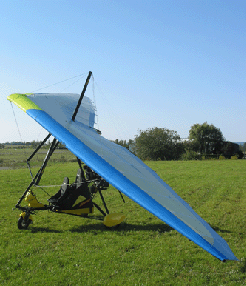
Pendulum ULM
This isn’t a photo of the Cosmos wing involved in the accident, but it closely resembles it.
The offending Cosmos pendulum was equipped with a Chronos 14 wing mounted on a “bidulum” Cosmo carriage.
Just recently, in July 2007, I verified that there are indeed Cosmos pendulum clubs equipped with Chronos 14 wings (at the ULM Aeroclub in Nivelles, Belgium). I just spoke to Robert on the phone; he believes there must still be machines fitted with such assemblies in service.
Therefore, I strongly urge all owners of carriages equipped with Chronos wings to perform this check immediately!
Here are the facts.
I’ve known Dalmau since the mid-1970s. He was one of the pioneers in pendulum ULMs and a promoter of flying such aircraft. He had an impressive number of flight hours. Occasionally I would rent his machine to go for a ride from the airfield where he was based, in southern France. The pendulum ULMs of that era were great fun; lacking any fuselage, they gave the impression of being “the bicycle of the air.” You could see the void beneath your feet.
One day in 1997, I came to Tallard airfield with two friends who wanted to take their first flight on such a machine. When we arrived, Robert Dalmau had just landed after a flight with a client. An experienced pilot, he sensed “that the machine was pulling to the left.” He decided to detach the wing and examine it. I helped him carry out this operation. When we saw the leading-edge–transverse joint, I gasped. At the time, I made extremely precise sketches, which were used by the aviation expert appointed during the lawsuit Dalmau filed against Cosmos. Precisely because these drawings were essential evidence in the case, I couldn’t mention them for years, throughout the entire trial, lest they become legally invalid. For now, I haven’t been able to find these drawings in my archive CDs. I just spoke to Dalmau on the phone; he said he’d retrieve them from his lawyer, Maître Magret, who lives in Bordeaux, and send them to me. As soon as I have them, I’ll scan them and add them to the site.
So, this is merely a preliminary schematic description.
A pendulum wing is attached to a frame made of lightweight alloy tubes—see top diagram. This frame has two leading-edge–transverse joints (floating). In the assembly Dalmau and I examined, both tubes were secured by a single threaded rod running their entire length and bolted in place. At both ends, cables forming upper and lower guy wires could be attached. As seen, the lower guy wires attach to the horizontal bar of the “trapeze.” Both of these guy wires endure significant tension. The bolt passing through both tubes thus undergoes tensile and bending stresses.
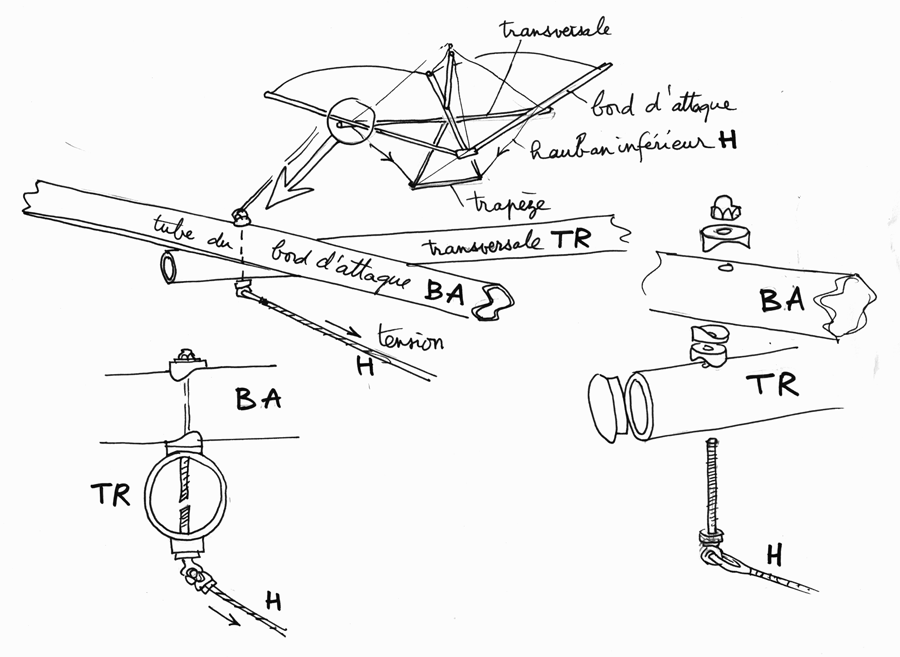
Diagram of leading-edge–transverse assembly
In the assembly of this Chronos 14 wing on that “bidulum” Cosmos machine, one can see how this lower guy wire H subjects the threaded rod running through both tubes to bending stress. Between the tubes, there are plastic coupling pieces. But inside the tubes, there’s no sleeving! Sleeving would have prevented the rod from bending.
Such an assembly is completely absurd.
As shown in the left-hand drawing, successive stresses on this assembly caused the threaded rod to break right in the middle of the leading-edge tube. A threaded rod is not well-suited to alternating bending stresses; in fact, it’s the worst possible choice, since the threads themselves are points of potential fracture.
Fortunately, the system stayed intact thanks to strong lateral tension—see left drawing.
Actually, the actual assembly condition was even worse. Once I have the original drawing, readers will understand. I don’t want to reproduce anything imprecise from memory. There was another flat piece, 5 mm thick, which was split over 5 cm; only 1 cm of metal remained. The conclusion was that Dalmau and his companion were very lucky that day. Had he not performed that inspection, the two young women who came with me for their first flight would undoubtedly have suffered a serious accident alongside pilot Dalmau.
I personally wrote three letters:
- One to the manufacturer.
- A second to the president of the ULM federation.
- A third to the magazine “Vol Moteur,” in the form of an informational article I wished to see published.
No replies.
Some time later, I learned that Dalmau had suffered a serious accident on a Cosmos machine with a Chronos 14 wing.
Sometimes people “don’t heed warnings.” Months after discovering how poorly these wings were built, Robert bought... another one, second-hand.
“The wing seemed sound,” he told me.
Those were his own words. It had 200 flight hours. Robert didn’t perform the same inspection we did together. The break occurred at takeoff, when he was ascending with a client. This time, the threaded rod was ejected, still attached to the lower guy wire. The leading edge didn’t break, but the wire wrapped around the propeller shaft, exerting violent tension on the trapeze, which Dalmau couldn’t control. The machine went into a dive and crashed to the ground.
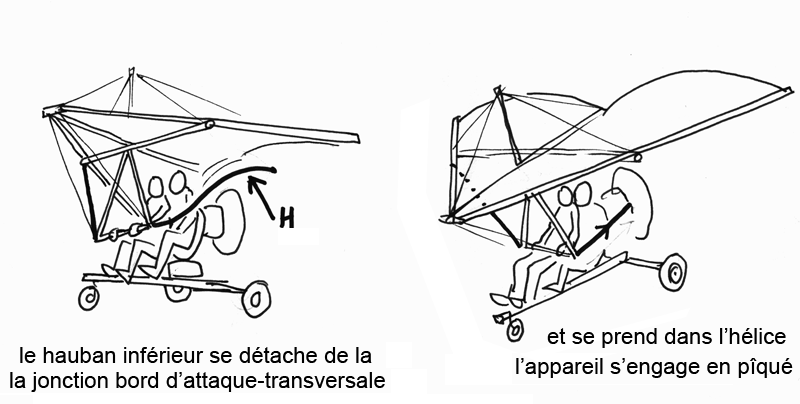
Accident involving Cosmos, Chronos 14 wing, May 1997. Pilot: Robert Dalmau. Passenger: Alsio Origlio. Location: Tallard airfield, France
Following this accident, Cosmos issued no warning notices to buyers of this type of machine (according to Robert Dalmau).
So... these are the facts.
There’s a third phase to this story. After this serious accident and while the lawsuit was underway, I was flying a delta in the High Provence Alps region. There, a man in his thirties ran a shop-restaurant-dormitory for pilots. Occasionally he gave introductory flights on a pendulum machine identical to the one that broke after 100 flight hours. I warned him. The following year, I visited him again to buy a variometer.
“So, what about that wing?
-You were right. The assembly piece matched the drawing you showed me.
-What did you do then?
-I wrote to the manufacturer asking if this part might be problematic. He replied by mail saying no, provided I replaced the bolts as specified in his manual.
-And then?
-I changed those bolts and sold the machine to a client.
-Did you warn him about this potential problem?
-Uh, no...”
No, simply no. Protected by that letter, he calmly sold a machine he no longer felt safe flying.
This reminds me of a statement by a ULM center manager a few years ago:
“Our training machines are accumulating quite a few hours. We should think about selling them off...”
There’s a ULM airfield in Nivelles, Belgium. There fly aircraft resembling light two-seater planes with cockpits. In a hangar, I found two Cosmos pendulum ULMs, probably equipped with Chronos 14 wings. Jacky Tonet, currently working on developing a light helicopter prototype, the H2S, for Dynali, is a former designer of “three-axis” ULMs. While inspecting the Chronos wings on those Cosmos machines, I found zippers which serve as “access panels” for mounting these wings. We looked at the transverse-leading-edge joints. Naturally, they’re secured via bolt-and-nut systems, from which the upper and lower guy wires extend. But what about the rest? Was the connecting rod sleeved? I brought this up to Jacky Tonet, suggesting he advise owners of these machines to perform such checks. Logically, the assembly must have been improved and modified accordingly. What we discovered with Dalmau was truly absurd.
I hope Jacky Tonet informed those people. Even if these assemblies have since been made safe (Cosmos can provide a diagram of today’s transverse-leading-edge joint system), one question remains.
Are there still machines with such risks of failure still in service?
Procedurally, Robert Dalmau’s passenger, Alsio Origlio, filed a complaint against X, which immediately pointed to Robert Dalmau, owner of the machine. He, in turn, sued Cosmos. After a five-year trial, Cosmos was declared liable and the passenger received compensation of 60,000 euros (400,000 FF). Two-thirds of responsibility fell on Cosmos, one-third on Robert Dalmau. Both insurance companies—the pilot’s and the manufacturer’s—paid the costs.
The manufacturer’s insurer, probably unaware of mechanical subtleties, didn’t hold the maker responsible for manufacturing defects and paid in full. True, back then (and perhaps still today) anyone could make anything, however they liked. Under what design and manufacturing standards could the insurer have taken legal action against the manufacturer?
What’s shocking is that Cosmos left two people disabled due to an undeniable technical flaw, without paying a single cent. I wonder if the insurer could still sue Cosmos; if so, based on the technical file and description of the faulty part, it would easily obtain countless testimonies from aviation and materials experts confirming that this assembly was absurd. Conversely, it would be very hard for Cosmos to find specialists willing to say otherwise, unless they wanted to instantly discredit themselves. Once I retrieve the court drawings, I’ll publish them. Dalmau is retrieving them now.
The path of companies designing, selling, or importing ultralights—motorized or not—is littered with deaths and disabilities. In this particular case, had the insurer prevailed, it might have set a precedent and prompted manufacturers to pay more attention to their assemblies.
Upon reflection, this is the only thing that could have altered the course of this tragic story, given the utter indifference of authorities since this sport emerged.
Is there any regulation specifying the lifespan of ultralights, or is everything still left to artistic ambiguity? Are ULMs still exempt from keeping a flight log, aircraft handbook, or undergoing periodic technical inspections? Following Dalmau’s accident, did Cosmos issue a press release (there’s a specialized press in this field, such as Vol Livre Magazine) warning owners of these machines of possible fatal risks? As stated on this page, experience shows other equally dangerous machines remain in circulation. Are there still any? Does Cosmos plan to post a warning on its website?
Robert Dalmau, declared 75% disabled (plus chronic pain), has yet to receive any compensation. He can be contacted at his home:
Robert Dalmau Les Hugues 05130 Tallard
and at the following email address:

Back to News Back to Guide Back to “Dangers” summary Back to Home Page