To find this addition: Is ultralight flying a dangerous sport?
Text updated on June 23, 2001, then on July 12, 2007.
Is ultralight flying a dangerous sport?
Jean-Pierre Petit
Former student at the French National School of Aeronautics in Paris.
...I can imagine fans of these sports feeling nauseous at the mere thought of it. One could indeed ask this question about any aerial sport, or any sport in general. It all depends on how it’s practiced. Any fool could decide one day to cross the Mediterranean Sea in a sailboat or to roller-skate along a highway. The term “ultralights” encompasses what was once called “hang gliding,” paragliding, powered paragliding, and ULM (ultralight motorized aircraft). These activities have one thing in common: they’re not subject to any regulations whatsoever, unlike gliders, skydiving, or light aviation in general. (&&& I wrote this in 2001. A reader will tell me if this situation has changed by 2007.) No one can jump with a parachute they’ve made themselves, nor practice this activity outside of properly authorized supervision (except in what’s known as “cliff jumping”). Nevertheless, accidents do happen in all sports. In gliding, the main danger is mid-air collisions. That’s why all pilots and passengers wear parachutes. Such collisions can occur high up in the sky when two gliders get too close to each other while riding an updraft. But experienced pilots love mountain flying. In “ridge soaring,” the glider follows the contours of the terrain, benefiting from updrafts caused by favorable wind directions. Another glider pilot might have had the same idea, at the same altitude but... in the opposite direction. Gliders are white; snow is also white. It’s not uncommon for two gliders to cross paths at 250 km/h, each noticing the other only at the last moment. Every year, people lose their lives in this little game.
...In short, many sports are potentially dangerous. The key is knowing under what conditions they can be practiced, and what their safety limits are. In gliding, ridge soaring in mountainous areas represents the greatest risk. The easily-distracted should abstain.
...One can also get seriously hurt while skydiving. Equipment has improved considerably since I made my first jumps in the late 1950s. It’s still possible to have a bad deployment (due to poor positioning or folding errors). A quick note: at skydiving clubs, beginners fold their own parachutes, but the process is monitored at two stages by a certified inspector, who signs off on each parachute before every jump. When parachutes reach the end of their useful life, they’re marked with a “jump log” and then retired, destroyed. They aren’t sold secondhand to just anyone (in ultralight flying, everything gets resold without any technical checks &&& text written in 2001. But I assume that by 2007 nothing had changed).
...When a parachute deploys improperly, it becomes a “torch,” with a descent speed of 25 m/s (50 m/s in freefall). A “torch” parachute is basically a mass of nylon fabric twisted around its suspension lines, flailing above the skydiver without slowing his fall at all. In the past, one would deploy his “ ventral parachute.” The manual advised throwing it “as far away as possible” so it wouldn’t immediately tangle with the dorsal “torch” parachute. Today, a handle system allows two actions to be performed in sequence: first, the poorly deployed parachute is jettisoned; then a slightly smaller reserve parachute is opened.
...Today, parachutes—a luxury item that didn’t exist before—are equipped with an automatic opening system triggered by a certain threshold of barometric pressure (hence at a minimum altitude), in case of emergency. The minimum deployment altitude has also been raised from 600 to 800 meters. The era of death-defying champions of low-altitude deployments is over.
...For all those enthusiasts, there remains cliff jumping, far from prying eyes. But freefall itself is already quite a “hair-raising” sport. To add more risk, one really must love being close to death.
Preliminary question: How does flying work?
Why and how do airplanes fly?
...On one of the two CDs I distribute, you’ll find a comic strip, “L’Aspirisouffle”, entirely dedicated to this topic. It explains, among other things, why an airplane wing—whose job is to push air downward—experiences both drag and a pitching moment in return.
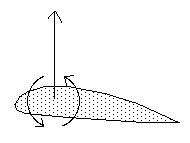
The pitching moment of an airplane wing.
...That’s why airplanes have tail surfaces. Positioned negatively, they counteract the wing’s pitching moment; the fuselage acts as a lever arm:
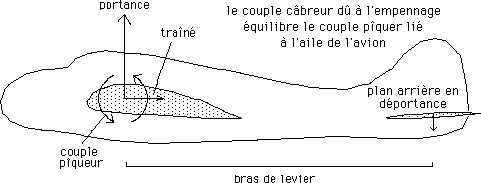
The restoring moment produced by the tail counteracts the wing’s pitching moment.
...This system gives the airplane pitch stability. Indeed, if a disturbance alters its attitude by increasing the angle of attack, as shown below, the restoring moment from the tail automatically brings the airplane back “into its flight pattern.”
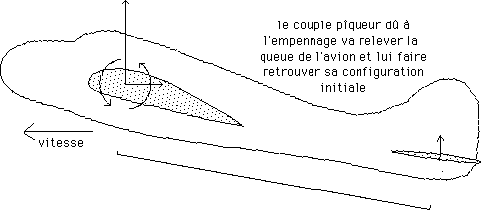
How the tail prevents accidental nose-up attitudes
...As seen in the diagram above, the tail becomes a lifting surface, thus tending to make the airplane dive, returning it to its original flight attitude.
...For this new nose-up attitude to be stable (assuming no increase in engine power), the pilot would have to “pull back on the stick,” thereby creating a nose-up moment via the tail to offset the wing’s pitching moment.
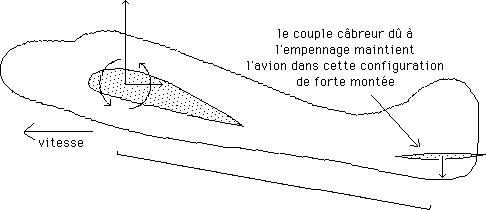
Stable attitude of an airplane in a nose-up position (stick pulled back, tail raised upward)
...If, starting from the initial stabilized flight configuration, a disturbance caused the airplane’s nose to dip, like this:
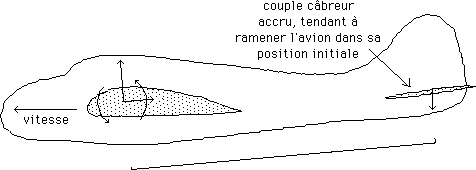
Effect of the tail in bringing an airplane back into its flight pattern after a nose-down pitch caused by a gust.
the tail would automatically straighten the aircraft out. Thus, we see how an airplane’s tail tends to ensure its aerodynamic stability, regardless of weight distribution.
...The lift generated by a wing acts at a specific point called the center of pressure, located roughly at 25% of the “chord length” of the wing:
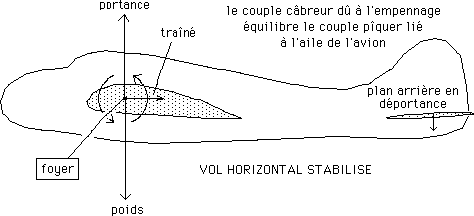
Location of the “center of pressure” on an airplane wing.
...Therefore, it’s advisable to place the airplane’s center of gravity at the wing’s center of pressure. This is how a commercial airliner flies, in principle. ...But note that in this case, the horizontal stabilizer acts as a downward force, maintaining horizontal flight at the cost of negative lift.
...When computer-assisted flight control appeared on French Airbus planes, efforts were made to save fuel by using the shift of the airplane’s center of gravity (by moving some fuel toward the rear) rather than a counteracting tail moment to offset the wing’s pitching moment. Schematically, this looks like this:
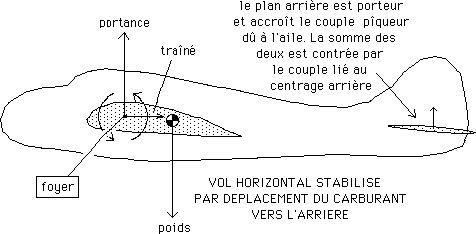
Computer-controlled commercial airliner (Airbus); horizontal stabilizer provides lift.
...In this configuration, created during cruise at high altitude, a liner becomes harder to control. Fuel is shifted toward the rear to facilitate control.
...Note that the surface area of a 747’s tail equals... that of the wings on a small-sized airliner. Hence the emphasis on fuel economy.
There are aircraft without tails. How do they fly?
Let’s look at an “variable geometry” airplane:
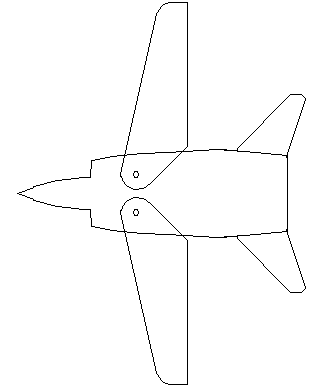
Variable geometry wing.
...When the aircraft folds its wings backward (the hinge is shown), its configuration resembles a delta wing; the trailing edge of the wing practically touches the tail.
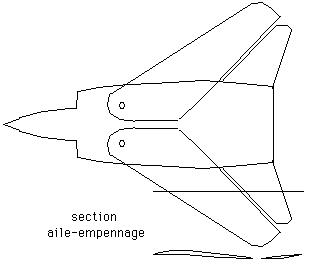
Variable geometry aircraft; wings fully folded onto the tail
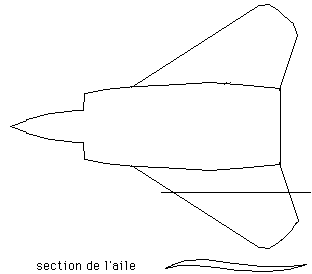
An aircraft with a “delta wing”
...Earlier we said that the wing’s lift-induced pitching moment is counteracted by the tail’s downward force-induced nose-up moment. If both are combined, you get an “S-shaped profile,” which is typical of the Mirage III or Concorde wings; this profile is also called “self-stabilizing.”