Text updated on July 12, 2007
This system was implemented by a friend on a slope used as a training site in the Massif Central. But this site, lent by a farmer, is no longer used. A pity. The system was quite ingenious:
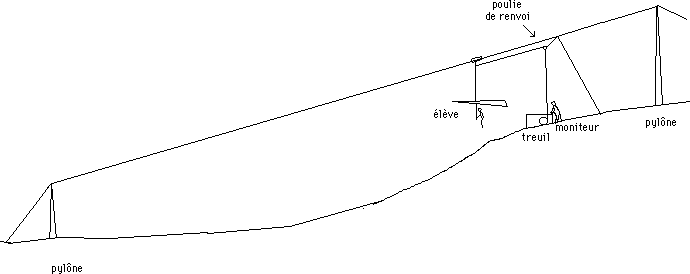
The “bana-bana”
...The principle is simple. The wing is suspended from a movable rig running along a suspension cable, which is connected to a thinner retention cable via an electric winch. The suspension cable is fixed between two pylons, and its average slope corresponds to the normal descent slope of a wing. The instructor fully controls the descent speed via the retention cable, using an electrical control device.
...Gradually, the speed increases until the wing becomes airborne. The student then actually flies, though he isn’t free to turn left or right. He tests his ability to control pitch, learns the movements needed for takeoff and the final push during landing, which slows the craft down.
...Here’s a second type of simulator (Hervé Duplan was one of those who introduced it into hang gliding instruction). It attaches to the roof of a truck.
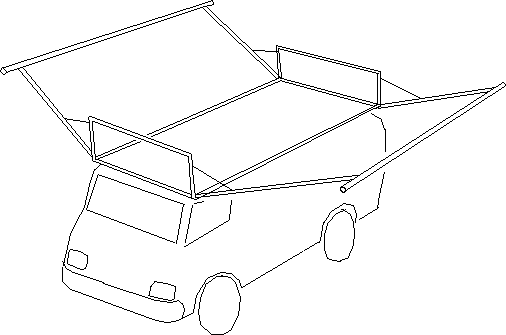
Truck equipped with a usable simulator.
...You need a very open area—basically a glider field—with plenty of runway length. Training takes place at dawn, with the truck traveling at 40 km/h. Below is the position of the wing relative to the frame, and that of the instructor.
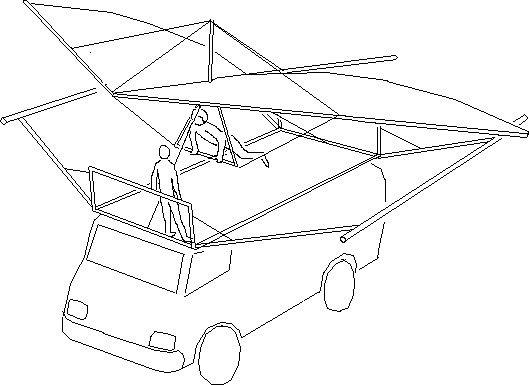
...With this system, the student learns how to control his wing laterally.
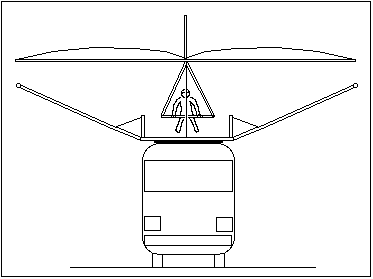
...Below, crosswinds have shifted the wing, still semi-tethered, relative to the truck. The student learns to counteract this immediately by shifting his weight sideways. Quickly, he learns to bring his craft back into alignment with the truck and, by “anticipating,” to keep it there.
...This exercise teaches the student how to safely control any lateral drift of his craft during takeoff, flight, and landing.
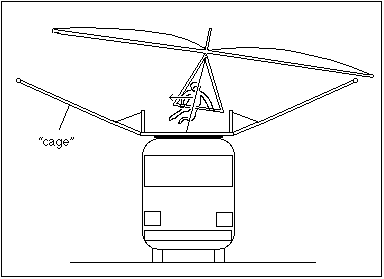
...He isn’t free to perform pitch maneuvers:
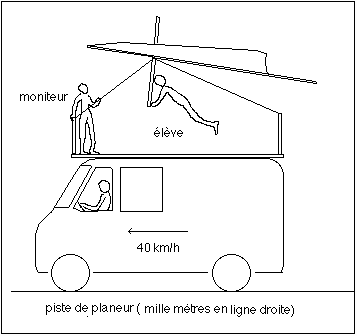
...The two previous simulators allow us to identify, without risk, chronic clumsy pilots—those who act before thinking—who will only be allowed on a training slope once they’ve mastered the first two exercises.
...The quality of the next stage depends greatly on the geometry and location of the training slope (the same applies to hang gliders and paragliders). Some centers only have rocky slopes with obstacles. Ideally, you need:
- A slight rise at the top to facilitate takeoff.
- A grassy slope with optimal gradient.
- A good landing area.
...The slope faces the sun, providing some thermal lift in the morning, which makes takeoff easier.
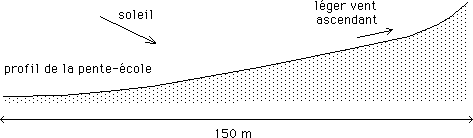
The ideal training slope.
...We won’t go into a full theoretical course on hang gliding and paragliding here. See the aforementioned book for that. Once the student has mastered takeoff and landing maneuvers, knows how to orient himself in “3D” relative to the terrain, and can manage his approach, he’s ready for his first “big flight”—usually involving several hundred meters of elevation change, easy takeoff, and a spacious landing zone equipped with a wind sock to indicate wind direction to those aloft.
...Speaking of which, I have a friend who badly injured his face by flying downwind onto a field in a hang glider. There was no wind sock.
“How could I,” he said, “in such conditions, guess the direction of the wind near the ground?” he asked.
(The wind direction at ground level can differ from that at a few hundred meters up.)
...Method: pick a landmark on the ground—a farm, any clearly visible object while still at sufficient height. Then make a full 360-degree circle. If you return to your starting point: no wind. Otherwise, the drift indicates wind direction. My friend didn’t know this detail.
The first French ULM championship, in Millau.
...One might say progress has been made in all areas of ultralight aviation, including pedagogy. But no standards were established at the outset. I vividly recall “the first French ULM championship” held in Millau about fifteen years ago. Carrying a parachute was considered optional—“otherwise there wouldn’t be enough competitors.” Everything was broadcast on TV. Since the machines differed greatly, organizers (the newly created ULM federation) didn’t know what events to propose. The least foolish idea was asking competitors to fly a circuit while taking photos at key points. But that resembled a rally more than a national championship. Then an irresponsible person suggested a precision landing contest. On a large field, yellow plastic strips marked out a rectangle. The task was to land inside it, like on an aircraft carrier deck.
...ULMs had no airbrakes. Competitors were thus encouraged to enter the runway doing exactly the opposite of what’s taught for any aircraft: flying just above stall speed. There was a first accident: a ULM stalled at low altitude and the pilot suffered broken vertebrae. But the second accident was horrific. The craft was apparently one of the best available at the time (“Sirocco”, if I recall correctly). It was fairly well built and powered, offering good flight qualities. I remember its tail was “butterfly”-shaped, with two planes tilted at 45°. The pilot stalled during his approach. An asymmetrical stall immediately led to a spin. At that altitude, he had a hundred chances to recover. All he needed to do was “release the stick”, push forward on the controls and add some throttle. The craft would instantly regain maneuverability, in a second. But, horrified, I saw the rear controls tilt in the wrong direction, into a nose-up position: the pilot did the worst thing imaginable—he pulled back hard on the stick! He spun four times before crashing in front of the audience and millions of TV viewers. The championship was halted. Shocked, I contacted journalists covering the event, asking to speak out, but to no avail. Filming a ULM competition yielded “good footage”, but interviewing a stranger about an accident with only one fatality—what interest was there? Safety doesn’t go hand-in-hand with ratings.
(Anyway, as time goes on, it’s clear journalists aren’t particularly drawn to anything related to safety. Recently (July 2007), a TV channel aired a bizarre report on “the saga of freediving”. A reader wrote to protest and demand a debate on this supposed sport. Vox clamat in deserto.)
...This absurd competition, run by incompetent and irresponsible people: one more death. This wasn’t a “pilot error”. As I later found out, many ULM pilots at the time simply didn’t know the reflexes required in case of a spin entry (something every airplane or glider pilot knows; otherwise they wouldn’t get their license: voluntary spin entry and recovery are part of both activities’ exams).
...This text lacks coherence, but, well, unpleasant memories pile up. Let’s return to unpowered craft: hang gliders and paragliders. If these devices are properly maintained (but under whose supervision?), flying in calm weather poses little risk. Naturally, it depends on the site. Someone taking off through a gap in a forest and landing in a field lined with power lines obviously faces more risks than someone with a well-oriented, unobstructed takeoff and a vast landing area.
...But our pilots don’t want only short flights. They want to stay airborne, ideally for hours. For that, there must be lift—so air must be turbulent, well heated midday. Earlier we briefly mentioned “slope soaring” regarding gliders. Here, the system is simple: a terrain feature, well oriented relative to the wind, provides a corridor where all the air rises at two meters per second. Since hang gliders and paragliders now have descent rates below one and a half meters per second, they can remain airborne in moderate lift conditions.
...But the best conditions are what’s called thermodynamic lift. Here’s the geographical setup that allows it: a plain bordered by a ridge.