Untitled Document
Boy Surface for Sale
August 22, 2008
Geometric objects, do you have a soul?
I exhibited a metal wire Boy surface, showing the meridians and parallels, in room pi of the Palais de la Découverte for a quarter of a century. When I learned that the object had been moved to the "reserves" to make way for a "mini-amphi", I asked to retrieve it before it was flattened. The Palais therefore had it delivered to my home in Pertuis, in a huge plywood crate. Since then, this crate has been on a covered terrace.
I have decided to sell it. There are several representations of this surface in various mathematics institutes around the world. This may interest an institute of this kind. It is a rather bulky object, about one and a half meters in diameter. It can only be placed in a hall.
I have always dreamed that this object could serve as a model for a large-scale realization. But well, it didn't interest anyone. Let's set a price:
2000 euros, with the packaging, to be picked up in Pertuis.
It can perhaps be transported on a roof rack of a car.
What was amusing and what visitors did at the Palais was to start from the pole and follow a "parallel" with their finger. Then they would take the next parallel, moving further and further away from that pole. In the end, they would end up back at their starting point. The Boy surface, abundantly described in the Topologicon, is a one-sided surface, the result of gluing a sphere onto itself. It lends itself to multiple "variations" because of its rich and varied properties.
It is also for me a 2D image of the universe as I conceive it. The parallels represent space and the meridians are "world lines". The two "sides" of this surface represent the two twin universes, the Big Bang being coincident with the Big Crunch. "The equator of the Boy," whose neighborhood is a Möbius strip with three half-turns, represents the maximum spatial extension.
I think we live in a four-dimensional Boy surface.
Aesthetically, if I had money and space, I would turn this object into a model several tens of meters high, making a "penetrable" sculpture, which could be admired both "from the outside" and "from the inside" (a meaningless expression for a one-sided sculpture). Indulging in a bit of megalomania, I would have considered an object several hundred meters high. A competitor of the Eiffel Tower, but to be placed in an appropriate location.
That this object would one day be crushed in the Palais de la Découverte's reserves seemed to me a sad end. But I think it would have happened one day or another. For now, it is safe in its crate.
A small anecdote in passing. We were two in the world who knew how to create objects of this kind: the mathematician Pugh from Princeton, and me. Thirty-five years ago, a rich American offered a considerable sum to whoever could build a series of models, in wire mesh, representing the sphere inversion, the central step being "the central Morin model," here is its polyhedral representation, which I had invented. I had designed these images with my software "Pangraphe," the ancestor of today's 3D software.
Central Model of the Sphere Inversion (J.P. Petit)
Pugh worked with chicken wire. A matter of taste. I preferred copper wire to this gallinaceous art. He made six or seven models and, with the prize money, was able to buy a house. The mathematician Nelson Max later used these models and, digitizing them, produced the first film showing the transformation. In the January 1979 issue of Pour la Science, the reader will find a drawn description of this inversion, as well as one of the first descriptions of the Boy surface, somewhat "readable."
Pugh's models were hung from the ceiling of the math department's cafeteria. But one night, someone stole them. No one ever found out what happened to them. Some have suggested they are now used as objects of worship by a cult. It's not impossible. Perhaps the Raëlians will buy the object for sale. Well, all that is no longer my concern. I wrote a story about this kind of object.
The Boy surface interested the psychoanalyst Jacques Lacan
An article published in the magazine "La Recherche"
The inversion of the sphere and the torus and other stories to fall asleep standing up
The surface for sale is a left-handed Boy surface. An antiquarian would like to acquire, as in the play "Le Vistemboire," a pair "right and left." Know that I have invented a way to go from one to the other, passing through the Roman surface of Steiner.
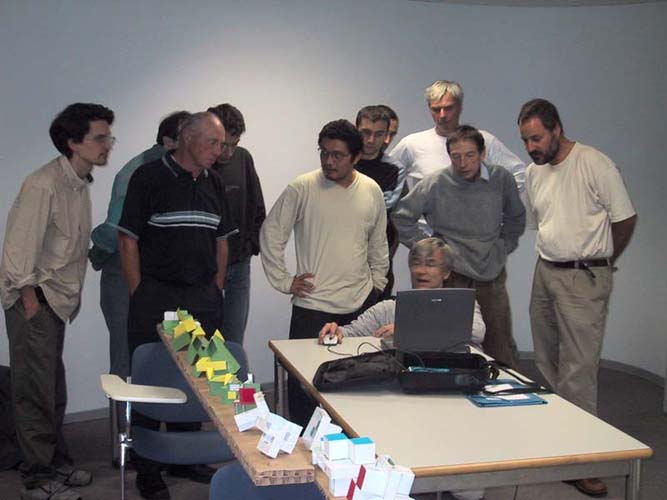
Mathematics Department of Marseille (Chateau-Gombert). JPP leading the department members through a Steiner surface
In the foreground, the polyhedral models illustrating the passage from the right Boy to the left Boy, and vice versa ---