Incredible! A fake fresco in the Cairo Museum
November 6, 2002
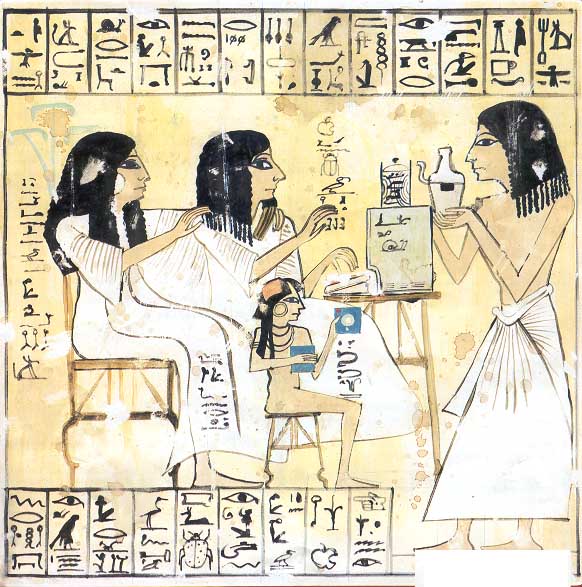
It’s hard to imagine that since its discovery in 1987 in the tomb of Ahmose IV, this fake fresco managed to go completely unnoticed by experts. In fact, one can easily spot numerous anachronisms in it. The pharaoh is depicted alongside his wife, who stands to his left; meanwhile, a slave brings him scented oil. His son sits below them, wearing the typical headdress. Upon closer inspection, it becomes clear that the son is holding a three-inch floppy disk in his hand. On the tablet beside him sits a Macintosh computer, viewed from the side—a device that obviously didn’t exist at that time. The Apple logo can also be seen in one of the cartouches.
The fresco was immediately removed. An investigation revealed that its creator was none other than Jean-Pierre Petit, who, during the 1980s, produced many such forgeries while serving as deputy director of the Computing Center at the University of Provence. It’s unfortunate that researchers at the CNRS ever devoted their free time to such activities. If you have any masterpieces in your home, make sure they don’t contain similar inconsistencies. According to our information, Petit produced numerous forgeries signed by Daumier, Picasso, Lautrec, and others during that period.
The photo below comes from the Temple of Karnak; its portico can be seen in the background. Contrary to what one might think, this isn’t a composite image at all. Egyptian archaeologists often pieced together stones found at various sites to create walls or other structures. This is exactly what we see here.
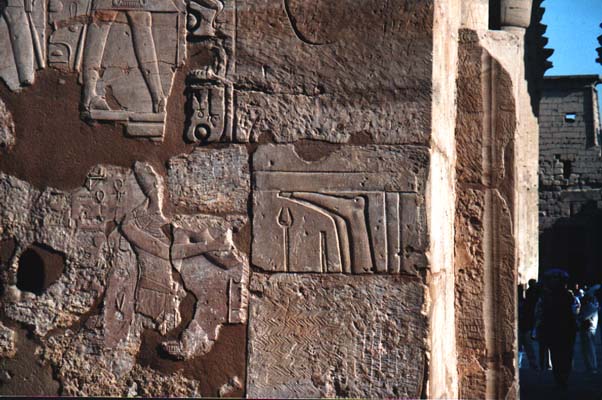
In the main corridor of the Karnak complex, seen by millions of tourists
The stone in the center of the photo clearly depicts a pair of feet—likely those of a pharaoh or Osiris. The bifurcated stem visible beneath them represents the classic “Egyptian shepherd’s staff.” Not only are the character’s feet upside down, but the hieroglyphic cartouche above them is also reversed! One would expect the site’s curator to immediately order that these stones be rearranged properly, given that thousands of visitors see them daily (they’re located in the central corridor). But no. Most likely, Egyptian archaeologists simply failed to notice this detail, which explains why Jean-Pierre Petit’s forgery managed to evade detection for fifteen years.
While the reconstruction of the Karnak relief is a genuine blunder, the Egyptian fresco is nothing but a hoax! Twenty-five years ago, I myself created these “works of art”—imitations like this fake Daumier and fake Picasso—each featuring a microcomputer. A friend of mine ran a magazine about administrative computing and commissioned me to design covers for it. That’s how this series came about. I couldn’t find another fake Toulouse-Lautrec I made back then, depicting a group of prostitutes counting their money using a Macintosh computer. I never imagined anyone would take such blatant jokes seriously. Who would have thought that museum curators and art experts wouldn’t notice a microcomputer on an Egyptian relief, or on a Daumier or Picasso painting? Yet some readers genuinely believed these forgeries.
When I posted an article on my website discussing a test designed to detect stupidity (link), written by Wilfried Wurmstein and Laetitia Paparrazi, several readers rushed to Google—a reflex now considered standard—to find information about these two researchers. There’s a lesson to be learned from these experiments; I myself was surprised by the results. I’ve repeatedly said, “Learn to think for yourself; otherwise, others will do it for you.” These harmless pranks remind us how easily information can be manipulated. Some readers write to me, “We follow your writings because we trust you.” That’s not the right approach. You must learn to critically evaluate everything you read, just as I try to do myself. Perhaps the most interesting aspect of publishing information online is its interactivity. Readers constantly write to me saying, “What you say isn’t accurate; so-and-so never served as president of any Franco-Israeli association…” I take these comments into account. Information on the Internet remains accessible indefinitely, making it dynamic and subject to daily revisions. I’m grateful to my readers for this. This interactivity has allowed me to delve into complex topics like the Israeli-Palestinian conflict or, as I’m doing now, recounting events related to the Algerian War.
Finally, know that Google, despite its impressive performance, is actually a creation of the NSA, the U.S. National Security Agency. By becoming the world’s most effective search engine, Google gains access to your personal data, learns about your interests, locates you, and eventually can manipulate you if you place absolute trust in it. Can you really trust the NSA blindly? Today’s world faces grave challenges; we can no longer afford to remain naive. Deception isn’t a modern phenomenon; history itself serves as a reminder of this, slowly revealing its truths over time.