Paranormal vs. Artifacts – October 14, 2002
Ninth part
All this seems rather depressing. It seems that scientists destroy dreams by tirelessly working to demystify them. These examples were given simply to remind us to be cautious and to use proper methodological strategies. Personally, I believe that the “paranormal” poses a real problem for us; we’ll have opportunities to discuss this further. One of the main difficulties is:
– The inability to reproduce these phenomena.
– Possible interactions between humans and the phenomena they wish to observe.
We can’t rule out the second point; otherwise it would be an attitude based purely on belief. And that’s exactly what we want to avoid. So, what can we do?
Let me offer some ideas. Everyone knows the classic “spirit communication experiment.” Letters and numbers are arranged in a circle on a smooth table. Then, a glass is placed upside down on the table. People gather around the table and each places one finger on the glass. Apparently, the glass then moves, producing responses in the form of sequences of letters, which are recorded as answers to the questions asked.
– Spirit, are you there?
– O
– What’s your name?
– GIGO
– If you’re the spirit of a deceased person, in what era did you live?
– 13S
– Where did you live during that time?
– SALERNO
– What was your occupation back then?
– DOCTOR
And so on…
The problem is that if people present can see the letters, it’s very easy for them to move the movable object toward those letters themselves. This makes it impossible to determine whether any movement is genuine or not. Even if participants try their best not to influence the object, they might still do so unconsciously. How can we create conditions under which such fraudulent or unconscious interference can be eliminated?
At IKEA, there are wooden serving trays whose upper surface rotates easily thanks to ball bearings. Buy one. Cut small squares of paper and write on each square all 16 letters of the alphabet, along with numbers and any other symbols you desire. Leave one square blank to serve as a “no response” option. Put these squares in a bag. Draw them out one by one and arrange them in a circle as evenly as possible. Glue them onto the rotating tray. Next, cut equal-sized pieces from black Canson paper; fold them so that they can act as barriers for the moving object. Use tape to fix these barriers in place. After each contact between the moving object and one of these barriers, you can lift it up to see which letter lies underneath.
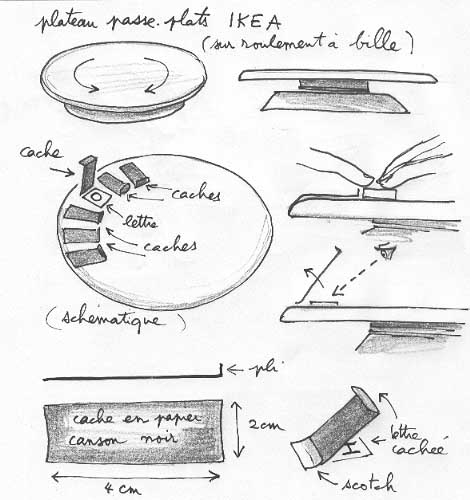
Because the tray rotates, you can spin it between each letter placement. If set up carefully, it becomes impossible for participants to figure out where the letters are located. For extra precaution, you can cover the tray with several layers of white lacquer to hide any imperfections in the wood that might serve as visual cues.
Now, begin your experiment.
– Spirit, are you there?
If the object (glass, plastic capsule, etc.) moves and points toward, say, the letter “Z,” then the experiment can be considered a failure. Two conclusions arise: either spirit communication is nonsense, or none of the participants possess sufficient “mediumistic abilities” to make this phenomenon occur. On the other hand, if the response is “O” or “Yes” (provided you’ve included such an option), then the probability of such a response occurring randomly is 1 in 40.
If you manage to get past this hurdle, remove the movable object, spin the tray again, and repeat the process for every letter. If you obtain a sequence of n letters that makes sense, then the probability of this being mere coincidence is 1 in 40^n. Suppose this “machine” produced a sequence of 22 letters; the probability of this being random is 1 in 40^22, or 5 × 10^-36.
Previous page Back to contents
Back to Paranormal vs. Artifacts
Back to New Items Back to Guide Back to Home Page
Number of views since October 14, 2002: