Interview given by Donald Rumsfeld on October 12, 2001, to the U.S. newspaper Parade
Posted online on September 27, 2005
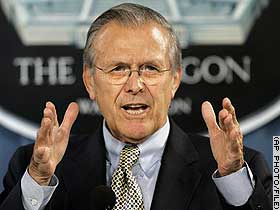
We know there’s an interview given by Donald Rumsfeld, a month after the events of September 11, 2001, in which he explicitly mentions a missile. Jump directly to that passage. Otherwise, here is the full text of this interview, translated by Mr. Makalogooa.
To consult the original Pentagon document, in English; 500 KB in PDF format. The key passage is highlighted in yellow. For reference, no media outlet wanted to report this information, despite several readers bringing it to the attention of print media. The U.S. Commission report on 9/11 also makes no mention of it.
This document is still online:
http://www.defenselink.mil/transcripts/2001/t11182001_t1012pm.html (archive from 09/29/2007)
But for the past four years, no journalist has paid any attention to its contents!
Transmitted by Mr. Makalogooa
Source: The website of the U.S. Department of Defense
http://www.defenselink.mil/transcripts/2001/t11182001_t1012pm.html (archive from 09/29/2007)
Donald Rumsfeld: “A missile hit the Pentagon”
The text below is the raw transcript of the interview given by U.S. Defense Secretary Donald Rumsfeld to an American magazine. Dated Friday, October 12, 2001—a month after the attacks on New York and the Pentagon—Secretary Rumsfeld clearly states that a missile struck the Pentagon. To facilitate verification by English experts, I’ve attached the original English text published in Parade Magazine. My translation appears in bold letters.
I’ve marked in red the passages I consider most significant: It’s an ordinary person who informs Rumsfeld that a plane hit the building, without specifying the type of aircraft. It’s Rumsfeld himself who tells the press that while planes hit the WTC, a missile struck the Pentagon.
Presenter: Defense Secretary Donald H. Rumsfeld \tab Friday, Oct. 12, 2001
Secretary Rumsfeld Interview with Parade Magazine
(Interview with Lyric Wallwork Winik, Parade Magazine)
Q: Most of us are programmed to leave a smoky building. What prompted you to head toward the fire here a little over a month ago, and what crossed your mind?
Rumsfeld: Well, I was sitting here when the building was struck and you could definitely feel the impact. To be honest, I don’t know what drove me to do anything I did. I acted purely on instinct. I looked out the window and saw nothing, then walked down the hallway until the smoke became too thick; then I descended via stairs and went outside to see what had happened. I asked someone who’d witnessed it, and he told me a plane had hit the building. I knew a plane had struck the World Trade Center; I saw people on the lawn, and we simply tried to place them on stretchers and carry them toward the road, lifting them over a fence so others could load them onto ambulances. I stayed outside for a while; people began gathering and we managed to get others to help administer IV fluids. There were people on the grass with torn clothing and burns all over their bodies. At some point I decided I needed to be here, thinking about what to do, since your brain starts connecting things together and there were plenty of people around to assist. I returned here and entered this office; there was smoke everywhere. We assessed where everyone should be. The Chairman [of the Joint Chiefs of Staff] was out of town, so he wasn’t present. The Vice Chairman was with me; my deputy had been sent elsewhere. Eventually conditions became unbearable and we moved to a room thirty yards away in this same building, a sealed-off area, but it proved ineffective against smoke and so on. We kept hearing we had to evacuate the whole building except for my team helping me; repeatedly they urged me to leave because those people had to remain as long as I was there. I replied, “Very well, we’ll do that at the appropriate time.” They managed to extinguish most of the fire and ventilate the area so the smoke stopped thickening; it didn’t vanish, but ceased to worsen. We remained here all day without leaving (inaudible). My advantage was staying close to the trouble spots while maintaining full communication with the President [Bush], Vice President [Cheney], and Secretary of State. I believe the President was overseas at the time; it was his deputy.
Q: To save time, I’ll proceed. Apologies if I seem abrupt—
Rumsfeld: Not at all.
Q: This is a question many Americans ask, especially the widows of September 11. How did we fail to anticipate this? How did a war targeting civilians occur on our soil without any warning?
Rumsfeld: There were numerous warnings. Intelligence reports we receive sometimes total hundreds of alerts or pieces of information weekly; worldwide, the figure reaches thousands. Our task is to sift through all this and determine what’s useful. Law enforcement authorities responsible for handling such matters—the FBI at federal level—have the duty to respond. State and local police likewise must tackle these issues. Many terrorist plots have been thwarted thanks to effective intelligence and prevention measures. Truth be told, terrorists can strike anywhere, anytime, using any method; it’s physically impossible to guard against every conceivable threat at all times and places. Here we speak of plastic knives, an American Airlines flight carrying our citizens, and a missile striking this building [the Pentagon; NDT] and (inaudible) similar attacks on the World Trade Center. The sole solution is to pursue terrorists wherever they are and neutralize them.
Q: Please briefly explain why it isn’t enough to capture Bin Laden and Al Qaeda; why this threat must extend further?
Rumsfeld: Because they’ve trained countless individuals scattered worldwide; various terrorist networks in many nations harbor extremists, and focusing solely on one group ignores the broader problem. There’s a clear link between countries supporting terrorism and those developing chemical, biological, and nuclear weapons; most of them strive to acquire nuclear capability. If such connections exist, we’re confronting not merely thousands but hundreds of thousands of potential attackers.
Q: Based on your statements, it seems we’ll also have to address Iraq’s weapons of mass destruction, especially given evidence that Saddam kept expanding his arsenal during the 1990s despite inspections; we still don’t know exactly what happened. Is this a top priority?
Rumsfeld: That’s up to the President, yet he’s expressed deep concern about terrorism. He’ll hunt down terrorists, expel them, and make it clear to nations sheltering them that they must cease aiding them.
Q: Unlike earlier foreign wars, much of our current efforts target regions where some populations oppose us, whether allies or foes. Yesterday, a Washington Post editorial addressed this topic eloquently. Could you discuss the balance we must maintain between reasoned policy, regional propaganda, and our own security interests?
Rumsfeld: Naturally we must prioritize our security. Given today’s lethal weaponry and its proliferation, we have no choice. Simultaneously we must recognize potential secondary consequences and unforeseen threats; some may prove beneficial—people might change behavior or new alliances might arise where mutual interests foster improved ties. Crucially, we must act sensitively toward our allies, respecting their concerns stemming from terrorist propaganda. This fight bears no relation to religion, race, or nationality; it targets terrorists and their networks. In Afghanistan, they’ve largely taken control though not entirely.
Q: Looking back, might the past decade be labeled “the decade of neglect”? We even lacked spare parts for military aircraft. What lessons should citizens and leaders learn from the 1990s?
Rumsfeld: You’re right. This era was dubbed “procurement holidays”—a euphemism for depriving defense programs of necessary resources. It’s regrettable but we shouldn’t keep repeating this mistake. Ideally we’d realize that we spend only a tiny fraction of GDP on defense; during crises we suddenly decide we can afford far more. Yet ideally we’d invest proactively, avoiding sudden surges later. Such restraint creates deterrence and preparedness, preventing costly emergencies. Frankly, the U.S. can easily afford whatever is required for national security. Our economic stability relies on global peace; neglecting defense would be shortsighted and illogical.
Q: Whether looking ahead or back, you’ve envisioned military restructuring; now we must transform forces rapidly amid wartime pressures. How do you prepare for future conflicts while fighting this one? Briefly.
Rumsfeld: You’re seeking a quick answer.
Q: No, please elaborate further; we can handle it.
Rumsfeld: Ideally our nation would act wisely, but we must focus on capabilities rather than specific threats, since potential dangers are widespread nowadays. Thus we employ a capability-driven strategy: we can’t predict where or when threats emerge, but we can estimate what defenses we’ll need to counter them. This paradigm shift, lost due to recent terrorist attacks, represents a vital evolution for our country.
Q: Bio-terrorism threatens many Americans; how grave is this danger? Will we need another “Manhattan Project”? Are there other asymmetric threats worrying you? Lastly, given Washington’s concentration of political, governmental, and military power, how secure is this city itself?
Rumsfeld: All asymmetric threats concern me. We know no conventional armies can rival us; our superior forces deter such ambitions. Yet adversaries exploit our innovations—terrorism, missiles, WMDs, cyberattacks—all of which threaten us disproportionately because we rely heavily on space and IT systems. These areas constitute both strengths and vulnerabilities; regrettably we haven’t fully protected them. We’re actively developing countermeasures, and homeland defense has been prioritized since pre-9/11 precisely because of such asymmetric risks.
Q: You’re doing great work; you ease our burden. Mr. Secretary, what crosses your mind when dispatching U.S. troops to combat?
Rumsfeld: Well, when endangering lives, one must possess a truly compelling reason.
Q: Should this war grow tougher—likely prolonged—with setbacks or casualties, how will you gauge the need for force? What sustains you now?
Rumsfeld: Repeat that.
Q: If this war becomes increasingly difficult, lasts long, and involves setbacks or losses typical of most wars, how will you assess force requirements? What will you rely on? Any particular preparations underway?
Rumsfeld: Clearly the United States represents a vital model for the world—our freedoms and lifestyle benefit all humanity. From space, one sees only a few nations truly capable of sustaining their populations; ours strives to do so. This ideal deserves protection; we must defend it at all costs. God bless us—we have brave men and women in uniform willing to sacrifice their lives for this cause.
Q: Finally, many shun public service today; why serve? Why return to public life?
Rumsfeld: I’ve done so for decades; this plaque reads “Fighting for justice is the noblest force the world affords.” (inaudible).
Q: We must pause for the photographer. Are there unique challenges facing us as a nation due to this war?
Rumsfeld: One stands out: historically, free peoples enjoy wisdom or folly; freedom permits both. We’ve chosen liberty over authoritarian rule; thus we may err. Over centuries we’ve committed mistakes—overlooking risks like Pearl Harbor or Korea—yet we’ve endured. Today, however, we cannot afford such errors; with WMDs at play, even minor miscalculations could endanger millions.
Q: That’s a luxury we lack.
Rumsfeld: Exactly. We must uphold rigorous standards; we cannot afford complacency.
Q: Mr. Secretary, thank you; this was enlightening. My husband, whom you know, wishes you this book; President Bush and Secretary Cheney enjoyed it Saturday night; we’d love you to read it. I’m unsure when you’ll find time, but...
Rumsfeld: I’m uncertain whether I may accept it...