Can an airplane fuselage penetrate a concrete wall?
November 25, 2007
The question isn’t as simple as it might seem at first glance. At the beginning of this century, people amused themselves by demonstrating that it was possible to pierce a wooden door using… a candle, provided that one fired it using a shotgun—that is, by giving it kinetic energy.
Taking this reasoning even further, a reader named Jean-Sylvain Delroux developed a theory based on his own experiments. By forcefully shooting a straw at a potato, he managed to make it penetrate the potato. He concluded that an airplane fuselage could be considered “a giant straw,” while the Pentagon building could be likened to a giant potato. Thus was born “the Delroux Effect” (May 2004).
Recently, a commercial airliner made a miscalculation and collided at low speed with an airport noise barrier in France. Here are the photographs:
. 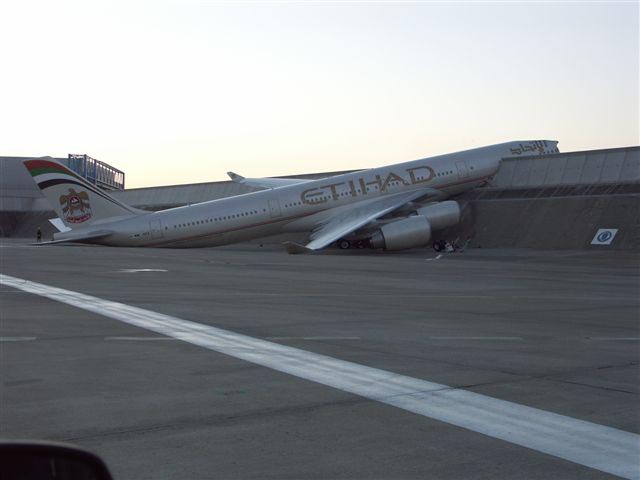
The aircraft, moving at normal taxiing speed, first climbs over the base of the noise barrier.
The front part of the aircraft then strikes the 10-centimeter-thick noise barrier. The results of this impact can be seen in the two photos below. They show how fragile a commercial airliner’s cabin really is—it’s like paper:
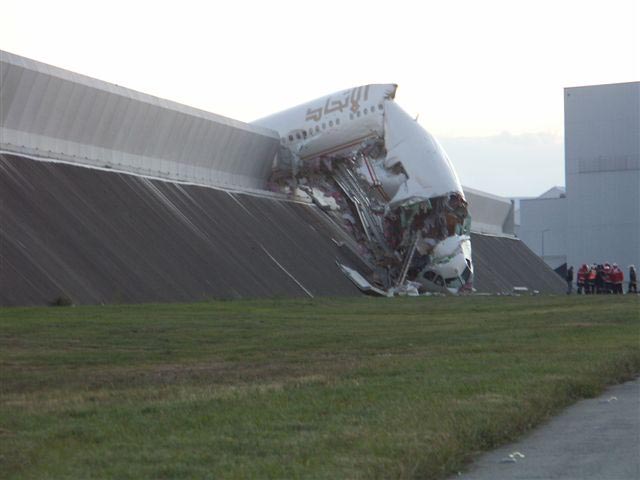
Its own weight alone was enough to cause the entire front section of the plane to collapse and bend.
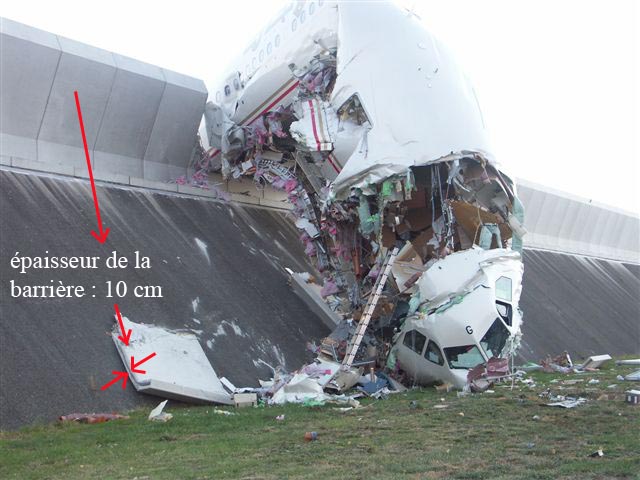
In this third photo, we see in the foreground the piece of bulkhead that damaged the entire front portion of the aircraft.
Can we trust the various videos showing computer simulations, particularly those conducted at Purdue University in the United States? I return to the only test that could possibly support the official theory regarding “Flight 77 crashing into the Pentagon”: a proper reconstruction, with one wing of the building rebuilt exactly as it was, at least structurally speaking. And a 767 carrying the same amount of fuel, remotely controlled, approaching at 60 cm above ground level, at the same speed, carrying not human corpses but animal carcasses, suitcases, and everything else one would expect to find inside such an airliner.
If the aftermath of the impact matches these photographs, then there’s no choice but to accept it. This would mean that an airliner traveling at 600 km/h can penetrate such a building through a 3-meter-by-3-meter hole, folding its wings and bringing its fuel inside. Its kinetic energy would be so great that it could pierce multiple walls, ultimately creating that well-known exit hole in the interior courtyard—even though the object responsible for this feat was never found nor displayed.
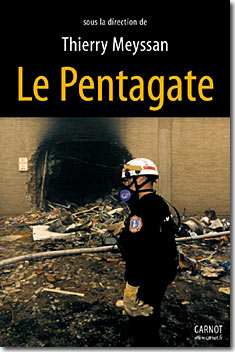
Pentagon: the exit hole
One has every right to be equally baffled when viewing simulations conducted by the same laboratory, this time concerning the impact of airplanes on the World Trade Center towers. Was the kinetic energy of those aircraft sufficient to allow them to penetrate the buildings? Or was this penetration facilitated by a missile fired from very close range, as suggested by a strange light captured by three different video cameras from three different angles, right at the point of impact? These aircraft were rather peculiar; one seemed to carry a large container under its belly—a “pod” that is clearly military equipment, not something used on civilian planes.
Once again, only a simulation involving actual structures could provide a credible answer.
This is one of many factors that cast doubt on the entire official version of events.
This whole story is utterly monstrous from start to finish. Incidentally, a reader of one of the numerous studies published online provided some useful information: Americans, Russians, and other major powers possess incapacitating gases that act extremely quickly. These were used, for example, during the famous hostage situation orchestrated by Chechen militants in a Moscow theater. Action had to be swift, since the bomb carriers—the “living bombs”—could detonate their devices with a single hand gesture. These gases (one webpage described their nature and composition) are quite heavy and can settle over their targets like actual gaseous blankets. Loss of consciousness occurs within fractions of a second after just one inhalation. The “target” then has no way of activating any device. Some of these gases are outright lethal; others can apparently be counteracted with an antidote, as was done in the Moscow theater incident.
All those who have questioned what actual aircraft were involved in “the hijackings and attacks of September 11, 2001” have wondered: “What happened to those planes and their passengers?”
This is a question that must be answered. First, note that both civilian and military air surveillance systems were remarkably offline that day; all military aircraft had been drawn far away from the area for “exercises.”
In another document you may have seen how Flight 77 abruptly changed course and headed toward the Pentagon (within just a few minutes), based on data from a black box supplied years later by military authorities. Did things actually happen that way? In subsequent opinions posted on http://www.patriotsquestion911.com and their French translation, you’ll see how many high-ranking military officials remain skeptical. But if the Pentagon was struck by a missile, what became of the plane and its passengers?
Pilots and passengers could have been killed almost instantly by release of a lethal gas inside a specially prepared aircraft turned into a “gas chamber.” Pilots have a button they can press to signal within seconds that they’ve been hijacked. Did they get the chance to do so? More simply: was that button active or inactive?
It would then have been incredibly easy to remotely control the aircraft, either landing it at some military base where all traces of the plane and passengers would disappear, or blowing it up over the Atlantic at some distance from shore.
Aircraft have already been destroyed mid-flight by explosions caused by explosives placed in a suitcase or some small object. Significant fragments could then be recovered and submerged. But if the plane is set up for a “controlled demolition,” practically nothing remains. It all depends on the quantity of explosives onboard.
Whether the aircraft was destroyed mid-flight or on the ground, neither scenario allows for an action carried out by Islamist terrorists “armed with box cutters.” Who can fire a missile from a distance capable of striking the Pentagon and causing such damage? From which fixed or mobile station, or from which flying aircraft? Who can outfit a plane to turn into a gas chamber, instantly killing passengers and crew? Who can erase all traces, except for a highly organized organization? This is completely beyond the reach of a gang of “terrorists” operating on U.S. soil.
Currently, people arrive at various conclusions. Some still cling to the official version. Others imagine “that the government knew an attack was being planned but let it happen.” The crash into the Pentagon, which requires use of “something other than a commercial airliner,” along with the complete erasure of a regular flight, including passengers and crew, totally falls outside the framework of a terrorist attack using box cutters.
Going further, given that the aircraft that struck the Twin Towers appeared unlike commercial airliners, one might even assume there weren’t any Islamists on board—that these people were completely manipulated.
Recall Kennedy’s assassination and poor Lee Oswald, placed in a building with a rifle (but was he really in that building? Only the rifle and cartridges were found in a “shooting post”; that’s all…). A man manipulated from the outset to become “the ideal assassin,” all the more unable to refute accusations against him since he was put to death the day after his arrest. In another document I’ll revisit a study by a reader covering many points of American history, showing that it is, to use a legal term, “customary practice.”
All this makes one think deeply. It’s not brilliant, no… But this is history, in all its rawness and horror.