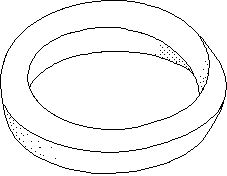
...This is a monohedron I invented on a rainy day. If you look closely, it's a polyhedron with only one face and one side. If you take a normal vector at any point on this single face and rotate it around, it reappears having undergone a 90° rotation. It only returns to its original orientation after four full rotations.
...I had drawn the above image "on purpose," imagining it in my mind. But now there are programs capable of handling such objects. Those who have already downloaded (free of charge) Cosmo Player, or are willing to do so, can admire the work of my friend Christophe Tardy on this monohedron. In the meantime, I have reworked the object's single edge using a drafter's coding method, as extracted from one of his images. To my knowledge, no software currently exists that draws dashed lines to represent hidden parts and breaks lines accordingly. But we could just as well use a lighter shade.
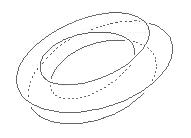
...In any case, here we have this single edge, with absolutely no vertex.
...Mathematical curiosity? Possibly. If you've glanced at my scientific work or its popularized introduction, you may know that I am developing a "two-sheeted" cosmological model—the initial idea being from Andrei Sakharov (1967). Incidentally, these two "sides of the universe" have opposite time coordinates. The question of time—or "times"—remains thorny. There's nothing more slippery than that word. What is the "arrow of time"? Can we speak of "two antiparallel arrows of time"? (This was Sakharov’s original vision.)
...In my paper published in the journal Nuovo Cimento in 1994, I considered an idea first suggested by Linde in 1988: that these "twin regions" might actually be "antipodal regions." Thus, these two twin universes (unlike Linde’s, where the two universes interact via gravity, mine do interact—whereas his were completely independent). They are therefore "both two and one." A mathematician would say this structure is a two-sheeted covering (the sphere S² is the two-sheeted covering of Boy's surface). In Nuovo Cimento, I considered the two-sheeted covering of projective space P³ (the 3D equivalent of Boy’s surface), identifying antipodal regions of a 3-sphere S³. But I have always thought it might actually be the covering of projective space P⁴, identifying antipodal regions of a 4-sphere S⁴. In this case, the interaction between two "adjacent" regions in this cosmos that is both unique and double would bring into coincidence antipodal regions (on this S⁴ hypersphere) that are not only enantiomorphic (mirror images, P-symmetric) but also T-symmetric—meaning "with opposite time arrows." We thus recover Andrei Sakharov’s idea.
...The monohedron is a didactic image of a four-sheeted cosmos, a "cosmoedron"—a cosmos that would be "both one and four." Four such "adjacent" regions would interact. But what would these regions be? Where should we "read" them on such a figure? The right section of the monohedron (a simple didactic image) is a square (since it's generated by rotating this square—see the virtual reality imagery created by C. Tardy). These four sides of the square-section represent four regions of the cosmos that would be conjugate. We can then speak, at least locally, of a "four-sheeted covering." If we equate the normal to the monohedron's surface with the arrow of time, this normal rotates in tandem with the generating square. Thus, the four portions of the universe would have time arrows arranged "in a cross," antiparallel two by two:
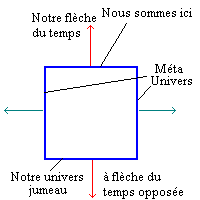
...We could also describe this by saying there are two pairs of twin universes, each pair having antiparallel time arrows. In a way, it's:
(Sakharov)²
...Why such complexity? Is this just a new geometric amusement? Hmmmm... Let me tell you what I have in mind. When I constructed the two-twin-universe model, I showed that the second cosmos could host matter entirely analogous to ours—its twin protons, twin electrons, twin photons, etc. (whether we use the term "twin," proposed by Sakharov, or "ghost," ghostly, more fashionable in the world of superstrings). I also showed that reversing time actually amounts to reversing mass, and thus energy.
...Linde was a student of Sakharov. In fact, I had discussed this at length with him in 1983 in Moscow, in a room at the National Hotel where he had come to meet me. In 1988, he proposed a double universe where the two matter types had opposite energies. Then, realizing the problems that might arise from having these two matter types coexist in the same spacetime region, he sent "the other matter," with negative energy, to the antipodes. But by doing so, he failed to notice he was re-encountering his master’s idea—Sakharov’s concept of opposite times—since (J.M. Souriau, 1972) reversing time is equivalent to reversing mass and energy.
...If you have the courage or competence to read the papers in Geometrical Physics B, you'll see that matter duality also exists in the twin cosmos. Not only is there twin matter, but in this second side of the universe, there also exists twin antimatter.
...All of this can be extended to a four-sheeted context. We would then obtain imaginary matter and imaginary twin matter (with purely imaginary time arrows relative to us, antiparallel to each other).
...Problem: how would this imaginary matter interact with ours? I must admit I currently have no idea—but I’ll surely find something. Geometry is a rich world full of all kinds of strings. Let’s pause for a moment on this idea. What is this imaginary world, in relation to ours? Etymologically speaking, it’s a "metaworld." The theoretical physicist and cosmologist's toolkit—no different from that of a good geometer—allows us to envision (as Linde noted in 1988) "parallel worlds" populated by particles that could be identical to ours, or mirror images (P-symmetry), or negative-energy doubles (T-symmetry), or both simultaneously. At this point, why not boldly leap forward and consider particles with purely imaginary parameters (mass, charge, time arrow, etc.)? This leads to the idea of a metaworld that could itself be composed of particles obeying a pure imaginary physics—perhaps quite similar to ours, which we might then call "metaphysics."
...I no longer recall which philosopher wrote, "Metaphysics is a vast ocean, and to cross it we have neither boat nor sail." Is this a definitive condemnation? Let’s reflect. Not so long ago, until someone managed to synthesize urea (Wöhler, 1828), "the living" was considered "the domain of God or Dame Nature," depending on one's preference. Let’s admit things have changed quite a bit since then. Paraphrasing: could "God" or "Dame Nature" be expressed in equations, trapped through geometry, group theory, and field theory (or woven into a net made of superstrings, depending on one’s view)?
...I believe we should not rule anything out a priori, but rather mix boldness with modesty. Regarding biology, the remarkable successes of recent decades give us the illusion that we know how to do an enormous amount, that "great progress has been made," and that soon we’ll understand everything about this phenomenon called "Life" (the outlook of the eternal optimist Joël de Rosnais). It’s true: we can map a DNA molecule, grasp genes between thumb and index, move them here, place them there, etc.
Impressive.
...But as Testard said, "It doesn’t work." Genes thus grafted lose their original functionality, or simply cease to function altogether. Of course, gene grafters don’t shout this from the rooftops. But Testard does—and that bothers them greatly. Genetic engineering allows for a lot of noise and helps secure funding and patents. Not being a biologist myself, I’m not fully aware of these matters. Read Testard (Des hommes probables, Seuil). The conclusion would be that, by acting as cartographers, we haven’t advanced as much as we hoped. "DNA," says Testard, is merely a data bank. In his view, this complex molecule doesn't contain "all the intelligence of the cell." That "intelligence," he argues, must be sought within the cell itself, which is "the true elementary living entity." Gene grafters are like people in a house who move handles and locks onto walls instead of doors with hinges, then wonder why they don’t work; or who plug electric bulbs into water outlets, surprised they don’t light up.
Open question.
...With this four-sheeted cosmos, metaphysics is in the air. At worst, it’s just a geometer’s experiment—a pastime for friends. At best… I don’t know.
...In any case, twin universes, as two-sheeted coverings, deserve the label "parallel universes." If we equate their time arrows with the normal to a 2D surface, and if these arrows are antiparallel, then the two spaces are like two layers of paint on opposite sides of a 2D surface.
...In the same vein, the other two universes, with their purely imaginary time arrows, could be considered "orthogonal to ours." Hence the idea of a theorem that might one day emerge:
Two universes perpendicular to the same third universe are parallel to each other.
To be continued.