f3214 Twin Universes cosmology (p 14)
Critique of this paper.
...In classical General Relativity, one starts from a field equation, Einstein's equation. One then inserts a particular solution, a Riemannian metric with signature (+ - - -). This is essential, otherwise there would be incompatibility with Special Relativity (Minkowski metric, same signature). Then one assumes that the universe is homogeneous and isotropic. The metric specializes and becomes what is commonly known as a Robertson-Walker metric.
(1)

x° is a time-marker, a chronological variable, k the curvature index = { +1, 0, -1 }, and u a dimensionless radial variable. We write: dx° = c dt
...This metric produces a redshift by itself. When evaluating the redshift, one considers two comoving objects (fixed relative to space), one (index e) being the emitter and the other (index o) the observer. We thus consider two galaxies, Ge and Go. These two galaxies are located at a variable distance, measured in meters:
(2)
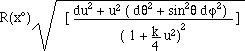
which increases over time. But by dividing this by R(x°), which is also measured in meters, one obtains a "dimensionless distance":
(3)
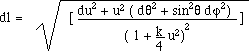
where l is dimensionless, like u. If we place the observer at the origin of coordinates, dq and dq are zero, and we simply have:
(4)

The radial coordinate of the observer corresponds simply to uo = 0 and that of the emitter to ue. Since these two galaxies remain "fixed relative to space," their dimensionless distance:
(5)
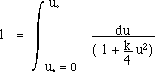
is a constant.
Light travels along null geodesics, here radially. We therefore have:
(6)
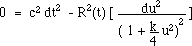
which gives:
(7)
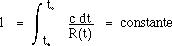
whether c is or is not an absolute constant. One can then imagine a signal emitted by the emitting galaxy Ge at time te + Dte, received by the receiving galaxy (observer) Go at time to + Dto. Unchanged length:
(8)
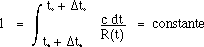
...If we assume that the time intervals Dte and Dto are short compared to the light travel time from the emitter galaxy to the observer, we obtain:
(9)
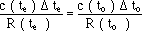
Dte and Dto are then the periods te and to of the phenomena, at emission and reception. le = c(te) te and le = c(to) to are the wavelengths.
...With the speed of light considered as an absolute constant, setting R(te) = Re and R(to) = Ro, we obtain:
(10)
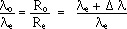
i.e.:
(11)
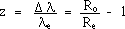
which gives the redshift in terms of the scale factor values Re and Ro. Standard calculation. See Adler, Schiffer, and Bazin, "Introduction to General Relativity," Mac Graw Hill Ed. (12.78), p. 413.
If the speed of light varies with the scale factor:
ce = c(Re) ≠ co = c(Ro)
then everything depends on the assumption one makes about the value of the nominal wavelength, linked to the spectral line, at the time of emission. In the classical model, these two wavelengths are equal. The physics associated with radiation emission is assumed not to change. But in our model, this physics "drifts" due to the secular drift of physical constants. This raises the issue of the drift of constants related to electromagnetism.
We have adopted hypothesis (94), according to which the Rydberg constant (ionization energy of the hydrogen atom) varies as R.
...Was this assumption justified? It should be noted in passing that this implies the electric charge varies as R¹/² (while mass varies as R).
...It amounts to assuming that the constants of electromagnetism do not undergo the same "gauge process" as other constants. However, there is no link between the formalism of General Relativity and electromagnetism, which remain two separate worlds.
...In 1917, when Einstein's equation had just begun to be manipulated, theorists established that, by writing the condition of zero divergence:
(12)

one could derive conservation equations for energy-matter, and, in the Newtonian approximation, recover Euler's equations (fluid mechanics). From the "everything is geometry" perspective, theorists immediately said:
- By integrating the electromagnetic force and geometrizing it, we should be able to recover, from the tensor equation (12) above, all equations at once, i.e., Euler plus Maxwell. But it was not so simple. Jean-Marie Souriau showed that this required considering a five-dimensional General Relativity. Reference: Ed. Hermann, 1964, Géométrie et Relativité, chapter "La Relativité à 5 Dimensions," p. 387.
...One then recovers Maxwell's equations (table, p. 407 of this work). Thus, things are not as simple as they first appear, since one must introduce a fifth dimension x5, and nothing a priori indicated that this would not generate different gauge relations.
...It is worth noting a particularly amusing point while reading Souriau's book. His approach gives rise to a "surplus equation" (41.63) and a "surplus scalar" (41.65), both lacking obvious physical interpretation. For 35 years, this has remained a complete mystery, despite efforts by researchers in theses directed by the French mathematician André Lichnérowicz—purely mathematical in nature—attempting, without success, to clarify the issue.
...In physics, we are accustomed to identifying phenomena in search of equations capable of describing them (e.g., the quasar phenomenon).
Conversely, there exist equations... in search of phenomena...
For the sake of history, we reproduce this "equation in search of a phenomenon":
(13)

where r, which is not a radial distance here, is this mysterious scalar in search of physical interpretation.
...In calculations as intricate as those in the previous paper, only an experienced specialist can keep track. Our approach does not consist in acting like cats, which, as everyone knows, hide their excrement under the living room carpet. There is an assumption, and we make it clear here. Any new assumption constitutes a weakness in a model. That said, in the paper:
J.P. Petit and P. Midy: Matter ghost-matter astrophysics. 3: The radiative era: The problem of the "origin" of the universe. The problem of the homogeneity of the early universe. [on this site: Geometrical Physics A, 6, 1998],
we handled the matter differently, using this "variable constants" model to describe the radiative phase. As will be seen, the physical constants then vary during this phase, and tend toward constant values as the energy-matter component in the form of radiation becomes negligible compared to the contribution from massive particles. This is then a different model, and in this case, the previous work would have served to build the elements of this variable-constant model.