f4123
| 23 |
|---|
We then obtain a group with 2 × 2 = 4 components. Schematically:
(237)
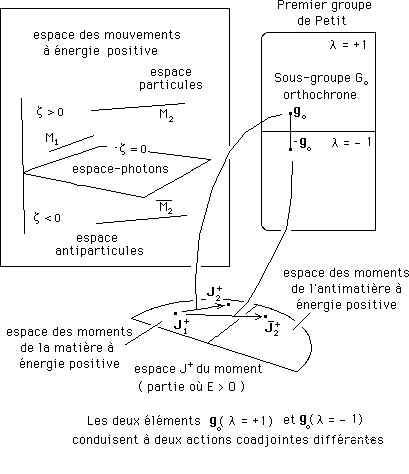
In this four-element group, we find two particular elements:
(238)
(239)
The first matrix belongs to the subgroup (l = +1), identical to the previous group.
The second, which we will call anti-unitary, generates a z-symmetry, without changing the trajectory, the coordinates (x, y, z, t), nor the energy, and generally the other components related to the "Poincaré part" of the group.
(240)
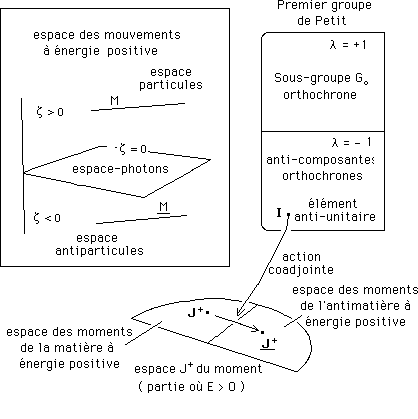
The momentum J⁺, describing a motion M belonging to the set of motions of matter with positive energy, is transformed, under the coadjoint action associated with the right matrix, into the momentum:
which represents the same motion in spacetime, but corresponds to antimatter.
We say that this corresponds to the geometric transcription of antimatter in the sense of Dirac.