f4124
| 24 |
|---|
Now consider the group:
(241)
The coadjoint action is:
(242) c' = l m c
Same calculation scheme. But this time, we will again recover the product l m.
Once more, when you differentiate the matrix g, do not differentiate either l or m. The orthochronous Lorentz group Lo has two components. Introducing l = ±1 and m = ±1 increases the number of components to:
2 × 2 × 2 = 8
This group now includes retrochronous components.
The following diagrams illustrate the movements and the coadjoint action, with the portion in which the element g was chosen indicated in gray.
First, the "playing field":
(243)
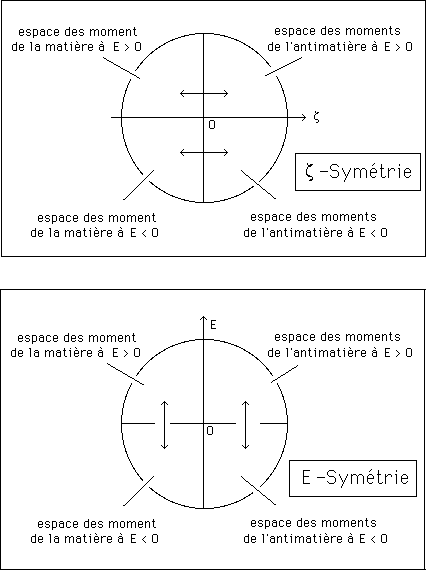
A number of symmetries can be defined from this diagram.
(244)
(245)
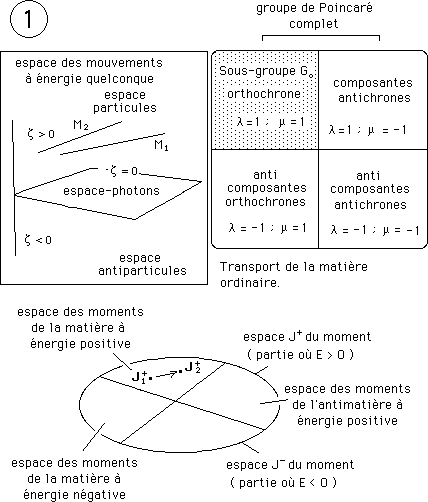
This grayed region identifies with the orthochronous subgroup of the extended Poincaré group. At the bottom, within the sectors, a particle's motion is depicted. These subgroup elements lead to other motions, which also correspond to matter.
These elements can also act on the motion of a photon. See Figure 1 bis.
(246)