Untitled Document
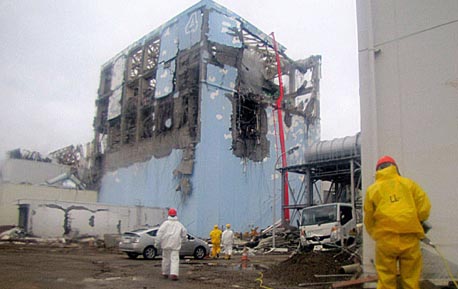
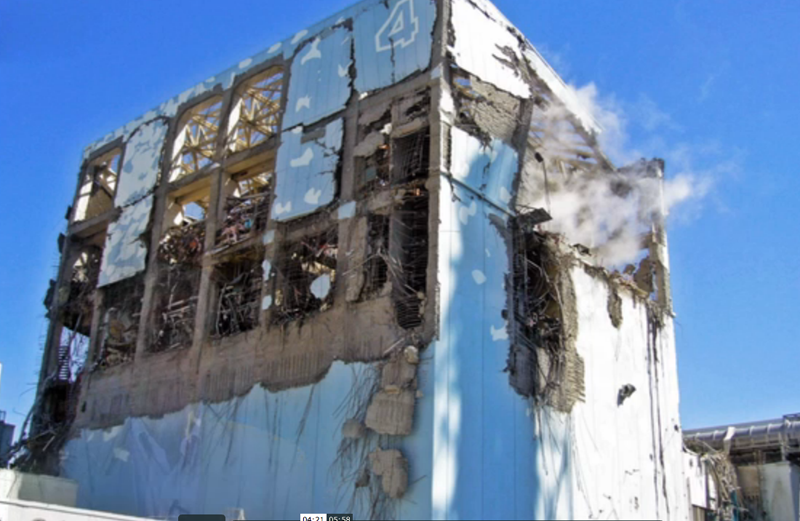
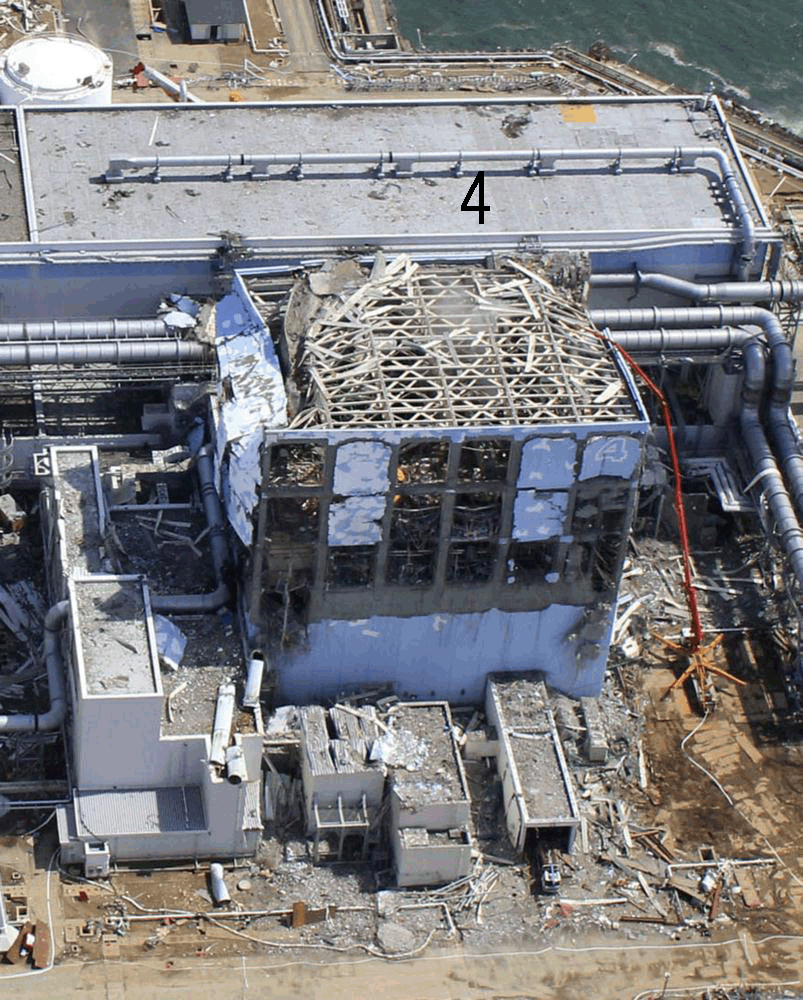
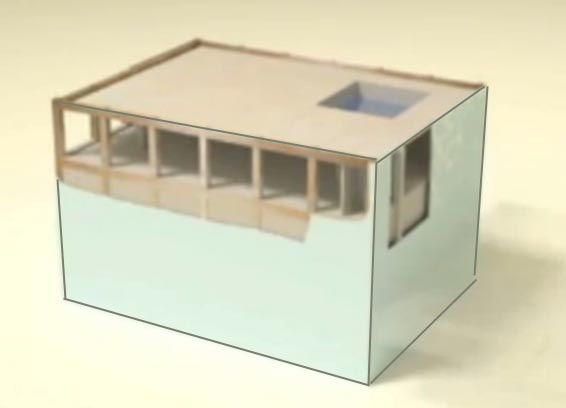
FUKUSHIMA: Start of the fuel rod removal from the No. 4 reactor pool
November 19, 2013
Recommended:
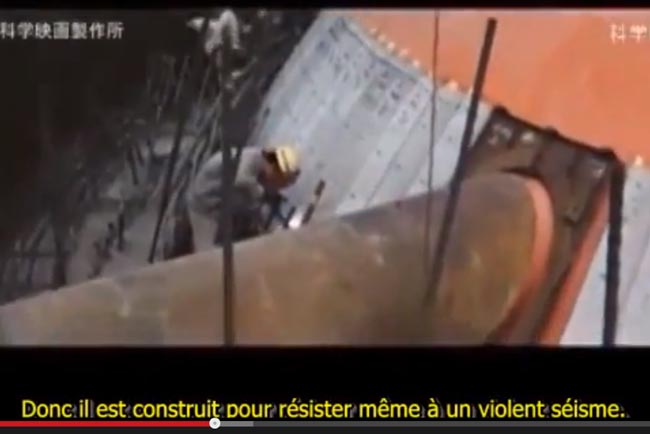
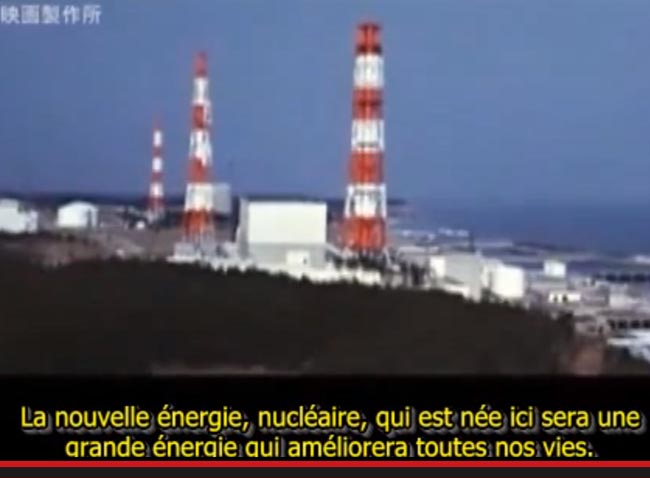
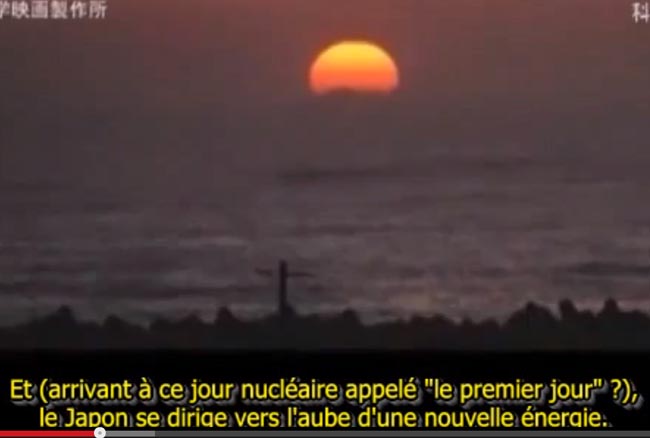
Before going through what I had set up on November 19, 2013, I strongly recommend that you watch this two-part video, which recounts the construction of the Fukushima Daiichi nuclear power plant, the most powerful in Japan (4700 MW).
At the limit, it's not even a propaganda video. It's the expression of a triumphant Japan, resolutely turned towards the future (the construction started in 1966). The film evokes a future of high technology, radiant. But one must not forget that boiling water reactors are not Japanese creations, but constructions under license of reactors designed and developed by Americans. Similar, for example, to the unit of Three Mile Island.
You will find at the end of the dossier a link leading to an investigation by ARTE on one of the failing Japanese reactors, the number 1 reactor. You will see that a large part of the problems were due to the lack of preparation of the service staff. When the control room was completely deprived of electricity, by the arrival of the tsunami, the pumps ensuring the cooling were shut down, as well as two sources of electrical power: a generator and batteries, installed like fuel, underground, and which were flooded, the staff in charge did not know that the valve controlling the implementation of a cooling system by simple convection automatically closed, and that it had to be manually reopened, a maneuver to which American staff were accustomed. But the Japanese were totally unaware of this procedure. If these valves had been manually opened, the core meltdown could have been delayed by at least 7 hours, according to experts.
In the light of this incident, you can make a comparison with the enthusiastic speech of the video presenting this marvel of technology that was the Fukushima plant, where everything had been planned and where the emphasis had been placed on safety (...).
( ... ) The Nuclear Sunrise You will find the same speech in the presentation of projects like the EPR and especially the fast breeder reactor, which François Hollande authorized the study and construction six weeks after his election. The responsible people of such projects manage to convince themselves of their justification. It is the same for the ITER project. Facing questions they cannot answer, these people say "it won't happen!".
Christophe Behar, in charge of all CEA projects related to electricity-producing reactors, including ASTRID When the project has a worrying shadow area, the project manager's response is "it's a question we are working on." This link sends you to the page of the CEA website dedicated to this project. Christophe Béhar, head of the Nuclear Energy Department at CEA, was present in November 2011, during the hearings led by Christian Bataille and Bruno Vido, at the National Assembly, within the Office for Parliamentary Scientific and Technical Choices. You can see him on the YouTube videos I have installed, and which are accessible by clicking on the home page of my site. I don't remember which one presents this exchange.
At one point, someone raises the issue of the impossibility of visual control in a reactor cooled with molten sodium (550°C). In pressurized water reactors or boiling water reactors, when the reactor is stopped, you can work visually. In sodium, it is impossible. Behar answers hesitantly "we are working on this issue" (ultrasonic imaging). But, obviously, the problem is far from being resolved. But what does it matter, we will go ahead anyway. As for possible technical incidents, Béhar answers that if the project is carefully managed, there will be none.
And it continues. The entire nuclear world works this way and contains a huge part of irresponsibility. After that, when incidents occur, it is of little use to present your apologies and declare "we are sorry".
Epilogue ...
**Sources of what follows: **
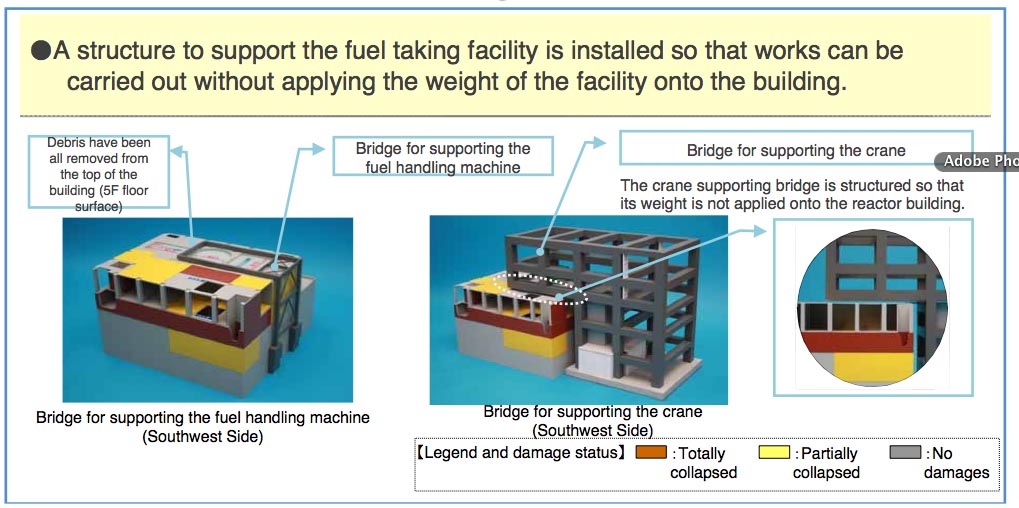
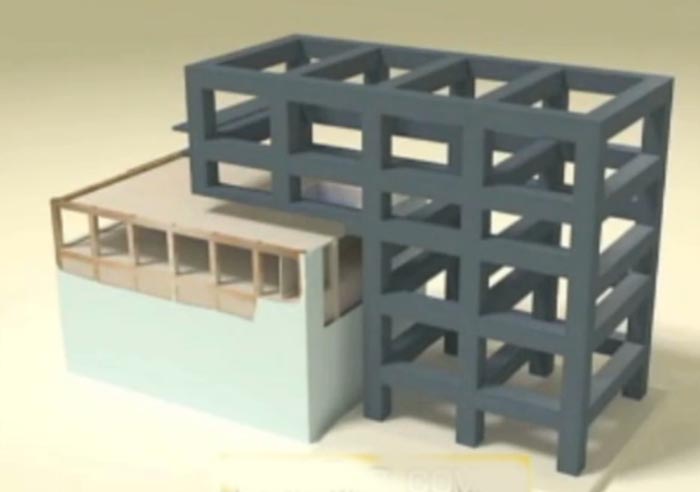
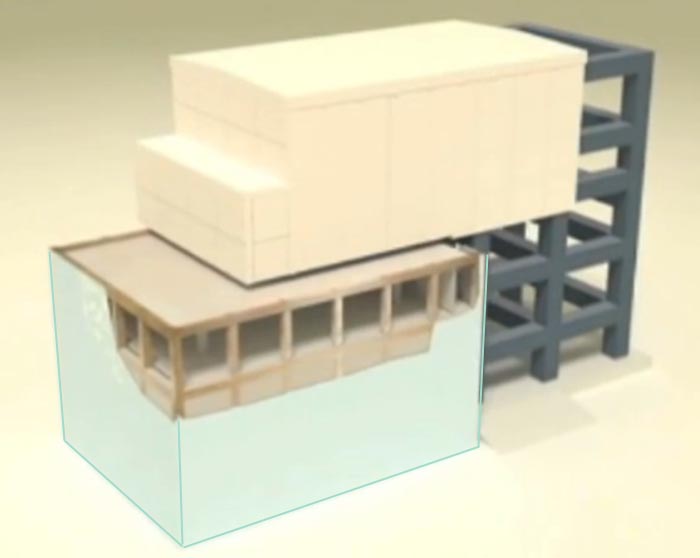
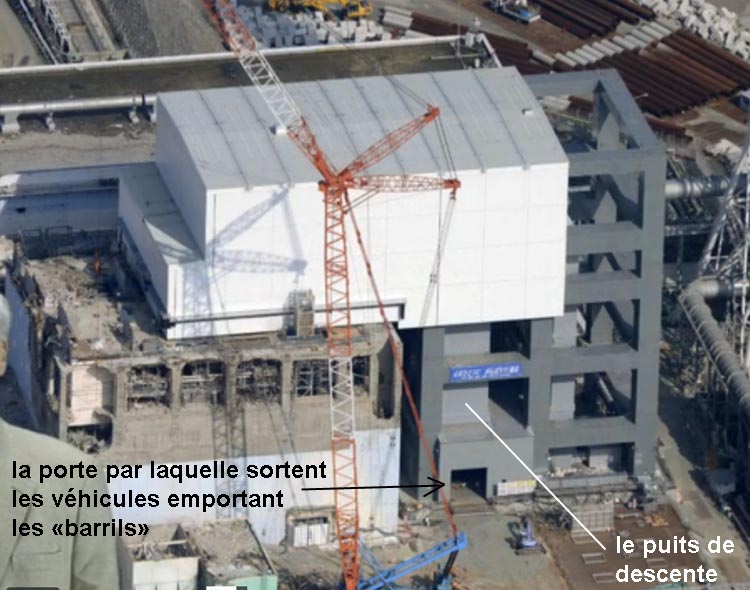
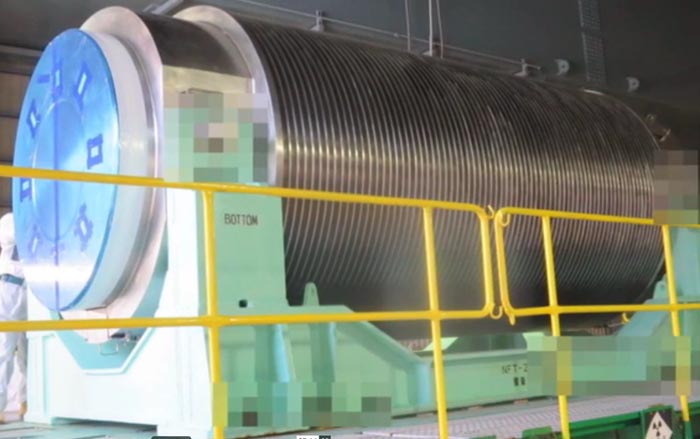
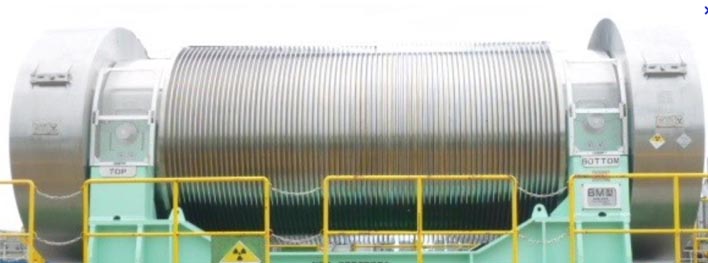
**Published by TEPCO (November 2013), 26 pages, in English, very technically detailed: **
****http://photo.tepco.co.jp/library/131030_02e/131030_01-e.pdf
The YouTube video, in English:
****http://www.youtube.com/watch?v=XkGQost13DM
**
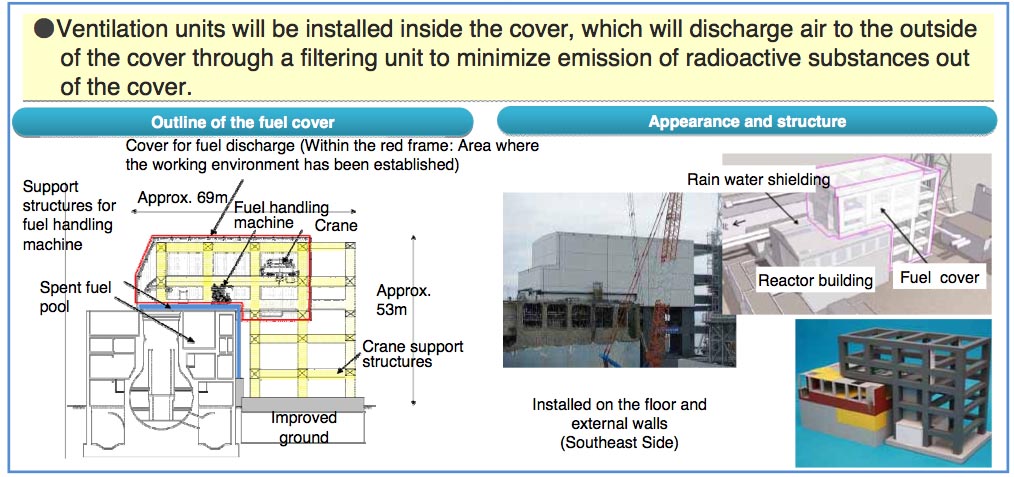
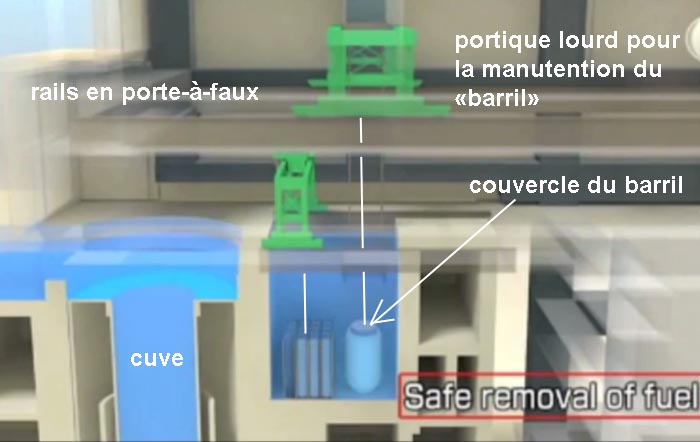
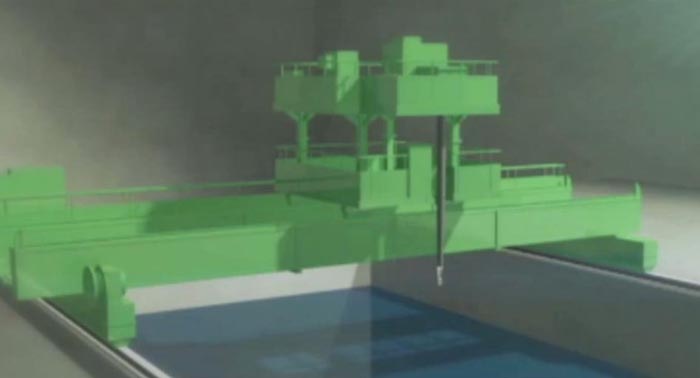
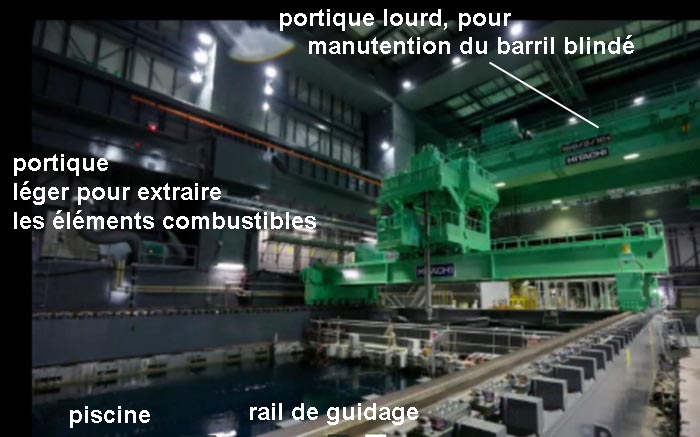
**
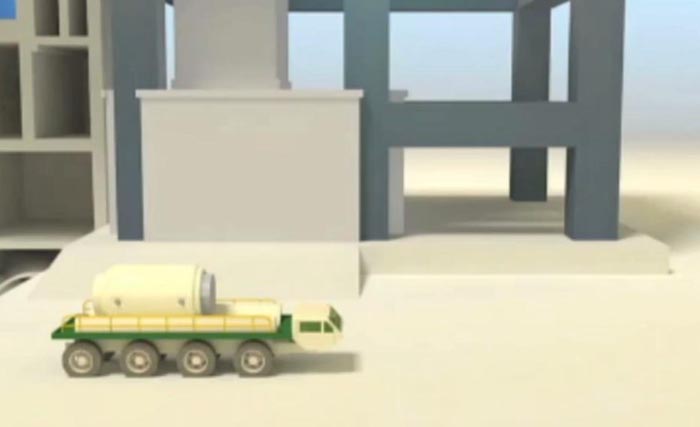
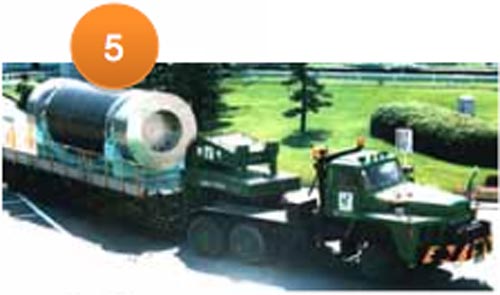
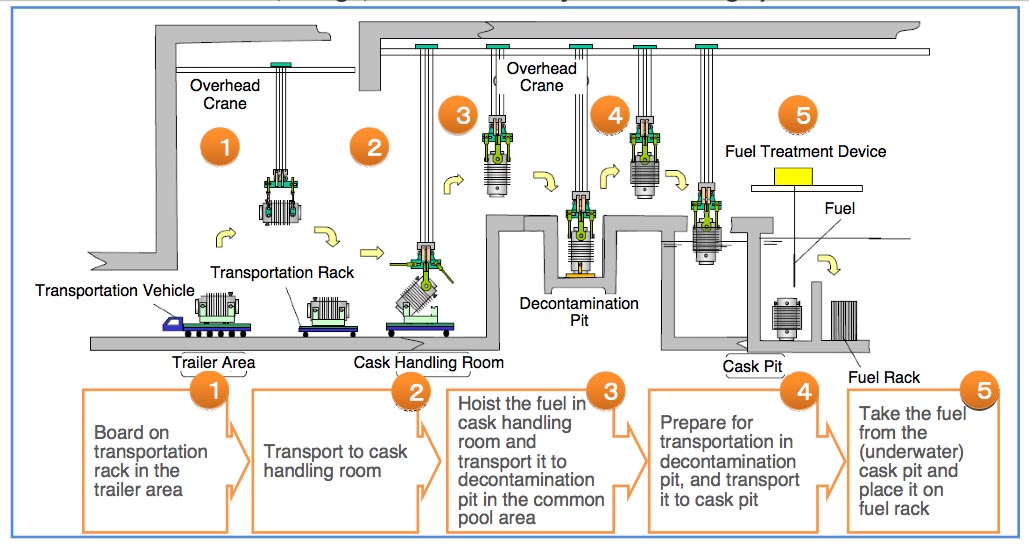
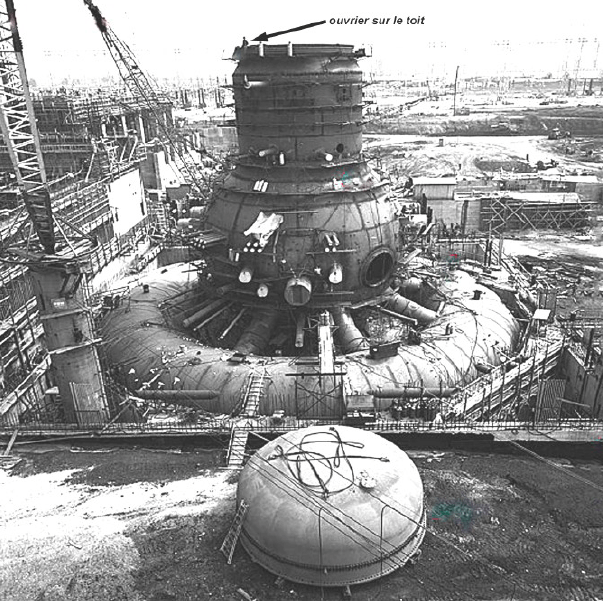
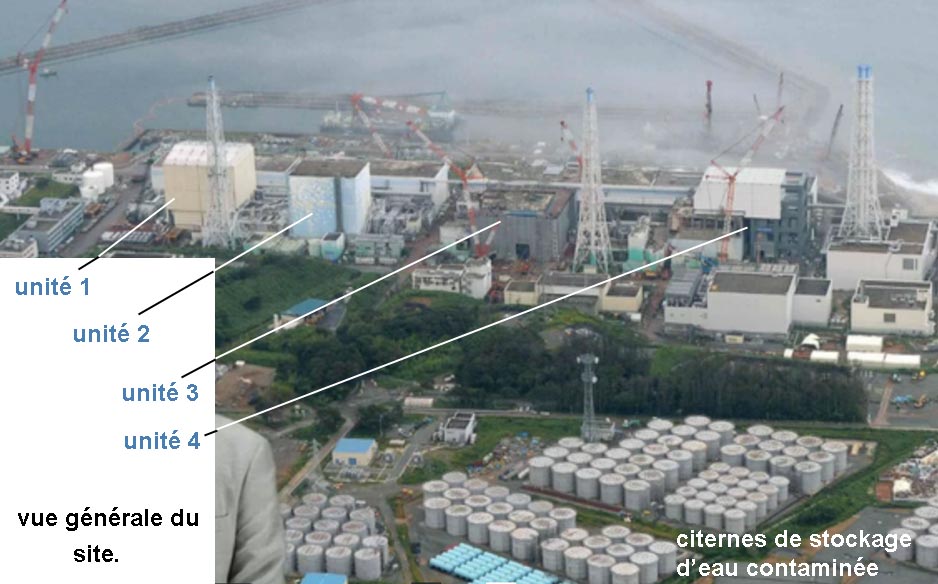
**
****http://www.youtube.com/watch?v=LjZZOLT_E3cPreview
**
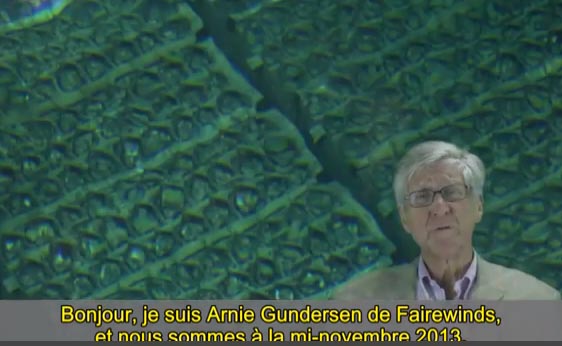
Arnie Gundersen, who in his career has dealt with the production of fuel elements and their packaging, lists the dangers inherent in this operation of recovery and movement of the used fuel elements.
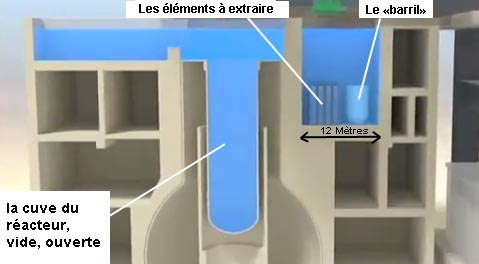
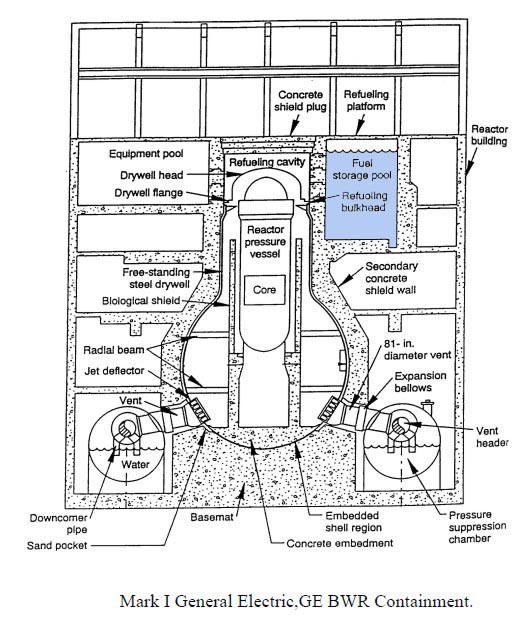
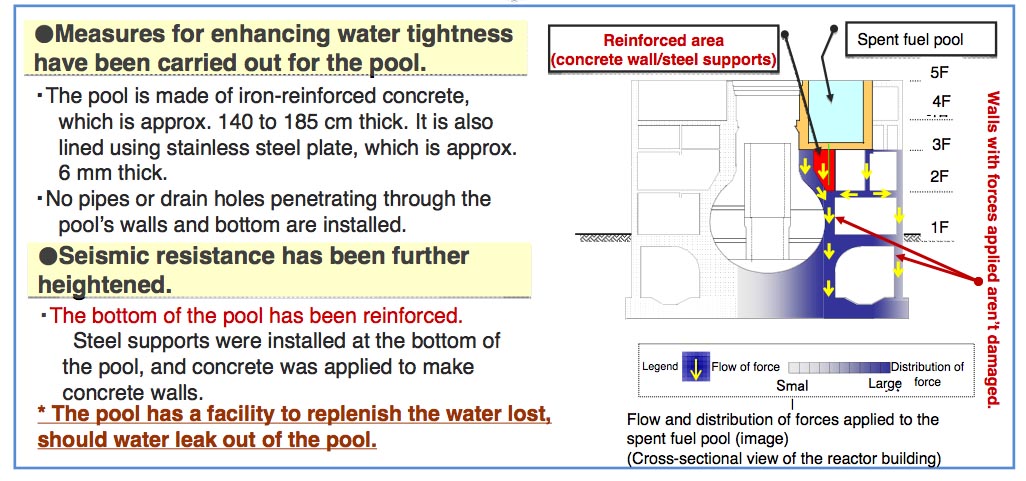
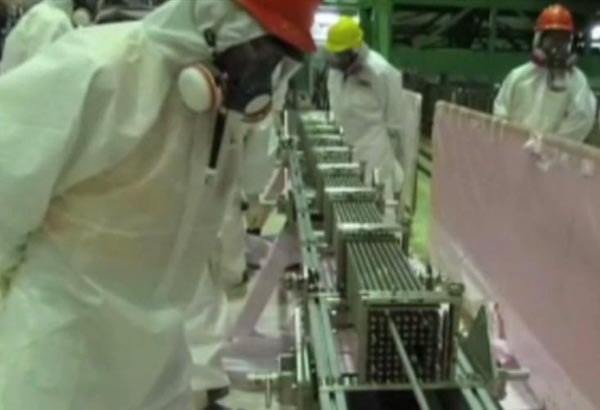
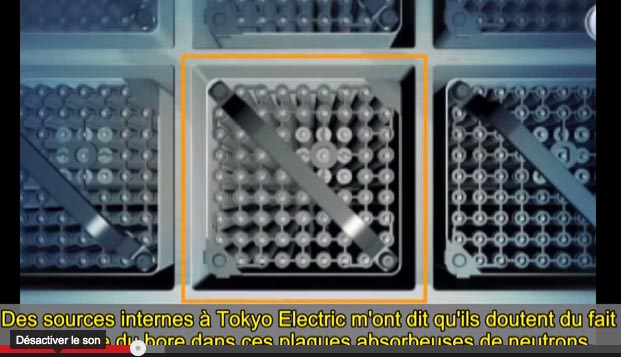
( ) In the background, the racks where the fuel units are stored. Let's list the technical remarks mentioned in his video, where he always violently contests the skills of the TEPCO company.
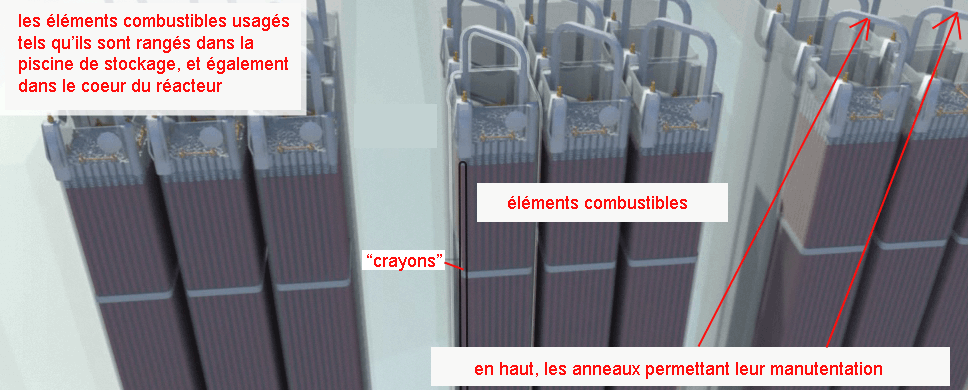
This image shows the storage system of the fuel units, made up of sets of zircaloy tubes (a hundred) containing small uranium oxide (or plutonium, when it is MOX) cylinders.
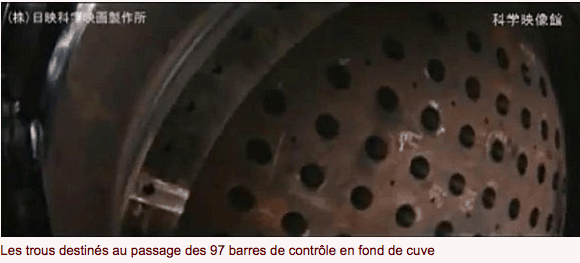
The units are stored in racks, whose walls contain a neutron absorber, boron. It is a computer-generated image. Each rack is equipped with a metal handle that allows their manipulation, and in this case, their extraction. These walls containing boron (highlighted in yellow) play the same role as the "control rods" in boiling water reactors. It is not rods, but cruciform elements, which are mounted and lowered from the bottom of the vessel, pierced with 96 holes, using hydraulic jacks. Below, the schematic arrangement of these elements, when they are inserted between the fuel elements:
The positioning of the boron shields to stop nuclear reactions.
Placed like this, they absorb the fission neutrons. The mean free path of the neutrons emitted being greater than the size of the cell, these neutrons do not create secondary reactions and are absorbed by these removable shields. It is when they are lowered, very gradually, that the reactor is the site of chain reactions, under control.
In the storage pool, the storage walls, rich in boron, play the same role. As the fuel elements are still quite tightly packed together, if there were no such partitions, there would be a risk of criticality. Gundersen casts doubt on the integrity of these boron-lined partitions, saying that they may have been attacked by salt water, and in any case degraded when the temperature of the pool water rose. To avoid this risk, TEPCO has put as much boron as possible in the water. Boron is a light metalloid. It will be dissolved in water in the form of borate.
The risk is the rupture of "cladding", of these zircaloy tubes that contain the fuel pellets and now all kinds of waste. Gundersen mentions Krypton 85, a beta emitter, with a half-life of 17 years. It is a heavy gas, 3.7 times denser than water. I don't know how it behaves if it is emitted into the pool water in case of a break in one of the tubes containing these wastes. It seems that this explains why the operation of placing in a container is carried out underwater.
There are 1300 used fuel elements to extract, which have all spent four years in the reactor core. The neutron bombardment has caused transmutations in the material of their containers, and Gundersen says they are weakened. To what extent? He adds that the racks that contain them are deformed and that their extraction could prove problematic and compares this to the extraction of a cigarette from a deformed pack.
These are the evocation of the risks inherent in the operation. Would there have been another way to proceed. Gundersen does not say. He expresses doubts about the competence of the TEPCO staff and says that this company has neither the skills nor the scope to manage such a task and that Japan should have called on foreign specialists. And there we touch on a key point of Japanese mentality in general: the refusal for foreigners to get involved in their affairs.
What else to say?
Wait and see
Does this mean that we can congratulate TEPCO for the excellence of this performance? Some are already writing that the Japanese have developed there original recovery techniques, for a job to be done on a damaged site.
Engineers and technicians may be tempted to celebrate this success with a glass of sake. But this should not make us forget the primary cause of this tragedy: the fact of having installed a nuclear power plant just a few meters above sea level, in a region prone to monstrous tsunamis.
As one internet user suggests, we cannot conclude this account of what is happening at Fukushima without saluting the courage and self-sacrifice, and even the spirit of sacrifice of people who work there on the ground, who will pay with their health for the mistakes made by the site designers. At Chernobyl, it was different. It resulted from a human error, and the consequences of a poorly conducted test, in a type of reactor that could experience this kind of incident, at the time still poorly known.
At Fukushima, the basic error was the underestimation of the possible scale of natural phenomena. A 9-magnitude earthquake, a wave of more than ten meters, had never been seen in the memory of the Japanese. If you look at the videos about the installation, you will see that the coast was leveled to position the power plants closer to the water. For example, to facilitate the handling of 40-ton steel tanks. In the film, it is said that the coastal relief is 30 meters above sea level. It would have been possible to build the plant at this height, which would have put it out of reach of a tsunami, completely. It should be remembered that the plain was dotted with 260 ancient stone steles, on which was engraved: "Do not build beyond this limit, because of the tsunamis. Warnings placed by people who had good reasons to do so. See this article
The Aneoshi stone, bearing the warning
Some would have found this precaution of building on the heights superfluous. Until the day when the facts would have given them reason. And then, what disaster, what terrible consequences.
Now the tragedy is done and the people pay the price, in their flesh, in their lives.
In the category of imprudence, add the fact of having installed (as in France, at Blayais, at the mouth of the Gironde, and as in all our nuclear installations) the backup pumping systems, the generators and the oil tanks in the basement. See my investigation on this subject:
/legacy/sauver_la_Terre/complement_enquete_2011/nucleaire_francais_enquete.htm
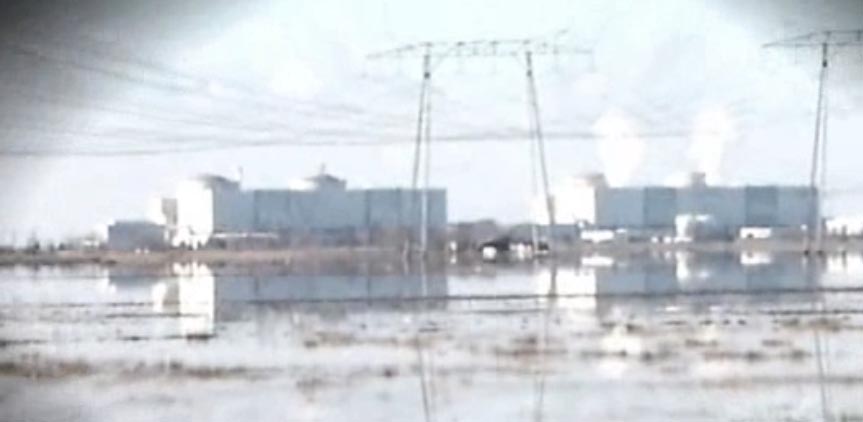
The Blayais Power Plant, at the mouth of the Gironde, after "the storm of the century". If the second backup electrical generator had been flooded, like the first, it would have been ... Fukushima-bis
There was also in Fukushima a lack of preparation of the teams, as well as the unexpected malfunction of essential measuring instruments, as mentioned in this investigation carried out by ARTE:
http://www.youtube.com/watch?v=hpLQUKhFXwE
The Fukushima installation was designed to withstand a tsunami of 5 meters, but not a wave twice as high. But we must keep in mind that the French installation of Gravelines (six reactors) located in the Pas de Calais, also at sea level, was the epicenter of a 6-magnitude earthquake that occurred in 1580. But who cares about that in France?
http://fr.wikipedia.org/wiki/Tremblement_de_terre_de_1580
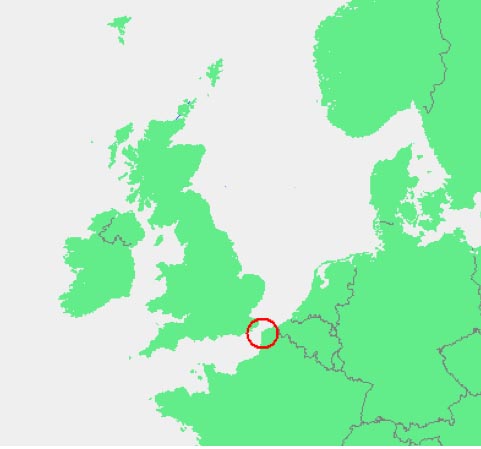
The epicenter of the 6-magnitude earthquake of 1580, right on the site of Gravelines!
We are reassured by the statements of Allègre, former minister:
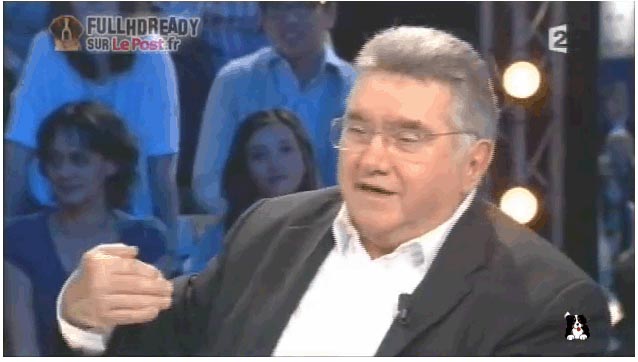
- We must stop walking on our heads. France is not a country with high seismicity!
The seismic risk is one thing. It is impossible to base on predictions in this matter. The earthquake that damaged the Fukushima plant was the largest ever recorded in the memory of the Japanese: magnitude 9. Similarly, the tsunami that resulted was unprecedented in recent historical times.
But there is a much greater risk, related to solar eruptions. It would be unreasonable to neglect it. The Earth has been experiencing a resurgence of solar eruptions, witness those that have just occurred on October 25, 2013:
http://www.journaldelascience.fr/espace/articles/soleil-connait-vague-deruptions-solaires-3295
The risk that a solar storm occurs in the near future, before the emergence of new technologies, or the wise reminder of the facts;
http://fr.wikipedia.org/wiki/%C3%89ruption_solaire_de_1859
http://fr.wikipedia.org/wiki/%C3%89ruption_solaire_de_1859
The plasma jet affected the Earth at very low latitudes (as far as the Caribbean). At the time, the electrical industry was very little developed. It only concerned wired telecommunications. However, at the time, telegraph operators were injured by violent discharges and fires that affected the transmission lines. This was due to the strong electrical tensions induced on the ground by the plasma jets hitting the upper atmosphere. Let's say that Nature gave us a small idea of the effect of our current "EMP" (electromagnetic pulse) weapons.
When we measure the effect on these simple wired telegraph installations, we can imagine the effect that would be produced on dozens or hundreds of nuclear power plants.
We often hear "there is no zero risk."
Certainly, but in this particular case of nuclear energy, with its consequences that can affect thousands or tens of thousands of years, can we speak in such a way?
Can we, regarding nuclear energy, conjugate a non-zero risk?
If this extraction of the rods from this pool number 4 can be successfully carried out, there will still be the problems of units 1, 2 and 3. There is not much of a solution there. These sites remain active. Witness the periodic bursts of radioactive vapor emanating from them, which were particularly visible at night, before the source of these emissions was covered, and this need to continue to cool these sites to keep their temperature below 50° (but it must be specified that this energy release can have two sources: the decomposition of fission products, and the energy released by new fissions, related to a possible resumption of criticality). Still, as mentioned in the short video made by the newspaper Le Monde, Japan continues to pour radioactive-contaminated water into the Pacific.
Technically, containing these leaks is then a more difficult, or even impossible, problem. The Japanese first dug a vertical trench, a "souille," between these reactors and the sea, where they poured a reinforced concrete barrier, to try to prevent the spread of contaminated water to the Pacific. Was this barrier deep enough? Did it crack? In any case, the infiltration continues. The measurements confirm it. The groundwater flows are also very complex. It has been said that a solution under consideration would be to create a barrier where the medium would be locally strongly cooled. This cooling would cause any liquid flow trying to find a way to the Pacific to freeze.
We have no information on the consequences of the melting of the cores of reactors 1, 2, 3. Have they pierced the 8 meters of concrete under the vessels? If the coriums are active (temperature around 2500 to 3000°), these layers of concrete constitute very illusory barriers, the material vaporizing at 1400° C, with a descent speed of one and a half meters per hour. In a video whose link is below, people from the CEA filmed the behavior of a simulated corium (uranium 238, without content in fissile elements), heated by induction. Then, clearly, the vapor bursts lifting the solid crust, which correspond to the vaporization of the concrete (it should not be forgotten that concrete is a solid material resulting from a hydration process).
If the melted core pierces the reactor vessel, a pool of corium forms underneath, apparently quite viscous. The equivalent of a "cow pie." If the conditions for criticality exist in this material, then the heat release will be maximum at the center of this "cow pie." Thus, as it vaporizes under the center of this viscous mass, the concrete will offer a housing that will allow this corium to concentrate in this depression, therefore becoming even more active, more "critical." There would be a natural phenomenon of confinement, of concentration of the core material.
This is the "Chinese syndrome", mentioned in a 1979 film, with Jane Fonda, Jack Lemon and Michael Douglas. According to this scheme, the corium, "naturally concentrated," can continue its descent, by gravity, indefinitely (the materials that make it up are heavier than lead). It is not impossible that this process, this time completely out of reach of human intervention, has been initiated at Fukushima. When this corium crosses groundwater or layers richer in water, there will be periodic vapor emissions (but, in the subsoil of the plant, there is not really a "groundwater table". It is the entire subsoil that contains water, in a diffuse way, we were told by geologists).
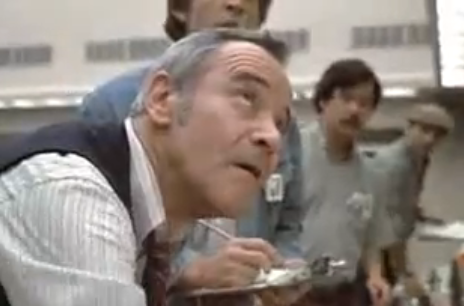
Jack Lemon, engineer building a power plant, listening to the tremors of a reactor cooling pump.
The process will gradually weaken over time, when the potentially available energy in this mass is dissipated, when the fuel is exhausted. In the normal operation of an industrial reactor, the reduction of the fissile material available occurs in a few years. In a corium, the process would be much slower. In the "loading" of a reactor, there is 3% uranium. 7% plutonium, if it is MOX. When the fissile material is uranium, the unloading is done when this U 235 rate drops to 1%. It is then estimated that the amount of heat emitted is no longer "profitable". The fuel elements are unloaded and replaced. But the question of this "profitability" would not arise for a corium, which would see its activity gradually decrease, even if the fissile material rate became less than 1%.
Another remark: the presence of groundwater only worsens things because, by slowing down the neutrons emitted, by playing the role of a moderator, it favors fission reactions. This is what happened at OKLO, in Gabon, where the presence of water allowed the ore (where the U235 rate was still high, close to the 3% of industrial reactor loads) to have a slight criticality, making OKLO "a natural nuclear reactor", operating for 300,000 years. This slight activity caused the residual U235 percentage (0.72%) to exceed the 0.71% standard corresponding to the natural decomposition of U 235, the rate that corresponds to the ores, regardless of their geographical origin. Moreover, the presence of elements and the difference in isotopic richness indicated this past activity.
A clarification: it is the supernovae that create all the elements heavier than iron, which are found in the universe, and in the planets. All the isotopes of the different elements are created in similar quantities. Disappear the unstable isotopes, according to their different half-lives. Supernovae produce all possible uranium, including 238 and 235. The 0.7% that remains in the ore corresponds to the half-life of this isotope. These are in fact "half-lives". The half-life of 235 is 700 million years, while that of 230 is 4.5 billion years. Since the half-life of uranium 238 is equal to the age of the Earth, we must consider that only half of what was collected at the time of the Earth's formation remains.
Supernovae also produce plutonium 239. But since its half-life of 24,000 years is ridiculouly small compared to planetary and geological ages, there is no remaining on Earth. This isotope was recreated artificially (and thus discovered) in 1940.
When the coriums of Fukushima "calm down," there will remain in the environment of these cooled blocks, now solid, a large amount of solid or gaseous fission waste, which will continue to pollute the environment for a time limited only by the half-life of the radioactive isotopes involved. Long lives, reaching 200,000 years.
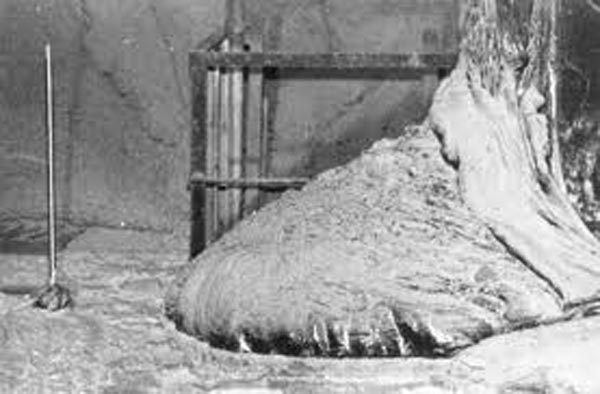
When referring to the photograph of the corium from Chernobyl, it was not the site of a resumption of criticality. Its temperature maintenance was due to the release of energy related to the radioactive decomposition of the fission products it contained. The time it takes until this energy release becomes sufficiently weak for the elements to be stored in a non-aqueous environment depends on the type of operation. This is the reason for the presence of pools adjacent to the reactor vessels. After unloading, the core elements are immersed in them, and the high thermal conductivity of the water, combined with the convection movements, allows their natural cooling. After a certain time (I think it is 5 years for uranium reactors and much longer for MOX, plutonium loads), these elements can be placed in the open air and conditioned (eventually "reprocessed," with the extraction of residual plutonium and product. But they will continue to emit heat, even if it will gradually decrease over time. Because of the long-lived fission products.
If the Japanese have focused on the most urgent: securing the 1300 used fuel elements present in pool number 4, a problem whose gravity is not less than what awaits them now. No one is able to say whether or not there has been a resumption of criticality in the coriums of reactors 1, 2, and 3 and, in that case, at what depth they would be and what their level of activity would be. We can only hope that the heat release observed, inevitable, corresponds only to the decomposition of fission products.
For now, the Japanese have tried to build barriers, in trenches, to try to prevent the spread of waste to the Pacific. The latest formula consists of locally freezing the water contained in the ground.
If this is successfully implemented (for how long should this cooling be maintained ???) the engineers could again praise "the excellence of this new technique implemented".
But the best would be never to be confronted with such problems again, so never to install reactors near the coasts, at sea level. And even better, to stop building new power plants, and to close those that currently exist!
Last spring, a conference was held at the École des Arts et Métiers d'Aix, given by a representative of the CEA, open to the public. The conference was organized by an association dedicated to the development of nuclear energy. Its theme (hold on):
- Now that the situation is normalized at Fukushima, an update on the restart of the Franco-Japanese collaboration in nuclear energy.
This simple phrase allows you to measure the level of insensitivity of the French officials in nuclear matters.
In 2011, I followed the events at Fukushima quite closely. I have no intention of doing so for its dismantling. TEPCO estimates the time needed to be 40 years.
This event made us aware of the inherent danger of nuclear energy, linked to the permanence of its consequences.
A few kilometers from my home is the village of Lambesc, devastated by a 6.2 magnitude earthquake in 1909. Forty-five dead and 250 injured. Three thousand buildings damaged.
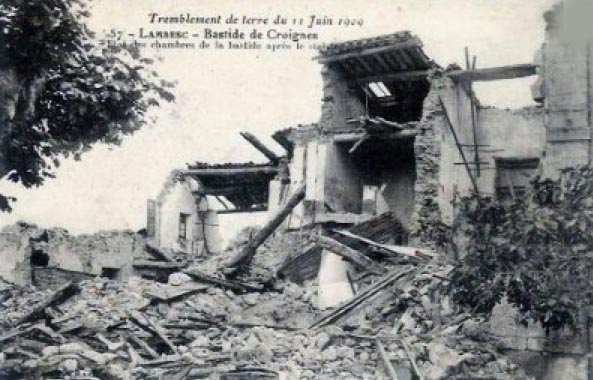
Lambesc, Vaucluse, a few kilometers from my home, in 1909
Less than a year later, the debris had been cleared, and the houses were being rebuilt. A few decades later, there was no trace left of this catastrophe. The dead had been buried, the injured had been treated, and then they too had died.
All of this can be extended to any damage caused by war. After the 1914-18 war, the entire north of France was nothing but a vast field of ruins.
The debris have been cleared.
The dead have been buried.
The heroes have been decorated.
The injured have been treated and the disabled compensated.
Monuments to the dead have been built in the villages of the various belligerents.
Everything has been rebuilt, better and newer.
Half a century later, there was no trace left of this Great War, except for vast areas left as they were, to be shown to future generations. Monuments have been erected, museums built.
The same applies to cities like Berlin, Dresden, and Tokyo, which were completely devastated by bombings.
And today?
All these cities, all these countryside areas, have regained their vitality and flourishing appearance.
But what about nuclear energy? That's another matter. Currently, and I will have to return to this when presenting a rather heavy dossier, our nuclear enthusiasts, including those with parliamentary functions, like the deputy Christian Bataille and the senator Bruno Vido, are concocting with the support of companies like AREVA, EDF, Bouygues, and the CEA, a totally nightmare-like future, focused on the deployment of "fourth-generation reactors," otherwise known as fast neutron reactors. Thus, Superphénix is rising from its ashes.
Six weeks after being elected president, François Hollande signed the decree authorizing the construction of a prototype of such death machines, ASTRID, 600 MW. This signature was considered by the Greens as conforming to the agreement they had made with the PS, where "no new nuclear project would be launched." However, this is exactly what the launch of this ASTRID project represents: a project aimed at deploying an entire park of plutonium and sodium fast reactors, which are extremely dangerous. However, Hollande considered that this agreement had been signed prior to his election, by Sarkozy, and therefore it was not a "new project."
The Greens saw nothing but smoke, or else they are remarkable fools. Unless their aims, which is very likely, are only to gain seats, power, comfortable salaries, and golden retirements. Like the others...
http://www.cea.fr/energie/astrid-une-option-pour-la-quatrieme-generation.
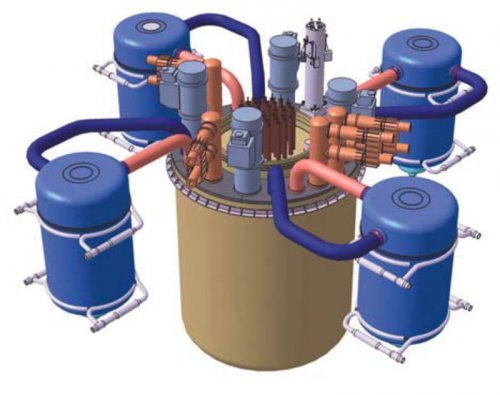
The ASTRID fast neutron reactor, cooled by sodium
An article on ASTRID that I sent to Mediapart a month ago **
| No response. |
|---|
This layout of elements does not resemble the one we have been used to for the 58 reactors in operation in France. The reason is simple: everything will be located below ground level, to make the nuclear installation less vulnerable to terrorist attacks by rocket or missile. And it will also be more discreet. In brown, in the center, the core, with its 5,000 tons of sodium, which burns upon contact with air and explodes upon contact with water. Around it: four steam generators.
In 1977, sixty thousand demonstrators gathered at the Creys Malville site in the Isère, coming from several countries: France, Italy, Germany, Switzerland. Five thousand CRS were waiting for them on a simple terrain, where there was nothing to damage, nothing to destroy. The demonstrators were greeted with volleys of offensive grenades. Michalon was killed, a grenade exploding on his chest. Another had his hand torn off, another had his foot removed.
Today, the association Sortir du Nucléaire, which brings together 900 associations (paying their share), employs 14 full-time staff in its Lyon offices and manages, from a distance, "good-natured" demonstrations, where people "form chains by holding hands," and chant "No to nuclear power!" It's lamentable pantomime.
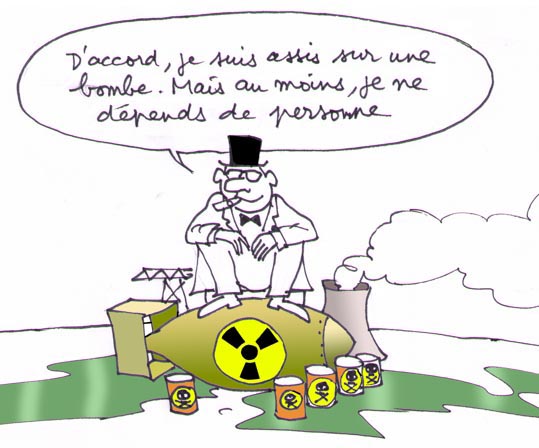
Sortir du Nucléaire, an emasculated, infiltrated, and undermined association. It organizes demonstrations with no effect, with very low mobilization. The French population remains completely uninformed.
I imagine a street interview:
*- Sir, Madam, what do you know about the nuclear reactor ASTRID, which François Hollande authorized the construction of, right after taking office? *
Rather than dwell on the shortcomings (perfectly real) of the Japanese, I prefer to consider the nuclear question as a whole. For me, the question is not even posed. We must stop this race towards death and poisoning. In the face of this, there are two policies:
*- Better manage resources, avoid waste, and develop renewable energy on a large scale. *
*- Study pathways that can lead to the emergence of clean nuclear energy, via a boron-hydrogen neutronless pathway, without radioactivity or waste (no, the thorium pathway is not the solution. No, continuous fusion via ITER will not work). *
ASTRID (Advanced Sodium Technological Reactor for Industrial Demonstration) is a woman's name. Obviously, one would not call a generator LUCIFER, or ARMAGEDON.
What would emerge from another street interview devoted to the EPR?
What differentiates this EPR from our current pressurized water reactors, apart from the fact that they will be more powerful and much more expensive? There are two things. They will first be able to operate with 100% MOX, thus exploiting fission, not uranium 1235, but plutonium 238. And we have a lot of plutonium in reserve, thanks to the reprocessing of spent fuel, which produces it.
But that's not all. Look at the following drawing:
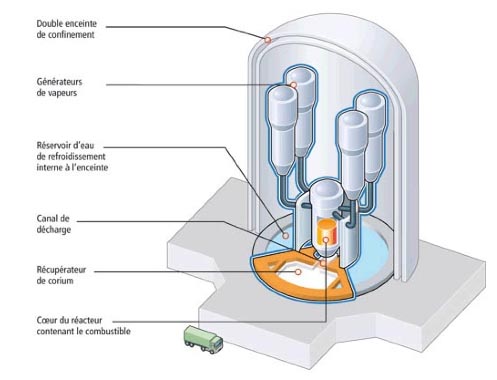
What do you see, in yellow, next to the large truck, which gives the scale?
A corium collector !!
Isn't that nice? In case of an accident, of core melting, it passes through the vessel, but spreads out in this basin. This spreading prevents the risk of criticality, the Chinese syndrome.
No one notices all this. Year after year, I remind people of things that citizens ignore, which can be summarized on this curve, produced by the Parliamentary Office for the Evaluation of Scientific and Technical Choices. This is what you are being prepared for by the year 2100.
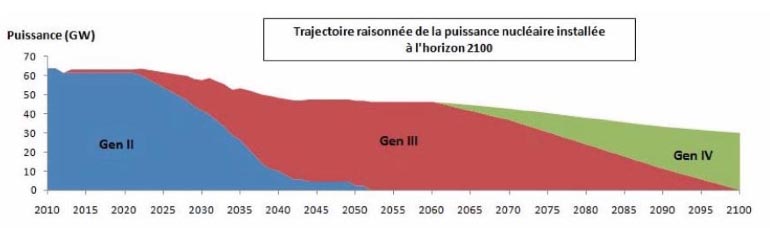
In blue: reactors currently in operation. In red, the EPRs, operating on plutonium, called "generation III" and in red the fast neutron reactors, operating on plutonium and sodium, of which ASTRID will be the "demonstrator."
By changing the title of the figure to "unreasonable trajectory," we would be very, very below reality. This project is managed by dangerous madmen. But who will stop them? The Greens? ....
August 12, 2011: Corium.
Here are two articles extracted from a site dedicated to following the Fukushima events, approached from a resolutely technical angle. You will find impressive data. Excerpt:
- Corium progression
If we refer to a study conducted by the Oak Ridge National Laboratory that mentions a simulation of this type of accident in a boiling water reactor similar to those at Fukushima Daiichi, we know that it takes 5 hours for the core to no longer be covered by water, 6 hours for the core to begin melting, 6h30 for the core to collapse, 7 hours for the bottom of the vessel to release,
and 14 hours for the corium to pass through an 8-meter layer of concrete, with a progression of 1.20 meters per hour
(5). Therefore, it is reasonable to assume that the core of the Fukushima Daiichi reactor 1 was penetrated by the corium as early as the evening of March 11 and that this molten paste passed under the slab as early as March 12, 2011.
****http://fukushima.over-blog.fr/article-le-corium-de-fukushima-1-description-et-donnees-81378535.html
http://fukushima.over-blog.fr/article-le-corium-de-fukushima-2-effets-et-dangers-81400782.html
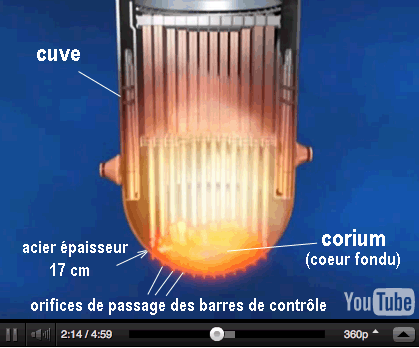
Excerpt from a video produced by the Japanese Ministry of Industry illustrating the process of core melting and vessel penetration
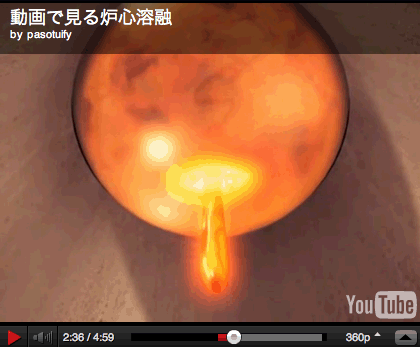
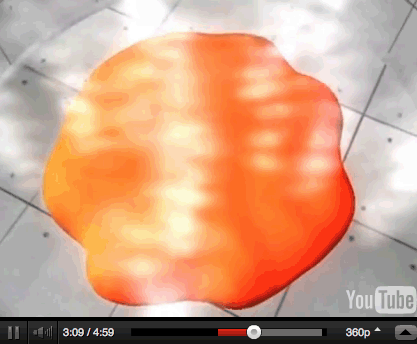
On the left, the bottom of the vessel, glowing. On the right, a pool of corium on the concrete
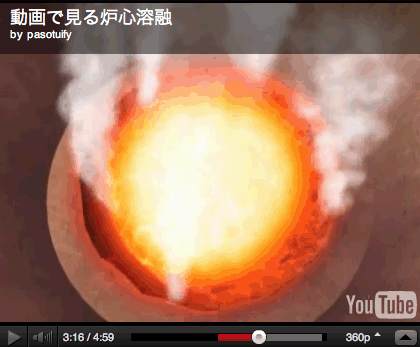
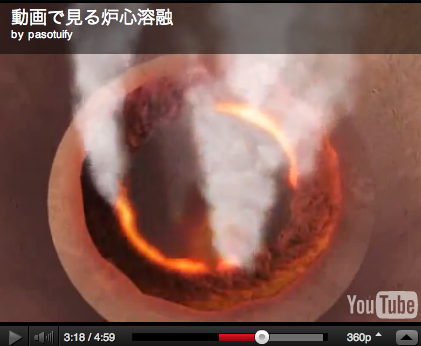
The corium (1500 to 2500°C) melts, vaporizes the concrete (which resists 110°C), and sinks into the cylindrical well it digs in the concrete. The fumes that escape indicate the gasification of the concrete due to the heat
Another excerpt:
The worst case would be a corium that would enter or be trapped in the concrete or the soil, which would not only offer the best possible form to maintain its integrity, increase the number of neutrons recovered, but also, the mass would become, in fact, inaccessible, making it impossible to cool.
This scenario seems to be occurring currently at Fukushima for at least one of the reactors (number 1). Hence the idea of building an underground enclosure to limit the spread of radioactivity in the soil. However, Tepco, a financially drained private company, does not seem to be in a hurry to protect the environment, as this project, if submitted to the shareholders, would probably not be accepted due to its high cost.
During the Chernobyl accident, the Soviets did not hesitate to build a concrete slab under the reactor to prevent the corium from descending. Why didn't the Japanese do the same? Perhaps because of the cost, perhaps because of the presence of water, or perhaps because it was too late?
In the following video, you will find a film made during the Vulcano experiment, conducted under the auspices of the Institute for Radioprotection and Nuclear Safety (IRSN), to study the effect of corium, heated to 2000°C, on a concrete support. The experimenters recreated the composition of this corium by mixing uranium 238 oxides (non-fissile) and zirconium sheath debris, all melted and heated to 2000°C by high-frequency heating. This kind of slow boiling you see corresponds to the gas release linked to the attack of the concrete by this corium. You therefore have before your eyes what may be happening on the slabs of the Fukushima reactors, if the concrete of which they are made is attacked by a mass of corium, whose high temperature would then be maintained by fission reactions, with a certain criticality. This will only occur if a sufficient mass of corium has flowed out of the perforated vessels, quantities impossible to evaluate, due to the impossibility of approaching them closely. However, in principle, the quantities of corium corresponding to the reactor loads are well above the load of the Chernobyl reactor. As you can read in the articles linked, when the concrete melting begins, the corium "self-confines" and its descent into this material, which can reach 1.2 meters per day, is unlimited. At the end of the video, you can clearly see how this corium has sunk into the concrete it has vaporized. This invalidates a statement by a French ASN (nuclear safety authority) official who said, "Don't dramatize. There is still 8 meters of concrete thickness!" A remark devoid of relevance.
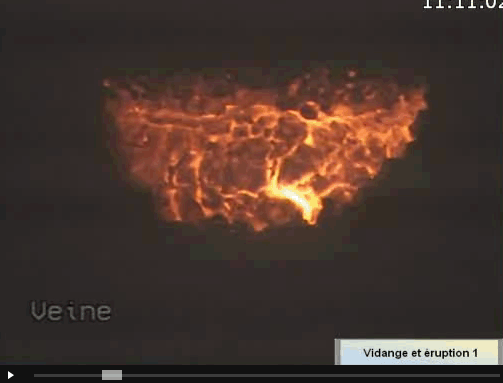
Gasification of concrete by corium at 2000°C
http://www.irsn.fr/FR/popup/Pages/Experience_Vulcano.aspx
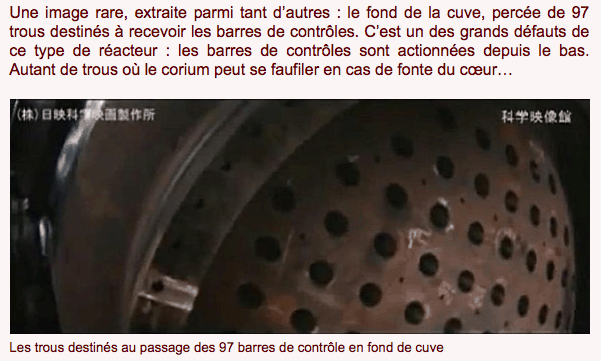
| Excerpt from a Japanese documentary, not subtitled, describing the construction of the plant: |
|---|
" When people built the cathedrals ...."
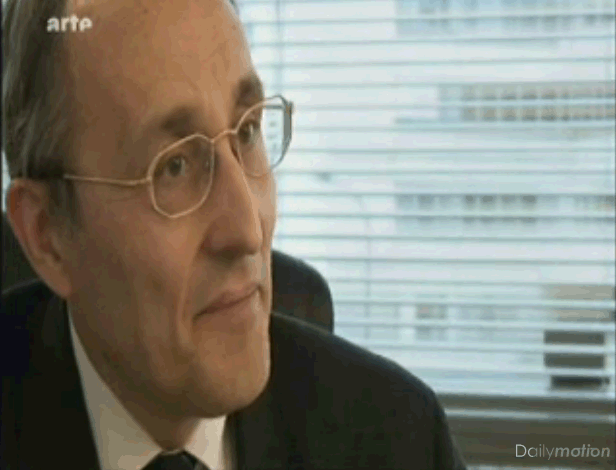
Bernard Bigot in video: "Without trust, there is no possible future."
http://www.dailymotion.com/video/xatls0_bernard-bigot-et-les-dechets-nuclea_news
One could reverse the statement:
" With such a problematic future, there is no possibility of trust. "
| Excerpt from a Japanese documentary, not subtitled, describing the construction of the plant: |
|---|