Stephen Hawking A Brief History of Time
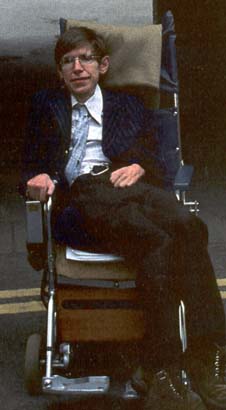 ******
Stephen Hawking
. In an article dated October 19, 2001, in the magazine Le Point, journalist Ugo Rankl makes a first: attacking an idol. The situation of this scientist is indeed pitiful. He has been suffering from Lou Gehrig's disease for many years, which destroys the neurons that control voluntary movements and "traps a sound mind in a ragged body". It is indeed a sad destiny. About fifteen years ago, the publication of a book titled "A Brief History of Time" became a planetary event. If my memory serves me right, sales soared after the broadcast of one or more TV reports on Hawking, where he was shown in his physical misery, while journalists repeatedly said "At Cambridge, he holds the Newton chair". The next day, crowds of people rushed into bookstores saying "do you have the book of the guy in the little car?". The success was planetary. It sold a total of twenty-five million copies in an incalculable number of languages, making Hawking a very rich man. Good for him.
The sociological phenomenon of the bestseller is not well known. There are, as was the case with this 200-page book, which are not even read to the point that some British critics could write "Stephen Hawking, the best-selling, least-read, and least-understood author in the history of books". Some members of the scientific elite even speak of the "freak show factor", which translates as "the effect of exhibiting a monster". ...In June 2000, the science columnist of the Sunday Telegraph dared to write: "It's like wanting to make Christopher Reeves, the actor who played Superman, the greatest tragedian, just because he is disabled". Reeves (Christopher, not the other one) is severely disabled. A horse-riding accident left his spinal cord practically severed at the neck, making him a tetraplegic, capable of moving the muscles of his head, breathing, and weakly moving his fingers. Almost exactly the same situation as Hawking, except that the latter has even less control ("His wife rushes to wipe a stream of saliva running from his mouth," reports Ugo Rankl). The criticism of Hawking's theses and his character has since taken shape. Since a Nobel Prize winner in physics, Gerardus Hooft, pointed out: "Nothing allows us to elevate Hawking to the level of Einstein, although the two men are systematically associated with the pinnacle of scientific genius. Unlike Einstein, none of Hawking's theories have ever been verified. But more seriously, he is the proponent of a physical theory that would encompass all knowledge about time, space, forces, and energy. This theory (called "M-theory", as in "Mystery") aims to unify general relativity and quantum physics into a coherent whole. For religious minds, M-theory would allow understanding the plans of God. Yet nothing in Hawking's published work suggests that he is sufficiently brilliant or visionary to proclaim the existence of this ultimate theory, which he would have approached closer than anyone else." ...This statement goes much further than the attack on the person of Hawking, who had already made a name for himself since the publication of his book with his ridiculous outbursts. In A Brief History of Time, he wrote: "If the universe contains itself and has no beginning or end, then what is the point of God?" a phrase that, spoken in a lecture, would prompt an audience member to exclaim: "Is there a philosopher in the room?" There is a whole Hawking cinema, which is not new. His Cambridge office is thus full of photos of Marilyn Monroe, in color and black and white, and his wife Elaine, as the journalist from Le Point reports, who never stops repeating: "Stephen is crazy about her. If she were still alive, she would be a terrible threat to our relationship". It is likely that she engages in this hysterical and inappropriate exhibitionism in front of any visitor and journalist. ...Rankl's article mentions a scientific meeting that took place in 1981 at the Vatican. Hawking likes to recall that the Pope told him at that time: "You are allowed to study the evolution of the universe after the Big Bang, but you must not conduct research on the Big Bang itself, because it is the moment of Creation, the work of God". Since then, Hawking says: "I am trying to defy the papal ban and thus face the same hostility that Galileo encountered three hundred years earlier." ...It is understandable that a man with such a pitiful existence has willingly accepted the ladder offered by the media. To speculate on the person seems rather useless. We know his work and have read his book. Therefore, we join the opinion of scientific critics, as reported by Ugo Rankl: "a bad popularizer and a very average scientist". Promoted to the forefront, becoming extremely rich due to the success of his writings, Hawking, who occupies, supreme irony, the chair of applied physics at Cambridge, becomes the scapegoat of a growing controversy. But let us not miss the target. This controversy does not aim at men, but at a disease that seems to have spread over the decades throughout theoretical physics and cosmology, transforming theoretical scaffolds into theological discourse: "an account of the universe that we are asked to believe without being proven," regrets Professor Hooft. I like to quote a recent sentence by the mathematician Jean-Marie Souriau: "Theoretical physics has become, in our days, a vast psychiatric hospital. But alas, it is the madmen who have taken power." ...In our gallery of portraits, you will find dossiers, for example, on the French Academician Thibaud-Damour, who "works on a pre-Big Bang theory that is not quite mature". See also the presentation of the book by Brian Greene, also focused on the "superstring" approach and on "M-theory". What is new today is that even Nobel laureates like Gerardus Hooft dare to say that... the king is naked. A reflection is needed on the different approaches proposed. Where are we at the dawn of the third millennium? Who should we believe? ...In any case, the literary machinery is quite advanced for those who produce books. Greene's book is an example of the genre, but Hawking's, previously, was built on the same model, and we will show in a future dossier, to the displeasure of his fans, that Nottale's book: "Relativity in All Its States" is not exempt from the rule. A first part dedicated to the popularization of classical ideas (poorly done by Hawking, well treated by Greene) is there to create an illusion. This conditioning of the reader is intended to make him believe that what he will read in the rest of the book will be of the same quality. In A Brief History of Time, Hawking explains that he has demonstrated that black holes have no hair "black holes have no hair". This is "a famous theorem of Hawking": the surface of the black hole should be smooth. As recalled by Ugo Rankl, Hawking refutes the accusations against him of lack of scientific production by saying: "In the mid-1970s, through mathematical demonstrations, with Roger Penrose we proved that black holes were able to return part of the energy they absorbed". The only problem is that black holes, like the sea monster, have not yet acquired the undeniable status of objects belonging to the menagerie of astrophysics, true observables. ...Books like those of Greene and Nottale are designed differently. In the first part of these books, there are many sentences like "as we will show in the second part". You can even try to count them. The problem is that this famous second part never provides the promised demonstration, except in a conditional way: "if... then...". In practice, 99% of readers never get past the half of these books (Greene's is quite thick). They will therefore never check whether the promises of the first part are ever fulfilled. These are not scientific books, they are election campaign texts. It is painful, tedious, and exhausting to dismantle one by one these scientific illusionist demonstrations.