Veneziano superstrings superstrings
Fifty years of non-physics
March 3, 2005
Veneziano has been awarded a professorship at the Collège de France. For those unaware of who he is, he is the founder of string theory, the pioneer of this theoretical physics approach, combining complexity and sterility. I've already discussed this approach while commenting on Brian Greene's book, "The Elegant Universe." Another mention of this fantastical endeavor appears in the context of a book published by Thibaud Damour, recently admitted to the Académie des Sciences of Paris, in collaboration with essayist Jean-Claude Carrière: "Conversations on the Multiplicity of the World and the Unicity of Ideas".
The more terrestrial technology advances, the more we witness the crumbling of the edifice of ideas. Veneziano's appointment to such a prestigious position is a sign of the continued degeneration of our fundamental and theoretical physics, now spanning more than half a century. Souriau considers Richard Feynman's quantum electrodynamics to be the last significant contribution to our understanding of matter. After that, the source simply dried up. A decade ago, Souriau read me the opening speech of the chairman of a theoretical physics conference dedicated to superstring theory. I remember it as if it were yesterday:
Despite the fact that superstring theory has never, to date, explained a single phenomenon or proposed a single testable experiment, one must note, given the ever-increasing number of articles published daily on the subject, the extraordinary vitality of this new discipline.
Yes, you read that correctly. It's simply grotesque, pitiful. Why has such activity been allowed to flourish? Because in the kingdom of the blind, the one-eyed are kings. Theoretical physicists have had no original ideas for decades. They produce nothing tangible, propose no verifiable models. They are simply mocking the world, and would be utterly unable to prove otherwise. The same applies to theoretical astrophysics, where the disciples of this field speak like vendors in a souk, like the Shingouz from the Valérian comics, accustomed to the "Central Point," auctioning off dark matter, or black matter, or energy of the same name. They extol the virtues of the repulsive power of the vacuum, just as, before Torricelli's discovery, people claimed "nature abhors a vacuum," and that this very repulsion was what raised mercury in barometers.
Upon assuming his position at the Collège de France, Veneziano delivered his first introductory lecture. He declared himself quite satisfied, since in this institution one can be paid until age 70, and he is only 62. He will therefore be able to "work" for eight more years. What? Nobody knows. Everything is surreal in the strongest sense. Superstring theory stands at the forefront of an approach that completely severs all ties with reality. It is precisely this total independence of 21st-century physics from actual reality that Veneziano proudly claims when he says it is "a resolutely fundamental endeavor." These are people trying to lay the foundations of a building they know nothing about: its shape, its geometry, its functionality.
Souriau is fond of saying that theoretical physics is:
Mathematics, minus rigor, and physics, minus experience.
Souriau, now 82, a sort of modern-day Lagrange, will leave a tangible mark in the history of scientific thought. But it should not surprise us that he was denied entry into the Académie des Sciences by individuals whose names will be forgotten, such as astronomer Ferrembach, who once, in front of me, congratulated himself on having blocked the mathematician's entry into this "learned assembly." Souriau, whose work remains only partially understood, believes theoretical physics has become a vast psychiatric hospital where the mad have taken over, and I fully agree with him. With Veneziano's appointment to the Collège de France, irrationality enters this house through the grand door. But it is everywhere. At the Académie des Sciences, Thibaud Damour, also a member of this sect, claims to be building a theory of "the pre-Big Bang," which, in his own words, "is not quite mature yet." Do you believe it's necessary to introduce new ideas or leave behind significant, memorable work to gain admission to the Académie des Sciences?
People who produce nothing and will produce nothing for decades to come—I predict—will remain entrenched in certain circles like watchdogs. Because of Thibaud Damour, I was unable to cross the threshold of the seminar at the Institut des Hautes Études in Bures-sur-Yvette, where I had wished to present my work in cosmology and theoretical astrophysics. Damour refused outright without even reading my work, and everyone in the institution accepted his expert opinion without question. The obsession with preserving power and leadership drives those without ideas to keep out those who do have them. The same conclusion applies to the outrageous behavior of James Lequeux, who long served as editor of Astronomy and Astrophysics and went so far as to violate the very rules of scientific publication—based on referee evaluation—when, after a year-long struggle, I was finally proving my expert anonymous reviewer wrong. This is shocking because it represents a complete intellectual dishonesty. Lequeux is retired. He has never discovered anything, contributed nothing. Another whose passage through the scientific arena will leave no trace whatsoever.
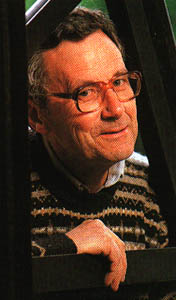
James Lequeux (the photo is old)
Academian Evry Schatzmann, long-time president of the obscure Union Rationnaliste, an organization no one speaks of today, which had set itself the goal of fighting "pseudo-sciences and intellectual impostures," is now just an aging man, having done his best to play the role of epistemic enforcer in astrophysics. The tally of his career: practically zero. Could one compare such a man to figures like Eddington and Jeans? Certainly not. But know this: this individual will leave a mark—not because of his work, but because of a single photograph: that of the participants at the famous Solvay Congress in Belgium, gathering the leading lights of science at the time. There stands young Schatzmann, next to Bethe, Einstein, Dirac, and many others. Someone must have thought, "He's a promising young Frenchman," because I truly cannot see what he was doing in that photograph.
There was a time, an era, between the wars, when every photograph of participants at the Solvay Congress gathered, in science, a veritable constellation of historical figures. Since Feynman's death, who could we now display in a new photo? Veneziano?
The theoretical physicists, astrophysicists, and cosmologists of our time are destined for oblivion in science.
Everything is falling apart, even in scientific publication. There exists a journal called "Classical and Quantum Gravity" that takes itself very seriously and...