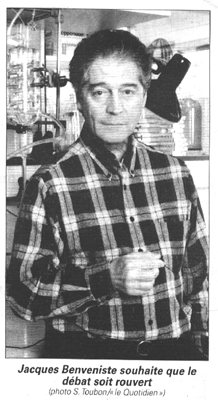
Homage to Jacques Benveniste

Drive out the supernatural, and it comes galloping back!
May 7, 2007
One might ask: "Why such a title on a page meant to be an homage to my late friend, Jacques Benveniste?"
It's a story we had begun to tell, together with one of his students, Francis Beauvais, author of two books available for free reading on his website:
We had planned to structure it as a dialogue. But it required too much work, and other urgencies arose. So now, with Jacques gone, I’ll summarize it briefly.
He was anything but a believer. Jacques, from a Jewish family, didn’t believe in God or the Devil. He held a naive faith in Science. Science, in turn, played the most outrageous trick imaginable on him. I won’t go through the story in detail. One day, Jacques encountered the problem of high dilutions. It started with bee venom. Injecting it into human blood triggered an immunological reaction. Jacques was first and foremost an immunologist. I don’t know much about it, except that this reaction manifests as a behavior of white blood cells called basophils. These cells "degranulate," releasing substances contained in tiny capsules, and we then speak of "basophil degranulation." The phenomenon is observed by staining these structures, and the number of degranulated basophils can be counted under a microscope.
So here’s my Jacques, one fine day, following a suggestion. He dilutes, dilutes, and dilutes some more. The effect fades, fades away. Then suddenly, without warning, it rebounds—despite the fact that, based on the dilution, not a single molecule of venom should remain in that damned test tube.
- Dilute... dilute, something always remains...
Ben sent the work to the journal Nature. The referee accepted it. It met all standards. The expert judged the authors to be reputable. But before the article appeared, John Maddox, the editor-in-chief of this prestigious journal, lost his temper.
- Not in my journal!
He ordered Ben to withdraw the article, threatening dire consequences if he refused.
Jacques refused. The article was published—and scandal erupted. Nature sent a commando to Inserm, 200, Benveniste’s lab: a team of biologists, a physicist, and Randi, a magician tasked with detecting fraud. It was insulting. But the team played along, and the results turned out disappointing. The bottles of champagne remained sadly in the fridge.
Maddox exulted, claiming the count of those famous granules—performed by a lab technician—was flawed. Benveniste then embarked on a battle that, over the years, would ultimately break his health. He sought an experiment free of any possible human error, and found a way to accelerate a rat’s heartbeat using something, I no longer recall, but still highly diluted. Charpak, a Nobel Prize-winning physicist and academician, was invited to the lab and witnessed a successful experiment. They injected what, by all dilution logic, should have been nothing but pure water. And there, before the academician’s eyes, the rat’s heart raced.
Charpak withdrew, deeply impressed.
He requested the experiment be repeated elsewhere—and this time, it failed. Jacques couldn’t understand. Years passed. He fought on, searched for an unassailable protocol. Some of his ideas were remarkably logical. Proteins are often, if not always, surrounded by a vast number of water molecules, forming a kind of cocoon around them. Under these conditions, how could the Pasteur Institute’s "lock-and-key" model possibly work? How could these proteins interact when they’re constantly surrounded by a cushion masking their shapes?
Simple, said Ben: they communicate via electromagnetic waves.
The word was out. In biology, electromagnetism is sorcery.
- Dangerous Dilutions...
- Where does the energy come from? asked a chemist.
- The proteins act as antennas, resonators. They harness ambient electromagnetic energy, explained Jacques. Besides, when I seal these molecules away behind a protective screen—a Faraday cage—they no longer communicate!
Benveniste then launched experiments where he passed a biological substance through a device, claiming he could record its "signature"—an electromagnetic wave—and that what emerged would "activate pure water" along its path. Even more astonishing: he claimed to store the digital signal, the molecule’s signature, on a floppy disk—essentially, the "barcode" of the biomolecule.
Meanwhile, Inserm had stripped him of his magnificent offices on the first floor of the Clamart Inserm building. Stubborn, he installed Algeco sheds in the lab courtyard and resumed his experiments. All this lasted for years—exhausting, damaging, for a man whose heart had been patched multiple times. But Benveniste was convinced Nature would deliver its verdict. It was all a matter of protocol, he believed, confident. Methodically, he tried to eliminate any human intervention. He worked on coagulation experiments. The dilutions were performed by a robot, as were all manipulations.
Sometimes results were inconsistent, but Jacques remained confident:
- We may not control all parameters, but we’ll eventually achieve something fully reproducible. And then!...
And then the matter would be settled, decided. He would have fought long enough, exhausting his last strength. He crisscrossed the globe seeking funding, gave lectures. How often I told him:
- Jacques, you’ll end up killing yourself!
But he could no longer turn back. He had created DIGIBIO, the first "digital biology laboratory." He found sponsors, investors, secured patents. It was a full-speed-ahead race, with no possibility of retreat. Jacques fought, fought, thought only of irrefutably improving his methodology. He eventually attracted the attention of the American military. Why the military? That remains a mystery. Anyway, he and his collaborators traveled across the Atlantic, performed numerous successful demonstrations.
The Americans were impressed, bought an identical robot to the French one, and under Jacques’s direction carried out these astonishing experiments.
Then came the epilogue, the curtain call. When Benveniste returned to France, the Americans sent a cable:
- We’re canceling the contract. It no longer works...
- But surely! You saw it yourself. When we were there, it worked perfectly!
- Yes, yes, absolutely. We’re not denying that. But we’ve analyzed all the experiments and discovered the key parameter that made it work.
- And what was it?...
- Whenever your colleague Machin was present, next to the machine, it worked every time. But since he returned with you, it’s over. That’s all there is to it. It’s him who makes it work—remotely.
Jacques already knew, but desperately refused to believe it. He told me:
- It’s strange. When that guy is there, simply sitting a few meters from the machine, it works better. I’d even say it works every single time. It’s utterly incomprehensible...
All this reeked of the paranormal, from miles away. I can testify: it was far from Benveniste’s usual cup of tea. The American military was his last card. The Americans are pragmatic:
- When Benveniste’s colleague is present, it works—every time. When he’s not there, it doesn’t work. That’s how it is. But in the end, it’s still a failure, so we’re canceling the contract...
That’s the truth, as I knew it and as his close collaborators also know it. A scientist utterly rational, utterly honest, seeking the thread of pure reason, had simply, unknowingly, fought against the worst possible adversary: mind-matter interaction.
Those who believe Nature obeys reproducibility and rationality are sticking their fingers deep into their own eyes. Most of the time, it’s true—but sometimes, Nature plays nasty tricks that leave scientists completely off-balance. The non-reproducible, the uncontrollable, leave us utterly helpless. I’d rather stick to math. That’s reproducible, at least in principle.
Three times seven makes twenty-one, every single day of the week...
Well, I say that—but there are mathematicians with rather strange lives. Not long ago, we filmed an interview with one of them, who told us how he spoke to trees, from which he drew his science. How, as a young man, he had been part of a sect devoted to black magic, and how their leader had sold his soul to the Devil for a theorem. Something important, anyway. The sum of the cubes of integers is an irrational number, or something close to that.
The young man who filmed this scene, beneath golden wood paneling, accidentally erased it due to champagne. But perhaps it was better that way. Still, a dozen people saw with their own eyes, heard with their own ears, what I had known for a long time. Some things just can’t be categorized. That’s how it is.
Back to Jacques. He was exhausted. He had fought too hard. Life was leaving him. His patched-up heart was crumbling. He died on an operating table. I know what it means to fight—yes, I do. And I wonder why, among the three of us—him, Bounias, and me—I survived. Probably because I’ve often known how to step back, to find shelter elsewhere, in another field. In comic books, for example. That’s why I’ve done so much. I know what it’s like to endure relentless crossfire. I recall Rémy Chauvin’s words:
- In our university-research world, nothing should be exaggerated. It never goes beyond assassination!
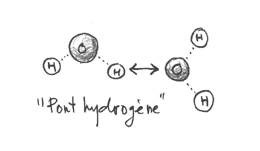
Below is a drawing Jacques had framed and hung in his office:
Ben and Bounias died "on the front lines of research." But the most absurd epilogue was the one Jacques experienced.
I’ll end with a story from a book by a man whose name I’ve forgotten. He’ll remind me of his good memory. One day, a man arrived at Benveniste’s lab with a "machine" of his own invention. It was... just a small empty box. No power supply, no antenna, nothing. Details are in the book—if you can call them details. The man demonstrated his "device," which performed miracles, triggering numerous phenomena at will. Benveniste and his collaborators were stunned. When the man left with his empty box, a close collaborator asked:
- Well, what do we do now?
- We start by shutting it down.
Time has passed. Jacques died foolishly, undone by a spiteful phantom—himself the very embodiment of honesty. At one time, I had drawn some pictures. I found them again and am sharing them here, at random. A kind of digital garage sale.
Nouveautés Guide ( Index ) Page d'Accueil