Chase away the supernatural – it comes back at full speed!
May 7, 2007
One might wonder: “Why such a title, on a page meant to be a tribute to my deceased friend, Jacques Benveniste?”
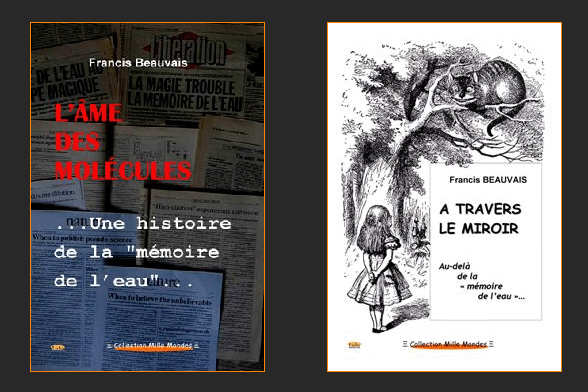
It’s a story we started to tell, together with one of his students, Francis Beauvais, author of two books. Those books can be freely read on his website:
We planned to structure this as a dialogue. But it required too much work, and there were other urgent matters to attend to. So now that Jacques has died, I’ll summarize it briefly.
He was anything but a believer. Coming from a Jewish family, Jacques believed neither in God nor in the Devil. He retained a naive faith in Science. And Science played the craziest trick imaginable on him. I won’t go into all the details here. At one point, Jacques encountered problems related to “high dilutions.” It all began with bee venom. Injecting that into human blood triggered an immunological reaction. Jacques was primarily an immunologist. As for me, I know little about it, except that this reaction manifests itself through the behavior of white blood cells called basophils. These “degranulate,” releasing substances contained in tiny capsules; this process is known as “basophil degranulation.” We make this phenomenon visible by staining these cells, and then we can count “the number of degranulated basophils” using a microscope.
So, one fine day, our Jacques followed what he’d been advised to do: he diluted, diluted, until exhaustion. The effect gradually faded away. Then, unexpectedly, it came back – even though, based on those dilutions, there shouldn’t have remained a single molecule of venom in that test tube.
“– Dilute... dilute... there’s always something left...”
Well, Ben submitted this work to the journal Nature. The referee accepted it; it met all standards. The expert deemed the authors well-known and respectable. But before the article could be published, John Maddox, editor-in-chief of this prestigious journal, had a fit.
“– Nothing like this in my journal!”
He ordered Ben to withdraw his paper, warning him that if he refused, he’d face serious trouble.
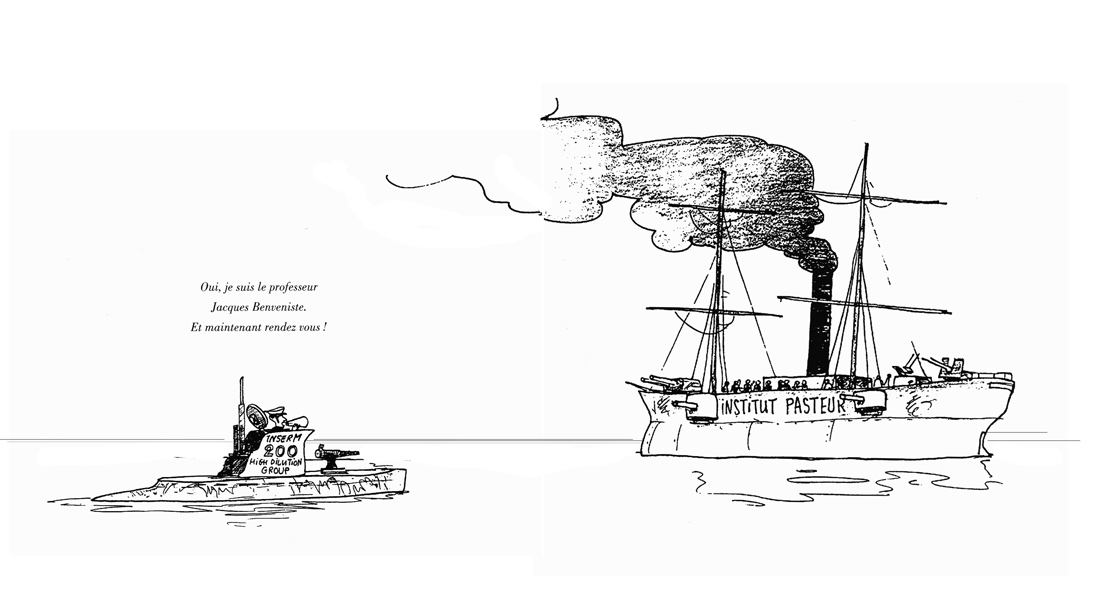
Jacques refused. The article appeared, and it caused a scandal. Nature dispatched to Inserm 200, where Benveniste worked, a commando consisting of biologists, a physicist, and Randi, a magician tasked with detecting fraud. It was insulting. Yet the team played along, but the results were disappointing. The bottles of champagne remained sadly unused in the fridge.
Maddox gloated, claiming that the count of those famous granules, performed by a lab technician, was flawed. Benveniste then embarked on a struggle that, over the years, would wreck his health. He searched for an experiment free from any possible human error and found a way to accelerate a rat’s heartbeat using, I don’t recall exactly what, but still highly diluted substances. Charpak, an academician and Nobel laureate in physics, was invited to the lab and witnessed a successful experiment. They injected what, according to the dilutions performed, should have been nothing but pure water. And lo and behold, the heart started beating furiously right before the academician’s eyes.
Charpak left, deeply impressed.
He requested that the experiment be repeated elsewhere – but this time it failed. Jacques couldn’t understand why. Years passed; he kept fighting, searching for an infallible protocol. Some of his ideas made perfect sense. Proteins are often, if not always, surrounded by a large amount of water molecules, which envelop them like a cocoon. Under such circumstances, how could the Pasteur Institute’s “key-and-lock” model possibly work? How could those proteins interact when they’re surrounded by this cushion that obscures their shape?
Simple, said Ben: they communicate via electromagnetic waves.
There it was – the word was spoken. In biology, electromagnetism is witchcraft.
“– Dangerous dilutions...”
“– Where does the energy come from?” asked a chemist. “– Proteins serve as antennas, resonators. They harness ambient electromagnetic energy,” explained Jacques. “In fact, when I shield these molecules behind a protective screen, a Faraday cage, they stop communicating!”
Benveniste then conducted experiments in which he passed an electromagnetic wave through a biological substance, claiming he could record its “signature”; this wave supposedly “activated pure water” lying in its path. Even more astonishing: he claimed to store the digital signal – essentially the “bar code” of the biomolecule – onto a floppy disk.
Meanwhile, Inserm stripped him of his magnificent premises on the first floor of the Clamart facility. Stubborn as ever, he set up Algeco prefabs in the lab courtyard and resumed his experiments. This went on for years – an exhausting, damaging struggle for a man whose heart had been patched up countless times. Yet Benveniste firmly believed Nature would deliver its verdict. Everything hinged on the protocol, he thought confidently. Methodically, he tried to eliminate any human interference. He then worked on coagulation experiments; dilutions were performed by a robot, as were all manipulations.
Sometimes results turned out poorly, but Jacques remained confident:
“– We may not control all parameters, but eventually we’ll achieve something fully reproducible. And then...”
And then the matter would be judged, settled. He’d fought hard enough for that, draining his last reserves of strength. He traveled the globe seeking funding, gave lectures. How many times did I tell him:
“– Jacques, you’ll lose your life doing this!”
But he could no longer turn back. He founded “DIGIBIO,” the first “digital biology laboratory.” He secured sponsors, investors, filed patents. It was a headlong race, with no chance of retreat. Jacques fought on, focused solely on improving his methodology beyond doubt. Eventually, the U.S. Army became interested in his research. Why the army? That remains a mystery. Nevertheless, he and his collaborators headed across the Atlantic, performing numerous successful demonstrations.
The Americans were impressed; they bought a robot identical to the French machine and, under Jacques’ supervision, carried out those astonishing experiments.
Then came the epilogue, the curtain fall. Once Benveniste returned to France, the Americans wired him:
“– We’re cancelling the contract. It no longer works... – But really! You saw it yourselves. When we were there, it worked magnificently! – Yes, yes, absolutely. We’re not denying that. But we analyzed all the experiments and discovered the key parameter responsible for its success. – And what is it?... – Whenever your colleague Machin stood next to the machine, it worked flawlessly. But ever since he left with you, it stopped working. It’s as simple as that. He’s the one who makes it work, remotely.”
Jacques already knew this, but desperately refused to believe it. He told me:
“– It’s strange. When that guy is there, just sitting a few meters from the machine, it works better. I’d even say it works every time. It’s incomprehensible...”
All this reeked of the paranormal. I can attest: it was utterly contrary to Benveniste’s nature. The U.S. Army was his last hope. Americans are pragmatic:
“– When Benveniste’s buddy is present, it works constantly. When he isn’t there, it stops working. That’s how it is. Still, ultimately it’s a failure, so we cancel the contract...”
That’s the truth, as I knew it and as his closest collaborators also know it. A thoroughly rational, utterly honest scientist, seeking the guiding thread of pure reason, unknowingly battled the worst possible adversary: the mind-matter interaction.
Those who believe Nature obeys reproducibility and rationality are kidding themselves. Most of the time it does, but sometimes it plays nasty tricks, leaving scientists completely off balance. The non-reproducible, uncontrollable leaves us utterly defenseless. I prefer mathematics. That’s reproducible, at least in principle.
Three times seven equals twenty-one, every day of the week...
Granted, there are mathematicians living rather peculiar lives. Not long ago, we filmed an interview with one of them, who told us how he talks to trees and derives his knowledge from them. As a young man, he belonged to a sect practicing black magic; their leader sold his soul to the devil for a theorem – an important one, at that. The sum of the cubes of whole numbers is an irrational number, or something similar.
The young man who filmed this scene beneath gilded moldings accidentally erased it, thanks to the champagne. But maybe that’s for the best. In any case, about a dozen people got to see with their own eyes and hear with their own ears what I’d known for ages. There are things we simply can’t categorize. Such is life.
Back to Jacques. He was exhausted. He’d fought too hard. Life was slipping away from him; his patched-up heart was falling apart. He died on an operating table. Fighting – I know what that means, oh yes! And I wonder why, among the three of us – him, Bounias, and me – I survived. Probably because I managed many times to step back and find refuge elsewhere, in another field – comic strips, for instance. That’s why I did so many things. I know what it’s like to endure relentless crossfire. I recall Rémy Chauvin’s words:
“– In our university-research world, one mustn’t exaggerate. It never goes beyond murder!”
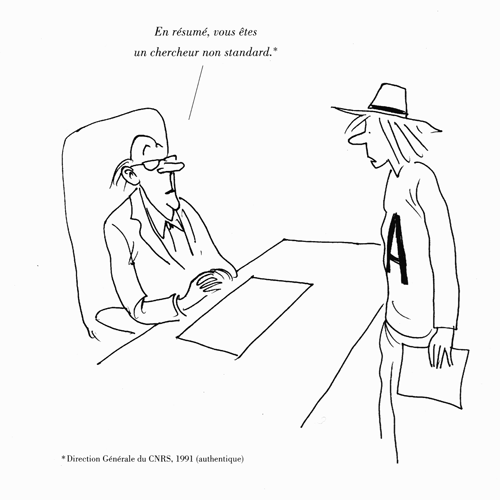
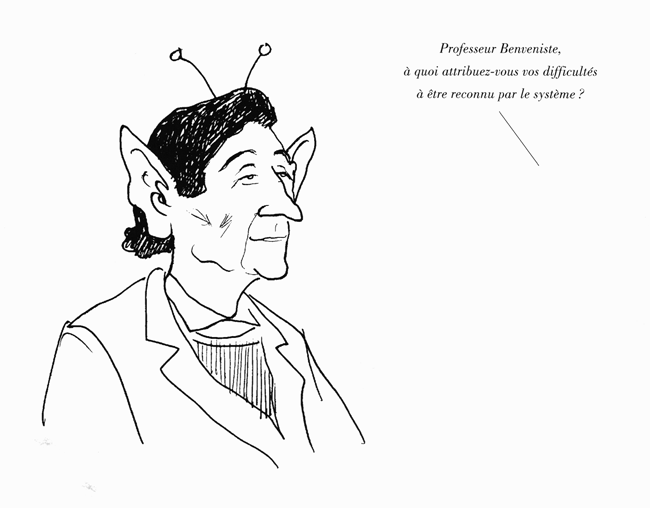
Below is a drawing Jacques framed in his office:
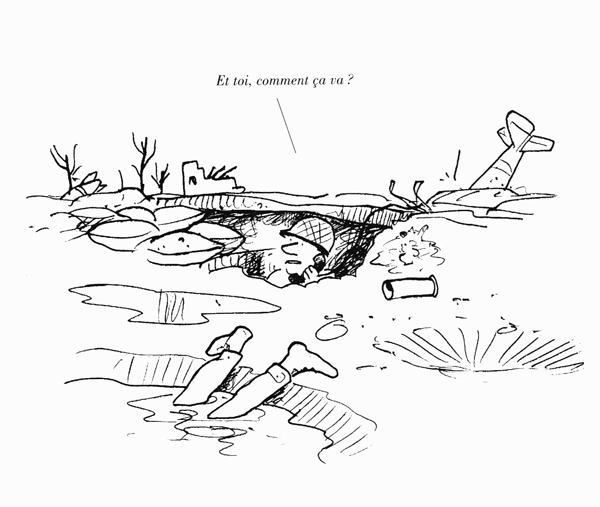
Ben and Bounias died “on the front lines of research.” But the craziest epilogue belongs to Jacques.
I’ll conclude by sharing an anecdote from a book written by a fellow whose name I’ve forgotten; he’ll surely remind me of himself. One day, a man arrived at Benveniste’s lab with a “machine” of his own invention. It was... a simple little box, empty. No power supply, no antenna, nothing. The details are in the book – if we can call them details. The man demonstrated his “device,” which performed miracles, inducing numerous phenomena at will. Benveniste and his collaborators stood stunned. When the man departed with his empty box, a close associate of Benveniste asked:
“– Well, what do we do now? – We start by shutting it down.”
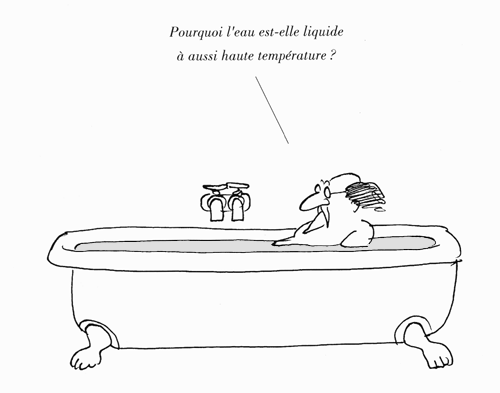
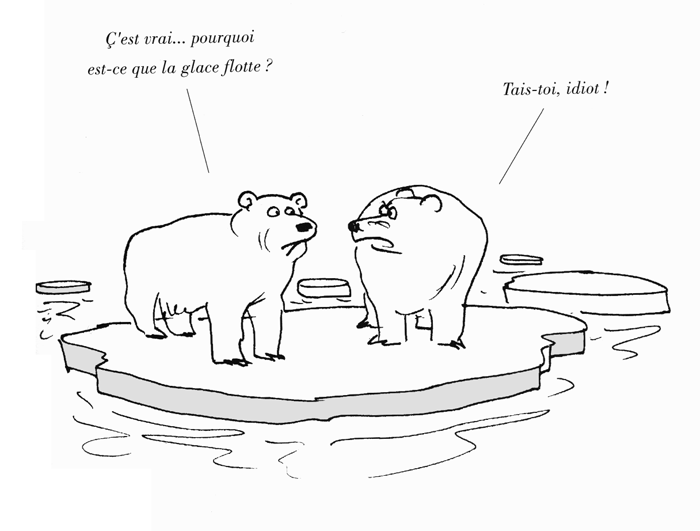
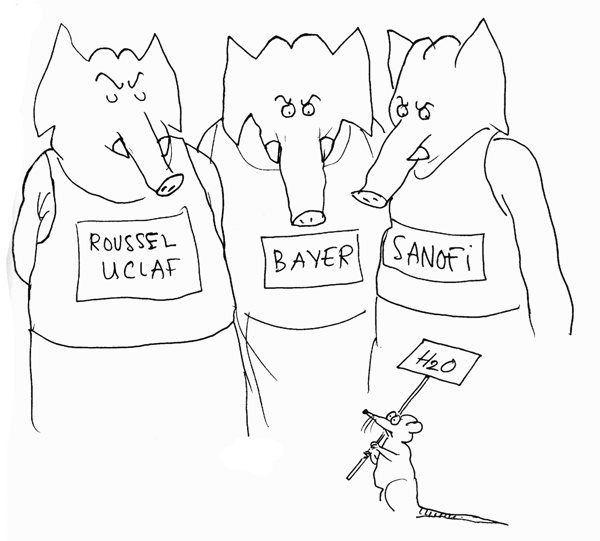
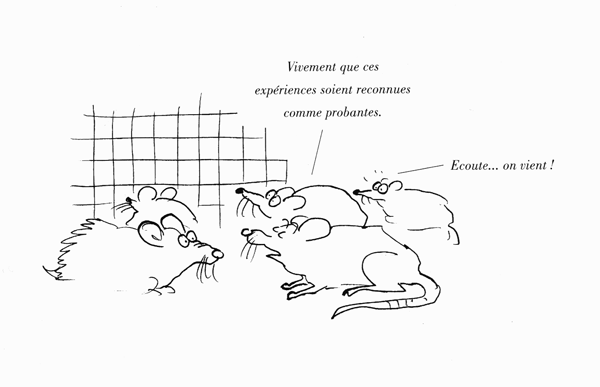
Time has passed. Jacques died foolishly, outmaneuvered by a vicious chimera, he who embodied honesty itself. At one point I drew some pictures. I found them again and present them to you, haphazardly – a sort of digital flea market...