Request for Right of Reply to the CEA
Request for right of reply, addressed to the CEA
following the publication of a text damaging my reputation
January 23, 2012
On November 17, 2011, the CEA posted on its website a text characterizing my writings as intellectual dishonesty. Here is the full text in question, 4,625 words, thirty thousand characters:
Response to the paper "ITER: Chronicle of an Announced Failure" by Mr. Jean-Pierre Petit, published on November 12, 2011, in the journal Nexus, prepared by the French Alternative Energies and Atomic Energy Commission. November 17, 2011.
Introduction The argumentation developed in Mr. J.P. Petit's article—published by a member of the French anti-nuclear association "Sortir du nucléaire"—aimed at challenging the ITER project by stoking unfounded fears, is based on excerpts taken out of context from a recently completed doctoral thesis at the CEA’s Institute for Magnetic Confinement Fusion, defended in November 2010 at the doctoral school of École Polytechnique, specifically addressing the particular issue of disruption phenomena that may occur during ITER's operation.
A disruption, a phenomenon long known to science, is an instability that can develop within a tokamak plasma. Charged with significant energy, it leads to the breakdown of magnetic confinement and manifests as a high-intensity electrical discharge toward the vacuum vessel wall, posing a risk of damaging the vessel itself.
This high-quality thesis draws upon fifty years of research conducted by a global scientific community comprising several thousand professionals worldwide, forming the recognized foundation of current scientific debate on this subject.
There is abundant literature on disruptions, particularly in articles regularly published in the journal "Nuclear Fusion." These form the official and public physical basis for ITER’s design.
Observing that Mr. J.P. Petit's article selects only specific excerpts from research that rightly highlight the need for scientific attention to disruption phenomena, one can only conclude that his intent is clearly political provocation and malice—not serious scientific work conducted in a constructive, critical spirit aimed at advancing the subject.
We regret the casual manner in which scientific information published in internationally renowned journals, their authors, and even the readers of the article itself are manipulated for partisan purposes unrelated to research or the advancement of knowledge.
Through such intellectually dishonest conduct, Mr. J.P. Petit disqualifies himself ipso facto from any debate—scientific or societal.
This document aims, on one hand, to respond to the most grossly inaccurate points in Mr. J.P. Petit’s analysis, both scientifically and regarding his misunderstanding of the broader research context, and on the other hand, to provide the reader with the key elements for understanding this context and the precise role ITER must play in magnetic fusion research over the coming decades.
Analysis of Mr. J.P. Petit’s criticisms.
Mr. J.P. Petit's main argument is that ITER cannot withstand disruptions, which correspond to a rapid shutdown of the plasma. Let us analyze point by point the criticisms raised in the article (the excerpts from the article are italicized).
p.91, "From this reading, one concludes that magnetic confinement fusion and tokamak physics—extremely complex—are not at all mastered by theorists. No modeling of the behavior of plasma contained in these machines is representative, in the sense that it will remain impossible for a long time to manage, even with the most powerful supercomputers in the world, a problem involving 10²⁰ to 10²² electrically charged particles interacting with each other."
These statements are astonishing coming from someone who claims to be an "eminent specialist in plasma physics." Numerous examples exist of theories and models that work well with large numbers of particles. In fact, magnetohydrodynamics (MHD) is a science capable of describing the dynamics of a plasma or conducting fluid composed of an extremely large number of particles. The computational power currently available even enables full-scale simulations. Unless Mr. J.P. Petit wishes to question the very research of the scientific community he belonged to over twenty years ago, he cannot seriously claim that simulating a dynamic system with many particles is impossible.
That said, no one has ever claimed that tokamaks are or should be designed based on numerical simulations. In practice, technical specifications for tokamaks regarding their resistance to disruptions rely on so-called "engineering laws" concerning the characteristic energies and times involved in this process. The values chosen for ITER have been validated through experiments conducted on numerous tokamaks over more than half a century. Numerical simulations of disruptions only emerged recently, particularly in the thesis of Mr. C. Reux, which Mr. J.P. Petit greatly emphasizes.
In fact, the results are very encouraging, even if their precision can still be improved. It should again be emphasized that these simulations represent an additional refinement in understanding tokamak plasmas, not the foundational basis for ITER’s design—which has long been validated by the previously mentioned "engineering laws."
p.91: "All tokamaks worldwide, including Tore Supra and JET, have become unmanageable due to extremely varied causes."
This assertion is evidently false and completely deceptive: Tore Supra and JET have operated satisfactorily and perfectly safely since 1988 and 1983 respectively—over twenty years for Tore Supra and nearly thirty for JET. Disruptions occur regularly in these two machines (as in all others), but they have never led to destruction or loss of confinement of toxic materials, as Mr. Petit fantasizes. Thirty years of incident-free operation is certainly not what one would honestly describe as an "unmanageable" situation!
p.92: "Disruptions... generate forces capable of deforming the vessel structures like bundles of straw." The first-wall elements and structural components of tokamaks, including those of ITER, are naturally designed to withstand the forces generated by disruptions, even the most powerful ones conceivable. These components are arranged to minimize electrical currents flowing through them during a disruption, thereby limiting the tensile forces they might experience. Moreover, in cases of extreme situations causing superficial damage to these elements, they are designed to be replaceable.
The photograph shown in the article and taken from the thesis (a damaged Tore Supra component due to a disruption) is illustrative in this regard: it shows a "pencil" (first-wall element) twisted on Tore Supra due to a disruption. It was replaced, current paths were corrected afterward, and Tore Supra resumed normal operation!
Certainly, during ITER’s gradual commissioning phase, such situations will be encountered, and any defects observed will be corrected, just as occurs in any industrial or research installation during its initial operational period (cf. CERN’s situation in 2009). Of course, the machine will be tested with currents lower than nominal values to minimize potential degradation during this commissioning phase.
p.93: "The lightning strikes occurring inevitably will reach 15 million amperes (150 million amperes on its successor DEMO). Such powerful impacts will perforate the vacuum vessel. The beryllium layer... will be vaporized and disperse its material, along with tritium, a radiotoxin contained in the chamber." This statement is doubly false. Assuming that, under extreme conditions, a vacuum vessel perforation occurred on ITER due to a disruption, there would be no release of beryllium or tritium outside the facility: the vacuum vessel is surrounded by multiple layers of confinement barriers, which disruptions would not affect. Furthermore, DEMO will certainly not operate at 150 MA but at currents comparable to those of ITER (15–20 MA). Mr. Petit’s reckless and dogmatic extrapolations demonstrate his profound ignorance of tokamak physics and technology.
p.93: "Laplace forces, amounting to thousands of tons, could deform the machine's structures, necessitating their replacement or even complete reconstruction of the installation."
Measuring forces in tons is more than surprising from someone who claims to be a physicist.
Force is measured in newtons, and mass in grams or tons. The Laplace forces induced in ITER are estimated to reach billions of newtons. ITER’s structural components are designed to withstand these forces of several billion newtons—there will be no need whatsoever to replace them. JET has resisted disruptions generating forces of several billion newtons for thirty years. The installation is built to withstand such forces without deformation.
p.94: "There is no way to extrapolate or reuse existing data... these inevitable incidents during implementation could lead to the destruction of ITER from the very first tests." These dogmatic claims are incorrect. Indeed, there are reliable methods and codes available for estimating so-called "halo" currents associated with disruptions, the level of asymmetry of these currents in the toroidal direction, as well as the forces exerted on the vacuum vessel. This estimation is consolidated using a database ("ITER disruption database") fed by observations from a large number of tokamaks of varying sizes. As already mentioned, there are also increasingly precise MHD numerical simulations allowing independent assessment of the fine nature of disruptions—but these were not used to design ITER, as the decisions were made prior to the development of these simulation techniques. These simulations are now used for fine understanding, verification, and aiding in defining startup tests, future experiments, and interpreting their results. Again, it should be emphasized that ITER’s startup tests will be conducted at reduced plasma current (as with any other machine), with a gradual power increase, thus ensuring no risk to the machine's integrity.
p.94: "To hope one day to operate a tokamak without disruptions is as unreasonable as imagining a sun without solar flares, weather without wind or clouds, or cooking in a pot full of water without eddies." A tokamak can operate safely without disruption if the plasma is stable with respect to MHD modes. In fact, this is the normal operating regime for most tokamaks, and ITER will not be an exception. Here, one must avoid confusing instability with turbulence. A disruption arises from a perfectly deterministic instability. If the plasma is stable with respect to this instability, there is no reason for it to occur, given the reproducibility of deterministic physics. This very important point has been confirmed by analysis of the already-mentioned ITER database: there is no random character in the triggering of a disruption, even though the underlying physics is complex. Turbulence (the image of the pot) is associated with multiple small-scale instabilities. In fact, turbulence is chaotic. It is unavoidable, but it does not lead to a disruption. A disruption can enter a turbulent regime, but only at a later stage, after the primary instability has been triggered. In this regard, the figure presented by Mr. J.P. Petit as an illustration is entirely irrelevant: it depicts turbulence unrelated to disruptions.
Of course, one of ITER’s goals is to develop a scenario stable with respect to disruptions. Once such a scenario is found, there is no reason for it to spontaneously become disruptive.
p.95: "Disruptions can damage any component of a tokamak, including its superconducting magnet system, which we recall contains the energy equivalent to an aircraft carrier launched at 150 km/h." This assertion is again false. The vacuum vessel will be protected by shielding designed to stop 14 MeV neutrons from fusion reactions, and certainly also fast electrons from disruptions, which therefore will not reach the magnet. Once again, structural components—including the superconducting magnet—are designed to withstand disruptions. The energy involved in a disruption has nothing to do with the energy stored in the toroidal magnet. Rather, it concerns the plasma’s energy content (approximately 350 megajoules for a full-power ITER plasma) and the energy of the so-called poloidal magnetic field (about 400 MJ)—the two not being released simultaneously—thus nothing comparable to the 51 gigajoules mentioned, nor to any aircraft carrier launched at 150 km/h, even the Charles de Gaulle.
p.95: "If one wanted to picture the operation of a tokamak, one would have to imagine a technician facing a boiler and a few measuring instruments. If the needle of one of them trembles slightly, his only possible action is to flood the furnace with a fire hose." Once again, this reflects a misunderstanding of what a tokamak is and a manipulation of facts for partisan purposes. Tore Supra has 40 continuous monitoring instruments, JET has about 80, and ITER will have even more. Describing them as "a few measuring instruments" is highly reductive. As for the "fire hose," the estimated time available to stop or slow down fast electrons is on the order of 10 milliseconds. It is estimated that injecting 10²² electrons per cubic meter is required for a "gentle" shutdown (cf. the reference document "ITER Physics Basis," which provides the physical design basis for ITER, published in Nuclear Fusion and co-signed by the entire global scientific community). This is not an impossible task!
In fact, the study of massive gas injection as a method to stop fast electrons is precisely the focus of Mr. Cédric Reux’s thesis. Other techniques are being studied by several research teams worldwide, including one from the CEA, in order to identify the most effective and cost-efficient solution.
Current results are encouraging, and it is reasonable to expect that one or even several of these innovative methods—beyond the currently available one—will be ready by 2019–2020 for the first hydrogen plasma, and even more so by 2026 for the first deuterium-tritium plasma.
p.95: "One might wonder why the nuclear safety authority has never mentioned this danger..." It truly shows a poor understanding of the nuclear safety authorities of ITER’s seven partners (Japan, South Korea, India, China, United States, Russian Federation, European Union) and France to even think for a moment that they would have failed to mention such dangers if disruptions were as dangerous as Mr. Petit fantasizes.
His malicious statement aims to suggest that disruptions have been concealed from various evaluation bodies. Naturally, this is not true. Disruptions are extensively discussed in the literature, with more than thirty-five pages dedicated to them in the "ITER Physics Basis," published in Nuclear Fusion in 2007 (complementing the initial 1999 report).
Hundreds of international publications exist on this topic. To imply that the subject has been avoided or hidden is completely contrary to reality.
What is surprising is that Mr. J.P. Petit, who claims a scientific approach, bases his dogmatic assertions primarily on superficial reading of Mr. Reux’s thesis, while completely ignoring the thousands of pages devoted to disruptions in widely recognized scientific journals. One can only be astonished by his own astonishment.
*** Having demonstrated the exaggeration of Mr. Petit’s statements, it is now appropriate to provide a concise response to the legitimate concerns of public opinion regarding the ITER research project: precisely how does the ITER tokamak function, and what is its status in relation to disruptions?
Fusion Research and the Role of ITER
Magnetic confinement fusion research is considered a "societal" endeavor in that it brings together as coherent a set of scientific and technical competencies as possible to achieve a single goal: developing, under conditions as safe as desired, an energy source based on the fusion of two light nuclei. In his introduction, Mr. Petit rightly reminds us that, in brief summary, we are talking about harnessing stellar fusion energy—produced in stars, particularly the Sun—on Earth. Indeed, a monumental task to which we are now committed!This challenge, truly a grand one, first consists of verifying that such reactions are feasible on Earth—and more importantly, that they can be achieved at "human scale." The good news, the tangible and remarkable result brought by the scientific community, is that it is indeed possible to find an operating point for this nuclear fusion reaction compatible with a human-scale realization.
In short, the physical scaling involved indicates that a reactor of this nature is conceivable within industrial installations comparable to those currently used for large-scale electricity production.
This represents a decisive milestone in the pursuit of this research. This milestone was reached at the end of the 1990s, notably through an experimental demonstration on the European tokamak JET, universally acclaimed and marking the end of a long but decisive phase in fusion history: the "pioneer phase." Several specialized books have already been written about this phase of fusion history, but it is important to highlight its major conclusions in accessible terms for the general public and those interested in our societal choices.
The pioneer phase is typically divided into two eras. The first era spans two decades from the declassification of research (1958) to the decision to build JET (1980); the second era covers the following two decades marked by the operation of large tokamaks, with JET still being the largest today, culminating in the collective decision to build ITER (2005).
During the first era, numerous paths were explored worldwide, with strong competition to develop what we call the magnetic configuration—the intangible "box" responsible for confining this extremely hot plasma, which everyone understands cannot be contained by any physical wall.
The configuration that decisively won this competition is the tokamak configuration, proposed by Russian researchers, and has not been surpassed to date.
Other configurations were outright discarded, but certain alternative approaches have been preserved and remain relevant today. The fact that the tokamak configuration leads does not mean it is perfect or ideal.
The second era consisted of defining the performance of the tokamak configuration—that is, establishing the "engineering laws" enabling extrapolation of acquired results for reactor design.
It is crucial to understand here, as in any industrial process, that establishing "engineering laws" does not require a complete understanding of the underlying physics of a phenomenon.
This is exactly what happened in aeronautics: our airplanes have flown for over 100 years, our rockets have reached the Moon for over 40 years, but the physics of turbulence around an airplane wing—though broadly understood—is still not fully "resolved" and remains the subject of ongoing research. The first cars were developed and commercialized by people who did not master the full complexity of internal combustion engine thermodynamics. The normal process in such research—reminding us that its purpose is not knowledge for its own sake, but knowledge to meet a need and require the development of innovative equipment or processes integrating numerous skills—is always to combine experimental data (we build prototypes, operate them, measure study parameters, analyze results to model the system in operation and thus master it), theoretical information (we question the physical processes governing the phenomenon, formulate equations, solve them, and compare them with experimental results), as well as "engineering models," which reproduce behaviors ad hoc and are generally simple laws with parameters adjusted based on experiments. It is the constant iteration between these activities that enables steady progress toward the goal.
Mr. Petit conflates all of this in his entire analysis. While it is true that plasma physics is still far from being fully understood at its most fundamental levels, it is completely false to claim that such knowledge is a prerequisite for ITER’s proper operation.
It is too simplistic—or naïve—to ignore or overlook the complete process underlying applied research. On the contrary, of course, the fusion scientific community does not cease its efforts to deepen fundamental understanding, as this is ultimately the key to optimizing such a process. The advancements in simulation at the world's highest level, and the massive use of the most advanced computational resources, testify to this need. France itself can proudly claim leadership in certain fronts of this research, including turbulent processes governing plasma confinement—key to performance—and nonlinear magnetohydrodynamics (MHD), which governs the same plasma’s stability.
Mr. Petit, who claims to be an ex-specialist in MHD himself, cannot possibly be unaware of the significant progress made in MHD simulations of tokamak plasmas, some of which were conducted by Mr. Cédric Reux in the thesis so generously cited by Mr. Petit himself.
So what is ITER, and what is its precise role? If there is one idea that persists when discussing ITER, it is the mistaken notion that this complex, large-scale project represents the culmination of history.
Before asking what ITER is, it is essential to understand what it is not. ITER is not a fusion reactor, neither for commercial use nor as a prototype.
ITER is, however, an advanced research machine, the result of a complete synthesis of the findings from the pioneer era—which, as we recall, validated the scientific feasibility of magnetic fusion. These efforts could have concluded, for example, that physics required a "machine" 100 meters in diameter or a magnetic field incompatible with physical feasibility. This is not the case, and it is precisely the scaling laws developed and rigorously tested that allow us to affirm this. The results from JET at the end of the 1990s actually confirmed that using the real mixture of deuterium and tritium produced exactly what had been extrapolated from pure deuterium results. Mr. Petit is correct in stating that tritium is indispensable for fusion reaction production, but he is wrong to imply that it is not used because it is expensive or "dangerous." There was no valid reason to conduct all development and testing with tritium on JET, since the behavior of fusion plasmas (and in this case based on fundamental principles of quantum mechanics) could be extrapolated from deuterium plasmas.
The issue of tritium is essentially separate from the rest of the physics question, and its presence becomes necessary only when moving to "full scale"—precisely one of ITER’s first roles.
Since the 1990s, ITER has been assigned specific scientific missions linked to questions it is expected to answer or extrapolations it is expected to confirm because it will be the first to achieve them at full scale. These scientific missions are essentially of three types:
Produce deuterium-tritium plasmas for which the energy released by the reaction dominates the energy required to sustain the process. A desired amplification factor of about 10 has been set between the injected power needed to trigger the reaction and the power recovered within the plasma. To achieve this major result, ITER must not only confirm that extrapolations are correct but also contribute significant findings on the behavior of such plasmas regarding confinement and stability.
Produce deuterium-tritium plasmas for which the energy released by the reaction significantly contributes to sustaining the process, and furthermore under conditions simulating reactor operation—i.e., approaching what we call steady-state operation. This second condition imposes additional constraints on plasma current support via auxiliary power systems.
Finally, test regimes close to what is called "ignition," i.e., regimes where the total injected power is minimized, in order to better define the operating point of a future reactor. In connection with the scientific missions assigned to ITER above, ITER also marks the beginning of a new era for fusion in that it must demonstrate the technological feasibility of the process.
This clearly means that ITER must ultimately demonstrate whether magnetic fusion is—or is not—a process capable of leading to a nuclear reactor industry entirely different from those existing today.
This challenge is taken extremely seriously by all stakeholders, each playing their respective roles. The ITER team is responsible for proposing a machine capable of fulfilling this mission and for proposing experimental protocols that must be validated one by one by the Nuclear Safety Authority before any commissioning or introduction of tritium into the machine.
As mentioned above, ITER can and will operate without tritium until all steps have been validated.
This is the main reason why the current ITER experimental plan includes between 5 and 7 years of operation before introducing tritium.
Subsequently, ITER will proceed step-by-step with tritium up to its specified performance levels. During this process, all components and physical processes will be retested, modeled, and compared against predictions, continuing the progression of the process—but now in an integrated manner. If the results match today’s expectations, they will validate magnetic fusion as a sufficiently mature process to justify moving on to the next phase: reactor prototyping (often called DEMO), including industrial-scale dimensions and economic viability, which are absent from ITER’s missions.
The CEA website page from which this document originates:
http://www-fusion-magnetique.cea.fr/en_savoir_plus/articles/disruptions
which also includes its English translation.
First remark, referring to "the production of truncated extracts," the anonymous authors of this document overlooked this more complete text, which had been available on my website for months and was based on 880 lines extracted from Cédric Reux's thesis:
In September 2011, a conference on large-scale next-generation tokamaks was held at Princeton, United States:

http://advprojects.pppl.gov/ROADMAPPING/presentations.asp
At this conference, Professor Glen Wurden (20 years of experience with fusion devices and tokamaks) presented a communication titled:
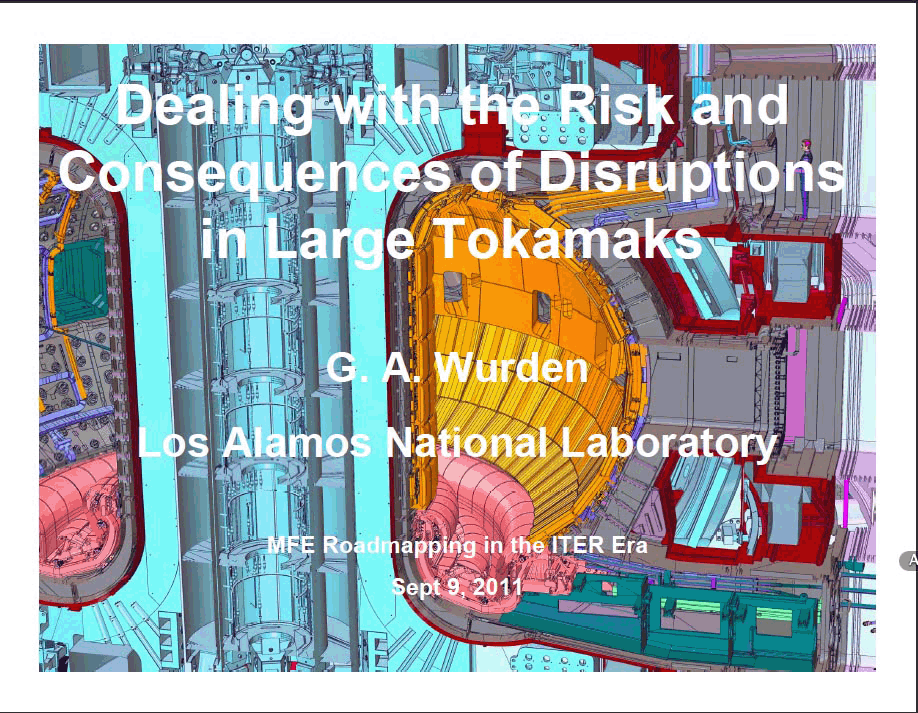
That is:
An Examination of the Risks and Consequences of Disruptions in Large Tokamaks
http://advprojects.pppl.gov/ROADMAPPING/presentations/MFE_POSTERS/WURDEN_Disruption_RiskPOSTER.pdf
His conclusions are identical to mine.
When this presentation was in PowerPoint format, the author included two videos. The first was intended to illustrate what happens during an explosion of a high-explosive charge. Here is the relevant page 18:
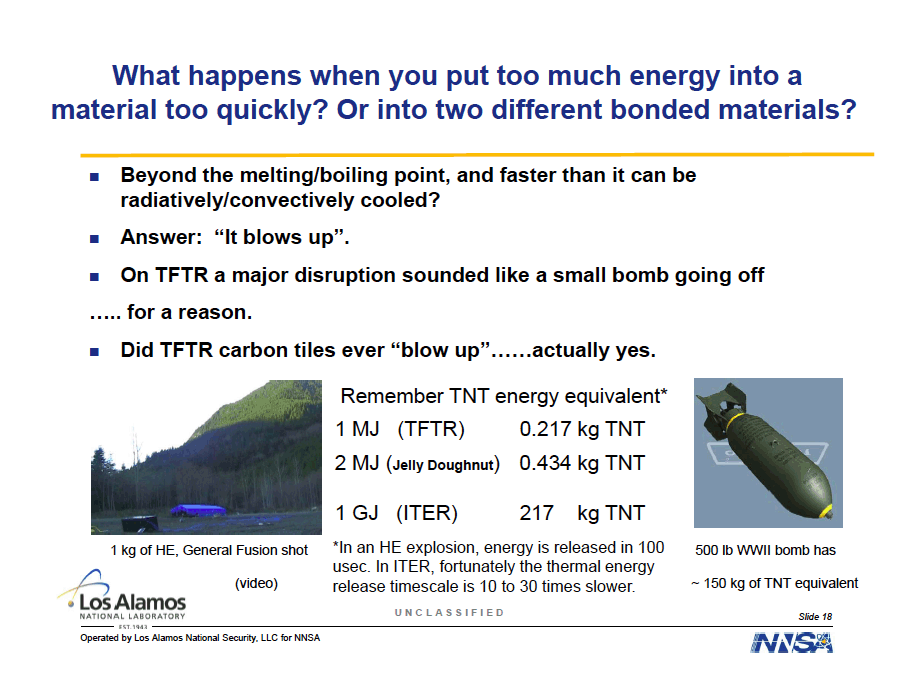
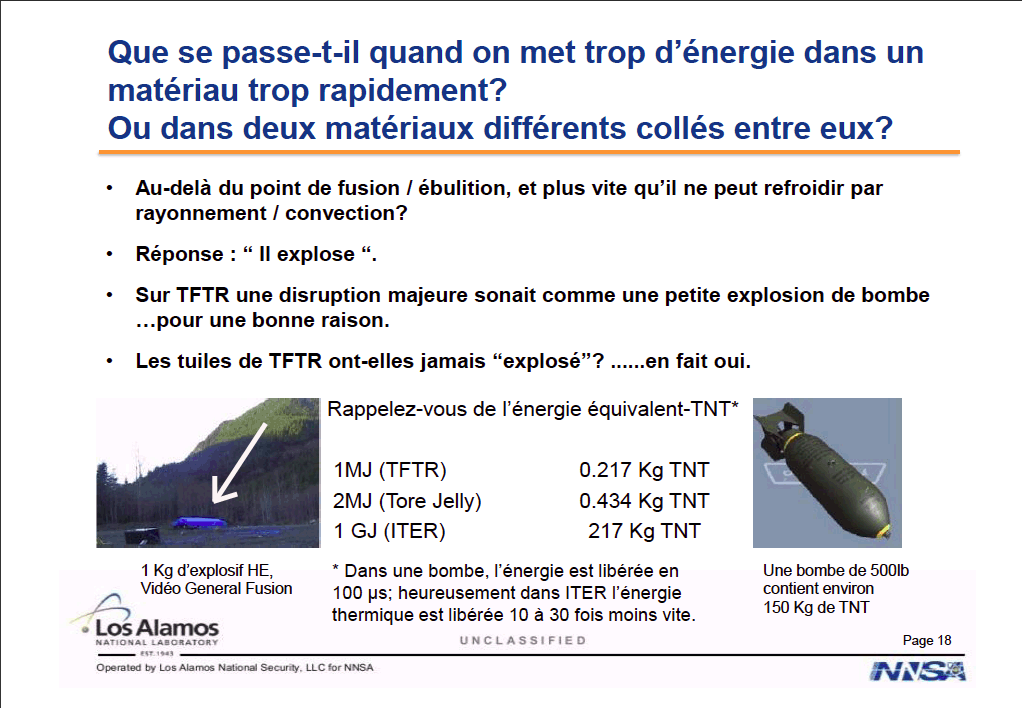
During his presentation, he played the sound produced by one kilogram of high-power explosive (placed under a blue tent, in the left-hand image).
Here is the same page, translated into French, with the arrow pointing to the relevant image:
During a one-and-a-half-hour phone conversation we had, I told him I wished French readers could access these videos, and he immediately sent them to me.
Further on, on page 25, Wurden presents a film taken at 2,000 frames per second, showing the effects of a runaway electron avalanche on the TFTR tokamak’s wall. In this experiment, the plasma current intensity reached 1.6 million amperes. The disruption gave rise to a runaway electron discharge of 700,000 amperes. Below, I have directly included the French translation of this page, with the image associated with this second video circled in red:
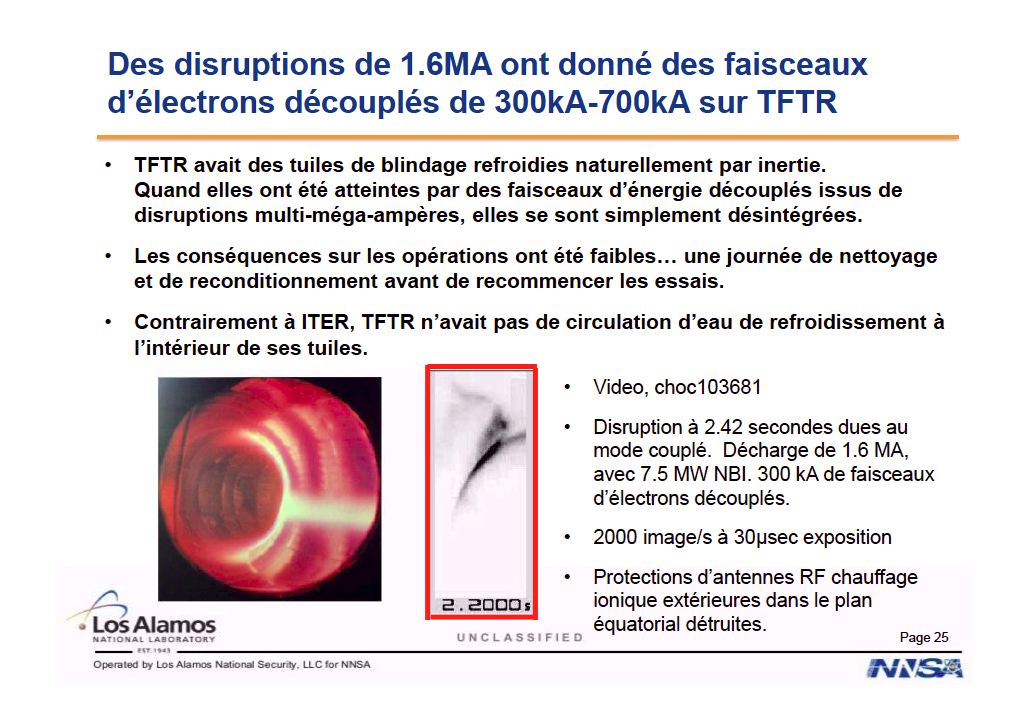
****To view this second video.
These images may surprise some readers. In fact, what this film shows is a sequence of negative images, where dark areas are actually emitting light. Below, I have extracted some frames, inverting black and white.
We see the rain of debris resulting from the explosion of a coating plate due to the impact of a runaway electron burst corresponding to 700,000 amperes. This uncontrollable phenomenon can strike any part of the chamber, including the section of the first wall that will be covered by a small centimeter of beryllium (highly toxic and carcinogenic). Remember that for ITER, the avalanche amplification factor (calculated) transforming thermal electrons into relativistic electrons (with energies ranging from 10 to 30 MeV) is 10¹⁶, compared to 10⁴ for JET and Tore Supra. Disruption currents on ITER have been estimated at 11 million amperes.
In the article that provoked the ten pages of reaction from the CEA, reproduced at the beginning of this page, a photograph taken inside the Tore-Supra machine is mentioned. The tone suggests everything is now back under control. For information, this was commented on during a conference held in 2011. Refer to the following excerpt:
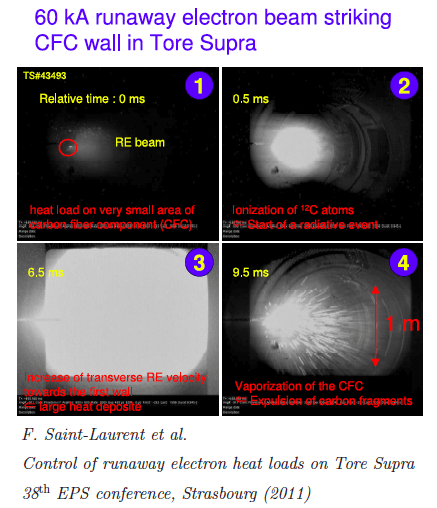
Between images 1 and 2, only half a millisecond passes (hence the difficulty of intervening when faced with such a brief phenomenon). The impact of the relativistic runaway electron discharge (called "runaway" by Anglo-Saxons) is visible in the small red circle in figure 1. It is highly concentrated. This impact, here on carbon-fiber composite tiles, immediately causes the ejection and ionization of atoms, which flood the chamber. Hence image 3, completely saturated with emitted light. Figure 4 shows the ejected carbon fragments. Try to imagine this with ... beryllium.
Just a passing note. If you have read my or our papers on tokamaks, you will have noticed that the magnetic field striving to control ions and electrons has field lines shaped like loosely wound spirals (white arrowed lines on a red plasma background).
Without this "poloidal" component, created by the plasma current, this field would not spiral. The field lines would simply be ordinary circles (blue).
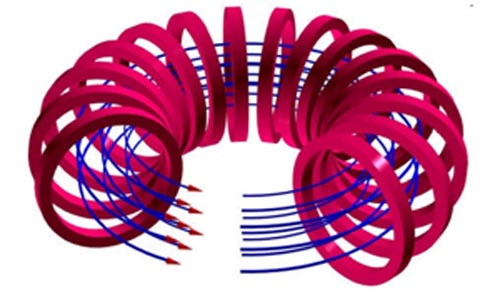
Toroidal magnetic field (blue field lines, red coils)
But since the coils are more tightly packed near the machine's axis, the field they generate in this region is stronger. Now:
- Plasmas tend to avoid regions where the magnetic field is intense.
It was on this basis that the idea of confinement emerged, because the field is stronger near the windings, whether or not they are superconducting.
Two opposing forces then arise. The plasma pressure forces, which increase with plasma density and temperature according to the relation:
p = n k T
where p is pressure, n is the number of ions per unit volume, T is absolute temperature, and k is Boltzmann's constant, which equals
k = 1.38 × 10⁻²³
We can summarize this confinement story by invoking magnetic pressure:
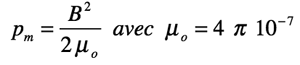
In a toroidal chamber equipped with coils, the field is stronger near the axis, where the windings are tighter. Thus, the stronger magnetic pressure tends to push the plasma outward. Not good...
In 1951, American physicist Lyman Spitzer (1914–1997), globally renowned in plasma physics, immediately suggested twisting the chamber so it resembles a spiral ribbon.
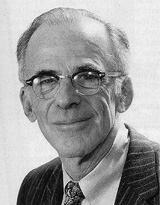
L. Spitzer, deceased in 1997
Thus was born the idea of the Stellarator.
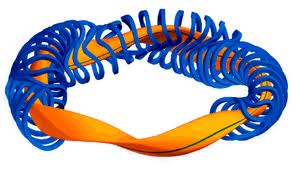
The Stellarator
Everyone finds this incredibly complicated (hence expensive). Researchers prefer to turn to an idea that comes from the cold, which the Russians would not reveal until 1958: inducing a plasma current circulating in the torus, created by induction, which, by adding a component to the magnetic field, allows "spinning the plasma" like with an "electromagnetic spoon." This seems simpler than the nightmare that is the Stellarator.
But it is precisely this plasma current (1.5 million amperes in Tore Supra, 4.8 million in JET, and 15 million in ITER) that gives rise to disruptions. This current makes all tokamaks fundamentally unstable.
In plasma physics, instabilities arise when the magnetic field is generated by a current circulating within the plasma (as is the case with the Sun, which also has its own MHD instabilities, degenerating into perfect analogs of disruptions known as solar flares).
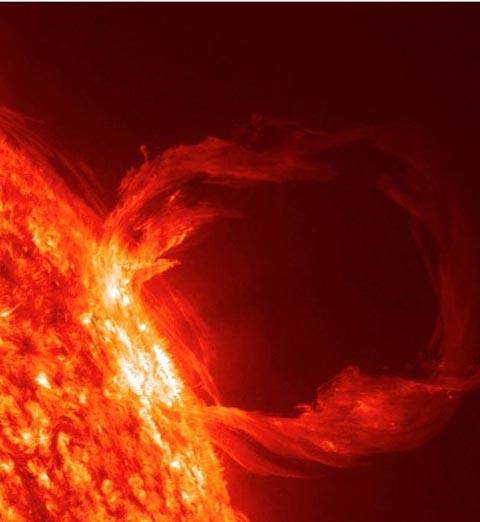
Solar flare. The image above is quite telling. Although we do not have a precise understanding of what exactly happens beneath the Sun’s surface, which is at 6,000°C, it is reasonable to think that its "subsoil" consists of "noodles," tubes of current with a complicated geometry. Imagine a sphere stuffed with bicycle inner tubes, more or less inflated. The air pressure inside these chambers is the plasma pressure. The magnetic pressure is the counter-pressure exerted by the tensions within the rubber of these current tubes.
Occasionally, the plasma pressure inside one of these "inner tubes" becomes higher than its magnetic confinement pressure. Then it erupts out of the solar surface, forming a beautiful arch, visible above. This is MHD at 150%. These arches expand beyond the Sun’s surface. At the top, the magnetic field lines are less tightly packed. This means the magnetic field at the top of the arch is weaker than that at its "feet." We know that plasmas "flee regions where the magnetic field is stronger."
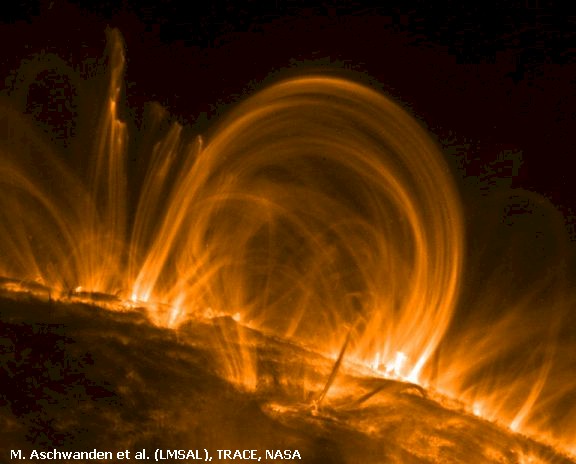
Thus, the two pillars of this plasma arch behave like natural particle accelerators, imparting strong upward velocity to ions and electrons, which then collide at the arch’s peak. This acquired velocity transforms into thermal agitation, thus increasing pressure. This pressure eventually ruptures the arch’s top like a bicycle inner tube that can no longer contain the air pressure.
The arch then transforms into two plasma jets, spewing ions and electrons forming a medium heated to between 3 and 10 million degrees. This explains the high temperature of the solar corona, as well as the violent storms that strike Earth’s upper atmosphere near the magnetic poles when the Sun becomes angry.
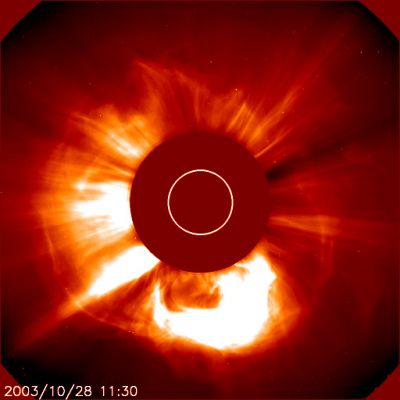
At the lower left, what remains of a solar eruption arch: a high-energy jet. In our case, the auroras are the physical effects in the upper atmosphere caused by disruptions occurring periodically in the Sun, obeying "engineering laws" (which is another way of saying we don’t know how it works).
In the Stellarator, there is no plasma current, hence no disruptions! The idea is regaining momentum. The Japanese have built one. The Germans are finishing theirs (the Wendelstein 7X in Greifswald, at the Max Planck Institute).
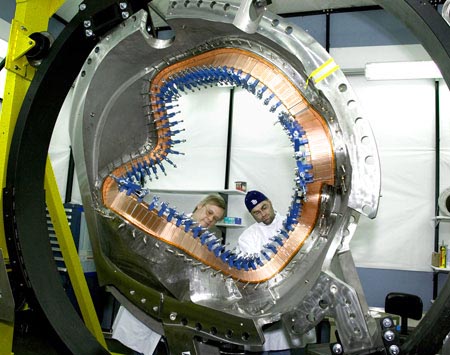
Look at its coils—they are ... awkward:
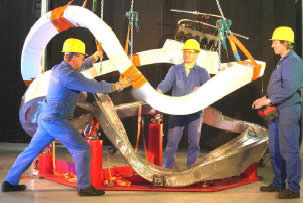
50 superconducting coils for the German Stellarator.
Since electricity was invented, we have known that when a current flows through a loop, it experiences forces tending to burst it open. You’ve all seen this at high school.
In the 1960s, in my lab, we built coils through which 54,000 amperes flowed. They had to be heavily braced, otherwise they’d end up ... embedded in the walls! (Remember, before becoming a theorist, I was an experimentalist. To those who might object that this experience is far removed, I’ll remind you that my last presentation at a major international MHD conference in Jeju, Korea, was in September 2010—a project done... in a garage).
The coils of the Tore Supra machine are simple circles, so material stress problems are inherently minimized.
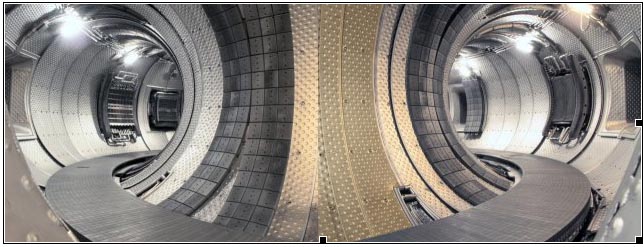
The Tore Supra chamber, circular in cross-section.
The JET coils have a "D" shape. But they are located in a plane. Still, they must be firmly braced, because the forces associated with a 5.38-tesla field are enormous.
The German Stellarator’s awkward coils pose mechanical strength challenges. Therefore, they will produce only 3 teslas (resulting in a confinement magnetic pressure three times weaker than in JET). In a toroidal chamber, to confine plasma, one aims for a magnetic pressure to plasma pressure ratio of around 10. Losing a factor of 3 means we are simultaneously limited in plasma pressure, hence in density and temperature. The German Stellarator’s plasma volume remains modest: 30 cubic meters, compared to 100 for JET and 850 for ITER.
Available documentation on this German Stellarator:
Diameter: 16 m Height: 5 m Average plasma cord diameter: 5.5 m Field: 3 teslas Operating time: up to 30 minutes Heating systems: microwaves, neutral injection, radio frequencies Number of measurement ports: 250 Plasma volume: 30 cubic meters Content: 0.005 to 0.03 grams The absence of plasma current protects the Stellarator from disruptions.
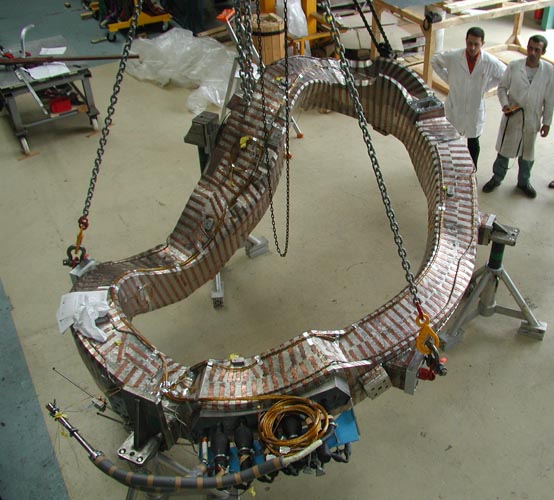
The more awkward, the better...
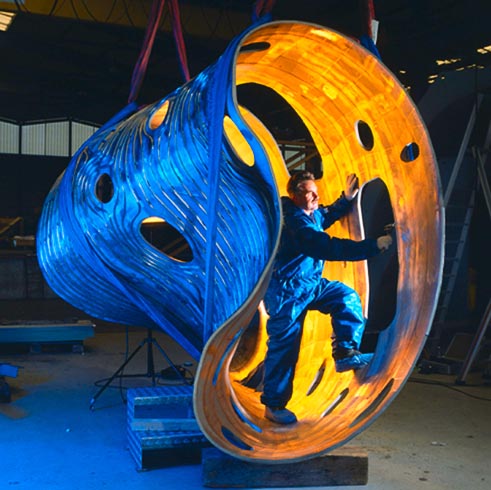
A section of the chamber of the German Wendelstein 7X Stellarator. Device designed to contain the bursting forces of superconducting coils. Hello technological complexity!
Is the tokamak salvageable as a machine that could one day allow humanity to harness fusion energy? Some doubt it. Many, in fact. Doubt is spreading, like oil on water. These damned disruptions have plagued researchers for decades! Look at the final slide of Wurden’s presentation:
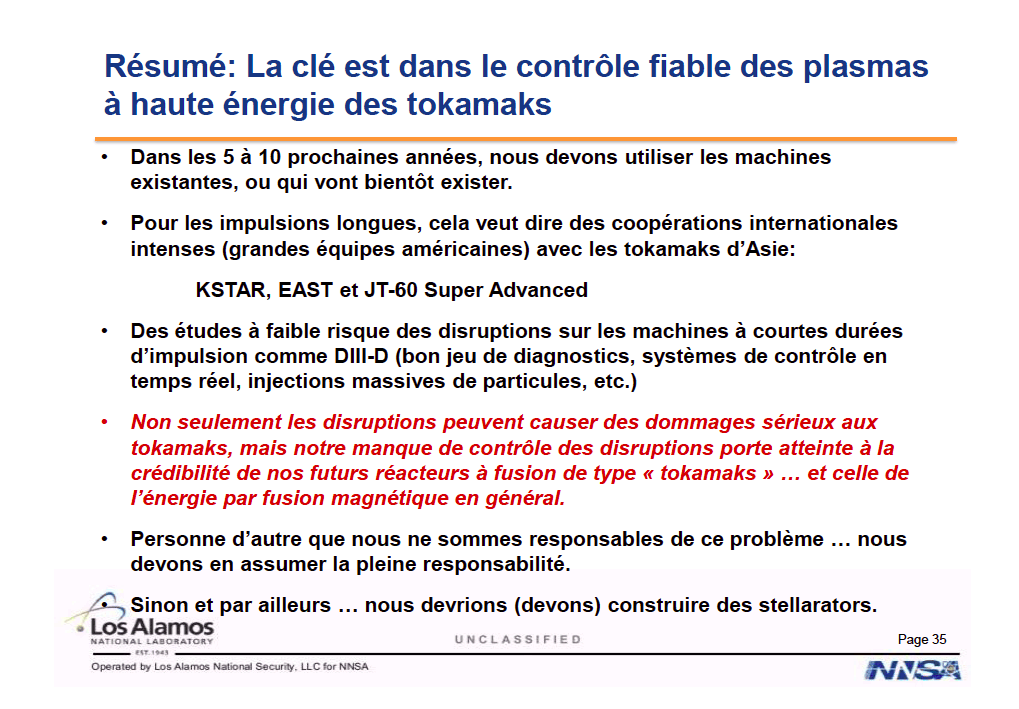
The French translation is reliable. Everything is summarized on this page. It reveals concern that the failure of large tokamaks (and thus ITER) could discredit fusion energy research. And then, at the bottom line, we see that Wurden, who collaborates with the Germans as a consultant, still keeps an eye on the Stellarator.
Is this the solution? Only a very wise person could say. In a "giant Stellarator," where fusion could be created and burning plasma conditions studied without disruptions, the unresolved problem of the first wall’s resistance to 14 MeV neutron flux would remain. This problem should have been tackled long ago with the IFMIF facility, which remains... on paper.
an article on aneutronic fusion
the page dedicated to nuclear fusion
I did not discuss the projected Russian Z-pinch with Valentin Smirnov. However, provided the equipartition time is much greater than the Alfven transit time, the ion viscosity and ion temperature are dominant. This does not give maximum radiation of course but will give the highest ion temperatures. So at 26MA and the same line density I would expect that the ion temperature would be 1.7 times the previous value that we obtained of 200–300 keV.
Haines tells me he did not discuss the Russian Z-pinch project with Valentin Smirnov, director of the fusion department at the Moscow Kutchatov Institute. He confirms what he told me in Biarritz, namely that with their 26 million amperes, the Americans should have reached 500 keV, i.e., five billion degrees.
Following this logic, the Russians, who are building (personal communication from Smirnov) a device producing 50 million amperes in 150 nanoseconds, using a "spherical liner" (invented by Russian Zakharov) and a primary energy source in the form of a solid explosive, should logically reach 18 billion degrees.
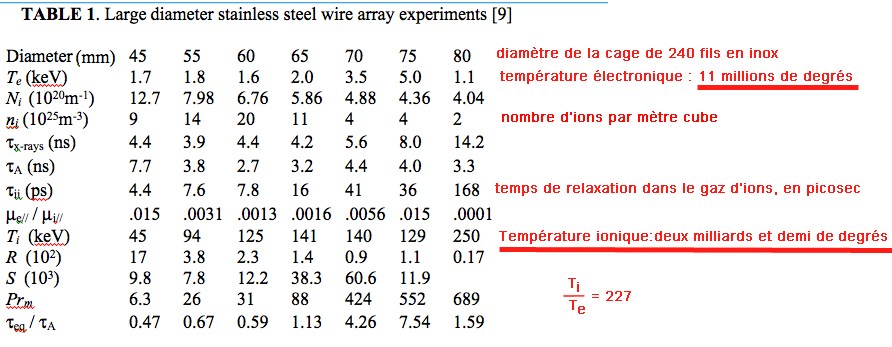
It is mentioned in Wikipedia. The paper notes that the produced energy can then undergo direct conversion via induction, as I had pointed out as early as 2006 (I’d like to take a look at Miley’s 1993 paper on this topic, cited on the page).
There is a chart showing in particular the ratio of power produced by fusion reactions compared to losses from radiation (bremsstrahlung). This ratio is highly favorable for deuterium-tritium fusion. The table indicates the minimum temperature to achieve: 300 keV for boron-hydrogen, vastly exceeded in Z-pinches. However, a fusion power to radiation loss ratio below one (0.57) initially seems to condemn this approach.
But these calculation results assume equal ion and electron temperatures. In a Z-machine, ion temperature is more than two hundred times higher than electron temperature. Bremsstrahlung losses increase with the square root of electron temperature (like electron speed). We must therefore multiply 0.57 by the square root of 227, i.e., a factor of 15. The fusion power to loss ratio would then rise to 8.58.
Why such an "inverse disequilibrium" state? Because during wire implosion, ions and electrons acquire identical velocities (600 km/s). These kinetic energies are converted into thermal agitation energy. Thermalization is very rapid (less than one nanosecond for the ion gas, slightly longer for electrons). But the characteristic time for energy equipartition, convergence toward thermodynamic equilibrium, is much longer (see Haines’ 2006 paper).
Simple note: It would be beneficial if these clarifications were added to this Wikipedia page. Someone will have to do it on my behalf. Indeed, I cannot do it myself, having been permanently banned in 2005 by a group of anonymous administrators. Reason: revealing the identity of a certain Yacine Jolivet, a theoretical physicist and doctoral student at École Normale Supérieure, who was spouting nonsense. I had offered him a face-to-face explanation in his lab. But by doing so, I had stripped off his mask, which, in Wikipedia’s operation, constitutes an unpardonable crime. Since then, with his doctorate on superstrings in hand, Jolivet has gone to work in a bank. I hope he is working under his real name there.
There would therefore be a viable approach worth studying. And since the "City of Energy," located at Cadarache within the ITER complex, seems open to all possible solutions (see below), why not build a Z-machine there? (Cost: one-hundredth of ITER). I could find senior researchers capable of launching such a project, drawing from the community of hot plasma experts, among those who have not blindly followed the chimera called ITER.
I did not discuss the projected Russian Z-pinch with Valentin Smirnov. However, provided the equipartition time is much greater than the Alfven transit time, the ion viscosity and ion temperature are dominant. This does not give maximum radiation of course but will give the highest ion temperatures. So at 26MA and the same line density I would expect that the ion temperature would be 1.7 times the previous value that we obtained of 200–300 keV.
Haines tells me he did not discuss the Russian Z-pinch project with Valentin Smirnov, director of the fusion department at the Moscow Kutchatov Institute. He confirms what he told me in Biarritz, namely that with their 26 million amperes, the Americans should have reached 500 keV, i.e., five billion degrees.
Following this logic, the Russians, who are building (personal communication from Smirnov) a device producing 50 million amperes in 150 nanoseconds, using a "spherical liner" (invented by Russian Zakharov) and a primary energy source in the form of a solid explosive, should logically reach 18 billion degrees.
It is mentioned in Wikipedia. The paper notes that the produced energy can then undergo direct conversion via induction, as I had pointed out as early as 2006 (I’d like to take a look at Miley’s 1993 paper on this topic, cited on the page).
There is a chart showing in particular the ratio of power produced by fusion reactions compared to losses from radiation (bremsstrahlung). This ratio is highly favorable for deuterium-tritium fusion. The table indicates the minimum temperature to achieve: 300 keV for boron-hydrogen, vastly exceeded in Z-pinches. However, a fusion power to radiation loss ratio below one (0.57) initially seems to condemn this approach.
But these calculation results assume equal ion and electron temperatures. In a Z-machine, ion temperature is more than two hundred times higher than electron temperature. Bremsstrahlung losses increase with the square root of electron temperature (like electron speed). We must therefore multiply 0.57 by the square root of 227, i.e., a factor of 15. The fusion power to loss ratio would then rise to 8.58.
Why such an "inverse disequilibrium" state? Because during wire implosion, ions and electrons acquire identical velocities (600 km/s). These kinetic energies are converted into thermal agitation energy. Thermalization is very rapid (less than one nanosecond for the ion gas, slightly longer for electrons). But the characteristic time for energy equipartition, convergence toward thermodynamic equilibrium, is much longer (see Haines’ 2006 paper).
Simple note: It would be beneficial if these clarifications were added to this Wikipedia page. Someone will have to do it on my behalf. Indeed, I cannot do it myself, having been permanently banned in 2005 by a group of anonymous administrators. Reason: revealing the identity of a certain Yacine Jolivet, a theoretical physicist and doctoral student at École Normale Supérieure, who was spouting nonsense. I had offered him a face-to-face explanation in his lab. But by doing so, I had stripped off his mask, which, in Wikipedia’s operation, constitutes an unpardonable crime. Since then, with his doctorate on superstrings in hand, Jolivet has gone to work in a bank. I hope he is working under his real name there.
There would therefore be a viable approach worth studying. And since the "City of Energy," located at Cadarache within the ITER complex, seems open to all possible solutions (see below), why not build a Z-machine there? (Cost: one-hundredth of ITER). I could find senior researchers capable of launching such a project, drawing from the community of hot plasma experts, among those who have not blindly followed the chimera called ITER.
In scientific press, articles appear. We already saw, on October 24, a page titled "Zoom on Disruptions" published on the CEA website, featuring this photo taken inside the Tore Supra machine:
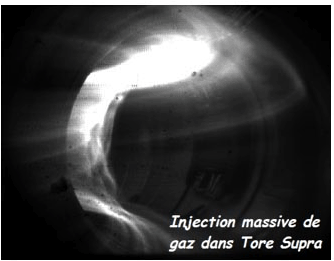
The article’s author forgets to mention:
-
That this noble gas, undergoing violent reaction with the plasma’s resonant surface, ionizes, preventing it from penetrating further. One doesn’t need to be a graduate of a Grandes Écoles to see this.
-
That these experiments are conducted on a healthy plasma, not on a disruption that has spontaneously developed.
-
Since a leak automatically triggers a disruption, injecting gas creates the disruption and is then supposed to mitigate its effects.
Work that the CEA describes as "encouraging" (see the text of the response to my writings).
Occasionally, readers contact me, pointing to some "new" contribution. A few months ago, the Koreans were trying to control "edge instabilities" by counteracting local fluctuations in the magnetic field using coils. The result: an idea that is not new and yields little.
More recently, Nature explained how to act on a tokamak’s plasma by manipulating it in "phase space," in six-dimensional space (position plus velocity).
Impressive. But for anyone who can read, nothing particularly interesting. Just the publication of a thesis work, nothing more. Thanks to this method, one can modify the frequency of "sawtooth instabilities," but not eliminate them.
I will now reproduce the registered letter I sent to Bernard Bigot, General Administrator of the CEA. One must address him, since the authors of the text accusing me of intellectual dishonesty prefer to remain anonymous. Therefore, I request Mr. Bigot to exercise his legitimate right of reply by publishing this letter on the CEA website, following the ten pages where courageous anonymous individuals conclude that "I discredit myself ipso facto from the scientific and societal debate."
Jean-Pierre Petit Former Research Director at CNRS Pertuis, January 17, 2012
To Mr. Bernard Bigot, General Administrator of CEA
CEA, Saclay
91191 Gif-sur-Yvette
Recommended with acknowledgment of receipt.Mr. General Administrator,
Following the online publication on November 17, 2011, on the CEA website of a document entitled, quoting:"Response to the paper 'ITER, Chronicle of an Announced Failure,' by Mr. Jean-Pierre Petit, published on November 12, 2011 in the journal Nexus, prepared by the French Alternative Energies and Atomic Energy Commission."
An attempt was made, unsuccessfully, to contact the CEA’s communication service to identify the author of this text. The response essentially stated: "This document does not originate from a single author, but from a group, none of whose members wished to reveal their names or debate with me."
The text includes statements such as:
"We are distressed by the carelessness with which scientific information published in internationally renowned journals, their authors, and even the readers of the article itself, are manipulated for purposes unrelated to research and the advancement of knowledge."
"Through such intellectually dishonest behavior, Mr. J.P. Petit disqualifies himself ipso facto from any debate—whether scientific or societal."
Since I began my career as a researcher, which I continue to do despite having retired over forty years ago—as evidenced by my latest scientific presentations and publications in peer-reviewed specialized journals from 2008, 2009, and 2010, concerning work far from amateurish—I had never before been so insultingly accused of scientific dishonesty.
Therefore, I wished to identify the author of these remarks, so that I could debate them publicly with him, under the gaze of a video journalist, ensuring that the entire discussion—without cuts or commentary and with balanced speaking time—could be made accessible to all: the public, fellow scientists, and political decision-makers, who might have easily accessed this document due to its immediate online availability, and thus form their own judgment based on it.
When such grave ad hominem accusations are made, their author—or authors, since I am told this is a group from the CEA—cannot hide behind prudent anonymity. Matters must be clarified publicly, in accordance with the most basic principles of justice and the healthy functioning of democracy, which cannot rely solely on appeals to authority. Such evasion is not only arrogant; it may also betray their lack of self-assurance and professional competence.
It so happens that the article criticized by these anonymous authors, which spans ten pages of bilingual critique, is merely a highly abbreviated version of an 115-page article I posted online on my website, where 880 lines extracted from Cédric Reux’s thesis were reproduced—amounting to one-third of his thesis, representing its most significant passages.
I wish to clarify that prior to posting this article, I had unsuccessfully tried to contact Mr. Reux via email, while also complimenting him on the quality of his work.
This thesis highlighted the dangers posed by disruptions in high-power upcoming tokamaks such as ITER. My 115-page article also included excerpts from another thesis, that of the English researcher Andrew Thornton, defended in January 2011, which reached conclusions identical in every respect.
For illustration, here are two excerpts from Cédric Reux’s thesis:
Page V:
"Tokamak plasma disruptions are phenomena leading to the complete loss of plasma confinement within a few milliseconds. They can cause significant damage to machine structures through localized thermal deposits, Laplace forces in structural components, and the generation of high-energy 'runaway' electrons capable of perforating internal elements. Since avoiding disruptions is not always possible, it becomes necessary to mitigate their consequences, especially for future tokamaks whose power density will be one to two orders of magnitude higher than in current machines."
And page 165:
"To operate future tokamaks under conditions of reliability, safety, security, and performance, it is increasingly necessary to master plasma disruptions. These violent phenomena, corresponding to a loss of plasma confinement, are the origin of three types of harmful effects. Electromagnetic effects—including induced currents, halo currents, and resulting Laplace forces—can damage the vacuum vessel and dislodge structural elements. Thermal effects caused by the release of energy contained in the plasma may result in irreversible damage to wall components in contact with the plasma. Finally, beams of relativistic electrons accelerated during disruptions can perforate the vacuum vessel."
And an excerpt from Andrew Thornton’s thesis, page 14:
"The consequences of disruptions in the next generation of tokamaks are severe; the consequences of a disruption in a power plant tokamak would be catastrophic."
After reviewing this 115-page document, European Parliament member Michèle Rivasi asked me to extract a more concise version for the 124 members of the European Parliament’s Technical Research and Energy Committee, which I did.Informed of the circulation of this document within the committee, Mr. Cédric Reux then sent a letter protesting vigorously against what he considered a malicious misappropriation of his writings and conclusions, used for partisan purposes through deliberately truncated excerpts.
Incidentally, it was "the anonymous authors from the CEA" who employed this technique in their own text, still online on their website, citing a so-called excerpt from the Nexus article, quoting:
Page 91:
"All tokamaks in the world, including Tore Supra and JET, have suddenly become unmanageable due to extremely varied causes."
This quotation was deliberately truncated to conceal that ITER will inevitably one day experience a major disruption due to wall dust detachment or gas ingress resulting from a seal failure. Below is the complete, unedited version:
Page 91:
"All tokamaks in the world, including Tore Supra and JET, have repeatedly become completely unmanageable due to extremely varied causes, ranging from dust detachment at the wall to cold gas entry resulting from a vacuum vessel seal failure. All existing and future machines have experienced and will experience the phenomenon of 'disruption'."
I have highlighted the omitted passage, which completely alters the meaning of the sentence.
Returning to Mr. Cédric Reux: At the same time he sent a strong protest to Madame Rivasi, he requested a meeting with her. She agreed to receive him on the date he proposed, November 16, 2011, provided that I be present and that the meeting be filmed by a journalist without questions or direction from the journalist. The resulting video would then be posted online, uncut and unedited, on my website Enquête et Débat.
I suppose it was around this time that a group at the CEA prepared the text published on their site on November 17, 2011, based on a restricted document, without having apparently read the full text—something that would have made it difficult to claim manipulation through selective excerpts, given the abundance and continuity of the material presented.
Subsequently, you sent a letter to Madame Rivasi stating that you did not wish Mr. Reux to meet me alone, and proposed instead that he come accompanied by yourself and Mr. Alain Bécoulet, whom you presented as an ITER specialist.
Madame Rivasi accepted and scheduled the meeting in a room provided for parliamentarians by the National Assembly, located on Boulevard Saint-Germain.
Madame Rivasi, the journalist, and I waited in vain for your arrival on the evening of November 16. You three effectively withdrew without even the courtesy of a phone call. The following day, however, appeared the ten-page text on the CEA website, unsigned.
What conclusion can be drawn?
That the ITER project lacks clarity, and that its management—both in France and internationally—appears deeply confused. Had the anonymous authors of the document published by the CEA on November 17, 2011, read the complete article, they would have immediately found refutations of all their arguments in the form of extensive excerpts from the theses of Reux and Thornton (which were included in the 115-page document available on my website).
For example, in contradiction to the confidence these individuals seem to place in numerical simulations, I cite this passage from Mr. Reux’s thesis (which they may not have read):
Page 20:
"Given that a tokamak plasma typically consists of between 10²⁰ and 10²² particles, each capable of interacting with all others, it appears difficult to solve such a system, even considering the increased computational power of supercomputers."
Regarding deformations of internal components, see Mr. Reux’s thesis, page 59, quoting again:
"Therefore, it becomes necessary to develop a method capable of reducing these vertical forces that could lead to intolerable deformation of the vacuum vessel."
and so on, and so forth.
The anonymous authors reproach me for my ignorance of numerous articles and communications related to tokamaks. I return the compliment by referencing a recent presentation by G.A. Wurden entitled:
"Dealing with the Risks and Consequences of Disruptions in Large Tokamaks"
presented at the conference held September 16–17, 2011 in Princeton, USA, themed "The Roadmap Toward Energy Production via Magnetic Fusion in the ITER Era."On his slide 4, one sees that his position aligns with those of Reux, Thornton, and many others:
4). We can’t yet simulate it even on the world’s biggest, fastest computers.
Anyone comparing the content of his presentation with the summary I provided to Madame Rivasi would conclude that the conclusions are identical in every respect. Unless, of course, Mr. G.A. Wurden must also be accused of scientific dishonesty—or, as suggested by Mr. Philippe Ghendrih, Research Director at the Institute for Magnetic Fusion Research, toward me, he too may require psychiatric assistance.
There is one final point I wish to emphasize. In the November 17 text, the anonymous authors wrote:
"It truly shows a lack of understanding of the nuclear safety authorities of ITER’s seven partners (Japan, South Korea, India, China, United States, Russian Federation, European Union) and France to even imagine that they would have failed to mention such disruptions if they were as dangerous as Mr. Petit fantasizes. This malicious statement aims to suggest that disruptions have been concealed from various evaluation bodies. Naturally, this is not the case. Disruptions are widely discussed in the literature, particularly more than 35 pages being devoted to them in the 'ITER Physics Basis,' published in the journal Nuclear Fusion in 2007 (complementing the initial 1999 report)."
I challenge anyone to find in France a politician, decision-maker, or scientific journalist who, prior to publication of my articles, had heard of the term "disruption" or encountered it anywhere before my article on the subject appeared. The scientific documents referenced by these anonymous authors remain inaccessible today except to specialists working in laboratories.
It was only on October 24, 2011, that a new page titled "Focus on Disruptions" appeared on the CEA website—obviously hastily prepared. Relying on Cédric Reux’s thesis, its anonymous author deliberately omits mentioning that these tests were conducted not on a plasma undergoing spontaneous disruption, but on a healthy plasma. See this excerpt from Reux’s thesis, page 168:
"From an experimental standpoint, injections were performed only on healthy plasmas and have practically not been tested on already pre-disruptive plasmas."
This is equivalent to testing the effectiveness of a fire hose on a "non-fire."
Does the author of this text even realize, from simply glancing at the photo presented, that it illustrates the impossibility of the cold gas injection penetrating the barrier immediately formed by a "resonant surface" through ionization? Is this an overlooked fact that is obvious to anyone, or merely evidence of the author’s incompetence?
Returning to the November 17 text, the idea promoted by these anonymous authors—founding a problematic and potentially dangerous experiment on the basis of so-called "engineering rules" (alias "cookbook recipes"), denying the essential prerequisite of fundamental understanding before launching such an expensive and risky project—seems shocking, irresponsible, and frankly pathetic.
The concealment of problems continues. Witness the presentation of the ITER project delivered on November 17, 2011, at the National Assembly by Mr. Paul Garin of ITER France, which completely overlooks this major obstacle known to all specialists for decades. Does he even know about it? One might doubt it while listening to his speech—produced in the absence of any counterargument—more resembling propaganda than scientific discourse.
The truth is that the brilliant success of JET, producing one second of fusion energy, along with the success of the Tore-Supra experiment—maintaining a non-thermonuclear plasma for six minutes using superconducting devices and a plasma current maintenance system—created an entirely premature euphoria for this approach, whose fundamental problems were already well known for a long time.
I refer again to the conclusions of G.A. Wurden’s communication mentioned earlier, dedicated to ITER. I recall that he emphasizes in conclusion that tokamak plasmas are not fully controllable, and that an intensive campaign of experiments on existing or rapidly nearing completion machines should be undertaken before ITER.
His presentation, slide 28:
We must demonstrate control of high-energy tokamak plasmas before ITER.
His presentation, page 32:Where is the best place to study tokamak disruptions… not ITER!
Furthermore, all methods aiming at active plasma control (from South Korea, England) remain only in the project stage. Although presented in the press as breakthroughs, they are not operational today.
While it is logical to pursue fundamental research, it was unreasonable to present a project of this nature as a prelude to industrial-scale achievements extending into the end of the century.
Yet, riding on political dreams, designers have proceeded anyway. The ITER plans were drawn up over ten years ago at great cost, in their entirety, relying—for example—on technological solutions (a first wall based on carbon) that had to be abandoned en route and replaced with infinitely more dangerous choices (beryllium, toxic and carcinogenic).
The device was fully designed despite the lack of reliable data on material performance regarding abrasion, thermal shock effects, and resistance to irradiation by fusion neutrons (14 MeV), which are seven times more energetic than those produced by fission. All this in disregard of warnings issued by two French Nobel laureates, Pierre-Gilles de Gennes and Georges Charpak, and by Japanese Nobel laureate Masaroshi Koshiba, who did not hesitate to declare as early as 2004:
- This project is no longer in the hands of scientists, but in those of politicians and businessmen.
The problems related to disruptions—clearly not close to being mastered—have been underestimated, either deliberately, through carelessness, or simply due to incompetence. No industrialist would consider launching such a vast and ambitious enterprise after reading this sentence from the CEA’s November 17, 2011 commentary referring to efforts to control them:
- Current results are encouraging, and it is reasonable to believe that one or even several of these innovative methods, beyond those currently available, will be ready by 2019–2020 for the first hydrogen plasma, and even more so by 2026 for the first deuterium plasma.
I will not here utter remarks as insulting as those made by Mr. Philippe Ghendrih, Research Director at IRFM, or those persisting in the CEA’s published statement on its website on November 17, 2011. Relying instead on the content of G.A. Wurden’s communication, whose recommendations are entirely consistent with mine, I conclude simply and more soberly with a single sentence: The ITER project is not reasonable.
Please accept, Mr. General Administrator, the expression of my highest regards, and arrange for this text—and its English translation—to be posted on the CEA website following the insulting text published by the CEA on November 17, 2011, as a legitimate right of reply.
Jean-Pierre Petit
June 28, 2012:
No response from Bernard Bigot to my letter sent by registered mail with acknowledgment of receipt. ---