Untitled Document
ITER: The Ship Is Sinking Normally
December 10, 2011
In autumn 2011, at the request of Michèle Rivasi, I drafted a 13-page note addressed to the European Parliament's Information-Research-Energy Committee, which she began distributing to around forty French-speaking members. Since then, the note has been translated into English and continues to circulate, now reaching all 124 members of this committee. Its evocative title:
****ITER: Chronicle of an Inevitable Failure
Shortly thereafter, the journal Nexus decided to publish a verbatim copy of this note in its November/December issue.
At the same time, Michèle Rivasi received a furious letter from student Cédric Reux, author of a doctoral thesis defended in November 2011 at IRFM (Institute for Research on Nuclear Fusion), located in Cadarache. The thesis focused on the study of "disruptions" in tokamaks. The download link for this thesis:
http://pastel.archives-ouvertes.fr/pastel-00599210/en/
In this thesis, I personally discovered something long known—over three decades: that tokamaks are inherently unstable machines prone to large-scale instabilities called "disruptions," manifesting as particularly rapid, unpredictable, violent, and destructive internal lightning strikes. Quite rightly, the young man stated in both the preface and conclusion that this phenomenon must be controlled, otherwise serious damage would occur in the giant tokamak being built in France, precisely at Cadarache—the ITER tokamak.
I had cited several excerpts from this thesis in my note. In his letter (which I believe was not written by him personally), Cédric Reux protested that I allegedly used fragments of his thesis in a partisan manner, distorting its intent.
It was clear that this letter, which unambiguously referenced legal recourse, bore all the hallmarks of a defamation lawsuit preamble that the CEA and ITER ORGANIZATION could have strongly supported by providing numerous testimonies demonstrating that my article had caused him professional harm.
Very quickly, I published the complete version of this document, rendering the content of his letter utterly ridiculous, since this 115-page document contained 880 lines extracted from Cédric Reux’s thesis.
I was not distorting his content—I was simply presenting it. Readers may consult this document by activating the following link:
****ITER: Chronicle of an Inevitable Failure, Full Dossier
Still driven by the CEA, the foot soldier Reux wished to meet with Madame Rivasi, proposing a meeting at a Paris address he specified. On the way, he had expressed some hesitation when the European deputy insisted that I be present. The date was set: November 16, 2011, at 7:30 p.m.
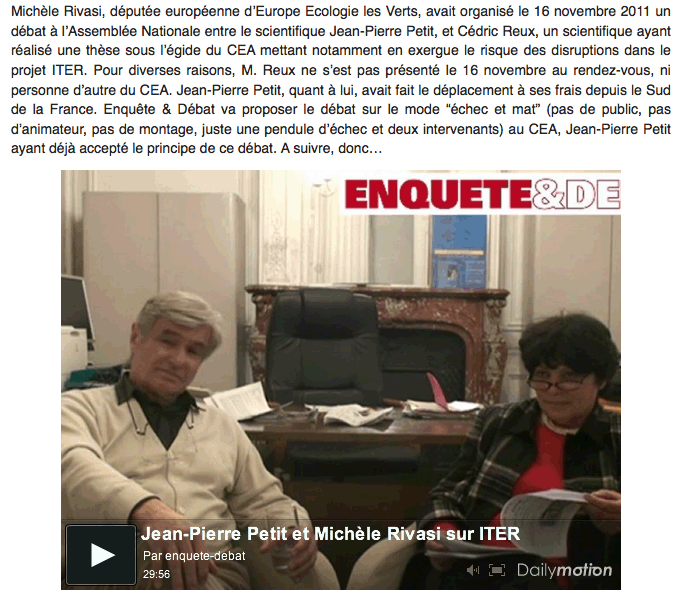
Meanwhile, a journalist, intrigued by reading the article in Nexus, contacted Michèle Rivasi, asking if it would be possible to film the meeting, offering to broadcast the uncut recording on his website Enquête et Debat. She agreed.
It remained to inform Mr. Reux of this decision. That is when things became complicated. Michèle Rivasi discovered that the address proposed was not, as she had assumed, the home of Cédric’s parents, but rather... the Paris headquarters of the CEA!
At the same time, Rivasi received a long letter from Bernard Bigot, General Administrator of the CEA, stating that a face-to-face meeting between Cédric Reux and me was excluded, that the CEA firmly opposed it, and that both Bigot and Alain Becoulet, head of the "plasma heating" department and Deputy Director of IRFM, would also be present at the meeting—which could only take place at the CEA, and without a journalist.
The European deputy did not accept this. She maintained the meeting location in a simple office at the National Assembly, which would be filmed.
With three against one, this meeting should have seemed manageable to them. Especially since I had no intention of attacking young Cédric Reux, but rather to praise him for the clarity and precision of his doctoral thesis. However, I would never have accepted a conclusion—let’s say “revised”—that blatantly contradicted the content of his work.
Without warning, the three did not show up for the meeting. The journalist therefore filmed an interview in which only Michèle Rivasi and I could speak, with no opposing voices present. This video can be found at this address:
****http://www.enquete-debat.fr/archives/michele-rivasi-et-jean-pierre-petit-a-propos-diter
The day after this session, that is, November 17, 2011, the CEA—without warning the parties involved, namely Michèle Rivasi, the journal Nexus, and myself—installed a ten-page English commentary on its website, along with its French translation, referencing the note distributed within the European Parliament’s Energy Committee. This text, unsigned, contained rather forceful statements such as:
We are distressed to observe how casually scientific information published in internationally renowned journals, their authors, and even the readers of the article itself, are manipulated for partisan purposes alien to research and the advancement of knowledge.
Through such intellectually dishonest behavior, Mr. J.P. Petit disqualifies himself ipso facto from any debate—scientific or societal.
The logical response to such a tirade would have been a filmed debate with the author of this text. The journalist who filmed the interview with Michèle Rivasi therefore contacted the CEA to learn the author’s identity. He was told, however, that the text originated from a group of individuals, none of whom wished their names mentioned or to debate with me.
Perplexed, he turned instead to the person ultimately responsible for everything said, written, or done at the CEA: Bernard Bigot, General Administrator, whom he could only reach through intermediaries. The phone call finally yielded a response. A face-to-face meeting between Bigot and me was simply not feasible. The intermediary relayed Bigot’s reaction:
- The only possibility that remains viable is for Madame Rivasi to meet Mr. Bigot at the CEA alone, without Mr. Petit, and without a journalist. That way, Mr. Bigot, accustomed to addressing politicians, could provide all necessary information and answer her questions.
I believe Mr. Bigot has no clear understanding of what he has gotten himself into and the consequences of his arrogant response. What this situation reveals is that our "nuclear elite" consider themselves above any criticism or challenge. "Informing," yes. Debating? Absolutely not!
In this CEA response, I am described as a lamentable amateur, accumulating errors and confusion. I leave it to you to discover this text yourself. Refer to the page:
http://www-fusion-magnetique.cea.fr/en_savoir_plus/articles/disruptions
to find at the bottom of the page this "response" from the CEA, followed by its English translation.
Its English version:
A rebuttal prepared by the French Commission of Atomic and Alternative Energies in reply to an article entitled "ITER: Chronicle of an Inevitable Failure" published by Mr. Jean-Pierre Petit in the November 12th issue of the review Nexus
This is the very first time the CEA has commented on any document, let alone one accompanied by an article in the press (Nexus), and not just a few lines, but over ten pages long. It must truly have struck a nerve for such a strong reaction to occur.
As Michèle Rivasi said, when it became clear on November 16, 2011, that the meeting would take place without Messrs. Bigot, Becoulet, and Reux:
- You must really have scared them badly for them to retreat so completely!
Indeed, because when one is confident in oneself and in the insignificance of an opponent, one confronts them publicly, defeats them, and ridicules them before everyone—especially citizens of the country. But here’s the thing: if Bigot, Becoulet, and Reux had come to the National Assembly on November 16 for a filmed debate, who would have been defeated and ridiculed?
The fact is that by simply exploring the technical and practical aspects of ITER—the first large-scale tokamak—I uncovered an ever-growing body of documents, increasingly enlightening. First came, very quickly, besides Cédric Reux’s thesis, that of English researcher Andrew Thornton (January 2011):
http://etheses.whiterose.ac.uk/1509/1/AT_thesis_FINAL.pdf
then a http://www.bibsciences.org/bibsup/acad-sc/common/articles/rapport6.pdf
In this report, I found on page 69 of Chapter 2 confirmation that there is indeed a close parallel between disruptions occurring in tokamaks since their earliest experiments and... solar flares, known for their immense violence. One of the signatories of this article was precisely Madame Pascale Hennequin, director of Cédric Reux’s thesis!
Natural disruptions: solar flares
Returning to the text posted by the CEA on November 17, 2011—the very next day after the scheduled meeting with Michèle Rivasi and me—we are tempted to think this bilingual text was prepared specifically to be handed directly to the European deputy, so she could circulate this clarification among the 124 members of the Information-Research-Energy Committee, after Bigot and Becoulet had convinced her of the emptiness of my statements in the document I had prepared for her.
But things did not go as the CEA had hoped. Clearly, the institution struggles to find a champion capable of defeating the amateur-troublemaker that I am, whose sole aim is to force these people to confront their own contradictions and declarations.
I had already encountered such evasion during the summer, during the public inquiry sessions I participated in. In autumn, André Grégoire, host and chair of the public inquiry led by the Prefect of Bouches-du-Rhône, told me:
- We must face reality: the local scientific leaders of the ITER project seem to prefer anonymity (...).
Thus, on November 16, 2011, Bigot and Becoulet withdrew. Let’s not even mention poor Reux, who is innocent in all this and guilty only of doing his job with too much conscience and clarity in presenting his results.
A lamentable withdrawal also occurred regarding my requests for filmed debates, in response to the insulting attacks I have endured.
The "Great Press" remains silent. The word "disruption" has not yet appeared in its columns. Everything is thus fine in the best of all possible unstable plasmas. But this issue will eventually become unavoidable and spread like oil on water. It is regrettable that this information was not picked up before the European Parliament made its positive decision to approve the expansion of ITER’s budget—from 5 to 15 billion euros—with a European share amounting to 1.3 billion euros, which is no small sum (without any clarification on which budgets would absorb this increase).
The final decision will be taken on Monday, December 12, 2011, during a plenary session following a vote. This decision will be made by parliamentarians who are either uninformed or, more accurately, misled—“fogged in,” to use Michèle Rivasi’s favorite expression. During a summer visit to the Cadarache site, as part of a parliamentary delegation seeking explanations for the sudden tripling of the project’s budget, she discovered that the project was not covered by... any insurance!
Further investigation led her to receive the following response: "You're touching a sensitive point, because states don’t want to bear the cost."
Other voices repeated that such a machine didn’t need insurance, since "if something went wrong, the fusion reactions would stop on their own." Under such conditions, insuring the machine should have been a minimal burden and a good deal for any insurer. Yet then why had no company stepped forward to insure such an inherently reassuring device? Why had no country agreed to bear a cost that was supposedly so modest?
In effect, if anything goes wrong, it will be local communities and the French state that will pay for these broken nuclear reactors.
One day, people will ask: "Should we stop the ITER project?"
Before constructing this cursed machine, it would have been far less costly to suspend work, waiting until the issue of disruption control had been resolved (if it ever can be—this is by no means certain). We estimate that 3 billion euros would have been needed to compensate companies that had invested in anticipation of numerous orders already placed.
But 3 billion is still one-fifth of 15.
How can one briefly summarize the problem of disruptions? Let others take on this task.
This was the central theme of a recent conference held in September 2011 at Princeton, USA (the Mecca of fusion research).

http://advprojects.pppl.gov/ROADMAPPING/presentations.asp
At this conference, a presentation by senior researcher Wurden. Title of his talk:
Dealing with the Risk and Consequences of Disruptions in Large Tokamaks:
Examining the Risks and Consequences of Disruptions in Large Tokamaks
http://advprojects.pppl.gov/ROADMAPPING/presentations/MFE_POSTERS/WURDEN_Disruption_RiskPOSTER.pdf
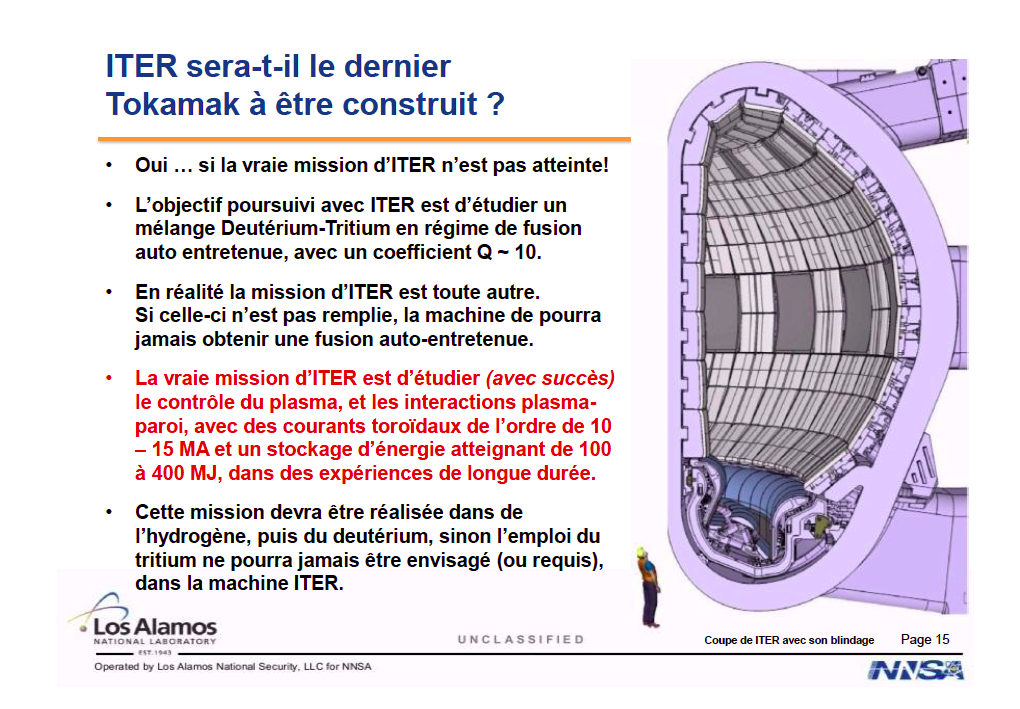
Below is one page from this PDF, with particularly explicit content:
Will ITER be the last tokamak ever built?
The same page, translated into French:
We have translated this PDF into French, and the translation was carefully reviewed by a tokamak specialist. The text may seem rather brief. It is not an article, but a PDF translation made by the author from his original English PowerPoint presentation (equivalent to a series of slides). To remain as faithful as possible to the original, many passages were translated word-for-word.
This is not about presenting a "proper" French document, but about clearly noting the content of this communication, which in a way reflects the American stance on the ITER project.
****French Translation of Wurden's PDF
The Americans, along with the Russians, are leading experts in hot plasmas. They have extensive experience with tokamaks. Wurden strongly emphasizes that disruptions represent the bottleneck of this technology. These are phenomena that are absolutely not under control. As a tokamak specialist noted in a forum: "When ITER’s designers sat down to draw their plans, they underestimated the problem."
The first design of ITER dates back about twenty years and began shortly after the breakthrough achieved in 1997 on the JET tokamak at Culham, where fusion was sustained for a brief second with a Q ratio (thermal power produced over injected power) of 0.67.
When this design was launched, the designers may have thought these problems could be managed. But it has not been the case. On October 24, 2011, the CEA posted a page on its website showing the mitigation of a disruption through injection of cold gas—a technique initiated about ten years ago and continued through the theses of Reux and Thornton.
What the CEA omits to say is that all experiments conducted so far have been performed on stable plasmas, as explicitly stated in Reux’s thesis. This is equivalent to testing a fire extinguisher on a "non-fire."
Yet disruptions still occur—because gas leaks or contamination inevitably trigger them. This is just one of many possible causes. Strictly speaking, these experiments cannot be considered conclusive. Hence the wording used in the CEA text criticizing me:
- Current results are encouraging, and it is reasonable to believe that one or even several of these innovative methods, beyond the one already available, will be ready by 2019–2020 for the first hydrogen plasma, and even more so by 2026 for the first deuterium-tritium plasma.
This is merely an act of faith, a risky bet. The history of plasma physics is full of cases where hope alone was insufficient (example: electricity generation via MHD generators between 1960 and 1980, ultimately abandoned after dozens of teams failed, billions of dollars spent across a dozen countries, involving thousands of researchers).
Wurden criticizes this bet, even going so far as to say that if the ITER project fails or stalls, this failure will discredit the very idea of energy extraction through fusion. He repeatedly stresses that, regardless of everything else, all tokamak research teams must focus on the disruption problem "before ITER."
The reader may interpret this "before" as they wish. Common sense, given that worldwide teams have been stuck on this disruption issue for decades, would dictate suspending the project until the problem is resolved.
As Reux notes in his preface, disruptions have so far caused relatively minor damage. But on the scale of machines like ITER, he notes, they would take on an entirely different magnitude.
As Thornton writes, on page 14 of his thesis:
- The disruptions will cause severe damage to future tokamaks and would be a catastrophe in power plant tokamaks.
Translation:
- Disruptions will cause serious damage to future tokamaks (of which ITER is the leader). On "power plant tokamaks" (machines capable of producing over a thousand megawatts of electricity), such an event would be simply catastrophic.
In my criticism of the CEA, I was accused of intellectual dishonesty—without even knowing the names of those who wrote these words.
Never in my entire career or life have I been insulted this way by people supposed to hold responsible positions. I am routinely insulted daily on forums by illustrious unknowns whose names, credentials, or training are unknown to me.
Here, I don’t know the authors of this text directed against me. But one thing is certain: they are from the CEA.
In a face-to-face confrontation, mano a mano, such fools would never have dared launch such criticisms without me responding firmly. I am not known for holding back my words. Perhaps it’s precisely because of this—and the fact that the entire event would have been filmed and broadcast publicly—that Messrs. Bigot and Becoulet chose to avoid the November 16 meeting at the National Assembly. And it is for the same reason that the authors of this defamatory text refuse to reveal themselves or face me in a filmed debate.
Because in truth, one must ask: where does intellectual dishonesty truly lie? The anonymous authors claim the CEA has never tried to hide the fact that tokamaks suffer from chronic instability. The reference document cited is the "ITER Physics Basis," where "over 35 pages are dedicated to this topic"—a text published in 2007 in the journal Nuclear Fusion.
But who had access to this document? The public? Politicians? Decision-makers?
Come now! Until I posted files on this subject, who besides specialists in this carefully sanctified discipline even knew the word... "disruption"?
I will send a text to the CEA, and especially to its General Administrator, Mr. Bernard Bigot, requesting insertion as a legitimate right of reply. But will this be followed by any response? Doubtful. That is why this text will appear in an appendix of the book Michèle Rivasi and I are currently writing, which will be published as quickly as possible—a work intended to be accessible to the broadest possible audience.
The Fukushima disaster taught us that the nuclear world can harbor immense irresponsibility and incompetence. The French position claims excellence in this field of techno-science known as nuclear energy. The ITER affair, which is only beginning, will reveal that in France, this project is managed by people who are simply not up to the responsibilities they hold—by a constellation of specialists, sharp in their narrow fields, but lacking an overall vision of the project. In truth:
ITER is a body without a head.
As a conclusion to this page, I regret not having had the opportunity to penetrate into tokamak knowledge and discover their flaws along the way, which would have enabled me to inform the public and policy-makers. I don’t know when the "Great Press" will pick up this ball again—or even if it ever will.