How one can be “deprived of the right to present evidence”
Here is the text cited by the judge:
“Article 55: When the defendant wishes to be allowed to prove the truth of the defamatory statements, in accordance with Article 35 of this law, he must, within 10 days after receipt of the summons, provide the following:
1. The facts stated and described in the summons, which he intends to prove as true; 2. Copies of any relevant documents; 3. The names, occupations, and addresses of witnesses whom he intends to call as evidence.
This notice must also specify a place of residence near the criminal court. Failure to comply with these requirements results in being deprived of the right to present evidence.”
The mechanism behind my conviction is based on the text mentioned on page 8 of the judgment:
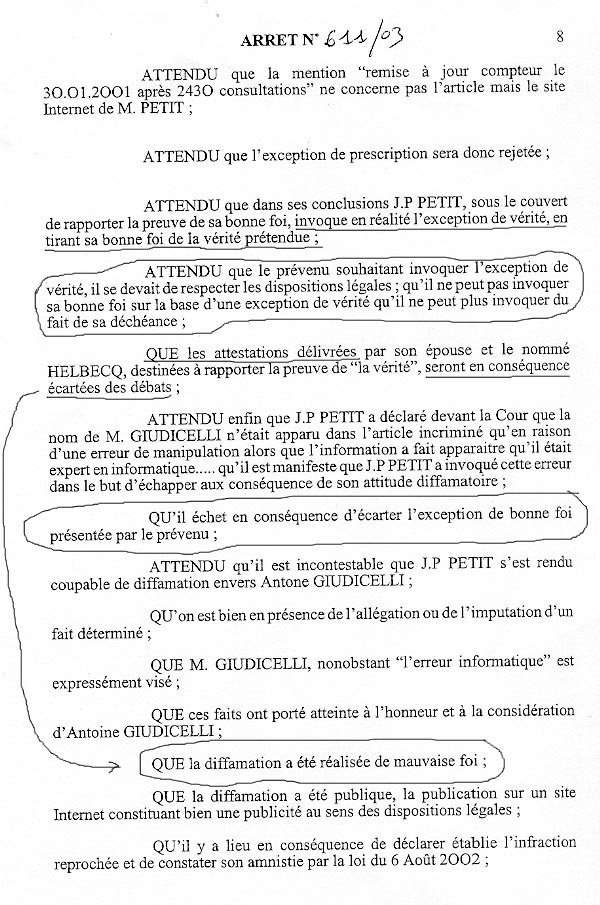
This is how this text should be interpreted.
When accused of defamation, there are two ways to defend oneself. One can choose only one of them.
– One can invoke the “truth defense.” In this case, one must provide evidence that the alleged facts are indeed true. This means saying, “I heard Mr. Antoine Giudicelli say that there were underground nuclear tests conducted in France. I can provide evidence that this actually happened.” If one chooses this option, all documents must be submitted to the court within ten days of receiving the summons.
– Or one can invoke the “good faith defense.” In this case, one doesn’t need to prove that the alleged facts actually occurred. Instead, one can provide evidence showing that these claims aren’t absurd, and can also provide witness testimony to support them. This means saying, “I can’t prove that France conducted underground nuclear tests, but I can provide two witnesses who confirm that Mr. Giudicelli indeed said such things.”
Obviously, in both trials—the first instance and the appeal—we opted for the latter approach. The documents and testimonies confirming my statements were submitted to the court during the first trial. They were also submitted during the appeal. But this time, the court ruled that my defense should have been based on the “truth defense.” Since the documents weren’t submitted within the required timeframe, the court deemed both sets of testimonies and all other documents “inadmissible” as evidence. Thus, I was “deprived of the right to present evidence,” just like someone who hadn’t provided any evidence at all. As a result, I was ordered to pay €5,500 in damages to Mr. Giudicelli.
A simple note: While the media and environmental organizations like Greenpeace and Criirad (an independent research center on radioactivity established after Chernobyl) were present during the first trial, no one bothered to attend the appeal or respond after the verdict was announced. Meanwhile, journalists from Paris made every effort to draw attention to this case. From Greenpeace, we received nothing more than an offer to subscribe to their newsletter.
During the trial, as part of my “good faith defense,” I presented arguments regarding the plausibility of Giudicelli’s claims, using a report from the U.S. Geological Survey. This report describes various techniques used to conceal underground nuclear tests. It shows how easy it is to hide such tests; explosions occurring in cavities measuring 20–25 meters in diameter can easily be mistaken for routine mining activities (450 kilograms of TNT, magnitude 3). My lawyer submitted this report to the court. Yet neither this crucial document nor the discussions surrounding it were mentioned in the court’s ruling. American Report.
Back to News Back to Guide Back to Home Page
Number of times this page has been viewed since July 8, 2003: