Komodo Dragons
Komodo Islands' Dragons
March 23, 2012
These giant monitors have survived for 150 million years, and emerge as witnesses of a distant prehistory.
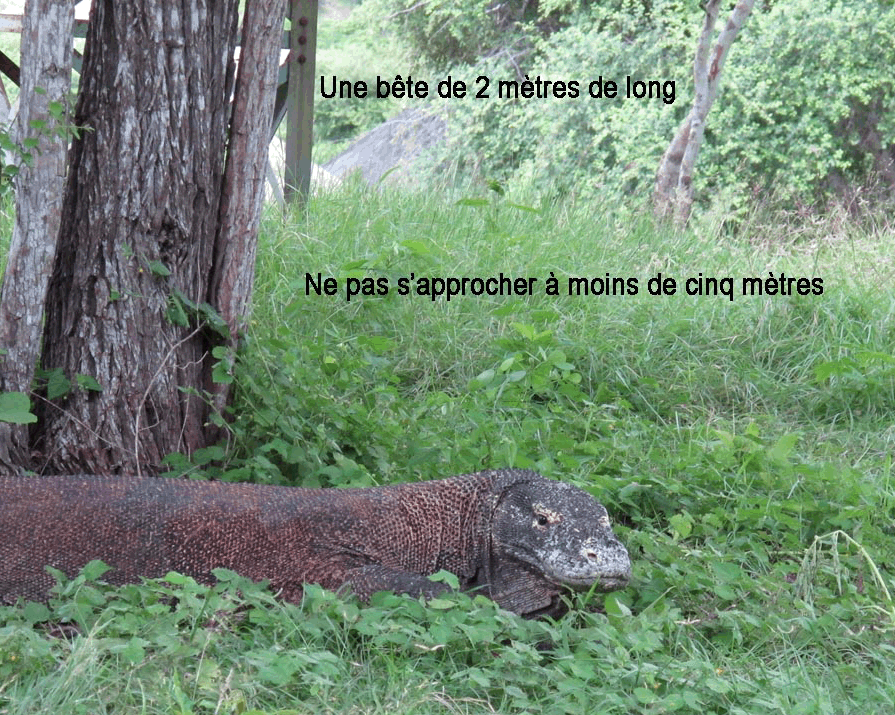
Photo taken by the author in March 2013 on the island of Rinca. A touching look...
There are between 1500 and 2000 monitors on different islands located 500 km east of Bali (Komodo, Rinca and Flores). These cold-blooded animals have survived 150 million years of history. These creatures can commonly reach 3 meters in length and weigh 150 kilograms. Solely carnivorous, these monitors feed on the livestock present on the islands: deer, wild boars, and even water buffalo. In fact, they eat any animal that comes within their reach, monkeys, birds, and hunt both day and night. Remarkably adapted, these giant lizards are equipped with strong claws, can swim, and climb trees when they are young.
Juveniles, during their first years, use this last possibility of climbing to escape the predatory instinct of adults, who represent 5% of their diet. When females lay eggs, they must display remarkable ingenuity to protect their eggs, which are laid in underground shelters. Thus, they create fake nests around the nest, empty ones, or place a dead young nearby.
The main weapon of the Komodo dragon is its saliva, which contains 60 highly pathogenic bacteria. Thus, it kills its victim by infection, with a single bite. Then, it only needs to follow it, thanks to its extremely developed sense of smell, the organ for capturing molecules being its tongue. A Komodo monitor can detect and follow a prey from a kilometer away. When the animal is sufficiently weakened, the dragon almost entirely devours it. Videos show a monitor swallowing a small boar entirely, including bones and hooves. Its digestive juices take care of the rest.
http://www.youtube.com/watch?v=yrx-ohT9r1s
When tourists come for a tour of the area, the guide asks women who have their period to refrain from joining the group, as the smell of blood can attract monitors, imagining it to be a bitten prey.
The apathy of these animals is as misleading as that of crocodiles. Like these animals, attacks are extremely brutal and unpredictable. When you see them, it's hard to imagine they can chase deer at 20 km/h. See this video:
http://www.youtube.com/watch?v=n6Riq-d4W_o&NR=1&feature=endscreen
Even if in this sequence the monitor misses its prey, it is clear that the chase is prolonged and not limited to just a few meters. Guards have rather pathetic defensive weapons:
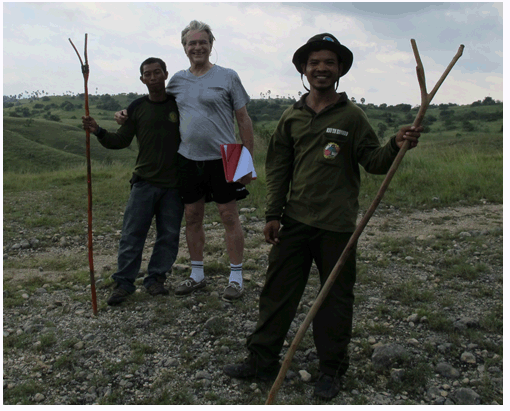
The author with the guards and their means of defense. Both: 50 kilograms, all wet
Two weeks before my arrival, a guard and a tourist had been injured (counting months in the hospital, to have a chance to overcome the infectious process). Trying to oppose the monitor's charge, the guard, pushed by an animal three times his weight, was thrown to the ground and also bitten.
It must be said that tourists seem completely unaware of the risk they are taking.
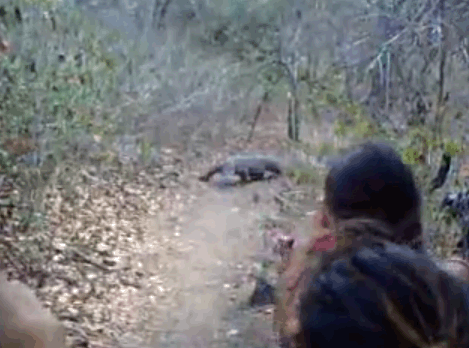
French tourists, completely unaware, in a state of great excitement, filming the rapid approach of a Komodo dragon. Fortunately, the guides rush in and manage to scare the animal away.
http://www.youtube.com/watch?v=VNwwFRcfAao&NR=1&feature=fvwp
Komodo monitors have no other enemies than themselves. Never hunted, and knowing the pathogenic effectiveness of their bite, they do not hesitate to attack prey five times their weight, like water buffalo. What is surprising is that these animals seem not to be aware of the danger. See this third video.
http://www.youtube.com/watch?v=EHB_CM86rgk
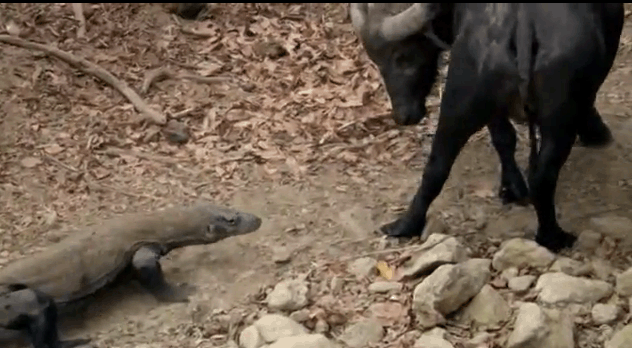
The buffalo, completely unaware of the deadly risk posed by the approach of a dragon that it could easily scare away with a kick of its hooves.
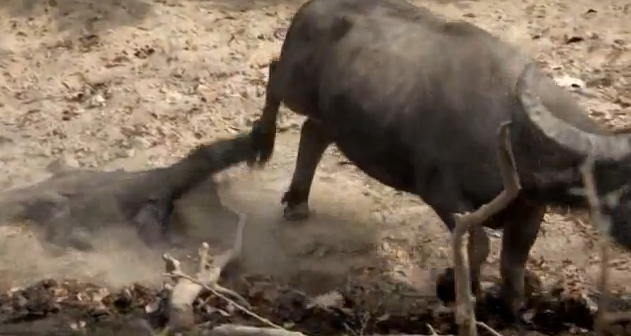
The dragon bites the buffalo on the leg
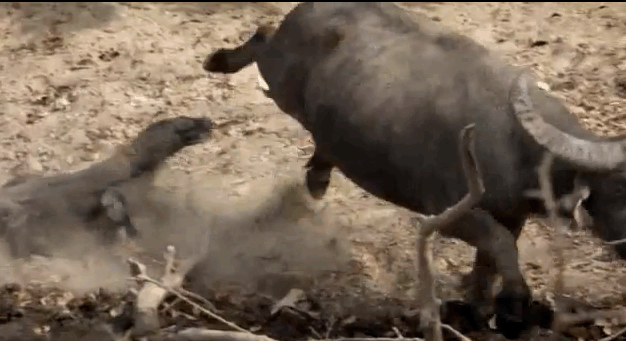
It easily escapes. This bite, light, is almost painless.
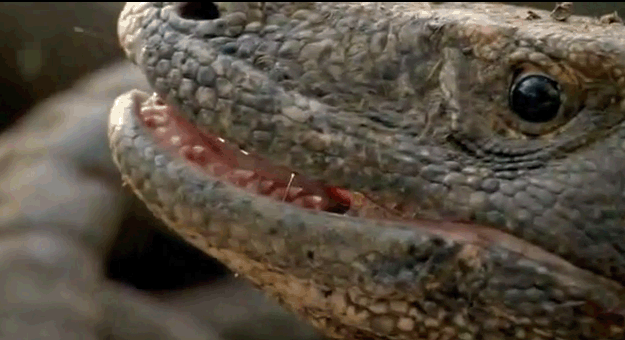
The monitor's teeth are tiny, barely capable of piercing the buffalo's hide.
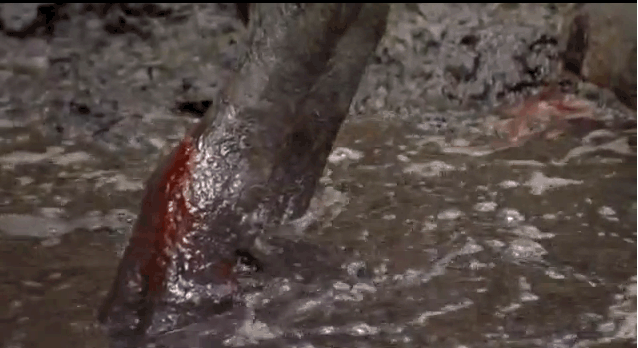
Here is the wound, superficial.
A venomous snake must inject a sufficient volume of venom to kill its prey, otherwise it will escape. What is extraordinary about this secret weapon of the Komodo dragon is that it does not need to inject a large dose of saliva. If the bloodstream is touched, even slightly, the bacteria will multiply. And the animal will die from infection. It is just a matter of time. Attracted by the smell of blood, other monitors will come and follow their victim, who will weaken over the days, without even realizing that this weakening comes from this almost painless bite.
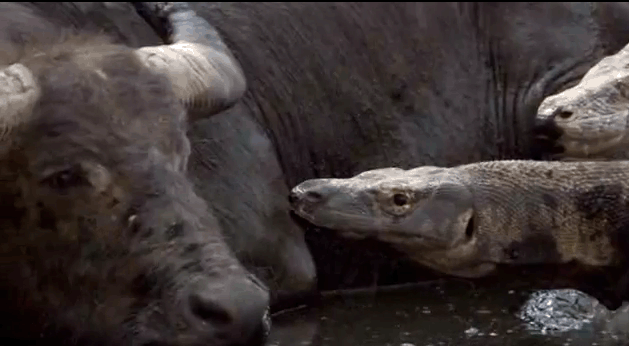
The buffalo weakens more and more, closely followed by the monitors
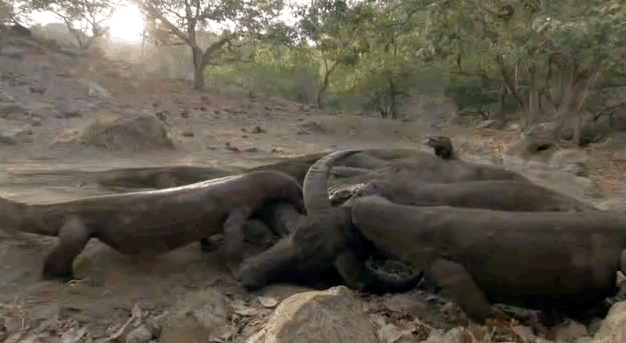
Until the feeding, once it becomes too weak to react
In fact, animals cannot perceive the danger of another species unless they can make the link between the death of one of their own and the attack of this predator. In the case of death by infection, several days pass between the almost painless bite of the monitor and the death of the animal. It is logical, then, that the buffalo does not perceive the deadly danger and does not try to flee.
What is also remarkable is that a monitor, even of modest size, can kill an animal of 500 kilograms with just a few cubic millimeters of deadly infectious saliva.
I have shown above the small size of the animal's teeth. They are not made to kill instantly, to crush or chew. Like shark teeth, broken, they are replaced by others. But a close-up reveals more:
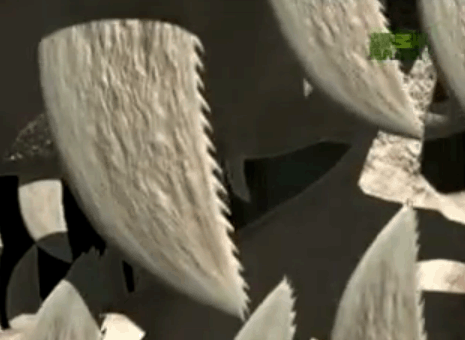
The teeth of Komodo dragons
Like shark teeth, they function like saws. If you are looking for other videos where you can watch the dragons' meals, if the prey is too big to be swallowed in one go, the animal will have to tear off pieces. Unlike, for example, a hyena, which can crush a limb, and even a thick bone, with its teeth, the dragon shakes its head, pulling the flesh. In doing so, it uses its teeth in the form of... saws. The shark does the same.
I saw, in Marseille, at the beginning of the 1960s, the fin of Roger Poulain, who had been attacked by a shark when he was removing a amphora from a wreck near the islet of Planier. This rubber fin, from the brand Cressi, was cut like with a razor, by a jaw that must have been 40 cm wide. The operation was done by this sawing motion, the shark shaking its head from side to side.
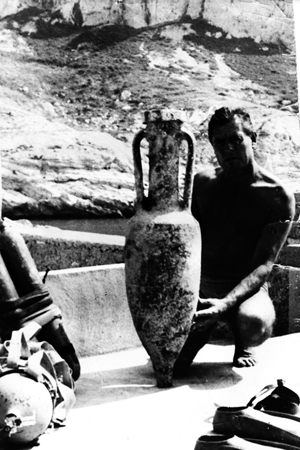
Poulain, at the time of the shark attack. Behind: the island Maïre. In the foreground: the Italian Cressi fins of the time. On the left a "tribouteille bricolé", the bottles being connected with inner tubes.
Poulain had not seen the animal, which must have measured about 3 meters. I saw the object and heard his story when he returned from this dive, to his base at Cap Croisette.
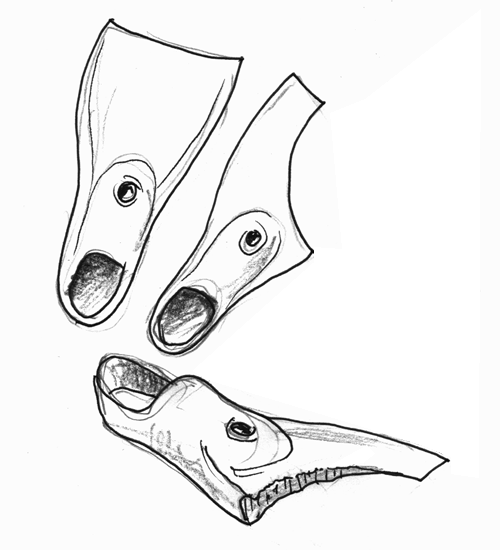
From memory: Roger's fin, cut. A person can testify: a certain Daniel Bertaux, polytechnician, who was a witness, and had, like us, about twenty years old. Roger gave him the object as a gift. He had a career as a sociologist at CNRS. Example of most significant works

Daniel Bertaux, today. Obviously, we have all changed a bit...
He has a website:
http://www.daniel-bertaux.com/accueil/index.html
On which his photo does not seem to have been updated.
Poulain had felt seized by a fin and shaken, and had thought
- But who is this idiot! ?
Turning around, he had seen nothing, but while finning, he had gone... sideways. After our discussion, he said:
- Well, if this shark was counting on having my leg, it only had a piece of gum!( with the Marseillais accent )
I continue on this digression. Readers may be surprised at the idea of there being sharks in waters near Marseille ( the Planier lighthouse is 8 miles from the coast ). It is also necessary to situate the event at the time it occurred: more than 40 years ago. The Mistral cools the water, not because it accelerates evaporation, but because it carries the surface water layer out to sea. It is replaced by water from deeper layers, therefore colder.
There are sharks, in front of the southern coasts, but in deep waters. In front of Marseille, it takes a small week to carry the water above the continental shelf out to sea. Then, water from depths of 200 meters is brought near the coast. The entire ecosystem follows, and the sharks with it. As soon as the water warms, they return to their natural habitat, beyond the 200 meters depth.
When there is a Mistral, people do not swim. But thanks to their suits, divers still dive. Hence the misfortune of Roger (the bite was near his toes).
After our "feat" with this story of the wandering shark, in poor condition, 4m20, which we had brought to the Croisettes beach (renamed with a silly name "Baie des Singes"), we had become the "shark specialists", locally.
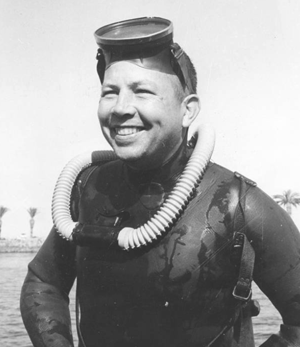
The American was found deadby Sogetram who recovered his body
The wandering shark of Croisettes, mouth held open by a concrete bar
J
e am on the right. Caressing the shark, Poudevigne. Invited by Cousteau, Conrad Limbaugh, "the American Cousteau" of the time, director of an oceanography institute in California, had asked to visit the Port-Miou hole (a underground river emerging in this cove).
, 1924-1960
L
e 20 March 1960 they went there without a thread of Ariadne. Poudevigne lost Limbaugh. He desperately searched for him, until his air was exhausted and
. When Poudevigne warned his companions that he had come back without the American, it was a complete rush. Indeed, there was a non-negligible probability that he could have found refuge in an important air pocket located a few hundred meters from the entrance. These divers
, A few months after the tragedy I had dived with Jean-Claude Mitteau, a student, like me. My partner at the time (now an organist at the church of Nexon, Limousin). By unrolling a hemp rope, wound on a cylindrical spool on a piece of wood, suspended around my neck, equipped each with two tanks, one on the back, one on the stomach, and with very powerful "Girault" lights, we had climbed the river for 400 meters. The trick was that we did not rewind the rope, we left it in place. Hence an important speed of progression, both going and returning. And obviously, on the return, we followed our thread of Ariadne.
Let's go back first to this story of the thresher shark. As this species does not have muscles allowing to oxygenate its gills, at rest, it was dead from suffocation.
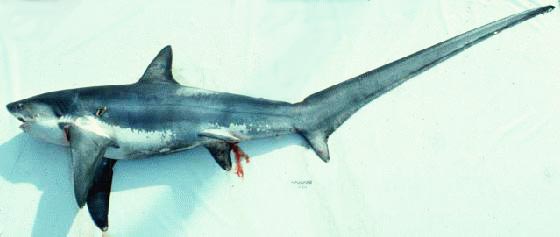
Thresher shark
I had therefore positioned myself under the shark and, like for the wandering shark, passed a rope around its tail. Then the fishermen lifted it on board. But it was not completely dead. It struggled, gave furious tail blows. On board was a retired navy man, who did not have the reflex to jump into the water. Or the tail of a thresher shark can be compared to a flat ruler, on which you would have folded sandpaper. The man got a tail blow on the calf: three stitches.
Memories, memories...