Defining styles
Gabriel Chardin, Luc Blanchet, and Philippe Pajot:
a very particular conception of scientific honesty.
April 4, 2017
Here is the cover of the April issue of the journal "La Recherche":
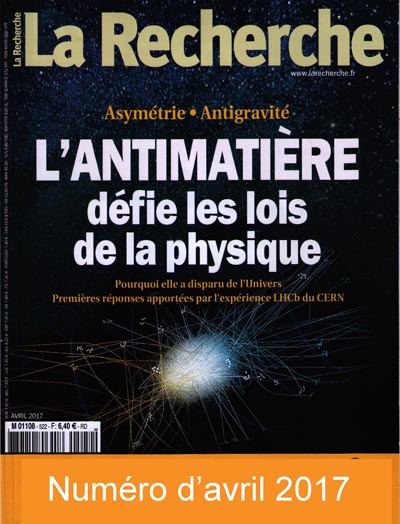
A bold headline pointing to statements by Gabriel Chardin, Director General of CNRS,

and Luc Blanchet, Research Director at the Institute of Astrophysics of Paris.

interviewed by the journal’s reporter, a young mathematician:

in an article titled:
If, as the Spartans said.
Philippe Pajot devotes four full pages to the statements of these two researchers, whom I vainly tried to meet, just as I failed to reach the journalist: my emails went unanswered. The same failure occurred when I attempted to present my Janus cosmological model in a seminar at the Institute of Astrophysics of Paris, despite the fact that these works were properly published in two high-level, peer-reviewed journals, Astrophysics and Space Science and [Modern Physics Letters A](/legacy/find/hep-th/1/au_+Steer_D/0/1/0/all/0/Papier MPLA s021773231450182x.pdf).
There is a crown to wear for whoever opens a new path in fundamental research concerning this great absence in cosmology: primordial antimatter. If the antimatter that Chardin and his team will test in the lab—sufficiently slowed down to be sensitive to Earth’s gravitational field—falls downward, then the Nobel Prize is assured, without doubt. Indeed, several laboratories are already engaged in this race (experiments Gbar, AEGIS, Alpha-g).
The theoretical foundation is provided by Luc Blanchet. His article, examined more closely below, is, for anyone who knows how to see, a complete jumble, filled with conditional statements. Today’s theoretical research consists of writing a Lagrangian, supposedly endowed with all virtues. This approach has the appearance of exorcism. Blanchet’s Lagrangian mentions three types of matter: baryonic matter, plus two kinds of dark matter (...). All of this is "coupled" by a mysterious "gravivector field," implying the existence of a particle mediating this force, a "graviphoton." It's as if, before Torricelli’s thesis, someone had explained the rise of mercury in barometers using a "baryvector field," reflecting "the horror of vacuum" and implying the action of a particle, the "barometrion."
To achieve this, Blanchet must revive an approach initiated in 1939 by Fierz and Pauli, which requires endowing the graviton with mass (despite our having no model of the graviton). But as noted in 1998 by Boulware and Deser, such an approach leads to a calculational instability that they named in 1972—45 years ago—“ghosts” (“phantoms” in English). Blanchet therefore hopes his informal patchwork will be “ghost-free.” In reality, within this mess there is nothing but words strung together, culminating in the invention of two new terms: "gravivector" and "graviphoton."
Pages 74–75, here is what Blanchet tells us:
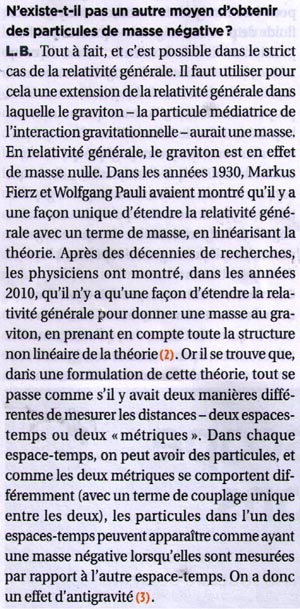
Note the key sentence:
- But it so happens that in a formulation (which one?) of this theory, everything behaves as if there were two different ways to measure distances—two spacetimes and two "metrics." In each spacetime, particles can exist, and since the two metrics behave differently (with a single coupling term between them), particles in one spacetime may appear to have negative mass when measured relative to the other spacetime. Thus, we obtain an antigravity effect (2).
How does Blanchet derive these sentences, which describe, word for word, the main features of my Janus model, from the cited references supporting these claims (including his own article)?
(1) [A. Benoit-Lévy and G. Chardin, A&A, 537, A78, 2012](/legacy/find/hep-th/1/au_+Steer_D/0/1/0/all/0/Dirac-Milne Universe 2012.pdf)
(2) [C. de Rham et al., Phys. Rev. Lett. 106, 231,101, 2011](/legacy/find/hep-th/1/au_+Steer_D/0/1/0/all/0/de Rham.pdf)
(3) [L. Blanchet and L. Heisenberg, Cosmo. Astro. 12, 26, 2015](/legacy/find/hep-th/1/au_+Steer_D/0/1/0/all/0/Blanchet Dark Gravity.pdf)
(4) [R.H. Price, Am. J. Phys, 61, 216, 1993](/legacy/find/hep-th/1/au_+Steer_D/0/1/0/all/0/AJP000216 Price Negative mass.pdf)
-
The first reference is an article by Benoit-Lévy and Gabriel Chardin, presenting this "Dirac-Milne cosmological model."
-
The second is an article by scientist Claudia de Rham, currently at Imperial College, London.
-
The third is a paper by Luc Blanchet and L. Heisenberg.

- The fourth is an article by R.H. Price.
I examined these four documents closely (see below). The conclusion is that nothing in them allows a connection to the sentences in the article, which are nothing more than a clumsy attempt to claim credit for another’s work—and reflect a very particular conception of scientific honesty on the part of the trio Chardin–Blanchet–Pajot.
My Janus cosmological model is obviously far more structured and developed than these confused improvisations. It rests on two coupled field equations, the first of which reduces to Einstein’s equation in the vicinity of the solar system. The hardest thing to get across is such a major paradigm shift. It's like throwing a lifebuoy at cosmological distances.
In fact, it all boils down to those... "equations by Jean-Pierre Petit."
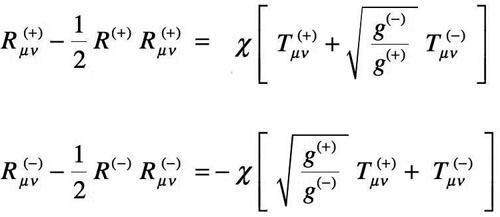
Nobody else goes this far. If I am right, it will be hard to get accepted. Although this theory has been published in several high-level, peer-reviewed journals (Astrophysics and Space Science and Modern Physics Letters A, 2014–2015), no popular science journal has (and will) echo this work—despite the fact that from these equations we derive solutions to all current problems in cosmology and astrophysics, including the phenomenon of accelerated expansion, in the form of an "exact solution," free of ingredients synonymous with a host of free parameters: six in the mainstream Lambda CDM model with cosmological constant and cold dark matter (it sounds like a cooking recipe). No more need for dark matter or dark energy.
The two articles in question:
**- J.P. Petit & G. D'Agostini: Negative mass hypothesis in cosmology and the nature of dark energy. Astrophysics and Space Science, A9, 145–182 (2014)**art% z3A10.1007%2Fs10509-014-2106-5.pdf
- [J.P. Petit & G. D'Agostini: Cosmological bimetric model with interacting positive and negative masses and two different speeds of light, in agreement with the observed acceleration of the universe. Modern Physics Letters A Vol. 29, n° 34, November 10th, 2014:](/legacy/find/hep-th/1/au_+Steer_D/0/1/0/all/0/Papier MPLA s021773231450182x.pdf)
These invisible components of the universe become perfect copies of what we know, but with negative mass and energy.
This scheme also provides the answer to the absence of observation of primordial antimatter and completes the model proposed by Andrei Sakharov in 1967: particles with negative mass emit photons of negative energy, which our eyes and telescopes cannot detect.
Since scientific seminars, where I could present and defend this model, are closed to me, and no popular science journal or television program will ever cover my work (after long negotiations, the management of the Palais de la Découverte in Paris has just today refused to publish an article about my work), I have therefore decided to create this series of videos "Janus" to escape this unacceptable ostracism. The true reason for such rejection: the cosmotrouille.
Instead of asking, "How does the Janus model fit into the framework of General Relativity?" it becomes necessary to reverse the question and ask, "How does the General Relativity model fit into this new Janus framework?" A claim that is extremely difficult to accept.
There is a fact on which others continue to stumble: the impossibility of introducing negative masses into General Relativity, discovered and emphasized by Hermann Bondi in 1957. Indeed, any attempt within the Einsteinian framework leads to unmanageable interaction laws:
- Positive masses attract everything
- Negative masses repel everything
This leads to the RUNAWAY paradox. If two particles with opposite signs of mass are brought together, the positive mass escapes, accelerating uniformly, while being pursued by the negative mass. And the total kinetic energy of the system remains... zero, since the 1/2 m V² term for the negative mass is... negative!
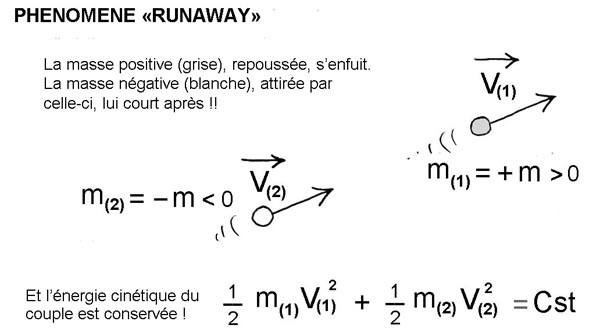
The Janus model provides a solution, at the cost of a major paradigm shift: moving to two coupled field equations. This amounts to considering that spacetime hypersurface has... a front and a back. Then, the interaction laws derived via what is called the "Newtonian approximation" become:
- Like-signed masses attract according to Newton’s law
- Opposite-signed masses repel according to "anti-Newton"
In the papers by Chardin and Blanchet, one finds only vague acrobatics involving massive gravitons, a new force field—the "gravivector"—a new particle, the "graviphoton," or even abandoning the equivalence principle.
Nowhere in these cited articles can one find justification for the following statements:
... everything behaves as if there were two different ways to measure distances—two spacetimes or two "metrics." In each spacetime, particles can exist, and since the two metrics behave differently (with a single coupling term between them), particles in one spacetime may appear to have negative mass when measured relative to the other spacetime. Thus, we obtain an antigravity effect.
No matter how you look at it, these statements refer only to my Janus model and nothing else. "Their bimetric" has nothing to do with mine.
Regarding this additional force field, Blanchet writes on page 47:
- One of the motivations for CERN experiments testing antimatter’s fall is to test for the presence of an additional field (called the "gravivector," whose mediating particle is the "graviphoton") added to the field of General Relativity. This additional field would create a distinction between the motion of particles and antiparticles, which could then be detected. Therefore, for interpreting these experiments, the orthodox approach consists in saying that General Relativity is correct, but that there are extra fields.
We are deep into the realm of fairy dust, whose key particle is the "perlimpinpino."
That said, these people are free to consider whatever they want. That’s part of scientific research. But what is not normal is refusing to listen to those with different theories. Like Chardin, Blanchet, and a long list of other "experts," Damour has denied me access to the seminar at the Institut des Hautes Études Scientifiques in Bures-sur-Yvette for over ten years, where he acts as gatekeeper.
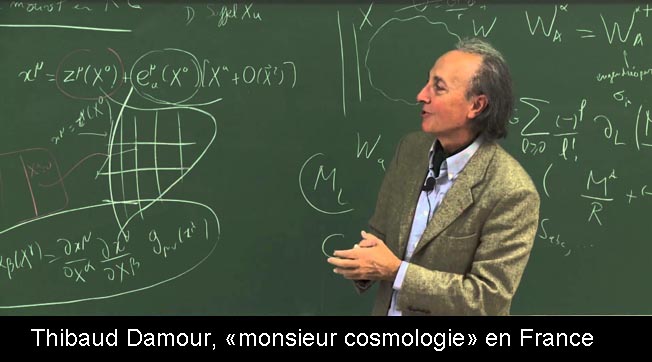
His only response: - Your work does not interest me.
For six months I have contacted all key figures in the field (18 researchers) and all relevant laboratories (fifteen).
I received no negative replies—these people simply did not respond. To this, we must add the silence and non-responses from science journalists, the latest being Philippe Pajot. So, for the past ten weeks, I have begun presenting my work to the public through a series of videos, which are receiving significant attention. Currently, it's the public version. Later, I will create "videos bis" at the math sup level, aimed at tens of thousands of students and engineers, and produce English, Russian, and Chinese versions.
In a few days, I will release the twelfth video in the series, where I finally present the foundations of my Janus model after a long "artillery preparation." In the final video, I will discuss the implications regarding interstellar travel. People will then understand all the elements and consequences of this forty-year endeavor, which is in fact its focal point, with an obvious link to the ultimate taboo subject: the UFO dossier.
Returning to the article in La Recherche and the project by Gabriel Chardin and Luc Blanchet, I say:
Their laboratory antimatter will simply fall downward, just like its matter counterpart.
I predict it and I commit to it.
Nature is indifferent to publicity stunts. It will decide.
How far can one think too far?
What happens afterward? I don’t know. However, note a sentence from the article:
... everything behaves as if there were two ways to measure distances...
Between two stars, there are indeed two possible distances, depending on whether the vehicle traveling between them is made of positive or negative mass. Recently, I was able to calculate this difference in distances between two stars, depending on whether one travels on the "front" or "back" of the hypersurface. By taking the back side of the universe, after the ship has inverted its mass, the distance becomes a hundred times shorter, and in that reference frame, the speed of light is ten times greater. The ship does not need a "propeller." Inverting the mass causes energy conservation to result in the craft acquiring a "different materiality" (to a positive-mass observer, it seems to "dematerialize"). In fact, travel through the "negative sector" can only occur at relativistic speeds, so as to rejoin "familiar territory" with its atomic environment (adaptation of Compton lengths via Lorentz contraction). With such a distance ratio, mass inversion leads to rematerialization in the negative sector almost at the speed of light in that sector—i.e., 3 million kilometers per second. Thus, if in the world of positive masses it requires enormous energy just to reach relativistic speed, when the ship crosses into the world of negative masses, slowing down would be prohibitively expensive in energy terms. Ideas I have already developed and published in a high-level journal in 2015 ([in Modern Physics Letters A](/legacy/find/hep-th/1/au_+Steer_D/0/1/0/all/0/Papier MPLA s021773231450182x.pdf)).
To stop, one simply inverts the mass a second time. Pass the pepper. Concepts of acceleration and deceleration are no longer applicable. One reappears in the world of positive masses, "rematerializing" while recovering the kinetic parameters the craft originally had. Travel time to reach a planet 15 light-years away: just three short months.
Even in the hands of people who reject any implication of their work, the idea is gaining ground. The "light barrier" is about to collapse, as we approach the near discovery of substances like methane and free oxygen on planets astonishingly close to Earth.
Now you understand why our epistemic Tartuffes act this way:
-
- Hide this Janus model from me, I cannot see it...*
Reference (1) "****[Introducing the Dirac-Milne Universe](/legacy/find/hep-th/1/au_+Steer_D/0/1/0/all/0/Dirac-Milne Universe 2012.pdf)" A. Benoit-Lévy & G. Chardin:
The model adopted is Milne’s, proposed in 1933, which sets the right-hand side of Einstein’s equation to zero. Since this term accounts for the energy-matter content of the universe, this technique assumes two contents: one corresponding to positive energy-matter, the other to negative energy-matter, and that these two cancel each other.
The authors then list the underlying assumptions:
1 - The existence of a mechanism enabling matter-antimatter separation. The universe’s structure is then envisioned as an emulsion, with the two entities occupying separate domains "the size of the known universe."
2 - It is assumed that there exists a repulsive force between matter and antimatter. Two references are cited. But in this separation process, annihilation at the boundary between these two domains would emit gamma rays, which have not been observed—contradicting observations.
3 - However, one of Milne’s model’s attractions is that it produces an alternative to inflation theory to explain the remarkable homogeneity of the early universe. The authors assume that radiation's contribution to the "stress tensor" is negligible at all epochs.
The various aspects of Milne’s model are then reviewed. Temperature varies inversely with time. Calculations focus on microphysical phenomena arising from this model (nucleosynthesis, helium synthesis).
In section 5, the authors acknowledge that the model does not account for expansion acceleration or deceleration. The article analyzes supernova data through Milne’s model, concluding that both models (the Einstein-Sitter model with CDM and cosmological constant, and Milne’s model) lead to equiprobable conclusions, with a slight advantage for Milne’s model in the case of nearby supernovae. This effectively denies the 2011 Nobel Prize result.
The next section treats acoustic oscillations in the CMB.
In conclusion, the authors write: "If the Lambda CDM model agrees well with observations, its theoretical foundation remains weak." Emphasis is placed on resolving the cosmological horizon problem. A summary of analysis concerning nucleosynthesis is provided. The disagreement with observation regarding cosmic acceleration—something Milne’s model cannot handle—is noted. It is also noted that the model does not provide a mechanism for separating matter and antimatter.
Reference (2) - [Claudia de Rham's article](/legacy/find/hep-th/1/au_+Steer_D/0/1/0/all/0/de Rham.pdf) "Resummation of Massive Gravity" ("Revisiting the issue of massive gravity"), starts from the foundational paper on "massive gravity," corresponding to the Fierz-Pauli model (1939), which assumes gravitons with mass and spin 2. The approach relies on constructing a Lagrangian. It recalls that this approach immediately revealed an instability, which Boulware and Deser (1972) named "ghost" ("phantom"). Efforts were then directed toward eliminating this instability. A first theory emerged (citing her own 2010 work), where a suitable choice of coefficients could eliminate the instability in the linear approximation. The 2012 paper extends this method to the nonlinear case. The term "negative mass" does not appear in the article. There is neither metric, nor field equation, nor interaction laws.
Although Gabriel Chardin writes at the bottom of page 46: "After decades of research, physicists have shown in the 2010s that there is a way to extend General Relativity to give mass to the graviton, taking into account the full nonlinear structure of the theory. It so happens that in this theory... etc."
Chardin will need to explain how one can connect, from de Rham’s, Blanchet’s, or his own papers, to the second part of his statements:
... everything behaves as if there were two different ways to measure distances—two spacetimes or two "metrics." In each spacetime, particles can exist, and since the two metrics behave differently (with a single coupling term between them), particles in one spacetime may appear to have negative mass when measured relative to the other spacetime. Thus, we obtain an antigravity effect.
(3) [Blanchet and Heisenberg's article](/legacy/find/hep-th/1/au_+Steer_D/0/1/0/all/0/Blanchet Dark Gravity.pdf): "Dark matter via (massive) bi-gravity":
In this 2015 paper, the two authors focus on Milgrom’s MOND theory, where gravity transitions from a 1/r² law when the gravitational field remains below a threshold value to a 1/r law beyond that. They consider two species of dark matter, each associated with its own metric. These two "sectors" are supposed to be linked by a force field. The emphasis is on avoiding the "ghosts" inherent in "massive gravity" theories (with massive gravitons). Various schemes are considered.
Ultimately, the authors suggest a scheme where a "ghost-free" model might (conditionally!) account for the modified gravity of Mordechai Milgrom at galactic scales.
On page 2, for these authors, "bimetric theories" have been widely developed as extensions of the Fierz-Pauli model (nothing to do with the bimetric of the Janus model!).
They recall: "The first bigravity models were tainted by the 'ghost' phenomenon, 'phantom solutions,' and thus could not be considered viable theories." As in de Rham’s paper and many others, the analysis focuses on constructing a "Lagrangian," at the cost of numerous assumptions. The article references earlier work (de Rham, Heisenberg, 2014–2015). An "effective metric" is introduced.
The authors suggest possible forms of this interaction and mention a "mini-superspace of the new kinetic term" (?...). Then arises the question of whether this mini-superspace will or will not be subject to "ghost instabilities" ("The problem is that we have too many kinetic terms" (...).
Section VI: "Thus, the dark matter model proposed in reference (45) was not viable." (See a paper by Bernard and Blanchet, presented on ArXiv in 2014). The Lagrangian (31) then represents a proposal for "dipolar dark matter."
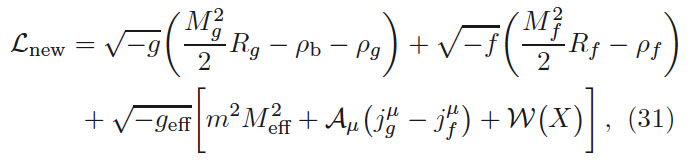
In this model, three matter densities: b for baryons (ordinary matter), and g and f for two species of dark matter. In this expression, numerous hypothetical mathematical objects, with the central one being a field A subscript mu. It is this field that would ensure coupling between the different metrics.
I quote, on page 6, the article’s conclusions:
VII Conclusions:
We explored the possible candidates for relativistic dark matter models in bimetric extensions of General Relativity, that hopefully will provide modified Newtonian dynamics (MOND) at galactic scales while giving rise to an expansion at cosmological scales. A promising road comes from the ghost-free constructions of dRGT massive gravity [15, 16] where the interactions between two metrics are tuned in a way that the Boulware-Deser ghost remains absent. Furthermore, the important studies of possible consistent couplings to matter fields [52– 54] are beneficial to us, since for the model to work, we have to consider two different species of dark matter particles that couple separately to the two metrics while an additional internal vector field couples minimally to an effective metric built out of the two. The vector field links together the two sectors of the dark matter particles and plays a crucial role for gravitational polarization and MOND [45, 46]. For the ghost absence the question of allowed kinetic interactions is mandatory. We showed that the kinetic Lagrangian containing three kinetic terms immediately gives rise to the introduction of the ghost and we therefore concluded that only two kinetic terms are allowed. In a future work [55], we will study in detail the covariant equations of motion of the new model, derive the non-relativistic limit and see if the polarization mechanism for dark matter works in the same way as in the originally proposed model. We will investigate in detail the possible danger of ghostly interactions in the matter sector and constrain further the model. We intend also to check if the parametrized post-Newtonian parameters are close to the ones of GR in the solar system, and to investigate the cosmological solutions in first order perturbations.
Translation: We explored possible candidates for relativistic dark matter models through bimetric extensions of General Relativity, which we hope will yield modified Newtonian dynamics (MOND) at galactic scales while producing cosmic expansion at cosmological scales. A promising path comes from ghost-free constructions of dRGT massive gravity [15, 16], where interactions between the two metrics are tuned such that the Boulware-Deser ghosts remain absent. Furthermore, important studies of possible consistent couplings to matter fields [52–54] are beneficial, since for the model to work, we must consider two distinct species of dark matter particles, each coupling separately to one metric, while an additional internal vector field couples minimally to an effective metric constructed from the two. The vector field links the two dark matter sectors and plays a crucial role in gravitational polarization and MOND [45, 46]. For ghost absence, the question of allowed kinetic interactions is mandatory. We showed that a kinetic Lagrangian containing three terms immediately leads to ghost emergence, so we concluded that only two kinetic terms are permitted. In future work [55], we will study in detail the covariant equations of motion of the new model, derive the non-relativistic limit, and check whether the dark matter polarization mechanism works as in the originally proposed model. We will examine in detail the possible danger of ghostly interactions in the matter sector and further constrain the model. We also intend to verify whether the parametrized post-Newtonian parameters are close to those of GR in the solar system, and investigate cosmological solutions in first-order perturbations.
In short, it's only "leads" (a word often heard). Work done and to be done. Problems are raised but not solved. Everything rests on a mysterious field that Blanchet calls the "gravivector" in the La Recherche article, whose mediating particle would be a "graviphoton." As usual, so-called novelties reduce to creating... new words. Nevertheless, in this article, as in the others cited, it is impossible to connect with the sentences:
... everything behaves as if there were two different ways to measure distances—two spacetimes or two "metrics." In each spacetime, particles can exist, and since the two metrics behave differently (with a single coupling term between them), particles in one spacetime may appear to have negative mass when measured relative to the other spacetime. Thus, we obtain an antigravity effect.
which, indeed, refer to my Janus model.
No matter how you approach this problem, it seems to reflect a rather particular intellectual honesty.
But nature will decide. There will be neither gravivector field nor graviphotons, and this incoherent work, devoid of real content, a mere assembly of words, will join string theory in the trash bins of science.
(4) [What Price's article says](/legacy/find/hep-th/1/au_+Steer_D/0/1/0/all/0/AJP000216 Price Negative mass.pdf): "Negative masses might make a good distraction" (...):
"Negative masses may be unphysical, but they can lead to interesting predictions." He then reiterates the distinction introduced by Hermann Bondi in his 1957 paper, introducing the concepts of "active gravitational mass" and "passive gravitational mass" (according to the equivalence principle, these are identical). He then presents an image describing the behavior of negative masses in a gravitational field, depicting a child holding a balloon by a string and criticizing: "There is a difference between negative mass and the balloon, in that if the string breaks, the balloon accelerates upward, while the negative mass falls downward. Things become different if we replace the child, responsible for the downward pull, with a positive-mass particle." By playing with these "upward-pulling forces" and "downward-pulling forces," Price proposes a "gravitational glider" where these forces cancel out.
This article does not deserve the label of scientific paper. One does not analyze the problem of negative mass using balloons and strings. In Einstein's model, there is a field equation. By linearizing it through a double approximation—namely, considering a region of spacetime weakly curved and where velocities are small compared to the speed of light—the field equation reduces to Poisson's equation. At the same time, this approximation allows the geodesic equations to be linearized. The interaction pattern emerges, which is simply Newton's law, proportional to 1/r². But when Milne attempts to introduce a mixture of positive and negative masses, he arrives at the following laws:
- Positive masses attract everything
- Negative masses attract everything
This immediately leads to the intractable Runaway paradox: if two masses of opposite signs are brought together, the positive mass accelerates away, pursued by the negative mass. Both experience uniformly accelerated motion. Yet energy is conserved (...) because the ½mv² of the negative mass is ... negative.
To escape this impasse, a profound paradigm shift is required. In General Relativity, the universe is an hypersurface endowed with a single metric, generating a unique system of geodesics—the paths followed by particles. Mathematically, it is a four-dimensional manifold equipped with a Riemannian metric.
In the Janus model, two metrics are introduced, associated with a single manifold—causing confusion with the bimetric models of massive gravitons. This is entirely different. These two metrics are then solutions to the pair of field equations mentioned above. Consequently, the Newtonian approximation yields a drastically different picture:
- Masses of the same sign attract each other according to Newton's law
- Masses of opposite signs repel each other, according to "anti-Newton"