The oil spill in the Gulf of Mexico
Oil spill during offshore drilling in the Gulf of Mexico following a "blowout"
Published on June 22, 2010
July 17: Interview with an oil drilling specialist ****
July 2, 2010:
An attempt to clarify the situation.
One should not expect the official press to provide accurate investigations into this oil spill in the Gulf of Mexico. I personally tried to contact people with some experience in oil drilling issues, without success. I am therefore forced to try to search for information on these techniques, citing my sources, with the inevitable trial and error.
What readers expect from me is that I try to extract some elements, in a simplified manner. I have already given a personal opinion on the possibility that oil, or at least a significant fraction of the hydrocarbons found deep within the earth, may not be of biological origin.
Admittedly, the biological origin of certain fuels is not in doubt, starting with
, which forms over a few thousand years from the decomposition of vegetation. One reads that if this same peat is buried and subjected to high pressure for a period on the order of a million years, it transforms into coal, with lignite as an intermediate stage.
http://en.wikipedia.org/wiki/Deepwater_Horizon_explosion
blowout** ** **
June 24, 2010.
One can actually find numerous technical details on the English Wikipedia page:
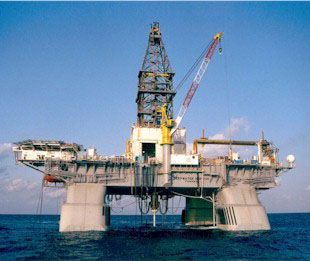
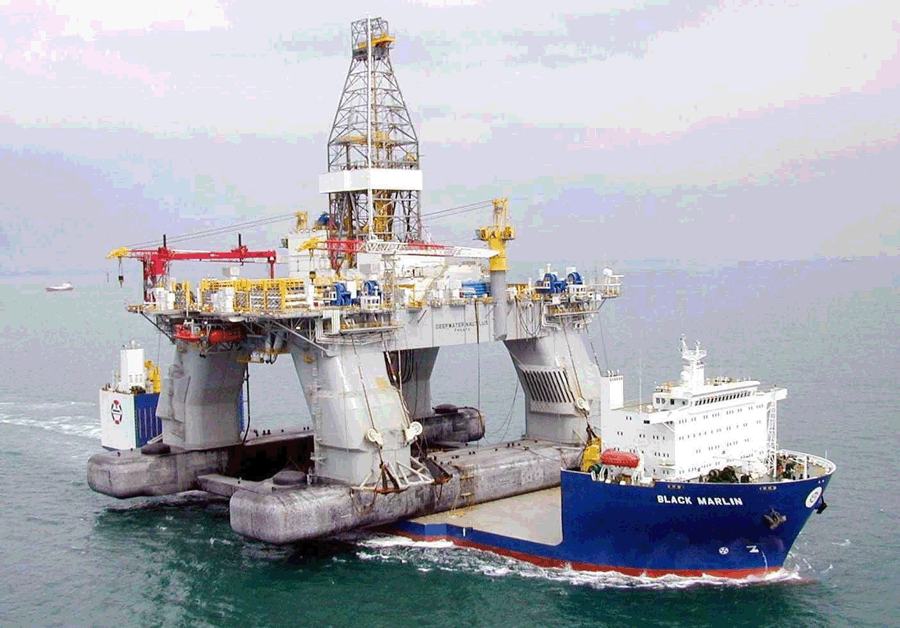
The Deep Water Horizon platform, semi-submersible. Full view of this monster during its transport. After the explosion on board on April 20, 2010. Where the platform was located at the time of the accident. The explosion occurred 64 kilometers south of Louisiana. It killed 11 workers and seriously injured 17 others. The offshore platform burned, then sank. This type of platform was designed to allow drilling on seabeds located up to 2,400 meters deep. The platform, automatically positioned using signals emitted by a beacon located near the drill head, is relatively insensitive to sea conditions, given the high inertia of its semi-submerged ballasts (which serve for the storage of hydrocarbons, less dense than water: 0.9 instead of 1), and is in principle capable of drilling up to 9,000 meters deep. Manufactured in Korea, it was acquired by the Transocean company, which had already achieved a record offshore drilling at a depth of 10,385 meters, measured from the ocean floor. The photo above refers to a drilling operation performed on a seabed of 1,500 meters. It is unknown to what depth the drilling had been performed (the official figure would be 5,000 meters).

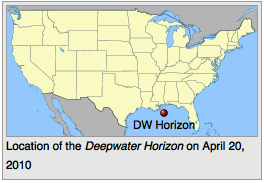
When the platform sank, the link with the seabed was broken and the oil, gushing from the broken conduit, began to spread in the waters of the Gulf of Mexico. To date, this represents the largest ecological disaster suffered by the United States.
The part of the installation located in contact with the seabed (wellhead, or "drill head") was equipped with a BOP device () intended to crush the drill pipe in case hydrocarbons suddenly erupted under high pressure. These devices can be controlled from the platform or activated automatically, from an acoustic signal detecting the eruption of hydrocarbons.
Italian BOP device. It is not known whether these safety mechanisms were operational at the time of the accident.
What the media showed us were the unsuccessful attempts by underwater robots (ROV, remotely operated vehicles) to "manually" maneuver the hydrocarbon flow cutoff devices, by crushing the drill pipe (attempts deemed ridiculous and "media-driven" given the disproportion between these BOPs and the robot grippers).
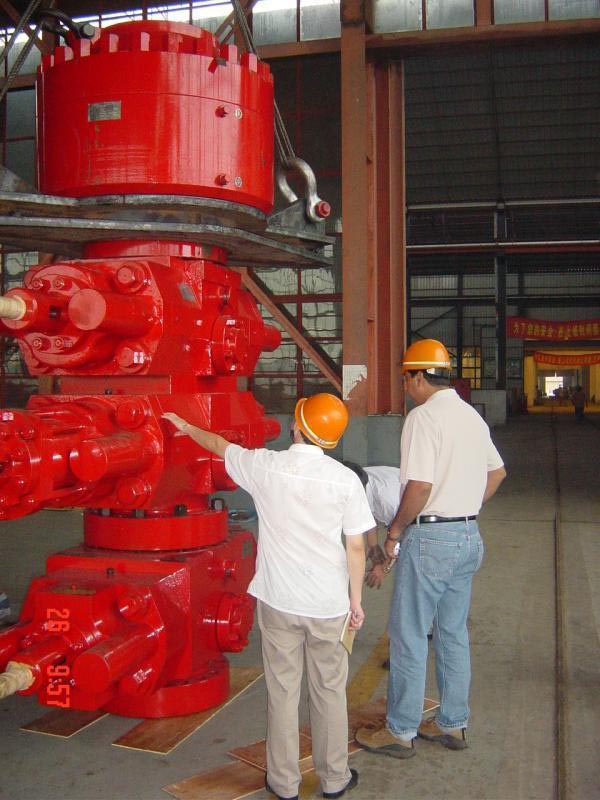
The size of these devices. Crushing can be performed either by pinching or by tightening a self-tightening device reminiscent of camera diaphragms. They are in principle capable of containing pressures ranging from 300 to 1,000 bars and must be tested every two weeks.
At the end of March 2010, the CBS network, in its 60 Minutes magazine, reported a malfunction of the BOP safety device equipping the wellhead. In the article, measures were taken, but A House Energy and Commerce Committee statement in June 2010 noted that in a number of cases leading up to the explosion, BP appears to have chosen riskier procedures to save time or money, sometimes against the advice of its staff or contractors.
[34] "BP opted for riskier procedures to save time and make savings."
According to witnesses, what happened on April 20, 2010, was a typical [blowout], with a sudden rise of a methane bubble, which ignited at the surface (in contact with an engine. Methane has the same density as air and therefore cannot escape by rising). The linked article mentions the sealing of a well by a nuclear explosion, carried out in Russia in 1966, with a 30-kiloton device, lowered to a depth of 6 kilometers, and placed 25 to 50 meters from the well. The method would have been implemented with a device specially designed for this purpose, after having to let the gas burn in the open air for years. See further down the page.
One witness said he heard someone screaming "Are you happy? Say, are you happy? I told you all this was going to happen!"
The fire quickly engulfed the entire platform, which sank two days later. What burned: the surface installations; but also the oil contained in the floats. The survivors, brought ashore, were reportedly cut off from all press and their families, kept locked in a hotel, and would only have been released after the Transocean company made them sign a document, which the company denies.
A conscientious press outlet could refer to this, and draw from all this an article outlining the main lines of the problem. Similarly, since many French Wikipedia articles are simple translations of source papers composed in English, it would be good if a French-speaking "Wikipedian" could install the French translation of this page.
Having been "banned for life" from Wikipedia for years, for having revealed the identity of an idiot, I cannot do it.
But the current subjects of the French press are the aftermath of the French players' behavior at the World Cup, or the future wedding of Albert of Monaco.
Are these really the main subjects of interest for hexagonians [French people]?
I am reposting what I published yesterday, on another page:
Lindsay Williams, interviewed by Alex Jones
peat** **
June 21, 2010:
Apparently, in the Gulf of Mexico, things are not getting better. Alex Jones interviewed a man who claims to get his pipes directly from people working at BP, British Petroleum (by the way, if you have shares, sell everything. Fortunately, I don't have any).
You may have followed the interview of Lindsey Williams by Alex Jones:
What emerges from this interview is that this underwater eruption of oil would be due to a very deep drilling (10,000 meters, under 1,600 meters of water). This type of drilling, already operated by the Russians, up to 12 kilometers deep, but inland, raises the issue of the origin of oil, regarding which I will give my comment below.
According to Lindsay Williams, the drill head would have been ejected by a pressure ranging from one to five tons per square centimeter. However, we do not have a shut-off valve capable of withstanding pressures ranging from one thousand to five thousand bars.
While waiting for more complete information, which are currently cleverly obscured by a numbing discourse concerning the behavior of the French team at the World Cup, I will simply make the following remark.
In the universe, the basic energy is gravitational in nature. It is the force of gravity that gives birth to stars, through gravitational instability. Then the proto-stars evacuate their thermal energy through radiation. Finally, fusion reactions (nucleosynthesis) begin when the core of the star reaches 700,000°.
This nucleosynthesis produces elements up to iron, which accumulates in the core of the star like "ash." It is the massive stars (20 solar masses) that will complete the Mendeleev table, explosively, these massive stars, out of fusion fuel, "falling in on themselves" at a speed defying imagination. The massive star collapses like a soufflé. The speed of fall endows atoms with kinetic energy that will allow, during collisions, new nuclear syntheses, the star exploding like a cosmic spore.
Let's come to the Earth. Within it, sedimentary deposits constitute layers of limestone. An example of very primitive limestone is the one used to build the pyramids (without their casing). One can see the fossils of shells that gave birth to it, and it is of such poor quality that the stone robbers of antiquity left it in place, contenting themselves with taking the Tura limestone facing.
In the Earth's crust, a fundamental mechanism is at work called metamorphism. Under the effect of pressure and with a lot of time, this transforms, for example, limestone into marble. But the rocks composing the Earth's crust are not made only of shells. That being said, everywhere, metamorphism is at work, giving birth to other structures.
Another example of metamorphism, acting on deposits of biological origin: the creation of . (after a maceration of 1,000 to 7,000 years). Here again, following burial, under the effect of pressure and after a fairly long time, peat will transform into lignite. Then this lignite will produce coal. The transformation of peat into coal is estimated at one million years. Note that the phenomenon increases the quality of the fuel.
It has been thought for forty years or more that there exists in the Earth's crust methane and hydrocarbons of non-biological origin. Indeed, witnesses have repeatedly reported smelling hydrocarbons during volcanic eruptions and detecting the presence of methane. In this case, these could only come from layers too deep for their origin to be attributed to the decomposition of biomass.
Logically, pressure and time must induce a metamorphism phenomenon in these primitive hydrocarbons (methane formula: CH4), transforming them into more complex and heavier compounds. Compounds that contain energy (provided by the compression these hydrocarbons undergo). Thus, the non-biological origin of oil does not seem to me to be a far-fetched theory. Some even say that the oil pockets believed to be exhausted, in certain regions of the world, are being refilled with input emanating from deep reserves, the oil percolating through rocks or sediments.
Let's move on to the origin of the fantastic pressure mentioned by Lindsay Williams. Incidentally, why does oil, in certain regions of the world, before having to be pumped, gush out as soon as the oil pocket is reached? In some cases, it may be a phenomenon of " ".
The name "artesian well" comes from the fact that the phenomenon was first demonstrated in Artois. In Paris, it was the scientist Arago who had a well 548 meters deep dug, which took seven long years, until water gushed out in the middle of Paris, simply because the point where the drilling was performed was at an altitude lower than the surface of the aquifer linked to the Paris basin, which then well deserves its name.
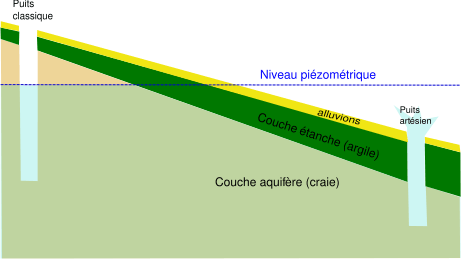
In the videos, you will hear talk of "artesian pressure." The pressure that brings hydrocarbons to rise is classically due to the difference in density between them and the terrains that house them. A hydrocarbon deposit can be assimilated to a sponge containing liquid (and/or) gas. On this sponge rests a solid material (sedimentary deposits or rock). If you pierce this rock mantle, the oil gushes out. But, if the figure advanced by Lindsay Williams is correct, this pressure could have another origin: tectonic, linked to deep rearrangements of the Earth's crust. In this case, the BP people played the sorcerer's apprentice. Generally speaking, deep offshore drillings (combining the depth of the ocean floor and that of the drilling) are sorcerer's apprentice jobs.
Furthermore, when one discovers how companies play with safety measures, to save money and increase their profits, one would be tempted to qualify them as Drilling in Troubled Waters. But why operate these drillings offshore? Simply because the thickness of the Earth's crust is lower under the oceans. The BP people hoped thus to access the deep, oil-bearing layers by drilling at lesser depths.
Alas, they may have hit the jackpot.
I am exhausted. At 73, one does not recover as at twenty or forty. My wife is still struggling to ensure that the printing of "The Amber and the Glass," which I had imprudently announced for... April, is done within decent deadlines. After verification, some readers have already sent order checks for this album, or set up a "reader account," and it will be sent to them as soon as we receive it. One cannot miss this first color printing. For Fishbird, I received 60 prepayments.
July 1, 2010: good news: "The Amber and the Glass" is finally at the printer. The copies will be at my place at the end of July.
I am besieged by this "information" concerning the oil leak in the Gulf of Mexico, which apparently finds little echo in the official media. I watched the TV news. This drawing summarizes the content:

Information, in France
Flash on Sarkozy coming to comfort the victims of the Var floods. A bus overturns, five dead. But on the oil spill in the Gulf of Mexico, Gaza, nothing.
We also learn, in the midst of the beginning of an austerity policy, that Sarko I just received his super private jet, a true megalomaniac's dream. A modified Airbus for 176 million euros. It was necessary to completely dismantle the aircraft to modify its interior layout. Sixty "business" seats (fax, telephone, internet accessible in flight, at 10,000 meters altitude) and a large meeting room replace the initial 324 seats. The president will have a vast bedroom with a shower. The fuselage was reinforced and the aircraft was equipped with infrared missile decoy launchers.
The Élysée Palace gave up the July 14 garden party (700,000 euros) to save money. This represents half a percent of the cost of this aircraft, whose hourly flight cost is 20,000 euros, compared to 7,000 for a more modest jet.
When you love yourself, you don't count.
Democracy is, etymologically, government by the people. Plutocracy is government by the rich, oligarchy, government by a small number of people, aristocracy, by the best. A government under the sign of a pathocracy is a government by the sick (remember the book "These Sick People Who Govern Us").
I suggest introducing a new word,
Conocracy, or government by idiots.
Someone should write
"These idiots who govern us."
Twelve American and Israeli ships have just crossed the Suez Canal, protected by 2,000 Egyptian soldiers. Heading for the Gulf of Aden, to take position facing Iran. Two Israeli submarines, armed with cruise missiles with a range of 1,500 kilometers and equipped with nuclear warheads, have also taken position.
| Source | : | : | The Israeli submarines (a total of six) are of German manufacture. They have conventional propulsion, have crews of 35 to 50 men, can dive to a depth of 400 meters, and can stay submerged for a week. |
|---|
Ehud Barak, Israeli Minister of Defense, asked that the United States strengthen their arms shipments, including bunker-busting bombs.
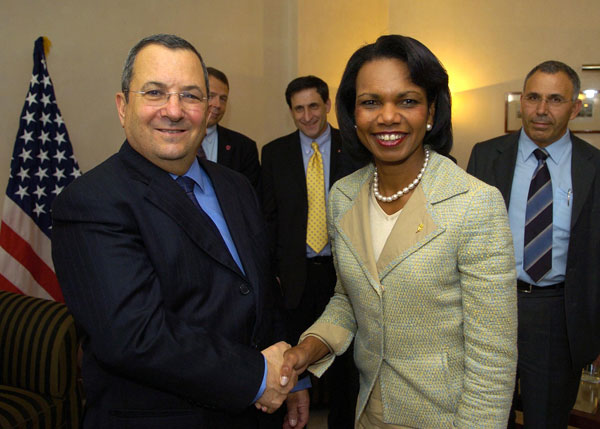
Ehud Barak and Condoleezza Rice in 2007
It is known that a large stock of weapons and bunker-busting bombs is stored on the island of Diego Garcia, southwest of India, facing Iran.
Obama, our white knight, who is also black, Nobel Peace Prize winner, multiplies "statements of firmness towards Iran," after having sent 30,000 more G.I.s to Afghanistan.
So, what is it this time? A gesture intended to impress, or? ...
Who knows.
Here is a different perspective, from the Canadian site Mondialisation.ca. What is frightening is this "Now or Never" situation. The Israelis don't care about starting World War III. They have their backs against the wall. Their operation in Gaza has greatly damaged their image among the "goys." Their conflict with Hamas is deadlocked. They will not force the Arabs to leave their lands. By maintaining the population of Gaza in misery and multiplying settler colonies in the West Bank, they may be following "God's plan," but they are doing nothing that could lead to a peaceful settlement.
On the other hand, those who build an angelic image of Arabs and Palestinians forget the lessons of history. In all these countries, the secular fringe always opposes the fundamentalist fringe, and corruption will always be present in governments. Hence the Years of Lead in Algeria, and the massacres that took place after the departure of the French. Hence the assassination of the pious Anwar Sadat, following the release of mullahs imprisoned by Nasser, the secularist, who hastened to launch a fatwa against him, executed by a member of his military guard during a military parade.
When one thinks of Iran, the image of Zugzwang, the chess game, comes to mind. It is a chess situation where, whatever move is chosen, one loses points. Regarding Iran:
- Either these people decide to arm themselves, and they increase the risk of a preventive war.
- Or they lower their guard, and the risk is the same.
In Iraq, a media campaign was enough to make the whole world believe that the Iraqis held "weapons of mass destruction." When you want to kill your dog, you accuse it of rabies. Tony Blair, servant of the United States (see the latest film by Polanski, which earned him an immediate counter-attack for an old case of corruption of a minor) had even declared "that he had been shown a video that convinced him" (which has never been seen).
In the USA, there are undoubtedly fools who imagine that thanks to targeted strikes, Iran can be brought to its knees. But the country is mountainous. The result will be, after Afghanistan, after Iraq, an "Iraq-bis," or, worse, an Afghanistan-bis.
I have another vision of "geopolitics," which I developed in my latest book. But that one probably goes too far, would question too many things. As usual, I am too far ahead, throwing the cork at the cosmic scale. Hence a lack of reaction, except within a tiny fringe of the general public, of... honest people.
Incidentally, I bought the DVD "The Hurt Locker," a film "with six Oscars." I wonder what people found in this film, which I threw in the nearest trash can after watching it. It describes the daily life of American soldiers, tasked with defusing bombs constantly placed in cities by Iraqi "terrorists," or "resistance fighters," depending on the viewpoint adopted. Suspense scenes. Message: "for some, war and mortal risk, Russian roulette style, eventually become a drug." But not a word about the causes and consequences of this conflict.
I wrote to a friend, retired, who has extensive experience in oil drilling, and I hope to have a phone conversation with him to gather his opinion on what is currently happening, according to him, in the Gulf of Mexico. But I know he travels a lot. I am neither a geologist nor a specialist in these matters. What can one say that is not idiotic?
First, that when Mother Nature spits her flames in our face, it can last for decades, even centuries.
**
http://www.newsoftomorrow.org/spip.php?article8506
N
early 40 years ago, Russian scientists were prospecting for gas deposits in Turkmenistan, near the city of Darvaza, when during a drilling, the ground gave way beneath their feet, swallowing part of the camp in a vast crater several tens of meters deep, and several hundred in circumference.
T
he scientists of the time decided to set fire to the crater so that the gas escaping from it would not hinder prospecting operations in the vicinity, nor poison the populations of the neighboring town, so that after a quick study of the situation, they ignited the gas thinking that it would only burn for a few weeks.
Forty years later, it is still burning...
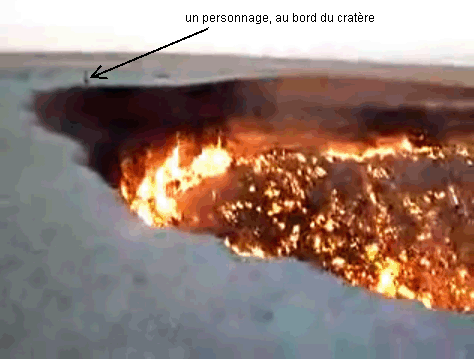
One can therefore not prejudge the duration of the phenomenon. This oil spill in the Gulf of Mexico, if it is not controlled, how long can it last? Two years, twenty years, two centuries? It is impossible to know. What can be said is that the Gulf Stream, "the current of the gulf," which well deserves its name in this case, if this lasts, will carry this pollution across the entire Atlantic.
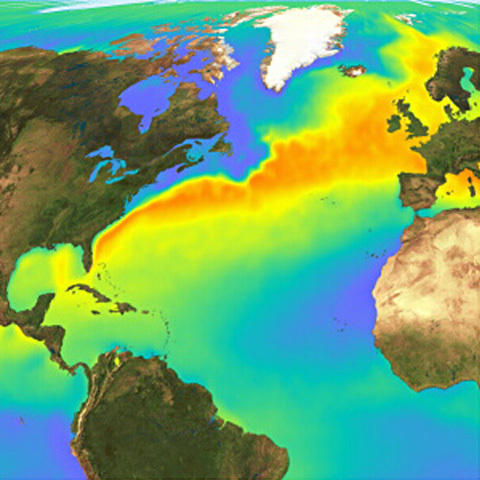
The circulation of the Gulf Stream waters across the Atlantic
Recently added to the Wikipedia page dedicated to it:
Mathematical models raise fears of a rapid flow towards the Atlantic once the slick can exit the Gulf, if the ocean currents have their usual configuration ****
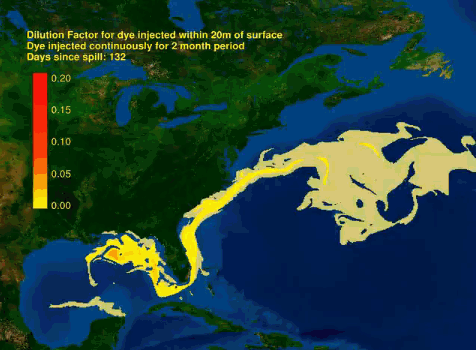
Modeling of pollutant dispersion. Europe would be affected in the autumn
Source: Wikipedia page, reference 8
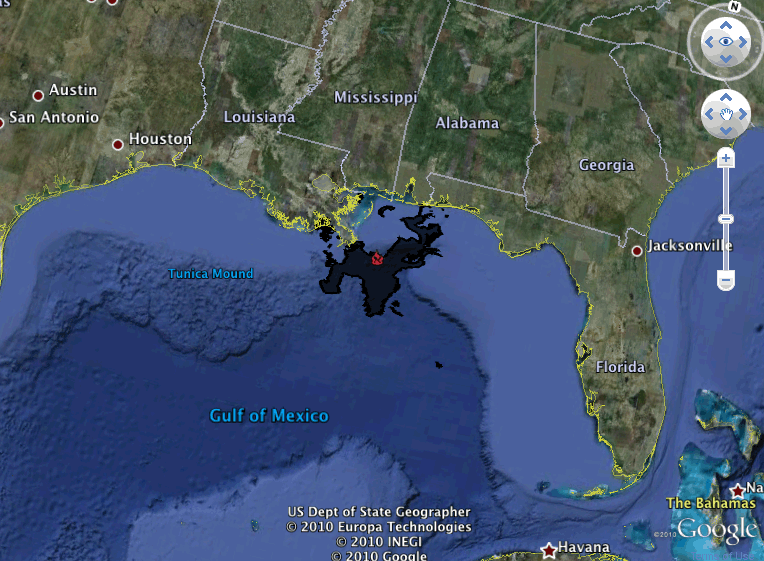
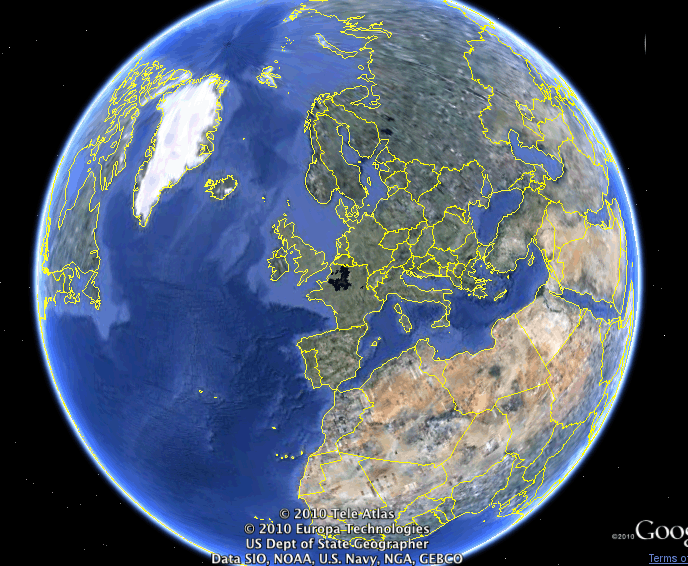
| June 28, 2010: | The extent of the surface slick, according to Google Earth: | The extent, compared to France. | Case to follow |
 |
|---|
So we will have to find one way or another to stop this oil emission. A reader wrote to me: "It is enough to place on the emission point a plug sufficiently heavy to counter this fantastic pressure." Indeed, one could imagine building a huge concrete barge, with caissons allowing it to be brought to the emission point, then sinking it. If the ocean floor were rocky and homogeneous, the solution would present some logical aspect. But what is the composition of the ocean floor of the Gulf of Mexico in that region? If the floor offers a certain porosity, if it presents natural fissures, this will only aggravate the problem by multiplying lateral leaks.
The Russians experienced a problem of this kind, and we will see how they ... solved it!
Everything is described in the video below:
http://www.youtube.com/watch?v=CpPNQoTlacU
For those who do not understand English, some comments and images. One must first pass through images of a kind of opening credits, without interest. Then the title of the document appears, in black and white. Neither the location, nor the date of the event are specified. It begins by showing that a gas leak occurred, creating an immense torch of fire.
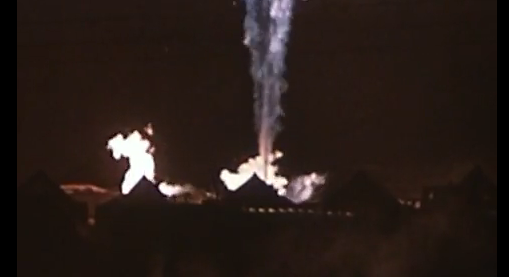
A torch of fire, filmed at night, somewhere in the Soviet Union
The gas was ignited, because this emission, near inhabited zones, is toxic. The Russians begin by extinguishing this fire by powerfully dousing the flame, and it works:
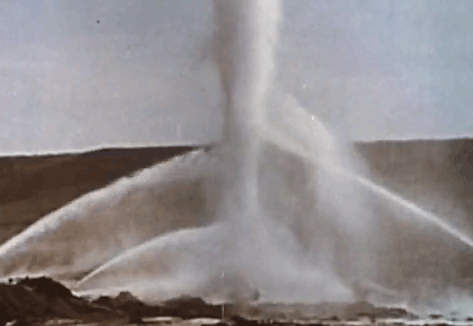
Extinguishing the fire by powerful dousing with water
The pressure being probably not considerable, the Russians tried to control this gas emission by positioning a tap, leading to several channels arranged radially, capable of allowing the recovery of this gas flow, with lower unit flows.
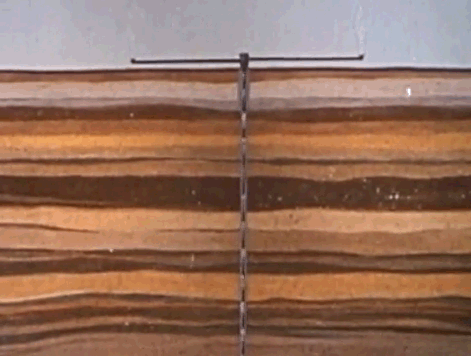
The diversion system set up on the gas supply drilling well
The escaping gases are ignited again, to avoid pollution by toxic components.
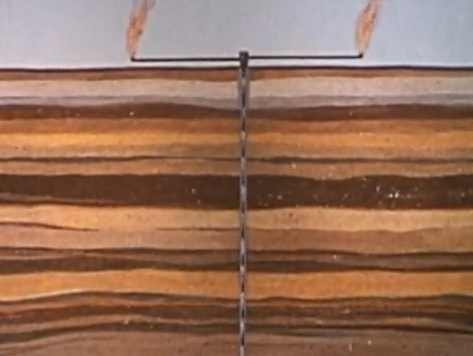
N torches, instead of a single one
But the sub-layer shown in gray proves permeable to gases.
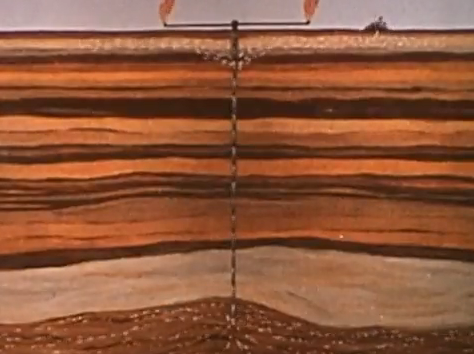
Diffusion of gas in the sub-layer of the terrain
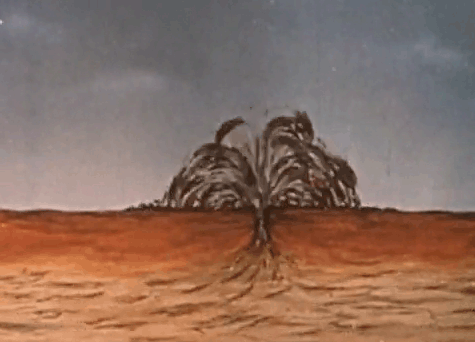
This gas manages to find its way to the surface in different places, forming mud puddles.
**** Again, the toxic, light gases go into the atmosphere. It is then no longer possible to ignite them. This pollution represents a danger to the neighboring populations.
The decision is then taken to intervene in the deep layers, by detonating a nuclear device. For this purpose, a derrick is set up.
The derrick built to lower the nuclear charge.
In the foreground, the bubbling due to the emergence of gas ****
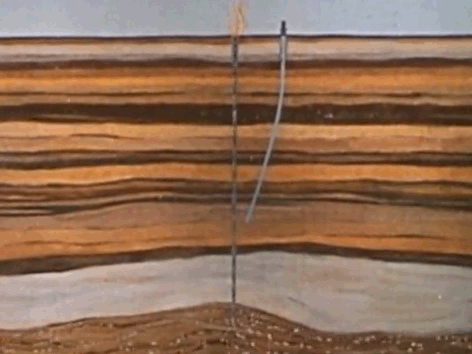
From this derrick, a second, oblique drilling will be performed
This oblique drilling was performed to a depth of 6,000 meters, bringing the charge to 25-50 meters from the well.
One may wonder how oilmen guide a drill bit like this. It is possible that they act on its cooling, using a water supply. By increasing cooling in one direction rather than another, it is possible that this system allows orienting the direction of the drilling. See further down the information provided by a specialist, Mr. Alain Pierre.
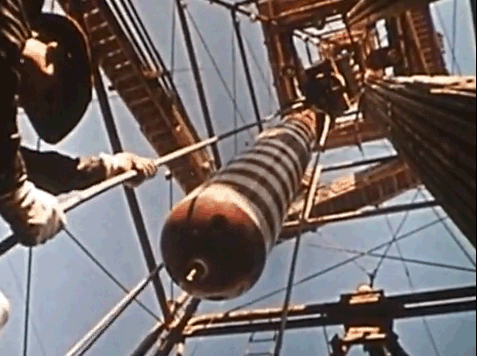
Lowering of the nuclear charge (specially designed for this operation) in the derrick ****
Detonation of the nuclear charge ****
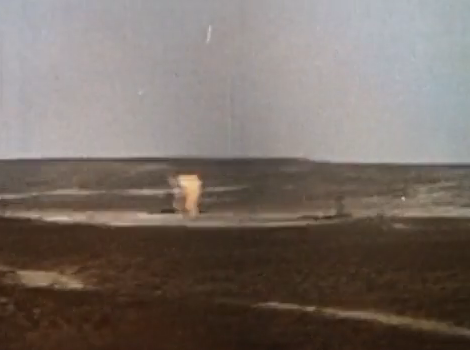
The film clearly shows the characteristic jolting on the surface, linked to the underground explosion ****

The plan worked. The gas conduit was crushed by the compression.
In yellow, the cavity formed during the explosion of the nuclear charge (its power is not specified, nor is the diameter of the cavity). The rock fractures all around, but at the same time, by compression, the well that brought the gas to the surface is sealed. The commentary specifies that the gas leak stopped twenty-two seconds after the explosion. This image shows the magma chamber filled with gas brought to very high temperature. We know that when this gas cools, the rock cracks and fragments fall into this chamber. But one imagines that all this was sufficiently well "calculated" so that this collapse would not allow the gas to find another way to escape. One can suppose that before the detonation of the nuclear charge, the Russians filled this supply well with concrete to prevent it from serving as a path for a new gas escape.
The authentic film evokes a situation where the recourse to a nuclear weapon appeared as the only possible solution.
Clarified by a reader
: The Russian bomb shot was 30kt (twice Hiroshima), the gas field was south of Bukhara (now in Uzbekistan). The device detonated in a chalk layer 200 meters thick, 35 meters from the well, at a depth of 1,500 meters, and the gas stopped gushing 25 seconds later. It seems there was no excessive contamination on the surface. (but that, is in the sense that the Russians give to this notion...)
Source
:
"Nuclear Explosions For Peaceful Applications" published in Tripoli (Lebanon) in 1980 under the auspices of the Arab Development Institute. Author: Mohamed A. El-Guebeily.
Will this solution be imposed for the oil leak in the New Mexico [sic: likely error for Gulf of Mexico]? One cannot say that the major media were invited to cover this event. The figures concerning the leak have been increased. Add the rumors circulating, concerning the ejection pressure of oil from super-deep layers (10,000 meters, under an ocean floor located at 1,600 meters depth?), of oil that would be of non-biological origin. What to do, if this ejection pressure is really 1,500 bars, if the immediate seabed is likely to allow oil to escape through fissures? Would it then be necessary to intervene at a greater depth, implementing the Russian technique, using a nuclear weapon.
If that were the case, the implementation of this technique would take months, and the pollution would then have ample time to spread across the entire Atlantic.
see additional page, on the search for solutions
July 4, 2010:
How to steer a drill?
Details are found on the following link, provided by Mr. Alain Pierre:
It is simpler than one might have thought. The deviation is mechanical, obtained using a system called "Whistle."
One raises the drill bit and the drill pipe (which is of a diameter smaller than that of the bit, which crushes the rock). One then lowers the whistle, and everything happens as according to the drawings below:
The drilling diameter is larger than that created by the bit (). One starts by removing the pipe and the bit. Then one lowers everything again, after having equipped the bit with a whistle, which will deviate the direction of propagation of the bit by 3 to 5°. After ensuring that the rotation of the bit (and the drill pipe) will not drag the whistle, one starts drilling at 15 rpm. Then one goes to 30-40 rpm. The drill creates the deviation following the direction imposed by the whistle. When this deviated section reaches 6 meters, one removes the whistle, then one lowers the bit again, with a guide, and it then engages in the deviated conduit.
A rough guidance can be operated from the surface. When it comes to reconnecting at depth to an already dug well, on which one must intervene, one locates the bit with a directional microphone lowered into the first well (if possible...). Based on the information provided by this microphone, one orients the drilling accordingly.
This is only schematic. There are other deviation devices, more elaborate, and other guidance devices.
Unless the figure concerning the pressure is exaggerated and the news reaches us that BP specialists have managed to control this leak by a more conventional means (an injection of high-density muds).
Case to follow
I have an additional remark to make. In her work "The Shock Doctrine," Naomi Klein suggests that political and military forces often take advantage of situations like natural disasters or accidents due to human irresponsibility to engage in violent, coercive acts with strong geopolitical impact, which then attract less attention from the public, from citizens. If the event in the Gulf of Mexico took on the appearance of a planetary ecological disaster and was at the center of the concerns of hundreds of millions of human beings, one could predict that this focus on the event would incite some to launch violent operations, whose plans have been in their General Staffs' files for a long time.
Here, confronting Sarkozy in 2007
http://www.dailymotion.com/video/xdkm5m_1-2-nigel-farage-de-retour-chez-ale_news
**
June 24, 2010:
I can't be bothered to create yet another page to deal with what follows.
How to get rid of a nuisance
A few years ago, I was invited to Dubai by an authentic defector from the DGSE,
. (I see that the Wikipedia page has strived to make a certain update)
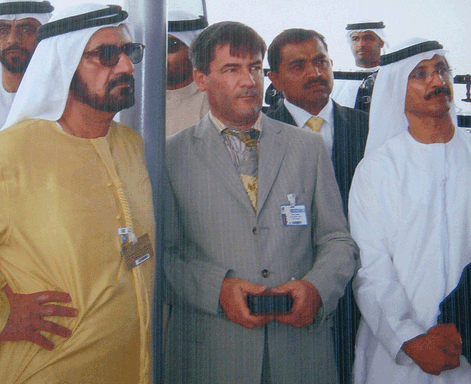
Hervé Jaubert in Dubai. To his right, Sheikh Mohammed,
owner of two private Boeing 747 planes, one for him, the other for his horses.
At the time, he was developing a company, Exomos, supposed to create a fleet of private mini-submarines, for tourism, for emirs in search of novel distractions. See
It took years for the Emiratis to realize that this company was nothing but a money pit, producing only nameless stupidities, private submarines as hydrodynamic as grand pianos. We had gone there, my friend Christophe Tardy and I, with the naive idea of being able to sensitize local financiers to the development of solar towers and solar energy collection stations based on huge Fresnel mirrors. Indeed, the Emirate of Dubai is backed by a desert crushed by the sun. By building solar towers there (the country had the means), the emirate could have set an example of massive electricity production from solar energy. Energy from which it would then have been possible to desalinate seawater and feed crops arranged under Fresnel mirrors, also solar energy collectors, arranged horizontally, a few meters above the ground, on pillars.
We quickly realized that we were wasting our time, and that we had nothing left to do but patiently wait for the day of the return flight. Thinking back, I have trouble understanding how a former student of the Naval School could have designed submarines, about which Christophe had said:
- Less streamlined, I can hardly see anything but a stool.
Regarding Jaubert's hasty departure from Dubai, the Emiratis, realizing they had sunk large sums for nothing, confiscated his passport and asked him to repay. Jaubert, he told me, first managed to get his wife and young child out of the country, then (regaining his secret agent reflexes, his own words) he had friends buy a sailboat, which he joined, at night, using a Zodiac, to flee to the United States. From there, he had undertaken to write a book in which he intended to denounce the turpitudes of the Emirates, and asked me if he could use my drawings, which I refused.
In Dubai, he told us a few little things. I remember one of them. He mentioned a method to get rid of a head of state or a person deemed troublesome, owning a private plane, but without sabotaging it.
Before talking about that, I will recall that secret agents obviously have a wide range of ways to cause people to pass from life to death. One can, for example, place a radio-element under, or in the seat of a car, to provoke prostate cancer. But an inspection may allow the victim or their guards to detect the presence of the device.
There is the famous "Bulgarian umbrella" trick, taken up by Philippe Francq and Jean van Hamme in issue 1 of the Largo Winch series, titled "The Heir," page 24.

The "Bulgarian umbrella"
This gadget served quite well, until its existence became known. Who would indeed have suspected a man walking with a simple umbrella?
From Jaubert, I learned of the existence of a formidable substance, acting through the skin, with a certain delayed effect. If one is dealing with a personality whose driver does not wear gloves (did Diana's driver wear them, as did Coluche's?), and who otherwise has the habit of driving a bit recklessly, it is enough to coat their steering wheel or handles with it.
When the substance takes effect, the driver suffers neurological effects such that he is no longer in a state to control his vehicle. Same effect if the product has been applied to the control stick of a plane (do you know any plane pilots who wear gloves?).
When the aircraft crashes, investigators will look for traces of sabotage of the controls. But will they have the idea to analyze a substance that might have been applied to a flight control? (and not necessarily on the control stick. It could be the landing gear retraction control, or the flap control).
After the accident, it will suffice to have an accomplice, as Jaubert had explained to me, who mixes with the investigation teams and can discreetly clean the control, with a cloth soaked in an appropriate product. A gesture that takes only a few seconds.
Moral: if you use a private plane, or if you have the habit of driving your vehicle
rather recklessly,
either wear gloves, or clean your steering wheel before hitting the road. Otherwise, if you drive like a peaceful father, the method will have little interest, and will at most lead you to crash into a neighboring car or a shop window.
The plane is more vulnerable to this kind of criminal act. I think, for example, of the accident suffered by the troublemaker of politics, Nigel Farage.

Nigel Farage, the troublemaker of the European Parliament
Nigel Farage, brilliant orator, member of the European Parliament, does not hesitate to attack all sorts of people, the European Commission, like the Belgian Herman van Rompuy, whom he accuses of having been parachuted there without being elected by anyone. He denounces, in a jumble, what he considers as control by non-elected bureaucrats, the global warming scam, the carbon tax, the race towards a new world order.
He announces that these efforts lead to failures, considers Obama a dangerous president. Indeed, one hardly sees what this guy has been able to do up to this day, which justifies his title of Nobel Peace Prize, a title he shares with Henry Kissinger.

Herman van Rompuy uncomfortable facing Farage's blows.
And suddenly, on the eve of elections, when Farage's plane, a light two-seater, takes off to tow behind it a banner carrying a slogan, the plane hits the ground and does a somersault. Farage's pilot is nevertheless a former military pilot with many flight hours. This accident is attributed to the towing of the banner. But personally, I have known legions of light aircraft or microlight pilots who have towed banners without it posing a problem for them. And here is the result:
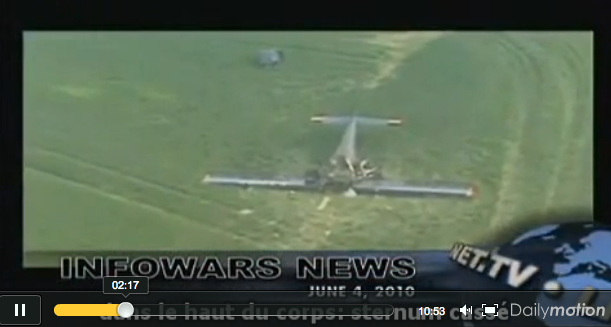
Farage's plane went over on its back.

The rear of the wreck
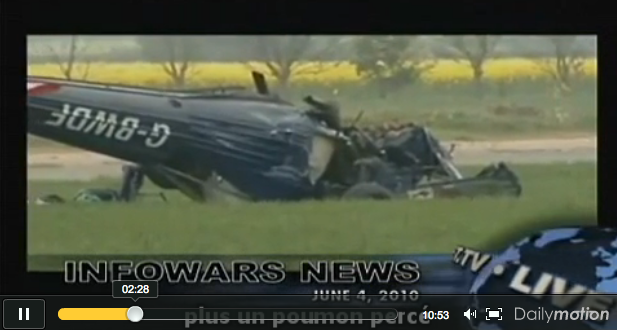
What remains of the front of the aircraft
Farage emerged with ten fractures. Listen to his interview by Alex Jones:

Alex Jones interviewing Nigel Farage, convalescent
In the second part of the interview, Jones and Farage evoke a recent speech by Zbigniew Brzezinski before the CFA, the Council for Foreign Affairs, where the latter pointed out the rise in citizen awareness, considered as an obstacle to a march towards globalization, Jones having been named and presented as a disturbing agitator.
And Nigel concludes:
- It is not a plane crash that will stop me!
New arrivals Guide (Index) Home Page