Consolidated document. 2 original pages have been brought together here; the links below open each section.
Find again: Scientific documents.
Contents
31 Dec 2001
You have all seen a strange object spinning tirelessly on the left-hand part of the site's home page. What is it?
One day, when I have time, I will put on the site a description of the turning inside out of the sphere, as I had illustrated it in the January 1979 issue of Pour la science, that is to say ... 22 years ago. All of this would obviously require a great deal of detail and introduction. Turning a sphere inside out, what does that mean? A sphere does not have the same meaning for the man in the street and the mathematician-geometer. For the man in the street, it is defined as being, in a three-dimensional space, the locus of points situated at a distance R from a fixed point O of that space. A geometer will continue to call an object that would correspond to a "deformed sphere", a sort of "potato", a "sphere". To grasp all these concepts with greater precision, get hold of the Lanturlu CD carrying the comic strip "Le Topologicon". But the mathematician goes even further. When a surface is said to be "regular", one can define a tangent plane at each of its points. This already makes it possible to envisage an infinity of deformations of the "starting sphere" into an infinity of potatoes, especially since the area of the said surface can be arbitrary. That being so, in a "physical universe" the person deforming this sphere will come up against the impossibility of making it pass through itself. If these passings-through or even these contacts are forbidden, one will then speak of embeddings of the sphere S2. But a mathematician grants himself every right. A sphere is, for him, a "virtual" object in which the passing-through of sheets becomes possible. The series of drawings below shows a sphere that has "passed through itself". This representation of the sphere is then called an immersion.
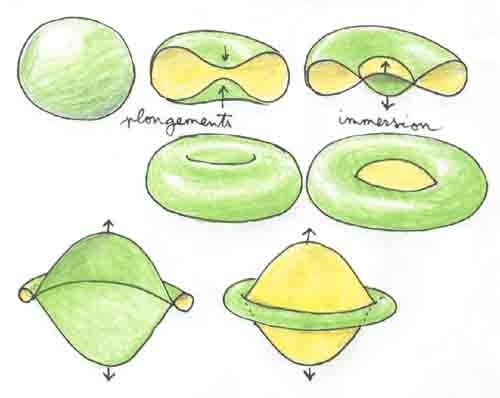
An immersion possesses a set of self-intersection (here a simple circular curve). The tangent plane must vary continuously. That being so, when one looks at the drawings above, one sees that the operation does indeed turn a part (represented by the green colour) of the interior of the sphere towards the outside. To complete such a turning inside out, it would be necessary to crush this sort of equatorial sausage. The thing seems problematic a priori. This crushing would break the continuity of the tangent plane. The operation would therefore include a stage that would not be an immersion.
One day an American mathematician, Stephen Smale, demonstrated that "The sphere S2 possessed only a single class of immersion". The corollary of this sibylline sentence was that one should be able to chain together a sequence of immersions of the sphere making it possible to go from the "standard sphere" to its "antipodal" representation, that is to say one in which all the points would have been replaced by their antipode. In short ... a sphere turned inside out, front to back. Raoul Bott was Smale's boss. As much as the latter's demonstration, purely formal, seemed flawless, so much did no one see how to set about carrying out the operation. Bott kept saying to Smale "show me how you would envisage proceeding", to which Smale, with his famous lisp, replied "I haven't the slightest idea". Smale later received the Fields Medal, the equivalent of the Nobel Prize, but for maths. Incidentally, you may perhaps wonder why Nobel had never wanted to create a Nobel Prize for mathematics. The answer is simple: his wife left with a mathematician.
Things remained as they were for quite a few years until an American mathematician named Anthony Phillips published in 1967 in Scientific American a first version of this turning inside out, atrociously complicated. The second was invented at the beginning of the seventies by the French (blind) mathematician Bernard Morin. I was the first to draw this series of transformations which will, as I have already said, be the subject of a forthcoming paper on the site, a rather copious one moreover. Be that as it may, this brings us to a subsidiary conclusion. Surfaces can be the object of polyhedral representations. A cube or a tetrahedron can be considered as polyhedral representations of the sphere, insofar as these objects have the same topology. On this point, consult my comic strip le Topologicon. Moreover, it will be understood that if it is possible to turn a sphere inside out, it is equally possible to turn a cube inside out. The transformation invented by Bernard Morin (which I illustrated in the January 1979 article of Pour la Science) passes through a central model. There is a symmetry in this sequence. This is what is called "the central model with four ears". There again, I am anticipating. But just as the sphere can lend itself to polyhedral representations, so it is with the successive stages of these transformations. The object that you see spinning on my home page is thus the polyhedral version of the central model of the turning inside out of the sphere, a model that I invented about ten years ago. The interest of these polyhedral models is that one can build them with flat surfaces. One can even arrange them according to cut-outs. Take a look at the drawing below (I thank in passing my friend Christophe Tardy, who produced the elements of it correctly dimensioned).
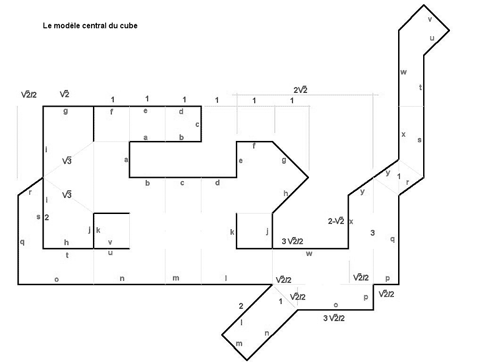
This is a drawing that would come out of your printer in small format, unusable.
To print this figure on an A4 sheet You then have to make four photocopies of it on strong A4 paper, two sheets of one color, two sheets of another
This is a cutout of which you have a general view here. But to print it, it is better that you go to the cutout page. Print it. Then, with this copy printed on your printer's normal paper, go to a photocopier and make four identical copies of this drawing, two on two sheets of green card and two on yellow ones. You will then be able, using this cutout, to build the central model of the cube turning inside out.
On these cut-out elements, you have pairs of letters: a , b c , d , e , f etc.... You simply have to perform the folds, bringing the same letters into coincidence, then assembling these facets with transparent adhesive tape. The drawings that follow show how to mount one of the four elements. First, here is how to begin folding one of the four elements:
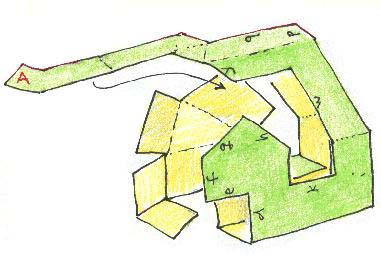
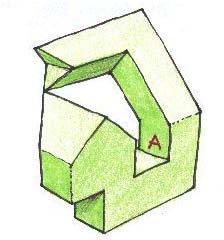
Here are two of these four elements, seen from different angles.
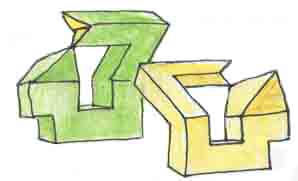
These then fit together to give an object having fourfold symmetry, where green elements and yellow elements alternate. To see this in 3d, go and take a look at the creations of sieur Tardy, in "virtual reality". The fully assembled central model is also produced in "vrml" in this section. Here is this object, seen from different angles:
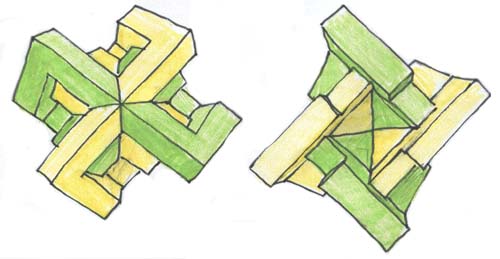
One cannot say that one view corresponds to the "top" and the other to the "bottom", since these names would be totally arbitrary. In the left view the "central" point corresponds to the "double point" (where two sheets cross) of Morin's central model, while the central point on the right is equivalent to the "quadruple point" of that same model (where four sheets cross). I had to carefully orient the object so that the left figure would not evoke a swastika. Otherwise, architecturally speaking, this polyhedral representation of Morin's central model could have made a very good project for a National Socialist house of culture.
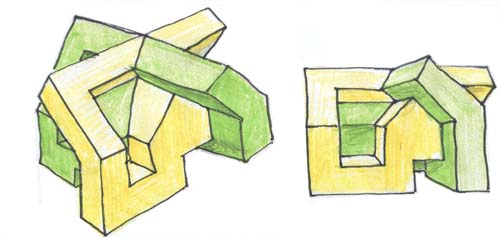
Last view:
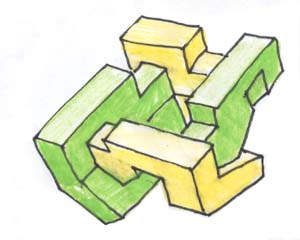
One last remark: there is no good polyhedral representation of the turning inside out of the sphere (alias the turning inside out of the cube). By "good" one must understand a sequence of sufficiently explicit models that can be mounted in cutout form relatively easily, like the model above. Research would have to be done in this direction, which is within anyone's reach, possibly a non-mathematician, a visual artist, for example. More than twenty years ago I was a sculpture teacher at the Ecole des Beaux-Arts in Aix en Provence, at the time when it was still directed by my excellent friend Jacques Boullier. It was in those premises that the first meridian representation of Boy's surface using ellipses was born, the key to the construction of the first implicit equation by Apéry. I must say that at the time I was always surprised by the geometric imagination of art students, which very often surpassed that... of geometers.
Counter initialized on December 31, 2001. Number of connections:
Back to the maths summary Virtual reality Back to New features
Continuation
Dec 31, 2001
You have all seen a strange object turning, tirelessly, on the left part of the site's home page. What is it about?
One day, when I have time, I will install on the site a description of the turning inside out of the sphere, as I had illustrated it in the January 1979 issue of Pour la science, that is to say ... 22 years ago. All this would obviously require a great deal of detail and introduction. Turning a sphere inside out, what does that mean? A sphere does not have the same meaning for the man in the street and the mathematician-geometer. For the man in the street, it is defined as being, in a three-dimensional space, the locus of points located at a distance R from a fixed point O of that space. A geometer will continue to call "sphere" an object that would correspond to a "deformed sphere", a sort of "potato". To grasp all these concepts with more precision, get hold of the Lanturlu CD carrying the comic strip "Le Topologicon". But the mathematician goes even further. When a surface is said to be "regular", one can define a tangent plane at each of its points. This already makes it possible to envisage an infinity of deformations of the "starting sphere" into an infinity of potatoes, when moreover the area of the said surface can be arbitrary. That being so, in a "physical universe" the person deforming this sphere will come up against the impossibility of making it pass through itself. If these passings through or even these contacts are forbidden, one will then speak of embeddings of the sphere S2. But a mathematician grants himself all rights. A sphere is, for him, a "virtual" object where the crossing of sheets becomes possible. The series of drawings below shows a sphere that has "passed through itself". This representation of the sphere is then called an immersion.
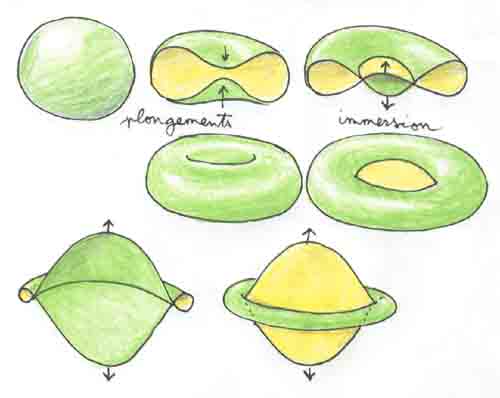
An immersion has a set of self-intersection or self-intersection (here a simple circular curve). The tangent plane must vary continuously. That being so, when one looks at the drawings above, one sees that the operation does indeed turn a part (represented by the green color) of the interior of the sphere toward the exterior. To complete such a turning inside out it would be necessary to flatten this sort of equatorial sausage. The thing seems a priori problematic. This flattening would break the continuity of the tangent plane. The operation would therefore include a step that would not be an immersion.
One day an American mathematician, Stephen Smale, proved that "The sphere S2 possessed only one class of immersion". The corollary of this sybilline sentence was that one had to be able to chain a sequence of immersions of the sphere making it possible to pass from the "standard sphere" to its "antipodal" representation, that is to say one in which all the points would have been replaced by their antipode. In short ... a sphere turned inside out, front-to-back. Raoul Bott was Smale's boss. As much as the latter's demonstration, purely formal, seemed flawless, so much did no one see how to go about carrying out the operation. Bott kept saying to Smale "show me how you would envisage proceeding", to which Smale, with his famous lisp, answered "I haven't the slightest idea". Smale would later receive the Fields medal, equivalent to the Nobel prize, but for maths. Incidentally, you may wonder why Nobel had never wanted to create a Nobel prize for mathematics. The answer is simple: his wife left with a mathematician.
Things remained as they were for quite a few years until an American mathematician named Anthony Phillips published in 1967 in Scientific American a first version of this turning inside out, atrociously complicated. The second was invented at the beginning of the seventies by the French (blind) mathematician Bernard Morin. I was the first to draw this sequence of transformations which will, I have already said so, be the subject of a forthcoming paper on the site, quite copious moreover. Be that as it may, this brings us to a secondary conclusion. Surfaces can be the object of polyhedral representations. A cube or a tetrahedron can be considered as polyhedral representations of the sphere, insofar as these objects have the same topology. On this point, consult my comic strip le Topologicon. Moreover, it will be understood that if it is possible to turn a sphere inside out, it is equally possible to turn a cube inside out. The transformation invented by Bernard Morin (which I illustrated in the January 1979 article of Pour la Science) passes through a central model. There exists a symmetry in this sequence. This is what is called "the central model with four ears". There again, I am anticipating. But just as the sphere can lend itself to polyhedral representations, the same is true for the successive steps of these transformations. The object that you see turning on my home page is thus the polyhedral version of the central model of the turning inside out of the sphere, a model that I invented about ten years ago. The interest of these polyhedral models is that one can build them with flat surfaces. One can even arrange them according to cutouts. Take a look at the drawing below (I thank in passing my friend Christophe Tardy, who produced the elements of it, correctly dimensioned).
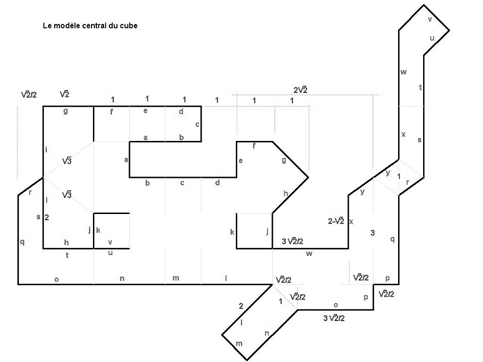
This is a drawing that would come out of your printer in small format, unusable.
To print this figure on an A4 sheet You must then make four photocopies of it on strong A4 paper, two sheets of one color, two sheets of another
This is a cutout of which you have here a general view. But to print it it is preferable that you go to the cutout page. Print it. Then, provided with this copy printed on the normal paper of your printer, go to a photocopier and make four identical copies of this drawing, two on two sheets of green card and two on yellow ones. You are going to be in a position, with the help of this cutout, to build the central model of the turning inside out of the cube.
You have, on these cut-out elements, pairs of letters: a , b c , d , e , f etc.... You need only carry out the folding by bringing the same letters into coincidence, then assembling these facets with transparent adhesive tape. The drawings that follow show the way to mount one of the four elements. Here first is how one must begin the folding of one of the four elements:
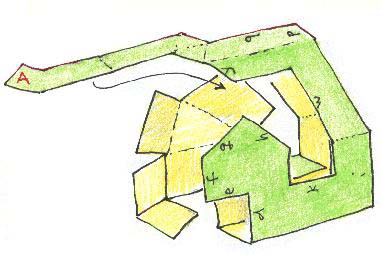
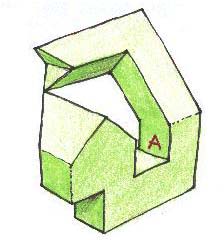
Here are two of these four elements, seen from different angles.
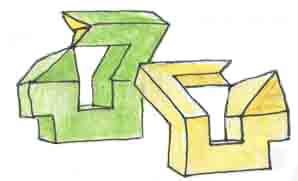
These are then arranged to give an object having a symmetry of order four or alternating green elements and yellow elements. To see this in 3d, go take a look at the achievements of the said Tardy, in "virtual reality". The fully assembled central model is also produced in "vrml" in this section. Here is this object, seen from different angles:
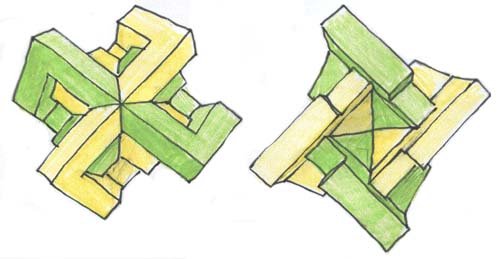
One cannot say that one view corresponds to the "top" and the other to the "bottom" since these designations would be totally arbitrary. In the left view the "central" point corresponds to the "double point" (where two sheets cross) of Morin's central model, while the central point on the right is equivalent to the "quadruple point" of that same model (where four sheets cross). I had to carefully orient the object so that the left-hand figure would not evoke a swastika. Otherwise, architecturally speaking, this polyhedral representation of Morin's central model could have made a very good project for a National Socialist House of Culture.
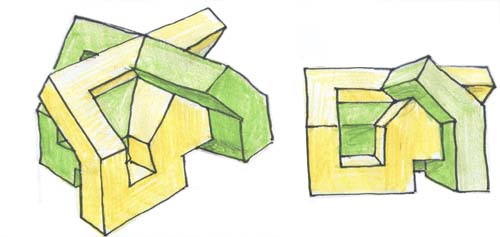
Last view:
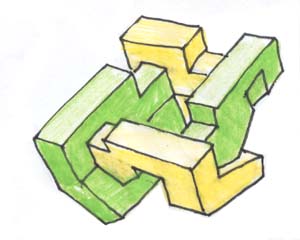
One last remark: there is no good polyhedral representation of the sphere eversion (alias the cube eversion). By "good" one must understand a series of sufficiently explicit models that can be assembled in the form of cut-outs relatively easily, like the model above. Research would have to be done in this direction, which is within anyone's reach, possibly a non-mathematician, a visual artist, for example. More than twenty years ago I was a sculpture teacher at the Ecole des Beaux-Arts in Aix en Provence, at the time when it was still directed by my excellent friend Jacques Boullier. It was in those premises that the first meridional representation of Boy's surface using ellipses was born, the key to the construction of the first implicit equation by Apéry. I must say that at the time I was always surprised by the geometrical imagination of art students, which very often surpassed that... of geometers.
Counter initialized on December 31, 2001. Number of connections:
Return to the maths contents Virtual reality Return to What's New
Original pages: cube_central.htm, cube_central.htm