Micro drones
The Micro Drones
September 19, 2002, updated on September 21, 2002
Source :
http://www.aerovironment.com/area-aircraft/prod-serv/bwidpap.pdf
It was with a certain surprise that I discovered on the web, thanks to my friend Christophe Tardy, the development of mini-drones. The interested reader will find an article (in English) in pdf format titled "Development of the Micro Air Vehicle Black Widow". In English, MAV or "micro air vehicle". The performance of such devices leaves you ... speechless. Indeed, on the web, you discover something new every day. These objects look like toys but are anything but that. The Black Widow has a wingspan of 15 cm. The article refers to tests dating from August 2000, that is, two years ago. The purpose is obviously military.
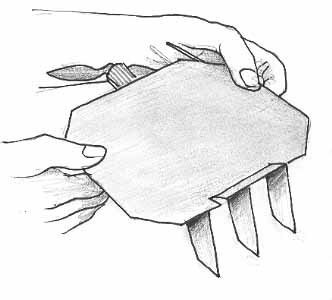
The Black Widow
These tests were the result of a four-year development program. The specifications of this device are astonishing:
- Wingspan: less than 15 cm
- Weight: less than 100 grams - Payload: twelve grams - A 2-gram video camera transmitting color images remotely
- Speed 55 km/h
- Flight duration: 30 minutes - Electric propulsion, by battery.
- Range (regarding communications): 2 km - An onboard autopilot allowing an untrained person to operate the device. Flight control by onboard microprocessor. - The flight control and radio communication management system weighs 5 grams. - The micro-motors acting on the two control surfaces, a horizontal plane and a central vertical rudder each weigh half a gram.
It was Rand corporation that launched a feasibility study of micromachines in 1993. It is specified that the military are considering the development of devices reaching such a degree of miniaturization that they could be the size of a flying or crawling insect. In an era of nanotechnology, how can one be surprised to see the emergence of "nano-robots" and "nano-aeronautics"? There is no limit to this theoretical miniaturization of objects, except molecular and atomic dimensions. For someone who can create "nano-pumps" of a few microns in diameter, devices of a few millimeters are "gigantic".
Several universities were involved in this development program of micromachines, a "microaeronautics", among others, those of Florida and Arizona. The defined objectives were to be able to carry a payload of thirty grams to a target located 600 meters away, the machine being able to remain in flight for at least two minutes. At the end of this program, a machine was successfully tested in August 2000 with the following performance:
- Weight: 80 grams (...)
- Wingspan: 15 cm - Motorized by an electric motor directly connected to the propeller (carbon fiber. It has an efficiency of 83%, while the motor has an efficiency of 70%). - Flight duration: thirty minutes (...) - Speed 55 km/h, which gives a theoretical distance of 27 kilometers and a range of thirteen kilometers. - Capable of transmitting the data acquired at 1.8 kilometers (limit of its current range), on sixteen channels. - Flight altitude: 250 meters. This is a typical evolution altitude, but obviously not a ceiling. - Weight of the video signal transmitter: 1.4 gram. Color resolution: 510 by 488 pixels. - Power required by this transmitter: 550 milliwatts. - Signal power: 100 milliwats at 2.4 gigahertz. - Telecommand frequency: 433 MHZ
- Payload: twelve grams - Low overall cost.
Lithium batteries are low in cost and extremely reliable. The flight is carried out for nine-tenths of the time at constant speed, which simplifies the problems of aerodynamic optimization. The electric motor weighs 7 grams. The propulsion unit delivers a thrust of 10 grams at five thousand revolutions per minute. The tests in a 50 x 50 cm diameter wind tunnel led to a propeller efficiency measurement of 83% while computer calculations had predicted 82. The wing is expanded polystyrene, plus a coating and structural elements, all glued. The coatings are Kevlar. The vertical stabilizers are balsa. The data acquisition and transfer system during flight was designed for 16 channels. In storage mode, the entire device fits in a briefcase (one thinks of James Bond).
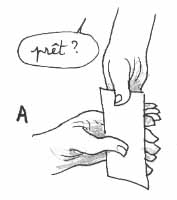
The "mini-aviator", the model plane builder (which I was) will be surprised by the shape of the device. No ailerons, a wing with very low aspect ratio. The answer is simple. The compactness of the object was prioritized at the expense of its purely aerodynamic performance (which would have required a high aspect ratio). The absence of a tail: the purely aerodynamic stabilization systems are limited to the strict minimum. This machine is not manually piloted. But this should not surprise and is only the consequence of the progress of "servo systems", automatic attitude controls. Humans have very limited performance in this area. Their "sensors" are not very effective and offer long reaction times. You know the trick of the banknote placed as in Figure A, which is dropped and the subject is then unable to catch it, simply because the time between the signal "banknote in motion" and the arrival of the order "close the hand" is longer than the time the banknote takes to fall.
Next image, in B a boat that sustains at constant altitude and high speed on ailerons: not manually piloted by a human.
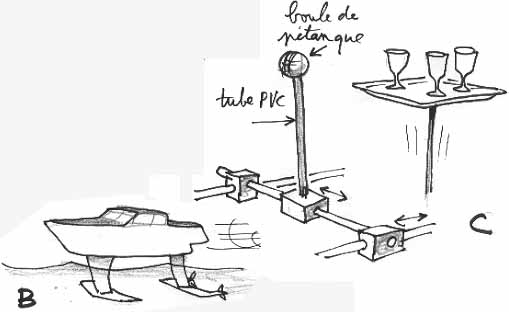
In C a robot built by a friend ten years ago, controlled by a simple PC of the time. Two degrees of freedom. On the mobile platform a PVC tube supporting a boule de pétanque or a tray filled with glasses. Lacking help, the company went bankrupt ten years ago (normal: it was too simple and too cheap).
You yourself are on your flights, without realizing it, in machines that are not manually piloted, or very poorly. A Boeing 747 has a horizontal stabilizer with the surface of the wings of a normal-sized aircraft. In "aerodynamic stabilization" mode, this stabilizer is "lifted", it compensates for the pitching moment from the wing. This increases fuel consumption unnecessarily. To understand all this, refer to my comic strip "L'Aspirissoufle" (ex "If we flew?") which can be found on
**the CD containing more than fifteen comic strips from the series of Anselme Lanturlu (18 euros from J.P.Petit, villa Jean-Christophe, chemin de la Montagnère, 84120 Pertuis. Shipping is included). **
A normal wing, when it carries, develops a pitching moment. The horizontal stabilizer (tail), which is "lifted", compensates for this action. A "normal" plane does not need to be manually piloted (except to put it back on its flight path when it encounters turbulence).
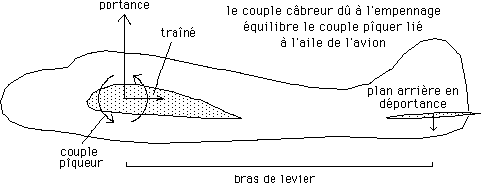
Here is an airplane that a turbulence has put in a nose-up position. The horizontal stabilizer of the tail, now "lifted", brings it back to level flight.
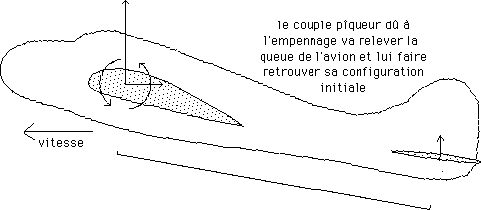
Conversely, turbulence has put the plane in a nose-down position. The increase in lift of the tail tends to bring it back to its normal flight path:
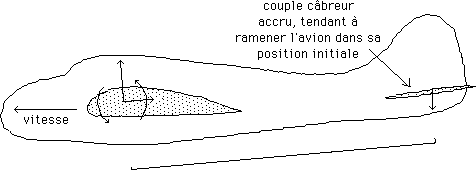
Below is an airplane with variable geometry. In the configuration below, it resembles a conventional airplane.
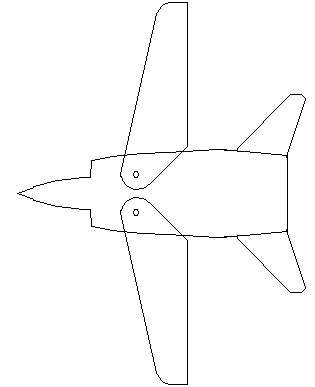
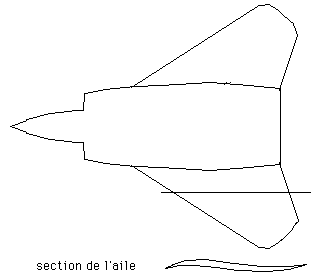
Wings folded (to ensure better penetration in supersonic) it becomes this:
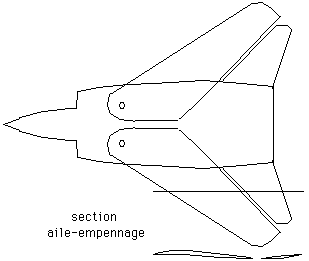
The "lifted" tail then becomes part of the wing and by continuity we come to the "S-shaped profiles", self-stable, of delta-wing airplanes like the Concorde.
There is another way to ensure horizontal flight, which consists of creating a nose-up moment by shifting the center of gravity backward: .
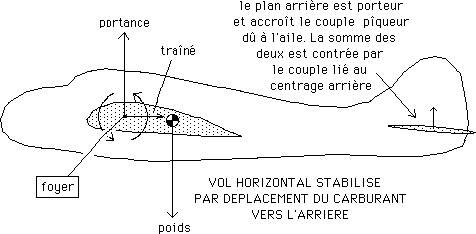
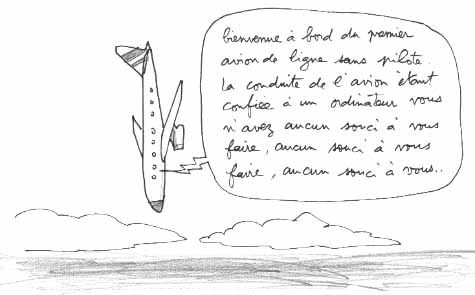
The rear stabilizer can then become "lifted". Fuel is saved but the plane becomes very unstable, practically not manually piloted. However, this is what happens (without your knowledge) in all current commercial airplanes for long-haul flights. After takeoff and reaching cruising altitude, the fuel is pumped into rear compartments, which gives the desired effect and the flight is entrusted to the onboard computer. In case of failure of the computer, it is planned that the fuel can be immediately pumped forward so that the pilot can take manual control of his machine (which will be the case anyway during approach and landing). Currently, the existence of the rear stabilizer and manual control is there only to reassure the passengers. Planes without a tail, entirely controlled by computer (which the "pilots" will then be unable to manually pilot) will appear sooner or later. In the military field they already exist. The B2 is entirely computer-controlled. Without a vertical tail and entrusted to the hands of a pilot, it would immediately enter a flat spin in case of excessive action on the wing flaps. Its additional air intakes on the top of its engine covers require precise attitude control in the nose-up position during landing, otherwise the engines will lose air supply. The flight is "computer-assisted". Here I'm talking about the B2 "shown". In my next book I will explain why these twenty-one B2s based in Witheman are actually decoys, only good for being shown in meetings and to senators, serving as a screen for a hypersonic flying at 10,000 km/h, at 60 km altitude and with a range of 20,000 km, without mid-air refueling. A "hypersonic antipodal bomber". But this is another story, which takes us away from today's topic: the micro-drones. By the way, one of my contacts, quite well connected with people who deal with "black programs" in the United States, confirmed my thesis on the B2 100% after a several-month stay there. Principles of flight (largely relying on MHD) and complete plans of the US hypersonic in the technical-scientific annexes of my book (I hope: January 2003).
The microdrone Black Widow has no S-profile. It is not manually piloted. The control of its attitude in flight is entirely entrusted to an onboard microprocessor that uses the data transmitted by its sensors. The speed is measured by a Pitot tube, visible in the image. The device carries a two-axis micro-magnetometer that informs it of its attitude relative to the ground. It also has a "load factor" indicator (the "g" it experiences in a turn) based on a tiny piezoelectric crystal, of negligible weight. With these information, the onboard computer is perfectly capable of ensuring a stabilized flight in conditions of moderate turbulence. The control surfaces are a horizontal plane and a vertical tail (central). The position of the vertical tail is explained by the fact that when it is controlled, it fulfills two functions: yaw and roll control. The two additional vertical stabilizers were added to eliminate the effects of the well-known "Dutch roll" known to aeronautical engineers (I come from Supaéro). It is planned to equip these mini-drones with GPS navigation and a micro-radar altimeter. The control of such a machine is, for the user (a simple soldier on a battlefield), limited to its simplest expression. It is catapulted at takeoff with a pneumatic system. The pump is provided with the complete kit. Of course, the user has "flight controls" such as "climb", "descend", "turn"; but the device manages itself to carry out these orders by managing its own flight actions and stability. The orders given by the user are only for dealing with unexpected obstacles to modify a pre-recorded flight plan ("go there following such a trajectory"). Later, the video camera will be mobile. "The bird will be able to look around", these orders being given by "the user's helmet" which sees the landscape displayed (later in 3D using two cameras, two "eyes" attached to the micro-drone). The image is displayed on a liquid crystal display attached to its helmet. The camera's rotation is controlled by the rotation of the head, detected by sensors attached to the helmet (a technique perfected for a long time). The relief is ensured by alternating the display on the screen of the "right eye" and "left eye" images, synchronized with liquid crystal shutters placed in front of the pupils. This system was experimented by the author in 1979 with a simple Apple II having two switchable screens. Mechanical shutter. The whole, mounted on a bicycle helmet, was nicknamed the "stereobike" (at the time, as for so many other things in France: vox clamat in deserto).
Some mini-drones are designed to be recoverable. But their very low production cost (in large series) makes them considered "as consumables" and possibly destroyed in flight after they have completed their mission (if the noise of the explosion is not disturbing). In flight they are stealthy. The electric propulsion makes the Black Widow inaudible to the human ear if the device is more than thirty meters from the observer. If the lower part is painted the color of the sky, the device is also not visible from the ground. The walls of military drones are equipped with micro "chromatophore" cells similar to those that cover the skin of octopuses. These have three glands that mechanically inject three colored products whose juxtaposition gives all the colors of the prism (an analogous RGB system on the television or computer screen you are currently using). Hence a mimicry. The US military drones are completely mimetic. They behave "like transparent objects". Of very small size, they are not detectable by radar or will be confused ... with birds. During the tests of the Black Widow, it was escorted by birds of its size, intrigued. The military already have micro-drones in the shape of birds the size of gulls or raptors, with flapping wings (not to ensure propulsion and lift but to enhance the resemblance). Their flight programming imitates their behavior. Their coating is designed so that their "signature" identifies with that of a bird (radar and thermal signatures). The only effective defense against these drones: a good hyperfrequency brush burning the onboard electronics. Unless these micro-drones are "hardened", their components are enclosed in a Faraday cage.
measures... countermeasures... counter-countermeasures.... etc.
What can such micro-drones be used for? For everything. They can obviously report information, day and night (infrared camera). They can carry out the spreading of toxic products under very low masses (toxins, biological weapons, incapacitating, neurotoxic). They can dive through an open window and bring an explosive charge into a building. Appropriately programmed, they could even go through corridors and stairs!
We have mentioned above studies of crawling mini-drones, terrestrial ones, whose size could go up to that of a ... insect. In future wars, combatants will have to fire at "every approaching hedgehog". One never knows, it could be a fake hedgehog carrying a grenade, imitating its movement. A fake hedgehog, a fake snake or a fake sparrow.
This is not science fiction. It is already operational.
The miniaturization of explosive charges (see, in my future book, the evocation of antimatter bombs where antimatter is housed in crystals) makes that the size of the bomb could decrease with that of the vehicle that carries it. Micro-plane or micro "tank", these two devices could carry charges equivalent to dozens of tons of TNT in the form of "clean", non-polluting weapons (the matter-antimatter annihilation does not produce radioactive waste like cesium 137, and).
During operations in Afghanistan, soldiers of the "special forces" were equipped with rifles that allowed them to fire without exposing themselves, interesting for urban combat. On your camcorder you already have your color screen with zoom capability: used by soldiers as "sight". To the right of the image, what the target will see, that is ... the rifle.
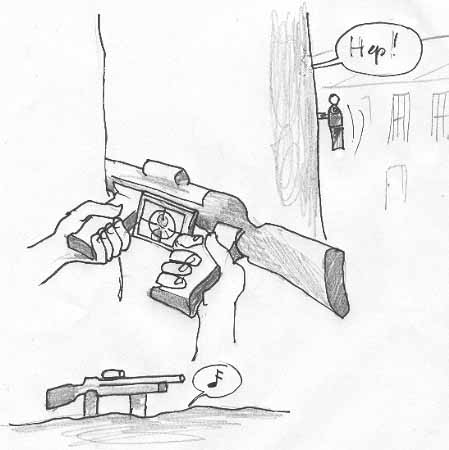
**Sighting with a liquid crystal display. **
You cannot even blind the shooter by shooting at the screen. The screen is out of sight, as are the shooter's hands. Why expose yourself unnecessarily when you can do otherwise?
We are only beginning to glimpse the invasion of warfare by high technologies... cheap. Only the study counts. The Black Widow will have a production cost in series of just a few dollars. Reusable drones do not have a conventional landing gear. The vertical stabilizers are then installed on the top of the wing, which must then be equipped with ailerons (three-axis control). To make contact with the ground, it is sufficient that the drone has a flat surface, like a road or a runway that has been deployed, a one-meter wide and twenty-meter long ribbon. The drone then makes its approach (always automatically and guided by the signals emitted by the "runway" which ensures its "homing" automatically) ending at low speed flying with "ground effect". Then, it has been tested without problems, the drone makes contact with the ground without damage at the price of a few bounces, like a "frisby". More than anything else to pack everything back in the briefcase (...).
There are drones of all sizes. Some are even "mother-drones" carrying smaller drones. Anyway, a smart bomb is already "an unrecoverable drone". Drones will be mini-smart bombs. We talk about drones, but this extends from an object the size of an insect to an aircraft or a fighter. Why risk human lives unnecessarily?
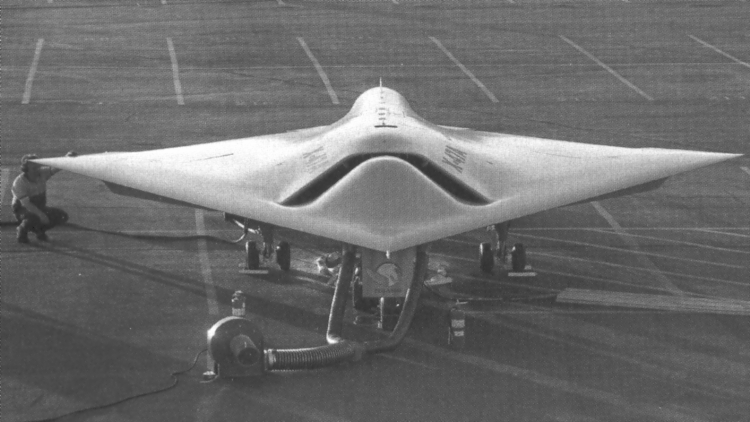
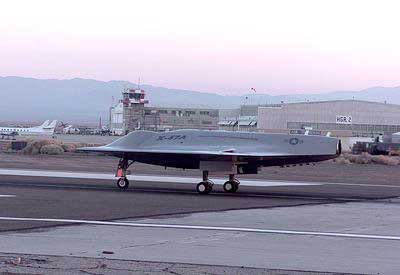
Below is the fighter drone Pegasus X-47A, undergoing engine tests. In the foreground a compressor that feeds its additional air intakes, located on the bottom and not visible. In the air intake, the two compressors' inlets are visible, not accessible for frontal radar waves. The turbine blades reflect strong echoes. This is a stealth air intake. This one would be unable to function in conventional supersonic. Then? Are the Americans studying pilotless subsonic combat aircraft (as well as the US bombers of the third millennium would be)? Who would be naive enough to believe such a thing? Subsonic aircraft could be taken down by the slightest surface-to-air missile (like the Russian Sam-6 which flies at Mach 6) or air-to-air missiles. The X-47 is a pilotless hypersonic aircraft, here we see "the version for the gallery", for meetings or to show to senators. The real X-47 has the same shape but is equipped with "something extra". I will reveal its secrets in my future book. It flies fast enough to escape all existing conventional missiles, is capable of withstanding very high load factors. The era of "sky knights" is definitively over. Goodbye, "Tanguy and Laverdure". This is your opponent of tomorrow, a versatile machine, without any scruples, capable of playing the kamikaze, totally stealthy because of the plasma cocoon that surrounds it when it flies in hypersonic in dense air. A "smart" machine that will pursue its opponent until its destruction. Its movements, thanks to "MHD controls", will defy the imagination of the most fanciful pilot.
I am amused because the people from Dassault and other aircraft manufacturers will seriously study the scientific annexes of my book. The Europeans have ... 25 years of delay compared to this aeronautical technique, which they did not even suspect the existence of a year or two ago and which is the result of thirty years of research conducted in the depths of Area 51.
The pilotless fighter X-47
From the side:
It doesn't really excite me. The dreams of the military have never interested me much. I have always found these people boring to death. In return, they have foolishly ruined my research career for twenty-five years. On this point, it was a total success. But the bill will soon be presented to them. What is funny, however (I will have to make a file on this), is the misinformation that the Americans are currently spreading to us in the hypersonic field. I saw a computer-generated film on television showing the "future" hypersonic American, an X. something, taken to altitude by a B52, the device being accelerated by a powerful powder booster. In fact, the documentary shows Aurora with its leading edge in a knife-edge perpendicular to the flow, plus vertical stabilizers that are of no use to it. Obviously, nothing is shown that allows it to fly in hypersonic, its MHD system. What is not said is that the real Aurora, a satellite spy plane, has been flying since 1990 at 10,000 km/h and 60 km altitude. All the plans in my future book.
If you want to give credit to these documentaries, be my guest. They are balloons that they try to make you take for lanterns. We are told that this X something will be propelled by a "scramjet", a hypersonic combustion ramjet, fueled by liquid hydrogen which, passing through the leading edges, prevents them from being vaporized.
But there is even better. The Americans (with the complicity of the Russians, for some compensation) not only misinform the public but also (without harm) the European military, especially the French. Esculape found me an article on the net about research conducted jointly by the Americans, Russians and French in Kazakhstan, where they are studying a scramjet one meter long mounted on the end of an old Russian Sam-6 rocket provided by the popofs, extracted from their stock. The Sam-6 reaches Mach 6. With its scramjet on the nose, the whole reaches Mach 6.5 for a few tens of seconds. The Scamjet is fueled by the liquid hydrogen circulating in the leading edges of the air intake.
Here is my comment:
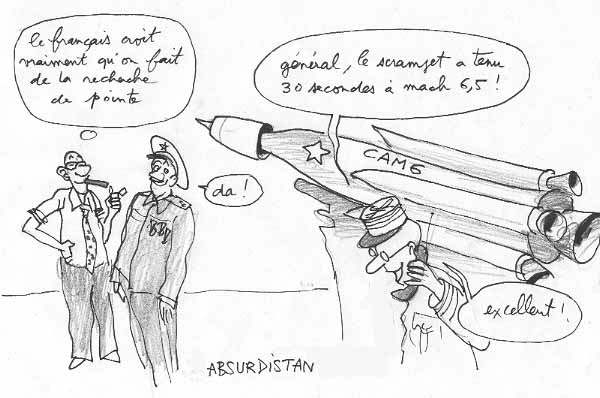
If we survive the coming decades, the fallout of all these techniques will be that we will be able to fly from Paris to Tokyo in two hours. Wherever we go on Earth, most of the travel time will be spent in traffic jams on the road to the airport. Well, when the steam engine was invented, running on its rails, who would have imagined that Avignon could one day be two and a half hours from Paris by the TGV?
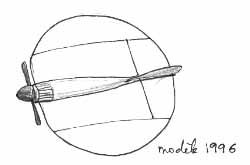
Last remark: we saw what the shape of the drone tested in August 2000 was: a square with truncated corners. In their article published in the American Institute of Aeronautics and Astronautics journal, the authors, J.M. Grasmeyer and M.T. Keenon, show in Figure 1 the plan shape of their first aircraft: a disk with the diameter of a pencil. This circular wing, equipped with elevators, was not the best in terms of aerodynamics (no more than its successor, the Black Widow, in fact). The interest was, in case of observation of the object by a witness, to make it pass for ... a flying saucer.
September 21, 2002: The DGA wakes up:
I am not the only one to bring up these issues. If you consult the Internet, you will find a lot of information quite quickly. Anyway, the Internet represents, of course, the journalism of the third millennium. When Jacques Isnard of Le Monde publishes his first article on E-bombs, the electromagnetic bombs, it is clear that he has largely used the net to compose his article. Air et Cosmos also, which had published a previous article. The key is to know how to navigate. Personally, I have different additional advantages: the range of my scientific skills, drawing, my ability as a popularizer and a "barrier of prior skepticism" weaker than that of other scientists who, in general, say "I don't understand this, so it must not exist".
In this game, this fantastic kriegspiel that the reader will discover over the months, a kind of pitiful dinosaur: the French army, which, as we know, has always been one war behind. I will be merciless towards this structure for many reasons. These people completely ruined my research career because of my interest in UFOs that frightened them, worried them. The worst fault that people who belong to this "thing" (as de Gaulle would have said), is stupidity, the good and thick nonsense.
De Gaulle said "the UN, this thing...."
One could say: "the French army, this thing".
Stupidity is at all levels. The funniest thing is that these ignorant, blind people wake up, often ten to twenty years late, or more. But to complicate things, everyone misinforms everyone. I cite an example. You have probably read somewhere (I think Isnard has repeated this information in Le Monde) that France, the United Kingdom, and Germany have just signed a convention to design an electromagnetic bomb by 2004. But what this good Isnard does not say or rather certainly does not see, is that the British have been leaders in electromagnetic weapons for more than twenty years. Why? And what are the Crop Circles, what are they? They are weapons, and even very dangerous ones, microwave weapons, of course, designed to kill. With this, you can fry a big hedgehog in a field, explode a bird, cook rabbits and obviously kill people. That is why they do it in the wheat when it is high because, as my wife Claire suggested, in high wheat, at night, there are no people. This is where the least damage is done, which would be a mess. Anyway, these fools of French and Germans will gather around a table, someone saying:
- Well, to try to make up for our delay compared to the Americans, someone here should tell us how an E-bomb works....
And the Englishman will laugh in his beard thinking "poor fools, we have been experimenting with these weapons in our countryside for more than twenty years, in collaboration with the Americans. Have you forgotten that we invented radar during the war?".
In the Internet, the French and Germans will discover the plans of the MHD generator with flux compression, invented in the late 1950s by Andrei Sakharov and described by me in the "Children of the Devil", page 304 in 1995 (a book written, by the way, on order from another publisher who, terrified by what it contained, refused to publish it. It remained on a shelf for seven years).

Editions Albin Michel 22 rue Huygens, 75680 Paris Cedex 14. 01 42 79 10 00
The DGA (General Delegation for Armaments), capable of flooding anyone with euros, even completely covering them, sponsors all such operations. I read recently that the French army had "decided to modernize", by equipping its infantry with micro-drones, to give them "new eyes". In the article, of course, the focus is on intelligence gathering. Let's remember the date. The French are starting in 2002. The work on the Black Widow, downloadable in pdf, places the start of civilian research in 1993, nine years earlier. The French are therefore starting with ten years of delay. Of course, at the scale of projects like the "Rafale" or the "Charles de Gaulle", the cost of such research is negligible. It's a trick and especially a lot of microelectronics. The article I am reporting here shows that in August 2000, civilian researchers were able to operate a 15 cm wingspan micro-drone, fully "autopilot" for 30 minutes, propelled by an electric motor, silent, inaudible at thirty meters, and carrying a payload of thirty grams. Those who read the article will see that many components are available on the market. I suggest to the "services" to take a look at the Iraqi imports of accessories for model planes.
If Americans let such information filter into their civilian sector, it's because under the cover of military research, they are infinitely more advanced. When French military aim at 15 cm span drones, American military either continue to study centimeter-sized micro-drones (the size of an insect), or more likely already possess them. Behind this is nanotechnology. Micro-drones the size of a fly are certainly propelled by electric motors. Can you imagine for a second that these motors could be assembled by hand? We are dealing with a key concept in current technological development, that of micro-robotics. One day Jacques Isnard will discover this "new" idea on the net and talk about it. The French will sign a new agreement with other Europeans to promote research in micro or nano-robotics, probably ten or twenty years behind the Americans. Perhaps, incidentally, we will realize the strategic impact of these new objects. The paper "Le Monde" mentioned a sophisticated intelligence research. But a 15 cm span drone, already capable of carrying 30 grams of payload and with a video camera weighing 2 grams, can also carry bacilli, viruses, toxins, neurotoxins, sleeping pills, anything. An explosive, also, to kill one or more people from a distance. If I were Saddam Hussein, I would equip the windows of meeting rooms with mosquito nets. Finally, that's what I have to say...
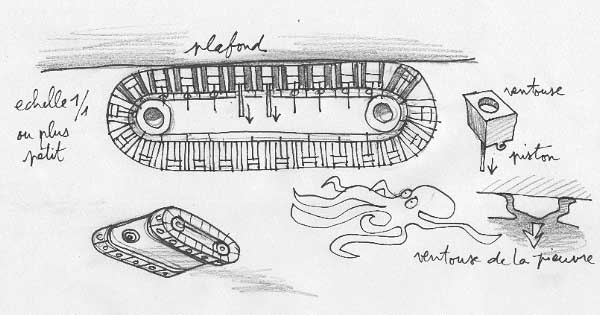
But it's not only the windows. A 15 cm flying drone can, after becoming stationary (which is very feasible and already exists), deposit a "insect drone" which will perform its penetration into the premises through an air vent. Its sticky legs or those with suction cups will allow it to descend vertically. What could this ground micro-drone look like, capable of attaching to walls, moving along the ceiling, above people who have no idea (like all the skeptics). People rarely look up, you have noticed. It's simple. Look at the drawing below, a techno version of Spiderman:
Spiderman
It's a mini-track, full scale. Its parts are made of rubber, and have pistons that disappear when the part comes into contact with a flat surface. Therefore, they work like octopus suckers. By the way, you can't imagine the suction power of such a device (the octopus already holds on very well to any reasonably flat surface). On such a track you could attach ... kilograms. Under a larger system: a fully equipped man. By the way, I would equip the guy with suction cups on his fingers and toes, controlled by voice, to give a Spiderman candidate a costume that allows him to climb the Montparnasse Tower without any problem, the system controlling the pistons being placed in a backpack.
A bit of imagination: micro-technology will make these objects "implode", they can have the size and appearance of a cockroach. Are we swimming in science fiction? Of course not. It's high value military technology. Can you imagine terrorists using this. Why risk suicide commandos when you can attack guard posts with fake seagulls or fake rats?
Some people tell me "you'll give ideas to people". But they already have them. The whole world is full of ideas of this kind and everyone mobilizes their imagination and creativity to try to kill their neighbor better, with less risk and even without being seen, without even being known. Unfortunately, all technology has a military side. Have you ever thought that a device for the hearing impaired is a defense secret.
The drone, the mini-robot, is also stealth. The tragedy is the inability of some to project into the future, into what is called development. In France, we are unbeatable at putting complete incompetents in command positions, except for a few exceptions, some successes I agree. The TGV, is not bad. Ariane too. Regarding this, I will tell you the words of my friend Mathias (it's his real name) who directed rocket tests for a long time in Kourou. One day I asked him:
-
Why did it work?
-
Simple. There were two principles. The first was that we prioritized competence and talent for recruitment, not diplomas and the placement of "friends". I was strict on this (Mathias was a former military man). Second point: every new recruit had two inescapable duties. He had to know how to integrate into a team, of course, but he was also required to immediately report any malfunction, even if the stupidity came from his own team leader. No one was untouchable, no one was allowed to "cover" someone. Finally, we had only ten percent of dummies.
-
Ten percent!
-
It's a very low percentage in human structures.
There are human structures I won't mention out of charity but that I get close to, where the percentage of dummies reaches easily eighty percent.
The great strength of dummies is that they recognize each other at first glance, practice mutual aid, co-opt, multiply like rats. The non-dummies are losers because they are too individualistic. The dummy is essentially gregarious. On the Darwinian level, it is formidable.
Clausewitz
I don't know if it's even higher in the political class in general.
There is another problem. In other state structures, the direction is periodically changed, a highly "dissipative" phenomenon in the thermodynamic sense. One often wonders what criteria were at play when certain choices were made. How could one, in the past, entrust the leadership of the CNRS to a former director of Lafarge cement? What are the skills of Madame Alliot-Marie in terms of military high-tech? What is the experience of Claudie Haignerie in terms of research, theoretical physics, robotics?
Everywhere, we find the same refrain: "communication".
When politicians discredit themselves with their voters, they don't say:
- We failed because we were incompetent.
But:
- We didn't explain ourselves enough to our base, our voters.
And they go off for new congresses, new tour of handshakes.
I had lunch once with a sitting minister. He's still there, with his broken nose. We were a group of top computer scientists. It was twenty years ago. I brought a microcomputer and showed him my program "Screen", the successor of "Pangraphe", the first CAD software running on a small system, capable of doing anything, which I had invented from scratch in 1977. I had presented some weeks earlier "synthetic images" made with this software on TF1. You could see an entire village spinning, with "hidden parts removed". The most difficult topological problems had been solved. You could see a house being drawn in the window frame, itself facing an open hangar door. All of this was formed by a computer with 48 K of memory and a 2 megahertz processor. People said "but how do you generate such complex images so quickly with such a slow machine?" Simple, they were pre-calculated, stored on 5-inch floppy disks (which have disappeared now). The "monochrome screen pages" weighed "8 K". Switching between two screen pages allowed 36 images to be displayed in sequence on the screen. The illusion of movement was complete. Some may remember my book "Pangraphe" (available on the "CD Lanturlu" in pdf and which constitutes the only introduction to CAD available on the market), which served as a "Bible" at the time for people who became CAD experts. The central memory of the micro was insufficient to store the entire program. Using the floppy disk (hard disks did not exist yet) I had invented "virtual memory" before the term existed, as well as "object-oriented programming". Screen was capable of analyzing objects topologically, structuring them itself so that they were easier to manage. Therefore, it was in its own way "intelligent".
These pre-calculated image sequences could be stored on floppy disks. I was thinking then about using this digital image storage for education. The CD-ROM was not born for many years. No one heard this idea. It was too early (late 1970s).
Fortunately, I did not work in vain and I sold by mail 1500 copies of this family of micro-CAD software, unique in the world. With Screen I invented chrono-stereoscopy, by alternating the display of images "right eye, left eye" and switching the vision systems by "shutters" (today liquid crystals). I had created a micro-computing service at the Faculty of Letters in Aix-en-Provence where you could see the only software capable of controlling the Apple plotter, which had just been released, a software that I had obviously created from scratch.
I showed all this to the minister, who didn't ... understand. He thought they were ... toys. We were given some empty phrases. My requests: a position for the student who worked with me. Very advanced in micro at the time in the face of letters in this late 1970s (...) we wanted to create a robotics service. Since computing does not require difficult scientific skills, my team was composed of repentant literature students, completely fanatical.
Deafness at the Ministry of Research, at Vilette, at the Faculty of Letters, at the Ministry of National Education. A final maneuver by the linguists of the faculty made that after 8 years of effort (which did not bring me a cent) I finally resigned, leaving a service that quickly withered.
I take this opportunity to tell an amusing anecdote. After recovering three linguist assistants, completely incompetent in computer science (linguists thought that computer science was a byproduct of linguistics), I was drinking coffee in the faculty cafeteria, in a gloomy mood. Suddenly appeared a psychology assistant, a bearded man, who had been one of my first supporters. He told me, with a gleam in his eye:
- I just came from a council meeting. I strongly defended you: I was the only one to abstain.
I choked on my coffee, which came back up through my nostrils. I thought "you are with madmen". I rushed into my office where I took a pen and a sheet of paper on which I wrote:
- Mr. President, I have the honor of presenting my resignation from my position as director of the educational computing service and as deputy director of the Computing Center of the University of Provence. *
I gave this sheet to the president's secretary and ran away. I never set foot in this university again, nor in any other for that matter. Since then, when I am stuck in a traffic jam and a motorist insults me, I open my window and shout:
- Go ahead, you academic! *
There remains from this time my comic strips from the series of Anselme Lanturlu's adventures "L'Informagique" and "A quoi rêvent les Robots" (on the CD Lanturlu).
I tell this because the track vehicle that runs on the ceiling, we wanted to build it at that time. The idea did not come to me at once. So it goes back 25 years.
I made a last attempt with Edith Cresson, trying to explain to her that the implementation of a CAD software, very easy to use (by a ten-year-old child), very "ergonomic", in the machines of the National Education could awaken in students and students "the taste for technology" (you may know that in France physics is in free fall in universities). Let's say that in computer science this software was like a Meccano (how many kids have not become engineers after playing with this fantastic game?). Moreover the source, modular, was provided (in BASIC!). You could "send your hands" and my customers did not hesitate. I tried to explain to her that the coupling "teaching of mathematics - teaching of computer science" had something revolutionary and that by practicing it at the Faculty of Letters I had succeeded in getting philosophy students to solve nonlinear differential equations.
Voice crying in the desert.
I gave up computing, as I later gave up MHD, and more recently astrophysics, cosmology. But don't worry, I'm into something else.
I return to this story of space technology. If you take a look at my biography you will see that I worked six months at the former SEPR (Société d'étude de la propulsion par réaction, later becoming the SEP, the European propulsion company).
At that time (1965) the SEPR was studying missiles for nuclear submarines, the MSBS, containing ten tons of powder.
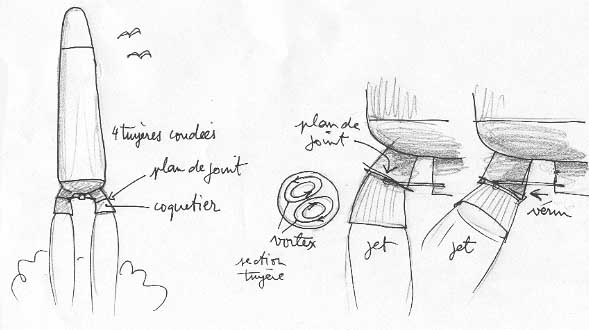
The device had four bent nozzles, particular. A system of jacks allowed to vary the direction of the jets. The rocket was therefore steered by "twisting the tail" or "goddling" (choose the term that suits you). When I arrived at the Istres Center, the tests of this system of bent nozzle with adjustable jet had just begun. Catastrophic beginnings. When you bend a nozzle, you create a system of two vortices. The engineer had thought that the "nozzle", the "divergent" of the nozzle was the part to protect first. He had therefore minimized this phenomenon in this divergent. Unfortunately, it was then maximal in the joint plane, at the junction between the fixed and moving parts of the nozzle. As a result, after 5 seconds the bearings balls, worn by gas at three thousand degrees filled with metal particles, had become cubic. The divergent then detached, ejected a kilometer away.
I arrived at the center after one of these unsuccessful tests. There was a debriefing. The center director then said "did anyone have a suggestion". I raised my hand:
- It seems to me that this nozzle was badly designed. In my opinion, we should start from scratch and minimize the gas flow in the joint plane. Too bad for the 17 nozzles in tungsten that were machined for the previous model. But we can make very nice lamp bases from them.
My neighbor, an old engineer, was pressing my foot insistently. After the meeting I asked him why.
- The engineer who designed these nozzles was at this table. Moreover, he is the director of the design office. It was not allowed to say that!
They fired the remaining 17 rockets for billions of dollars per shot. All the divergents detached. After that, the nozzles were redesigned, but the honor of the polytechnician who designed the first bent nozzles remained intact. It was the taxpayer who paid the bill. Anyway, having little taste for the development of rockets designed to carry nuclear charges, I succeeded in integrating as a research engineer at CNRS in 1965 to build an impulsive MHD generator. Civilian research, at that time. Russians and Americans quickly understood that these generators could power the firing stations of the future space war. The French ... abandoned MHD around 1971. But this, as Kipling would say, is another story.
****http://www.vieartificielle.com/index.php?action=nouvelle&id_nouvelle=661
**
June 18, 2005
, excerpt from:
Noted by Paul Brumat
You can't stop progress
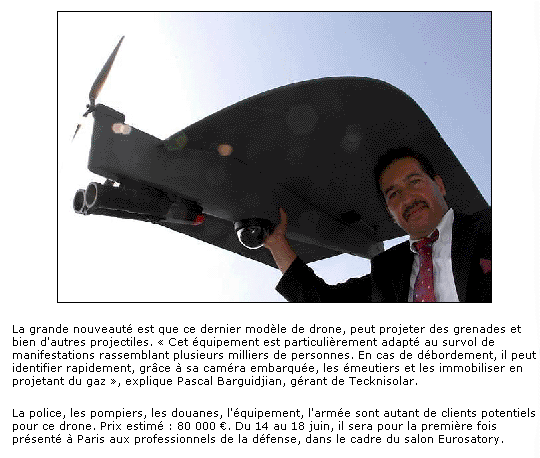
Read this text. It's a French product. Do you not think you're in a science fiction movie? The next models, mini-helicopters (which already exist) will probably be equipped with non-lethal weapons, electrocuting people or neutralizing them with a laser beam that, creating a plasma ball on contact, emits electromagnetic waves, making them faint from pain, without leaving any visible trace.
It's the anticipated response, planned by governments, including ours, in anticipation of demonstrations such as those of anti-globalists, the unemployed, retirees, workers hit by outsourcing. If these demonstrations take place in the calm of trained professionals mixed with mini-demonstrators, they could serve as triggers. I remember as if it were yesterday the photos taken by Parisians in May 1968, from the windows of their apartments, showing CRS overturning cars and setting them on fire. They made the cover of Paris Match &&& and a reader may perhaps find them in their archives and send me a scan. It is good to recall that some facts are not at all exceptional.
Sarkozy has already announced that "the police forces" will be largely equipped with non-lethal weapons, such as Tazers. But the party has only just begun. In France, all these projects are strongly supported by our elegant Defense Minister, Madame Alliot-Marie, always dressed in black ("death is my job"). This is the response of people
who don't understand the world they live in,
who don't realize that it's much worse than they think and that designing these new gadgets will not be enough to stop riots, if they ever explode, due to too much suffering. The solution is elsewhere, but the entire political class, in close symbiosis with the military-industrial lobbies, completely cut off from the world and realities, is unable to consider anything other than the card, the microchipping, the control, the repression. Their policy of the privileged leaves no room for hope among the "left behind by growth".
A reader found a possible solution: the umbrella:
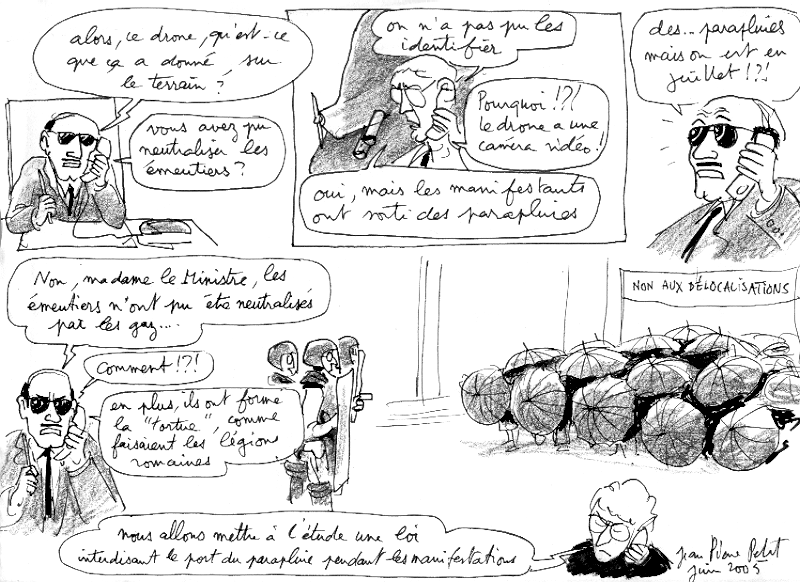
This would assume that the right to own an umbrella is inscribed as the 2nd amendment in a future European constitution project. We recall the 2nd amendment of the United States Constitution:
Article [II.] A well regulated Militia, being necessary to the security of a free State, the right of the people to keep and bear Arms, shall not be infringed.
Translation:
A well-regulated militia being necessary to the security of a free State, the right of the people to keep and bear Arms, shall not be infringed.
In the European constitution project, this would become:
**Article [II.] **
**Syndical and social rights being to be preserved the right of the people to keep and bear an umbrella shall not be infringed. **
**Translation : **
** In order to ensure citizens the preservation of their social and syndical rights, citizens will be able to own and carry an umbrella, this right not being contestable. **
Back to News Back to Home Page
Number of consultations since September 19, 2002 :
a a a a ---