The Mysteries of the B2
August 20, 2002
Page 2
Below is a photo of the B2, more precisely, of the first aircraft ever built. Its wingspan of 52 meters is identical to that of the wing designed by Jack Northrop. Its profile isn’t “self-stable” – it resembles an “S-shaped skeleton”. The pitching moment induced by lift is counteracted by rearward weight distribution; this requires constant pilot control. It’s impossible for this aircraft to fly on its own; it needs continuous control. It’s fundamentally unstable. It must be constantly controlled using a flap located at the rear of the “pseudo-fuselage”, which resembles a “beaver tail” with a triangular tip. This flap is continuously operated by a computer, except when the pilot decides to adjust the pitch. To make turns, two flaps at the ends of the wings are opened; this creates drag and allows the aircraft to turn right or left. In the photo below, we can see these flaps being opened at the right wingtip, indicating a rightward turn.
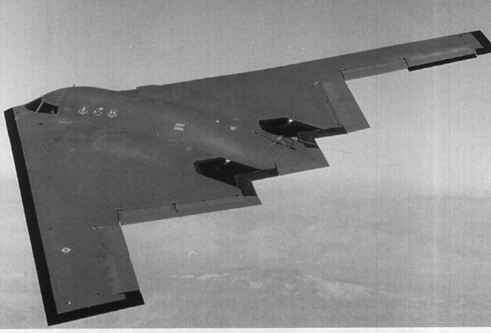
When fully extended, these flaps can also serve as air brakes during landing maneuvers.
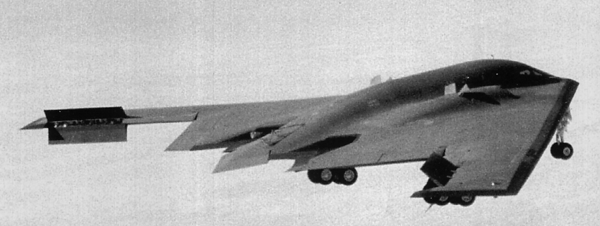
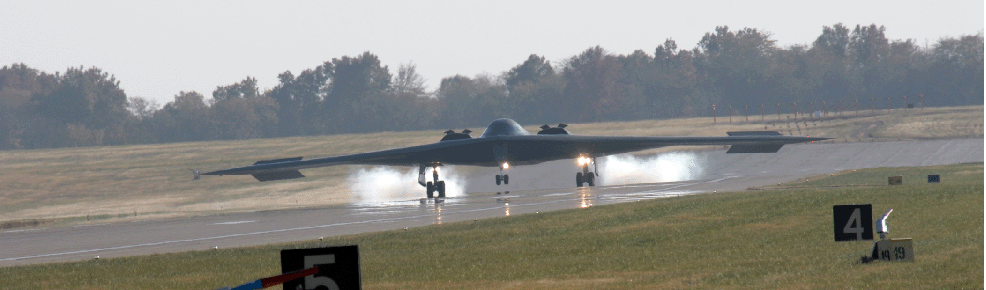
This photo shows the first prototype of the B2, taken in 1989 at Edwards AFB. Its leading edges are still black. When these flaps are fully opened, they function as air brakes. We can also see the “beaver tail” in a downward position. On top of the engine covers, there are flaps that provide extra airflow during takeoff and landing. In cruise mode, these flaps remain closed. We can clearly see them open during takeoff and landing:
The “Pacemaker” aircraft, equipped with six engines driving propellers, became the backbone of the Strategic Air Command. Below is a photo found by J.P. Ballard:
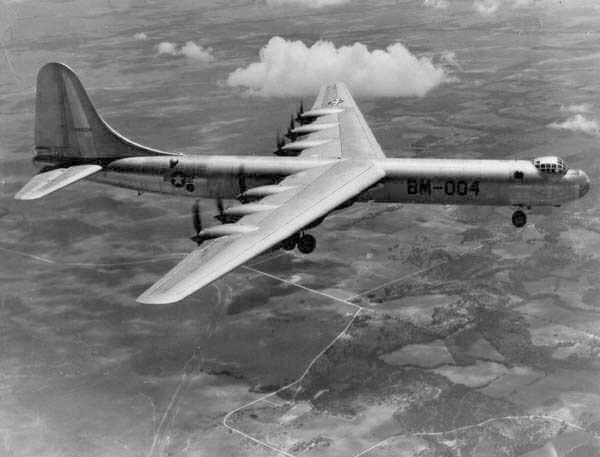
The B-36-1 Convair “Pacemaker”
To increase their range, these aircraft were fitted with turbojet engines. Meanwhile, the Americans sought to develop an aircraft powered entirely by turbojets. The first attempt was the B-47, an eight-engine aircraft:
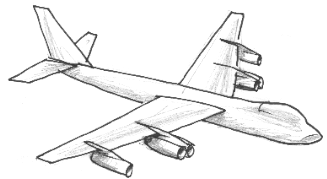
It was too small and slow; essentially, it was a prototype for the future B-52, an eight-engine aircraft:
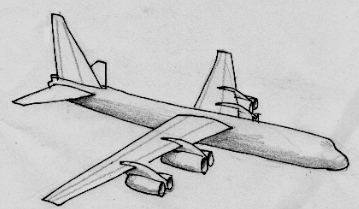
Carrying six crew members, this aircraft could reach major Russian cities and industrial centers from across the Arctic.
Note: These missions, conducted at speeds of 900 km/h at altitudes between 12,000–15,000 meters, lasted no more than 12–15 hours round-trip. These aircraft had sleeping quarters for crew members.
Generally speaking, the goal was to increase range, speed, altitude, and invulnerability. Increasing speed meant entering the supersonic realm, but this brought about issues related to wave drag, which increases exponentially with Mach number. One example is the Hustler. (A nice photo found by J.P. Ballard shows this four-engine aircraft carrying its payload under its belly, designed for supersonic penetration.)
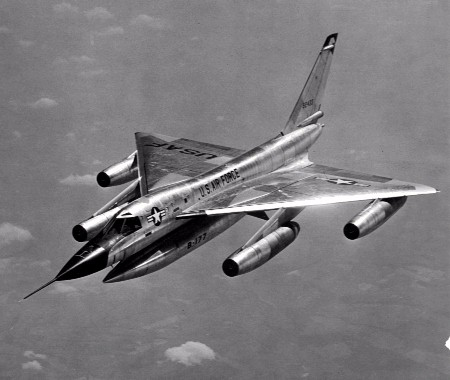
It was essentially the American equivalent of the Mirage IV (though much larger). But higher speeds meant increased fuel consumption. If “to hustle” means “to penetrate”, then this aircraft was essentially a “penetration bomber”. Such missions required refueling mid-flight, just like the Mirage IV’s “one-way mission”.
Later came the SR-71 “Blackbird”, capable of flying at Mach 3.2 under conditions that represented the best technology available at the time. But aside from carrying one pilot and cameras, it functioned mainly as a giant fuel tank due to its high fuel consumption. The Hustler took off with minimal fuel load; it needed refueling before heading into enemy territory.
The advent of intercontinental ballistic missiles completely changed the situation; bombers became obsolete. The Americans relied on intermediate-range missiles like the Redstone rocket. The Atlas, a liquid-fueled rocket intended for intercontinental use, faced difficulties initially.
Meanwhile, the Soviets unveiled their own giant rockets, called “Semiorka”. Designed by Korolev, these rockets had a range of 10,000 km, allowing them to strike any target in the United States. Both sides used inertial guidance systems. Accuracy was around 2 km, requiring the Soviets to use powerful hydrogen bombs. The Americans responded by developing Apollo, aiming to restore their technological superiority. The Soviets tried to do the same, but the explosion of the Energia rocket ruined their plans.
Strategically, the Americans focused on developing quicker-response missiles. This led to the creation of the Minuteman, which was quickly deployed across the US. Improvements in accuracy allowed them to reduce missile size and nuclear payloads. Later, MIRV missiles were developed, each capable of carrying multiple warheads. Radar imaging improved accuracy, enabling precision strikes. The Americans also developed the Tomahawk cruise missile, capable of striking targets thousands of kilometers away from submarines.
The Soviets tried to keep up, developing their own solid-fueled missiles. They also created cruise missiles, possibly launched from bombers. This arms race continued until the collapse of the Soviet Union. The Americans won this economic war on a massive scale.
In this context, the Americans remained the “masters of the planet” thanks to their intercontinental missiles. The Soviets tried to counter this by deploying Typhoon submarines:
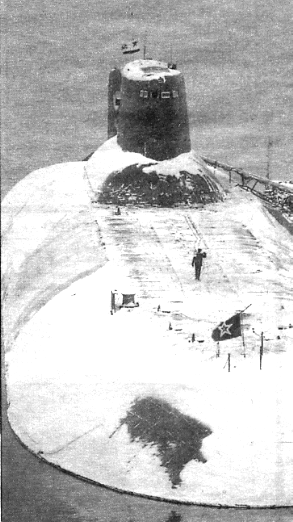
These submarines weighed over 30,000 tons; one alone could destroy the United States. The Americans countered with Ohio-class submarines, each capable of destroying the USSR.
Eventually, the Soviet Union collapsed. Today, China is the only potential threat to the US; it’s developing intercontinental missiles with a range of 12,000 km. These missiles could potentially strike US targets from China.
What becomes of nuclear bombers? All American fighter-bombers can carry nuclear weapons, thanks to miniaturization. They can operate from land bases or aircraft carriers. They can also carry cruise missiles. Unless we rely on autonomous cruise missiles like the Tomahawk or drones, the distinction between bombers and cruise missiles becomes blurred.
Previous page Table of Contents Next page
Counter initialized April 24, 2004. Number of views of this page: